濃度とは「溶液のある量の中に、溶質がどれだけ入っているか」であり、何で割るか・何を数えるかで表し方が変わる。化学の計算ではモル濃度(mol/L)、日常と医療では質量パーセント(%)、薬の投与では質量濃度(mg/mL)がよく使われ、検査報告にはこの3つが混在する。
覚えるべき式は少ない。n = m/M、c = n/V、w = m(溶質)/m(溶液)、m(溶液)= ρV、そして希釈の c1V1 = c2V2。すべての換算は「いったん mol か g に戻す」ことで解ける。
- 物質量とモル濃度 — mol/L はすべての計算の共通語
- 質量分率(%)と密度 — 溶液の質量は体積×密度
- 質量濃度と投与量 — mg/mL で考える
- 濃度の換算 — 1 L と仮定して mol と g を行き来する
- 希釈と混合 — 溶質の物質量は変わらない
- 電離を考えた濃度と溶液の化学量論 — 中和に要る体積
物質量とモル濃度 — mol/L はすべての計算の共通語
物質量 n(mol)は粒子の数を数える単位で、1 mol は 6.022 × 10²³ 個である。直接は量れないので、質量を量ってモル質量で割る:n = m / M。M は周期表の原子量の和で、NaOH なら 23.0 + 16.0 + 1.0 = 40.0 g/mol。
モル濃度 cM = n / V(V は溶液全体の体積、単位は L)。単位は mol/L で、M とも書く。2式をまとめると cM = m / (M · V)。例:NaOH 4.00 g を水に溶かして全体を 250.0 mL にすると、n = 4.00/40.0 = 0.100 mol、c = 0.100/0.2500 = 0.400 mol/L。
よくある間違いは2つ。1つは mL を L に直し忘れること(250 mL は 0.250 L)。もう1つは、V を加えた水の体積と取り違えることである。モル濃度の分母は溶液全体の体積なので、溶質をメスフラスコに入れてから標線まで水を加えて作る。溶質 4.00 g に水 250 mL を足すと、全体は 250 mL ちょうどにはならない。
化学の計算でモル濃度が中心になるのは、反応式の係数が粒子の数の比だからである。溶液どうしの反応は「体積 × モル濃度 = 物質量」で粒子の数に直してから比べる。なお「molar(モル濃度の)」と「molal(質量モル濃度、mol/kg 溶媒)」は別の量で、後者は温度で変わらない。
検査値の多くは mmol/L で報告される。血清 Na 135〜145 mmol/L、K 3.5〜5.0 mmol/L、血糖(欧州表記)約4〜6 mmol/L(空腹時)などである。単位が mol 系だと、値が粒子の数を直接表すので、浸透圧の計算や電荷のバランス(アニオンギャップ)をそのまま足し引きできる。mg/dL ではこれができない。
English version
Core
Amount of substance n (mol) counts particles; 1 mol is 6.022 × 10²³ particles. We cannot count them directly, so we weigh the mass and divide by the molar mass: n = m / M. M is the sum of atomic masses from the periodic table; for NaOH, 23.0 + 16.0 + 1.0 = 40.0 g/mol.
Molar concentration cM = n / V, where V is the volume of the whole solution in litres. The unit is mol/L, also written M. Together, cM = m / (M · V). Example: dissolve 4.00 g of NaOH and make the total 250.0 mL. n = 4.00/40.0 = 0.100 mol; c = 0.100/0.2500 = 0.400 mol/L.
Going further
Two common mistakes. First, forgetting to change mL to L (250 mL = 0.250 L). Second, using the volume of water added as V. The denominator is the volume of the whole solution, so we put the solute in a volumetric flask and add water up to the mark. 4.00 g of solute plus 250 mL of water does not give exactly 250 mL.
Molar concentration is central because the coefficients of an equation are ratios of particle numbers. For reactions between solutions, change “volume × molarity” into moles first, then compare. Note that “molar” (mol/L) and “molal” (mol per kg of solvent) are different; molality does not change with temperature.
In the clinic
Many lab values are reported in mmol/L: serum Na 135–145 mmol/L, K 3.5–5.0 mmol/L, fasting glucose (European units) about 4–6 mmol/L. With mol-based units the value directly counts particles, so you can add and subtract them for osmolality or for charge balance (the anion gap). You cannot do this with mg/dL.
質量分率(%)と密度 — 溶液の質量は体積×密度
質量分率 w = m(溶質)/ m(溶液)で、100 倍して % で表すと質量パーセント濃度(w%)になる。分母は溶液全体の質量(溶質+溶媒)である。例:水 95 g に食塩 5 g なら w = 5/100 = 5%。
体積しかわからないときは密度 ρ = m / V で質量に直す:m(溶液)= ρ · V。まとめると w% = m(溶質)× 100 / (ρ · V)。例:グルコース 10.0 g を含む溶液 250.0 mL(ρ = 1.02 g/mL)は、m(溶液)= 255 g、w = 10.0/255 × 100 = 3.92%。
割合で表す濃度にはほかに、体積分率(v/v、φ%)と、ごく少量を表す ppm(10−6)・ppb(10−9)がある。空気中の O2 約21% は体積分率、水道水中の微量物質は ppm(1 ppm ≈ 1 mg/kg ≈ 1 mg/L)で表すことが多い。
密度は溶液全体の性質で、溶質の量が増えると変わる。NaCl 水溶液では濃いほど密度が大きく、w% と密度はほぼ直線の関係になる。だから密度を測れば濃度を逆算できる——比重計で尿や溶液の濃さを見積もるのはこの原理である。また量るのは質量のほうが体積より精密で温度の影響も受けにくいが、手間がかかる。
医療で「%」と書かれた製剤は、実際には溶液 100 mL 中の溶質の g(w/v%)であることが多い。生理食塩液 0.9% は 100 mL 中に NaCl 0.9 g(9 g/L)、5% ブドウ糖液は 100 mL 中にグルコース 5 g を含む。消毒用のエタノールは体積分率で表し、70〜80% 程度が最もよく効く(水が少し入っているほうが蛋白を変性させやすい)。オキシドールは約3% の過酸化水素水である。同じ「%」でも何を何で割ったかを確かめる習慣が、計算ミスを防ぐ。
English version
Core
Mass fraction w = m(solute) / m(solution); times 100 it is mass percent (w%). The denominator is the mass of the whole solution (solute + solvent). Example: 5 g of salt in 95 g of water gives w = 5/100 = 5%.
If you only know the volume, use density ρ = m / V: m(solution) = ρ · V. Together, w% = m(solute) × 100 / (ρ · V). Example: 250.0 mL of solution with 10.0 g of glucose (ρ = 1.02 g/mL): m(solution) = 255 g; w = 10.0/255 × 100 = 3.92%.
Going further
Other ratio-type concentrations are volume fraction (v/v, φ%) and, for very small amounts, ppm (10−6) and ppb (10−9). The 21% O2 in air is a volume fraction; trace substances in tap water are often given in ppm (1 ppm ≈ 1 mg/kg ≈ 1 mg/L).
Density belongs to the whole solution and changes with the amount of solute. For NaCl solutions, density rises with concentration almost in a straight line with w%. So measuring density lets you work back to concentration — the principle of using a hydrometer for urine or solutions. Weighing is more precise than measuring volume and less affected by temperature, but it takes more work.
In the clinic
In medicine, a product labelled “%” usually means grams of solute per 100 mL of solution (w/v%). Normal saline 0.9% has 0.9 g of NaCl per 100 mL (9 g/L), and 5% glucose has 5 g per 100 mL. Ethanol for disinfection is given by volume, and about 70–80% works best (a little water helps it denature proteins). Hydrogen peroxide for wounds is about 3%. Always check what was divided by what, even when both say “%”.
質量濃度と投与量 — mg/mL で考える
質量濃度 γ = m(溶質)/ V(溶液)で、単位は mg/mL や g/L など幅が広い(1 mg/mL = 1 g/L)。薬の濃度表示は多くがこの形で、医療でいちばん身近な濃度である。
投与量の計算は2段階で考える。①必要な量(mg)= 体重あたりの量 × 体重、②必要な体積(mL)= 必要な量 ÷ 質量濃度。例:体重 60.0 kg、5.0 mg/kg、製剤 25 mg/mL なら、① 5.0 × 60.0 = 300 mg、② 300 ÷ 25 = 12 mL。
モル濃度との関係は γ = cM × M。0.10 mol/L のグルコース(M = 180 g/mol)なら 18 g/L = 18 mg/mL である。逆に、mg/mL の値をモル質量で割れば mol/L に戻る。
単位を付けたまま計算すると、式の立て方の誤りがすぐわかる。(mg/kg) × kg = mg、mg ÷ (mg/mL) = mL と、残った単位が答えの単位と一致するかを毎回確かめる。「10 kg あたり 6 mg」のような書き方なら、まず 1 kg あたり 0.6 mg に直してから体重を掛ける。
小児の薬用量は体重あたりで決まり、成人でも抗菌薬・抗がん薬・ヘパリンなどは体重や体表面積から計算する。投与事故の典型は桁の取り違え(mg と µg、mg と mL、10倍・1000倍の誤り)で、単位を付けて検算する習慣がそのまま安全対策になる。同じ薬でも製剤によって濃度(mg/mL)が違うので、「何 mL」ではなく「何 mg」で指示を考える。
English version
Core
Mass concentration γ = m(solute) / V(solution). Units vary: mg/mL, g/L and others (1 mg/mL = 1 g/L). Most drug labels use this form, so it is the most familiar concentration in medicine.
Calculate a dose in two steps: ① amount needed (mg) = dose per kg × body weight; ② volume needed (mL) = amount ÷ mass concentration. Example: 60.0 kg, 5.0 mg/kg, product 25 mg/mL. ① 5.0 × 60.0 = 300 mg; ② 300 ÷ 25 = 12 mL.
Going further
The link to molarity is γ = cM × M. For 0.10 mol/L glucose (M = 180 g/mol), γ = 18 g/L = 18 mg/mL. Divide a mg/mL value by the molar mass to go back to mol/L.
Calculating with units shows a wrong set-up at once: (mg/kg) × kg = mg; mg ÷ (mg/mL) = mL. Each time, check that the unit left over is the unit of the answer. If a dose is written as “6 mg per 10 kg”, first change it to 0.6 mg per kg, then multiply by the weight.
In the clinic
Children’s doses are set per kg, and in adults antibiotics, anticancer drugs and heparin are also calculated from weight or body surface area. Typical dosing accidents are errors of scale (mg vs µg, mg vs mL, ten-fold or thousand-fold mistakes). Checking with units is itself a safety measure. Products of the same drug can have different mg/mL, so think of an order in mg, not in mL.
濃度の換算 — 1 L と仮定して mol と g を行き来する
w%、cM、γ のあいだの換算は、溶液を 1 L(= 1000 mL)と仮定すると機械的に解ける。濃度は量によらない性質なので、都合のよい量を仮定してよい。
w% → cM:①m(溶液)= ρ × 1000 mL、②m(溶質)= m(溶液)× w、③n = m/M、④c = n / 1 L。まとめると cM = 10 · ρ · w% / M(ρ は g/mL)。例:98% 硫酸(ρ = 1.84 g/mL、M = 98.1)は 10 × 1.84 × 98 / 98.1 ≈ 18.4 mol/L。
cM → w% は逆にたどる:1 L 中の n → m(溶質)= n × M → w% = m(溶質)× 100 / (ρ × 1000)。
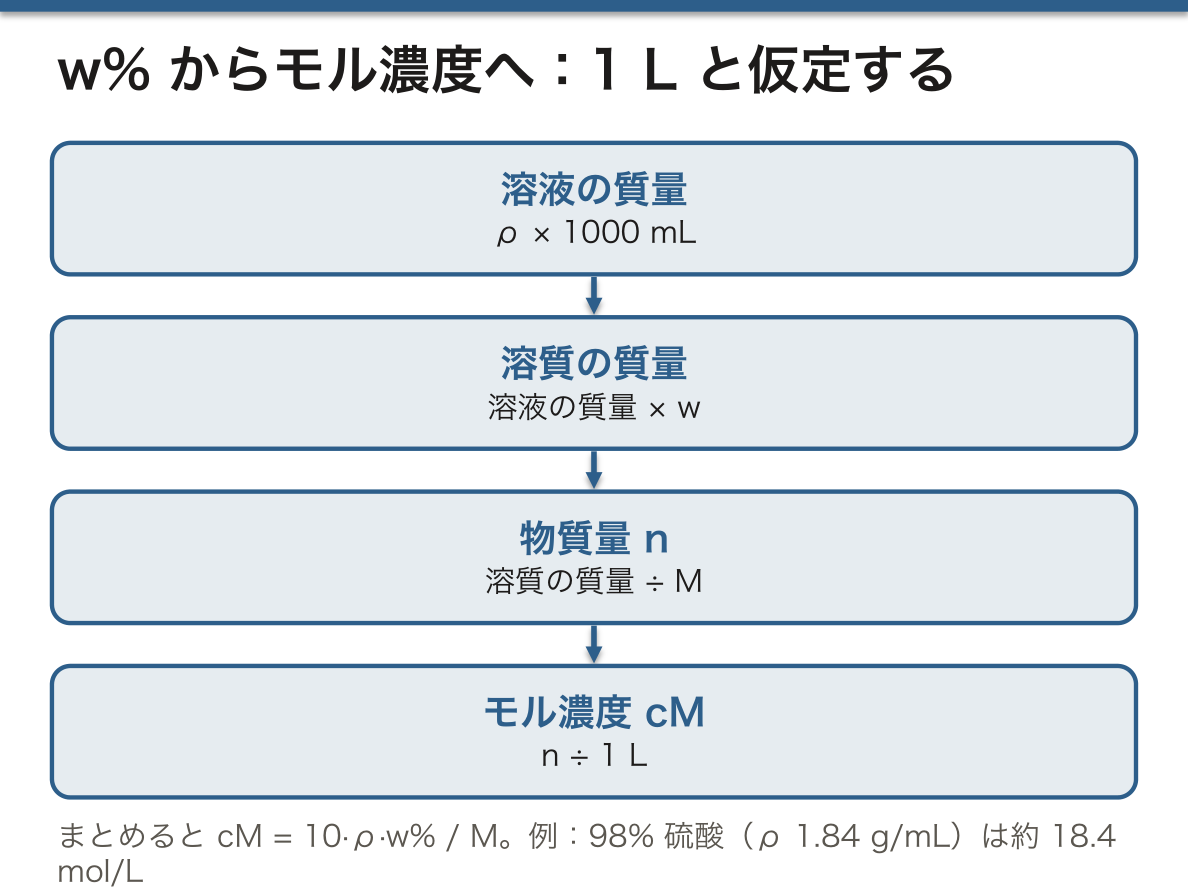
流れは常に w% ⇄ m ⇄ n ⇄ cM の一本道で、密度は「質量の世界」と「体積の世界」をつなぐ橋である。密度が与えられていないのに w% と cM を行き来しようとしたら、条件が足りないと気づくべきだ。
温度の影響も、この区別から説明できる。溶液を温めると体積はわずかに増えるが、質量は変わらない。だから体積を分母にもつ cM や γ は温めると少し下がり、質量どうしの比である w% は変わらない。精密な仕事で質量基準の濃度が好まれるのはこのためである。
生理食塩液 0.9%(9 g/L、ρ ≈ 1.00 として)をモル濃度にすると、9 ÷ 58.4 ≈ 0.154 mol/L。NaCl は Na+ と Cl− に分かれるので、粒子としては約 0.31 mol/L となり、血漿の浸透圧に近い。「なぜ 0.9% なのか」は、%表示を mol に直して初めて説明できる。
English version
Core
Conversions between w%, cM and γ become routine if you assume 1 L (= 1000 mL) of solution. Concentration does not depend on the amount, so any convenient amount may be assumed.
w% → cM: ① m(solution) = ρ × 1000 mL; ② m(solute) = m(solution) × w; ③ n = m/M; ④ c = n / 1 L. Together, cM = 10 · ρ · w% / M (ρ in g/mL). Example: 98% sulfuric acid (ρ = 1.84 g/mL, M = 98.1): 10 × 1.84 × 98 / 98.1 ≈ 18.4 mol/L.
cM → w%: go backwards. n in 1 L → m(solute) = n × M → w% = m(solute) × 100 / (ρ × 1000).
Going further
The path is always w% ⇄ m ⇄ n ⇄ cM, and density is the bridge between the world of mass and the world of volume. If you are asked to go between w% and cM without a density, you should notice that information is missing.
The effect of temperature follows from this. Warming a solution makes the volume slightly larger, but the mass stays the same. So cM and γ, which have volume in the denominator, fall a little; w%, a ratio of masses, does not change. This is why precise work prefers mass-based concentrations.
In the clinic
Normal saline 0.9% (9 g/L, taking ρ ≈ 1.00) is 9 ÷ 58.4 ≈ 0.154 mol/L. NaCl splits into Na+ and Cl−, so as particles it is about 0.31 mol/L — close to the osmotic pressure of plasma. You can only explain “why 0.9%” after converting the percent into moles.
希釈と混合 — 溶質の物質量は変わらない
水を加えて薄めても溶質の物質量は変わらない。n = c × V なので、c1V1 = c2V2(1 が濃い原液、2 が薄めた液)。
例:2.0 mol/L の原液から 0.20 mol/L の溶液を 250 mL 作るなら、V1 = 0.20 × 250 / 2.0 = 25 mL。原液 25 mL をメスフラスコに取り、標線(250 mL)まで水を加える。希釈倍率は c1 / c2 = V2 / V1 = 10 倍である。
同じ溶質の2つの溶液を混ぜるときは、物質量を足して全体積で割る:c = (c1V1 + c2V2) / (V1 + V2)。0.50 M を 40.0 mL と 0.10 M を 60.0 mL 混ぜると、(0.020 + 0.0060) / 0.100 = 0.26 M。
加える水の量を V2 − V1 と考えてよいのは、薄い水溶液で体積がほぼ足し算になるときだけである。濃い溶液やエタノールと水では、混ぜると体積が足し算より少し減る。だから正確な希釈は「水を何 mL 足す」ではなく「標線まで満たす」で行う。
希釈の精度は、使った器具のうちいちばん精度の低いもので決まる。ホールピペットで原液を取ってもメスシリンダーで全体積を合わせれば、濃度の確かさはメスシリンダーの水準まで落ちる。また体積だけで薄めた場合、密度がわからなければ希釈後の w% は計算できない。w% は質量の比だからである。
検量線用の標準液は、1つの原液から段階的に薄めて作ることが多い(段階希釈)。10倍希釈を3回くり返せば 1000 倍になる。
濃い電解質製剤はそのまま静注してはいけない。代表が カリウム製剤で、急速に入ると心停止を起こしうるため、必ず輸液で十分に薄め、速度も制限して点滴する。抗菌薬や抗がん薬の調製、小児用に薬を薄めて量をとる作業も、すべて c1V1 = c2V2 の応用である。
English version
Core
Adding water does not change the moles of solute. Since n = c × V, c1V1 = c2V2 (1 is the concentrated stock, 2 is the diluted solution).
Example: to make 250 mL of 0.20 mol/L from a 2.0 mol/L stock, V1 = 0.20 × 250 / 2.0 = 25 mL. Put 25 mL of stock into a volumetric flask and fill to the 250 mL mark. The dilution factor is c1 / c2 = V2 / V1 = 10.
When mixing two solutions of the same solute, add the moles and divide by the total volume: c = (c1V1 + c2V2) / (V1 + V2). Mixing 40.0 mL of 0.50 M with 60.0 mL of 0.10 M gives (0.020 + 0.0060) / 0.100 = 0.26 M.
Going further
Taking the water added as V2 − V1 works only when volumes simply add, as in dilute water solutions. With concentrated solutions, or ethanol and water, the mixed volume is a little less than the sum. So an exact dilution is done by “filling to the mark”, not by “adding so many mL of water”.
The precision of a dilution is set by the least precise piece of glassware used. Taking the stock with a volumetric pipette but making up the volume in a measuring cylinder lowers the precision to the cylinder’s level. Also, after diluting by volume only, you cannot calculate the new w% without the density, because w% is a ratio of masses.
Standards for a calibration line are often made by diluting one stock step by step (serial dilution). Three ten-fold steps give a thousand-fold dilution.
In the clinic
Concentrated electrolyte products must never be pushed undiluted into a vein. The classic example is potassium: given quickly it can stop the heart, so it is always well diluted in a drip and given at a limited rate. Preparing antibiotics or anticancer drugs, and diluting a drug to measure a child’s dose, are all uses of c1V1 = c2V2.
電離を考えた濃度と溶液の化学量論 — 中和に要る体積
強電解質の溶液では、イオンの濃度=塩の濃度 × 電離式の係数になる。0.20 mol/L の Na2SO4 なら Na2SO4 → 2Na+ + SO42− より、[Na+] = 0.40 mol/L、[SO42−] = 0.20 mol/L。
溶液どうしの反応は、体積 × モル濃度で物質量に直し、反応式の比を使う。例:0.100 mol/L の H2SO4 25.0 mL を 0.200 mol/L の NaOH で中和する。n(H2SO4) = 0.100 × 0.0250 = 2.50 × 10⁻³ mol。2NaOH + H2SO4 の比 2 : 1 より n(NaOH) = 5.00 × 10⁻³ mol。V(NaOH) = 5.00 × 10⁻³ / 0.200 = 0.0250 L = 25.0 mL。
流れは「濃度 → 物質量 → 比 → 物質量 → 濃度・体積・質量」で、化学量論の章と同じである。違うのは入口と出口が濃度と体積になったことだけだ。この形がそのまま滴定の計算になる。滴定では、濃度のわかった溶液を加えた体積から、相手の物質量と濃度を逆算する。
H2SO4 のように1分子が H+ を2つ出す酸は、同じモル濃度の HCl の2倍の塩基を中和する。係数を見落とすと答えがちょうど2倍か半分になるので、答えがきりのいい倍数でずれたら係数を疑う。
生理食塩液 0.154 mol/L は、Na+ も Cl− もそれぞれ 154 mmol/L を含む。血漿の Cl− は約100〜108 mmol/L なので、生理食塩液は血漿より Cl− がかなり多い。大量に入れると Cl− が増えて HCO3− が押し下げられ、高クロール性代謝性アシドーシスが起こりうる。乳酸リンゲル液などの「より血漿に近い」輸液が使われる理由の1つで、イオン濃度を係数から数えられれば理解できる。
English version
Core
In a strong electrolyte solution, ion concentration = salt concentration × the coefficient in the dissociation equation. For 0.20 mol/L Na2SO4 (Na2SO4 → 2Na+ + SO42−), [Na+] = 0.40 mol/L and [SO42−] = 0.20 mol/L.
For reactions between solutions, change volume × molarity into moles, then use the ratio in the equation. Example: neutralise 25.0 mL of 0.100 mol/L H2SO4 with 0.200 mol/L NaOH. n(H2SO4) = 0.100 × 0.0250 = 2.50 × 10⁻³ mol. The ratio 2NaOH : H2SO4 = 2 : 1 gives n(NaOH) = 5.00 × 10⁻³ mol. V(NaOH) = 5.00 × 10⁻³ / 0.200 = 0.0250 L = 25.0 mL.
Going further
The route is “concentration → moles → ratio → moles → concentration, volume or mass”, the same as in stoichiometry. Only the start and end are now concentration and volume. This is exactly the titration calculation: from the added volume of a solution of known concentration, we work back to the moles and concentration of the other substance.
An acid such as H2SO4 gives two H+ per molecule, so it neutralises twice as much base as HCl of the same molarity. Missing a coefficient makes the answer exactly double or half, so if your answer is off by a neat factor, check the coefficients.
In the clinic
Normal saline (0.154 mol/L) contains 154 mmol/L of Na+ and 154 mmol/L of Cl−. Plasma Cl− is about 100–108 mmol/L, so saline has much more Cl− than plasma. Large volumes raise Cl−, push HCO3− down and can cause hyperchloraemic metabolic acidosis. This is one reason for using more plasma-like fluids such as lactated Ringer’s — easy to understand once you can count ions from coefficients.
まとめ
| 物質量とモル濃度 — mol/L はすべての計算の共通語 | 物質量 n(mol)は粒子の数を数える単位で、1 mol は 6.022 × 10²³ 個である。 |
|---|---|
| 質量分率(%)と密度 — 溶液の質量は体積×密度 | 質量分率 w = m(溶質)/ m(溶液)で、100 倍して % で表すと質量パーセント濃度(w%)になる。 |
| 質量濃度と投与量 — mg/mL で考える | 質量濃度 γ = m(溶質)/ V(溶液)で、単位は mg/mL や g/L など幅が広い(1 mg/mL = 1 g/L)。 |
| 濃度の換算 — 1 L と仮定して mol と g を行き来する | w%、cM、γ のあいだの換算は、溶液を 1 L(= 1000 mL)と仮定すると機械的に解ける。 |
| 希釈と混合 — 溶質の物質量は変わらない | 水を加えて薄めても溶質の物質量は変わらない。 |
| 電離を考えた濃度と溶液の化学量論 — 中和に要る体積 | 強電解質の溶液では、イオンの濃度=塩の濃度 × 電離式の係数になる。 |
このノートは医学生が授業の内容を自分の言葉でまとめたもので、診療の判断に使うものではありません。誤りに気づいたらお知らせください。