熱力学が「起こりうるか」を決めるのに対し、反応速度論(kinetics)は「どれだけ速く起こるか」を扱う。両者は独立で、ΔG が大きく負でも、越えるべき山(活性化エネルギー)が高ければ反応はほとんど進まない。
速度を決めるのは、粒子がぶつかる回数と、ぶつかったときに山を越えられる割合である。濃度・表面積・温度・触媒はすべてこのどちらかを変える。医学では、酵素(生体の触媒)、薬の血中濃度の減り方(一次反応と半減期)、薬の分解と保存条件として、この章の考え方が繰り返し現れる。
- 反応速度 — 単位時間あたりの濃度変化
- 衝突理論 — 速度を変える5つの因子
- 活性化エネルギーとアレニウスの式 — 温度が速度を大きく変える理由
- 速度式と反応次数 — 0次・1次・2次と律速段階
- 半減期 — 1次反応では濃度によらず一定
- 触媒 — 均一触媒・不均一触媒・自己触媒
- 酵素 — 生体の触媒と、ふつうの触媒との違い
反応速度 — 単位時間あたりの濃度変化
反応速度は、反応物または生成物の濃度が単位時間あたりにどれだけ変わるかで表し、単位は mol/(L·s)(mol·L−1·s−1)である。
R → P なら、速度 = −Δ[R]/Δt = +Δ[P]/Δt。反応物は減るので Δ[R] が負になり、速度を正の値にするためにマイナスを付ける。
濃度–時間のグラフでは、ある区間の平均の速度は2点を結ぶ直線の傾き、ある瞬間の速度はその点での接線の傾きである。反応物が減るにつれて曲線は寝ていき、速度は落ちていく。
係数が1でない反応では、どの物質で測るかで数字が変わる。2H2O2 → 2H2O + O2 では、H2O2 が 2 mol 減るあいだに O2 は 1 mol しか増えない。そこで係数で割ってそろえる:速度 = −(1/2)Δ[H2O2]/Δt = Δ[O2]/Δt。こうすれば、どの物質で測っても同じ値になる。
実際に速度を測るには、濃度の変化に結びついた何かを時間とともに追う。色の濃さ(吸光度)、発生する気体の体積、pH、電気伝導度、濁りが出るまでの時間などである。一定の変化(たとえば濁りが見えるまで)にかかる時間 t が短いほど速いので、1/t を速度の目安に使うこともできる。
English version
Core
The rate of reaction is how much the concentration of a reactant or product changes per unit time. The unit is mol/(L·s) (mol·L−1·s−1).
For R → P, rate = −Δ[R]/Δt = +Δ[P]/Δt. The reactant decreases, so Δ[R] is negative; the minus sign makes the rate positive.
On a concentration–time graph, the average rate over an interval is the slope of the line joining two points, and the rate at one moment is the slope of the tangent at that point. As reactant is used up, the curve flattens and the rate falls.
Going further
When coefficients are not 1, the number depends on which substance you measure. In 2H2O2 → 2H2O + O2, only 1 mol of O2 forms while 2 mol of H2O2 disappear. So divide by the coefficient: rate = −(1/2)Δ[H2O2]/Δt = Δ[O2]/Δt. Then every substance gives the same value.
To measure a rate, follow something linked to concentration over time: colour (absorbance), volume of gas, pH, conductivity, or the time until the mixture turns cloudy. The shorter the time t to reach a fixed change (such as visible cloudiness), the faster the reaction, so 1/t can be used as a measure of rate.
衝突理論 — 速度を変える5つの因子
2つの粒子が反応するには、①衝突する、②十分なエネルギー(活性化エネルギー以上)で衝突する、③反応する部分どうしが向き合う正しい向きで衝突する、の3条件がそろう必要がある。衝突の回数を増やすか、エネルギーの足りる衝突の割合を増やすものは、すべて反応を速くする。
| 因子 | なぜ速くなるか |
|---|---|
| 反応物の性質 | 結合の切れやすさが物質ごとに違う(K より Rb のほうが水と激しく反応する) |
| 濃度(気体なら圧力) | 粒子が多いほど衝突の回数が増える |
| 表面積(粒の細かさ) | 固体は表面でしか反応しない。細かいほど衝突できる面が増える |
| 温度 | 衝突が増え、何よりエネルギーの足りる衝突の割合が大きく増える |
| 触媒・阻害剤 | 触媒は活性化エネルギーの低い別の道筋を作る。阻害剤は反応を遅くする |
温度の効果は「衝突が増えるから」だけでは説明できない。温度を 10 K 上げても衝突の回数は数%しか増えないのに、多くの反応の速度はおおよそ2倍になる。効いているのは衝突の回数ではなく、活性化エネルギーを超える高エネルギーの衝突の割合である(次の項目のマクスウェル–ボルツマン分布)。
向きの条件があるので、大きく複雑な分子ほど、ぶつかっても反応しない衝突が多い。酵素が基質を決まった向きで活性部位に固定するのは、この「向きの条件」を満たす確率を上げる働きでもある。
表面積の効果は薬の製剤設計そのものである。錠剤は崩れて細かい粒になってから溶け、溶けてから吸収される。徐放錠をかみ砕いたり粉砕したりしてはいけないのは、ゆっくり溶けるように作った構造が壊れ、一度に大量の薬が溶け出して血中濃度が急に上がるからである。
English version
Core
For two particles to react, three things are needed: ① they collide, ② they collide with enough energy (at least the activation energy), and ③ they collide in the right orientation, with the reacting parts facing each other. Anything that increases the number of collisions, or the fraction with enough energy, makes the reaction faster.
| Factor | Why it speeds up the reaction |
|---|---|
| Nature of reactants | Bonds break more or less easily (Rb reacts with water more violently than K) |
| Concentration (pressure for gases) | More particles mean more collisions |
| Surface area (particle size) | Solids react only at the surface; smaller pieces give more surface to hit |
| Temperature | More collisions, and above all a much larger fraction with enough energy |
| Catalyst / inhibitor | A catalyst gives another path with lower activation energy; an inhibitor slows the reaction |
Going further
“More collisions” cannot explain the effect of temperature. A 10 K rise increases the number of collisions by only a few percent, but many reactions go about twice as fast. What matters is the fraction of high-energy collisions above the activation energy (the Maxwell–Boltzmann distribution in the next item).
Because orientation matters, large complex molecules have many collisions that do not react. When an enzyme holds the substrate in its active site in a fixed position, it also raises the chance of the right orientation.
In the clinic
The effect of surface area is the basis of drug formulation. A tablet breaks into small particles, the particles dissolve, and only then is the drug absorbed. Extended-release tablets must not be chewed or crushed: the structure designed to dissolve slowly is destroyed, a large amount of drug dissolves at once, and the blood level rises suddenly.
活性化エネルギーとアレニウスの式 — 温度が速度を大きく変える理由
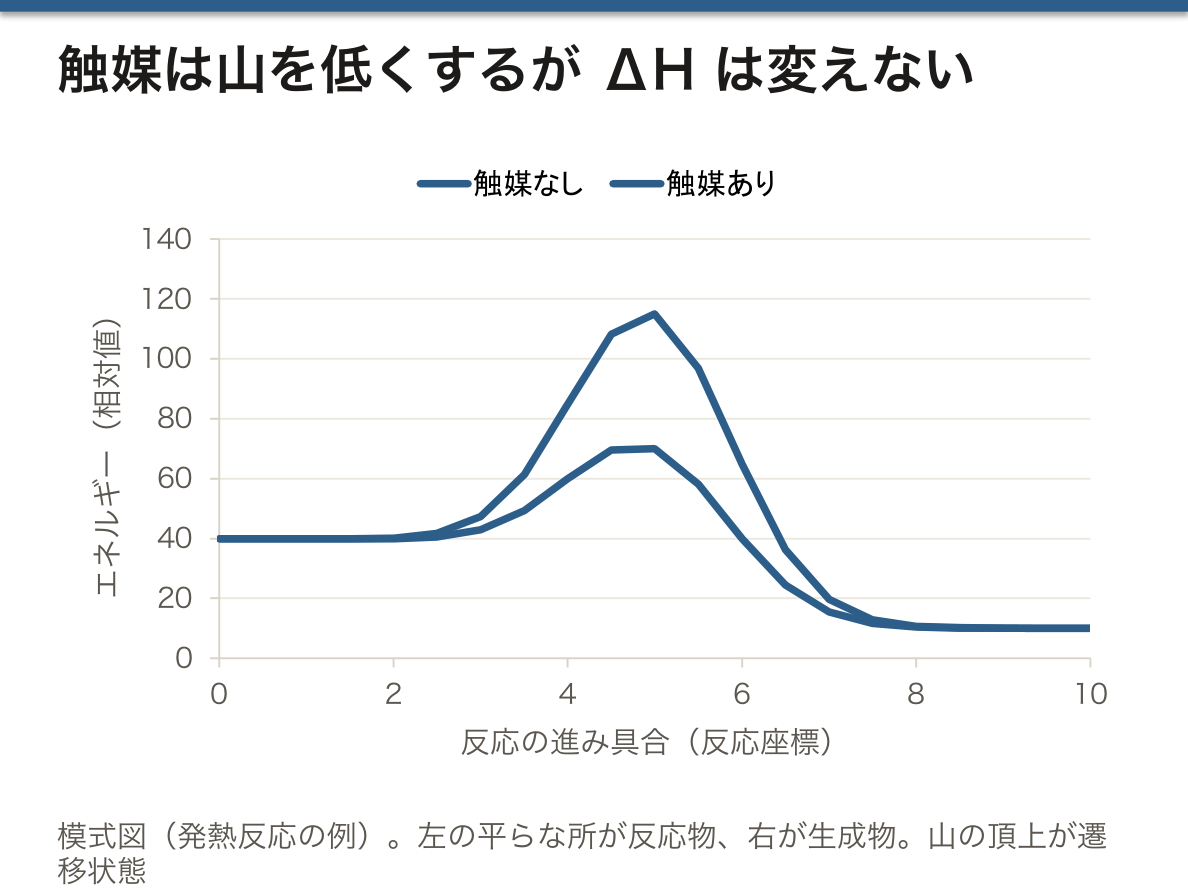
反応物が生成物に変わる途中には、結合が半分切れ半分できた不安定な状態(遷移状態・活性錯体)があり、そこまで登るのに要るエネルギーが活性化エネルギー Ea である。エネルギー図では、反応物から山の頂上までの高さが Ea、反応物と生成物の高さの差が ΔH で、ΔH = Ea(正反応)− Ea(逆反応)となる。
ある温度の粒子の運動エネルギーはばらついており、その分布がマクスウェル–ボルツマン分布である。温度を上げると分布の山は低く右に広がり、Ea を超える粒子の割合(曲線の右すその面積)が大きく増える。
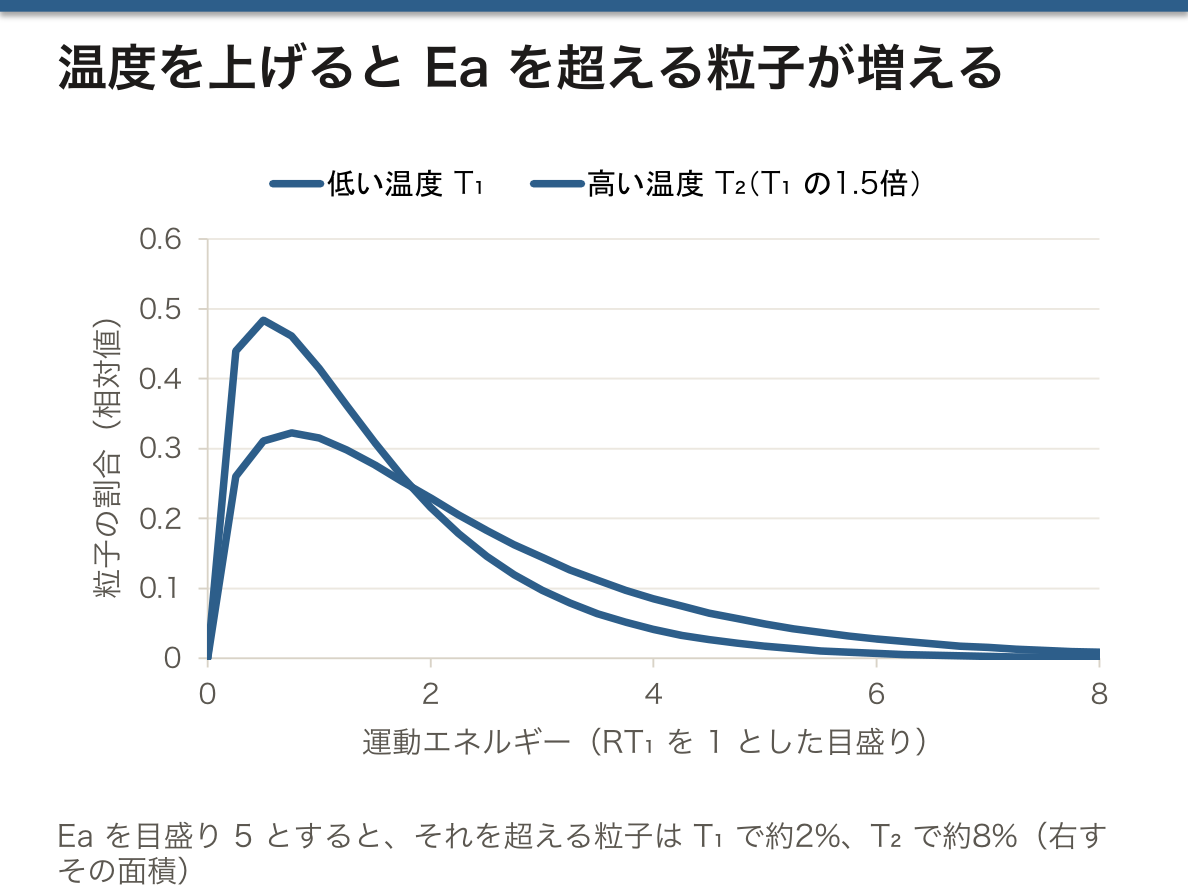
これを式にしたのがアレニウスの式 k = A · e−Ea/RT(k:速度定数、A:頻度因子、R = 8.314 J/(mol·K)、T:絶対温度)である。指数の中に T があるので、温度のわずかな変化で k が大きく変わる。また Ea が大きい反応ほど温度に敏感である。両辺の対数をとると ln k = ln A − Ea/(RT) となり、ln k を 1/T に対してプロットすると傾き −Ea/R の直線になる。これで実験から Ea を求められる。
触媒は分布そのものは変えず、Ea の位置を左に動かす。同じ温度でも Ea を超える粒子の割合が増えるので速くなる。温度を上げることと触媒を使うことは、同じ面積を増やす別の方法と言える。
体温が上がると代謝反応は全体に速くなり、酸素消費も増える。逆に低体温療法は、心停止後の脳で代謝と障害の進行を遅らせることをねらう。薬やワクチンを冷所保存するのも、分解反応の速度を下げるためである。「室温で数日もつ薬が、高温の車内では短時間で劣化する」のはアレニウスの式どおりの現象である。
English version
Core
On the way from reactants to products there is an unstable state where bonds are half broken and half formed (the transition state, or activated complex). The energy needed to climb there is the activation energy Ea. On an energy diagram, the height from reactants to the top of the hill is Ea, and the height difference between reactants and products is ΔH, so ΔH = Ea(forward) − Ea(reverse).
At a given temperature, particle energies are spread out; this spread is the Maxwell–Boltzmann distribution. Raising the temperature makes the peak lower and spreads it to the right, and the fraction of particles above Ea (the area of the right tail) grows a lot.
Going further
The Arrhenius equation k = A · e−Ea/RT puts this into numbers (k: rate constant; A: frequency factor; R = 8.314 J/(mol·K); T: absolute temperature). T is inside the exponent, so a small change in temperature changes k a lot, and reactions with a large Ea are more sensitive to temperature. Taking logs gives ln k = ln A − Ea/(RT); a plot of ln k against 1/T is a straight line with slope −Ea/R. This is how Ea is found from experiments.
A catalyst does not change the distribution; it moves Ea to the left. At the same temperature more particles are above Ea, so the reaction is faster. Heating and using a catalyst are two ways to increase the same area.
In the clinic
When body temperature rises, metabolic reactions speed up in general and oxygen use increases. Therapeutic hypothermia, on the other hand, aims to slow metabolism and the progress of injury in the brain after cardiac arrest. Drugs and vaccines are kept cold to slow their breakdown. A medicine that lasts days at room temperature but spoils quickly in a hot car is the Arrhenius equation in action.
速度式と反応次数 — 0次・1次・2次と律速段階
A + B → 生成物 の速度は、濃度のべき乗に比例する:速度 = k [A]x [B]y。k は速度定数(温度で決まる)、x と y が A と B についての次数、x + y が全体の次数である。
| 次数 | 速度と濃度 | 直線になるグラフ | k の単位 |
|---|---|---|---|
| 0次 | 濃度によらず一定 | [A] 対 t(傾き −k) | mol/(L·s) |
| 1次 | 濃度に比例(2倍で2倍) | ln[A] 対 t(傾き −k) | s−1 |
| 2次 | 濃度の2乗に比例(2倍で4倍) | 1/[A] 対 t(傾き +k) | L/(mol·s) |
次数は反応式の係数からは決まらず、実験で決める。係数と一致するのは、それ以上分けられない1段階の反応(素反応)のときだけで、素反応の次数は反応に加わる粒子の数(分子数:単分子・二分子・三分子)に等しい。
多くの反応は複数の素反応の連なり(反応機構)でできており、いちばん遅い段階(律速段階)が全体の速度を決める。高速道路の一番狭い区間が渋滞を決めるのと同じである。全体の速度式は律速段階の速度式になるので、実験で決めた次数は反応機構を推定する手がかりになる。次数を決めるには、一方の濃度だけを段階的に変えて初めの速度を比べる。濃度を2倍にして速度が2倍なら1次、変わらなければ0次である。
体内の薬の消失の多くは1次で、血中濃度が高いほど速く減る。ところがエタノールは、通常の飲酒量でも分解酵素がほぼ飽和するため0次に近く、時間あたりほぼ一定量ずつしか減らない。飲んだ量が多いほど抜けるまでの時間が比例して延びるのはこのためで、フェニトインなど一部の薬も高濃度で同じ振る舞いをし、少しの増量で血中濃度が急に上がる。
English version
Core
For A + B → products, the rate is proportional to powers of the concentrations: rate = k [A]x [B]y. k is the rate constant (set by temperature), x and y are the orders with respect to A and B, and x + y is the overall order.
| Order | Rate vs concentration | Straight-line graph | Unit of k |
|---|---|---|---|
| Zero | constant, independent of concentration | [A] vs t (slope −k) | mol/(L·s) |
| First | proportional (double → double) | ln[A] vs t (slope −k) | s−1 |
| Second | proportional to the square (double → four times) | 1/[A] vs t (slope +k) | L/(mol·s) |
Going further
Order is found by experiment, not from the coefficients of the equation. It matches the coefficients only for a single step that cannot be split further (an elementary step). The order of an elementary step equals the number of particles taking part (its molecularity: unimolecular, bimolecular, termolecular).
Many reactions are a series of elementary steps (a mechanism), and the slowest step (the rate-determining step) sets the overall rate — like the narrowest section of a motorway causing the traffic jam. The overall rate equation is that of the rate-determining step, so the measured order helps us guess the mechanism. To find the order, change one concentration step by step and compare the initial rates. If doubling the concentration doubles the rate, it is first order; if nothing changes, zero order.
In the clinic
Most drugs are eliminated by first-order kinetics: the higher the blood level, the faster it falls. But ethanol is close to zero order, because the enzymes are almost saturated even at ordinary drinking levels; it falls by about the same amount each hour. This is why the time to sober up grows in proportion to the amount drunk. Some drugs, such as phenytoin, behave the same way at high levels, so a small dose increase can raise the blood level sharply.
半減期 — 1次反応では濃度によらず一定
半減期 t1/2 は、濃度(または量)が初めの半分になるまでの時間である。
1次反応では t1/2 = ln 2 / k ≈ 0.693 / k で、初めの濃度によらず一定になる。100 → 50 にかかる時間と、50 → 25 にかかる時間は同じである。n 回の半減期のあとに残る割合は (1/2)n で、4回で約6%、5回で約3%。
グラフからも読める。濃度–時間の曲線で、ある値が半分になるまでの時間を読めばよい。ln[A] 対 t の直線の傾きから k を出し、0.693/k で計算してもよい。
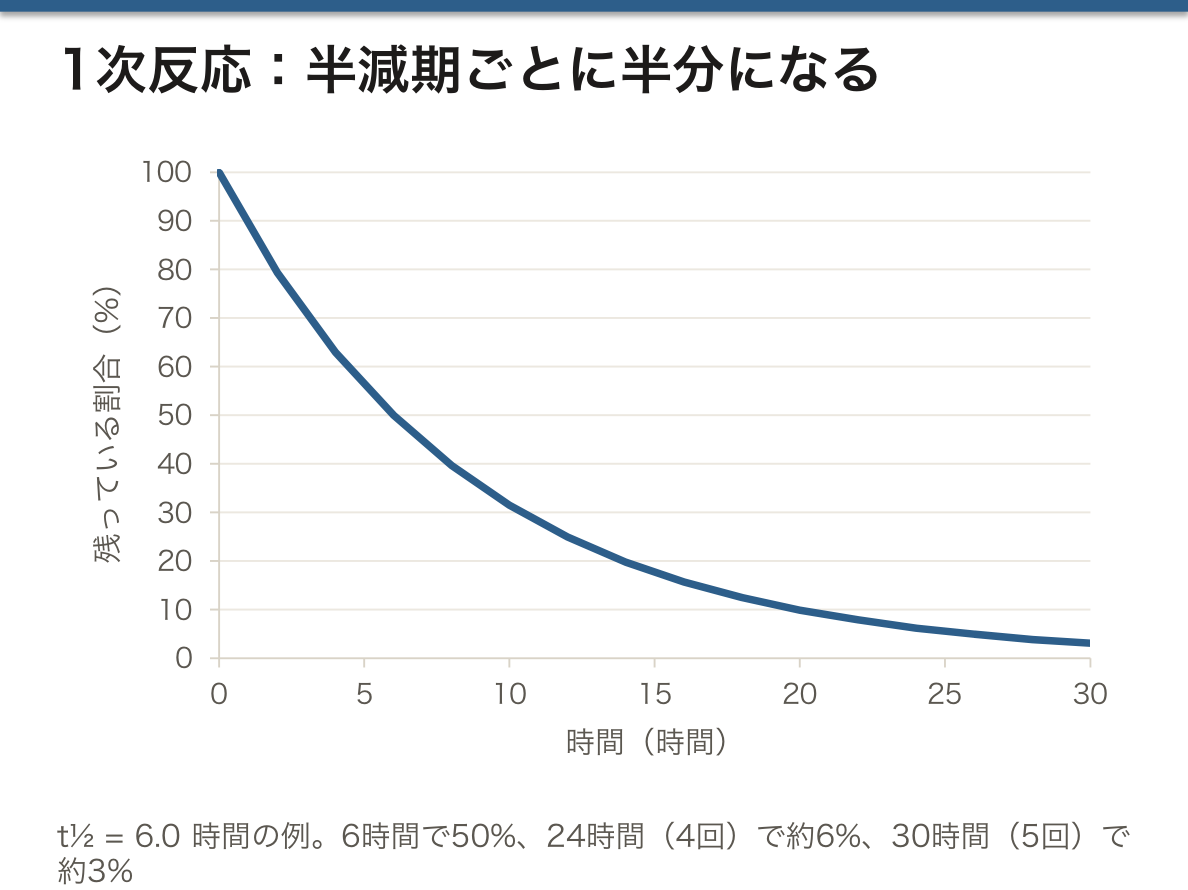
なぜ1次反応だけ半減期が一定なのか。1次反応ではいまある量のうち一定の「割合」が単位時間に反応するからである。量が半分になれば、減る速さも半分になる。だから半分になるまでの時間は毎回同じになる。式で書けば ln([A]0/[A]) = kt で、[A] = [A]0/2 を入れると t = ln 2 / k となり、[A]0 が消える。
0次反応では一定の「量」が減るので、t1/2 = [A]0 / (2k) と初めの濃度に比例する。2次反応では t1/2 = 1 / (k[A]0) で、濃いほど短い。半減期が初めの濃度で変わるかどうかを見れば、次数を見分けられる。
例:t1/2 = 6.0 時間の1次反応なら k = 0.693 / 6.0 ≈ 0.12 h−1。24時間後(4回の半減期)には初めの 1/16 ≈ 6% が残る。
半減期は薬の使い方を決める。くり返し投与では半減期の4〜5倍の時間で定常状態(入る量と出る量が釣り合う)に達し、中止すると同じく4〜5倍の時間でほぼ消える(ウォッシュアウト)。増量の効果を判断する時期、別の薬に切り替える時期、離脱症状が出る時期は、この時間から見積もる。放射性同位体の壊変も1次反応で、核医学で使う 99mTc(半減期約6時間)や 131I(約8日)の扱いも同じ考え方による。
English version
Core
The half-life t1/2 is the time for a concentration (or amount) to fall to half its starting value.
For a first-order reaction, t1/2 = ln 2 / k ≈ 0.693 / k, and it is the same whatever the starting concentration. Going from 100 to 50 takes as long as going from 50 to 25. After n half-lives, (1/2)n remains: about 6% after four, about 3% after five.
You can read it from a graph: on the concentration–time curve, read the time for any value to halve. Or find k from the slope of ln[A] against t and calculate 0.693/k.
Going further
Why is the half-life constant only in first order? Because a fixed fraction of what is present reacts per unit time. When the amount halves, the rate also halves, so each halving takes the same time. In equations, ln([A]0/[A]) = kt; put [A] = [A]0/2 and t = ln 2 / k — [A]0 disappears.
In zero order a fixed amount disappears, so t1/2 = [A]0 / (2k), proportional to the starting concentration. In second order, t1/2 = 1 / (k[A]0), shorter when more concentrated. Whether the half-life depends on the starting concentration tells you the order.
Example: a first-order reaction with t1/2 = 6.0 h has k = 0.693 / 6.0 ≈ 0.12 h−1. After 24 h (four half-lives), 1/16 ≈ 6% remains.
In the clinic
Half-life decides how drugs are used. With repeated doses, steady state (intake balancing elimination) is reached after 4–5 half-lives, and after stopping, the drug is almost gone after another 4–5 half-lives (washout). This tells you when to judge the effect of a dose change, when to switch to another drug, and when withdrawal symptoms may appear. Radioactive decay is also first order; the handling of 99mTc (half-life about 6 hours) and 131I (about 8 days) in nuclear medicine uses the same idea.
触媒 — 均一触媒・不均一触媒・自己触媒
触媒は、反応の前後で自分は変化せずに反応を速くする物質で、活性化エネルギーの低い別の反応経路を用意することで働く。Ea が下がると速度定数 k が大きくなる。
触媒は正反応と逆反応を同じ割合で速めるので、平衡の位置(平衡定数)も ΔH・ΔG も変えない。生成物が早くできるだけで、できる量は増えない。
| 種類 | 特徴 | 例 |
|---|---|---|
| 均一触媒 | 反応物と同じ相(例:どちらも水溶液)にある | H2O2 の分解に KI(I− ) |
| 不均一触媒 | 反応物と別の相(例:固体と液体)にあり、表面で働く | H2O2 の分解に MnO2(固体) |
| 自己触媒 | 反応の生成物が、その反応自身の触媒になる | MnO4− と シュウ酸の反応で生じる Mn2+ |
自己触媒の反応は、初めはゆっくりで、生成物がたまるにつれて急に速くなるという独特の経過をとる。酸性の過マンガン酸カリウムにシュウ酸を加えると、しばらく紫色が残ったあと、ある時点から一気に色が消える。2MnO4− + 6H+ + 5H2C2O4 → 2Mn2+ + 10CO2 + 8H2O で生じた Mn2+ が反応を速めるからで、最初から Mn2+(MnSO4)を加えておくと、待ち時間なしに速く進む。
不均一触媒は表面で働くので、粉末にして表面積を大きくするほど効く。同じ金属酸化物でも、表面の性質によって触媒としての強さは大きく違う(H2O2 の分解では MnO2 のほうが Fe2O3 よりずっと激しく泡が出る)。
過酸化水素水(オキシドール)を傷口に付けると泡が出るのは、組織や血液のカタラーゼが 2H2O2 → 2H2O + O2 を強力に触媒するからである。同じ反応を MnO2 や KI でも起こせるが、カタラーゼはそれらよりはるかに速い。体内では、代謝で生じる H2O2 をすみやかに分解して細胞を守る働きをしている。
English version
Core
A catalyst speeds up a reaction and is unchanged at the end. It works by offering another reaction path with a lower activation energy; a lower Ea gives a larger rate constant k.
A catalyst speeds up the forward and reverse reactions equally, so it changes neither the position of equilibrium (the equilibrium constant) nor ΔH or ΔG. Products form sooner, but no more product forms.
| Type | Feature | Example |
|---|---|---|
| Homogeneous | In the same phase as the reactants (e.g. both in solution) | KI (I−) for H2O2 decomposition |
| Heterogeneous | In a different phase (e.g. solid and liquid); works at the surface | MnO2 (solid) for H2O2 decomposition |
| Autocatalysis | A product of the reaction catalyses the reaction itself | Mn2+ formed in the reaction of MnO4− with oxalic acid |
Going further
An autocatalytic reaction has a typical course: slow at first, then suddenly fast as product builds up. Add oxalic acid to acidified potassium permanganate: the purple colour stays for a while, then vanishes quickly. Mn2+ formed in 2MnO4− + 6H+ + 5H2C2O4 → 2Mn2+ + 10CO2 + 8H2O speeds up the reaction; if Mn2+ (MnSO4) is added at the start, it goes fast with no waiting time.
A heterogeneous catalyst works at its surface, so a fine powder with a large surface works better. Even similar metal oxides differ greatly in strength (for H2O2, MnO2 makes far more bubbles than Fe2O3).
In the clinic
Hydrogen peroxide foams on a wound because catalase in tissue and blood strongly catalyses 2H2O2 → 2H2O + O2. MnO2 or KI can catalyse the same reaction, but catalase is much faster. In the body it quickly removes H2O2 formed by metabolism and protects cells.
酵素 — 生体の触媒と、ふつうの触媒との違い
酵素は生体の反応を触媒する蛋白質で、基質が結合する活性部位をもつ。触媒としての原理(Ea を下げる、平衡は変えない、反応後に元に戻る)はふつうの触媒と同じだが、次の点が違う。
| ふつうの触媒 | 酵素 | |
|---|---|---|
| 特異性 | 低い(多くの反応に効く) | 非常に高い(特定の基質・特定の反応) |
| 速さ | 中程度 | けた違いに速い |
| 条件 | 高温・高圧も使える | 体温・中性付近で働く。最適温度・最適 pH がある |
| 熱・pH への弱さ | 比較的強い | 高温や極端な pH で変性して働かなくなる |
| 調節 | ほとんどない | 阻害・活性化・量の増減で細かく調節される |
酵素の反応速度は、基質濃度が低いうちは濃度にほぼ比例(1次)し、高くなると頭打ちになる(0次に近づく)。すべての酵素分子が基質でふさがる(飽和する)と、それ以上基質を増やしても速くならないからである。この頭打ちの速度が Vmax、その半分の速度になる基質濃度が Km で、Km が小さいほど基質への親和性が高い。
温度を上げると初めは速くなるが(アレニウスの式)、ある温度を超えると蛋白質が変性して急に遅くなる。だから酵素には最適温度があり、同様に最適 pHがある(ペプシンは pH 2 前後、多くの細胞内酵素は pH 7 前後)。
阻害には、基質と活性部位を奪い合う競合阻害(基質を増やすと打ち勝てる)と、別の場所に結合して働きを落とす非競合阻害(基質を増やしても戻らない)がある。
多くの薬は酵素阻害薬である。スタチンは HMG-CoA 還元酵素を競合的に阻害してコレステロールの合成を抑え、アスピリンはシクロオキシゲナーゼをアセチル化して不可逆的に止める(血小板では新しい酵素が作られないので、効果が血小板の寿命のあいだ続く)。詳しい酵素反応速度論は生化学で扱う。
English version
Core
An enzyme is a protein that catalyses reactions in the body. It has an active site where the substrate binds. The basic principle is the same as for any catalyst (it lowers Ea, does not change the equilibrium, and returns to its original form), but there are differences:
| Ordinary catalyst | Enzyme | |
|---|---|---|
| Specificity | low (works on many reactions) | very high (one substrate, one reaction) |
| Speed | moderate | many orders of magnitude faster |
| Conditions | can use high temperature and pressure | works at body temperature and near neutral pH; has an optimum temperature and pH |
| Sensitivity | fairly robust | denatured and inactive at high temperature or extreme pH |
| Regulation | almost none | finely controlled by inhibition, activation and the amount of enzyme |
Going further
The rate of an enzyme reaction is almost proportional to substrate concentration at first (first order), then levels off (towards zero order). When every enzyme molecule is occupied by substrate (saturated), more substrate cannot make it faster. The level-off rate is Vmax; the substrate concentration giving half of it is Km. A small Km means high affinity for the substrate.
Raising the temperature speeds the reaction at first (Arrhenius), but above a certain point the protein denatures and the rate drops sharply. So an enzyme has an optimum temperature, and likewise an optimum pH (pepsin about pH 2; most cell enzymes about pH 7).
In competitive inhibition the inhibitor competes with the substrate for the active site (more substrate overcomes it). In non-competitive inhibition it binds elsewhere and lowers activity (more substrate does not help).
In the clinic
Many drugs are enzyme inhibitors. Statins competitively inhibit HMG-CoA reductase and reduce cholesterol synthesis. Aspirin acetylates cyclo-oxygenase and stops it irreversibly; platelets cannot make new enzyme, so the effect lasts for the platelet’s life span. Enzyme kinetics in detail belongs to biochemistry.
まとめ
| 反応速度 — 単位時間あたりの濃度変化 | 反応速度は、反応物または生成物の濃度が単位時間あたりにどれだけ変わるかで表し、単位は mol/(L·s)(mol·L−1·s−1)である。 |
|---|---|
| 衝突理論 — 速度を変える5つの因子 | 2つの粒子が反応するには、①衝突する、②十分なエネルギー(活性化エネルギー以上)で衝突する、③反応する部分どうしが向き合う正しい向きで衝突する、の3条件がそろう必要がある。 |
| 活性化エネルギーとアレニウスの式 — 温度が速度を大きく変える理由 | 反応物が生成物に変わる途中には、結合が半分切れ半分できた不安定な状態(遷移状態・活性錯体)があり、そこまで登るのに要るエネルギーが活性化エネルギー Ea である。 |
| 速度式と反応次数 — 0次・1次・2次と律速段階 | A + B → 生成物 の速度は、濃度のべき乗に比例する:速度 = k [A]x [B]y。 |
| 半減期 — 1次反応では濃度によらず一定 | 半減期 t1/2 は、濃度(または量)が初めの半分になるまでの時間である。 |
| 触媒 — 均一触媒・不均一触媒・自己触媒 | 触媒は、反応の前後で自分は変化せずに反応を速くする物質で、活性化エネルギーの低い別の反応経路を用意することで働く。 |
| 酵素 — 生体の触媒と、ふつうの触媒との違い | 酵素は生体の反応を触媒する蛋白質で、基質が結合する活性部位をもつ。 |
このノートは医学生が授業の内容を自分の言葉でまとめたもので、診療の判断に使うものではありません。誤りに気づいたらお知らせください。