人工呼吸器や人工栄養が命を長く支えられるようになって、いつ、どのように治療をやめるかが医療の日常の問題になった。その延長に、医師が死を助けることは許されるかという安楽死・自殺幇助の問いがある。
この章では、まず言葉を正確に分け(自殺幇助・安楽死・4類型)、世界の法的状況と賛否の論拠を見たうえで、議論の核心にある2つの区別——殺すことと死なせること、意図した結果と予見した結果(二重結果の原則)——を検討する。最後に日本の判例(東海大学事件の4要件)と国のガイドライン、無益な治療の考え方をまとめる。
- 自殺幇助と安楽死 — 言葉を正確に分ける
- 安楽死の4類型 — 行為の性格×本人の意思
- 世界の法的状況 — 少数の国、異なる名前と条件
- 安楽死をめぐる賛成論と反対論
- 殺すことと死なせること — 本当に違うのか
- 二重結果の原則 — 意図した結果と予見した結果
- 日本の終末期医療 — 4要件・ガイドライン・無益な治療
自殺幇助と安楽死 — 言葉を正確に分けるEuthanasia
終末期の議論は、言葉を混ぜた途端に混乱する。まず定義を分ける。
| 用語 | 定義 | 最後の行為をする人 |
|---|---|---|
| 自殺 | 自分の死を、それ自体を目的として、または別の目的の手段として意図して、自分の命を終わらせること | 本人 |
| 自殺幇助 | 他人が自殺するのを手助けすること | 本人 |
| 医師による自殺幇助(PAS) | 自殺を手助けするのが医師である場合(致死薬の処方など) | 本人 |
| 安楽死 | その死が本人の最善の利益になるから死んでほしいという意図で、他人の死をもたらす何かをすること(殺すこと、または死なせること) | 他者(多くは医師) |
自殺幇助と安楽死の両方をまとめて「死の援助(assisted dying)」と呼ぶ。両者の決定的な違いは、死に至る最後の行為を誰が行うかである。
安楽死の定義で重要なのは「本人の最善の利益のために」という部分である。遺産や介護の負担から逃れるために死なせることは、どんなに穏やかな方法でも安楽死ではなく殺人である。安楽死という語はギリシャ語の「よい死」に由来し、動機が相手のためであることがこの概念の芯にある。
もう一つ、安楽死の定義が「殺すこと、または死なせること」を含む点に注意する。このため教科書的な分類では、延命治療の差し控え・中止までが「消極的安楽死」に含まれる(次の項目)。しかし実際の法律や研究の多くは、安楽死を「本人の明示的な要請に基づき、医師が致死薬を投与すること」に限って定義し、治療の差し控え・中止は通常の医療行為として別に扱う。どちらの言葉づかいをしているのかを確かめずに議論すると、話がすれ違う。
同じ行為を国ごとに違う名前で呼ぶことも混乱のもとになる。カナダは安楽死と自殺幇助をまとめて「医療的臨死介助(MAiD)」、オーストラリアの諸州は「自発的な死の援助(VAD)」、米国の州は「尊厳死」「医療的臨死介助」と呼ぶ。日本で「尊厳死」というと、多くは延命治療の差し控え・中止を指し、米国の用法とは違う。文献を読むときは、まず定義を確認する習慣をつけたい。
English version
Core
End-of-life debates become confused as soon as words are mixed. First, separate the definitions.
| Term | Definition | Who performs the final act |
|---|---|---|
| Suicide | Ending one’s own life, intending one’s death either as an end in itself or as a means to some further end | The person |
| Assisted suicide | Someone helping another person to commit suicide | The person |
| Physician-assisted suicide (PAS) | The helper is a physician (e.g., prescribing a lethal drug) | The person |
| Euthanasia | Doing something to bring about another’s death (killing or letting die) with the intention that the person die because death is in that person’s best interests | Another person (usually a doctor) |
Together, assisted suicide and euthanasia are called ‘assisted dying’. The decisive difference is who performs the final act that causes death.
Going further
The key part of the definition of euthanasia is ‘in the best interests of the person’. Causing death to gain an inheritance or escape the burden of care is murder, however gentle the method. The word comes from the Greek for ‘good death’, and a motive directed at the other’s good is the core of the concept.
Note also that the definition includes ‘killing or letting die‘. So in the teaching classification, withholding or withdrawing life-sustaining treatment counts as ‘passive euthanasia’ (next item). But many laws and studies define euthanasia narrowly as a doctor giving a lethal drug at the patient’s explicit request, and treat withholding or withdrawing treatment as normal medical practice. If you do not check which usage is in play, the discussion goes nowhere.
In the clinic
Different names for the same act in different countries add to the confusion. Canada calls euthanasia and assisted suicide together ‘medical assistance in dying (MAiD)’; Australian states say ‘voluntary assisted dying (VAD)’; US states say ‘death with dignity’ or ‘medical aid in dying’. In Japan, ‘songenshi’ (death with dignity) usually means withholding or withdrawing life-sustaining treatment, unlike the US usage. When reading the literature, check the definition first.
安楽死の4類型 — 行為の性格×本人の意思
安楽死は2つの軸で分類される。行為の性格による分類では、積極的安楽死は他者が死を引き起こすこと(致死薬の注射など)、消極的安楽死は他者が(行為によって、または行為をしないことによって)人を死なせること(延命治療を始めない・中止する)である。本人の意思による分類では、自発的安楽死は本人の意思に従うもの、非自発的安楽死は本人が望んだわけではないが、拒んだわけでもない(意思を表せない)場合である。
| 自発的(本人の意思に従う) | 非自発的(本人の意思が表されていない) | |
|---|---|---|
| 積極的(死を引き起こす) | ①判断能力のある患者の要請で、医師が致死薬を投与する | ②意思を表せない患者に、家族の求めなどで致死薬を投与する |
| 消極的(死なせる) | ③患者の要請で人工呼吸器を始めない・外す | ④意識のない患者の延命治療を、推定意思に基づき中止する |
これに加え、本人が望んでいないのに意思に反して死なせることを反自発的(involuntary)と呼ぶことがあるが、これは安楽死ではなく殺人として扱われる。
4つの類型は、道徳的な評価がはっきり分かれる。③は今日ほとんどの国で許容されている。判断能力のある患者は、命を支える治療を含め、どんな治療でも拒否できるからだ。④も、本人の推定意思や最善の利益に基づく手続きを踏めば、多くの国で認められる。議論が集中するのは①で、②はさらに慎重に扱われる。
ここで「積極的」と「消極的」の区別は、殺すことと死なせることの区別に重なる。この区別に本当に道徳的な意味があるのかは、それ自体が大きな論点である(後の項目)。たとえば人工呼吸器を「外す」のは身体的な行為なのに、なぜ「死なせる」側に入るのか。分類表は議論を整理する道具であって、どの欄の行為が正しいかを決めるものではない。
日本の臨床で日々向き合うのは③④の領域、つまり延命治療の差し控えと中止である。人工呼吸・人工栄養・透析を始めるか、続けるかの判断は、ICU や高齢者医療の日常であり、本人の意思の確認と、それができない場合の代理意思決定(インフォームド・コンセントの章)が鍵になる。
English version
Core
Euthanasia is classified along two axes. By the character of the act: active euthanasia means someone inducing death (a lethal injection); passive euthanasia means someone allowing a person to die, by acting or not acting (not starting or stopping life support). By the will of the person: voluntary euthanasia follows the person’s will; non-voluntary euthanasia is when the person has neither willed it nor ruled it out (cannot express a will).
| Voluntary (follows the person’s will) | Non-voluntary (no will expressed) | |
|---|---|---|
| Active (induces death) | (1) A doctor gives a lethal drug at a competent patient’s request | (2) A lethal drug given to a patient who cannot express a will, e.g., at the family’s request |
| Passive (allows death) | (3) Not starting or withdrawing a ventilator at the patient’s request | (4) Stopping life support for an unconscious patient based on presumed wishes |
Causing death against a person’s will is sometimes called involuntary, but it is treated as murder, not euthanasia.
Going further
The four types are judged very differently. Type (3) is accepted in almost all countries today, because competent patients may refuse any treatment, including life-sustaining treatment. Type (4) is also accepted in many countries if procedures based on presumed wishes or best interests are followed. Debate centres on (1), and (2) is treated with even more caution.
The active/passive distinction overlaps with killing versus letting die. Whether that distinction has real moral weight is itself a major issue (later item). For example, removing a ventilator is a physical act, so why is it ‘letting die’? The table organises the debate; it does not decide which box contains right actions.
In the clinic
What Japanese clinicians face daily is types (3) and (4): withholding and withdrawing life-sustaining treatment. Whether to start or continue ventilation, artificial nutrition or dialysis is routine in ICUs and care of older people. The keys are confirming the patient’s wishes and, when that is impossible, surrogate decision-making (informed consent chapter).
世界の法的状況 — 少数の国、異なる名前と条件
積極的自発的安楽死や医師による自殺幇助を合法とする国・地域は、まだ少数である。
| 認めるもの | 主な国・地域(法の成立・施行) |
|---|---|
| 安楽死と自殺幇助 | オランダ(2002年)、ベルギー(2002年)、ルクセンブルク(2009年)、コロンビア、カナダ(2016年)、オーストラリアの諸州(ヴィクトリア州が2019年に施行)、さらにスペインとニュージーランド(いずれも2021年) |
| 自殺幇助のみ | スイス(刑法は利己的な動機による自殺幇助だけを罰する)、米国の一部の州(オレゴン州の尊厳死法、1997年施行が最初) |
各国の制度は、呼び方と定義、そして条件が大きく違う。
| 条件 | 違いの例 |
|---|---|
| 年齢 | 多くは18歳以上。オランダは12歳以上(親の関与つき)、ベルギーは2014年に判断能力のある未成年について年齢制限をなくした |
| 診断 | 米国の州は余命6か月以内の終末期であることを求める。オランダ・ベルギーは終末期を要件とせず、回復の見込みのない病気による耐えがたい苦痛を求める |
| 手続き | 独立した別の医師への相談、待機期間、事後の審査委員会への報告など |
スイスでは、自殺幇助を支援する団体が、国外からの希望者も受け入れてきた。代表的な団体であるディグニタスのもとには、自国では認められない人々がドイツなどから渡航する。いわゆる「自殺ツーリズム」である。
実施の状況も国ごとに違う。オランダでは安楽死による死亡が全死亡の数%を占めるまでに増え、件数は年々増加してきた。要請の理由として多いのは、痛みそのものより、自立の喪失、生活の質の低下、尊厳の喪失といった心理的・実存的な苦しみである。診断の内訳では癌が最も多い。さらに、精神疾患や認知症、未成年への適用は、判断能力の評価と「回復の見込みがない」ことの判断が難しく、合法化した国の中でも議論が続いている。
日本では安楽死も自殺幇助も法律で認められていない。医師が致死薬を投与すれば殺人罪、自殺を手助けすれば自殺幇助罪(刑法)に問われうる。だからこそ日本の医師が出会うのは、海外での死の援助を考えている患者や家族からの相談、そして国内での延命治療の差し控え・中止と緩和ケアの問題である。
English version
Core
Only a small number of countries and regions allow active voluntary euthanasia or physician-assisted suicide.
| What is allowed | Main countries/regions (law passed or in force) |
|---|---|
| Euthanasia and assisted suicide | Netherlands (2002), Belgium (2002), Luxembourg (2009), Colombia, Canada (2016), Australian states (Victoria first, in force 2019), and Spain and New Zealand (both 2021) |
| Assisted suicide only | Switzerland (the penal code punishes assisted suicide only with selfish motives); some US states (Oregon’s Death with Dignity Act, in force 1997, was the first) |
Systems differ greatly in names and definitions and in conditions.
| Condition | Examples of differences |
|---|---|
| Age | Mostly 18+. The Netherlands allows 12+ (with parental involvement); Belgium removed the age limit for competent minors in 2014 |
| Diagnosis | US states require a terminal illness with 6 months or less to live. The Netherlands and Belgium do not require terminal illness but require unbearable suffering from an incurable condition |
| Procedure | Consultation with an independent second doctor, waiting periods, reporting to a review committee afterwards |
Going further
In Switzerland, right-to-die organisations have accepted people from abroad. People not allowed assisted dying at home travel from Germany and elsewhere to organisations such as Dignitas — so-called ‘suicide tourism’.
Practice differs too. In the Netherlands, euthanasia has grown to a few per cent of all deaths and has risen year by year. The most common reasons for requests are not pain itself but psychological and existential suffering: loss of independence, falling quality of life, loss of dignity. Cancer is the most common diagnosis. Use for psychiatric illness and dementia and for minors remains debated even in countries that allow it, because judging capacity and ‘no prospect of improvement’ is difficult.
In the clinic
In Japan neither euthanasia nor assisted suicide is legal. A doctor who gives a lethal drug may be charged with murder; helping a suicide may be a crime under the Penal Code. So Japanese doctors meet consultations from patients or families considering assisted dying abroad, and, at home, questions of withholding and withdrawing life-sustaining treatment and palliative care.
安楽死をめぐる賛成論と反対論
積極的自発的安楽死と医師による自殺幇助をめぐる主な論拠を並べる。
| 反対論 | 中身 |
|---|---|
| 人の生命の価値を下げる | 生命は本質的に侵されてはならない(生命の神聖さ)。ある生命を「生きる価値がない」と社会が認めることになる |
| 医療費抑制の手段になる | 費用のかかる患者に、死を選ぶ圧力がかかる |
| 医師の使命に反する | 医師は命を救い癒す者であり、患者を死なせる者ではない。患者の医師への信頼を損なう |
| 適切な緩和ケアがあれば不要 | 苦痛の多くは緩和ケアで和らげられる |
| 滑り坂 | 判断能力のある終末期患者に限ったはずの基準が、少しずつ広がっていく |
| 賛成論 | 中身 |
|---|---|
| 苦しみを減らす | 緩和しきれない苦しみから解放する |
| 他の人を助けるための医療資源が空く | 望まれない延命に使う資源を他に回せる |
| 死に方を選ぶ権利 | 自分の人生の最期を自分の価値観に従って決める自己決定 |
論拠どうしは、互いに向き合っている。「医療費の節約になる」という賛成論は、反対論の「医療費抑制の手段になる」と表裏の関係にあり、賛成の側からも強調すべきでない論拠とされることが多い。費用を理由に死を勧めることは、自律ではなく圧力になるからだ。
滑り坂の議論には2つの型がある。論理的な滑り坂は「判断能力のある成人の苦しみを理由に認めるなら、判断能力のない人の苦しみも理由になるはずだ」と、原理が拡張を避けられないと主張する。経験的な滑り坂は、実際に対象が広がるかを事実で問う。合法化した国で、対象が精神疾患や未成年へ広がった例は、反対論の側から経験的な証拠として挙げられ、賛成論の側からは慎重な手続きのもとでの正当な拡張だと反論される。緩和ケアについては、多くの苦痛は和らげられるが、すべてではない。また、要請の理由が痛みより尊厳や自立の喪失であることが多い点(前の項目)は、緩和ケアだけでは要請がなくならないことを示している。
「死にたい」と口にする患者に出会ったとき、医療者がまずすべきことは、安楽死の是非を論じることではない。その言葉の背後にある苦しみ——痛み、息苦しさ、うつ、孤立、負担をかけているという思い——を一つずつ尋ね、和らげられるものを和らげることである。治療できるうつ病が背景にあることも少なくない。
English version
Core
The main arguments on active voluntary euthanasia and physician-assisted suicide:
| Against | Content |
|---|---|
| Diminishes the value of human life | Life is inviolable (sanctity of life); society would declare some lives ‘not worth living’ |
| A means of health-care cost containment | Patients who cost a lot may be pressured to choose death |
| Against the mission of the doctor | Doctors save and heal, not kill; patients’ trust in doctors may suffer |
| Adequate palliative care makes it unnecessary | Most suffering can be relieved by palliative care |
| Slippery slope | Criteria meant only for competent terminally ill patients gradually widen |
| For | Content |
|---|---|
| Less suffering | Release from suffering that cannot be relieved |
| Frees medical funds to help others | Resources used for unwanted life extension can go elsewhere |
| The right to choose the way to die | Self-determination about the end of one’s own life, by one’s own values |
Going further
The arguments face each other. ‘It saves money’ (for) is the mirror image of ‘it becomes cost containment’ (against), and even supporters often treat it as an argument not to stress, because recommending death for cost reasons is pressure, not autonomy.
The slippery slope has two forms. The logical form says that if we allow it because of a competent adult’s suffering, the suffering of incompetent people must also count, so the principle cannot avoid widening. The empirical form asks whether widening actually happens. Extension to psychiatric illness and minors in some countries is cited by opponents as evidence, and defended by supporters as legitimate extension under careful procedures. As for palliative care, much suffering can be relieved, but not all. And because requests are often about dignity and independence rather than pain (previous item), palliative care alone will not remove all requests.
In the clinic
When a patient says ‘I want to die’, the clinician’s first task is not to debate euthanasia. It is to ask, one by one, about the suffering behind the words — pain, breathlessness, depression, isolation, feeling a burden — and relieve what can be relieved. Treatable depression is often part of the picture.
殺すことと死なせること — 本当に違うのか
医師は患者が死なせてほしいという決定を尊重しなければならないが、患者を殺すことは道徳的に別で、まず許されない——これが広く受け入れられた考えである。最も一般的な区別は作為と不作為による。殺すとは、行為によって、そうしなければ死ななかった人を死なせること。死なせるとは、死を防ぐ能力と機会があり、それを知りながら防がず、その人が死ぬことである。泳げない人をボートから突き落とすのが前者、落ちた人に浮き輪を投げないのが後者だ。
では、この区別にそれ自体として道徳的な違いはあるのか。レイチェルズの有名な例がある。遺産目当てに、浴槽で幼いいとこを溺れさせるスミスと、溺れさせるつもりで入ったところ、子が滑って頭を打ち溺れていくのをただ見ているジョーンズ。2人の行為に道徳的な差があると思えるだろうか。
ブロックはさらに医療の場面で考えた。判断能力のある ALS の患者の要請で、医師が人工呼吸器を外す。これは広く「死なせること」とされ、許容されている。では、遺産を守りたい息子が、母が眠っている間に同じように呼吸器を外したら?「殺したのではない、病気で死んだのだ」という息子の言い分は詭弁だろう。物理的には同じ行為なのだから、医師も「殺した」ことになる。違いは、医師には本人の同意、善い動機、それを許された社会的役割があることで、それが行為を正当化している。つまり問うべきは「殺したか死なせたか」ではなく、「正当化されるか」である。
同じ論理で、治療を始めない(差し控え)こととやめる(中止)ことにも本質的な違いはない、とされる。家族が渋滞で15分遅れて着き、その間に挿管されてしまったら、本人が明確に拒否していた呼吸器を外せないのか。むしろ、効果が不確かなまま試しに始め、効かないと分かってからやめる方が理にかなうことも多い。「一度始めたらやめられない」という思い込みは、必要な治療の試みをためらわせる。同様に、通常の治療と特別な治療の区別も、技術の高低ではなく、その患者にとって利益が負担を上回るかに置き換えるべきだとされる。
「差し控えと中止は倫理的に同等」という考えは、多くの国の指針に取り入れられている。日本の現場では、中止の方が心理的にも法的にも重く感じられ、ためらわれやすい。そのため、治療を始める時点で「期間を決めて試し、効果がなければ見直す」(期間限定の治療の試み)と本人・家族と合意しておく方法がとられることがある。
English version
Core
It is widely accepted that doctors must respect patients’ decisions to be allowed to die, but that killing patients is morally different and rarely, if ever, allowed. The most common distinction is act versus omission. To kill is to do something that causes the death of someone who would otherwise not have died. To let die is to have the ability and chance to prevent a death, know it, not prevent it, and the person dies. Pushing a non-swimmer out of a boat is the first; not throwing a lifebelt to someone who fell is the second.
Is there a moral difference in itself? Rachels’s famous example: Smith drowns his young cousin in the bath for an inheritance. Jones goes in to do the same, sees the child slip, hit his head and start drowning, and just watches. Is Jones’s conduct any better than Smith’s?
Going further
Brock applied this to medicine. At the request of a competent ALS patient, a doctor removes the ventilator. This is widely called ‘letting die’ and accepted. But suppose a son who wants to protect his inheritance removes the ventilator the same way while his mother sleeps. His claim ‘I didn’t kill her; her disease did’ is sophistry. Physically the act is the same, so the doctor also kills. The difference is that the doctor has consent, a good motive and a social role that authorises the act, and these justify it. The real question is not ‘killing or letting die?’ but ‘is it justified?‘
By the same logic, there is no essential difference between not starting (withholding) and stopping (withdrawing) treatment. If the family arrives 15 minutes late because of traffic and the patient has been intubated meanwhile, may we not remove a ventilator he clearly refused? Often it is more reasonable to start a treatment of uncertain benefit and stop it once it proves not to work. The belief ‘once started, you can’t stop’ discourages useful trials of treatment. Likewise, the distinction between ordinary and extraordinary treatment should be replaced by asking whether benefits outweigh burdens for this patient, not whether the technology is high or simple.
In the clinic
The view that withholding and withdrawing are ethically equivalent is in many countries’ guidelines. In Japanese practice, withdrawing still feels heavier psychologically and legally and is more often avoided. One approach is to agree with the patient and family at the start on a time-limited trial: try the treatment for a set period and review it if it does not work.
二重結果の原則 — 意図した結果と予見した結果
末期癌の患者の痛みを和らげるために鎮痛薬の量を増やすと、呼吸抑制で死期を早める危険が高まると考えられてきた。意図的に患者を死なせることは許されないなら、死を早めるかもしれない鎮痛は許されるのか。耐えがたい痛みの中で死ぬことを患者に強いるべきだと考える人はほとんどいない。その正当化として最もよく使われるのが二重結果の原則である。
一つの行為が善い結果と悪い結果の両方を生むとき、次の条件を満たせば、その行為は許される。
| 条件 | 鎮痛の例 |
|---|---|
| ①行為そのものが善い、または中立である | 鎮痛薬を投与する |
| ②悪い結果を意図していない(予見はしている) | 意図は苦痛の緩和で、死は予見された副作用 |
| ③悪い結果が、善い結果を得るための手段になっていない | 痛みは死によってではなく薬の作用で和らぐ |
| ④善い結果が悪い結果と釣り合う重大な理由がある | 末期の耐えがたい痛みの緩和 |
この原則によれば、苦痛緩和のための鎮痛は許されうるが、致死薬の注射(安楽死)は、死そのものを手段として意図するので許されない。
批判も強い。安楽死の場合も、医師の目的は苦痛の緩和であり、苦しみを避けられるなら患者も医師も死を望まない。違いは、安楽死では死が苦痛緩和への因果の道の手段であり、鎮痛では避けられない副作用である、という点だけだ。この意図の区別だけで「許される死」と「許されない死」という大きな道徳的違いを支えられるのか、と批判者は問う。また「安楽死では死は確実だが、鎮痛では確率にすぎない」という区別も、原則の核である意図とは別の話で、鎮痛による死の危険が十分高ければ、その差はわずかになる。
別の正当化もある。医師は意図したかどうかに関係なく、予見できるすべての結果に責任を負う。危険の高い手術で患者が死ねば、意図しなくても外科医に責任がある。それでも手術が正当化されるのは、十分な利益の見込みと、危険を知らされたうえでの患者の同意があるからだ。同じように、死期を早める危険のある鎮痛を正当化するのは、医師の意図ではなく患者の要請と同意だ、という考え方である。
実際には、適切に調整されたオピオイドが死期を早めるという根拠は乏しく、痛みを恐れずに十分に治療してよいことが緩和医療の常識になっている。死を早める恐れから鎮痛が不十分になることこそが問題である。二重結果の原則がより切実に問われるのは、ほかの方法で和らげられない苦痛に対して意識を下げる薬を使う終末期の鎮静の場面である。日本でも学会の指針が、適応と手続き、本人・家族の意思確認を定めている。
English version
Core
Increasing analgesia for a dying cancer patient has been thought to raise the risk of hastening death through respiratory depression. If deliberately killing patients is wrong, is pain relief that may hasten death allowed? Few think patients should be made to die in agony. The most common justification is the doctrine of double effect.
When one act has both a good and a bad effect, it is permissible if:
| Condition | Pain relief example |
|---|---|
| (1) The act itself is good or neutral | Giving an analgesic |
| (2) The bad effect is not intended (though foreseen) | The aim is relief; death is a foreseen side effect |
| (3) The bad effect is not the means to the good effect | Pain is relieved by the drug’s action, not by death |
| (4) There is a serious reason, proportionate to the bad effect | Relief of unbearable terminal pain |
On this doctrine, analgesia for relief can be permitted, but a lethal injection (euthanasia) is not, because it intends death as the means.
Going further
Critics push back. In euthanasia too, the doctor’s end is relief of suffering; neither patient nor doctor would want death if the suffering could be avoided. The only difference is that death is the means on the causal path to relief in euthanasia, and an unavoidable side effect in analgesia. Can this difference in intention alone support the huge moral gap between permissible and impermissible killing? Saying ‘death is certain in euthanasia but only probable with analgesia’ is a separate point from intention, and if the risk from analgesia is high enough, the gap becomes small.
An alternative justification: doctors are responsible for all foreseeable results, intended or not. If a patient dies in high-risk surgery, the surgeon is responsible even without intending it. Surgery is still justified by the prospect of enough benefit and the patient’s informed consent to the risk. In the same way, what justifies pain relief that may hasten death is not the doctor’s intention but the patient’s request and consent.
In the clinic
In fact there is little evidence that properly titrated opioids hasten death, and palliative medicine teaches that pain can be treated fully without fear. The real problem is undertreatment out of fear of hastening death. Double effect matters more sharply in palliative sedation, where drugs that lower consciousness are used for suffering that cannot be relieved otherwise. In Japan, professional guidelines set out its indications, procedures and how to confirm the wishes of patients and families.
日本の終末期医療 — 4要件・ガイドライン・無益な治療
日本には安楽死や延命治療の中止を定めた法律がなく、判例と指針が枠組みをつくってきた。1995年、医師が末期癌の患者に塩化カリウムを注射して死亡させた東海大学安楽死事件で、横浜地裁は医師を有罪としつつ、積極的安楽死が許されうる4つの要件を示した。
| 4要件 |
|---|
| ①患者に耐えがたい肉体的苦痛がある |
| ②死が避けられず、死期が迫っている |
| ③苦痛を除去・緩和する方法を尽くし、ほかに代替手段がない |
| ④生命の短縮を承諾する患者本人の明示の意思表示がある |
ただしこの要件を満たして適法とされた例はなく、その後も延命治療の中止をめぐって医師が刑事責任を問われる事件が続いた。これを受けて国は2007年に終末期医療の決定プロセスに関するガイドラインをつくり、2018年に人生の最終段階における医療・ケアの決定プロセスに関するガイドラインへ改訂した。
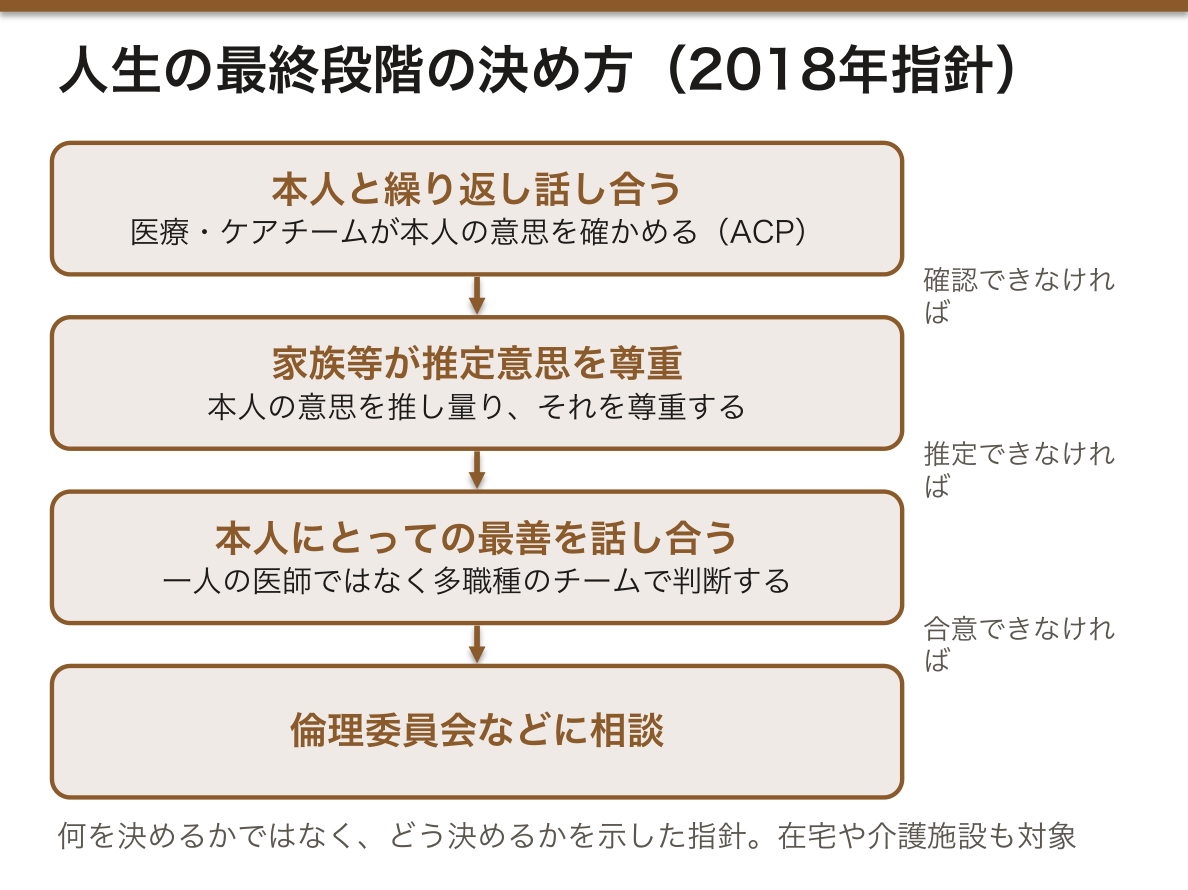
ガイドラインの核心は、何を決めるかではなくどう決めるかを示したことにある。医療・ケアチームが、本人と繰り返し話し合い、本人の意思が確認できなければ家族等が推定意思を尊重し、それもできなければ本人にとっての最善を話し合う。一人の医師ではなく多職種のチームで判断し、合意できなければ倫理委員会などに相談する。2018年の改訂では、こうした話し合いを前もって繰り返す ACP の考え方が取り入れられ、在宅や介護施設も対象になった。
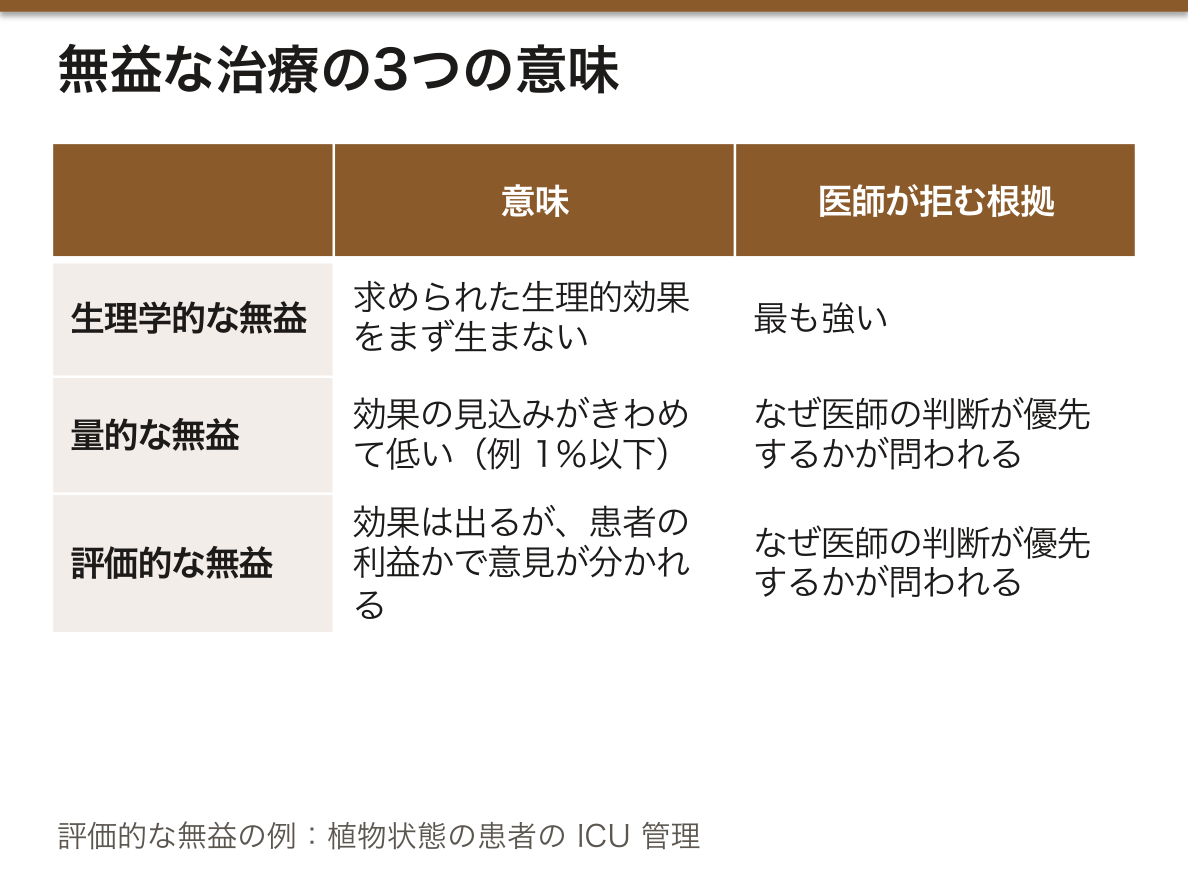
反対の方向の衝突もある。患者や家族が、医師が無益だと考える治療(たとえば転移の広がった末期癌患者への心肺蘇生)を求める場合である。無益には3つの意味がある。生理学的な無益は、求められた生理的効果をまず生まない治療で、医師が拒む根拠が最も強い。量的な無益は、効果の見込みがきわめて低い(たとえば1%以下)治療。評価的な無益は、効果は生じるが、それが患者にとって利益かどうかで意見が分かれる治療(植物状態の患者の ICU 管理)である。後の2つでは、なぜ医師の価値判断が患者や家族の判断に優先するのかが問われる。
国試・臨床で押さえるべきは、4要件は積極的安楽死の要件であり日本で適法とされた例はないこと、そして現場の実務はガイドラインに沿った話し合いのプロセスで動いていることである。本人の意思を確かめる努力、多職種チーム、記録——この3つが、延命治療の差し控え・中止を判断するときの柱になる。
English version
Core
Japan has no law on euthanasia or withdrawing life support; case law and guidelines form the framework. In the 1995 Tokai University euthanasia case, a doctor had killed a terminal cancer patient with potassium chloride. The Yokohama District Court convicted him, but set out four requirements under which active euthanasia might be permitted.
| Four requirements |
|---|
| (1) The patient has unbearable physical pain |
| (2) Death is unavoidable and imminent |
| (3) All means to remove or relieve the pain have been used and no alternative remains |
| (4) The patient has clearly expressed consent to shortening life |
No case has ever been found lawful under these requirements, and doctors continued to face criminal investigation over withdrawing life support. The government therefore issued guidelines on decision-making for terminal care in 2007, revised in 2018 as guidelines on decision-making for medical and long-term care at the final stage of life.
Going further
The core of the guidelines is that they say how to decide, not what to decide. The care team talks repeatedly with the patient; if the patient’s wishes cannot be confirmed, the family respects the presumed wishes; if even that is impossible, they discuss what is best for the patient. Decisions are made by a multidisciplinary team, not one doctor, and an ethics committee is consulted if agreement cannot be reached. The 2018 revision added ACP, repeated advance discussions, and extended the scope to home and nursing care.
Conflict can also run the other way: patients or families demand treatment the doctor thinks futile (for example, CPR for a patient with widely spread cancer). Futility has three senses. Physiological futility: the treatment almost certainly will not produce the desired physiological effect — the strongest ground for refusal. Quantitative futility: a very low chance of effect (say, 1% or less). Evaluative futility: the effect will occur, but people disagree whether it is a benefit (ICU care for a patient in a vegetative state). In the last two, one must ask why the doctor’s values should override the patient’s or family’s.
In the clinic
For the national examination and practice, remember: the four requirements are for active euthanasia, and no case has been found lawful in Japan; real practice runs on the discussion process set out in the guidelines. Efforts to confirm the patient’s wishes, a multidisciplinary team, and records are the three pillars when deciding to withhold or withdraw life-sustaining treatment.
まとめ
| 自殺幇助と安楽死 — 言葉を正確に分ける | 終末期の議論は、言葉を混ぜた途端に混乱する。 |
|---|---|
| 安楽死の4類型 — 行為の性格×本人の意思 | 安楽死は2つの軸で分類される。行為の性格による分類では、積極的安楽死は他者が死を引き起こすこと(致死薬の注射など)、消極的安楽死は他者が(行為によって、または行為をしないことによっ… |
| 世界の法的状況 — 少数の国、異なる名前と条件 | 積極的自発的安楽死や医師による自殺幇助を合法とする国・地域は、まだ少数である。 |
| 安楽死をめぐる賛成論と反対論 | 積極的自発的安楽死と医師による自殺幇助をめぐる主な論拠を並べる。 |
| 殺すことと死なせること — 本当に違うのか | 医師は患者が死なせてほしいという決定を尊重しなければならないが、患者を殺すことは道徳的に別で、まず許されない——これが広く受け入れられた考えである。 |
| 二重結果の原則 — 意図した結果と予見した結果 | 末期癌の患者の痛みを和らげるために鎮痛薬の量を増やすと、呼吸抑制で死期を早める危険が高まると考えられてきた。 |
| 日本の終末期医療 — 4要件・ガイドライン・無益な治療 | 日本には安楽死や延命治療の中止を定めた法律がなく、判例と指針が枠組みをつくってきた。 |
このノートは医学生が授業の内容を自分の言葉でまとめたもので、診療の判断に使うものではありません。誤りに気づいたらお知らせください。