- 病い行動 — 病いは逸脱か
- セルフケアと素人紹介システム — 受診の前に相談される人たち
- 社会人口学的変数と、階級による消費者主義 — 誰がどれだけ医療を使うか
- 医療化 — 定義とその働き方
- 医療化からバイオ医療化へ — 技術と市場が境界を押し広げる
病い行動 — 病いは逸脱か
病い行動 illness behavior(Mechanic)——症状を感じてから受診に至るまでに人が取る行動。同じ症状でも受診する人としない人がいる。
「病いは逸脱か」——Parsons は逸脱だとした。社会の期待する役割を果たせなくなるから。ただし非難されない逸脱であり、そこが犯罪と違う。
反論——①病いは選ばれたものではない(逸脱は通常、規範への違反を含意する)②逸脱とみなすこと自体がスティグマを生む③慢性疾患では状態が常態であり、逸脱という語が合わない。
答え方の型——「Parsons の意味では逸脱と言えるが、それは社会的な位置づけの記述であって道徳的評価ではない。ただし実際には道徳的評価として作用してしまう(HIV、依存症、肥満)」。
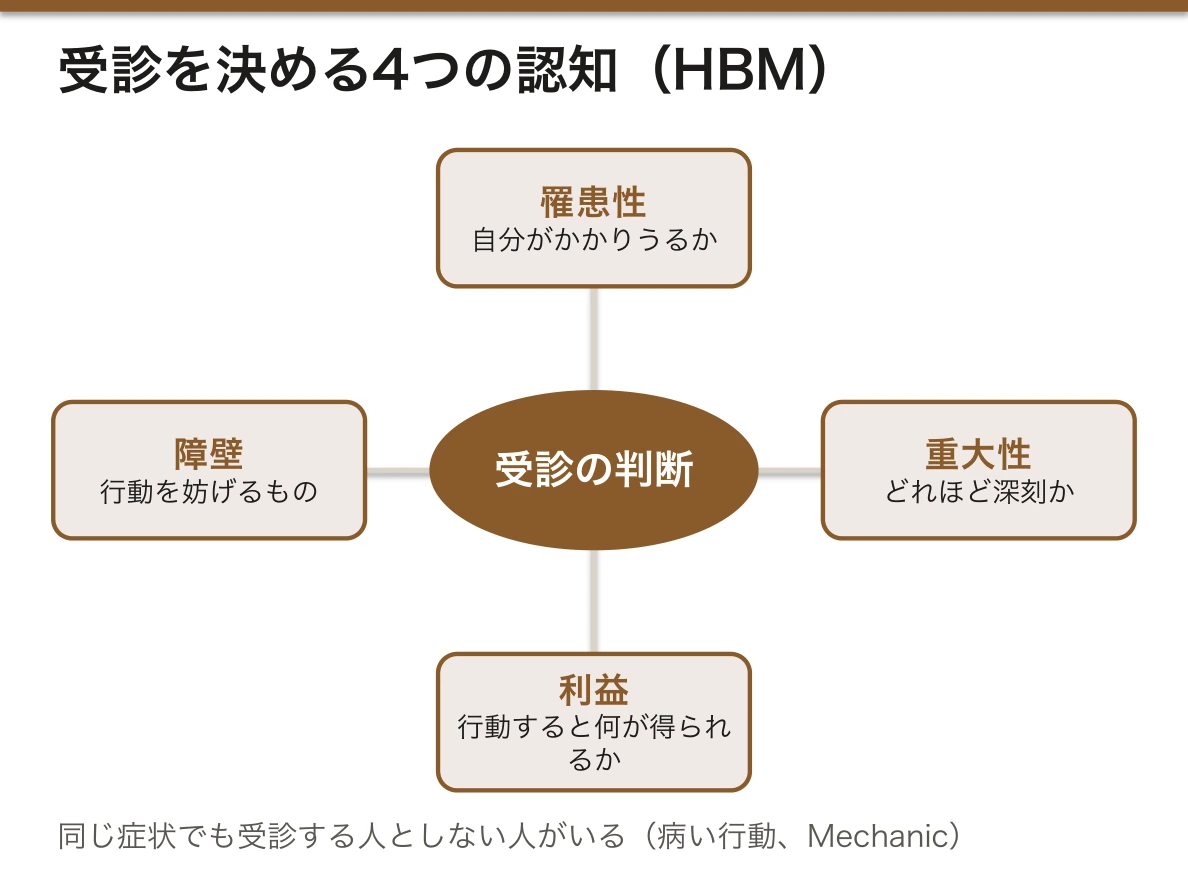
受診を決める要因として引かれるのが Health Belief Model(罹患性・重大性・利益・障壁の認知)と、Zola の5つの引き金(対人関係の危機、他者からの圧力 など)。
English version
Core
Illness behaviour (Mechanic) — what a person does between feeling a symptom and consulting. With the same symptom, some consult and some do not.
"Is illness deviance?" — Parsons held that it is, because one becomes unable to fulfil the roles society expects. But it is deviance that is not blamed, and there it differs from crime.
The rebuttals — ① illness is not chosen (deviance usually implies a breach of a norm) ② regarding it as deviance itself generates stigma ③ in chronic disease the state is the normal state, and the word deviance does not fit.
The pattern of an answer — "in Parsons’s sense it can be called deviance, but that is a description of a social position and not a moral evaluation. In practice, however, it comes to operate as a moral evaluation (HIV, addiction, obesity)."
Going further
The factors cited as deciding whether to consult are the Health Belief Model (perceived susceptibility, severity, benefits and barriers) and Zola’s five triggers (an interpersonal crisis, pressure from others, and others).
セルフケアと素人紹介システム — 受診の前に相談される人たち
セルフケア self-care は、症状への反応として世界中でいちばん多いものである。予防(ビタミン剤を飲む)、症状への自己対処(家庭の療法・市販薬)、診断済みの慢性疾患の自己管理(糖尿病患者のインスリン、抗凝固薬)までを含む。特徴は自分で始め、自分で管理することで、医療者に相談しながら行うこともある。現代でセルフケアを後押ししているのは、医療費の高さ、事務的で冷たい専門職のケアへの不満、近代医学の限界の認識、生活習慣と健康の関係の知識、そして自分の健康を自分で管理したいという願いである。ただしセルフケアは医学から独立しているわけではなく、医学の規範と情報に沿って行われる。
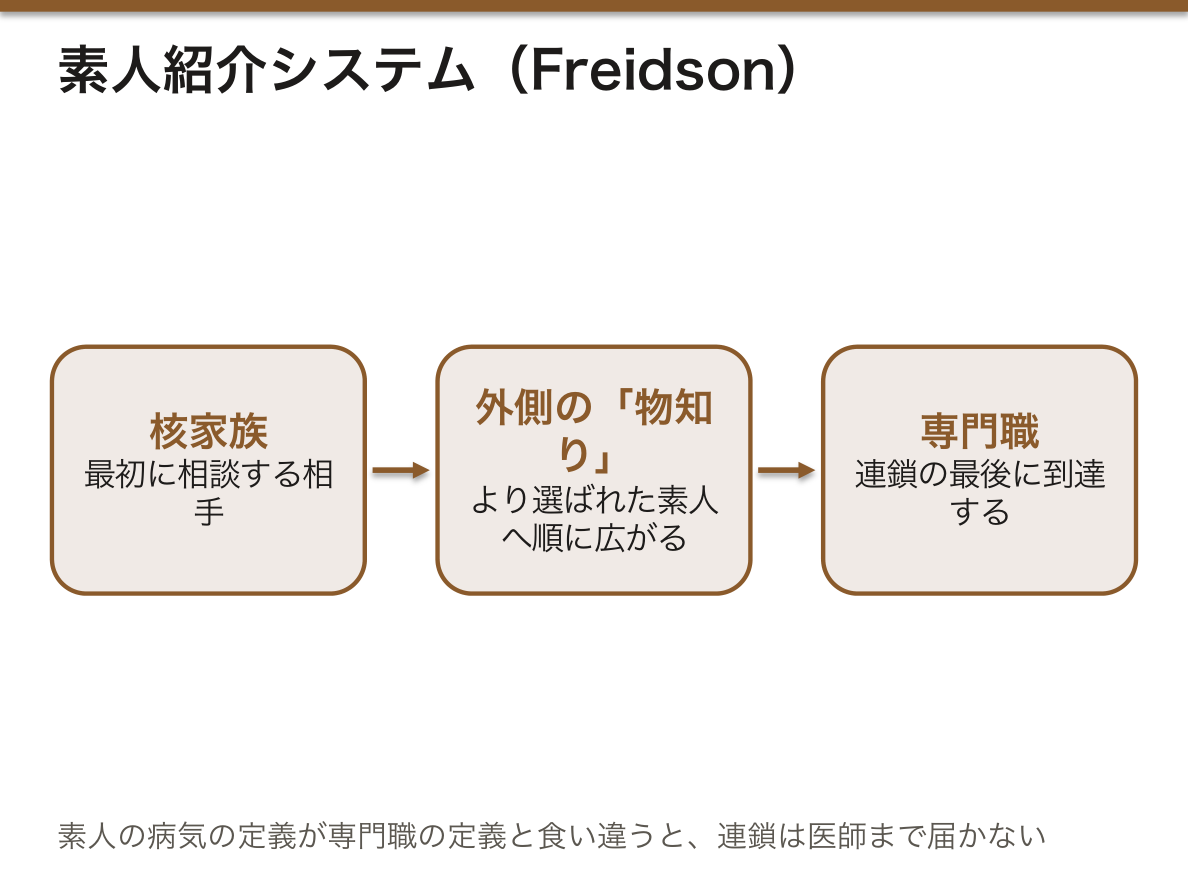
受診を決めるうえで大きいのが、家族・友人・隣人の社会的ネットワークである。Freidson(1960)は、受診に至る過程を、核家族から始まり、外側の、より選ばれた「物知り」の素人へと順に相談が広がり、最後に専門職に達する連鎖として描いた。これが素人紹介システム lay-referral system である。素人の病気の定義が専門職の定義と食い違うと、この連鎖は医師まで届かない。
Suchman(1965)はニューヨークの複数の民族集団を調べ、結びつきが強く、民族的に閉じた集団ほど、症状が出たときにまず集団の中で相談し、専門職から遠ざかることを示した。受診への抵抗がいちばん強かったのは、民族意識が強く、拡大家族のつながりが濃い下層の地区だった。
ところが10年後、Geertsen らがソルトレイクシティで同じ研究をすると、逆の結果が出た。健康と教育を重んじるモルモン教徒の共同体では、集団の結束が強いほど、専門的な医療を使う傾向が高まった。ここから導かれる結論は、強い集団は、その集団の文化が言うことを増幅する、ということである。集団の文化が医学と一致していれば受診を早め、医学への不信を含んでいれば受診を遅らせる。
Suchman は病いの経験を5段階にも整理した——①症状の経験 ②病人役割の引き受け ③医療との接触 ④依存する患者の役割 ⑤回復またはリハビリテーション。素人紹介は主に①から③のあいだで働く。
SNS 以前も、人は家族と地域の中で病気を解釈し、民間の治療者や年長者の知恵で専門職の代わりにしてきた。今はインターネットとSNSがこの「素人の相談相手」の輪を一気に広げた。素人紹介システムは消えたのではなく、形を変えて大きくなったと言える。
受診が遅れた患者に「なぜもっと早く来なかったのか」と問う前に、誰に相談し、何と言われたかを聞くと、受診行動の背景が見える。移民や宗教的・民族的に結束の強い共同体の患者では、共同体のキーパーソンや宗教指導者が医療につなぐ鍵になることがある。
English version
Core
Self-care is the most common response to symptoms in the world. It includes prevention (taking vitamins), treating symptoms yourself (home remedies, over-the-counter drugs), and managing a diagnosed chronic disease (insulin in diabetes, blood thinners). What makes it special is that it is self-started and self-managed, though it may involve advice from professionals. Self-care today is pushed by high costs, dissatisfaction with impersonal professional care, awareness of the limits of medicine, knowledge about lifestyle and health, and the wish to control one’s own health. But it is not independent of medicine; it follows medical norms and information.
The social network of family, friends and neighbours strongly affects the decision to see a doctor. Freidson (1960) described help-seeking as a chain of consultants: it starts in the nuclear family and moves outward to more selected, “knowing” laypeople, until it reaches a professional. This is the lay-referral system. If lay definitions of illness conflict with professional ones, the chain may never reach the doctor.
Suchman (1965) studied several ethnic groups in New York. Close and ethnically exclusive groups first turned to the group, not to professional care. Resistance was strongest in lower-class neighbourhoods with strong ethnic identity and extended families.
Going further
Ten years later, Geertsen and colleagues repeated the study in Salt Lake City and found the opposite. In the Mormon community, which values health and education, strong group closeness increased the use of professional care. The conclusion: a strong group amplifies what its culture says. If the culture agrees with medicine, people seek care earlier; if it distrusts medicine, they seek care later.
Suchman also described five stages of the illness experience: (1) symptom experience, (2) assumption of the sick role, (3) medical care contact, (4) dependent-patient role, (5) recovery or rehabilitation. Lay referral works mainly between stages 1 and 3.
Before social media, people also interpreted illness within family and community and used folk healers and elders instead of professionals. Today the internet and social media have greatly widened this circle of lay advisers. The lay-referral system did not disappear; it changed shape and grew.
In the clinic
Before asking a late patient “why didn’t you come earlier?”, ask whom they consulted and what they were told. This shows the background of their help-seeking. For migrants or close religious or ethnic communities, community key persons or religious leaders can be the bridge to care.
社会人口学的変数と、階級による消費者主義 — 誰がどれだけ医療を使うか
医療の利用は、年齢・性別・人種/民族・社会経済的地位で偏る。実際にはいくつもの変数が組み合わさって働くが、1つずつ見ると傾向がはっきりする(以下は米国の研究)。
| 変数 | 分かっていること |
|---|---|
| 年齢 | 高齢者がいちばん多く使う。乳幼児も受診が多い |
| 性別 | 女性は生涯を通して男性より受診が多い。出産に関わる受診を除いても多く、生殖に関わる受診は全体の2割に満たない。女性は健康の知識が多く、早く診断される利点がある |
| 人種・民族 | 黒人の受診はかつて少なかったが、この数十年で大きく増えた。ヒスパニック系は利用がいちばん少なく、その多くは民族そのものより所得・教育・保険の差で説明される |
| 社会経済的地位 | かつては下層ほど受診が少なかった。公的保険の導入後は、低所得層の受診が増え、中所得層が相対的に少なくなった時期もある |
下層の受診の少なさを説明するのに使われたのが貧困の文化——依存・宿命論・満足を先送りできないこと・健康を重く見ないこと、という特徴が貧困の中で育ち、不利な位置を固定するという見方である。Koos(1954)の古典的研究では、同じ症状でも下層の人は「医者に行くほどのことではない」と見なしやすかった(腰痛は「よくあること」とされた)。
階級による消費者主義——医療が市場で買う商品である社会では、患者は医療機関を選ぶ自由が大きい。社会化医療(税で賄う医療)では選択肢は少ない。ただ、選ぶ力を実際に使うのは主に中流以上である。彼らは情報を集め、医師を評価し、自分の健康に責任を持とうとする。下層の人は、自分の健康の責任を医師と医療制度に預ける受け身の姿勢をとりやすい。米国の医療は、私的な道と公的な道の二層構造になっている。
葛藤理論(生物医学モデルの章)から見ると、これは個人の態度の差ではなく、資源の配分をめぐる階級の差が医療の利用に現れたものである。「受け身な患者」は、選択肢を持たない立場の結果でもある。Cockerham は、生活習慣では中流の健康行動をまねようとする下層の人が、なぜ医療との関わり方では中流のようにならないのかを、問いとして残している。
日本の国民皆保険と高額療養費制度は、所得による受診の差を小さくする仕組みである。それでも自己負担を理由にした受診控え、健康診断の受診率の差など、社会経済的地位による差は残る。外来で「受け身に見える患者」の背景に、情報や時間の不足がないかを考えたい。
English version
Core
Use of health care is uneven by age, gender, race/ethnicity and socioeconomic status. In reality several variables act together, but looking at them one by one shows clear trends (from US research).
| Variable | Findings |
|---|---|
| Age | The elderly use most care; infants and children also visit often |
| Gender | Women visit doctors more than men throughout life, even without pregnancy; reproduction accounts for less than 20% of visits. Women know more about health and get earlier diagnosis |
| Race/ethnicity | Black Americans once visited less, but use has risen a lot. Hispanics use the least care, mostly explained by income, education and insurance, not ethnicity itself |
| Socioeconomic status | Lower classes once used less care. After public insurance, the poor visited more, and for a time the middle-income group used relatively less |
The low use by the poor was once explained by the culture of poverty: dependence, fatalism, inability to delay gratification, and low value on health develop in poverty and keep people in a disadvantaged position. In Koos’s classic study (1954), lower-class people often saw the same symptoms as not serious enough for a doctor (backache was “normal”).
Going further
Class-based consumerism: where health care is a commodity bought in a market, patients have more freedom to choose providers than in socialized medicine. But mainly the middle and upper classes use this power. They gather information, judge doctors and take responsibility for their own health. Lower-class people more often take a passive stance and give responsibility to doctors and the system. US health care has a two-tier structure, private and public.
From conflict theory (chapter on the biomedical model), this is not just a difference in attitude, but class inequality in resources showing up in the use of care. The “passive patient” is also a result of having no options. Cockerham leaves a question: lower-class people try to copy middle-class health lifestyles, so why do they not copy middle-class ways of dealing with doctors?
In the clinic
Japan’s universal insurance and the high-cost medical expense benefit reduce income-based differences in care. Still, people avoid visits because of co-payments, and check-up rates differ, so gaps by socioeconomic status remain. When a patient looks “passive,” think about a lack of information or time behind it.
医療化 — 定義とその働き方
医療化 medicalization——これまで医学の問題ではなかったものが、医学の問題として定義され、医学的に扱われるようになる過程(Conrad)。
働き方は3層——①概念の層(医学の語彙で語られ始める)②制度の層(診断名が付き、保険が適用され、専門外来ができる)③相互作用の層(診察室で実際に診断され治療される)。
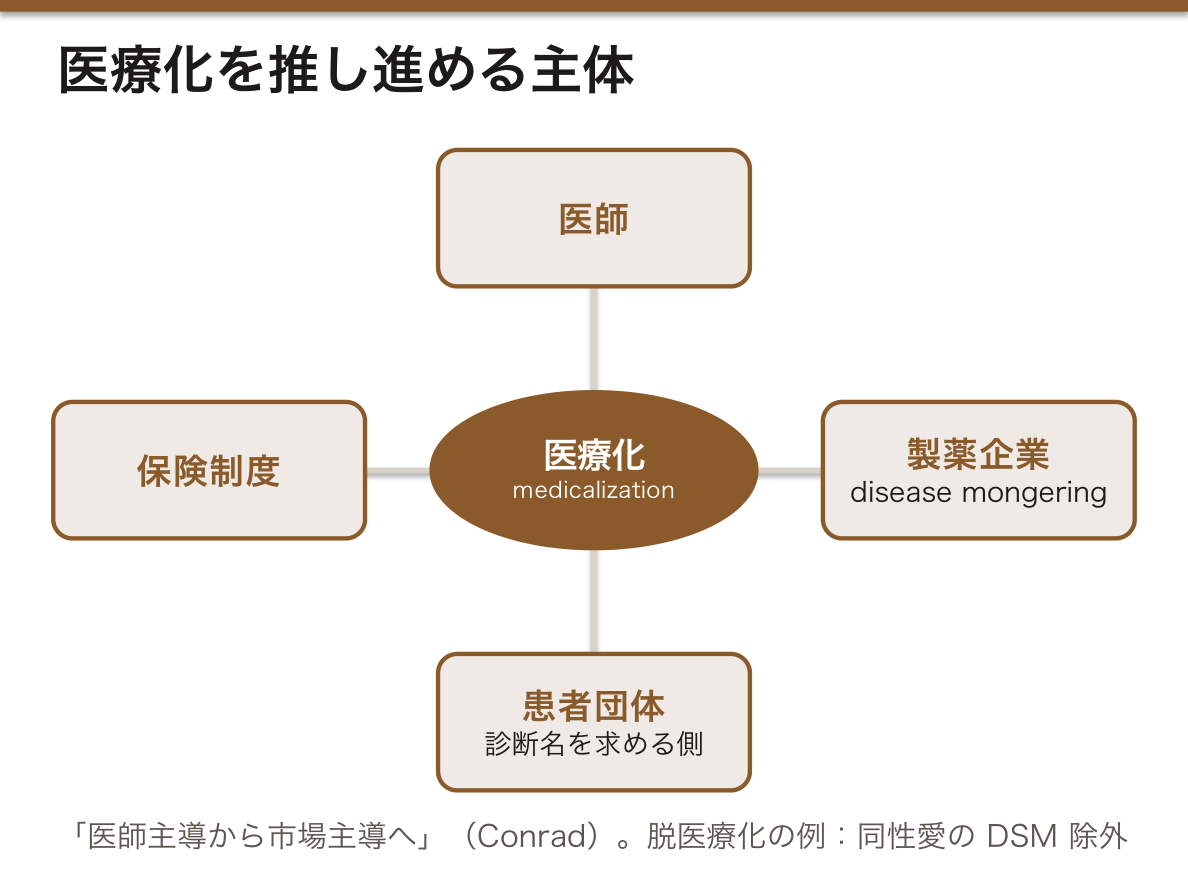
推進する主体は医師だけではない——現代では製薬企業(disease mongering)、患者団体(診断名を求める側)、保険制度が大きい。「医師主導から市場主導へ」が Conrad の指摘。
例——出産、加齢、悲嘆、シャイネス(社交不安症)、ADHD、肥満、男性型脱毛。
評価は両面——診断は救いにもなる(責められていた苦痛が病気として認められる)。脱医療化の例が同性愛の DSM 除外である。
「生物医学モデル」の章の葛藤理論と接続する——医療化は社会的な不満を個人の病理に還元し、構造への異議を封じる。
English version
Core
Medicalisation — the process by which something that was not a medical matter comes to be defined as one and dealt with medically (Conrad).
It works at three levels — ① the conceptual (it begins to be spoken of in medical vocabulary) ② the institutional (a diagnosis is named, insurance applies, a specialist clinic appears) ③ the interactional (it is actually diagnosed and treated in the consulting room).
The drivers are not doctors alone — in the modern world pharmaceutical companies (disease mongering), patient organisations (seeking a diagnosis) and insurance systems loom large. "From doctor-driven to market-driven" is Conrad’s point.
Examples — childbirth, ageing, grief, shyness (social anxiety disorder), ADHD, obesity, male pattern baldness.
The assessment cuts both ways — a diagnosis can also be a rescue (suffering that was being blamed is recognised as illness). The example of demedicalisation is the removal of homosexuality from the DSM.
Going further
It connects with the conflict theory of the chapter on the biomedical model — medicalisation reduces social discontent to individual pathology and silences objection to structure.
医療化からバイオ医療化へ — 技術と市場が境界を押し広げる
医療化の広がりを示す数字としてよく引かれるのが DSM である。Cockerham のテキストの数え方では、1952年の初版は106の精神疾患を載せた約130ページの本だったが、2013年の DSM-5 は341の疾患と992ページになった。「医学の問題」の境界が半世紀で大きく広がったことが分かる。
Clarke らはこれを一歩進めてバイオ医療化 biomedicalization と呼んだ。コンピュータの情報処理と新しい技術——遺伝学、生体工学、化学的予防(病気になる前に薬を使う)、個別化された薬、患者のデータバンク、電子化された記録——によって、医療の監視と介入がこれまでの境界をはるかに越えて広がる過程である。インターネット、広告、消費者主義、製薬企業の販売戦略もこれを押し進める。
違いを一言で言えば、医療化は「医学が定義し管理する範囲の拡大」、バイオ医療化は「技術と市場による身体と健康そのものの作り変え」である。前者は病気の側にとどまるが、後者は「まだ病気でない人」のリスク・予防・能力の強化(エンハンスメント)にまで及ぶ。
Conrad は、医療化を動かすエンジンが変わったと指摘する。かつての主役は医師だったが、今はバイオテクノロジー(特に製薬)・消費者・マネージドケア(保険)が主な推進力である。医師はいまも治療の門番だが、医療化の拡大や縮小での役割は従属的になった。
この拡大の社会的・倫理的な問題は3つある。①過剰診断——正常な反応(悲しみ・不安・子どもの落ち着きのなさ)まで病気として扱う。②製薬企業の影響——診断名が増えれば市場が増える。③社会の問題の個人化——貧困や過重労働から来る苦しみが、個人の脳や体の問題として処理される。一方で、診断名が付くことで苦しみが認められ、治療や支援につながるという面も忘れてはいけない。
臨床では、検査値の基準を少し下げるだけで「患者」の数が大きく変わる(高血圧・脂質異常症・前糖尿病など)。基準の変更がどんな根拠と利害で決まったかを考えることは、過剰診断と過剰治療を避ける視点になる。
English version
Core
The DSM is often cited to show the spread of medicalization. By the count in Cockerham’s text, the first edition in 1952 listed 106 mental disorders in about 130 pages, while DSM-5 in 2013 had 341 disorders and 992 pages. The boundary of “medical problems” widened a lot in half a century.
Clarke and colleagues went further and called this biomedicalization: computer information and new technologies — genetics, bioengineering, chemoprevention (drugs before disease), individualised drugs, patient data banks, digital records — extend medical surveillance and intervention far beyond past boundaries. The internet, advertising, consumerism and drug marketing also push it.
In one sentence: medicalization is the growth of what medicine defines and controls; biomedicalization is the remaking of the body and health itself by technology and markets. The first stays on the side of illness; the second reaches people who are not yet ill — risk, prevention and enhancement.
Going further
Conrad says the engines of medicalization have changed. Doctors used to be the main drivers; now biotechnology (especially drug companies), consumers and managed care (insurance) drive it. Doctors are still gatekeepers for treatment, but their role in expanding or shrinking medicalization is secondary.
The expansion raises three social and ethical problems. (1) Overdiagnosis — normal reactions (sadness, anxiety, restless children) are treated as illness. (2) Drug company influence — more diagnoses mean bigger markets. (3) Individualising social problems — suffering from poverty or overwork is treated as a problem of one person’s brain or body. On the other hand, a diagnosis can recognise suffering and open the way to treatment and support.
In the clinic
In clinical practice, lowering a test threshold a little can greatly change the number of “patients” (hypertension, dyslipidaemia, prediabetes). Asking what evidence and interests stand behind a change in criteria helps avoid overdiagnosis and overtreatment.
まとめ
| 病い行動 — 病いは逸脱か | 病い行動 illness behavior(Mechanic)——症状を感じてから受診に至るまでに人が取る行動。 |
|---|---|
| セルフケアと素人紹介システム — 受診の前に相談される人たち | セルフケア self-care は、症状への反応として世界中でいちばん多いものである。 |
| 社会人口学的変数と、階級による消費者主義 — 誰がどれだけ医療を使うか | 医療の利用は、年齢・性別・人種/民族・社会経済的地位で偏る。 |
| 医療化 — 定義とその働き方 | 医療化 medicalization——これまで医学の問題ではなかったものが、医学の問題として定義され、医学的に扱われるようになる過程(Conrad)。 |
| 医療化からバイオ医療化へ — 技術と市場が境界を押し広げる | 医療化の広がりを示す数字としてよく引かれるのが DSM である。 |
このノートは医学生が授業の内容を自分の言葉でまとめたもので、診療の判断に使うものではありません。誤りに気づいたらお知らせください。