disease / illness / sickness の区別は臨床で最も実用的な概念である。
この3語は日本語では全部「病気」だが、英語では別の現実を指す。訳し分けられることが理解の証拠になる。
- Disease・Illness・Sickness と、障害の2モデル
- 身体化社会 — Brian Turner
- 病いの語り — Hydén の定義と5つの用法
- Frank の3類型 — 回復・混沌・探求
- 相互作用論の前提 — Mead と Blumer
- Strauss の貢献 — 病いの軌跡と交渉された秩序
- Goffman の貢献 — スティグマと全制的施設
Disease・Illness・Sickness と、障害の2モデル
| 語 | 誰の視点 | 内容 |
|---|---|---|
| Disease(疾病) | 医療者 | 生物学的な異常。検査で示される客観的な状態 |
| Illness(病い) | 本人 | 主観的な体験。苦痛・不安・生活の変化 |
| Sickness(病気) | 社会 | 社会的に承認された状態。役割・制度・給付 |
3つはずれる。疾病〈disease〉はあるが病い〈illness〉が無い(無症候性高血圧)、illness はあるが 疾病〈disease〉が見つからない(医学的に説明できない症状)、疾病も病いもあるが病気〈sickness〉として認められない(慢性疲労症候群・線維筋痛症の歴史)。
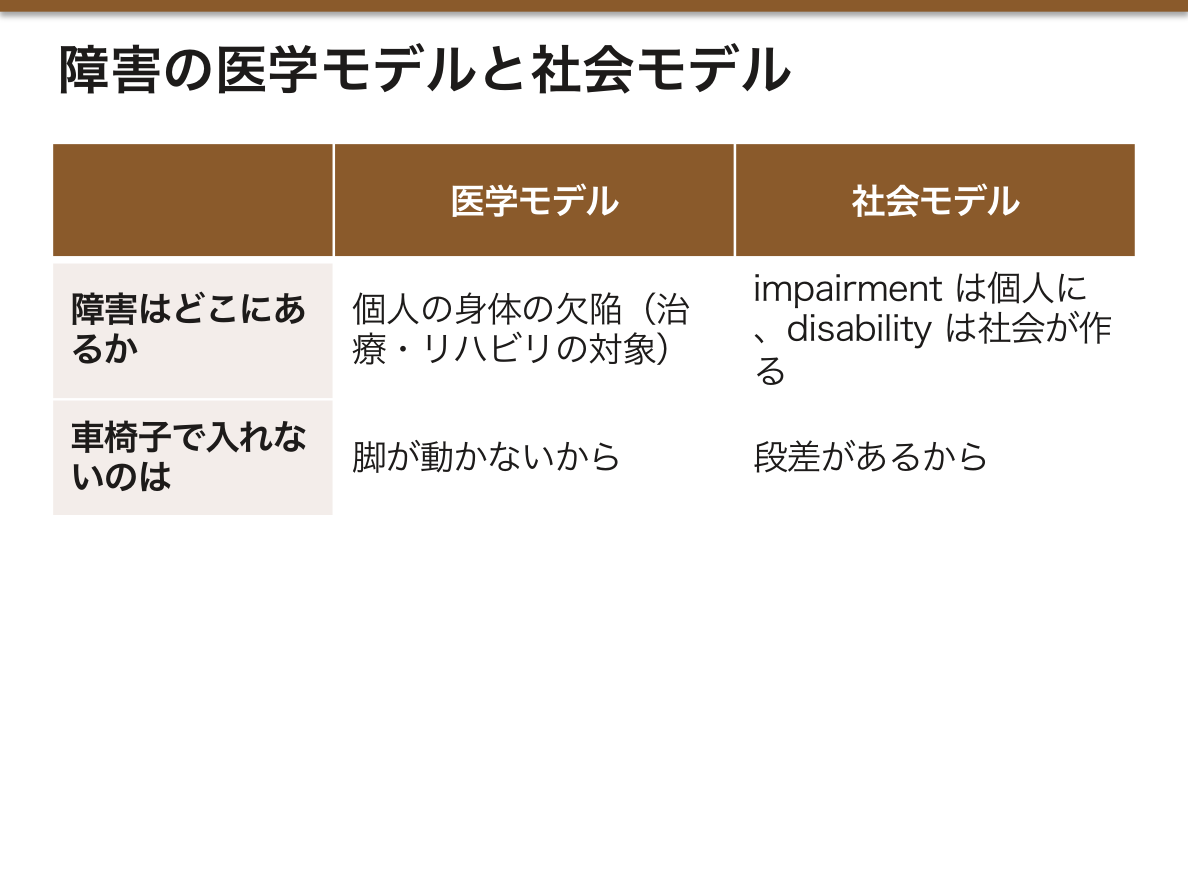
障害の2モデル:医学モデル=障害は個人の身体の欠陥であり、治療・リハビリの対象。社会モデル=impairment(機能障害)は個人にあるが、disability(障害)は社会が作る。段差があるから車椅子で入れないのであって、脚が動かないから入れないのではない。
3語の区別が診療の質を左右する。疾病〈disease〉だけを診れば「検査は正常です」で終わるが、病い〈illness〉を診れば「あなたは苦しんでいる」に到達する。「医学的に説明できない症状(MUS)」の患者が満足を得られないのは、疾病〈disease〉の枠組みしか使われないからである。
病いの語り(illness narratives)——Lars-Christer Hydén は語りの5つの用途を挙げた:①病いを説明する ②アイデンティティを再構築する ③体験を秩序づける ④他者と繋がる ⑤医療の場で交渉する。
Arthur W. Frank の3類型は臨床で最も使える枠組みである。
| 類型 | 筋書き |
|---|---|
| Restitution(回復の物語) | 「昨日は健康、今日は病気、明日はまた健康」。急性疾患に合うが、慢性疾患では破綻する |
| Chaos(混沌の物語) | 筋書きが無い。「そして…そして…」と続く。聞き手が最も耐えがたく、遮られやすい |
| Quest(探求の物語) | 病いを受け入れ、そこから何かを得たものとして語る |
Chaos の語りを遮らずに聞けるかどうかが、医療者の力量になる。回復の物語へ引き戻そうとする(「きっと良くなりますよ」)のは、聞き手の不安を鎮めるためであって、患者のためではないことがある。
相互作用論(symbolic interactionism)——Mead・Blumer:人は物事に付与した意味にもとづいて行為し、意味は相互作用の中で作られ、解釈を通じて修正される。Anselm Strauss:慢性疾患を生きることは「病いの仕事〈illness work〉」であり、患者と家族が日々やりくりしている。Erving Goffman:スティグマと「印象操作(自己呈示)」——病いを隠す/開示するという選択そのものが社会的行為である。
Turner の「身体化社会(somatic society)」——現代社会では政治も自己も身体をめぐって組織される(美容・健康・フィットネス・生殖)。Elias の文明化の過程では、身体の統制がしつけを通じて内面化される。Shilling の「プロジェクトとしての身体」では、身体は与えられたものではなく作り上げる対象になる。
English version
Core
| Word | Whose view | Content |
|---|---|---|
| Disease | The clinician | A biological abnormality. An objective state shown by tests |
| Illness | The person | The subjective experience. Suffering, anxiety, change in life |
| Sickness | Society | A socially sanctioned state. Roles, institutions, benefits |
The three come apart. There is disease without illness (asymptomatic hypertension); illness with no disease found (medically unexplained symptoms); disease and illness that are not recognised as sickness (the history of chronic fatigue syndrome and fibromyalgia).
Two models of disability: the medical model = disability is a defect of the individual body, the object of treatment and rehabilitation. The social model = impairment is in the individual, but disability is made by society. It is because there is a step that a wheelchair cannot enter, not because the legs do not move.
Going further
The distinction of the three words governs the quality of practice. Look at disease alone and it ends at "the tests are normal"; look at illness and one reaches "you are suffering". Patients with medically unexplained symptoms are not satisfied because only the framework of disease is used.
Illness narratives — Lars-Christer Hydén listed five uses of narrative: ① to explain the illness ② to reconstruct identity ③ to give order to experience ④ to connect with others ⑤ to negotiate in the medical setting.
Arthur W. Frank’s three types are the most usable framework in the clinic.
| Type | The plot |
|---|---|
| Restitution | "Yesterday I was healthy, today I am ill, tomorrow I shall be healthy again." It fits acute disease and breaks down in chronic disease |
| Chaos | There is no plot. It goes on "and … and …". The hardest for a listener to bear, and the most readily interrupted |
| Quest | The illness is accepted and told as something from which something was gained |
Whether one can listen to a chaos narrative without interrupting is a measure of a clinician’s competence. Pulling it back towards restitution ("I am sure you will get better") can be for the listener’s own comfort rather than the patient’s.
Symbolic interactionism — Mead and Blumer: people act on the basis of the meanings they attach to things; meanings arise in interaction and are revised through interpretation. Anselm Strauss: living with chronic disease is "illness work", managed daily by the patient and family. Erving Goffman: stigma and impression management — the very choice of hiding or disclosing an illness is a social act.
Turner’s "somatic society" — in modern society politics and the self alike are organised around the body (beauty, health, fitness, reproduction). In Elias’s civilising process, control of the body is internalised through upbringing. In Shilling’s "body as a project", the body is not something given but something to be built.
身体化社会 — Brian Turner
Turner の言う身体化社会 somatic society とは、政治と文化の中心的な問題が「身体」をめぐって立てられる社会のこと。
かつて社会の主要な争点は生産と労働だった。現代では生殖・中絶・臓器移植・安楽死・肥満・ジェンダー・ワクチン——いずれも身体をどう扱うかが争点になる。
「身体は自然の与件ではなく、社会が管理し、意味づけ、規律する対象になった」と言えれば足りる。Foucault の生権力と地続きの発想である。
Turner はさらに、社会が身体に対して解かねばならない4つの課題を挙げた(人口の再生産、身体の規律、内的欲望の抑制、外的な表象)。「身体の社会学」の論点の「身体の社会的規制」はこの続き。
English version
Core
What Turner calls somatic society is a society in which the central questions of politics and culture are posed around "the body".
The main issues of society were once production and labour. In the modern world they are reproduction, abortion, organ transplantation, euthanasia, obesity, gender, vaccination — in every case what is at issue is how the body is treated.
It suffices to be able to say "the body is no longer a given of nature but an object that society manages, gives meaning to and disciplines". The idea runs continuously from Foucault’s biopower.
Going further
Turner further listed four tasks society must solve with respect to the body (reproduction of the population, discipline of bodies, restraint of internal desire, external representation). "The social regulation of the body" in the topic of the sociology of the body continues this.
病いの語り — Hydén の定義と5つの用法
病いの語り illness narrative とは、患者が自分の病いの経験に筋道を与えて語る物語。医学的な病歴とは別物で、意味づけがその中心にある。
Hydén の5つの用法——①病いを語り直して意味を与える(なぜ自分に起きたか)②自己を再構築する(病いで壊れた自己像を組み直す)③他者に経験を伝える④病いそのものを説明の道具にする(語ることで理解する)⑤社会的・政治的な主張の手段にする(患者運動)。
診療上の意味——語りを聴くことは共感のためだけではなく、患者が何を問題とみなしているかを知る唯一の方法である。
臨床への応用が narrative-based medicine。EBM と対立するのではなく補完するものとして位置づけられる。
English version
Core
An illness narrative is the story in which a patient gives a thread to the experience of their illness. It is a different thing from a medical history, and meaning is at its centre.
Hydén’s five uses — ① to retell the illness and give it meaning (why it happened to me) ② to reconstruct the self (to reassemble a self-image broken by illness) ③ to convey the experience to others ④ to make the illness itself an instrument of explanation (understanding by telling) ⑤ to make it a means of social and political claim (patient movements).
Its significance in practice — listening to the narrative is not only for empathy: it is the only way of knowing what the patient regards as the problem.
Going further
Its clinical application is narrative-based medicine. It is placed as complementing evidence-based medicine rather than opposing it.
Frank の3類型 — 回復・混沌・探求
Arthur W. Frank『傷ついた物語の語り手』による3類型。
①回復の語り restitution——「昨日は健康、今日は病気、明日はまた健康」。社会が最も好み、医療が前提とする型。だが慢性疾患や末期では語れなくなる。
②混沌の語り chaos——筋がなく、時系列も因果もない。「そして…そして…」と続く。聴くのが最もつらく、それゆえ最も聴かれない。Frank はこれを語れるようにすることが支援だとする。
③探求の語り quest——病いを何かを得る旅として引き受ける。「病気になって初めて分かったことがある」。
3つに優劣はないが、医療者は回復の語りしか受け取れない傾向がある——ここが批判の要点。
Frank 自身が癌と心筋梗塞の当事者。「病者には語る義務ではなく、語る権利がある」という立場も押さえておくと厚い。
English version
Core
The three types of Arthur W. Frank’s The Wounded Storyteller.
① The restitution narrative — "yesterday healthy, today ill, tomorrow healthy again". The type society most prefers and medicine presupposes. But it becomes untellable in chronic disease and at the end of life.
② The chaos narrative — no thread, no chronology, no causation. It goes on "and … and …". The hardest to listen to, and therefore the least listened to. Frank holds that making it possible to tell is itself the support.
③ The quest narrative — the illness is taken on as a journey from which something is gained. "There are things I only understood by falling ill."
None of the three is superior, but clinicians tend to be able to receive only the restitution narrative — that is the point of the criticism.
Going further
Frank himself had cancer and a myocardial infarction. His position that "the ill have a right, not a duty, to tell" is worth holding as well.
相互作用論の前提 — Mead と Blumer
象徴的相互作用論は、社会を大きな構造ではなく、日々のやりとりの積み重ねとして見る立場。
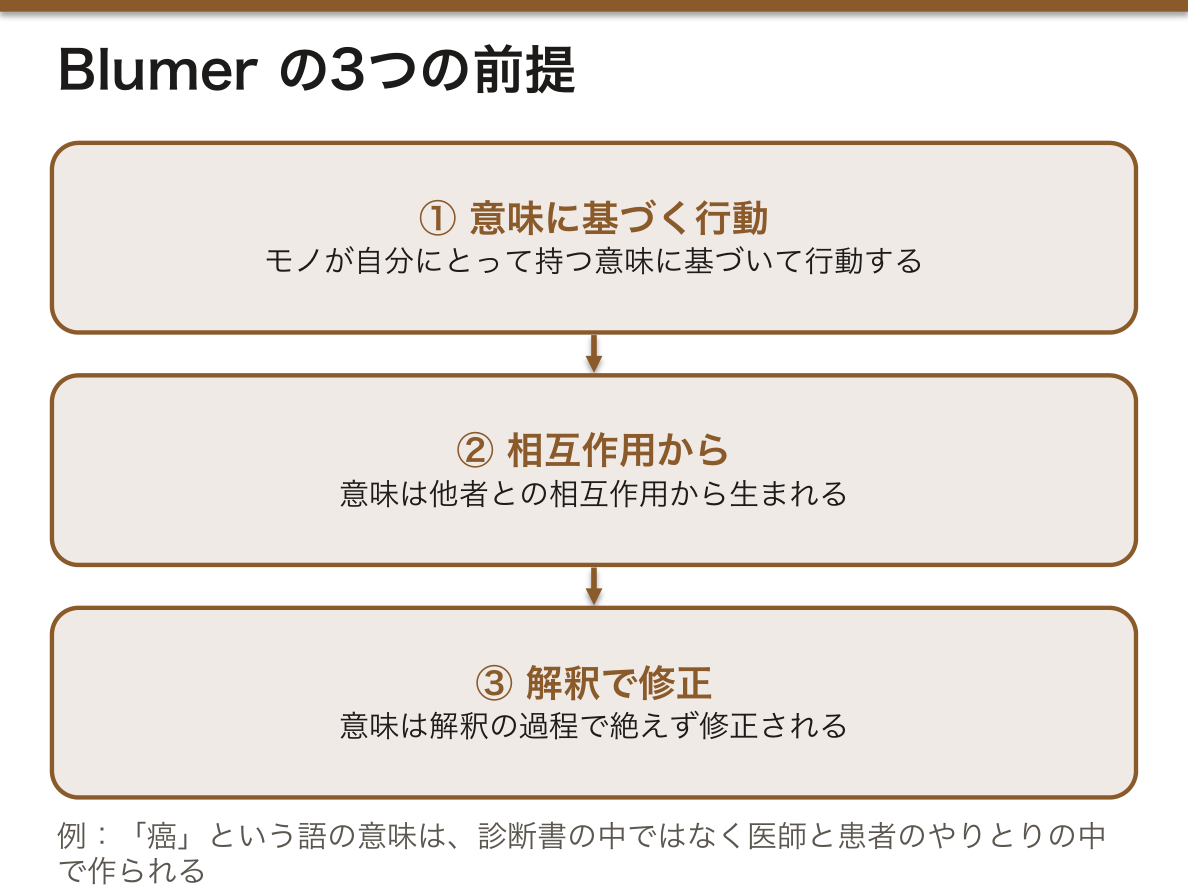
Blumer の3前提——①人はモノに対して、そのモノが自分にとって持つ意味に基づいて行動する ②意味は他者との相互作用から生まれる(モノに内在するのではない)③意味は解釈の過程で絶えず修正される。
Mead は自我が「I(衝動的な私)」と「me(他者の目に映る私)」からなるとし、役割取得——他者の視点に立って自分を見ること——で自我が育つとした。
医療への含意——「癌」という語の意味は診断書の中ではなく、医師と患者のやりとりの中で作られる。
Parsons の構造機能主義が上から社会を見るのに対し、相互作用論は下から見る。この対比が理解の軸である。
English version
Core
Symbolic interactionism sees society not as a large structure but as the accumulation of daily exchanges.
Blumer’s three premises — ① people act towards things on the basis of the meanings those things have for them ② meanings arise from interaction with others (they do not inhere in the things) ③ meanings are continually revised in a process of interpretation.
Mead held that the self consists of the "I" (the impulsive self) and the "me" (the self as it appears to others), and that the self grows through role-taking — seeing oneself from another’s point of view.
The implication for medicine — the meaning of the word "cancer" is made not in the certificate but in the exchange between doctor and patient.
Going further
Where Parsons’s structural functionalism sees society from above, interactionism sees it from below. This contrast is the axis of understanding.
Strauss の貢献 — 病いの軌跡と交渉された秩序
Anselm Strauss の鍵概念は2つ。
①病いの軌跡 illness trajectory——慢性疾患は「経過」だけでなく、それを管理するために患者・家族・医療者が行う仕事の総体である。彼は仕事を3種に分けた——病いの仕事(服薬・処置)、日常生活の仕事(家事・育児)、生活史の仕事(変わってしまった人生を組み直す)。
②交渉された秩序 negotiated order——病院の秩序は規則で決まっているのではなく、現場の当事者が絶えず交渉して作り直している。
グラウンデッド・セオリー(Glaser と共同)の創始者でもある。
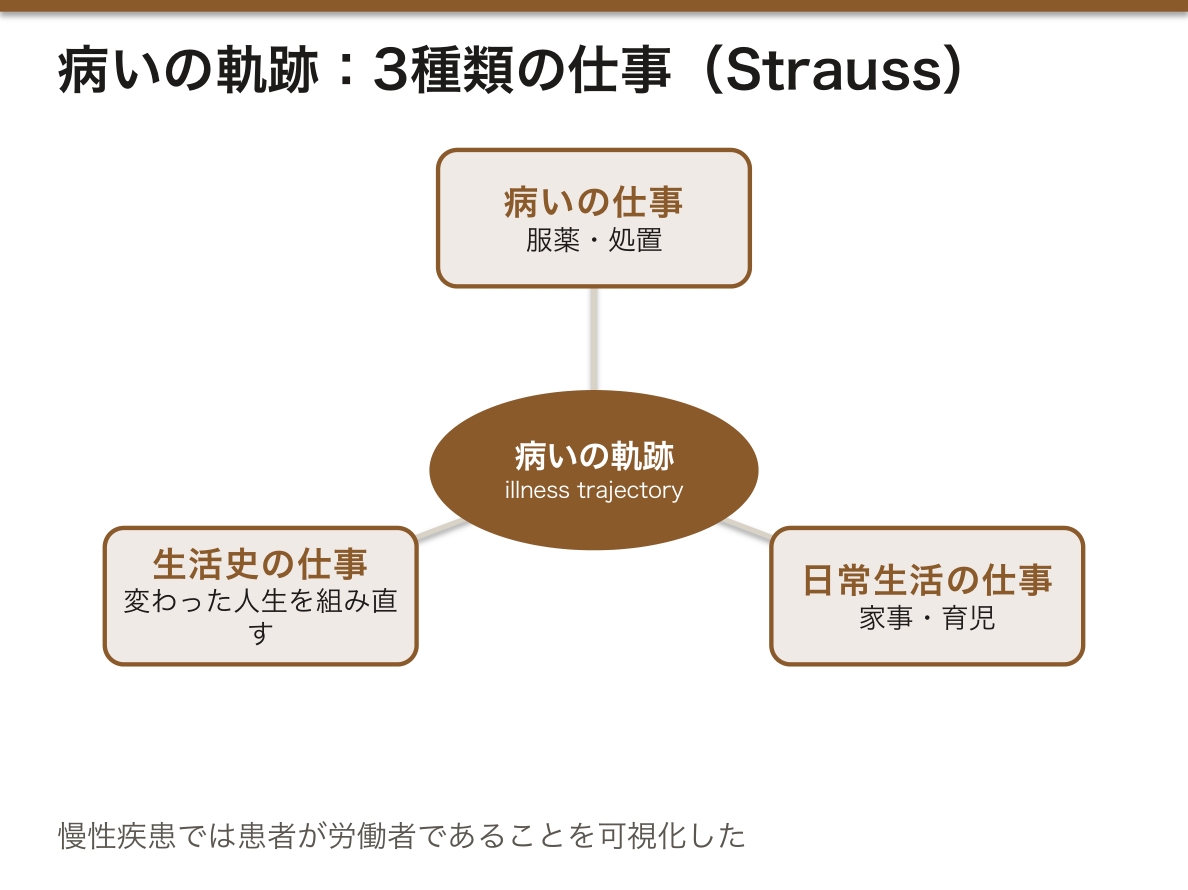
「病いの仕事」という捉え方は、慢性疾患では患者が労働者であることを可視化した点で大きい。Parsons の受動的な病人役割への、実証からの反証でもある。
English version
Core
Anselm Strauss has two key concepts.
① The illness trajectory — chronic disease is not only a "course" but the whole of the work done by patient, family and clinicians to manage it. He divided the work into three — illness work (medication, procedures), everyday life work (housework, childcare) and biographical work (reassembling a life that has changed).
② Negotiated order — the order of a hospital is not settled by rules but continually renegotiated and remade by those on the spot.
He is also (with Glaser) the founder of grounded theory.
Going further
The conception of "illness work" is important for making visible that in chronic disease the patient is a worker. It is also an empirical refutation of Parsons’s passive sick role.
Goffman の貢献 — スティグマと全制的施設
Erving Goffman の鍵概念は3つ。
①スティグマ——「他者を貶める属性」。属性そのものではなく関係が生む。信頼失墜(discredited、既に露見)と信頼失墜可能(discreditable、隠せる)を区別し、後者では情報の管理(パッシング)が課題になる。
②全制的施設 total institution——精神病院・刑務所・修道院のように、生活の全局面が同じ場所・同じ権威の下で営まれる施設。入所者は自己剥奪 mortification of self(私物・衣服・名前を奪われる)を経て施設の人間に作り替えられる。
③ドラマトゥルギー——人は表舞台で役を演じ、舞台裏で素に戻る。医師の白衣と診察室は舞台装置である。
『アサイラム』は脱施設化運動に直接影響した。「病院という社会制度」の論点の没個人化は、この自己剥奪の病院版である。
English version
Core
Erving Goffman has three key concepts.
① Stigma — "an attribute that discredits". It is produced by the relation, not by the attribute itself. He distinguished the discredited (already visible) from the discreditable (concealable), the latter posing the task of managing information (passing).
② The total institution — an institution such as a mental hospital, a prison or a monastery, in which all aspects of life are conducted in the same place under the same authority. The inmate is remade into an inmate through mortification of the self (belongings, clothes and name are taken away).
③ Dramaturgy — people play a part front stage and return to themselves backstage. The doctor’s white coat and the consulting room are stage properties.
Going further
Asylums had a direct influence on the deinstitutionalisation movement. Depersonalisation in the topic of the hospital as a social institution is the hospital version of this mortification of the self.
まとめ
| Disease・Illness・Sickness と、障害の2モデル | 語誰の視点内容Disease(疾病)医療者生物学的な異常。 |
|---|---|
| 身体化社会 — Brian Turner | Turner の言う身体化社会 somatic society とは、政治と文化の中心的な問題が「身体」をめぐって立てられる社会のこと。 |
| 病いの語り — Hydén の定義と5つの用法 | 病いの語り illness narrative とは、患者が自分の病いの経験に筋道を与えて語る物語。 |
| Frank の3類型 — 回復・混沌・探求 | Arthur W. Frank『傷ついた物語の語り手』による3類型。 |
| 相互作用論の前提 — Mead と Blumer | 象徴的相互作用論は、社会を大きな構造ではなく、日々のやりとりの積み重ねとして見る立場。 |
| Strauss の貢献 — 病いの軌跡と交渉された秩序 | Anselm Strauss の鍵概念は2つ。 |
| Goffman の貢献 — スティグマと全制的施設 | Erving Goffman の鍵概念は3つ。 |
このノートは医学生が授業の内容を自分の言葉でまとめたもので、診療の判断に使うものではありません。誤りに気づいたらお知らせください。