「社会学は何をする学問か」を自分の言葉で言えることが出発点である。
医学部で社会学を学ぶ理由は、同じ病気でも、誰が・どこで罹るかが偏っているという事実を扱うためである。生物学だけでは、その偏りを説明できない。
- 社会学的想像力と、医療社会学の位置
- 社会学の5つの機能と、社会学的視点の5つの要素
- 行為と構造の論争 — Giddens の構造化理論
- 医療社会学とは何か — 成り立ちと4つの下位領域
社会学的想像力と、医療社会学の位置
社会学 sociology=人間の社会的行為・集団・制度を体系的に研究する学問。
社会学的想像力(C. Wright Mills)=個人の悩み(personal troubles)を、社会構造の問題(public issues)として捉え直す視点。1人が失業するのは個人の問題だが、1,000万人が失業するのは社会の問題である。
医療社会学 medical sociology は2つに分けられる。
- Sociology IN medicine——医学の目的に奉仕する(服薬アドヒアランスを上げる方法を探る、など)
- Sociology OF medicine——医学そのものを研究対象にする(なぜ医師という職業が権威を持つのか、など)
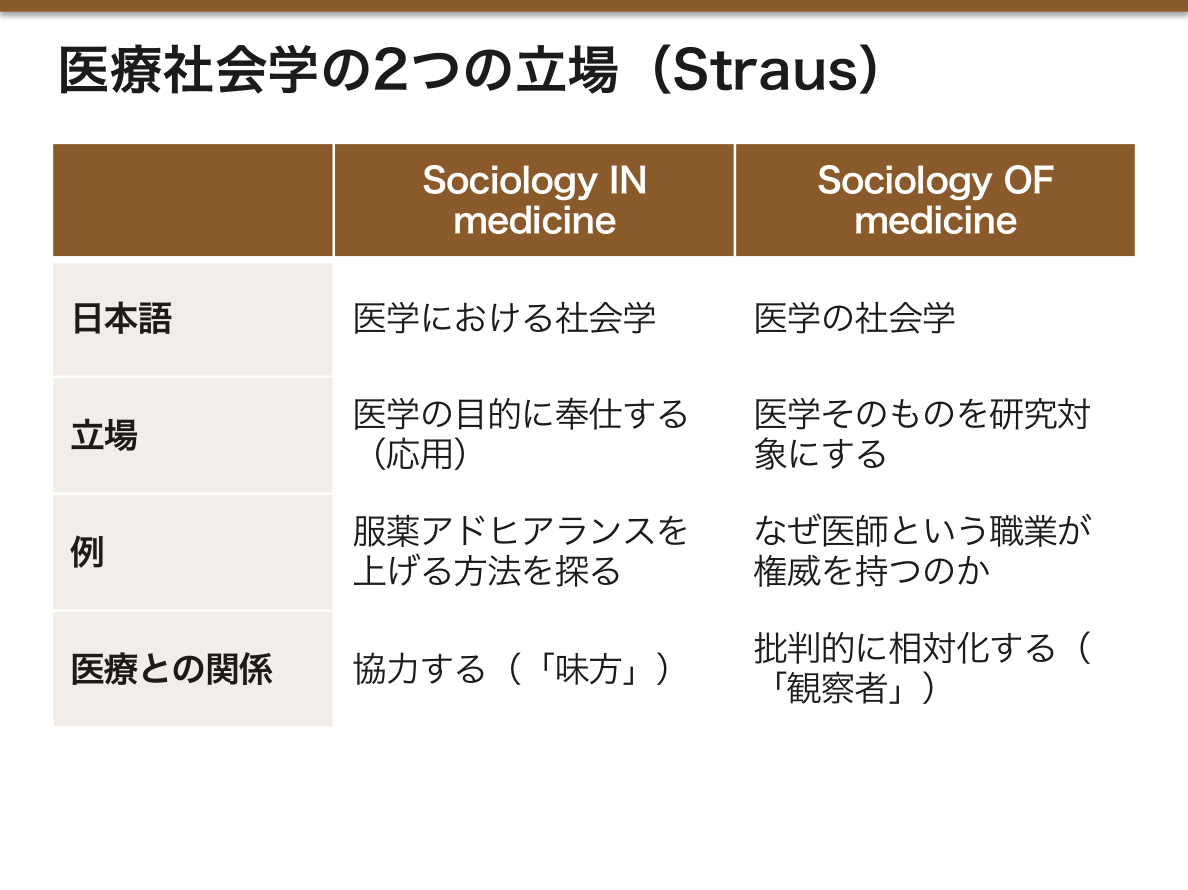
この2つの区別(Robert Straus, 1957)が、医療社会学の性格を決めている。前者は医療に協力し、後者は医療を批判的に相対化する。同じ学問が「味方」にも「観察者」にもなるため、しばしば緊張が生じる。ある研究を読むときは「どちらの立場からの研究か」を見分けることが要る。
発展の契機(Cockerham のテキスト):①第二次大戦後、疾病構造が急性感染症から慢性疾患へ移り、生活習慣と社会環境の比重が増した。②米国で研究資金が投じられ、Parsons の『社会システム論』(1951)が「病人役割」を提示して理論的な出発点となった。③1960〜70年代に医療批判(Illich の「医原病」、Freidson の職業的支配論)が広がり、sociology of medicine が確立した。
感染症の再興(reemergence of infectious diseases)は、疾病構造の転換が一方通行ではないことを示した。抗菌薬耐性・国際的な人の移動・都市化・気候変動・ワクチン忌避——いずれも生物学ではなく社会的な要因である。COVID-19 はこの主題の最大の実例として、講義でも繰り返し参照される。
English version
Core
Sociology = the systematic study of human social action, groups and institutions.
The sociological imagination (C. Wright Mills) = the view that recasts personal troubles as public issues, problems of social structure. One person losing a job is a personal matter; ten million losing their jobs is a problem of society.
Medical sociology divides in two.
- Sociology IN medicine — serving the purposes of medicine (looking for ways to improve adherence to medication, and the like).
- Sociology OF medicine — making medicine itself the object of study (why the medical profession holds authority, and the like).
Going further
This distinction (Robert Straus, 1957) sets the character of medical sociology. The first cooperates with medicine; the second relativises it critically. Because the same discipline can be both "ally" and "observer", tension often arises. In reading a study, one needs to tell from which position it was made.
The occasions of its development (Cockerham’s textbook): ① after the Second World War, the pattern of disease shifted from acute infection to chronic disease and the weight of habits and social environment increased. ② Research funding was put in in the United States, and Parsons’s The Social System (1951) presented the sick role and became the theoretical point of departure. ③ In the 1960s and 70s medical critique spread (Illich’s "iatrogenesis", Freidson’s professional dominance), and the sociology of medicine was established.
The re-emergence of infectious diseases showed that the shift in the pattern of disease is not one-way. Antimicrobial resistance, international movement of people, urbanisation, climate change, vaccine hesitancy — all social rather than biological factors. COVID-19 is referred to repeatedly in the lectures as the largest instance of this theme.
社会学の5つの機能と、社会学的視点の5つの要素
社会学は社会に対して何をするのか。よく使われる整理では、5つの機能がある。
| 機能 | 中身 |
|---|---|
| 診断 diagnosis | 社会の問題を分析し、何が起きているかを明らかにする |
| 予測 prognosis | 今の行動のパターンと歴史のデータから、これからの社会の動きを読む |
| 批判的評価 critical evaluation | 構造・制度・規範の隠れた働きを示し、問い直す |
| 実践・応用 practical | 社会政策や介入を設計し、実行するための道具と方法を与える |
| 統合 integration | 異なる集団と利害の共存を理解し、社会のまとまりを助ける |
医学の言葉(診断・予後)と重なるのは偶然ではない。社会学も「どこが悪いのか」「この先どうなるか」を問う学問である。ただし、何が社会にとって「良い」状態なのかを決めるところで、イデオロギーに入り込む危険がある。
社会学的視点 sociological perspective=人間の行動の社会的な側面を見てとる力。個人だけを見る見方から、人が属する集団・組織・制度が行動と経験をどう形づくるかを見る見方へ切り替える力である。社会学的想像力(Mills)はこの視点の一部で、個人の生活を、より広い社会の文脈とその歴史につなぐ。
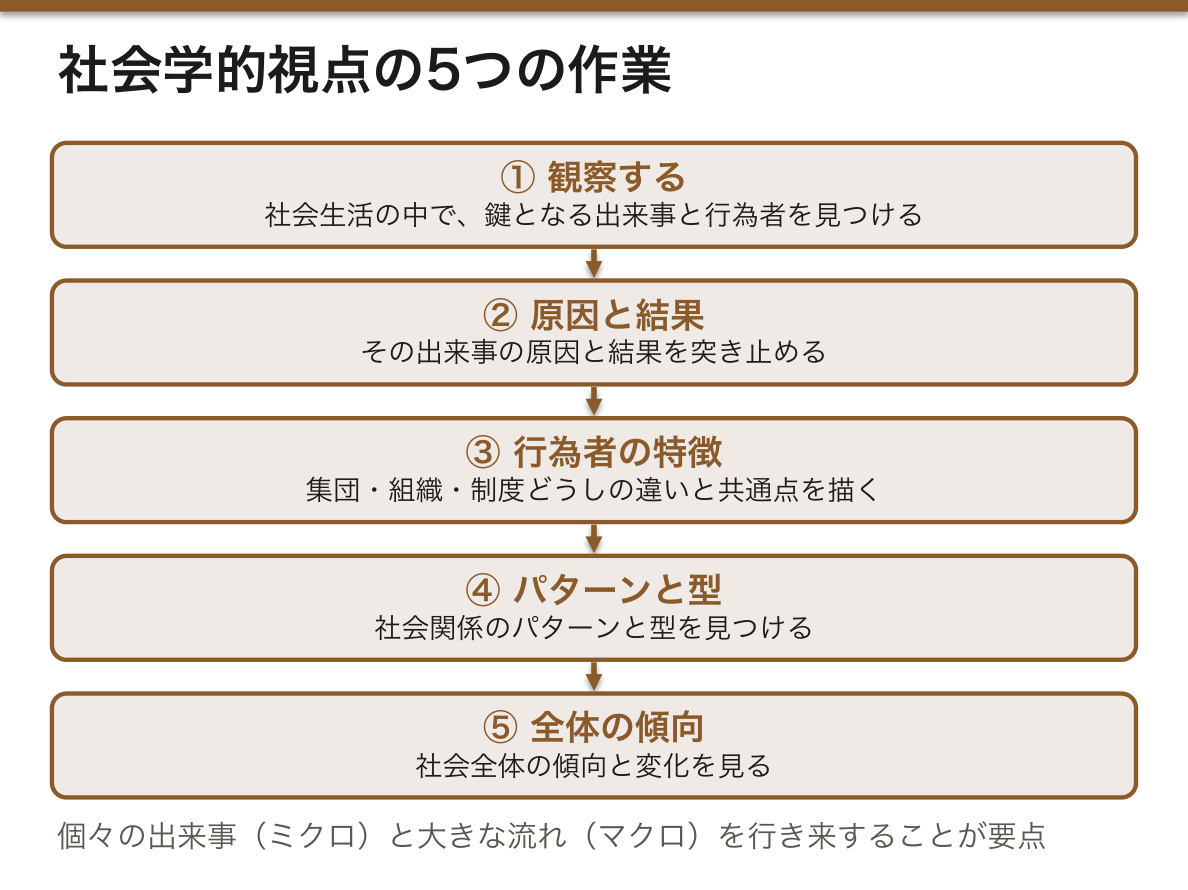
社会学的視点は、具体的には5つの作業からなる。①社会生活を観察し、鍵となる出来事と行為者を見つける(社会的な出来事=2人以上の行為者のあいだの相互作用。行為者=自分と他者から評価される行為をする人や組織)。②その出来事の原因と結果を突き止める。③行為者の特徴(集団・組織・制度どうしの違いと共通点)を描く。④社会関係のパターンと型を見つける。⑤社会全体の傾向と変化を見る。個々の出来事(ミクロ)と大きな流れ(マクロ)を行き来することが要点である。
例として肥満を考える。「食べすぎる人が増えた」で終われば個人の見方である。社会学的視点は、食べ物が余る豊かな国で、安くて甘い食品の市場が広がったのはこの数十年のことだ、と問いを広げる。誰が(どの階層・地域で)、なぜ、いつから増えたのかを問うと、個人の意志の問題が社会のパターンとして見えてくる。
医療に引きつけると、社会学的視点は「この患者がなぜこの病気になったか」に加えて「この病気がなぜこの集団に多いか」を問う力である。生活習慣病の指導がうまくいかないとき、本人の意志だけでなく、働き方・収入・住む地域を視野に入れられるかどうかが、この視点の有無で決まる。
English version
Core
What does sociology do for society? A common list gives five functions.
| Function | Content |
|---|---|
| Diagnosis | Analyses social problems and shows what is happening |
| Prognosis | Predicts future social trends from current patterns and historical data |
| Critical evaluation | Shows the hidden work of structures, institutions and norms, and questions them |
| Practical | Gives tools and methods to design and carry out social policies and interventions |
| Integration | Helps us understand how different groups and interests live together, and supports social cohesion |
The overlap with medical words (diagnosis, prognosis) is not an accident: sociology also asks “what is wrong?” and “what will happen next?” But when it decides what a “good” society is, it can fall into ideology.
The sociological perspective is the ability to see the social side of human behaviour. It is the shift from looking only at the individual to looking at how groups, organisations and institutions shape behaviour and experience. Mills’s sociological imagination is part of this perspective: it links an individual life to the wider social context and its history.
Going further
In practice the perspective has five tasks. (1) Observe social life and find the key events and actors (a social event is an interaction between two or more actors; an actor is a person or organisation whose actions are judged by themselves and others). (2) Find the causes and outcomes of events. (3) Describe the characteristics of the actors (differences and similarities between groups, organisations and institutions). (4) Find patterns and models of social relations. (5) See the general trends and changes in society. The key is to move between single events (micro) and the large picture (macro).
Take obesity. “More people eat too much” is an individual view. The sociological perspective asks more: in rich countries with extra food, a market for cheap sweet food grew only in recent decades. Asking who (which class, which region), why, and since when turns a question of personal will into a social pattern.
In the clinic
In medicine, the sociological perspective means asking not only “why did this patient get this disease?” but also “why is this disease common in this group?” When lifestyle advice fails, this perspective lets you look at work, income and neighbourhood, not only at the patient’s will.
行為と構造の論争 — Giddens の構造化理論
社会学の根本的な問いは「人は自由に行為しているのか、それとも社会構造に決められているのか」である。
- Agency(行為主体性)——個人は主体的に選択し、社会を作る
- Structure(構造)——階級・制度・規範が個人の選択を規定する
Anthony Giddens の構造化理論(structuration theory)は、この二項対立を否定する。構造は行為を制約すると同時に、行為を可能にする。そして構造は行為が繰り返されることによってのみ再生産される——これを構造の二重性(duality of structure)という。
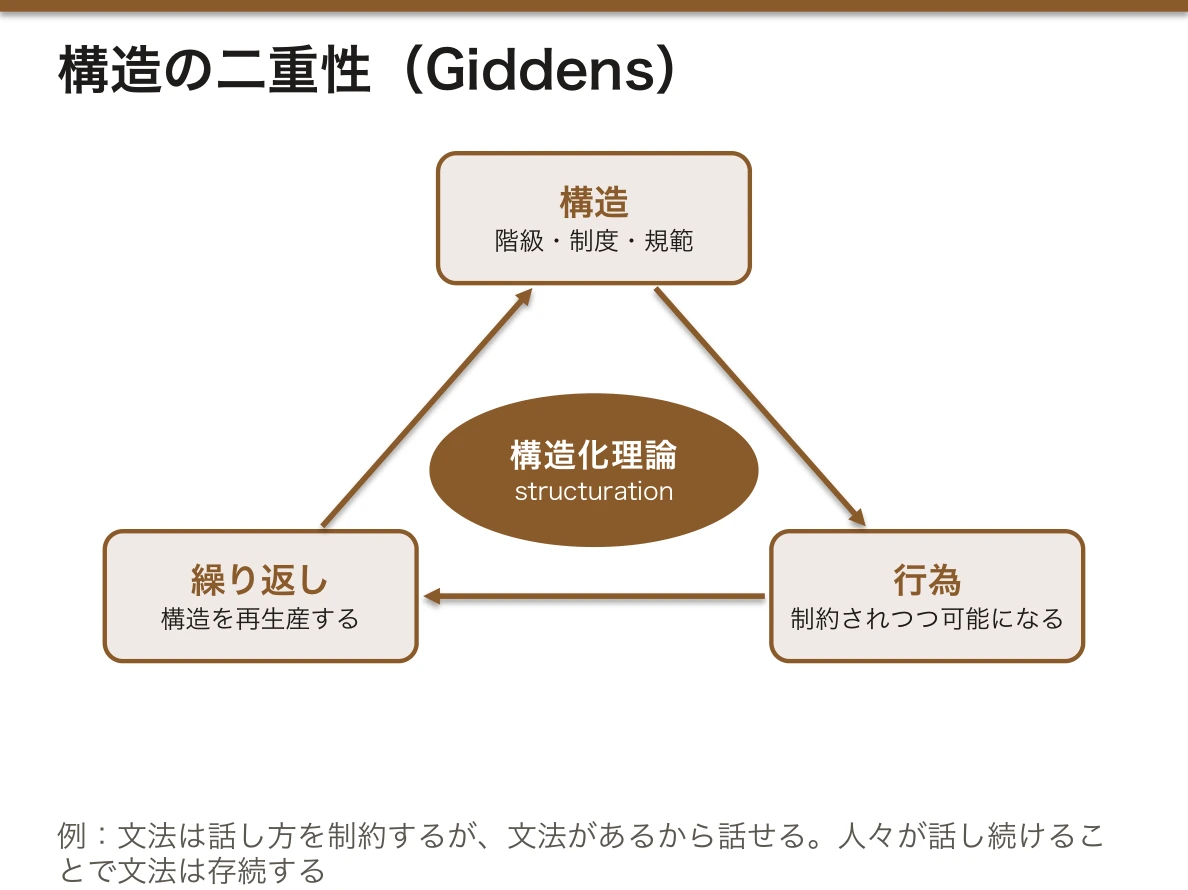
言語がいちばん分かりやすい例である。文法は話し方を制約するが、同時に文法があるから話せる。そして人々が話し続けることによってのみ文法は存続する。構造は行為の外にあるのではなく、行為の中で毎回作り直されている。
医療での応用:喫煙は個人の選択(agency)か、階級と広告と地域環境の産物(structure)か。構造化理論は「両方であり、その2つは分けられない」と答える。低所得層に喫煙が多いのは構造の作用だが、その構造は日々の喫煙という行為によって維持されてもいる。
この立場が、公衆衛生の介入設計を変える。行為だけを見れば「本人に禁煙を勧める」で終わるが、構造も見れば価格政策・広告規制・環境整備が必要になる。行動変容と環境整備を両輪にする現代の健康政策は、この論争への一つの回答である。
「医学の黄金時代」の章で扱う批判的実在論(critical realism)は、これに別の解を出す——構造と行為は「繋がっているが、別々に研究できる」とし、Giddens が両者を融合しすぎたと批判する立場である。
English version
Core
The fundamental question of sociology is "do people act freely, or are they determined by social structure?"
- Agency — individuals choose actively and make society.
- Structure — class, institutions and norms govern individual choice.
Anthony Giddens’s structuration theory denies this dichotomy. Structure both constrains action and makes action possible. And structure is reproduced only through the repetition of action — this is the duality of structure.
Going further
Language is the plainest example. Grammar constrains how one speaks, and at the same time it is grammar that makes speech possible. And grammar survives only because people go on speaking. Structure is not outside action; it is remade within action every time.
The application in medicine: is smoking an individual choice (agency) or a product of class, advertising and local environment (structure)? Structuration theory answers "both, and the two cannot be separated". That smoking is commoner in low-income groups is the working of structure, and that structure is also maintained by the daily act of smoking.
This position changes the design of public health interventions. Looking at agency alone ends at "advise the person to stop"; looking at structure too calls for pricing policy, regulation of advertising and change to the environment. Modern health policy, running behaviour change and environmental change together, is one answer to this debate.
Critical realism, treated in the chapter on the golden age of medicine, gives another answer — holding that structure and agency are connected and can nonetheless be studied separately, and criticising Giddens for fusing them too far.
医療社会学とは何か — 成り立ちと4つの下位領域
医療社会学は、健康・病い・医療を社会関係の産物として扱う分野。「病気そのもの」ではなく、誰が・どこで・なぜ病むのか、そして医療がどう組織されるかを問う。
成立は第二次大戦後と新しい。1951年の Parsons『社会システム論』(病人役割)が理論的な出発点とされ、米国で公的研究費が付いたことが制度化を後押しした。ASA の部会設置は1959年。
Straus(1957)の区分が有名——「医学の社会学 sociology of medicine」(医療そのものを対象化して批判的に見る)と「医学における社会学 sociology in medicine」(医療の課題解決に協力する)。前者は学問的自律、後者は応用。この対比は必ず押さえておく。
Cockerham は、医療社会学が他の社会学分野と違って「実務と隣り合わせで生まれた」ことを強調する。そのため理論が弱いと批判された時期があり、1980年代以降に Foucault・Bourdieu・Giddens らを取り込んで理論的に厚くなった。
English version
Core
Medical sociology treats health, illness and medicine as products of social relations. It asks not about "the disease itself" but who falls ill, where and why, and how medicine is organised.
Its emergence is recent, after the Second World War. Parsons’s The Social System of 1951 (the sick role) is taken as the theoretical point of departure, and the arrival of public research funding in the United States drove its institutionalisation. The ASA section was founded in 1959.
Straus’s (1957) distinction is well known — "the sociology of medicine" (making medicine itself an object and viewing it critically) and "sociology in medicine" (assisting with the problems of medicine). The first is academic autonomy, the second application. This contrast must be grasped without fail.
Going further
Cockerham emphasises that medical sociology, unlike other branches of sociology, was born alongside practice. It was therefore criticised for a time as theoretically weak, and from the 1980s it grew theoretically richer by taking in Foucault, Bourdieu and Giddens.
まとめ
| 社会学的想像力と、医療社会学の位置 | 社会学 sociology=人間の社会的行為・集団・制度を体系的に研究する学問。 |
|---|---|
| 社会学の5つの機能と、社会学的視点の5つの要素 | 社会学は社会に対して何をするのか。よく使われる整理では、5つの機能がある。 |
| 行為と構造の論争 — Giddens の構造化理論 | 社会学の根本的な問いは「人は自由に行為しているのか、それとも社会構造に決められているのか」である。 |
| 医療社会学とは何か — 成り立ちと4つの下位領域 | 医療社会学は、健康・病い・医療を社会関係の産物として扱う分野。 |
このノートは医学生が授業の内容を自分の言葉でまとめたもので、診療の判断に使うものではありません。誤りに気づいたらお知らせください。