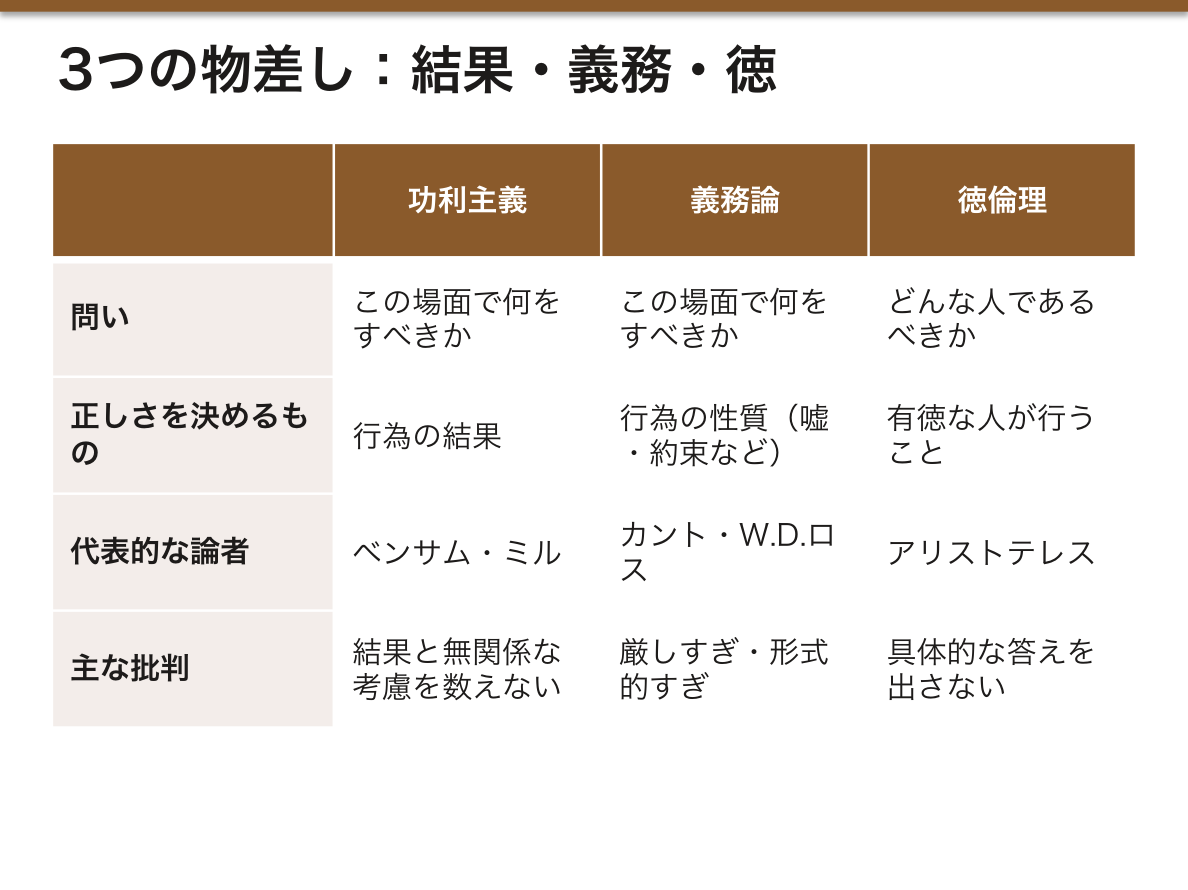
生命倫理の問いに答えるには、何が行為を正しくするのかという物差しが要る。物差しは大きく3つある。結果で測る功利主義、行為の性質(義務)で測る義務論、行為する人の性格で測る徳倫理である。
3つは「どれが正解か」を競うものではない。同じ症例に当てると、それぞれ別のものが見える。この章では各理論の中身と、それぞれへの代表的な批判をセットで押さえ、最後に一つの症例に3つを当ててみる。
批判まで覚えるのが大事である。理論の弱点を知っていると、臨床の議論で一つの理屈に引きずられずに済む。
- 生命倫理学とは — 医の倫理より広い学問
- 功利主義 — 正しさは結果で決まる
- 行為功利主義と規則功利主義 — そして3つの批判
- 義務論とカント — 結果ではなく行為の性質
- 義務論への批判 — 厳しすぎ・形式的すぎ
- 徳倫理 — 「何をすべきか」より「どんな人であるべきか」
- 3つの理論で1つの症例を読む — 「がんではないですよね?」
生命倫理学とは — 医の倫理より広い学問
生命倫理学(bioethics)は1960年代後半に一つの学問として形をとった。きっかけは2つある。1つは新しい技術である。人工呼吸器・透析・臓器移植・体外受精は、それまでの医の倫理が想定していなかった問い(呼吸器を外してよいか、誰に透析を回すか)を次々に生んだ。もう1つは権力の問題で、医師や科学者に患者や被験者の運命をどこまで決めさせてよいのかが、社会全体の関心事になった。
医の倫理(medical ethics)は医師と患者の関係の倫理が中心である。生命倫理はそれより広く、生命科学の研究、医療政策、動物、環境までを扱い、科学の進む方向そのものを問う。医師として、研究者として、医療政策をつくる側として、医療者はいずれ必ず倫理的な決定を下す立場に立つ。だから医学部で学ぶ。
まず言葉を分けておく。道徳(morality)は人々が実際に従っている善悪の規範で、倫理学(ethics)はその規範を体系的に考える営みである。日常では混ぜて使うが、試すような場面では区別できると議論が整理される。
| 問いの種類 | 何を問うか | 例 |
|---|---|---|
| 非規範的:記述倫理学 | 人々が実際に何を正しいと考えているか | 脳死を人の死と考える人は何%か |
| 非規範的:メタ倫理学 | 「善い」「べき」とはそもそも何を意味するか | 道徳的な主張は真や偽になりうるか |
| 規範的:一般規範倫理学 | 行為を正しくするものは何か(理論) | 功利主義・義務論・徳倫理 |
| 規範的:応用倫理学 | 具体的な問題で何をすべきか | 安楽死・臓器移植・研究倫理 |
生命倫理は応用倫理学に属する。ただし応用は理論なしには立たない。「この行為はなぜ正しいのか」と問われたとき、結果がよいからか、行為そのものの性質(約束を守る・嘘をつかない)のためか——この分かれ目から、次の項目以下の3つの理論が生まれる。
日本の医学教育でも、医の倫理は独立した柱になっている。国試・CBTで問われるヒポクラテスの誓い、ジュネーブ宣言(1948年)、ヘルシンキ宣言(1964年)、リスボン宣言(1981年、患者の権利)は、この学問が実務に落とし込まれた形である。病院には臨床倫理委員会や倫理コンサルテーションの窓口が置かれ、判断に迷う症例を多職種で検討する。
English version
Core
Bioethics took shape as a discipline in the late 1960s. Two things drove it. The first was new technology. Ventilators, dialysis, organ transplants and IVF raised questions that the old medical ethics had never faced (May we switch off a ventilator? Who gets dialysis?). The second was power: how much should doctors and scientists be allowed to decide about patients and research subjects?
Medical ethics is mainly about the doctor–patient relationship. Bioethics is broader. It also covers life-science research, health policy, animals and the environment, and it asks where science itself should go. Every doctor will one day make ethical decisions — as a clinician, as a researcher, or as someone who shapes health policy.
Going further
First, separate two words. Morality is the set of rules people actually live by. Ethics is the systematic study of those rules.
| Type of question | What it asks | Example |
|---|---|---|
| Non-normative: descriptive ethics | What do people actually believe is right? | What % accept brain death as death? |
| Non-normative: metaethics | What do ‘good’ and ‘ought’ mean? | Can moral claims be true or false? |
| Normative: general normative ethics | What makes an action right? (theories) | Utilitarianism, deontology, virtue ethics |
| Normative: applied ethics | What should we do in a concrete problem? | Euthanasia, transplants, research ethics |
Bioethics is applied ethics. But application needs theory. When we ask why an action is right, the answer splits: because of its good consequences, or because of the kind of act it is (keeping a promise, not lying). The three theories in the following items come from this split.
In the clinic
In Japan, medical ethics is a separate pillar of medical education. The documents that appear in the national examination — the Hippocratic Oath, the Declaration of Geneva (1948), the Declaration of Helsinki (1964) and the Declaration of Lisbon (1981, patients’ rights) — are this discipline turned into practice. Hospitals have clinical ethics committees and ethics consultation services to discuss difficult cases.
功利主義 — 正しさは結果で決まるUtilitarismus
功利主義は帰結主義(consequentialism)の代表で、行為の正しさはその結果だけで決まると考える。ベンサムの功利の原理によれば、行為は幸福(快、または苦痛のないこと)を増やす傾向に比例して正しく、その逆を生む傾向に比例して誤っている。「最大多数の最大幸福」という標語はここから来る。
では「功利(utility)」とは何か。価値には道具的価値(他の何かを得る手段として求めるもの:お金)と非道具的価値(それ自体を目的として求めるもの)がある。功利主義が最大化しようとするのは後者で、何をそれに置くかで型が分かれる。
| 型 | 最大化するもの | 要点 |
|---|---|---|
| 快楽功利主義・量的(ベンサム) | 快の量 | 強さ・持続などを足し引きする |
| 快楽功利主義・質的(ミル) | 快の量と質 | 高級な快と低級な快を区別する |
| 多元的功利主義 | 複数の内在的価値 | 知識・友情・美なども数える |
| 選好功利主義 | 選好(望み)の充足 | 本人が何を望むかを基準にする |
なぜ量だけでは足りないのか。快の量だけを数えるなら、気分を良くする薬を全員にこっそり飲ませる社会が最善になりかねない。ミルはこれに抗して快には質の違いがあるとし、「満足した豚より不満足な人間、満足した愚者より不満足なソクラテスのほうがよい」と述べた。ただし質を判定するには快以外の物差しが必要になり、純粋な快楽主義からは離れていく。
選好功利主義は「何が善いかを外から決めない」点で現代医療と相性がよい。同じ治療でも、延命を最優先する人と生活の質を優先する人では、最善の結果が違う。本人の価値観を結果の評価に入れる発想は、後で学ぶ共同意思決定や QALY の議論にそのままつながる。
医療の日常判断はかなり功利主義的である。リスクとベネフィットの比較、根拠に基づく医療(EBM)、治療必要数(NNT)、費用対効果の評価は、いずれも「結果を数えて比べる」作業だ。功利主義を学ぶ意味は、その強みと同時に、次の項目で見る落とし穴を自覚することにある。
English version
Core
Utilitarianism is the main form of consequentialism: an action is right or wrong only because of its consequences. Bentham’s principle of utility says that actions are right as far as they tend to promote happiness (pleasure, or the absence of pain), and wrong as far as they tend to produce the opposite. The slogan ‘the greatest happiness of the greatest number’ comes from this.
What is ‘utility’? Some values are instrumental (we want them only as a means, like money). Others are non-instrumental (we want them as ends in themselves). Utilitarianism maximises a non-instrumental value, and the versions differ in what they choose.
| Version | What is maximised | Key point |
|---|---|---|
| Hedonistic, quantitative (Bentham) | Amount of pleasure | Add up intensity, duration, etc. |
| Hedonistic, qualitative (Mill) | Amount and quality of pleasure | Higher and lower pleasures differ |
| Pluralistic | Several intrinsic values | Knowledge, friendship, beauty also count |
| Preference | Satisfaction of preferences | What the person wants is the standard |
Going further
Why is quantity not enough? If only the amount of pleasure counts, the best society might be one where everyone secretly takes a mood-lifting drug. Mill answered that pleasures differ in quality: it is better to be a human dissatisfied than a pig satisfied, better Socrates dissatisfied than a fool satisfied. But judging quality needs a standard other than pleasure, so the theory moves away from pure hedonism.
Preference utilitarianism does not decide from outside what is good, so it fits modern medicine. For the same treatment, the best outcome differs for a person who wants the longest life and a person who wants the best quality of life. Counting the patient’s own values leads directly to shared decision-making and QALYs, which come later.
In the clinic
Everyday clinical reasoning is quite utilitarian. Weighing risks against benefits, evidence-based medicine, the number needed to treat and cost-effectiveness studies all count and compare outcomes. Studying utilitarianism means seeing its strength and also the traps shown in the next item.
行為功利主義と規則功利主義 — そして3つの批判
功利の原理を何に当てはめるかで2つに分かれる。行為功利主義は、一つ一つの行為ごとに「どれが最も良い結果を生むか」を計算する。規則功利主義は、行為を導く規則に原理を当てはめ、「一般に守られたとき最も良い結果を生む規則」に従うことを求める。「医師は患者に嘘をつかない」は、個々の場面で損をすることがあっても、全体として信頼を生むので守るべき規則になる。
功利主義への代表的な批判は3つある。
| 批判 | 中身 |
|---|---|
| 要求が大きすぎる | 常に最善の結果を出すことが義務なら、自分の生活や計画に割く余地がほとんど残らない |
| 結果の予測に頼りすぎる | 医療の結果は不確かで、良かれと思った介入が後で害と分かることがある |
| 結果と無関係な道徳的考慮を無視する | 公正・権利・約束など、結果に還元できない理由を数えられない |
3つ目の批判をよく示すのが移植医の思考実験である。身寄りのない健康な患者1人の臓器を使えば、移植を待つ5人が助かる。誰にも知られないなら、行為功利主義は彼を死なせることを正当化しかねない。ほとんどの人はこれを不正だと感じる。
規則功利主義はこう答える。「病院で患者が臓器のために殺されうる」という規則が許されれば、誰も病院を信用しなくなり、全体の幸福は大きく下がる。だからその規則は採用されない。ただし反論も残る。規則に「例外の方が良い結果を生むときは破ってよい」と書き足せば行為功利主義に戻ってしまうし、書き足さなければ結果が悪くても規則を守ることになり、帰結主義の看板と矛盾する。権利や公正を結果とは別の根拠で守る必要がある——ここから義務論の出番になる。
「予測の失敗」の古典的な例が未熟児網膜症である。かつて未熟児の生存を助けると考えられて高濃度の酸素が投与されたが、のちに網膜の血管増殖を招き失明の原因になることが分かった。医療は試行錯誤で進み、善意の介入でも害が後から見えてくる。規則功利主義が「経験から作られた規則に従え」と言うとき、その規則に当たるのが臨床研究に基づく診療ガイドラインである。
English version
Core
The principle of utility can be applied to two things. Act utilitarianism calculates, for each single action, which choice brings the best result. Rule utilitarianism applies the principle to rules: follow the rules that bring the best results when people generally keep them. ‘Doctors do not lie to patients’ is such a rule. It may lose something in a single case, but it builds trust overall.
There are three classic objections.
| Objection | Content |
|---|---|
| Too demanding | If we must always produce the best result, little room is left for our own life and plans |
| Relies too much on predicting consequences | Medical outcomes are uncertain; a well-meant act may later prove harmful |
| Ignores considerations unrelated to consequences | Fairness, rights and promises cannot be reduced to outcomes |
Going further
The transplant surgeon thought experiment shows the third objection. One healthy patient with no family could provide organs for five people waiting for transplants. If no one ever finds out, act utilitarianism may justify letting him die. Almost everyone feels this is wrong.
Rule utilitarianism answers: if a rule allowed patients to be killed for their organs, nobody would trust hospitals, and total happiness would fall. So the rule is rejected. But a problem remains. If we add ‘break the rule when breaking it gives a better result’, we are back to act utilitarianism. If we do not, we keep the rule even when the result is bad, which contradicts consequentialism. Rights and fairness need a basis other than consequences — and this is where deontology comes in.
In the clinic
A classic failure of prediction is retinopathy of prematurity. High-concentration oxygen was once given to premature babies to help them survive. Later it was found to cause abnormal growth of retinal vessels and blindness. Medicine moves by trial and error, and harm from a good intention may appear only later. When rule utilitarianism says ‘follow rules built from experience’, those rules are today’s clinical guidelines based on research.
義務論とカント — 結果ではなく行為の性質Deontologia
義務論(deontology)は、行為の正しさを結果以外の性質——嘘をつくことか、約束を破ることか、人を殺すことか——で判断する。名前はギリシャ語の deon(なすべきこと)に由来する。義務の根拠をどこに求めるかで、神の命令説(神が命じたから)、自然法論(人間の本性に備わる善に従う)、カント倫理学(理性)、人権論などに分かれる。
カントは道徳を理性に基づけ、命令を2種類に分けた。仮言命法は「Xを望むならYせよ」という条件つきの命令で、Xを望まない人には効かない(健康でいたいなら運動せよ)。定言命法は「Yせよ」という無条件の命令で、望みに関係なく従う義務がある。その第一の定式は、自分の行為の原則(格率)が、同時に普遍的な法則になることを意志できるように行為せよというものだ。
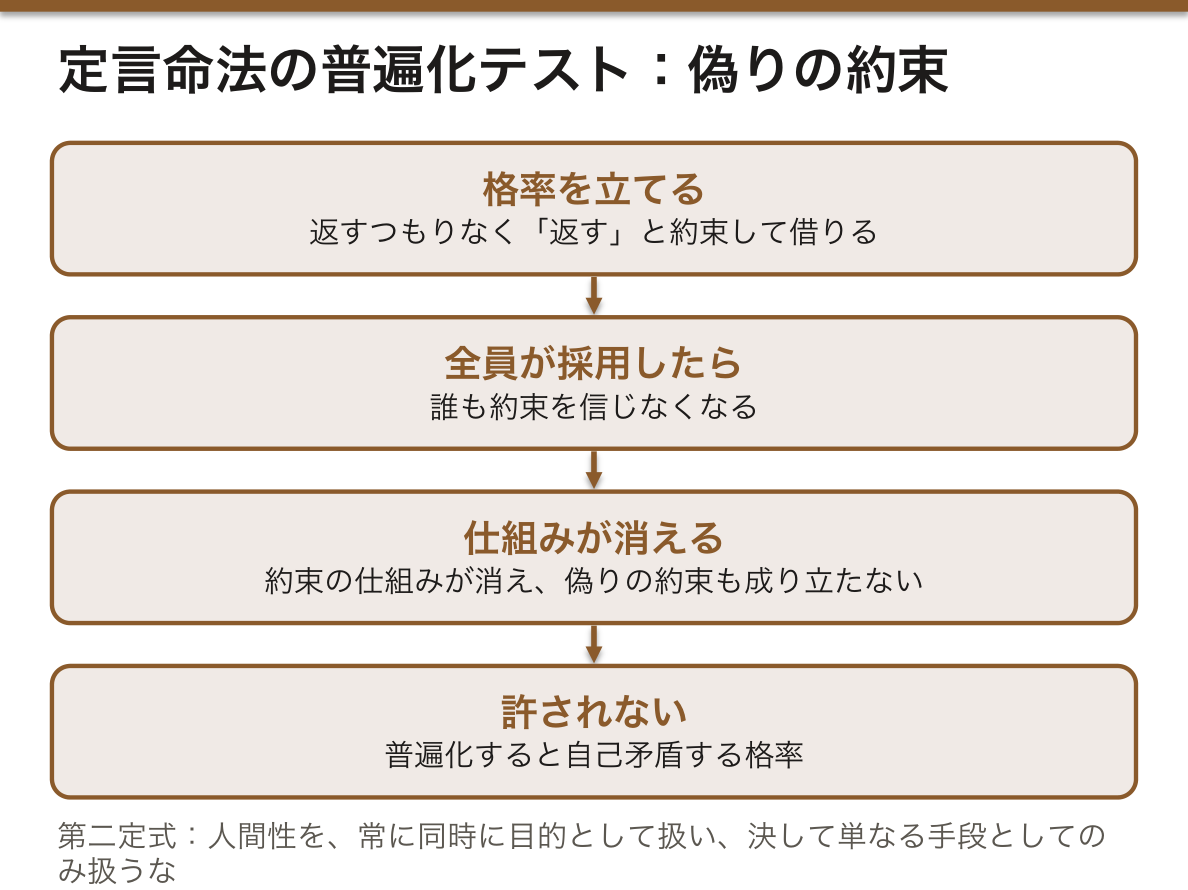
カント自身の例が借金の偽りの約束である。「返すつもりがないのに『返す』と約束して金を借りる」という格率を全員が採用したと想像する。すると誰も約束を信じなくなり、約束という仕組み自体が消え、偽りの約束も成り立たなくなる。普遍化すると自己矛盾するので、この格率は許されない。定言命法は具体的な中身を与えるというより、あらゆる行為原則を試す形式的な物差しとして働く。
第二の定式はさらに重要である。人間性を、自分のものであれ他人のものであれ、常に同時に目的として扱い、決して単なる手段としてのみ扱わないように行為せよ。ここで効いているのは「単なる」という語だ。私たちはバスの運転手や医師を目的達成の手段として使っているが、彼らは自ら選んでその役を引き受けている。本人の同意なく、本人の目的を無視して利用することが禁じられているのであり、ここから自律の尊重とインフォームド・コンセントの考え方が出てくる。
「人を単なる手段として扱うな」は、研究倫理の土台である。被験者の同意なしに知識のために人体を使った戦時の人体実験は、まさにこの原則への違反だった。臨床でも、ドナーとして利用するために子をもうける「救世主きょうだい」の是非や、教育目的の不要な診察の可否など、この定式で整理できる問いは多い。
English version
Core
Deontology judges an action by qualities other than its consequences — is it a lie, a broken promise, a killing? The name comes from the Greek deon, ‘what is required’. Theories differ in where duties come from: divine command theory (God commands it), natural law theory (follow the goods built into human nature), Kantian ethics (reason), and human rights theories.
Kant based morality on reason and separated two kinds of command. A hypothetical imperative says ‘if you want X, do Y’. It does not bind someone who does not want X (if you want to stay healthy, exercise). A categorical imperative says simply ‘do Y’. It binds us whatever we want. Its first formula: act only on the principle (maxim) that you could at the same time will to become a universal law.
Going further
Kant’s own example is borrowing money with a false promise. Imagine everyone adopting the maxim ‘borrow money by promising to repay, with no intention of repaying’. Then no one would believe promises, the practice of promising would disappear, and even the false promise would become impossible. Universalised, the maxim contradicts itself, so it is forbidden. The categorical imperative works less as a source of content than as a formal test for any principle of action.
The second formula matters even more: treat humanity, in yourself or in others, always as an end and never merely as a means. The key word is ‘merely’. We use bus drivers and doctors as means to our goals, but they have chosen those roles. What is forbidden is using people without their consent and ignoring their own goals. Respect for autonomy and informed consent grow from this.
In the clinic
‘Never treat people merely as means’ is the foundation of research ethics. Wartime human experiments, which used human bodies for knowledge without consent, broke exactly this rule. In clinical work it also helps with questions such as whether to conceive a ‘saviour sibling’ as a donor, or whether unnecessary examinations for teaching are acceptable.
義務論への批判 — 厳しすぎ・形式的すぎ
義務論への批判は大きく3つある。
| 批判 | 中身 |
|---|---|
| 厳しすぎ、義務の衝突に非現実的な答えを出す | カントは、友人をかくまっている家に殺人者が来て居場所を尋ねても嘘をついてはならないとした。嘘の禁止と命を守る義務がぶつかると、絶対的な規則は動けなくなる |
| 不道徳な行為を正当化しうる | 普遍化の検査は形式だけを見るので、矛盾なく普遍化できる冷酷な格率(「困っている他人を決して助けない」)がすり抜けることがある |
| 広すぎる・中身が薄い | 形式的な原理なので、多くの格率が検査を通り、具体的に何をすべきかまでは教えてくれない |
義務の衝突への有力な答えが、W.D.ロスの一応の義務(prima facie duty)という考え方である。真実を語る、約束を守る、害を与えない、といった義務はどれも「一見したところ」の義務で、ぶつかったときにはその場の事情を見てどれが優先するかを判断する。後で学ぶ4原則アプローチも、この考え方を受け継いでいる。
もう一つの批判は合理性への偏りである。カントの道徳共同体は理性的な存在者から成るので、論理的に考える力の乏しい人(幼い子、重い認知障害のある人)が尊重の対象から外れる余地を残す。また、論理的な一貫性さえあれば道徳的だというのは求めすぎでもあり、求めなさすぎでもある。私たちが医療者に期待するのは、規則の文面に従う冷たさではなく、共感やいたわり、自分の判断の限界を知る謙虚さである。それは理性だけでなく感情の領域に属し、ここから徳倫理への関心が生まれる。
生体腎移植の場面を考えるとよい。適合した兄弟がドナーになるのが怖いと打ち明け、家族に知られたくないと言う。医師が家族に「医学的に適合しなかった」と伝えるのは嘘なのか、理由を伏せただけなのか。真実を語る義務と、本人を守る義務・秘密を守る義務がぶつかる。実際の移植医療では、提供の意思が自発的かを、移植チームから独立した立場の人が本人だけと面談して確かめる仕組みが置かれている。義務の衝突を、制度の側で起こりにくくする工夫である。
English version
Core
There are three main objections to deontology.
| Objection | Content |
|---|---|
| Too strict; unrealistic answers to moral conflicts | Kant held that even if a murderer asks where your friend is hiding, you must not lie. When the ban on lying meets the duty to protect life, absolute rules get stuck |
| Can justify immoral action | The universalisation test looks only at form, so a cold maxim that can be universalised without contradiction (‘never help others in need’) may pass |
| Too broad; little content | As a formal principle, it lets many maxims pass and does not say concretely what to do |
Going further
A strong answer to conflicts of duty is W. D. Ross’s idea of prima facie duties. Telling the truth, keeping promises and not harming are all duties ‘at first sight’. When they conflict, we look at the situation and judge which one wins. The four-principles approach, which comes later, inherits this idea.
Another objection is the bias towards rationality. Kant’s moral community is made of rational beings, so people with little capacity for logical thought (young children, people with severe cognitive impairment) risk falling outside it. Also, demanding only logical consistency asks both too much and too little. What we want from clinicians is not cold obedience to the letter of a rule but empathy, compassion and the humility to know the limits of one’s own judgement. These belong to emotion as well as reason, which leads to virtue ethics.
In the clinic
Think of living kidney donation. A matched brother confesses that he is too frightened to donate and does not want the family to know. If the doctor tells the family he is ‘not medically compatible’, is that a lie or just withholding the reason? The duty to tell the truth collides with the duty to protect him and keep his confidence. In real transplant practice, someone independent of the transplant team interviews the donor alone to confirm that the decision is voluntary. This kind of system reduces such conflicts before they happen.
徳倫理 — 「何をすべきか」より「どんな人であるべきか」
功利主義と義務論は「この場面で何をすべきか」を問う。徳倫理は問いを変え、「どう生きるべきか、どんな人であるべきか」を問う。注目するのは個々の選択ではなく、人とその性格、そして人生全体である。普遍的な道徳原則の一覧を作ることはできないと考え、有徳な人が行うことが正しい行為だとする(徳の優先)。中心の問いは、どう生きるべきか・どの徳を育てるべきか・徳とは何か・徳はどう身につくか、の4つである。
徳とは、ある状況での態度と行為を方向づける、後天的に身につけた性格の傾向である。徳には認知的な要素(状況を正しく見て判断する実践知、アリストテレスの言うフロネーシス)と情緒的な要素(適切な感じ方)の両方が含まれる。アリストテレスによれば道徳的な徳は中庸にある。勇気は臆病(不足)と無謀(過剰)の間にあり、節制は暴食と禁欲の間にある。
ギリシャ語の「徳(アレテー)」は特別な聖人の性質ではなく、そのものの働きがよく発揮されている状態を指す。よいナイフの徳はよく切れることだ。よい人とは、人間としての働きをよく発揮している普通の人であり、その行き着く先がエウダイモニア(よく生きること、人間の開花)である。
批判も3つ押さえる。①普遍的な徳の一覧があるのか——アリストテレスの模範は自由民のアテネ男性で、文化によって徳の中身は変わりうる。②義務論とどう違うのか——「有徳な人のようにふるまえ」は、結局「正直であれ」「親切であれ」という義務の言い換えになり、また具体的な場面での答えを出してくれない。③固定した性格特性は幻想ではないか——心理学の実験では、人の行動は性格よりも状況(急いでいるか、周りに人がいるか)に大きく左右される。それでも徳倫理は、正しい決定を下せる人を育てるという、他の理論が手薄な部分を受け持つ。
医学教育でよく言われる「隠れたカリキュラム」は、徳倫理の問題そのものである。学生は講義で語られる理想よりも、病棟で上級医がどうふるまうかから、はるかに多くを学ぶ。逆向きの見方もある。病気や障害、死の恐れに向き合う患者の勇気や忍耐は、医療者に人間らしさとは何かを教える。「有徳な患者」とは従順な患者のことではない。
English version
Core
Utilitarianism and deontology ask what should I do in this situation. Virtue ethics asks a different question: how should I live, and what kind of person should I be? It looks at the person and their character, and at life as a whole, not single choices. It holds that no universal list of moral principles can be written, and that an action is right if a virtuous person would do it (the priority of virtues). Its central questions: how should one live, which virtues should be cultivated, what are virtues, and how are they acquired?
A virtue is an acquired disposition of character that governs one’s attitudes and actions in certain situations. It has a cognitive part (practical wisdom to see and judge the situation — Aristotle’s phronēsis) and an affective part (feeling in the right way). For Aristotle, moral virtue lies in the golden mean: courage lies between cowardice (too little) and rashness (too much); temperance lies between gluttony and asceticism.
Going further
The Greek word for virtue, aretē, does not mean the quality of a saint. It means a thing doing its function well. The virtue of a knife is to cut well. A good person is an ordinary person who does the human function well, and the goal is eudaimonia — living well, human flourishing.
Know three objections. (1) Is there a universal set of virtues? Aristotle’s model was a free Athenian man; the content of virtue may change with culture. (2) How does it differ from duty ethics? ‘Act as a virtuous person would’ often turns into duties such as ‘be honest’ and ‘be kind’, and it gives no clear answer in a concrete case. (3) Are fixed character traits an illusion? Psychology experiments show that behaviour depends more on the situation (being in a hurry, others nearby) than on character. Still, virtue ethics covers what the other theories neglect: forming people who can be trusted to decide well.
In the clinic
The ‘hidden curriculum’ in medical education is a virtue-ethics problem. Students learn far more from how senior doctors behave on the ward than from the ideals taught in lectures. It also works the other way: patients who face illness, disability and fear of death with courage and patience teach clinicians what it means to be human. A ‘virtuous patient’ is not simply an obedient patient.
3つの理論で1つの症例を読む — 「がんではないですよね?」
典型的な教材の型を、自分で組み直した例で考える。高齢の男性が、配偶者を亡くした後に重いうつ状態になり自殺未遂をした過去をもつ。ようやく持ち直し、何年ぶりかの楽しみである海外旅行を控えて健康診断を受けたところ、進行の遅い、すぐには治療を要さないがんが見つかった。結果を聞きに来た彼は「がんではないですよね?」と先に尋ねる。主治医は、いま告げれば旅行どころか再び危険な状態になると考え、「何も心配ありません」と答えた。
| 理論 | 考え方 | 結論の傾向 |
|---|---|---|
| 行為功利主義 | 旅行の喜び、うつの再発の危険、後で知ったときの不信と損失を見積もる | 短期の結果次第では嘘を正当化しうる |
| 規則功利主義 | 「医師は患者を欺かない」という規則が全体の信頼を支える | 嘘は許されにくい |
| カント的義務論 | 嘘は普遍化できず、本人が自分の人生を計画する理性的存在であることを無視する | 嘘は許されない |
| 徳倫理 | 正直さと思いやりの中庸を探す | 嘘ではなく、時機・伝え方・本人がどこまで知りたいかを工夫する |
この症例が教えるのは、理論ごとに「見えるもの」が違うということだ。功利主義は結果の見積もりを、義務論は患者が自分の人生の主体であることを、徳倫理は伝える医師のあり方を照らす。どれか一つで機械的に答えを出すのではなく、複数の光を当てて見落としを減らすのが理論の使い方である。
もう一点、医師の判断の前提が本当に正しいかを問う必要がある。「告げれば必ず崩れる」という予測は、功利主義的な正当化の唯一の支えだが、医療の予測は不確かだった(前の項目)。また、がんは今は進まなくても、いずれ緩和治療や生活の準備が必要になる。旅行の後に、支えを用意したうえで伝えるという選択肢は、嘘か即時の告知かという二択の外にある。徳倫理が言う実践知とは、こうした第三の道を見つける力のことでもある。
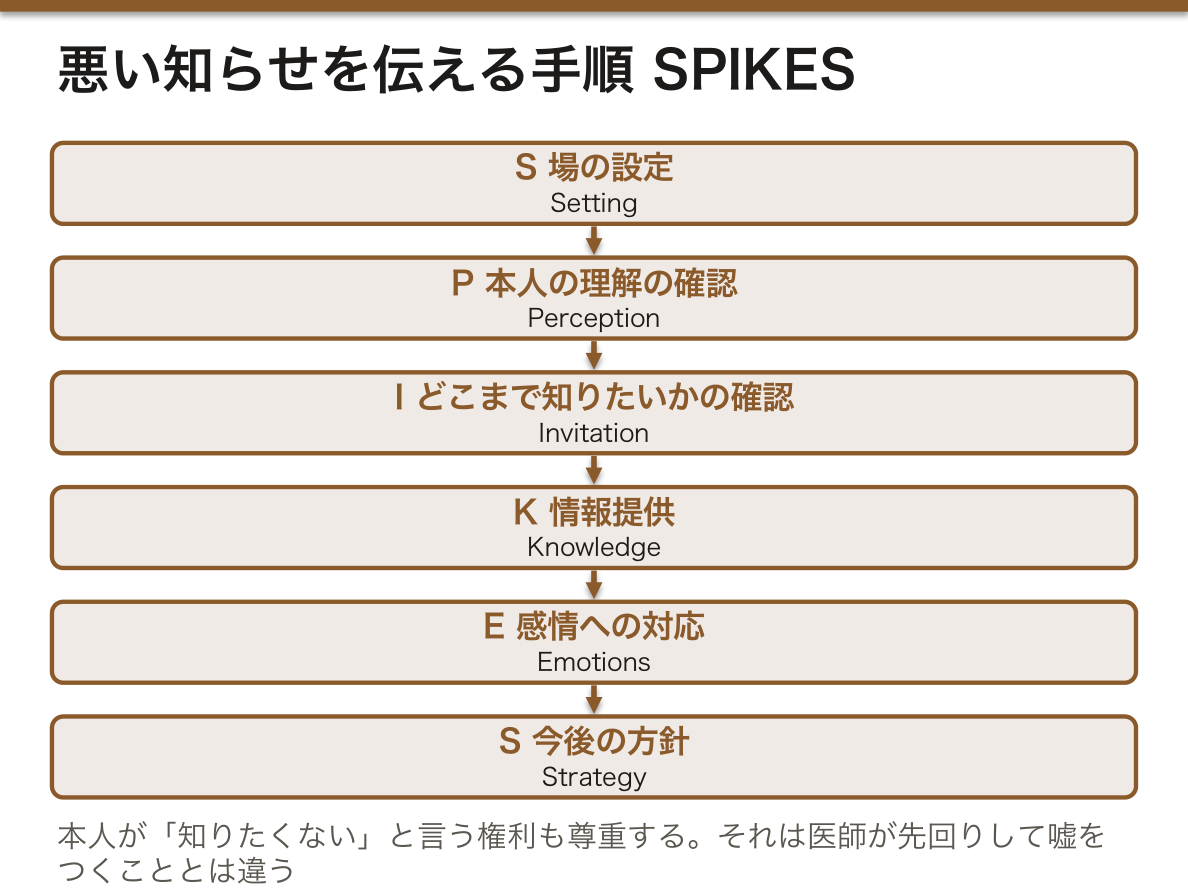
日本ではかつて、がんを本人には告げず家族にだけ伝えることが珍しくなかった。現在は本人への告知が原則で、悪い知らせを伝える手順として SPIKES(場の設定・本人の理解の確認・どこまで知りたいかの確認・情報提供・感情への対応・今後の方針)が広く教えられている。本人が「知りたくない」と言う権利も尊重されるが、それは医師が先回りして嘘をつくこととは違う(インフォームド・コンセントの章の「権利の放棄」を参照)。
English version
Core
Here is a typical teaching case, rebuilt in my own words. An elderly man became severely depressed and attempted suicide after his spouse died. He has finally recovered and is about to take a long-awaited trip abroad. A pre-travel check-up finds a slow-growing cancer that needs no immediate treatment. When he comes for the results, he asks first: ‘It’s not cancer, is it?’ The doctor believes the news would ruin the trip and put him in danger again, and answers, ‘Nothing to worry about.’
| Theory | How it reasons | Likely conclusion |
|---|---|---|
| Act utilitarianism | Weighs the joy of the trip, the risk of relapse, and the distrust and loss if he finds out later | May justify the lie, depending on short-term results |
| Rule utilitarianism | The rule ‘doctors do not deceive patients’ supports trust overall | The lie is hard to justify |
| Kantian deontology | A lie cannot be universalised and ignores that he is a rational being who plans his own life | The lie is not allowed |
| Virtue ethics | Looks for the mean between honesty and compassion | No lie; choose timing, manner and how much he wants to know |
Going further
The case shows that each theory makes different things visible. Utilitarianism shows the estimate of outcomes; deontology shows that the patient is the author of his own life; virtue ethics shows the character of the doctor who speaks. The point is not to get a mechanical answer from one theory, but to shine several lights and miss less.
We must also question the doctor’s assumption. ‘If I tell him, he will surely collapse’ is the only support for the utilitarian justification, and medical predictions are uncertain (previous item). The cancer will also need palliative care and life planning one day. Telling him after the trip, with support prepared, is an option outside the choice ‘lie or tell now’. The practical wisdom of virtue ethics is partly the skill of finding such a third way.
In the clinic
In Japan it was once common to tell only the family, not the patient, about cancer. Now telling the patient is the rule, and SPIKES (Setting, Perception, Invitation, Knowledge, Emotions, Strategy) is widely taught for breaking bad news. Patients also have a right not to know, but that is different from a doctor lying in advance (see ‘waiver’ in the informed consent chapter).
まとめ
| 生命倫理学とは — 医の倫理より広い学問 | 生命倫理学(bioethics)は1960年代後半に一つの学問として形をとった。 |
|---|---|
| 功利主義 — 正しさは結果で決まる | 功利主義は帰結主義(consequentialism)の代表で、行為の正しさはその結果だけで決まると考える。 |
| 行為功利主義と規則功利主義 — そして3つの批判 | 功利の原理を何に当てはめるかで2つに分かれる。 |
| 義務論とカント — 結果ではなく行為の性質 | 義務論(deontology)は、行為の正しさを結果以外の性質——嘘をつくことか、約束を破ることか、人を殺すことか——で判断する。 |
| 義務論への批判 — 厳しすぎ・形式的すぎ | 義務論への批判は大きく3つある。批判中身厳しすぎ、義務の衝突に非現実的な答えを出すカントは、友人をかくまっている家に殺人者が来て居場所を尋ねても嘘をついてはならないとした。 |
| 徳倫理 — 「何をすべきか」より「どんな人であるべきか」 | 功利主義と義務論は「この場面で何をすべきか」を問う。 |
| 3つの理論で1つの症例を読む — 「がんではないですよね?」 | 典型的な教材の型を、自分で組み直した例で考える。 |
このノートは医学生が授業の内容を自分の言葉でまとめたもので、診療の判断に使うものではありません。誤りに気づいたらお知らせください。