- 医療社会学の発展 — Cockerham の整理
- Virchow・Neumann・Grotjahn — 医療社会学は医学から生まれた
- 感染症の再興
医療社会学の発展 — Cockerham の整理
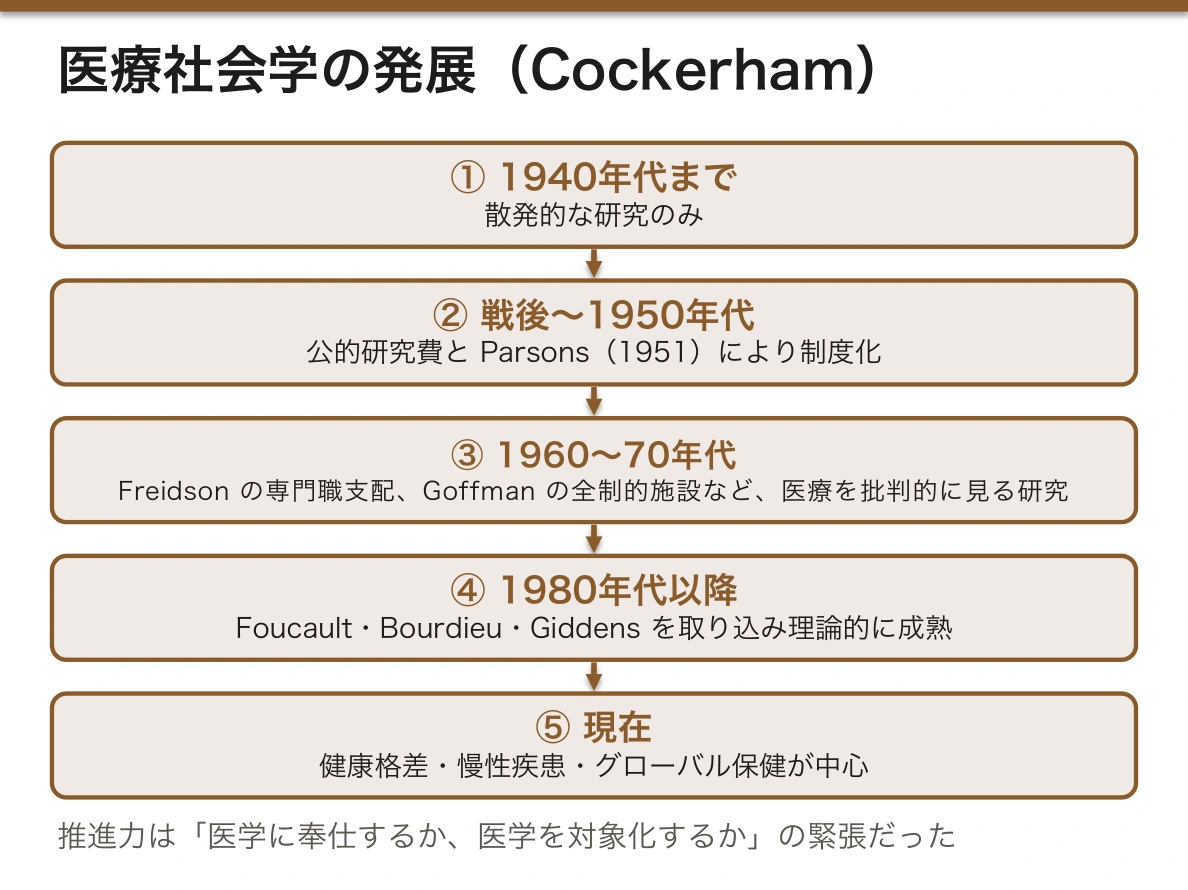
Cockerham は発展を段階で描く。①1940年代まで——散発的な研究のみ。②戦後〜1950年代——公的研究費と Parsons(1951) により制度化。③1960〜70年代——Freidson の専門職支配、Goffman の全制的施設など、医療を批判的に見る研究が主流に。④1980年代以降——Foucault・Bourdieu・Giddens を取り込み理論的に成熟。⑤現在——健康格差・慢性疾患・グローバル保健が中心。
この分野は「医学に奉仕するか、医学を対象化するか」の緊張を抱えて育った(Straus の2区分)。Cockerham はこの緊張こそが分野の推進力だったと見る。
近年の特徴は生物学への再接近——エピジェネティクスやストレス生理学と結びつき、「社会が身体に刻まれる」過程を実証しようとしている。
English version
Core
Cockerham describes the development in stages. ① Up to the 1940s — only scattered studies. ② From after the war through the 1950s — institutionalised by public research funding and Parsons (1951). ③ The 1960s and 70s — studies viewing medicine critically became the mainstream, such as Freidson’s professional dominance and Goffman’s total institution. ④ From the 1980s — theoretical maturity through taking in Foucault, Bourdieu and Giddens. ⑤ The present — health inequality, chronic disease and global health at the centre.
The field grew carrying the tension of "serve medicine or make medicine the object" (Straus’s two categories). Cockerham sees that very tension as what drove the field.
Going further
A recent feature is a renewed approach to biology — linking with epigenetics and the physiology of stress, it seeks to demonstrate the process by which "society is inscribed on the body".
Virchow・Neumann・Grotjahn — 医療社会学は医学から生まれた
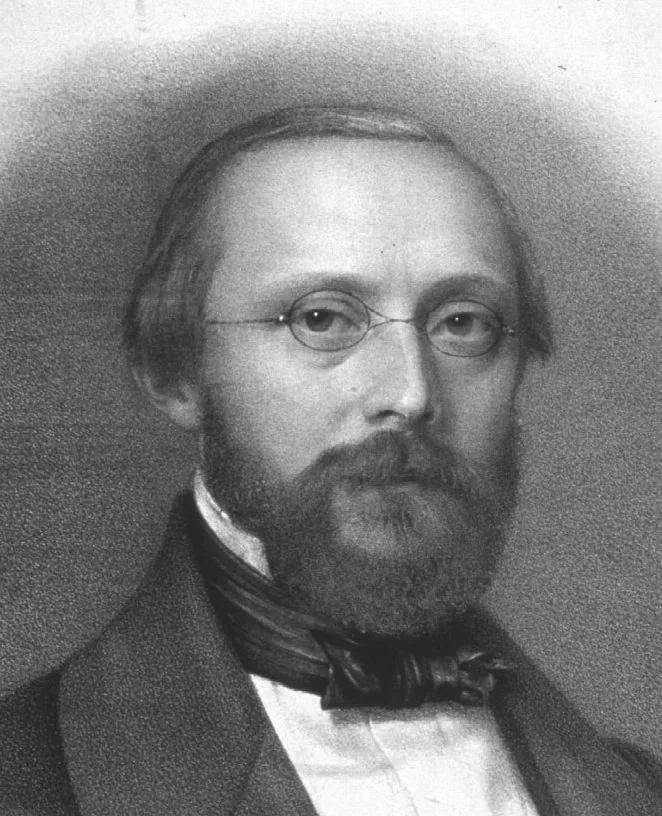
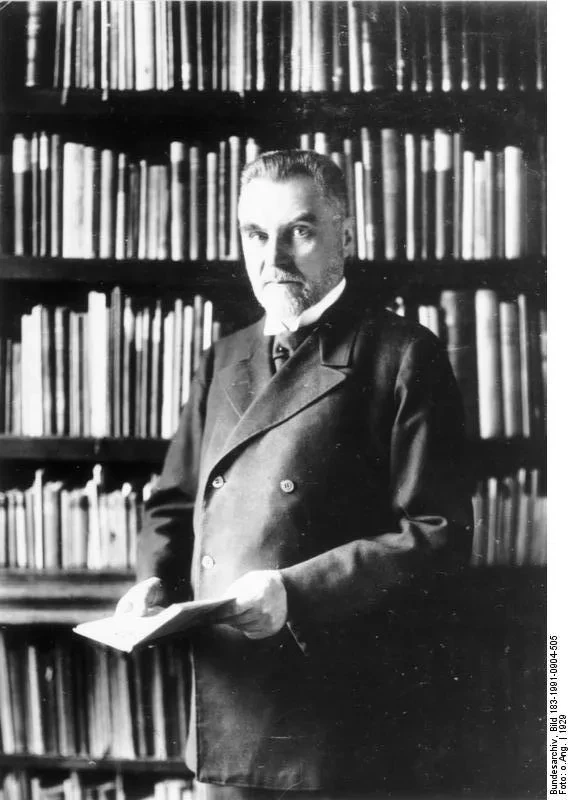
医療社会学の起源は、社会学ではなく医学にある。出発点に置かれるのは19世紀ドイツの3人の医師である。3人とも、医療には社会を見る視点が欠かせないと主張した。
| 人物 | したこと | 残した考え |
|---|---|---|
| Rudolf Virchow(1821–1902) | 1847年、上シレジアの少数派ポーランド系住民に広がった発疹チフスの流行を調べ、病気と社会条件の深い結びつきを示した | 「医学は社会科学である」(1848)。医師は時に「貧しい人の弁護人」であるべきだ |
| Salomon Neumann(1819–1908) | ベルリンで貧困と健康の悪さの結びつきを観察した | 医学はその核心において社会科学である |
| Alfred Grotjahn(1869–1931) | 医学生のときに社会学者 Tönnies の授業を受け、街を歩いて社会を観察した。のちにドイツ社会学会の創設者の1人になる | 『社会病理学』(1912)で特定の病気と社会条件を結びつけ、社会衛生学を医学の一分野として打ち立てた |
「医療社会学 medical sociology」という語が最初に現れたのも、1894年の米国の医学雑誌で、書いたのは医師だった。社会学者が本格的に参入したのは第二次大戦後、公的な研究費が付いてからである。
なぜ医師が社会に目を向けたのか。19世紀の都市は工業化で人口が集中し、貧困地区に感染症が集中した。病気を細胞や病原体だけで説明しても、なぜ貧しい地区でばかり流行するのかは説明できない。Virchow は細胞病理学を築いた人物でもあり、「病気の場所は細胞にある」と言いながら、同時に「病気の原因は社会にもある」と言った。この2つの視点の両立が、のちの生物心理社会モデルや健康の社会的決定要因の考え方の源流にあたる。
彼らの影響は2つの方向に残った。1つは公衆衛生と社会医学(環境・住居・労働条件を整えれば病気が減る)、もう1つは医療社会学(病気と医療を社会の産物として研究する)である。19世紀に感染症の死亡が減った主な理由が、医学の新発見より栄養・住居・衛生の改善だったことは、彼らの主張を裏づける。
Virchow の名は病理学(Virchow の三徴=血流の停滞・血管内皮の障害・血液凝固能の亢進)でも出てくる。同じ人物が「医学は社会科学である」とも言ったことを知っておくと、病理と公衆衛生がもともと1つの視野にあったことが分かる。
English version
Core
Medical sociology began in medicine, not in sociology. Its starting point is three German physicians of the 19th century. All three argued that medicine needs a social perspective.
| Person | What he did | Main idea |
|---|---|---|
| Rudolf Virchow (1821–1902) | In 1847 he studied a typhus epidemic among the Polish minority in Upper Silesia and showed a close link between disease and social conditions | “Medicine is a social science” (1848). The physician should sometimes be an “attorney for the poor” |
| Salomon Neumann (1819–1908) | Observed the link between poverty and poor health in Berlin | Medicine is, at its core, a social science |
| Alfred Grotjahn (1869–1931) | As a medical student he took a course with the sociologist Tönnies and walked the city observing society; later a co-founder of the German Sociological Association | His book Social Pathology (1912) linked specific diseases to social conditions and founded social hygiene as a branch of medicine |
The term “medical sociology” first appeared in 1894 in an American medical journal, written by a physician. Sociologists joined fully only after the Second World War, when public research money became available.
Going further
Why did physicians look at society? In 19th-century cities, industrialisation crowded people together, and infections concentrated in poor districts. Explaining disease only by cells or germs cannot explain why epidemics hit poor districts. Virchow also built cellular pathology. He said disease sits in the cell, and at the same time that its causes lie in society. Holding both views is a root of the later biopsychosocial model and the social determinants of health.
Their influence went in two directions: public health and social medicine (better environment, housing and work reduce disease), and medical sociology (studying disease and medicine as products of society). The fall in deaths from infection in the 19th century came mainly from better diet, housing and hygiene, not from new medical discoveries. This supports their view.
In the clinic
Virchow’s name also appears in pathology (Virchow’s triad: stasis of blood flow, endothelial injury, hypercoagulability). Knowing that the same man said “medicine is a social science” shows that pathology and public health were once seen together.
感染症の再興
20世紀半ばには「感染症は克服された」とされ、疫学転換(死因が感染症から慢性疾患へ移る)が語られた。その前提が崩れたのが再興感染症の議論。
原因として挙げられるもの——①薬剤耐性(抗菌薬の乱用、畜産での使用)②グローバル化(人と物の高速移動)③都市化と過密④生態系の破壊による人獣共通感染症(HIV、SARS、Ebola、Covid-19)⑤公衆衛生への投資不足⑥ワクチン忌避(麻疹の再流行)⑦気候変動(媒介動物の分布拡大)。
社会学の主張は「感染症の再興は生物学的な出来事ではなく、社会が作った条件の結果だ」という点にある。
Cockerham は結核が貧困と共に戻ってきたことを強調する。感染症は社会の不平等を映す鏡である。「生物医学モデル」の章の葛藤理論とつながる。
English version
Core
By the middle of the twentieth century infectious disease was held to have been overcome, and the epidemiological transition (causes of death moving from infection to chronic disease) was spoken of. That premise collapsed, and this is the debate on re-emerging infections.
The causes named — ① drug resistance (misuse of antibiotics, use in livestock) ② globalisation (rapid movement of people and goods) ③ urbanisation and crowding ④ zoonoses from the destruction of ecosystems (HIV, SARS, Ebola, COVID-19) ⑤ underinvestment in public health ⑥ vaccine hesitancy (the return of measles) ⑦ climate change (the spread of vectors).
The sociological claim is that the re-emergence of infection is not a biological event but the result of conditions society has made.
Going further
Cockerham emphasises that tuberculosis came back together with poverty. Infectious disease is a mirror of a society’s inequality. It connects with the conflict theory of the chapter on the biomedical model.
まとめ
| 医療社会学の発展 — Cockerham の整理 | Cockerham は発展を段階で描く。 |
|---|---|
| Virchow・Neumann・Grotjahn — 医療社会学は医学から生まれた | 医療社会学の起源は、社会学ではなく医学にある。 |
| 感染症の再興 | 20世紀半ばには「感染症は克服された」とされ、疫学転換(死因が感染症から慢性疾患へ移る)が語られた。 |
このノートは医学生が授業の内容を自分の言葉でまとめたもので、診療の判断に使うものではありません。誤りに気づいたらお知らせください。