- 医師‐患者関係のジェンダー差
- 医師‐患者関係と新しい技術
- 市場経済の中の医師‐患者関係 — 消費者としての患者と、第三者支払者
- 新しい遺伝学と医師‐患者関係 — 「まだ病気でない人」を診る
医師‐患者関係のジェンダー差
女性医師の診療の特徴(実証研究の一致した所見)——診察時間が長い、患者が話す割合が高い、心理社会的な話題に触れる頻度が高い、共感的な発話と予防の助言が多い。患者の満足度も高い傾向がある。
女性患者——受診頻度が高く、症状を多く訴える。だが訴えが「心理的なもの」と解釈されやすいという偏りが繰り返し報告されている。女性の心筋梗塞は診断が遅れやすいのが代表例。
要点は「差は個人の資質ではなく、社会的な役割期待から生じる」こと。女性医師には共感が期待され、そのぶん時間を使う——それが評価されないと燃え尽きにつながる。
近年の研究では女性医師が担当した入院患者の死亡率・再入院率がやや低いという報告もある(Tsugawa ら)。ただし因果は確定していない。
English version
Core
The characteristics of consultations by women doctors (a consistent finding of empirical research) — longer consultations, a higher proportion of patient speech, more frequent reference to psychosocial matters, more empathic utterances and preventive advice. Patient satisfaction also tends to be higher.
Women patients — they consult more often and report more symptoms. But there is a repeatedly reported bias that their complaints are readily interpreted as "psychological". Myocardial infarction in women being diagnosed late is the representative example.
The point is that the difference arises not from individual disposition but from social role expectation. Empathy is expected of women doctors and they spend time on it — and when that goes unrecognised it leads to burnout.
Going further
Recent research has also reported that mortality and readmission are slightly lower among inpatients cared for by women doctors (Tsugawa and colleagues). Causation, however, is not established.
医師‐患者関係と新しい技術
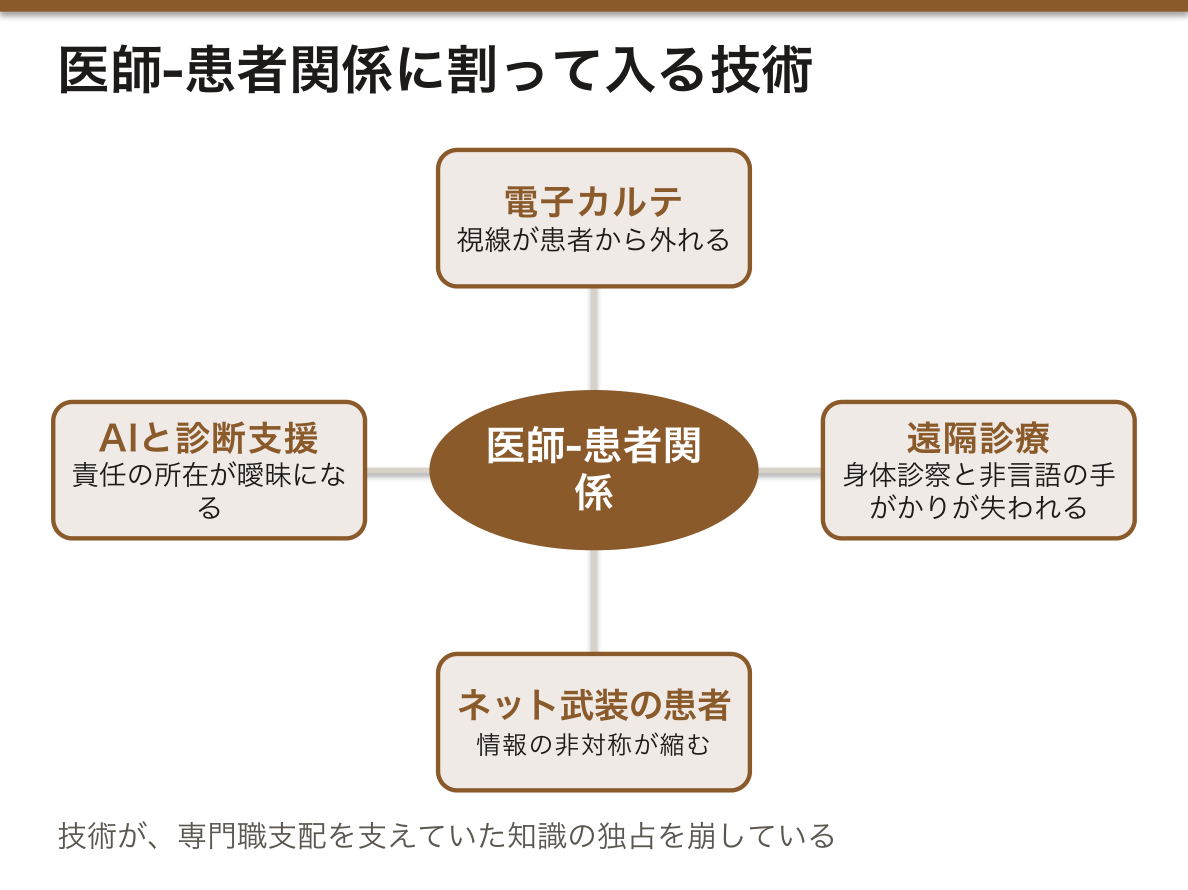
技術は関係を変えるだけでなく、間に割って入る。
①電子カルテ——医師が画面を見る時間が増え、視線が患者から外れる。記録の質は上がるが対話は痩せる。
②遠隔診療——アクセスを広げるが、身体診察と非言語的な手がかりが失われる。
③インターネットで武装した患者——情報の非対称が縮み、医師の権威の基盤が揺らぐ。良い面は参加、悪い面は誤情報。
④AI と診断支援——責任の所在が曖昧になる。
Freidson の専門職支配は、知識の独占の上に立っていた。技術がその独占を崩している——ここが社会学的な要点である。
Cockerham は「関係は非対称から交渉へ移りつつある」と見る。Strauss の交渉された秩序が診察室にも及ぶ、という読み方ができる。
English version
Core
Technology not only changes the relationship but comes between the parties.
① The electronic record — the doctor spends more time looking at a screen and the gaze leaves the patient. The quality of the record rises and the dialogue thins.
② Telemedicine — it widens access, and physical examination and non-verbal cues are lost.
③ The patient armed with the internet — the asymmetry of information narrows and the basis of the doctor’s authority is shaken. The good side is participation, the bad side misinformation.
④ AI and diagnostic support — where responsibility lies becomes unclear.
Freidson’s professional dominance stood on a monopoly of knowledge. Technology is dismantling that monopoly — this is the sociological point.
Going further
Cockerham sees that the relationship is moving from asymmetry to negotiation. It can be read as Strauss’s negotiated order extending into the consulting room.
市場経済の中の医師‐患者関係 — 消費者としての患者と、第三者支払者
Parsons が描いた「思いやりのある医師と、信頼して従う患者」の関係は長く続かなかった。米国では1960年代、公民権運動とベトナム戦争をめぐる社会の動揺の中で、人々は権威を持つ者の動機を疑うようになり、医師もその例外ではなかった。医療費の高さ、医師の高収入、一部の医師の尊大な態度も、幻滅を広げた。
こうして広がったのが消費者主義 consumerismである。患者は情報を集め、比べ、選び、自分の治療の決定に加わろうとする。医療が商品化(commodification)されるほど、患者は保険を選び、市場で医療を買い、病院は「消費者」としての患者を奪い合う。医療側はこれに患者中心のケアで応え、患者満足度が医師とケアの質を測る物差しとして使われるようになった。
もう1つの変化が第三者支払者(政府の保険・民間保険会社・マネージドケア)である。支払う側が、医師が診る患者数、1人にかける時間、さらには臨床判断にまで口を出す。払うかどうか、いくら払うかを決めるのが彼らだからである。Potter と McKinlay は、医師と患者の出会いがタクシー運転手や靴屋とのやりとりに近づいているのではないか、それはまだ「関係」と呼べるのか、と問うた。
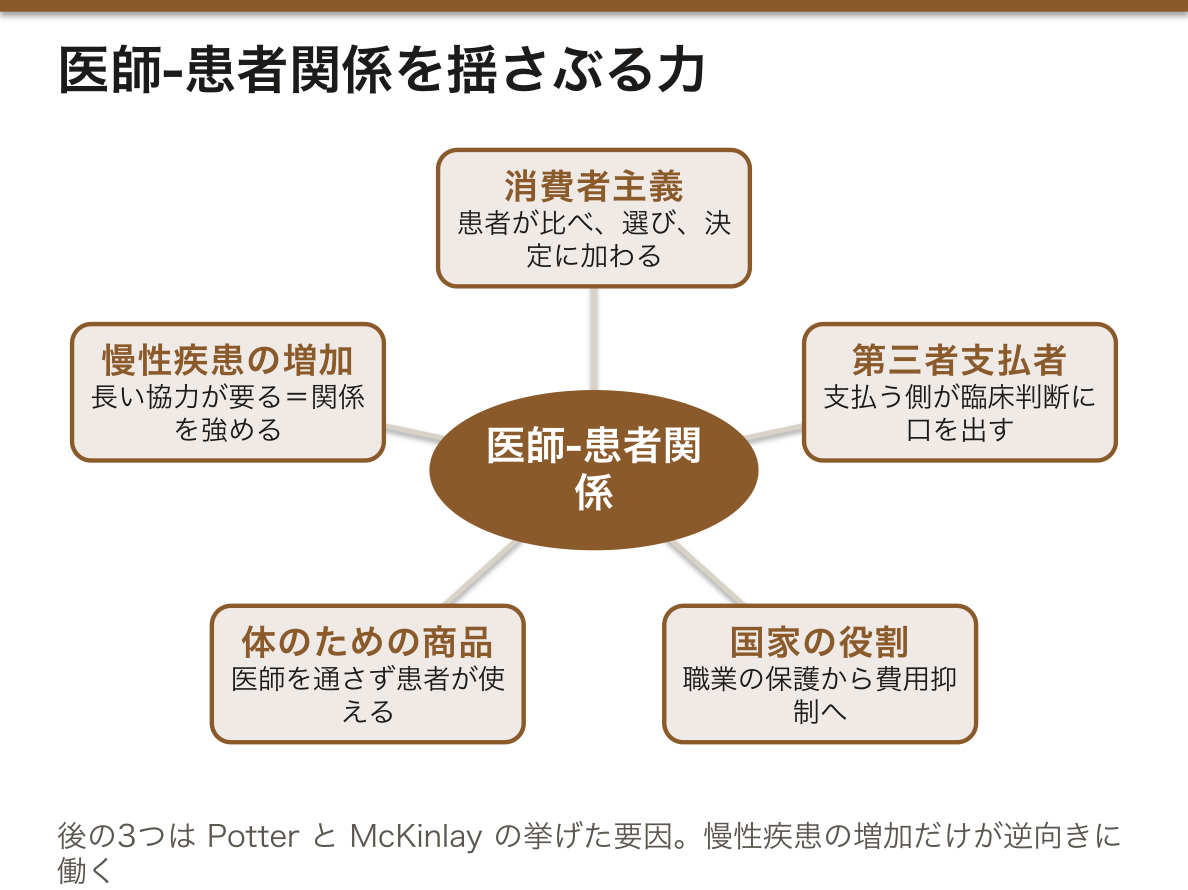
Potter と McKinlay は、関係を弱める要因として次の3つを挙げた。①国家の役割が「医師という職業を守る」から「費用を抑えたい企業の利益を守る」へ移った。②医師を通さずに患者が使える、体のための商品(市販薬・健康機器など)が増えた。③慢性疾患が増え、長く続く医師と患者の協力が必要になった——これだけは関係を強める逆向きの流れである。
医師の板挟みはここから生まれる。患者のために時間をかけたい一方で、組織は件数と費用の目標を求める。患者の側も、医療を「サービス」として評価するようになり、待ち時間や説明の分かりやすさに不満を持ちやすい。ただし消費者になれるのは主に中流以上で、情報も交渉の力もない人は受け身のままである——この偏りは「病い行動」の章の階級による消費者主義につながる。
それでも、医師に会うことが靴を買うのと同じになることはない、と Cockerham は見る。病気は不確かで、患者は弱い立場にあり、信頼なしには診療が成り立たないからである。
日本は国民皆保険で診療報酬(価格)を国が決めるため、米国のような価格競争は起きにくい。それでも患者満足度の調査や口コミサイト、短い診察時間の中での説明責任など、消費者としての患者に応える場面は日常的にある。満足度を上げることと、医学的に正しいことを勧めることがぶつかる場面(不要な抗菌薬を求められる、など)をどう扱うかが、実務の課題になる。
English version
Core
Parsons’s picture of a caring doctor and a trusting, obedient patient did not last. In the US in the 1960s, the civil rights movement and the Vietnam War made people question the motives of those in authority, including doctors. High costs, high doctors’ incomes and some doctors’ superior attitudes added to the disappointment.
What spread was consumerism. Patients collect information, compare, choose, and want to take part in decisions about their care. The more health care becomes a commodity, the more patients choose insurance plans and buy care in a market, and hospitals compete for patients as consumers. Providers responded with patient-centred care, and patient satisfaction became a measure of doctor and care quality.
Another change is third-party payers (government insurance, private insurers, managed care). They watch how many patients a doctor sees, how much time is spent, and even clinical decisions, because they decide whether and how much to pay. Potter and McKinlay asked whether meeting a doctor is becoming like meeting a taxi driver or a shoe seller, and whether it is still a “relationship”.
Going further
Potter and McKinlay listed three factors. (1) The state moved from protecting the medical profession to protecting corporate interests that want lower costs. (2) There are more products for the body that patients can use without a doctor. (3) Chronic disease increased the need for a long doctor–patient alliance — this one is a countercurrent that strengthens the relationship.
This creates the doctor’s dilemma: the doctor wants to spend time on the patient, but the organisation wants numbers and cost targets. Patients judge care as a “service” and complain more easily about waiting or unclear explanations. But mainly middle- and upper-class patients act as consumers; people without information or bargaining power stay passive. This links to class-based consumerism in the chapter on illness behaviour.
Still, Cockerham thinks that seeing a doctor will never be the same as buying shoes. Illness is uncertain, the patient is vulnerable, and care is impossible without trust.
In the clinic
Japan has universal insurance and the state sets fees, so price competition like in the US is unlikely. But patient satisfaction surveys, review websites and the duty to explain within short visits are daily realities. A practical problem is what to do when satisfaction and medically correct advice conflict (for example, a patient asking for unnecessary antibiotics).
新しい遺伝学と医師‐患者関係 — 「まだ病気でない人」を診る
ヒトゲノム計画の完了以降、遺伝学の進歩は医師‐患者関係そのものを変えつつある。患者は遺伝子スクリーニングで、将来どの病気にかかりやすいか、どんな対策が要るかを知るようになる。診療所や検査室でゲノムを読み、がん・まれな病気・薬への反応の確率を出す技術も広がった。遺伝子治療(欠陥のある遺伝子を健康な遺伝子で置き換える)や、個人の DNA に合わせた精密医療・個別化医療も期待されている。
これは医師の役割を変える。従来の医師は「今ある病気を治す人」だったが、遺伝情報を扱う医師は「将来のリスクとのつき合い方を案内する人」になる。患者の側も、自分を「病気ではないが、リスクを抱えた人」として見るようになり、健康の見方が変わる。
社会学が問うのは、その社会的な結果である。遺伝子検査は社会統制の手段になりうるのか。遺伝的な特徴で人が分類され、新しいスティグマと差別が生まれないか。遺伝子と社会環境の相互作用(ストレス・喫煙・飲酒・精神的健康との関係)を調べる社会エピジェネティクスという新しい分野も生まれた。
遺伝情報には他の医療情報にない特徴がある。本人もまだ知らない将来を示し、しかも家族や同じ集団にも当てはまる。だから雇用主・保険会社・研究者・製薬企業にとって価値があり、雇用や保険での差別の可能性が生まれる。米国では多くの州が遺伝子検査にもとづく保険での差別を禁じ、連邦法(遺伝情報差別禁止法 GINA, 2008)もある。
同意も一段と重くなる。米国で、まれな劣性遺伝病(Canavan 病)の家族が子どもの組織を研究に提供したところ、病院がその成果で出生前検査の特許を取り、家族に検査料を請求した事例がある。家族は特許化と利用制限について説明を受けていなかった。また先住民 Havasupai 族が糖尿病研究のために提供した血液が、同意の範囲外の研究(集団の起源の研究など)に使われ、大学が和解した事例もある(2010年)。どちらも同意書に署名していても、本人たちの理解と意図から外れれば信頼は壊れることを示している。
実務では、遺伝子検査の前後に遺伝カウンセリングを置き、結果が本人だけでなく血縁者にも意味を持つことを説明する。「知らないでいる権利」を尊重するかどうか、血縁者に知らせるかどうかは、倫理の側の論点(遺伝子技術の倫理の章)と重なる。社会学はそこに、誰が検査を受けられるか、結果が人をどう分類するかという視点を足す。
English version
Core
Since the Human Genome Project, progress in genetics has been changing the doctor–patient relationship. Through genetic screening, patients learn which diseases they are likely to get and what they need to do. Technology in clinics and labs can read a genome and give probabilities for cancer, rare diseases and drug responses. Gene therapy (replacing a faulty gene with a healthy one) and precision or personalised medicine matched to a person’s DNA are also expected.
This changes the doctor’s role. The traditional doctor treated an existing illness. A doctor who uses genetic information becomes a guide for living with future risk. Patients also start to see themselves as “not ill, but at risk,” and their view of health changes.
Sociology asks about the social results. Can genetic testing become a tool of social control? Will people be sorted by genetic traits, creating new stigma and discrimination? A new field, social epigenetics, studies how genes interact with the social environment (stress, smoking, alcohol, mental health).
Going further
Genetic information is special. It shows a future that even the person may not know, and it also applies to family members and the group. So it has value for employers, insurers, researchers and drug companies, and it can lead to discrimination in jobs and insurance. In the US many states ban insurance discrimination based on genetic tests, and there is a federal law (GINA, 2008).
Consent becomes even more important. In one US case, families with a rare recessive disease (Canavan disease) gave their children’s tissue for research. The hospital patented a prenatal test from the work and charged the families for testing. The families had not been told about the patent. In another case, blood given by the Havasupai tribe for diabetes research was used for other studies (such as the tribe’s origins), and the university settled in 2010. Both show that a signed form is not enough: if use goes beyond what people understood and intended, trust breaks.
In the clinic
In practice, genetic counselling is placed before and after testing, and the doctor explains that results matter for relatives too. Whether to respect the “right not to know” and whether to inform relatives overlap with the ethics side (chapter on the ethics of genetic technology). Sociology adds who can get tested and how results sort people.
まとめ
| 医師‐患者関係のジェンダー差 | 女性医師の診療の特徴(実証研究の一致した所見)——診察時間が長い、患者が話す割合が高い、心理社会的な話題に触れる頻度が高い、共感的な発話と予防の助言が多い。 |
|---|---|
| 医師‐患者関係と新しい技術 | 技術は関係を変えるだけでなく、間に割って入る。 |
| 市場経済の中の医師‐患者関係 — 消費者としての患者と、第三者支払者 | Parsons が描いた「思いやりのある医師と、信頼して従う患者」の関係は長く続かなかった。 |
| 新しい遺伝学と医師‐患者関係 — 「まだ病気でない人」を診る | ヒトゲノム計画の完了以降、遺伝学の進歩は医師‐患者関係そのものを変えつつある。 |
このノートは医学生が授業の内容を自分の言葉でまとめたもので、診療の判断に使うものではありません。誤りに気づいたらお知らせください。