- 病院の語源と、社会制度としての変遷
- 救貧院・精神病院・死の家 — 病院が医療技術の中心になるまで
- 病院の所有形態と「二重の権威」 — 管理部門と医師のあいだ
- 没個人化 — 入院患者に何が起きるか
- 入院費はなぜ上がり続けるのか — 原因と抑え方
病院の語源と、社会制度としての変遷
語源——ラテン語 hospes(客・もてなす者)→ hospitalis(客をもてなす)。hotel・hospice・hospitality と同語源。元々は「治療の場」ではなく「もてなしと収容の場」だったことが要点。
変遷——①中世:修道院に付属する宗教的な慈善施設。貧者・旅人・病者を収容したが、治療機関ではない。②18〜19世紀:貧民のための施設。金のある者は自宅で診てもらった。感染が蔓延し「死ぬ場所」と恐れられた。③19世紀後半:麻酔・消毒・看護の専門化(Nightingale)により、治せる場所へ。④20世紀:技術と検査の集積地となり、中間層以上も入院するようになる。医師の権力の基盤となった。⑤現在:在院日数の短縮、外来・在宅への移行、経営体としての病院。
「慈善 → 貧民収容 → 治療 → 技術 → 経営」という流れで答える。
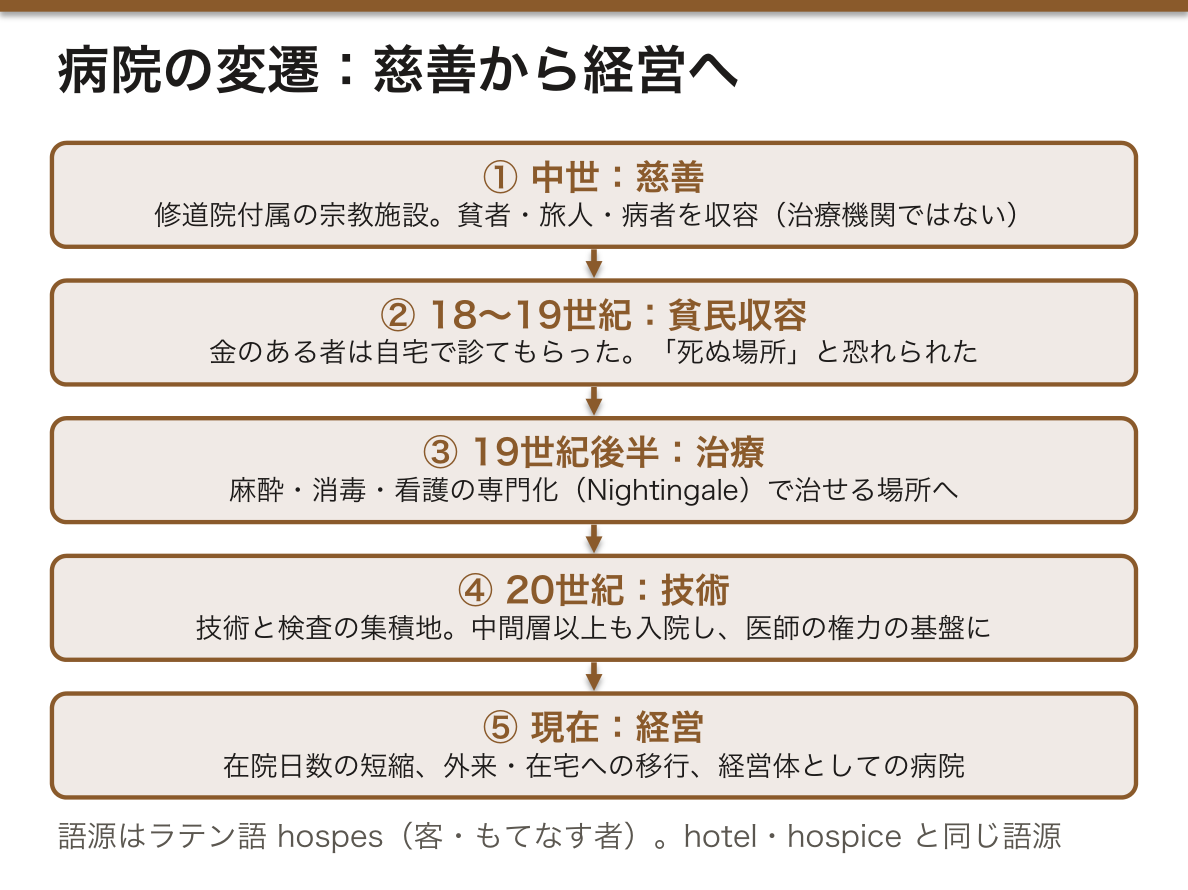
Foucault の臨床のまなざしは③の時期に対応する。病者が一箇所に集められたことで、比較・分類・統計が可能になり、近代医学が成立した。
English version
Core
The etymology — Latin hospes (guest, host) → hospitalis (hospitable). The same root as hotel, hospice and hospitality. The point is that it was originally not "a place of treatment" but "a place of hospitality and shelter".
Its transformations — ① The Middle Ages: a religious charitable institution attached to a monastery. It housed the poor, travellers and the sick, and was not an institution of treatment. ② The 18th and 19th centuries: an institution for the poor. Those with money were attended at home. Infection was rife and it was feared as "a place to die". ③ The later 19th century: with anaesthesia, antisepsis and the professionalisation of nursing (Nightingale) it became a place where people could be cured. ④ The 20th century: it became the place where technology and investigation were concentrated, and the middle classes and above began to be admitted. It became the basis of the doctor’s power. ⑤ The present: shorter stays, a shift to outpatient and home care, the hospital as a business.
Answer with the sequence "charity → shelter for the poor → treatment → technology → management".
Going further
Foucault’s clinical gaze corresponds to the third period. Because the sick were gathered in one place, comparison, classification and statistics became possible, and modern medicine was constituted.
救貧院・精神病院・死の家 — 病院が医療技術の中心になるまで
中世の病院は教会の慈善の場で、医療と同時に魂の世話(祈り・告解)を担った。修道士と修道女が働き、病者だけでなく貧者や旅人も受け入れた。
救貧院としての病院——教会の統一的な管理が外れると、病院は都市ごとのばらばらな運営になり、資金の流用や設備の荒廃が起きた。英国では16世紀半ばの修道院解散で病院制度が崩れ、残った病院は「治る見込みのある病人」だけを受け入れるようになった。これは病院を治療の場と定義し直す始まりでもあった。一方、16世紀末に浮浪者が増えると、病院は病気かどうかに関係なく食事と寝場所を与える宿泊所になり、障害者・高齢者・孤児・知的障害者を世間の目から隠す社会の「倉庫」になった。
この遺産は精神病院に残った。慢性で治りにくい病気、隔離が要る感染症、精神疾患の患者は公的な施設に送られる、という流れである。米国の精神病院の多くは州や郡が運営し、入院には本人が同意する任意入院と、国家の法的権限による非自発的入院がある。
死の家としての病院——17世紀までに医師が医学知識を独占し、病院の中の医療を指揮するようになった。19世紀初めには、病院は治療・研究・医学教育の場という今の役割を持つ。しかし18世紀の治療は効かず、病院は汚く、換気が悪く、1つのベッドに複数の患者を寝かせ、医師は手も洗わずにベッドを回った。だから病院は「貧しい人が死にに行く場所」と見られた。COVID-19 の流行でも、入院した家族が戻らない経験から、同じ見方が一部で再び現れた。
医療技術の中心へ——19世紀末からの転換には3つの理由がある。①医学が科学になった(生理学・細菌学、エーテル麻酔による手術)。高価な設備は病院に集められ、中流以上の患者も入院するようになり、自費で個室に入る「私費患者」が生まれた。②消毒と無菌——清掃・換気・感染者の隔離・手洗い・手袋・滅菌器具で死亡と回復期間が減った。③訓練を受けた看護師と検査技師の登場。米国の病院史家 Rosenberg は、病院の日常の仕事をもっとも変えたのは訓練された看護師だったと述べている。
院内感染対策、手指衛生、看護の専門職化は、病院が「死の家」から抜け出した理由そのものである。手指衛生が今も医療安全の基本とされるのは、歴史的にそれが病院の死亡率を決めてきたからである。
English version
Core
In the Middle Ages, hospitals were church charities that cared for the soul (prayer, confession) as well as the body. Monks and nuns worked there, and they took in the poor and travellers as well as the sick.
Hospitals as poorhouses: when central church control ended, hospitals were run separately by towns, and funds were misused and buildings neglected. In England the closing of monasteries in the mid-1500s broke the hospital system, and the remaining hospitals took only sick people who could be cured. This was the start of redefining hospitals as places of treatment. But when vagrancy grew in the late 1500s, hospitals became lodging houses giving food and shelter to anyone, sick or not, and a social “warehouse” that hid invalids, the old, orphans and the mentally disabled from public view.
This legacy remained in mental hospitals: people with chronic, incurable, highly infectious or mental illness are sent to public institutions. Most US mental hospitals are run by states or counties, and admission is either voluntary or involuntary (by the state’s legal power).
Going further
Hospitals as deathhouses: by the 17th century physicians had a monopoly on medical knowledge and came to direct care in hospitals. By the early 19th century, hospitals had their present role of treatment, research and medical education. But 18th-century treatment did not work, and hospitals were dirty, poorly ventilated, with several patients in one bed and doctors moving between beds without washing their hands. So hospitals were seen as places where the poor went to die. During COVID-19, when relatives did not come back from hospital, the same view briefly returned.
Centres of medical technology: three changes from the late 19th century. (1) Medicine became a science (physiology, bacteriology, ether anaesthesia for surgery). Expensive equipment was centralised in hospitals, middle- and upper-class patients began to use them, and the paying “private patient” appeared. (2) Antisepsis: cleaning, ventilation, isolating infectious patients, hand washing, gloves and sterile instruments reduced deaths and recovery time. (3) Trained nurses and laboratory technicians. The historian Rosenberg said that trained nurses changed daily hospital work more than anything else.
In the clinic
Infection control, hand hygiene and professional nursing are exactly why hospitals stopped being deathhouses. Hand hygiene is still the basis of patient safety because, historically, it decided hospital death rates.
病院の所有形態と「二重の権威」 — 管理部門と医師のあいだ
米国の病院の所有形態は3つ——非営利・営利・政府(連邦・州・地方)。最も多いのは連邦以外の非営利の地域病院(短期入院の一般病院)で、地域病院の半分強を占める。理事会が管理し、税が免除され、利益ではなく費用を賄うことを目的にする(ただし安いわけではない)。営利病院は約4分の1で、2000年以降もっとも伸びた。大企業のチェーンにまとまり、医師は会社の被雇用者になる。州・地方政府の病院は約2割で、都市の低所得層の主な受け皿である。こうして米国の病院は、豊かな人向けと貧しい人向けの二層の制度になっている。
病院の組織図を見ると、医療部門の長(medical director)と管理部門の長(administrator)はどちらも理事会に直接つながるが、互いには間接的にしかつながっていない。権威が2本の系統に分かれている——これが二重の権威 dual authority である。
背景にあるのは官僚制と専門職のぶつかり合いである。Weber の官僚制は、職位の階層、規則で決まった管轄、文書による命令、個人と職務の分離、そして権威が人ではなく職位に付くこと(合法的支配)を特徴とする。病院の管理者はこの論理で、全員に同じ規則を当てはめて効率よく調整しようとする。医師は専門職として、目の前の患者について自分で判断する自律を求める。救急のように、規則より柔軟さが命を救う場面もある。
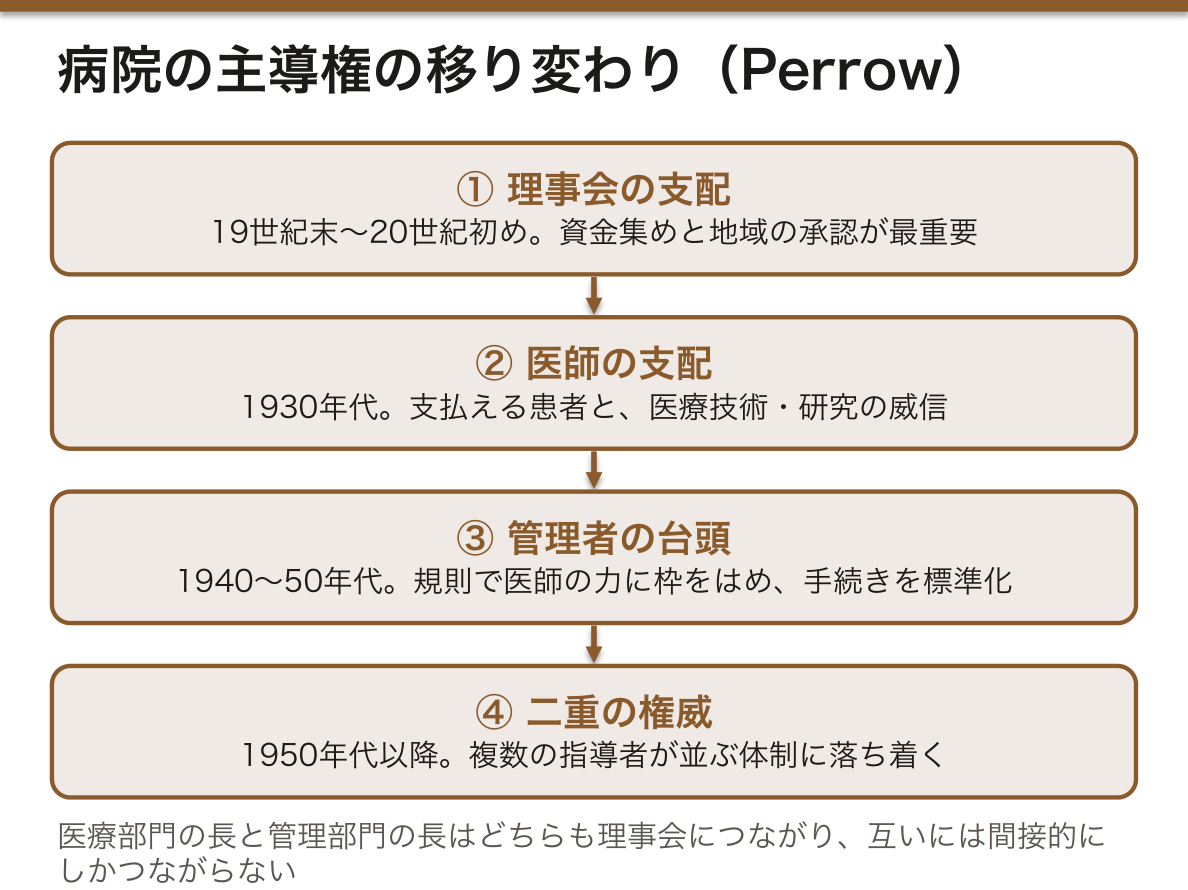
Perrow(1963)は1つの病院の歴史から、主導権の移り変わりを描いた。①19世紀末〜20世紀初め:理事会の支配(資金集めと地域の承認が最重要だった)。②1930年代:医師の支配(支払える患者に重心が移り、医療技術と研究の威信が増した)。ただし医長の私的な権力による不正やえこひいきも起きた。③1940〜50年代:管理者の台頭——規則で医師の力に枠をはめ、手続きを標準化した。④1950年代以降:複数の指導者が並ぶ体制、つまり二重の権威に落ち着いた。1980年代からは、財政方針・費用抑制・政府規制・企業の手続きによって、医師の統制力はさらに下がった。
板挟みになるのは病棟の看護師である。医師の指示を実行する責任を負いながら、看護部と管理部門にも責任を負う。それでもこの仕組みには利点がある。一方の権威が理不尽なとき、もう一方に頼れるので、組織の硬直を和らげる。Strauss らは精神科病院の研究で、病院の秩序は固定した規則ではなく、管理部門・医師・職員・患者のあいだの絶えざる交渉で保たれていると示した(交渉された秩序)。全員をまとめていたのは「患者を入院時より良い状態で社会に返す」という共通の目標で、彼らはそれを組織をつなぐ「象徴的なセメント」と呼んだ。
日本では医療法で病院の管理者(院長)は医師とされ、営利を目的とする病院の開設は原則として認められていない。それでも事務部門と診療部門の考え方の違い(費用と効率か、目の前の患者か)は日常的に現れる。研修医が「その検査は病院の方針で…」と言われる場面は、二重の権威の小さな現れである。
English version
Core
US hospitals have three ownership types: non-profit, for-profit and government (federal, state, local). The most common is the nonfederal non-profit community hospital (short-stay general hospital), just over half of community hospitals. It is run by a board of trustees, is tax-exempt, and aims to cover costs, not to make profit (but it is not cheap). For-profit hospitals are about a quarter and grew most after 2000. They join corporate chains, and doctors become employees. State and local government hospitals are about a fifth and are the main care for low-income people in cities. So US hospitals form a two-class system, one for the well-off and one for the poor.
On the organisation chart, the medical director and the administrator are both directly linked to the board, but only indirectly to each other. Authority runs in two lines — this is dual authority.
Behind it is the conflict between bureaucracy and professionalism. Weber’s bureaucracy has a hierarchy of offices, fixed areas set by rules, written orders, separation of the person from the office, and authority attached to the office, not the person (rational-legal authority). The administrator uses this logic to coordinate efficiently with the same rules for all. The doctor, as a professional, wants the autonomy to judge each patient. In emergencies, flexibility saves lives more than rules do.
Going further
Perrow (1963) traced how control shifted in one hospital. (1) Late 1800s–early 1900s: trustee domination (raising money and community recognition mattered most). (2) 1930s: medical domination (focus on paying patients, technology and research prestige), with some abuse of personal power by chiefs. (3) 1940s–50s: rise of the administrator, who limited doctors’ power with rules and standard procedures. (4) From the 1950s: multiple leadership, that is, dual authority. Since the 1980s doctors’ control has fallen further because of fiscal policy, cost control, government rules and corporate procedures.
Nurses on the wards are caught in the middle: responsible to the doctor for orders, and also to nursing supervisors and administration. But the system has an advantage: if one authority is unreasonable, staff can turn to the other, which reduces rigidity. In a psychiatric hospital study, Strauss and colleagues showed that hospital order is kept not by fixed rules but by continual negotiation among administration, doctors, staff and patients (negotiated order). What held everyone together was the shared goal of returning patients to society in better condition — the “symbolic cement” of the organisation.
In the clinic
In Japan, the Medical Care Act requires the hospital manager (director) to be a physician, and opening a hospital for profit is in principle not allowed. Still, differences between administration and clinical staff (cost and efficiency versus the patient in front of you) appear every day. When a resident is told “that test is against hospital policy,” this is a small example of dual authority.
没個人化 — 入院患者に何が起きるか
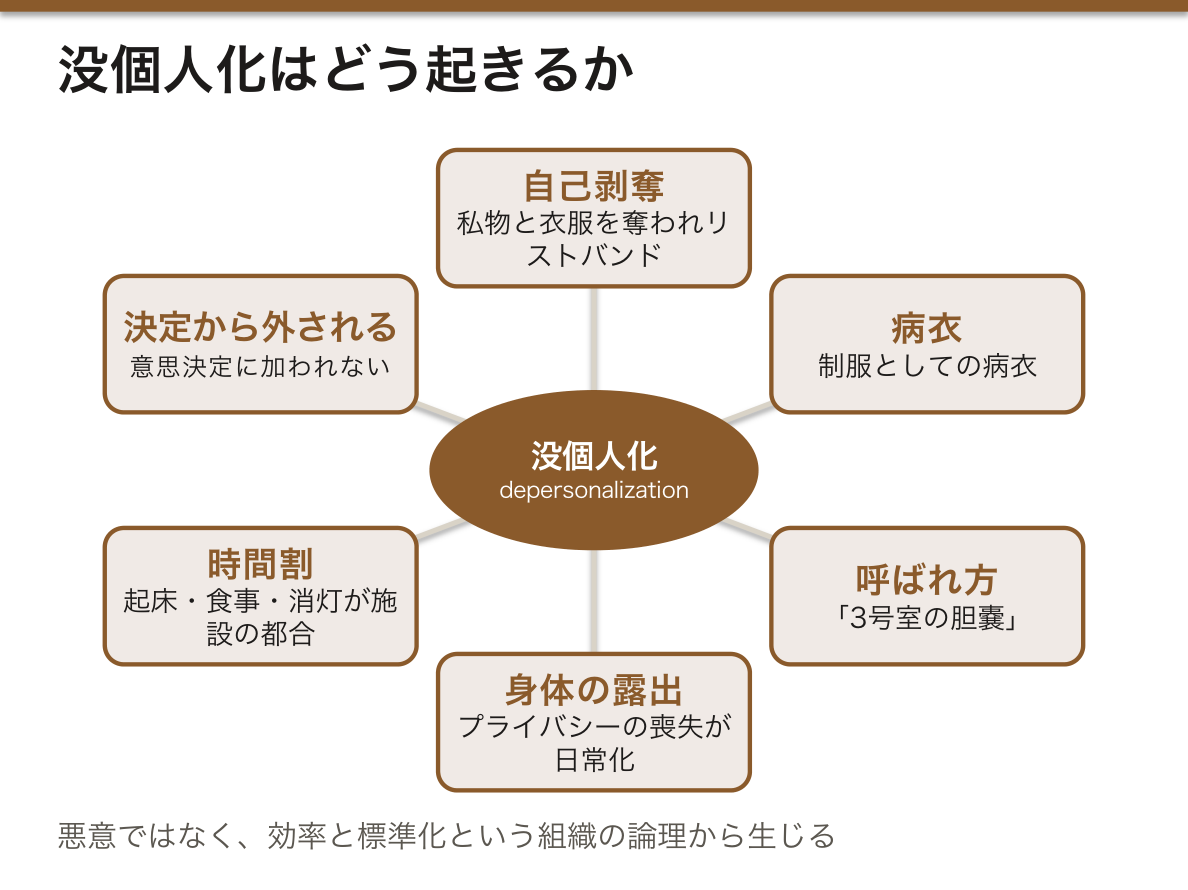
没個人化 depersonalization——患者が固有の人格を持つ人としてではなく、症例・臓器・番号として扱われるようになること。
どう起きるか——①入院手続きで私物と衣服を奪われ、リストバンドを付けられる(Goffman の自己剥奪)②病衣という制服③「3号室の胆嚢」のような呼ばれ方④身体の露出とプライバシーの喪失が日常化する⑤時間割が施設の都合で決まる(起床・食事・消灯)⑥意思決定から外される。
組織にとっては合理的——効率と標準化のために個別性は邪魔になる。「悪意ではなく組織の論理から生じる」点が重要。
Goffman の全制的施設の概念が、そのまま一般病院にも当てはまると示したのがこの議論の核心。
対策として挙げられるのは患者中心のケア、名前で呼ぶこと、私物の持ち込み、面会の自由、意思決定への参加。「医学の黄金時代」の章の患者中心のケアと接続する。
English version
Core
Depersonalisation — the patient coming to be treated not as a person with an individual identity but as a case, an organ, a number.
How it happens — ① on admission, belongings and clothes are taken away and a wristband put on (Goffman’s mortification of the self) ② the hospital gown as a uniform ③ being called "the gall bladder in room 3" ④ exposure of the body and loss of privacy become routine ⑤ the timetable is set by the institution’s convenience (waking, meals, lights out) ⑥ being excluded from decisions.
It is rational for the organisation — individuality is an obstacle to efficiency and standardisation. The important point is that it arises from the logic of the organisation, not from ill will.
The core of the argument is that Goffman’s concept of the total institution applies to the ordinary general hospital as it stands.
Going further
The measures raised are patient-centred care, using names, allowing personal belongings, free visiting, and participation in decisions. It connects with patient-centred care in the chapter on the golden age of medicine.
入院費はなぜ上がり続けるのか — 原因と抑え方
米国の入院費は、医療の中でもっとも急に上がった。1925年、ボストンの大病院の1日の入院費は3ドルで、患者が全額払っていた。2017年には全米平均で1日約3,950ドルになり、病院の費用の約9割を第三者(民間保険・公的保険)が払うようになった。2019年の米国の医療費は3.8兆ドルで、その約3分の1が病院医療に使われた。
病院の支出は2つに分かれる。日常的費用(部屋と食事、24時間いる看護師・技師・研修医の給与、医療以外の物品)と、付随的費用(検査室・薬剤部・手術室・放射線室などの設備と医療材料)。使わない患者がいても、設備の維持費はかかり続ける。
費用を押し上げる要因は——①人件費・医療機器・材料・建設費の上昇。②事務作業:保険者ごとに書式が違う米国では請求処理に大量の職員が要る。カナダの単一書式の病院では請求係が1人なのに、同規模の米国の病院では45人という比較がある。③医療技術:一部の患者しか使わず、操作に人手が要る技術は費用を上げる。病院は医師をつなぎとめるために、費用対効果にかかわらず最新の機器をそろえようとする。④無保険者の救急外来の利用:法律で救急患者を断れないため、無保険の人がかかりつけ代わりに救急外来を使い、回収できない費用が膨らむ。
抑える方法として挙げられているのは、①請求書式を1つにして事務を減らす、②全員に基本的な保険を与え、救急外来ではなく通常の外来を使えるようにする、③1件ごとの定額払いである。米国は1983年、高齢者向けの公的保険(Medicare)で、診断群(DRG)ごとに病院への支払いを定額にする仕組みを入れた。それまでは病院が使った分だけ払っていたので、使えば使うほど収入が増えた。定額にすると、病院には効率よく治療する動機が生まれる。
誰が費用を抑える責任を負うべきか——政府か、保険者か、病院か。どこか1つに任せると、負担はほかへ押し付けられる。病院は定額払いに対して、サービスを広げ、診療所や救急センターと網を作って収入を守ろうとした。非営利病院でさえ、新しい技術の購入や設備の維持のために利益を追う事業体として振る舞う。費用の問題は、誰がどの階級のために病院を動かしているかという葛藤理論の問いにつながる。
日本の急性期病院の多くで使われる DPC(診断群分類にもとづく1日あたりの包括払い)は、米国の DRG と同じ発想の仕組みである。在院日数の短縮やクリニカルパスの普及は、この支払い方式と結びついている。病棟で「なぜ早く退院させるのか」を理解する手がかりになる。
English version
Core
In the US, the cost of hospital care has risen faster than any other part of medical care. In 1925, one day in a large Boston hospital cost 3 dollars, paid fully by the patient. In 2017 the US average was about 3,950 dollars per day, and about 90% of hospital costs are paid by third parties (private or public insurance). In 2019, US health spending was 3.8 trillion dollars, and about one third went to hospital care.
Hospital spending has two parts: routine costs (room and meals, salaries of nurses, technicians and residents available 24 hours, non-medical supplies) and ancillary costs (laboratories, pharmacy, operating rooms, X-ray and other facilities, and medical supplies). Facilities cost money even when some patients never use them.
Drivers of cost: (1) rising labour, equipment, supply and construction costs; (2) paperwork — in the US each insurer has different forms; one comparison found one claims clerk in a Canadian hospital with a single form, and 45 in a US hospital of the same size; (3) technology that only a few patients use and that needs many staff; hospitals buy the newest machines to keep doctors, whether or not they are cost-effective; (4) uninsured people using emergency rooms — hospitals cannot refuse emergency patients by law, so the uninsured use the ER for primary care and costs that cannot be recovered grow.
Going further
Proposed solutions: (1) one claim form to cut paperwork; (2) basic insurance for everyone, so people use normal clinics, not the ER; (3) fixed payment per case. In 1983 the US introduced, for Medicare (public insurance for the elderly), fixed payments to hospitals by diagnosis-related group (DRG). Before, hospitals were paid what they spent, so spending more meant earning more. Fixed payment gives hospitals a reason to treat efficiently.
Who should control costs — government, insurers or hospitals? If one party is left alone, it pushes the burden onto others. Hospitals answered fixed payment by expanding services and building networks with clinics and urgent care centres to protect income. Even non-profit hospitals act like profit-seeking businesses to buy technology and maintain buildings. The cost problem leads to a conflict-theory question: who runs the hospital, and for which class?
In the clinic
Many acute hospitals in Japan use DPC (per-diem bundled payment based on diagnosis groups), which follows the same idea as the US DRG. Shorter hospital stays and clinical pathways are linked to this payment system. This helps you understand why patients are discharged early on the ward.
まとめ
| 病院の語源と、社会制度としての変遷 | 語源——ラテン語 hospes(客・もてなす者)→ hospitalis(客をもてなす)。 |
|---|---|
| 救貧院・精神病院・死の家 — 病院が医療技術の中心になるまで | 中世の病院は教会の慈善の場で、医療と同時に魂の世話(祈り・告解)を担った。 |
| 病院の所有形態と「二重の権威」 — 管理部門と医師のあいだ | 米国の病院の所有形態は3つ——非営利・営利・政府(連邦・州・地方)。 |
| 没個人化 — 入院患者に何が起きるか | 没個人化 depersonalization——患者が固有の人格を持つ人としてではなく、症例・臓器・番号として扱われるようになること。 |
| 入院費はなぜ上がり続けるのか — 原因と抑え方 | 米国の入院費は、医療の中でもっとも急に上がった。 |
このノートは医学生が授業の内容を自分の言葉でまとめたもので、診療の判断に使うものではありません。誤りに気づいたらお知らせください。