溶液のある種の性質は、溶けているものが何かに関係なく、溶けている粒子の数だけで決まる。これを束一的性質と呼び、医学でいちばん大切なのが浸透圧である。
水は半透膜(細胞膜)を通って、粒子の濃い側へ移動する。だから細胞を取り囲む液の粒子の濃さが、細胞が膨らむか縮むかを決める。この章では、浸透圧の式 π = icRT、電解質の粒子数を数える等張係数 i、そして等張・高張・低張の考え方を、輸液や脳浮腫の治療まで結びつけて扱う。
- 束一的性質 — 粒子の「種類」ではなく「数」で決まる性質
- 浸透と浸透圧 — π = icRT
- 等張係数 i — 電解質は何個の粒子として効くか
- 等張・高張・低張 — 赤血球は膨らむか縮むか
- 輸液・浮腫・脳浮腫 — 臨床の浸透圧
束一的性質 — 粒子の「種類」ではなく「数」で決まる性質
溶媒に溶質を溶かすと、溶液は純粋な溶媒と比べて次の4つが変わる。①蒸気圧が下がる、②沸点が上がる、③凝固点が下がる、④浸透圧が生じる。どれも変化の大きさは溶けている粒子の数(濃度)で決まり、粒子が何であるかにはよらない(溶媒の種類にはよる)。これを束一的性質という。
たとえば凝固点の低下は ΔTf = i · Kf · m(Kf:水では 1.86 K·kg/mol、m:質量モル濃度、i:粒子の数の係数)で表され、同じ濃度なら NaCl はグルコースの約2倍凝固点を下げる。
なぜ粒子の種類によらないのか。4つの性質はどれも、溶媒分子の「逃げやすさ」が、溶質の粒子に割り込まれて下がることから生じるからである。液面の一部を溶質が占めれば、そこから蒸発する溶媒分子が減って蒸気圧が下がる。蒸気圧が下がれば、沸騰させるのにより高い温度が要る。凍るときも、溶質が溶媒分子の整列を邪魔するので、より低い温度まで冷やさないと固まらない。割り込むのが Na+ でもグルコースでも、1個は1個として効く。
だから電解質では、1つの化合物がいくつの粒子に分かれるかを必ず数える。ここで出てくる係数 i が、浸透圧の計算でもそのまま使われる。
検査室の浸透圧計の多くは、血清や尿の凝固点がどれだけ下がるかを測って浸透圧(mOsm/kg)を出している。血漿はおよそ 0.29 Osm/kg なので、凝固点は約 −0.54 °C(0.29 × 1.86)になる。冬の道路に塩をまくのも同じ原理である。
English version
Core
Dissolving a solute changes four things compared with the pure solvent: ① the vapour pressure falls, ② the boiling point rises, ③ the freezing point falls, and ④ an osmotic pressure appears. The size of each change depends on the number (concentration) of dissolved particles, not on what they are (it does depend on the solvent). These are colligative properties.
For example, freezing-point depression is ΔTf = i · Kf · m (Kf = 1.86 K·kg/mol for water; m: molality; i: particle-number factor). At the same concentration, NaCl lowers the freezing point about twice as much as glucose.
Going further
Why does the kind of particle not matter? All four effects come from solute particles getting in the way and making solvent molecules less able to “escape”. If solute takes up part of the surface, fewer solvent molecules evaporate, so the vapour pressure falls; a higher temperature is then needed to boil. When freezing, solute disturbs the ordering of solvent molecules, so it must be cooled further before it solidifies. Whether the particle is Na+ or glucose, one particle counts as one.
So with electrolytes, always count how many particles one compound splits into. The factor i that appears here is used directly in osmotic pressure calculations.
In the clinic
Most laboratory osmometers measure how far the freezing point of serum or urine falls and convert it to osmolality (mOsm/kg). Plasma is about 0.29 Osm/kg, so it freezes at about −0.54 °C (0.29 × 1.86). Spreading salt on winter roads uses the same principle.
浸透と浸透圧 — π = icRT
浸透とは、溶媒(水)は通すが溶質は通さない半透膜を通って、溶媒が自然に移動する現象である。水は粒子の少ない側(薄い側)から多い側(濃い側)へ正味で流れる。
浸透圧 π は、半透膜で純水と隔てた溶液に、水の流れ込みを止めるために加えなければならない圧力である。U字管の片側に純水、反対側にグルコース水溶液を入れると、溶液側の液面が上がり、その高さの差が浸透圧に釣り合ったところで止まる。
π = i · cM · R · T(i:等張係数、cM:mol/L、R = 8.314 J/(mol·K)、T:絶対温度 K)。この単位で入れると π は kPa で出る。
単位が kPa になる理由:mol/L × J/(mol·K) × K = J/L で、1 J/L = 1000 J/m3 = 1000 Pa = 1 kPa だからである。T は必ず K(t + 273.15)で入れる。
なぜ水は濃い側へ動くのか。半透膜の両側で水分子は膜を行き来しているが、溶液側では溶質の粒子が割り込むぶん膜にぶつかる水分子の割合が少ない。純水側から溶液側へ入る水のほうが多くなり、正味の流れが生じる。これは「濃い液を薄めて、両側の濃さをそろえようとする」動きと見ることもできる。
例:0.100 mol/L のグルコース(i = 1)の 25 °C での浸透圧は π = 1 × 0.100 × 8.314 × 298.15 ≈ 248 kPa。大気圧(約101 kPa)の2倍を超える。薄い溶液でもこれほど大きいので、浸透圧から高分子(蛋白など)のモル質量を求めることもできる。
English version
Core
Osmosis is the natural movement of solvent (water) through a semipermeable membrane that lets solvent pass but not solute. Water flows on balance from the side with fewer particles (dilute) to the side with more (concentrated).
Osmotic pressure π is the pressure that must be applied to a solution, separated from pure water by a semipermeable membrane, to stop water flowing in. In a U-tube with pure water on one side and glucose solution on the other, the solution level rises and stops when the height difference balances the osmotic pressure.
π = i · cM · R · T (i: isotonic coefficient; cM in mol/L; R = 8.314 J/(mol·K); T in K). With these units, π comes out in kPa.
Going further
Why kPa? mol/L × J/(mol·K) × K = J/L, and 1 J/L = 1000 J/m3 = 1000 Pa = 1 kPa. Always put T in kelvin (t + 273.15).
Why does water move to the concentrated side? Water molecules cross the membrane both ways, but on the solution side solute particles take up space, so a smaller fraction of the molecules hitting the membrane are water. More water enters from the pure-water side, giving a net flow. You can also see it as the system trying to dilute the concentrated side to even out the two sides.
Example: 0.100 mol/L glucose (i = 1) at 25 °C has π = 1 × 0.100 × 8.314 × 298.15 ≈ 248 kPa — more than twice atmospheric pressure (about 101 kPa). Because osmotic pressure is so large even for dilute solutions, it can be used to find the molar mass of large molecules such as proteins.
等張係数 i — 電解質は何個の粒子として効くか
浸透圧は粒子の総数で決まるので、電解質では 1 mol が何 mol 分の粒子になるかを係数 i(等張係数、ファントホッフ係数)で補正する。
i = 1 + α(N − 1)(α:電離度、N:1つの化学式から生じる粒子の数)
| 物質 | 種類 | N | α | i |
|---|---|---|---|---|
| グルコース、スクロース | 非電解質 | 1 | 0 | 1 |
| NaCl | 強電解質 | 2 | 1 | 2 |
| CaCl2、Ca(NO3)2 | 強電解質 | 3 | 1 | 3 |
| Na3PO4 | 強電解質 | 4 | 1 | 4 |
| Al2(SO4)3 | 強電解質 | 5 | 1 | 5 |
| 弱電解質(例 α = 0.05、N = 2) | 弱電解質 | 2 | 0.05 | 1.05 |
式の意味を読むと覚えなくてよくなる。溶かした分子のうち (1 − α) は分子のまま1個として残り、α は N 個に分かれる。合計は (1 − α) + αN = 1 + α(N − 1)。つまり cM(何個溶かしたか)× i(1個が何個になるか)= 実際の粒子の濃度で、これをオスモル濃度(Osm/L)と呼ぶ。
同じモル濃度なら、浸透圧は i の大きい順になる。K3PO4(i = 4)> K2SO4(3)> KCl(2)> 果糖(1)。逆に濃度が違っても浸透圧が等しくなることがある:0.10 mol/L の NaCl(粒子 0.20)と 0.20 mol/L のグルコース(粒子 0.20)は等張である。なお実際の NaCl 水溶液ではイオンどうしが少し引き合うため、i は2よりわずかに小さく(約1.8〜1.9)なる。計算では強電解質の α を1とおく。
生理食塩液 0.9%(0.154 mol/L)は i = 2 で粒子 0.308 Osm/L。37 °C での浸透圧は π = 2 × 0.154 × 8.314 × 310.15 ≈ 794 kPa(約0.79 MPa)で、血液の浸透圧(約0.74〜0.78 MPa)とほぼ同じである。臨床で使う血漿浸透圧の概算式 2 × Na + 血糖/18 + BUN/2.8(Na は mEq/L、血糖と BUN は mg/dL)で Na を2倍するのは、NaCl などの塩が陰イオンとセットで2個の粒子として効くからである。
English version
Core
Osmotic pressure depends on the total number of particles, so for electrolytes we correct with the factor i (the isotonic or van ‘t Hoff coefficient), which tells how many moles of particles 1 mol gives.
i = 1 + α(N − 1) (α: degree of dissociation; N: number of particles from one formula unit)
| Substance | Type | N | α | i |
|---|---|---|---|---|
| Glucose, sucrose | non-electrolyte | 1 | 0 | 1 |
| NaCl | strong electrolyte | 2 | 1 | 2 |
| CaCl2, Ca(NO3)2 | strong electrolyte | 3 | 1 | 3 |
| Na3PO4 | strong electrolyte | 4 | 1 | 4 |
| Al2(SO4)3 | strong electrolyte | 5 | 1 | 5 |
| Weak electrolyte (e.g. α = 0.05, N = 2) | weak electrolyte | 2 | 0.05 | 1.05 |
Going further
Read the meaning and you need not memorise it. Of the dissolved molecules, (1 − α) stay as one particle each, and α split into N. The total is (1 − α) + αN = 1 + α(N − 1). So cM (how many dissolved) × i (how many each becomes) = the real particle concentration, called the osmolarity (Osm/L).
At the same molarity, osmotic pressure follows i: K3PO4 (i = 4) > K2SO4 (3) > KCl (2) > fructose (1). And solutions with different concentrations can have the same osmotic pressure: 0.10 mol/L NaCl (0.20 particles) and 0.20 mol/L glucose (0.20 particles) are isotonic. In real NaCl solutions the ions attract each other a little, so i is slightly below 2 (about 1.8–1.9). In calculations, take α = 1 for strong electrolytes.
In the clinic
Normal saline 0.9% (0.154 mol/L) has i = 2, so 0.308 Osm/L of particles. At 37 °C, π = 2 × 0.154 × 8.314 × 310.15 ≈ 794 kPa (about 0.79 MPa), almost the same as blood (about 0.74–0.78 MPa). In the bedside formula plasma osmolality ≈ 2 × Na + glucose/18 + BUN/2.8 (Na in mEq/L; glucose and BUN in mg/dL), Na is doubled because sodium salts act as two particles together with their anions.
等張・高張・低張 — 赤血球は膨らむか縮むか
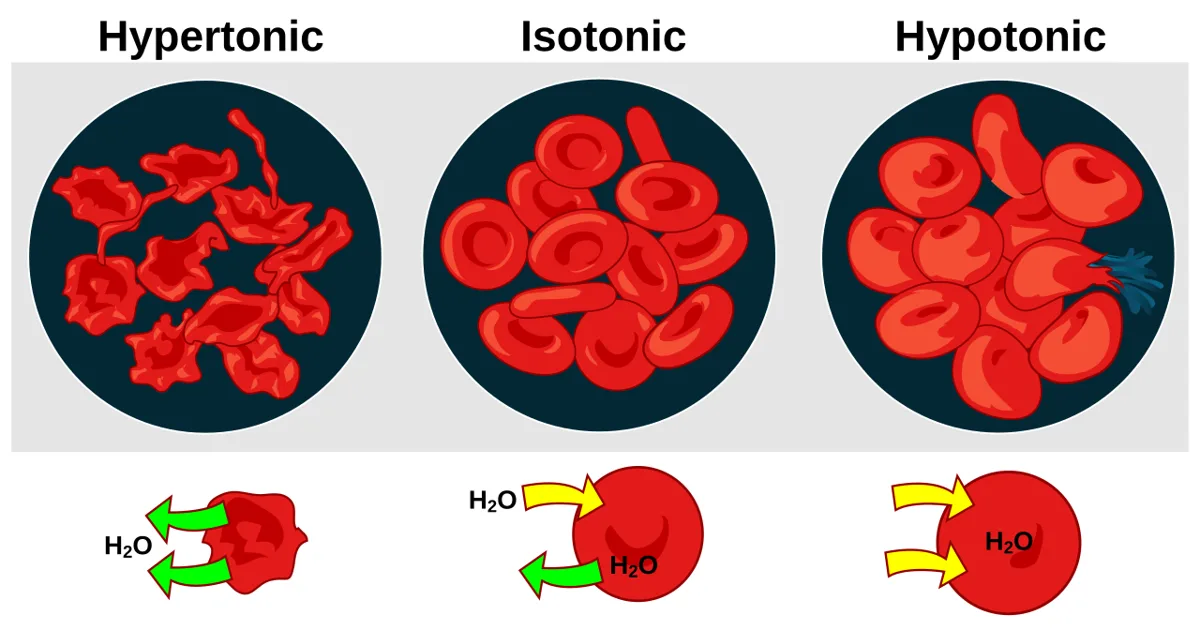
張度(tonicity)は、細胞の外の液が、浸透によって細胞に水を出し入れさせる力である。いつも「何と比べて」の言葉で、2つの液の浸透圧が等しければ互いに等張である。
| 細胞の外の液 | 水の動き | 赤血球 |
|---|---|---|
| 等張液 | 正味の出入りなし | 形と大きさが保たれる |
| 高張液(外が濃い) | 細胞から外へ出る | 縮んで表面がこぶ状になる(金平糖状) |
| 低張液(外が薄い) | 外から細胞へ入る | 膨らみ、ついには破れる(溶血) |
水の向きは「濃いほうを薄めようとする」と覚えればまちがえない。細胞の中より外が濃ければ、外を薄めるために水が細胞から出ていく。
注意したいのは、浸透圧が等しい(等浸透圧)ことと、細胞にとって等張であることは別という点である。膜を自由に通り抜ける溶質(尿素など)は、試験管の中では浸透圧に数えられるが、細胞膜の両側に同じように広がるので水を動かさない。張度に効くのは膜を通れない粒子だけである。
高張な液を等張にしたければ水で薄め、低張な液なら溶質を加える。2つの液が等張かどうかは、cM × i(粒子の濃度)を比べれば判断できる。1.0 mol/L のスクロース(i = 1)と 1.0 mol/L の CaCl2(i = 3)は同じモル濃度でも等張ではない。
5% ブドウ糖液は瓶の中では血漿とほぼ等浸透圧だが、体に入るとグルコースが細胞に取り込まれて代謝され、あとには水だけが残る。そのため生体内では実質的に低張な輸液(自由水を与える液)として働き、大量に入れると低ナトリウム血症の原因になる。また純水を静脈に入れると赤血球が溶血するので、注射液や点眼液は等張に調整されている。
English version
Core
Tonicity is the ability of the fluid outside a cell to move water into or out of the cell by osmosis. It is always a comparison: two fluids with equal osmotic pressure are isotonic to each other.
| Fluid outside the cell | Water movement | Red blood cell |
|---|---|---|
| Isotonic | no net movement | keeps its shape and size |
| Hypertonic (outside more concentrated) | out of the cell | shrinks and gets a bumpy surface (crenation) |
| Hypotonic (outside more dilute) | into the cell | swells and finally bursts (haemolysis) |
Going further
Remember that water moves to dilute the more concentrated side, and you will not go wrong. If the outside is more concentrated than the cell, water leaves the cell to dilute the outside.
Note that equal osmotic pressure (iso-osmotic) is not the same as isotonic for a cell. A solute that crosses the membrane freely (such as urea) counts towards osmotic pressure in a test tube, but it spreads equally on both sides of the membrane, so it does not move water. Only particles that cannot cross the membrane affect tonicity.
To make a hypertonic fluid isotonic, dilute it with water; for a hypotonic fluid, add solute. To judge whether two fluids are isotonic, compare cM × i (particle concentration). 1.0 mol/L sucrose (i = 1) and 1.0 mol/L CaCl2 (i = 3) have the same molarity but are not isotonic.
In the clinic
5% glucose is almost iso-osmotic with plasma in the bottle, but in the body the glucose is taken into cells and metabolised, leaving only water. So in the body it acts as a hypotonic fluid (it gives free water), and large volumes can cause hyponatraemia. Pure water injected into a vein would haemolyse red cells, so injections and eye drops are adjusted to be isotonic.
輸液・浮腫・脳浮腫 — 臨床の浸透圧
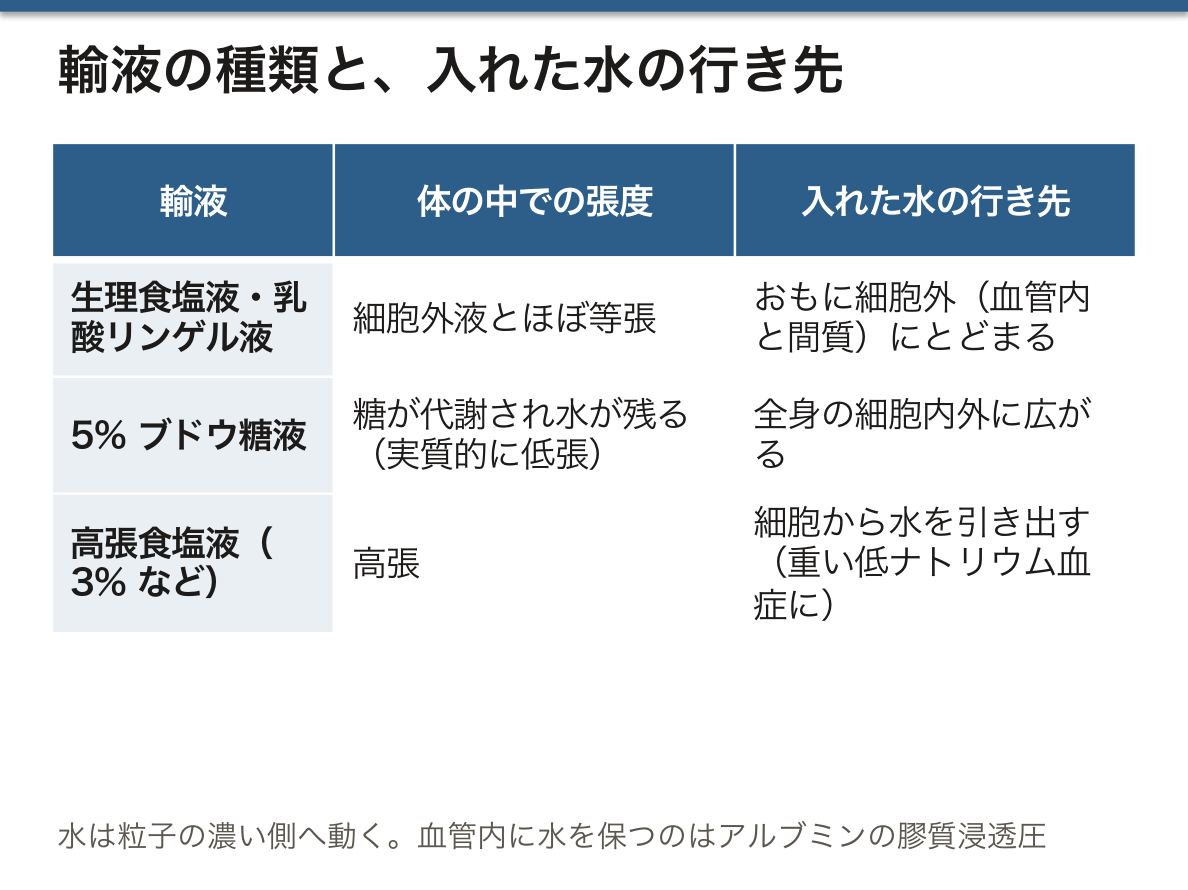
輸液の基本は浸透圧である。生理食塩液・乳酸リンゲル液は細胞外液とほぼ等張で、入れた水はおもに細胞外(血管内と間質)にとどまる。5% ブドウ糖液はグルコースが代謝されると水として全身の細胞内外に広がる。高張食塩液(3% など)は細胞から水を引き出し、重い症状のある低ナトリウム血症に使う。
血管内に水を保つのは、血管壁を通りにくい血漿蛋白(主にアルブミン)による浸透圧で、これを膠質浸透圧(約25 mmHg)と呼ぶ。総浸透圧のごく一部だが、毛細血管で水を血管内へ引き戻す力になっている。
浸透圧の差は、細胞の体積を変える。脳圧亢進(脳浮腫)にはマンニトールや高張食塩液を静注する。マンニトールは血液脳関門を通りにくいので、血管内を高張にして脳組織から水を引き出し、さらに腎で再吸収されずに浸透圧利尿を起こす。
逆に、慢性の低ナトリウム血症では、脳細胞は細胞内の溶質を減らして膨らまないように適応している。ここへ急に Na を補正して外を濃くすると、今度は細胞から水が急に抜けて浸透圧性脱髄症候群を起こしうる。補正の速さに上限があるのは、浸透による水の動きの速さに細胞の適応が追いつかないからである。
低アルブミン血症(ネフローゼ症候群・肝硬変・低栄養)では膠質浸透圧が下がり、毛細血管から間質へ出た水が戻れなくなって浮腫や胸水・腹水がたまる。糖尿病の高血糖では血漿浸透圧が上がり、細胞内から水が引き出されて脱水が進む(高浸透圧高血糖状態)。どれも「水は粒子の濃い側へ動く」の一言で説明できる。
English version
Core
Intravenous fluids are built on osmotic pressure. Normal saline and lactated Ringer’s are nearly isotonic with extracellular fluid, so the water stays mainly outside cells (in vessels and the interstitium). 5% glucose spreads as water into and out of all cells once the glucose is metabolised. Hypertonic saline (e.g. 3%) draws water out of cells and is used for hyponatraemia with severe symptoms.
Water is held inside vessels by the osmotic pressure of plasma proteins (mainly albumin) that do not cross the vessel wall easily. This is the oncotic (colloid osmotic) pressure (about 25 mmHg). It is only a tiny part of the total osmotic pressure, but it pulls water back into capillaries.
Going further
Differences in osmotic pressure change cell volume. For raised intracranial pressure (brain oedema), mannitol or hypertonic saline is given intravenously. Mannitol hardly crosses the blood–brain barrier, so it makes the blood hypertonic and draws water out of brain tissue; it is also not reabsorbed by the kidney and causes osmotic diuresis.
On the other hand, in chronic hyponatraemia brain cells adapt by reducing their internal solutes so they do not swell. If Na is corrected too fast and the outside becomes concentrated suddenly, water leaves the cells quickly and osmotic demyelination syndrome can occur. There is an upper limit on the speed of correction because the cells cannot adapt as fast as water moves by osmosis.
In the clinic
In hypoalbuminaemia (nephrotic syndrome, cirrhosis, malnutrition), oncotic pressure falls, water that leaves capillaries cannot return, and oedema, pleural effusion and ascites build up. In diabetic hyperglycaemia, plasma osmolality rises and water is drawn out of cells, worsening dehydration (hyperosmolar hyperglycaemic state). All of these come from one idea: water moves towards more particles.
まとめ
| 束一的性質 — 粒子の「種類」ではなく「数」で決まる性質 | 溶媒に溶質を溶かすと、溶液は純粋な溶媒と比べて次の4つが変わる。 |
|---|---|
| 浸透と浸透圧 — π = icRT | 浸透とは、溶媒(水)は通すが溶質は通さない半透膜を通って、溶媒が自然に移動する現象である。 |
| 等張係数 i — 電解質は何個の粒子として効くか | 浸透圧は粒子の総数で決まるので、電解質では 1 mol が何 mol 分の粒子になるかを係数 i(等張係数、ファントホッフ係数)で補正する。 |
| 等張・高張・低張 — 赤血球は膨らむか縮むか | 張度(tonicity)は、細胞の外の液が、浸透によって細胞に水を出し入れさせる力である。 |
| 輸液・浮腫・脳浮腫 — 臨床の浸透圧 | 輸液の基本は浸透圧である。生理食塩液・乳酸リンゲル液は細胞外液とほぼ等張で、入れた水はおもに細胞外(血管内と間質)にとどまる。 |
このノートは医学生が授業の内容を自分の言葉でまとめたもので、診療の判断に使うものではありません。誤りに気づいたらお知らせください。