中和滴定を、指示薬の色ではなく pH 計で pH を測りながら行い、加えた体積に対して pH をグラフにしたものが滴定曲線である。1本の曲線から、当量点(反応の終わり)、緩衝域、半中和点が読み取れ、そこから試料の濃度と弱酸の pKa が同時にわかる。
曲線の形を見れば「何を何で滴定したか」(強酸か弱酸か、強塩基か弱塩基か)も判断できる。前の章の pH 計算と、次の章の緩衝液をつなぐ章である。
- 電位差滴定 — pH 計で当量点を見つける
- 滴定曲線の形 — 何を何で滴定したかを読む
- 半中和点 — pH = pKa が曲線から読める
- 滴定曲線から濃度を求める
- 指示薬の選び方 — 変色域を跳躍の中に置く
電位差滴定 — pH 計で当量点を見つける
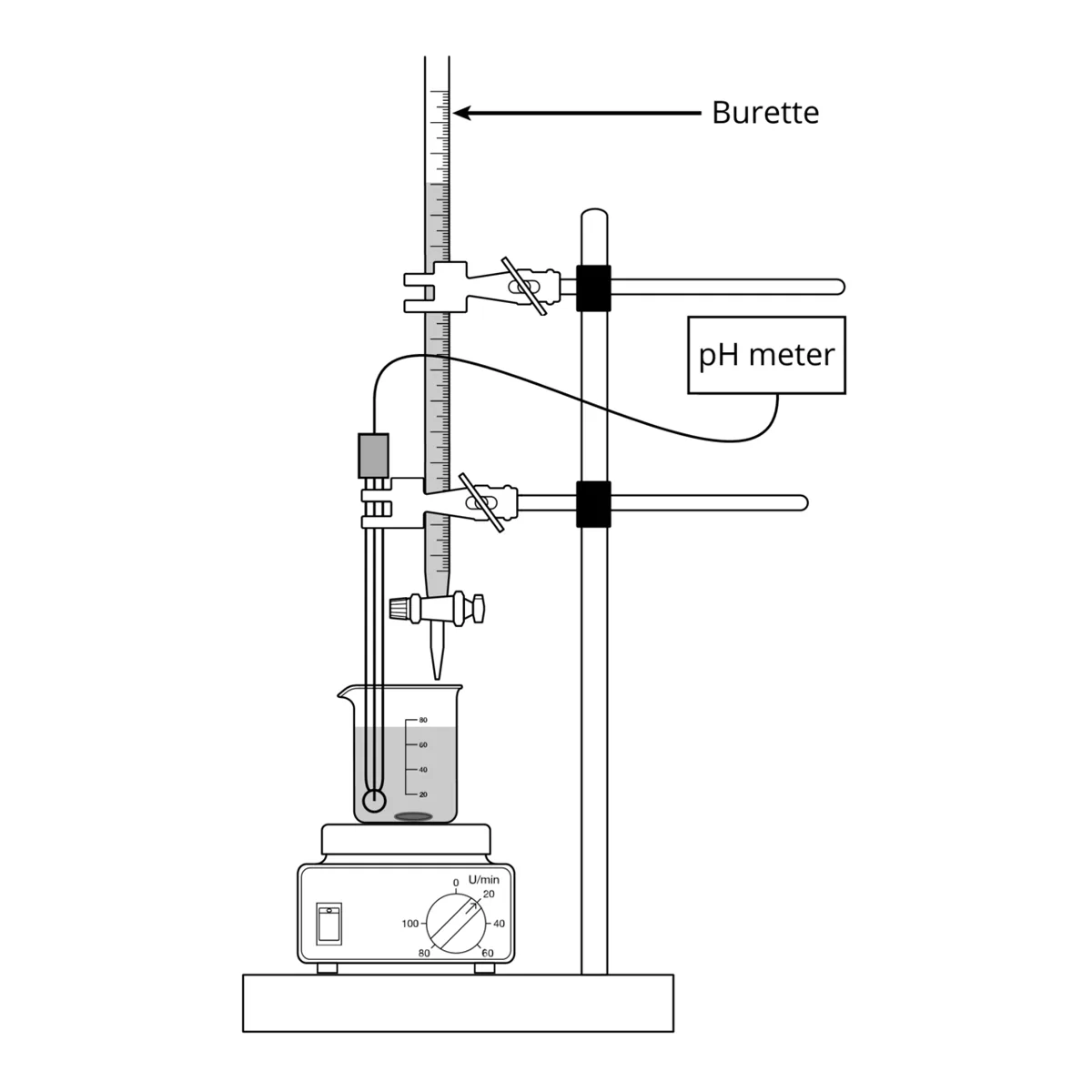
電位差滴定は、溶液に電極を入れて電位(電圧)の変化を追いながら行う滴定である。中和滴定では pH 計(ガラス電極)を使い、滴定液を少量(例:0.2 mL)ずつ加えるたびに pH を記録して、pH 対 加えた体積のグラフを描く。
手順は、試料をホールピペットでビーカーに取り、マグネチックスターラーで混ぜながら、電極の先が液につかり撹拌子に当たらない位置に固定し、ビュレットから滴定液を加えていく。電極は測定ごとに蒸留水で洗う。
なぜ「電位差」と呼ぶのか。pH 計は、ガラス膜の内外の H+ 濃度の違いで生じる電位を、基準電極と比べて測っている。電位は pH に比例して変わり、25 °C では pH 1 あたり約 59 mV(ネルンストの式による)。装置はこのミリボルトの値を pH に換算して表示する。
指示薬に比べた利点は、①色のついた液や濁った液でも使える、②当量点を色の主観ではなく曲線の形から客観的に決められる、③当量点だけでなく曲線全体が得られるので pKa も求まる、ことである。測る前に、pH のわかった標準液(緩衝液)で pH 計を校正する。蒸留水の pH が7ちょうどにならず少し酸性に出るのは、空気中の CO2 が溶けて炭酸ができるからである。
English version
Core
A potentiometric titration follows the change in electrical potential (voltage) of an electrode in the solution. For acid–base titration a pH meter (glass electrode) is used: after each small addition of titrant (e.g. 0.2 mL), pH is recorded and a graph of pH against added volume is drawn.
Take the sample into a beaker with a volumetric pipette, stir with a magnetic stirrer, fix the electrode so its tip is in the liquid but not hit by the stirring bar, and add titrant from the burette. Rinse the electrode with distilled water between measurements.
Going further
Why “potentiometric”? A pH meter measures the potential that arises from the difference in H+ concentration across a glass membrane, compared with a reference electrode. The potential changes in proportion to pH — about 59 mV per pH unit at 25 °C (from the Nernst equation). The meter converts these millivolts to pH.
Compared with indicators, it ① works with coloured or cloudy solutions, ② finds the equivalence point objectively from the curve rather than by judging a colour, and ③ gives the whole curve, so pKa can also be found. Before measuring, calibrate the meter with standard solutions (buffers) of known pH. Distilled water does not read exactly pH 7 but slightly acidic, because CO2 from the air dissolves and forms carbonic acid.
滴定曲線の形 — 何を何で滴定したかを読む
滴定曲線は、①ゆるやかに pH が変わる区間、②当量点付近で pH が急に跳ね上がる(または下がる)区間、③過剰の滴定液で再びゆるやかになる区間、からなる。跳躍のまん中(傾きが最大の点)が当量点である。
| 組み合わせ(0.1 mol/L どうし) | 始めの pH | 当量点の pH | 跳躍 |
|---|---|---|---|
| 強酸を強塩基で | 約1 | 7 | 大きい(約4〜10) |
| 弱酸(酢酸)を強塩基で | 約2.9 | 7より上(約8.7) | 中くらい。手前に緩衝域 |
| 弱塩基(アンモニア)を強酸で | 約11 | 7より下(約5.3) | 中くらい。手前に緩衝域 |
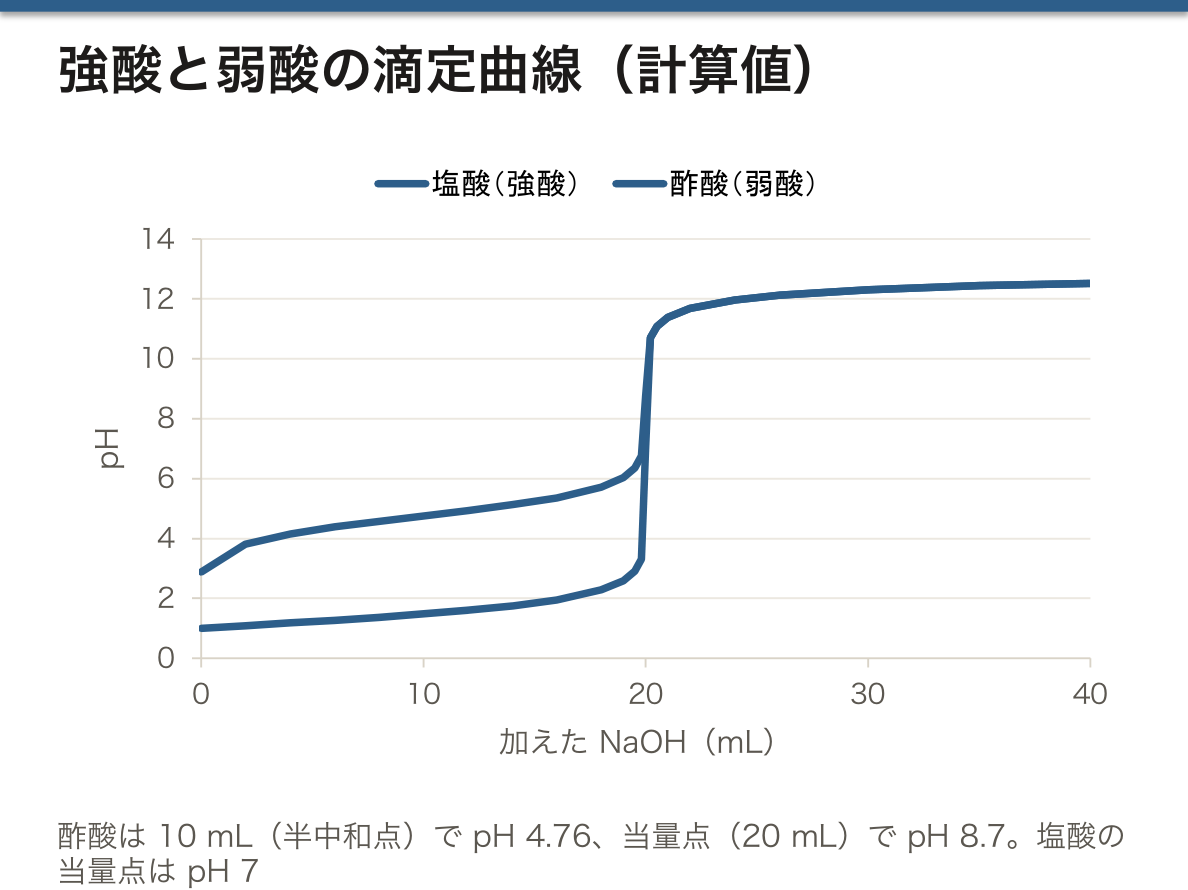
当量点の pH が7からずれるのは塩の加水分解のためである。酢酸を NaOH でちょうど中和すると、液には CH3COONa だけが残り、CH3COO− が水から H+ を受け取って OH− を生むので塩基性になる。濃度 0.050 mol/L の酢酸イオン(pKb 9.24)なら pOH = (9.24 + 1.30)/2 ≈ 5.27、pH ≈ 8.7。アンモニアを塩酸で中和すれば NH4+ が残って酸性になる。
曲線の読み方の手がかり:始めの pH が低く跳躍が大きいなら強酸、始めの pH が高めで、すぐに pH が少し上がったあと平らな区間(緩衝域)があるなら弱酸、当量点が7なら相手も強い、と判断できる。弱酸と弱塩基どうしの滴定は跳躍がはっきりせず、当量点を決めにくいので普通は使わない。多価の酸(H3PO4 など)では、H+ を1つずつ失うごとに跳躍が現れ、曲線に階段が複数できる。
English version
Core
A titration curve has ① a section where pH changes slowly, ② a section near the equivalence point where pH jumps up (or down) sharply, and ③ a section where it becomes gentle again with excess titrant. The middle of the jump (the point of steepest slope) is the equivalence point.
| Combination (both 0.1 mol/L) | Starting pH | pH at equivalence | Jump |
|---|---|---|---|
| Strong acid with strong base | about 1 | 7 | large (about 4 to 10) |
| Weak acid (acetic) with strong base | about 2.9 | above 7 (about 8.7) | medium, with a buffer region before it |
| Weak base (ammonia) with strong acid | about 11 | below 7 (about 5.3) | medium, with a buffer region before it |
Going further
The equivalence pH moves away from 7 because of salt hydrolysis. When acetic acid is exactly neutralised by NaOH, only CH3COONa is left; CH3COO− takes H+ from water and forms OH−, so the solution is basic. For 0.050 mol/L acetate (pKb 9.24), pOH = (9.24 + 1.30)/2 ≈ 5.27, so pH ≈ 8.7. Neutralising ammonia with hydrochloric acid leaves NH4+, so it is acidic.
Clues for reading a curve: a low starting pH and a big jump mean a strong acid; a higher starting pH, a quick small rise, then a flat section (buffer region) mean a weak acid; an equivalence point at 7 means the partner is strong too. Titrations of a weak acid with a weak base have no clear jump and are hard to read, so they are not normally used. Polyprotic acids (such as H3PO4) show a jump each time they lose one H+, giving a curve with several steps.
半中和点 — pH = pKa が曲線から読める
弱酸を強塩基で滴定するとき、当量点までに要る体積のちょうど半分を加えた点を半中和点という。ここでは弱酸の半分が塩(共役塩基)に変わっているので [HA] = [A−] で、pH = pKa になる。
手順は、①曲線から当量点の体積 Veq を読む、②Veq/2 の位置を横軸にとる、③そこでの pH を読めば、それが pKa である。弱塩基を強酸で滴定した場合は、半中和点で pOH = pKb、すなわち pKb = 14 − pH(半中和点)となる。
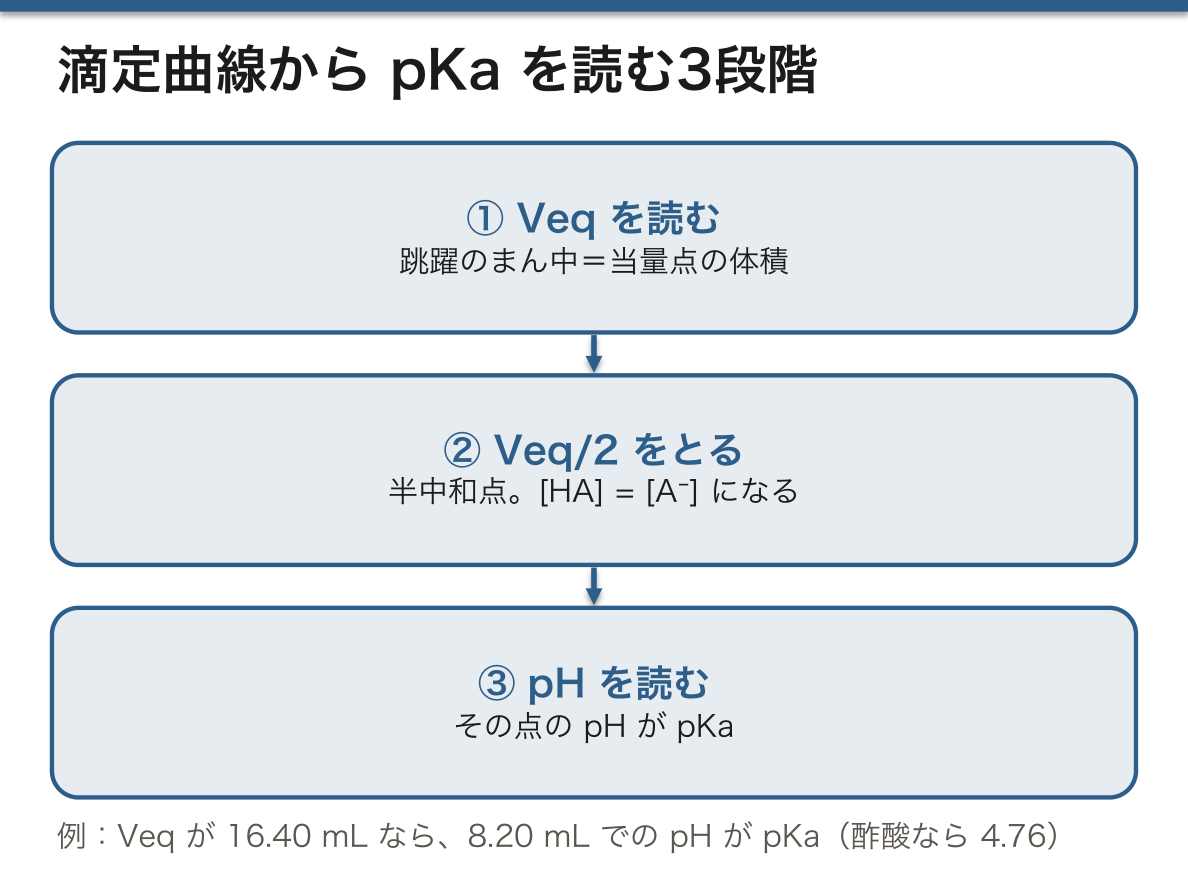
なぜ pH = pKa になるのか。Ka = [H+][A−]/[HA] で [A−] = [HA] なら、両者が約分されて Ka = [H+]、つまり pKa = pH。緩衝液の章で出てくる式 pH = pKa + log([A−]/[HA]) で、log 1 = 0 になる点と言ってもよい。
半中和点のまわりが、曲線のいちばん平らな部分(緩衝域)である。HA と A− が同じくらいあるので、少しの塩基を加えても HA が、少しの酸を加えても A− が吸収して pH があまり動かない。緩衝作用が最も強いのは pH = pKa のときで、曲線の形がそれを目に見える形で示している。実験で求めた pKa を文献値(酢酸 4.76)と比べると、濃度・温度・電極の校正の誤差を評価できる。
English version
Core
When a weak acid is titrated with a strong base, the point where exactly half the volume needed to reach equivalence has been added is the half-neutralisation point. Here half of the weak acid has become its salt (conjugate base), so [HA] = [A−] and pH = pKa.
Steps: ① read the equivalence volume Veq from the curve; ② go to Veq/2 on the x-axis; ③ the pH there is the pKa. For a weak base titrated with a strong acid, pOH = pKb at half-neutralisation, so pKb = 14 − pH (at half-neutralisation).
Going further
Why pH = pKa? In Ka = [H+][A−]/[HA], if [A−] = [HA] they cancel, so Ka = [H+] and pKa = pH. In the buffer equation of the next chapter, pH = pKa + log([A−]/[HA]), it is the point where log 1 = 0.
Around the half-neutralisation point is the flattest part of the curve, the buffer region. HA and A− are present in similar amounts, so a little added base is taken up by HA and a little added acid by A−, and the pH hardly moves. Buffering is strongest at pH = pKa, and the shape of the curve shows this visibly. Comparing the measured pKa with the literature value (4.76 for acetic acid) lets you judge errors in concentration, temperature and electrode calibration.
滴定曲線から濃度を求める
当量点の体積がわかれば、あとは溶液の化学量論である。①n(滴定液)= c × Veq、②反応式の比で n(試料)、③c(試料)= n / V(試料)。
例:酢酸 20.00 mL を 0.100 mol/L NaOH で滴定し、当量点が 16.40 mL だった。CH3COOH + NaOH → CH3COONa + H2O(1 : 1)より、n = 0.100 × 0.01640 = 1.640 × 10⁻³ mol、c = 1.640 × 10⁻³ / 0.02000 = 0.0820 mol/L。半中和点は 8.20 mL で、そこでの pH を読めば pKa が得られる。
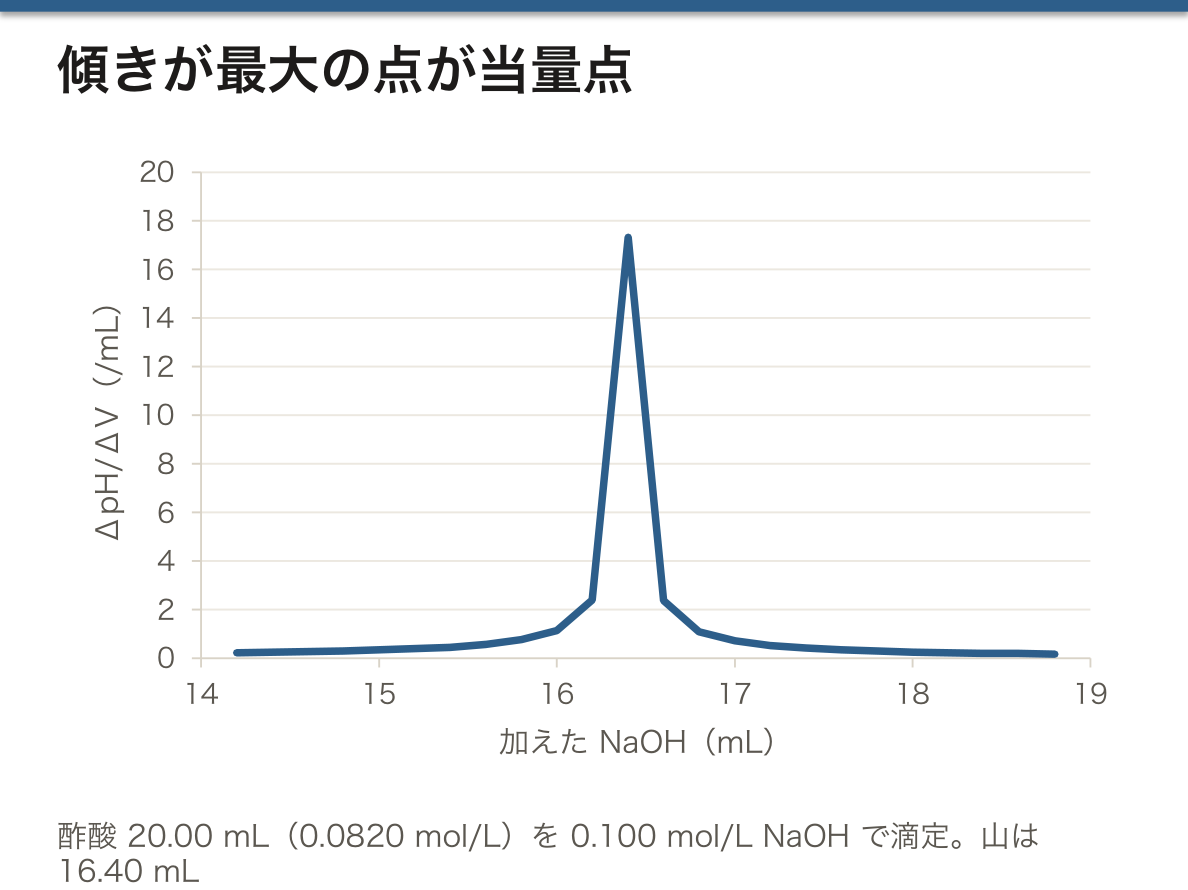
当量点の体積を正確に読むには、跳躍の部分を細かく刻んで測る(当量点の近くでは加える量を小さくする)。グラフ上では、跳躍の上下で曲線に平行な2本の接線を引き、その中間を通る線と曲線の交点をとる方法や、ΔpH/ΔV(傾き)をプロットしてその最大の位置をとる方法がある。表計算ソフトを使えば傾きの最大は簡単に求まる。
試料を最初にメスフラスコで薄めてから一部を取って滴定した場合は、最後に希釈倍率と分取の倍率を掛け戻すことを忘れない。H2SO4 のような2価の酸や Ca(OH)2 のような2価の塩基では、比が 1 : 2 になる点にも注意する。
English version
Core
Once you know the equivalence volume, the rest is solution stoichiometry: ① n(titrant) = c × Veq; ② n(sample) from the ratio in the equation; ③ c(sample) = n / V(sample).
Example: 20.00 mL of acetic acid is titrated with 0.100 mol/L NaOH, and the equivalence point is at 16.40 mL. From CH3COOH + NaOH → CH3COONa + H2O (1 : 1), n = 0.100 × 0.01640 = 1.640 × 10⁻³ mol, c = 1.640 × 10⁻³ / 0.02000 = 0.0820 mol/L. Half-neutralisation is at 8.20 mL; the pH there gives pKa.
Going further
To read the equivalence volume accurately, take small steps across the jump (add smaller amounts near the equivalence point). On the graph, you can draw two parallel tangents above and below the jump and take where the line midway between them crosses the curve, or plot ΔpH/ΔV (the slope) and take its maximum. A spreadsheet finds the maximum slope easily.
If the sample was first diluted in a volumetric flask and a portion was titrated, remember to multiply back by the dilution and aliquot factors at the end. For a diprotic acid such as H2SO4 or a base such as Ca(OH)2, the ratio is 1 : 2.
指示薬の選び方 — 変色域を跳躍の中に置く
指示薬自身も弱酸(HIn)で、HIn と In− の色が違う。色が変わる範囲(変色域)は、その指示薬の pKa のまわりおよそ ±1 で、この範囲が滴定曲線の跳躍の中に入る指示薬を選ぶ。
| 滴定 | 当量点 | 適した指示薬 |
|---|---|---|
| 強酸 – 強塩基 | pH 7(跳躍が大きい) | フェノールフタレイン、メチルオレンジのどちらでもよい |
| 弱酸 – 強塩基 | pH 7より上 | フェノールフタレイン(変色域 約8.2〜10) |
| 弱塩基 – 強酸 | pH 7より下 | メチルオレンジ(変色域 約3.1〜4.4) |
変色域が ±1 になるのは、緩衝液と同じ理由である。pH = pKa(HIn) + log([In−]/[HIn]) で、人の目が一方の色だけに見えるのは、だいたい片方が他方の10倍以上になったとき、つまり pKa から ±1 離れたときだからである。
弱酸の滴定にメチルオレンジを使うと、当量点よりずっと手前(緩衝域の途中)で色が変わってしまい、少なすぎる体積を読むことになる。指示薬の選択を誤ると系統誤差になる。また指示薬は弱酸なので、入れすぎると自分自身が滴定液を消費する。数滴で十分である。
腎臓は1日に生じる不揮発酸を尿へ捨てている。その一部は、尿中のリン酸の H2PO4− のように H+ をもった緩衝塩基の形で出ていき、尿を NaOH で血液の pH(7.4)まで滴定すると量れるので滴定酸と呼ばれる。残りはアンモニウムイオン NH4+ として出る。腎の酸排泄 ≈ 滴定酸 + NH4+という考え方は、腎尿細管性アシドーシスなどを理解する基礎になる。
English version
Core
An indicator is itself a weak acid (HIn), and HIn and In− have different colours. It changes colour over about ±1 pH unit around its own pKa, and you choose an indicator whose range falls inside the jump of the titration curve.
| Titration | Equivalence point | Suitable indicator |
|---|---|---|
| Strong acid – strong base | pH 7 (large jump) | phenolphthalein or methyl orange |
| Weak acid – strong base | above pH 7 | phenolphthalein (range about 8.2–10) |
| Weak base – strong acid | below pH 7 | methyl orange (range about 3.1–4.4) |
Going further
The range is about ±1 for the same reason as with buffers. pH = pKa(HIn) + log([In−]/[HIn]), and the eye sees only one colour when one form is about ten times the other — that is, about 1 unit away from pKa.
Using methyl orange for a weak-acid titration makes it change colour well before the equivalence point (in the middle of the buffer region), so you read too small a volume. The wrong indicator gives a systematic error. Also, an indicator is a weak acid, so too much of it uses up titrant itself; a few drops are enough.
In the clinic
The kidneys excrete the non-volatile acid produced each day into urine. Part leaves as buffer bases carrying H+, such as H2PO4− from urinary phosphate. It can be measured by titrating urine with NaOH up to blood pH (7.4), so it is called titratable acid. The rest leaves as ammonium NH4+. The idea that renal acid excretion ≈ titratable acid + NH4+ is the basis for understanding disorders such as renal tubular acidosis.
まとめ
| 電位差滴定 — pH 計で当量点を見つける | 電位差滴定は、溶液に電極を入れて電位(電圧)の変化を追いながら行う滴定である。 |
|---|---|
| 滴定曲線の形 — 何を何で滴定したかを読む | 滴定曲線は、①ゆるやかに pH が変わる区間、②当量点付近で pH が急に跳ね上がる(または下がる)区間、③過剰の滴定液で再びゆるやかになる区間、からなる。 |
| 半中和点 — pH = pKa が曲線から読める | 弱酸を強塩基で滴定するとき、当量点までに要る体積のちょうど半分を加えた点を半中和点という。 |
| 滴定曲線から濃度を求める | 当量点の体積がわかれば、あとは溶液の化学量論である。 |
| 指示薬の選び方 — 変色域を跳躍の中に置く | 指示薬自身も弱酸(HIn)で、HIn と In− の色が違う。 |
このノートは医学生が授業の内容を自分の言葉でまとめたもので、診療の判断に使うものではありません。誤りに気づいたらお知らせください。