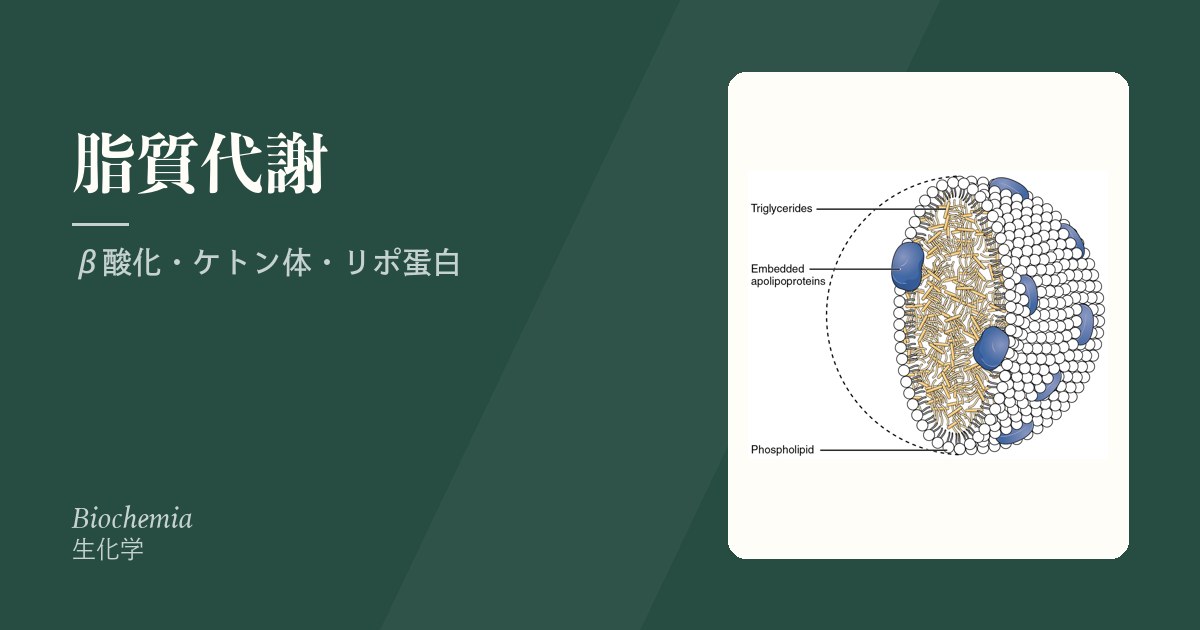
脂質は水に溶けない——この一点が脂質代謝のほぼ全部を決めている。溶けないから運ぶのに容れ物(リポ蛋白)が要り、膜を越えるのに運び屋(カルニチン)が要り、血中に出すのに変換(ケトン体)が要る。
エネルギー源としては圧倒的に有利である。同じ重さで糖の2倍以上のATPを生み、水を伴わずに蓄えられる。だから体は余剰をすべて脂肪に変えて貯める。糖は速いが少ない、脂肪は遅いが多い。
臨床では動脈硬化と先天性の脂肪酸酸化異常の2方向で問われる。前者はリポ蛋白の話、後者はβ酸化の話であり、章の前半と後半にそのまま対応する。
- β酸化 — 脂肪酸を2炭素ずつ切る
- ケトン体 — 脳に脂肪を届ける形
- 脂肪酸・コレステロールの合成
- リポ蛋白 — 水に溶けないものを運ぶ
- 置いてはいけない場所の脂肪 — 脂肪細胞に入りきらなかった分が、病気を作る
- ペルオキシソームのβ酸化 — ミトコンドリアが扱えない脂肪酸を、先に短くする
β酸化 — 脂肪酸を2炭素ずつ切る
ミトコンドリア基質で、脂肪酸をカルボキシル基側から2炭素ずつ切り出してアセチルCoA にする。1回の切断でNADH 1・FADH₂ 1・アセチルCoA 1。
ミトコンドリアへ入るにはカルニチンシャトルが要る。
- 脂肪酸 + CoA →(アシルCoA合成酵素)→ アシルCoA
- CPT-1(外膜)——カルニチンに載せ替える。律速。マロニルCoA に阻害される
- カルニチン-アシルカルニチントランスロカーゼ(内膜)
- CPT-2(内膜内側)——CoA に戻す
短鎖・中鎖脂肪酸はカルニチンを要さずそのまま入れる。
マロニルCoA による CPT-1 阻害が、脂肪酸の合成と分解を切り替えるスイッチである。マロニルCoA は脂肪酸合成の最初の産物なので、「作っている最中は壊さない」という理にかなった制御になっている。インスリンが合成側へ、グルカゴンが分解側へ倒す。
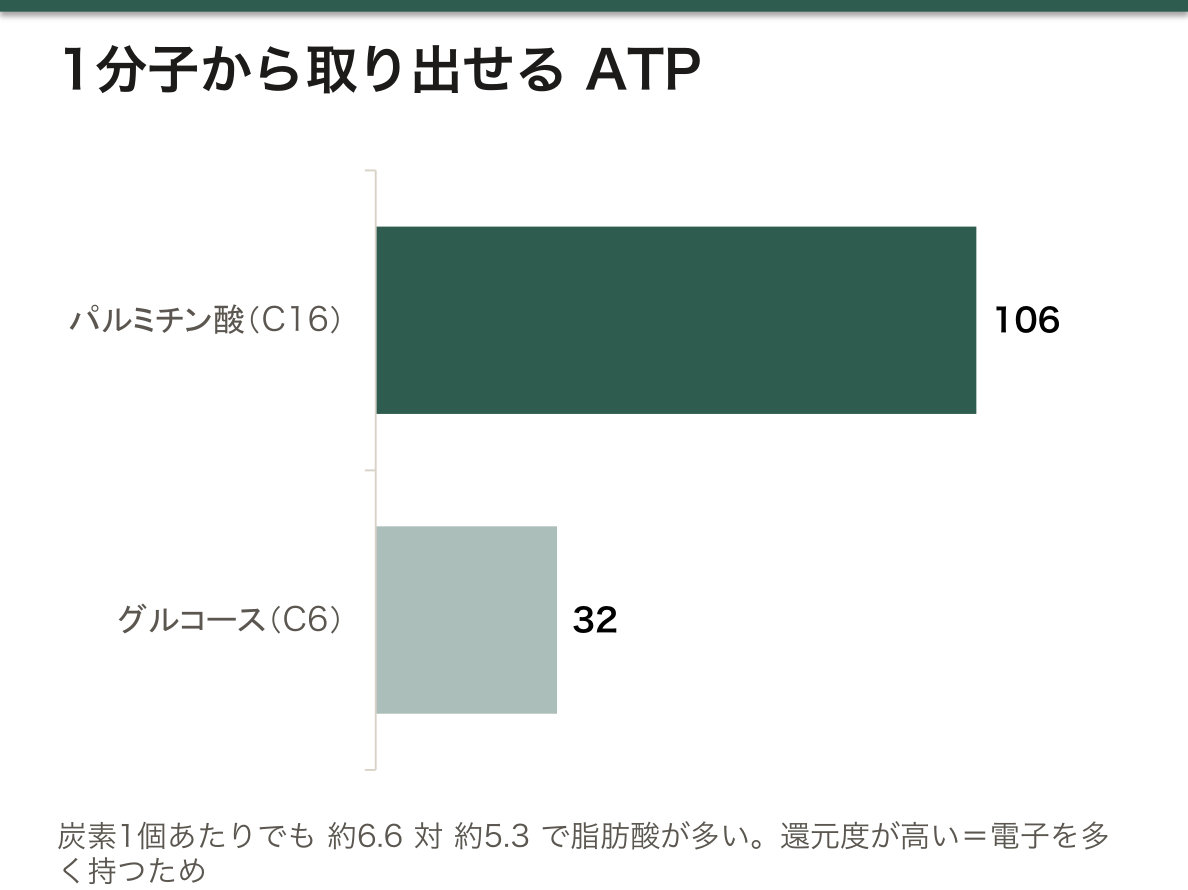
効率の比較——パルミチン酸(C16)1分子から約106 ATP。グルコース(C6)が約32 ATP なので、炭素あたりでも脂肪酸のほうが多い。脂肪酸は還元度が高い=電子を多く持っているためである。
ただしβ酸化には酸素が要る(NADH・FADH₂ を処理するため)。だから虚血下では脂肪酸を燃やせず、心筋は解糖に頼らざるを得ない。虚血心筋が急速にATP不足に陥る理由の一つである。
MCAD 欠損症(中鎖アシルCoA脱水素酵素欠損)——新生児マススクリーニングの対象で、脂肪酸酸化異常の中で最多。
- 普段は無症状。空腹・感染・嘔吐で発症する
- 低ケトン性低血糖——脂肪を燃やせないのでケトン体が作れず、糖だけが消費されて枯れる
- 意識障害・けいれん・突然死(乳幼児突然死の鑑別に入る)
「低血糖なのにケトンが出ていない」は脂肪酸酸化障害を強く示唆する——正常なら低血糖時にケトン体が上がるはずだからである。治療は単純で、絶食させないことと発症時のブドウ糖投与。診断がつけば防げる死であり、スクリーニングの意義がここにある。
English version
Core
In the mitochondrial matrix, the fatty acid is cut two carbons at a time from the carboxyl end to give acetyl-CoA. Each cut yields 1 NADH, 1 FADH₂ and 1 acetyl-CoA.
Entry into the mitochondrion requires the carnitine shuttle.
- Fatty acid + CoA → (acyl-CoA synthetase) → acyl-CoA
- CPT-1 (outer membrane) — transfers it onto carnitine. Rate-limiting; inhibited by malonyl-CoA.
- Carnitine–acylcarnitine translocase (inner membrane)
- CPT-2 (inner face) — returns it to CoA
Short- and medium-chain fatty acids need no carnitine and enter as they are.
Going further
Inhibition of CPT-1 by malonyl-CoA is the switch between the synthesis and the breakdown of fatty acids. Malonyl-CoA is the first product of fatty acid synthesis, so the control is reasonable: do not break down what you are making. Insulin tilts it to synthesis, glucagon to breakdown.
Comparison of efficiency — about 106 ATP from one molecule of palmitate (C16). Glucose (C6) gives about 32, so per carbon the fatty acid still yields more, because it is more reduced and carries more electrons.
But β-oxidation requires oxygen (to dispose of the NADH and FADH₂). So under ischaemia fatty acids cannot be burnt and the myocardium must fall back on glycolysis — one reason ischaemic myocardium runs short of ATP so rapidly.
In the clinic
MCAD deficiency (medium-chain acyl-CoA dehydrogenase deficiency) — included in newborn screening and the commonest of the fatty acid oxidation defects. Silent at rest; it presents with fasting, infection or vomiting.
- Hypoketotic hypoglycaemia — fat cannot be burnt, so no ketones are made and glucose alone is consumed until it runs out.
- Impaired consciousness, seizures, sudden death (it enters the differential of sudden infant death).
"Hypoglycaemia without ketones" strongly suggests a fatty acid oxidation defect — normally the ketones should rise as the glucose falls.
The treatment is simple: do not let the child fast, and give glucose at presentation. It is a preventable death once the diagnosis is made, and here lies the value of screening.
ケトン体 — 脳に脂肪を届ける形
肝のミトコンドリアで、余ったアセチルCoA から作られる水溶性の分子。3種——アセト酢酸・β-ヒドロキシ酪酸・アセトン。
できる条件は「アセチルCoA が余り、オキサロ酢酸が足りない」状況、すなわち飢餓・糖尿病・高脂肪食・アルコール。
肝は自分では使えない(ケトン体を分解する酵素 SCOT を持たない)。作って他へ送るだけである。
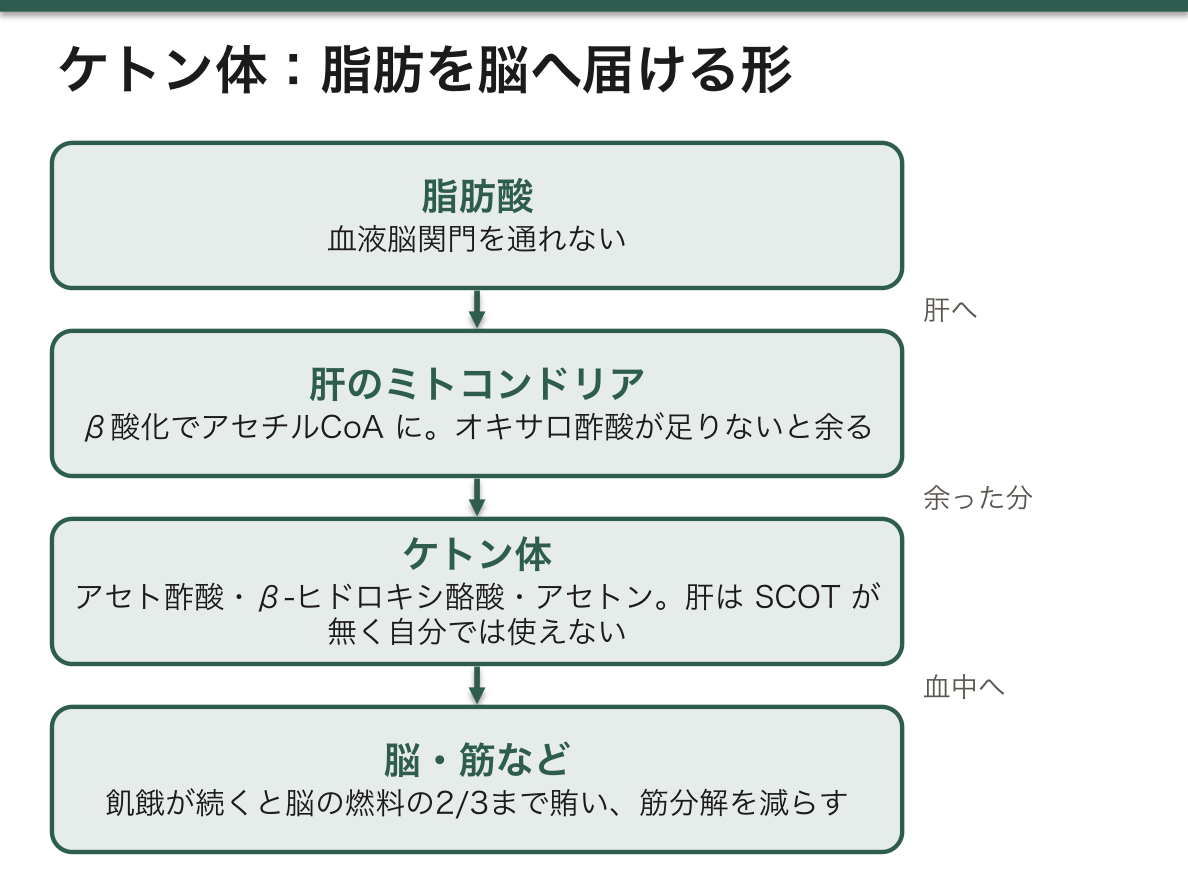
ケトン体の存在意義は「脂肪酸は血液脳関門を通れない」という制約の回避にある。脂肪酸をアセチルCoA まで分解し、水溶性のケトン体に組み直せば脳へ届く。飢餓が続くと脳の燃料の2/3までをケトン体が賄い、糖新生のための筋分解を減らす。
血中で最も多いのはβ-ヒドロキシ酪酸で、これが臨床上の落とし穴を作る。
尿ケトン試験紙(ニトロプルシド反応)はアセト酢酸とアセトンしか検出せず、β-ヒドロキシ酪酸を検出しない。重症のDKAでは還元状態が強く、比率がβ-ヒドロキシ酪酸に偏るため最重症のときほど尿ケトンが弱く出る。さらに治療で改善するとアセト酢酸へ戻るため、尿ケトンが「増えて」見える。治療効果の判定に尿ケトンを使わない——血中β-ヒドロキシ酪酸か、アニオンギャップで追う。
アルコール性ケトアシドーシスは血糖が正常〜低値のまま起きる。アルコール代謝で NADH が増えるとオキサロ酢酸がリンゴ酸へ倒れ、TCA回路が回らずアセチルCoA がケトン体へ流れる。同時に糖新生も止まるため低血糖になる。「飲酒歴+アシドーシス+血糖が高くない」でDKAと区別する。治療はブドウ糖とビタミンB1(先に)と輸液。
English version
Core
Water-soluble molecules made in hepatic mitochondria from surplus acetyl-CoA. Three — acetoacetate, β-hydroxybutyrate and acetone.
They are made when acetyl-CoA is in surplus and oxaloacetate is short — that is, in starvation, diabetes, a high-fat diet and alcohol.
The liver cannot use them itself (it lacks SCOT, the enzyme that breaks them down). It only makes them and sends them elsewhere.
Going further
Ketone bodies exist to get round the constraint that fatty acids cannot cross the blood–brain barrier. Break the fatty acid down to acetyl-CoA and rebuild it as a water-soluble ketone body and it reaches the brain. In prolonged starvation ketones supply up to two thirds of the brain’s fuel and reduce the breakdown of muscle for gluconeogenesis.
The commonest in the blood is β-hydroxybutyrate, and this creates a clinical trap. The urinary ketone strip (the nitroprusside reaction) detects acetoacetate and acetone but not β-hydroxybutyrate. In severe DKA the redox state is strongly reduced and the ratio is skewed towards β-hydroxybutyrate, so the urinary ketones are weakest when the patient is sickest. And as treatment improves matters it converts back to acetoacetate, so the urinary ketones appear to increase.
Do not use urinary ketones to judge the response to treatment — follow the blood β-hydroxybutyrate or the anion gap.
In the clinic
Alcoholic ketoacidosis occurs with a normal or low blood glucose. Alcohol metabolism raises NADH, oxaloacetate is tipped towards malate, the TCA cycle will not turn and acetyl-CoA overflows into ketones. Gluconeogenesis stops at the same time, hence the hypoglycaemia.
Distinguish it from DKA by "a history of drinking + acidosis + a blood glucose that is not high". Treatment is glucose, thiamine (first) and fluid.
脂肪酸・コレステロールの合成
脂肪酸合成は細胞質で、材料はクエン酸として運び出したアセチルCoAとNADPH(ペントースリン酸経路由来)。
- 律速はアセチルCoAカルボキシラーゼ(アセチルCoA → マロニルCoA、ビオチン要求)。クエン酸で促進、パルミトイルCoAで抑制、インスリンで活性化
- 脂肪酸合成酵素が2炭素ずつ伸ばし、パルミチン酸(C16)まで作る
コレステロール合成も細胞質+小胞体。律速はHMG-CoA還元酵素(スタチンの標的)。夜間に活性が高い。
ヒトが作れない脂肪酸がある。二重結合をω-9より先に入れられないため、リノール酸(ω-6)とα-リノレン酸(ω-3)は必須脂肪酸である。長期の脂肪を含まない輸液で欠乏すると皮膚炎・脱毛・創傷治癒遅延をきたす。
アラキドン酸(リノール酸由来)からはプロスタグランジン・トロンボキサン(COX経路)とロイコトリエン(LOX経路)が作られる。NSAIDs が COX を止めると基質がLOX側へ流れるため、アスピリン喘息(NSAIDs過敏喘息)が起こる——「片方を塞ぐともう片方へ流れる」という代謝の基本形である。
コレステロールは細胞膜の流動性・胆汁酸・ステロイドホルモン・ビタミンD の材料であり、悪者ではない。しかし分解できない(環構造を開けない)ので、体外へ出す唯一の道は胆汁への排泄である。だから陰イオン交換樹脂で胆汁酸を捕まえて排泄させるという治療が成立する。
English version
Core
Fatty acid synthesis is cytosolic, from acetyl-CoA exported as citrate and NADPH (from the pentose phosphate pathway).
- Rate-limiting: acetyl-CoA carboxylase (acetyl-CoA → malonyl-CoA, requiring biotin). Activated by citrate and by insulin, inhibited by palmitoyl-CoA.
- Fatty acid synthase extends it two carbons at a time as far as palmitate (C16).
Cholesterol synthesis is cytosolic and in the endoplasmic reticulum. Rate-limiting: HMG-CoA reductase (the target of the statins). Its activity is highest at night.
Going further
There are fatty acids humans cannot make. We cannot insert a double bond beyond ω-9, so linoleic acid (ω-6) and α-linolenic acid (ω-3) are essential fatty acids. Deficiency on long-term fat-free infusion gives dermatitis, hair loss and delayed wound healing.
From arachidonic acid (derived from linoleic acid) come the prostaglandins and thromboxane (the COX pathway) and the leukotrienes (the LOX pathway). When NSAIDs block COX the substrate flows to the LOX side, hence aspirin-exacerbated respiratory disease — the basic form of "block one and it flows to the other".
Cholesterol is not a villain: it provides the fluidity of the membrane and is the material of bile acids, steroid hormones and vitamin D. But it cannot be broken down (the ring cannot be opened), and the only way out of the body is excretion in the bile. This is why binding bile acids with an anion exchange resin works as a treatment.
リポ蛋白 — 水に溶けないものを運ぶ
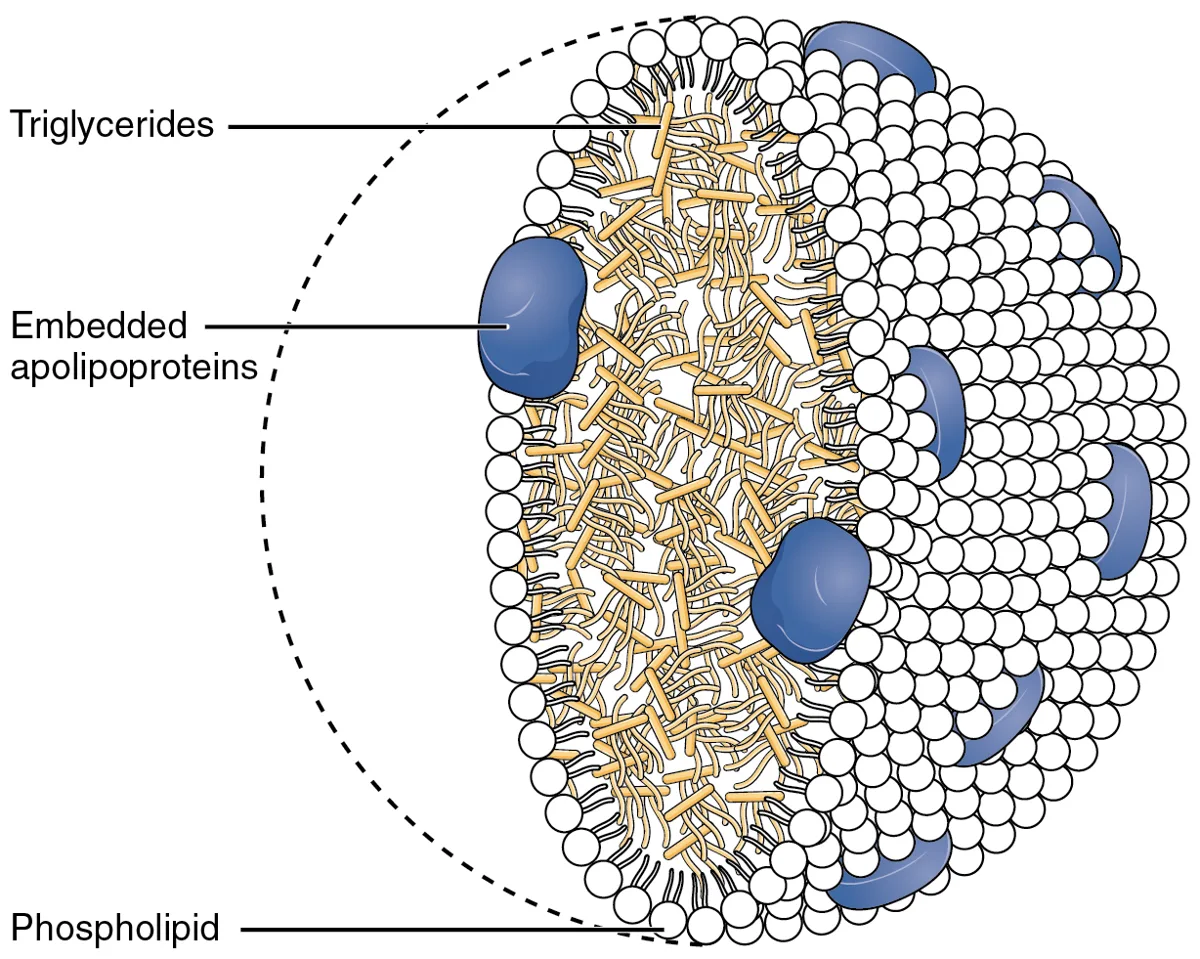
脂質を蛋白(アポ蛋白)で包んだ粒子。大きく・軽いほど中性脂肪が多く、小さく・重いほど蛋白が多い。
- カイロミクロン——小腸から。食事由来の中性脂肪を運ぶ
- VLDL——肝から。内因性の中性脂肪を運ぶ
- LDL——VLDLの成れの果て。コレステロールを末梢へ運ぶ。いわゆる悪玉
- HDL——末梢から肝へコレステロールを回収。いわゆる善玉
血管内皮のリポ蛋白リパーゼ(LPL)が中性脂肪を分解して脂肪組織・筋へ渡す。LPLを活性化するのはアポC-II。
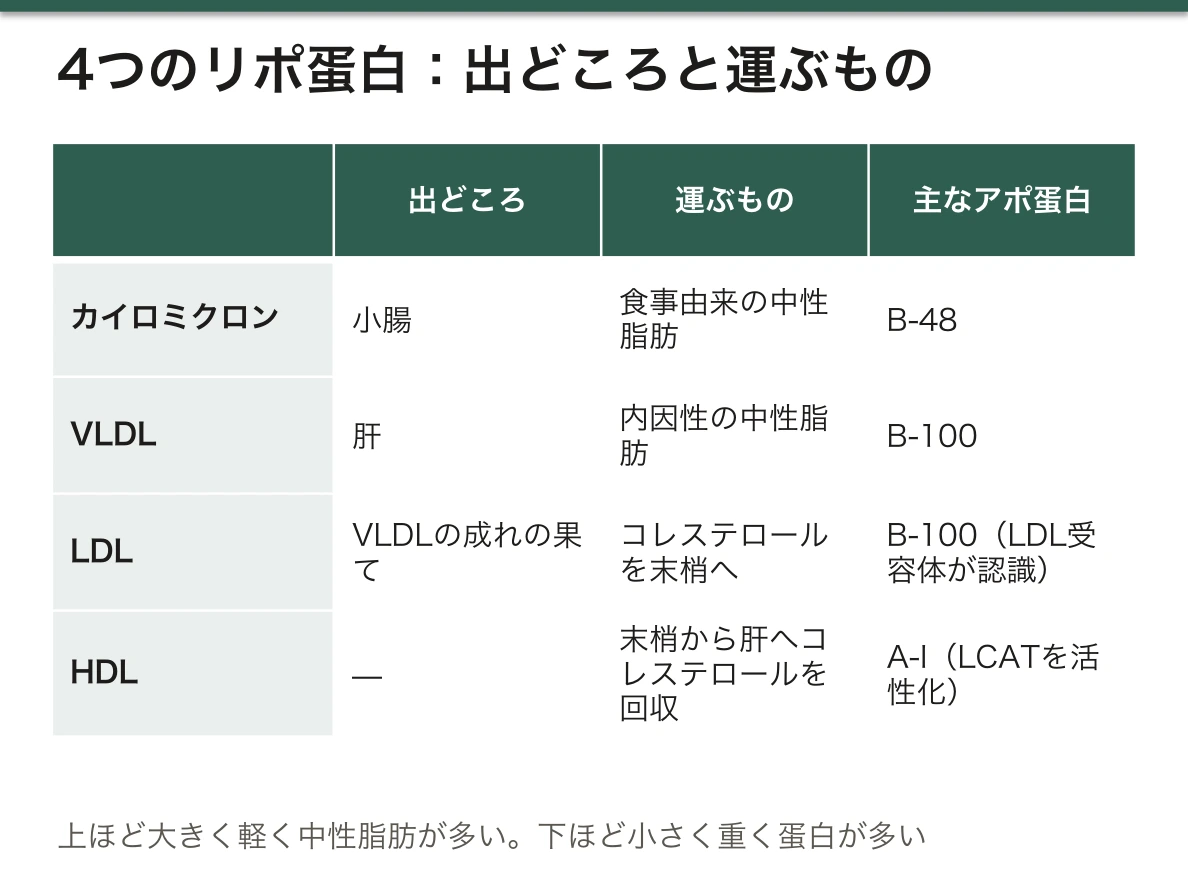
アポ蛋白を「宛先ラベル」として読むと整理できる。
- アポB-48——カイロミクロン(小腸)
- アポB-100——VLDL・LDL(肝)。LDL受容体が認識するのはこれ
- アポC-II——LPL の活性化スイッチ
- アポE——肝の受容体に認識される「回収ラベル」
- アポA-I——HDL。LCAT を活性化する
家族性高コレステロール血症はLDL受容体(またはアポB-100、PCSK9)の異常で、LDLが回収されず血中に溜まる。常染色体顕性で、ヘテロ接合体で約200〜500人に1人と決して稀ではない。
- アキレス腱肥厚(X線で厚さを測る)・手背の腱黄色腫・角膜輪
- 若年性の冠動脈疾患——ホモ接合体では小児期に心筋梗塞を起こしうる
スタチンが効くのは細胞内コレステロールを減らすとLDL受容体の発現が増えるからで、HMG-CoA還元酵素の阻害そのものより受容体の増加が主な機序である。受容体がゼロのホモ接合体にはスタチンが効きにくい——分子の理解が治療反応性を予測する。
English version
Core
Particles of lipid wrapped in protein (apolipoproteins). The larger and lighter, the more triglyceride; the smaller and denser, the more protein.
- Chylomicron — from the small intestine; carries dietary triglyceride.
- VLDL — from the liver; carries endogenous triglyceride.
- LDL — what VLDL becomes; carries cholesterol to the periphery. The so-called bad one.
- HDL — collects cholesterol from the periphery back to the liver. The so-called good one.
Lipoprotein lipase (LPL) on the vascular endothelium breaks down the triglyceride and hands it to adipose tissue and muscle. It is activated by apo C-II.
Going further
Read the apolipoproteins as address labels and it falls into order.
- Apo B-48 — chylomicron (intestine).
- Apo B-100 — VLDL and LDL (liver). This is what the LDL receptor recognises.
- Apo C-II — the switch that activates LPL.
- Apo E — the collection label recognised by the hepatic receptor.
- Apo A-I — HDL; activates LCAT.
Familial hypercholesterolaemia is a defect of the LDL receptor (or of apo B-100 or PCSK9); LDL is not collected and accumulates. Autosomal dominant, and in the heterozygote about 1 in 200–500 — by no means rare.
- Thickened Achilles tendons (measured on radiograph), tendon xanthomas on the backs of the hands, corneal arcus.
- Premature coronary disease — a homozygote may infarct in childhood.
Statins work because lowering the cholesterol within the cell increases the expression of LDL receptors: the increase in receptors, rather than the inhibition of HMG-CoA reductase itself, is the principal mechanism. So a homozygote with no receptors responds poorly to statins — an understanding of the molecule predicting the response to treatment.
置いてはいけない場所の脂肪 — 脂肪細胞に入りきらなかった分が、病気を作る
中性脂肪そのものは害が少ない。問題はどこに置かれるかである。
脂肪細胞は中性脂肪を安全に貯蔵する専用の容器で、容量を超えると余った脂質が肝・骨格筋・膵・心筋・血管周囲へ溢れ出す(異所性脂肪)。そこでは中性脂肪ではなく、ジアシルグリセロールやセラミドといった中間体が溜まり、インスリンの信号を邪魔する。
脂肪毒性という言い方の中身がこれである——脂質が細胞の信号伝達と小胞体に負荷をかけ、インスリン抵抗性・アポトーシス・炎症を起こす。
「太っているかどうか」より「どこに置かれているか」が効く。この考え方が、一見矛盾する2つの臨床像を同時に説明する。
| 脂肪萎縮症 | 脂肪細胞が無いのに重症の糖尿病と脂肪肝 | 置き場所が無いので全部が異所性脂肪になる。レプチン補充が効く |
| 代謝的に健康な肥満 | BMI が高いのに代謝が保たれている | 皮下脂肪の容量に余裕があり、溢れていない |
| やせているのに糖尿病 | アジア人に多い | 皮下の容量が小さく、少ない体重でも溢れる。日本人の糖尿病が低 BMI で発症する理由の一つ |
チアゾリジン薬(ピオグリタゾン)の効き方も、この枠組みで理解できる。PPARγ を活性化して皮下脂肪細胞を新しく作らせる——つまり容器を増やして、溢れた脂を安全な場所へ戻している。だから体重は増えるのにインスリン抵抗性は改善する、という一見奇妙なことが起きる。
減量で最初に減るのが肝の脂肪だという事実も同じ理屈で、体重が数%落ちただけで糖代謝が明らかに良くなるのは、溢れが引くからである。
やせ型の患者でも、腹囲と脂肪肝の有無を見る。BMI が正常でも代謝症候群の病態を持っていることがある。
English version
Core
Triglyceride itself does little harm. The problem is where it is put. The adipocyte is a container dedicated to storing triglyceride safely, and once its capacity is exceeded the surplus lipid spills over into liver, skeletal muscle, pancreas, myocardium and the tissue around vessels (ectopic fat).
There it is not triglyceride but intermediates such as diacylglycerol and ceramide that accumulate and interfere with insulin signalling. This is the substance of the term lipotoxicity — lipid loading the signalling and the endoplasmic reticulum of the cell and causing insulin resistance, apoptosis and inflammation.
Going further
Where it is put counts for more than whether the person is fat. This idea explains two apparently contradictory clinical pictures at once.
| Picture | Explanation | |
|---|---|---|
| Lipodystrophy | No adipocytes, yet severe diabetes and fatty liver | With nowhere to put it, all of it becomes ectopic fat. Leptin replacement works |
| Metabolically healthy obesity | A high BMI with preserved metabolism | There is spare capacity in the subcutaneous fat and nothing has spilled over |
| Thin with diabetes | Common in Asians | The subcutaneous capacity is small and it spills over at a low body weight — one reason Japanese diabetes presents at a low BMI |
The action of the thiazolidinediones (pioglitazone) is understood in the same framework. Activating PPARγ makes new subcutaneous adipocytes — that is, it increases the containers and returns the spilled fat to a safe place. Hence the apparently odd result that the weight rises while the insulin resistance improves.
That the first fat lost on dieting is hepatic fat follows the same reasoning: a fall of a few per cent in weight improves glucose metabolism markedly because the overflow recedes.
In the clinic
Even in a thin patient, look at the waist circumference and for fatty liver. The pathology of the metabolic syndrome can be present with a normal BMI.
ペルオキシソームのβ酸化 — ミトコンドリアが扱えない脂肪酸を、先に短くする
脂肪酸の酸化はミトコンドリアだけの仕事ではない。炭素が 22 個を超える極長鎖脂肪酸はミトコンドリアが受け付けないので、ペルオキシソームが先に短く刻む。炭素 8 個程度まで縮めてから、ミトコンドリアへ渡す。
| ミトコンドリア | ペルオキシソーム | |
| 扱う脂肪酸 | 短鎖〜長鎖 | 極長鎖・分枝鎖・胆汁酸の前駆体 |
| 最初の酸化 | FAD に電子を渡す(ATP になる) | 酸素に直接渡し、過酸化水素を出す(ATP にならない。熱になる) |
| 最後まで分解するか | アセチル CoA まで | 途中で止め、ミトコンドリアへ渡す |
過酸化水素を出すので、ペルオキシソームはカタラーゼを大量に持っている。オルガネラの名前もここに由来する。
3つの疾患が、この経路の壊れ方の違いで説明できる。
| 副腎白質ジストロフィー | 極長鎖脂肪酸の取り込みができない(ABCD1、X 連鎖) | 脳の脱髄と副腎不全。学童期の男児で、行動の変化と皮膚の色素沈着が同時に出る |
| Zellweger 症候群 | ペルオキシソームそのものが作れない | 新生児期から重篤。特異な顔貌・重度の筋緊張低下・肝腫大 |
| Refsum 病 | 分枝鎖のα酸化ができない(フィタン酸が溜まる) | 網膜色素変性・多発神経炎・小脳失調・魚鱗癬。食事制限(乳製品・反芻動物の肉)が治療になる |
フィタン酸だけ扱いが違うのはβ炭素の隣にメチル基が付いていて、β酸化が始められないためである。だから炭素を1個だけ外すα酸化で邪魔なメチル基をずらしてから、β酸化に入る。構造上の1つの障害物が、専用の経路を1本必要にしている。
⚠️ 副腎白質ジストロフィーは、副腎不全が先に出ることがある。小児の原因不明の副腎不全(特に男児)では、極長鎖脂肪酸を測る。
男児の学業低下+行動異常+皮膚色素沈着が揃ったら、副腎白質ジストロフィーを鑑別に入れる。造血幹細胞移植は発症前〜早期でのみ有効である。
English version
Core
The oxidation of fatty acids is not the mitochondrion’s work alone. Very long chain fatty acids of more than 22 carbons are not accepted by the mitochondrion, so the peroxisome chops them shorter first, down to about eight carbons, and hands them over.
| Mitochondrion | Peroxisome | |
|---|---|---|
| Fatty acids handled | Short to long chain | Very long chain, branched chain, bile acid precursors |
| The first oxidation | Hands electrons to FAD (becoming ATP) | Hands them straight to oxygen, releasing hydrogen peroxide (no ATP; it becomes heat) |
| Complete breakdown? | To acetyl-CoA | Stops part way and hands over to the mitochondrion |
Producing hydrogen peroxide, the peroxisome carries a great deal of catalase — whence the name of the organelle.
Going further
Three diseases are explained by different ways of breaking this pathway.
| Disease | Defect | Picture |
|---|---|---|
| Adrenoleukodystrophy | Very long chain fatty acids cannot be taken up (ABCD1, X-linked) | Cerebral demyelination and adrenal failure. A schoolboy with a change in behaviour and pigmentation of the skin at the same time |
| Zellweger syndrome | Peroxisomes cannot be made at all | Severe from the newborn period. Characteristic facies, profound hypotonia, hepatomegaly |
| Refsum disease | α-oxidation of branched chains fails (phytanic acid accumulates) | Retinitis pigmentosa, polyneuritis, cerebellar ataxia, ichthyosis. Dietary restriction (dairy, ruminant meat) is the treatment |
Phytanic acid alone is handled differently because it has a methyl group next to the β carbon and β-oxidation cannot begin. So a carbon is removed by α-oxidation to shift the obstructing methyl group, after which β-oxidation can proceed. One structural obstacle requiring a dedicated pathway of its own.
⚠️ In adrenoleukodystrophy the adrenal failure may come first. In unexplained adrenal insufficiency in a child (especially a boy), measure the very long chain fatty acids.
In the clinic
In a boy with falling school performance, abnormal behaviour and pigmentation of the skin, put adrenoleukodystrophy into the differential. Haematopoietic stem cell transplantation is effective only before or very early after onset.
まとめ
| β酸化 — 脂肪酸を2炭素ずつ切る | ミトコンドリア基質で、脂肪酸をカルボキシル基側から2炭素ずつ切り出してアセチルCoA にする。 |
|---|---|
| ケトン体 — 脳に脂肪を届ける形 | 肝のミトコンドリアで、余ったアセチルCoA から作られる水溶性の分子。 |
| 脂肪酸・コレステロールの合成 | 脂肪酸合成は細胞質で、材料はクエン酸として運び出したアセチルCoAとNADPH(ペントースリン酸経路由来)。 |
| リポ蛋白 — 水に溶けないものを運ぶ | 脂質を蛋白(アポ蛋白)で包んだ粒子。大きく・軽いほど中性脂肪が多く、小さく・重いほど蛋白が多い。 |
| 置いてはいけない場所の脂肪 — 脂肪細胞に入りきらなかった分が、病気を作る | 中性脂肪そのものは害が少ない。問題はどこに置かれるかである。 |
| ペルオキシソームのβ酸化 — ミトコンドリアが扱えない脂肪酸を、先に短くする | 脂肪酸の酸化はミトコンドリアだけの仕事ではない。 |
このノートは医学生が授業の内容を自分の言葉でまとめたもので、診療の判断に使うものではありません。誤りに気づいたらお知らせください。