神経の興奮、心電図、電気泳動、除細動——医学で出会う電気の現象は、どれも電荷がどう力を及ぼし合い、どうたまるかという静電気の法則の上に立っている。
この章では、電荷の保存から始めて、電荷どうしの力(クーロンの法則)、その力を空間の性質として表した電場、単位電荷あたりのエネルギーである電位と電圧、電荷をためるコンデンサと誘電体へと進む。最後に、細胞膜そのものがコンデンサであることを使って、膜電位を数で理解する。
要の1文は「電圧は電荷1つあたりの仕事」。電場は電圧の坂の傾きで、容量は「同じ電圧でどれだけ電荷をためられるか」である。
- 電荷と電荷保存則 — 電荷は作れず、移るだけ
- クーロンの法則 — 電荷どうしの力は距離の2乗に反比例する
- 電場(電界) — 電荷が周りの空間に作る「力の場」
- 電位と電圧 — 電圧とは「電荷1つあたりの仕事」
- コンデンサと静電容量 — 電荷をためる装置
- 誘電体と誘電分極 — 絶縁体をはさむと容量が増える理由
- 細胞膜はコンデンサ — 膜電位をつくる電荷はごくわずか
電荷と電荷保存則 — 電荷は作れず、移るだけ
電荷(electric charge)は記号 Q(または q)、単位は C(クーロン)。正と負の2種類があり、同じ符号どうしは反発し、違う符号どうしは引き合う。
電荷には最小の単位がある。素電荷(elementary charge)e = 1.602×10⁻¹⁹ C で、陽子は +e、電子は −e。大きさは同じで符号だけが逆である。どんな物体の電荷も e の整数倍になる。
電荷保存則(conservation of charge):外とやりとりの無い系では、正負を足した電荷の総和は一定に保たれる。2つの物をこすり合わせると帯電するが、これは電荷を新しく作ったのではなく、電子が一方から他方へ移っただけである。電子を受け取った側が負に、失った側が同じ量だけ正に帯電する。
「帯電する」とは、正負の釣り合いが局所的に崩れることである。ふつうの物体は正と負の電荷を同じ数だけ持っていて、全体として中性に見える。こすったときに動くのは、軽くて外側にある電子だけで、原子核の陽子は動かない。だから「正に帯電した」は「電子が足りない」と読み替えると誤解が少ない。
体の中で電荷を運ぶのは、電子ではなくイオンである。金属の導線では自由電子が流れるが、体液では Na+・K+・Cl−・Ca2+ が動く。1価のイオン 1 mol が運ぶ電荷は、素電荷にアボガドロ数をかけたファラデー定数 約 9.65×10⁴ C/mol である。神経の興奮も心電図も、このイオンの移動で説明される——この章で扱う静電気の法則が、そのまま細胞の電気現象の土台になる。
English version
Core
Electric charge has the symbol Q (or q) and the unit C (coulomb). There are two kinds, positive and negative. Like charges repel; unlike charges attract.
Charge comes in a smallest unit, the elementary charge e = 1.602×10⁻¹⁹ C. A proton carries +e and an electron −e: the same size, opposite sign. The charge of any object is a whole-number multiple of e.
Conservation of charge: in a closed system, the total charge (positive plus negative) stays constant. Rubbing two objects together charges them, but no charge is created — electrons simply move from one object to the other. The side that gains electrons becomes negative; the side that loses them becomes positive by the same amount.
Going further
"Being charged" means the local balance of positive and negative is broken. An ordinary object has equal numbers of positive and negative charges and looks neutral. When you rub it, only the light, outer electrons move; the protons in the nucleus do not. So read "positively charged" as "short of electrons".
In the body, charge is carried by ions, not electrons. In a metal wire free electrons flow, but in body fluids Na+, K+, Cl− and Ca2+ move. One mole of monovalent ions carries the elementary charge times Avogadro’s number: the Faraday constant, about 9.65×10⁴ C/mol. Nerve excitation and the ECG are both explained by this movement of ions, so the laws of electrostatics in this chapter are the base of cell electricity.
クーロンの法則 — 電荷どうしの力は距離の2乗に反比例する
2つの点電荷 q1・q2 が距離 r だけ離れているとき、互いに及ぼす力の大きさは
F = k · q1q2 / r2
である(クーロンの法則, Coulomb’s law)。力は2つの電荷を結ぶ直線の向きに働き、同符号なら反発、異符号なら引力になる。
比例定数は k ≈ 8.99×10⁹ N·m2/C2(概算では 9×10⁹)。単位は式を k = Fr2/(q1q2) と変形すれば N·m2/C2 と分かる。k は 真空の誘電率(permittivity of free space)ε0 ≈ 8.85×10⁻¹² F/m を使って k = 1/(4πε0) とも書く。
形は万有引力の法則 F = Gm1m2/r2 とそっくりである。違いは、重力が引力だけなのに対し、電気力は引力にも斥力にもなること。
なぜ距離の「2乗」なのか。点電荷の影響が四方八方に均等に広がると考えると、距離 r の球面の面積は 4πr2 なので、単位面積あたりの「濃さ」は 1/r2 で薄まる。光の照度や、点線源からの放射線の線量率が距離の2乗に反比例するのと同じ幾何学である。距離を2倍にすると力は 1/4、3倍で 1/9 になる。
電気力は重力よりけた違いに強い。水素原子の電子と陽子のあいだでは、電気力は重力の約 1039 倍になる。それでも日常で電気力を感じにくいのは、物体の正負がほぼ完全に打ち消し合っているからである。わずかでも釣り合いが崩れると、髪が逆立つ・紙片が吸いつくといった目に見える力になる。
まわりに物質があると力は弱まる。媒質の比誘電率を εr とすると力は 1/εr 倍になる。水では εr が約 80 なので、イオンどうしの引力は真空中の約 1/80 に弱まる——食塩が水に溶けてばらばらのイオンになれる理由である(詳しくは誘電体の項)。
English version
Core
For two point charges q1 and q2 at a distance r, the size of the force between them is
F = k · q1q2 / r2
(Coulomb’s law). The force acts along the line joining the charges: repulsion for like signs, attraction for unlike signs.
The constant is k ≈ 8.99×10⁹ N·m2/C2 (roughly 9×10⁹). Rearranging to k = Fr2/(q1q2) gives the unit N·m2/C2. It is also written k = 1/(4πε0), where ε0 ≈ 8.85×10⁻¹² F/m is the permittivity of free space.
The form is almost the same as Newton’s law of gravity, F = Gm1m2/r2. The difference: gravity only attracts, but the electric force can attract or repel.
Going further
Why the square of the distance? If the effect of a point charge spreads equally in all directions, the sphere at distance r has area 4πr2, so the "density" per unit area falls as 1/r2. It is the same geometry that makes light intensity, and the dose rate from a point radiation source, fall with the square of the distance. Double the distance and the force becomes 1/4; triple it and it becomes 1/9.
The electric force is far stronger than gravity. Between the electron and proton of a hydrogen atom, the electric force is about 1039 times the gravitational force. We rarely feel it in daily life because the positive and negative charges in objects cancel almost perfectly. A small imbalance is enough to make hair stand up or bits of paper jump.
A surrounding material weakens the force. With a medium of relative permittivity εr, the force is divided by εr. Water has εr of about 80, so the attraction between ions is about 1/80 of that in vacuum — the reason table salt can dissolve into separate ions (see the dielectric item).
電場(電界) — 電荷が周りの空間に作る「力の場」
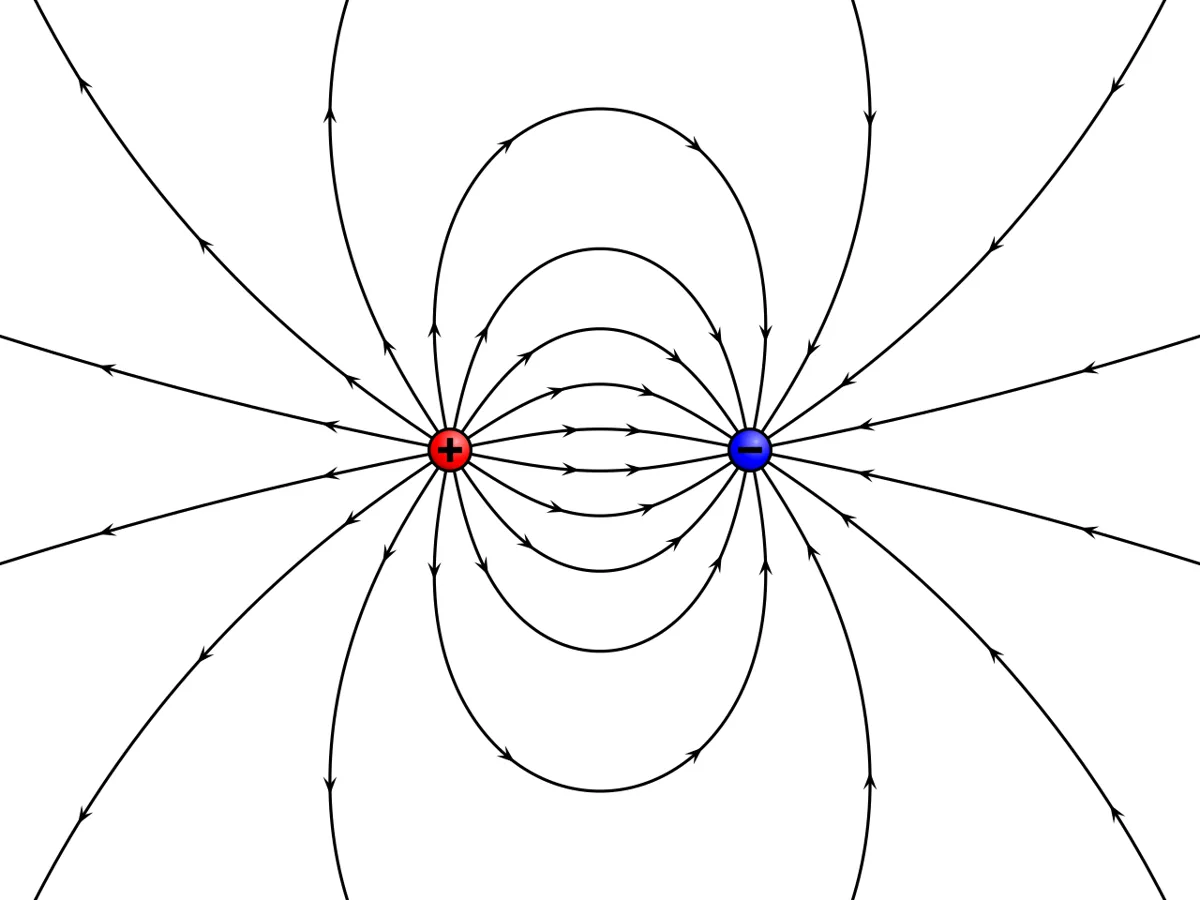
離れた電荷どうしがなぜ力を及ぼし合えるのか。これを、電荷はまわりの空間に電場(electric field)を作り、別の電荷はその場所の電場から力を受けると考える。
電場の強さ E は、その点に置いた小さな試験電荷 q が受ける力を、その電荷で割ったものとして定義する。
E = F / q 単位は N/C(= V/m。同じ単位の別名)
クーロンの法則の F を代入すると試験電荷 q は約分され、点電荷 Q が距離 r に作る電場は E = kQ/r2 になる。電場は向きを持つベクトルで、正電荷はこの向きに押され、負電荷は逆向きに引かれる。
電場は電気力線(electric field lines)で描く。正電荷から出て負電荷に入り、線が密なところほど電場が強い。電荷が複数あれば、それぞれの作る電場をベクトルとして足し合わせればよい(重ね合わせの原理)。2つの同符号の電荷のちょうど中間では、向きが逆の電場が打ち消し合って 0 になる。
試験電荷を2倍にしても電場は変わらない。受ける力 F は2倍になるが、E = F/q の分母も2倍になるからである。「測るための道具が測られる量を変えてはいけない」という測定の原則がそのまま定義に入っている。電場は場をつくる側の電荷と位置だけで決まる量である。
平行な2枚の極板の間では、電場は一様になる。極板間の電圧を V、間隔を d とすると E = V/d。電場は「電圧が距離あたりどれだけ変わるか」、つまり電位の坂の傾きである。電場と電圧の違いを1文で言えば、電圧は2点のあいだの差(スカラー)、電場はその場所での傾きと向き(ベクトル)である。
導体の内部では電場は 0 になる。導体の中の自由電子が動いて、外からの電場を打ち消す位置に並ぶからである。金属の箱で囲むと中に外の電場が入らない(静電遮蔽、ファラデーケージ)。
電気泳動では、電場 E がイオンや蛋白質を動かす。泳動速度は v = μE(μ は電気移動度)なので、同じ電源電圧でもゲルが長ければ E = V/d が小さくなり、泳動は遅くなる。条件を比べるときは電圧ではなく電場(V/cm)で比べる。
MRI 室は金属の網で囲まれている。外の放送電波などが受信コイルに入り込むのを防ぐ静電遮蔽の応用で、脳波などの微弱な生体信号を測る部屋も同じ考え方でつくられる。
English version
Core
How can distant charges push on each other? We say that a charge creates an electric field in the space around it, and another charge feels a force from the field at its own position.
The field strength E is defined as the force on a small test charge q placed at that point, divided by that charge:
E = F / q, unit N/C (= V/m; two names for the same unit)
Putting in F from Coulomb’s law, the test charge cancels, and the field of a point charge Q at distance r is E = kQ/r2. The field is a vector: a positive charge is pushed along it, a negative charge is pulled the opposite way.
Fields are drawn with electric field lines. They leave positive charges and end on negative charges; where the lines are dense, the field is strong. With several charges, add the fields of each as vectors (superposition principle). Exactly halfway between two like charges, the opposite fields cancel and the field is zero.
Going further
Doubling the test charge does not change the field. The force F doubles, but so does the denominator in E = F/q. The rule of measurement — the tool must not change what it measures — is built into the definition. The field depends only on the source charges and the position.
Between two parallel plates the field is uniform. With voltage V across the plates and spacing d, E = V/d. The field is how fast the voltage changes with distance — the slope of the potential. In one sentence: voltage is a difference between two points (a scalar); the field is the slope and direction at one place (a vector).
Inside a conductor the field is zero. The free electrons move until they cancel the outside field. A metal box keeps outside fields out (electrostatic shielding, a Faraday cage).
In the clinic
In electrophoresis, the field E moves ions and proteins. The speed is v = μE (μ = electrophoretic mobility), so with the same power-supply voltage a longer gel gives a smaller E = V/d and slower migration. Compare conditions by field (V/cm), not by voltage.
An MRI room is surrounded by a metal mesh. It is electrostatic shielding that keeps outside radio waves out of the receiver coil. Rooms for measuring weak body signals such as the EEG use the same idea.
電位と電圧 — 電圧とは「電荷1つあたりの仕事」
重力の場で物体を高さ h まで持ち上げると、位置エネルギー mgh がたまる(力 mg × 距離 h)。電場でもまったく同じで、一様な電場 E の中で電荷 q を電場に逆らって距離 d 動かすと、電気的な位置エネルギー Ep = qEd がたまる(力 F = qE × 距離 d)。
位置エネルギーは置く電荷の大きさで変わってしまうので、電荷で割った量を考える。これが電位(electric potential)である。
φ = Ep / q 単位は V(ボルト)= J/C
2点の電位の差が電位差(potential difference)で、これを電圧(voltage)と呼ぶ。式を変形すると
V = φ1 − φ2 = W / q
となり、電圧とは、電荷を2点間で動かすときの、単位電荷あたりの仕事だと分かる。一様な電場では V = Ed。
電位には「どこを 0 にするか」の約束が要る。高さを床から測るか地面から測るかで数字が変わるのと同じで、電位の値そのものは基準しだいである。しかし2点の差(電圧)は基準によらない。だから実際に測り、意味を持つのはいつも電圧のほうで、回路では大地(アース)を 0 V とすることが多い。
電位が等しい点をつないだ面(等電位面)は、電気力線と直交する。等電位面に沿って電荷を動かしても仕事はいらない。地図の等高線と、斜面を転がる向きの関係と同じである。
電子ボルト(eV)は、電子1個を 1 V の電圧で加速したときに得るエネルギーで、1 eV = 1.602×10⁻¹⁹ J。X 線管で電子を 100 kV で加速すると、電子は 100 keV の運動エネルギーを持つ——放射線のエネルギーを eV で表すのはこのためである。
心電図や脳波は、2つの電極のあいだの電圧を測っている。「誘導」とは、どの2点の電位差を見るかの約束である。単極誘導と呼ばれるものも、実際には複数の電極を結んでつくった基準点(ウィルソンの結合電極など)との電位差を測っている——「どこを 0 にするか」の問題がそのまま臨床の測定法になっている。
細胞の静止膜電位(約 −70 mV)も、細胞外を 0 としたときの細胞内の電位である。厚さ数 nm の膜に 70 mV がかかるので、膜の中の電場は約 107 V/m(1 cm あたり10万 V)にもなる。電位依存性チャネルの電位センサーが数十 mV の変化で大きく動くのは、この強い電場の中にあるからである。
English version
Core
Lift an object to height h in a gravitational field and it stores potential energy mgh (force mg × distance h). An electric field works the same way. Move a charge q a distance d against a uniform field E, and it stores electric potential energy Ep = qEd (force F = qE × distance d).
Potential energy depends on the size of the charge, so we divide by the charge. This is the electric potential:
φ = Ep / q, unit V (volt) = J/C
The difference in potential between two points is the potential difference, called voltage. Rearranging,
V = φ1 − φ2 = W / q
so voltage is the work per unit charge needed to move a charge between two points. In a uniform field, V = Ed.
Going further
Potential needs an agreed zero. Just as a height changes depending on whether you measure from the floor or the ground, the value of a potential depends on the reference. But the difference between two points (the voltage) does not. So what we actually measure and use is always the voltage; in circuits the earth (ground) is usually set to 0 V.
Surfaces of equal potential (equipotential surfaces) cross field lines at right angles. Moving a charge along such a surface needs no work — like the contour lines on a map and the direction a ball rolls down a slope.
The electron volt (eV) is the energy an electron gains when accelerated through 1 V: 1 eV = 1.602×10⁻¹⁹ J. An electron accelerated through 100 kV in an X-ray tube has 100 keV of kinetic energy — which is why radiation energies are given in eV.
In the clinic
The ECG and EEG measure the voltage between two electrodes. A "lead" is an agreement about which two points to compare. Even the so-called unipolar leads actually measure against a reference point made by joining several electrodes (such as Wilson’s central terminal) — the question of "where is zero" becomes a clinical measuring method.
The resting membrane potential (about −70 mV) is the inside potential when the outside is set to 0. Because 70 mV sits across a membrane only a few nm thick, the field inside the membrane is about 107 V/m (100,000 V per cm). This is why the voltage sensors of voltage-gated channels move strongly with changes of a few tens of mV.
コンデンサと静電容量 — 電荷をためる装置
コンデンサ(capacitor, キャパシタ)は、2枚の導体(極板)を絶縁体で隔てたもので、電荷をためる働きをする。電圧 V をかけると一方の極板に +Q、もう一方に −Q がたまり、Q は V に比例する。
Q = CV 比例定数 C が静電容量(capacitance)。単位は F(ファラド)= C/V。1 F はとても大きいので、実際には μF・nF・pF を使う。
平行平板コンデンサでは
C = ε0εr A / d (A:極板の面積、d:間隔、εr:あいだの物質の比誘電率)
で、広く・近く・誘電率の大きい物質をはさむほど多くの電荷をためられる。
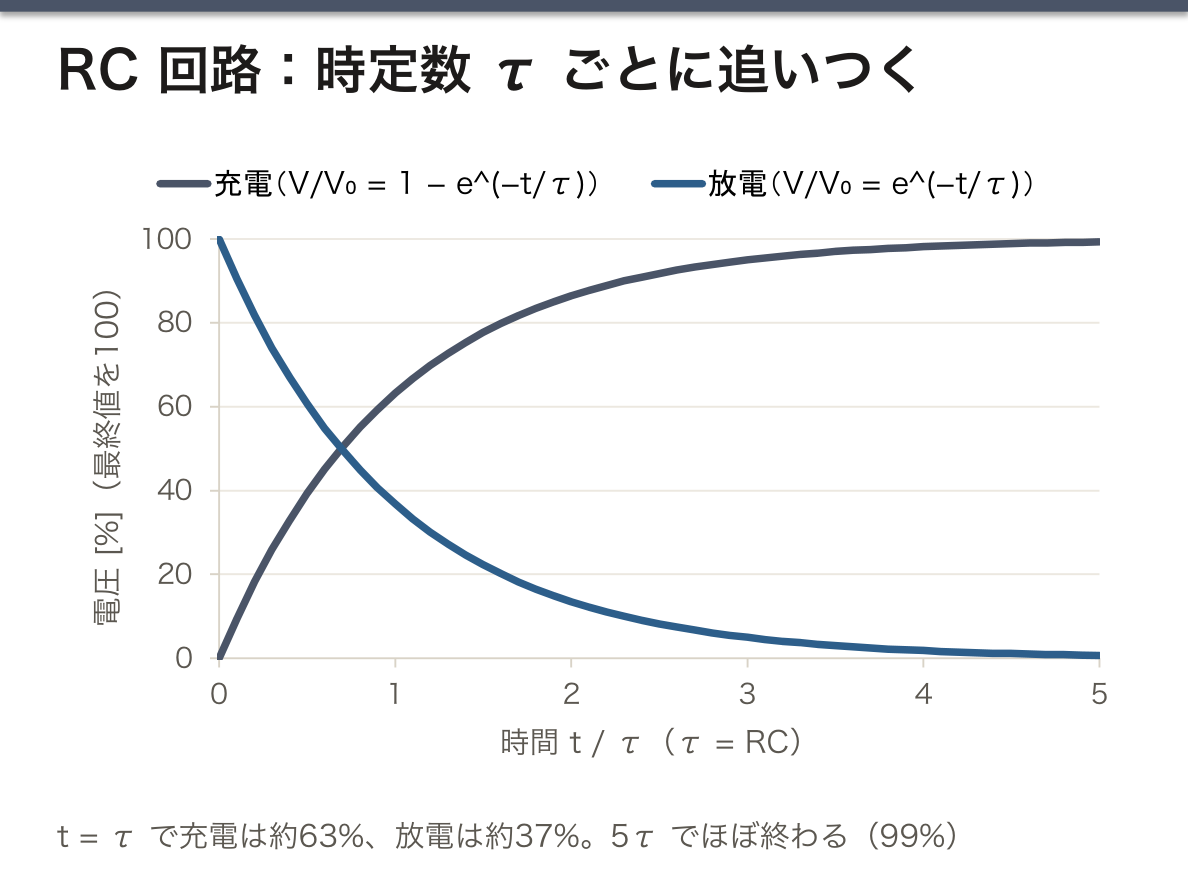
ためたエネルギーは W = ½CV2 = ½QV。抵抗 R を通して充電・放電すると、電圧は指数関数的に変化し、その速さは時定数 τ = RC で決まる(τ の時間で最終値の約 63% に達する)。
なぜエネルギーは ½QV で、QV ではないのか。充電の初めは極板の電圧が 0 で、電荷を運ぶのに仕事はほとんどいらない。たまるにつれて電圧が上がり、後から運ぶ電荷ほど大きな仕事が必要になる。電圧は 0 から V まで直線的に上がるので、平均すると V/2——だから全体の仕事は Q × V/2 になる。
なぜ間隔が狭いほど容量が大きいのか。極板が近いと、反対側の極板の電荷が強く引きつけ合うので、同じ電圧でもより多くの電荷を極板に寄せておける。面積が大きいほど電荷を並べる場所が増える。この2つの直感で式の形が説明できる。
時定数は「どれだけ速く電圧が追いつくか」の目安である。抵抗が大きいと電流が少しずつしか流れず、容量が大きいと満たすべき電荷が多いので、どちらも充電を遅くする。心電計などの増幅器のフィルタも、この RC の組み合わせで「速い変化だけ通す」「遅い変化だけ通す」をつくっている。
除細動器(AED を含む)はコンデンサにためた電気を一気に流す装置である。電池から時間をかけてコンデンサを高電圧に充電し、数ミリ秒で胸に放電する。たとえば 100 μF のコンデンサを 2,000 V に充電すると ½×100×10−6×(2×103)2 = 200 J——成人の除細動で使うエネルギーのけたになる。電池だけでは一瞬にこれだけの電力を出せないので、コンデンサで「ため込んでから出す」必要がある。AED が「充電中」と言って数秒待つのはこのためである。
English version
Core
A capacitor is two conductors (plates) separated by an insulator. It stores charge. Apply a voltage V and one plate collects +Q and the other −Q; Q is proportional to V.
Q = CV. The constant C is the capacitance, unit F (farad) = C/V. One farad is very large, so μF, nF and pF are used in practice.
For a parallel-plate capacitor,
C = ε0εr A / d (A: plate area, d: spacing, εr: relative permittivity of the material between)
so larger plates, a smaller gap and a material of higher permittivity store more charge.
The stored energy is W = ½CV2 = ½QV. When charged or discharged through a resistor R, the voltage changes exponentially, at a rate set by the time constant τ = RC (after one τ it reaches about 63% of the final value).
Going further
Why is the energy ½QV and not QV? At the start of charging, the plate voltage is 0 and moving charge takes almost no work. As charge builds up, the voltage rises, and each later bit of charge needs more work. The voltage rises in a straight line from 0 to V, so its average is V/2 — the total work is Q × V/2.
Why does a smaller gap give a larger capacitance? When the plates are close, the charges on the opposite plates attract each other strongly, so more charge can be held on the plates at the same voltage. A larger area gives more room to place charge. These two ideas explain the shape of the formula.
The time constant tells how fast the voltage catches up. A large resistance lets only a little current flow; a large capacitance means more charge to fill. Both slow charging. The filters in ECG amplifiers use this RC combination to "pass only fast changes" or "pass only slow changes".
In the clinic
A defibrillator (including an AED) releases electricity stored in a capacitor all at once. A battery slowly charges the capacitor to a high voltage, which is then discharged through the chest in a few milliseconds. For example, a 100 μF capacitor charged to 2,000 V holds ½×100×10−6×(2×103)2 = 200 J — the order of energy used to defibrillate an adult. A battery alone cannot give that much power in an instant, so the capacitor must "store first, then release". This is why an AED says "charging" and waits a few seconds.
誘電体と誘電分極 — 絶縁体をはさむと容量が増える理由
誘電体(dielectric)は電気を通さない物質(絶縁体)で、電場の中に置くと誘電分極(dielectric polarization)を起こす。分子の中の正負の電荷がわずかにずれる(電子分極)か、もともと極性を持つ分子(水など)が電場の向きにそろう(配向分極)。その結果、誘電体の表面に外の電場と逆向きの電荷が現れ、内部の電場が弱まる。
弱まる割合を表すのが比誘電率(relative permittivity, εr)で、真空を 1 とする。
| 物質 | 比誘電率 εr(目安) |
|---|---|
| 真空 | 1 |
| 空気 | ほぼ 1 |
| 脂質(膜の炭化水素の部分) | 約 2 |
| 水(室温) | 約 80 |
コンデンサの極板のあいだに誘電体を入れると、同じ電荷でも電圧が 1/εr に下がる。C = Q/V なので、容量は εr 倍に増える。
誘電体にかける電場を強くしすぎると、ある値で急に電流が流れて壊れる。これを絶縁破壊(dielectric breakdown)という。乾いた空気ではおよそ 3×10⁶ V/m で起き、火花(放電)になる。
水の比誘電率が大きいのは、水分子が強い極性を持つからである。酸素側がやや負、水素側がやや正に偏った分子が電場の向きに回って並び、外の電場を強く打ち消す。そのため水の中では、イオンどうしのクーロン力が約 1/80 に弱まり、イオン結晶がばらばらのイオンとして溶けていられる。
逆に、比誘電率の小さい脂質の中にイオンを入れるのは非常に不利である。電荷のまわりの電場のエネルギーは、まわりの比誘電率が小さいほど大きくなる。水(約 80)から脂質(約 2)へイオンを移すと、このエネルギーが大きく跳ね上がる。だからイオンは脂質二重層をほとんど通れず、チャネルや輸送体という「水の通り道」が必要になる。細胞膜がイオンを隔てる絶縁体として働くのは、この物理のためである。
局所麻酔薬は、電荷を持たない形で膜を通り抜ける。多くは弱塩基で、非イオン型が膜を通って神経の中に入り、中でイオン型になって Na+ チャネルをふさぐ。炎症で組織が酸性に傾くとイオン型が増え、膜を通れなくなって効きが悪くなる——電荷を持つものが脂質を通れないという、上の物理の臨床版である。
電気穿孔(エレクトロポレーション)は膜の「絶縁破壊」を利用する。短く強い電圧パルスで膜の電位差がおよそ数百 mV〜1 V を超えると、膜に一時的な孔が開く。遺伝子を細胞に入れる実験技術のほか、孔を戻らなくして細胞を死なせる方法が、心房細動のカテーテルアブレーション(パルスフィールドアブレーション)や一部の腫瘍の治療に使われている。
English version
Core
A dielectric is a material that does not conduct electricity (an insulator). In an electric field it shows dielectric polarization: the positive and negative charges in each molecule shift slightly (electronic polarization), or molecules that are already polar, such as water, turn to line up with the field (orientation polarization). As a result, charges opposite to the outside field appear on the surfaces, and the field inside becomes weaker.
How much weaker is given by the relative permittivity εr, with vacuum = 1.
| Material | Relative permittivity εr (approx.) |
|---|---|
| Vacuum | 1 |
| Air | almost 1 |
| Lipid (hydrocarbon part of the membrane) | about 2 |
| Water (room temperature) | about 80 |
Put a dielectric between capacitor plates and, for the same charge, the voltage falls to 1/εr. Because C = Q/V, the capacitance rises by a factor of εr.
If the field across a dielectric is made too strong, at some value current suddenly flows and the material fails. This is dielectric breakdown. In dry air it happens at about 3×10⁶ V/m and makes a spark.
Going further
Water has a high relative permittivity because its molecules are strongly polar. The oxygen side is slightly negative and the hydrogen side slightly positive; the molecules turn to line up with the field and cancel it strongly. So in water the Coulomb force between ions drops to about 1/80, and an ionic crystal can stay dissolved as separate ions.
On the other hand, putting an ion into lipid, with its low permittivity, is very costly. The energy of the field around a charge is larger when the surrounding permittivity is smaller. Moving an ion from water (about 80) into lipid (about 2) makes this energy jump. That is why ions can hardly cross the lipid bilayer, and channels and transporters — "water paths" — are needed. The cell membrane works as an insulator that separates ions because of this physics.
In the clinic
Local anaesthetics cross the membrane in their uncharged form. Most are weak bases: the non-ionised form crosses into the nerve, becomes ionised inside and blocks the Na+ channel. When inflammation makes tissue acidic, more drug is ionised, it cannot cross the membrane, and it works less well — the clinical version of the rule that charged things cannot cross lipid.
Electroporation uses "breakdown" of the membrane. When short, strong voltage pulses push the membrane voltage above roughly a few hundred mV to 1 V, temporary pores open. Besides the laboratory technique of putting genes into cells, methods that make the pores permanent and kill the cells are used in catheter ablation for atrial fibrillation (pulsed field ablation) and for some tumours.
細胞膜はコンデンサ — 膜電位をつくる電荷はごくわずか
細胞膜は、導体(細胞内液と細胞外液。どちらもイオンを含む電解質溶液)を、薄い絶縁体(脂質二重層)で隔てた構造である。これはコンデンサそのものである。
膜の単位面積あたりの静電容量(膜容量, membrane capacitance)は、細胞の種類によらずほぼ約 1 μF/cm2 になる。脂質二重層の厚さ(数 nm)と比誘電率(2〜3 程度)を平行平板の式 C/A = ε0εr/d に入れると、このけたの値が出る。膜がとても薄いので、容量は大きい。
膜電位 −70 mV をつくるのに必要な電荷を Q = CV で計算すると、1 cm2 あたり 1×10−6 F × 0.07 V = 7×10⁻⁸ C。素電荷で割ると約 4×10¹¹ 個、つまり1 μm2 あたりわずか数千個のイオンが膜の両側に偏るだけでよい。
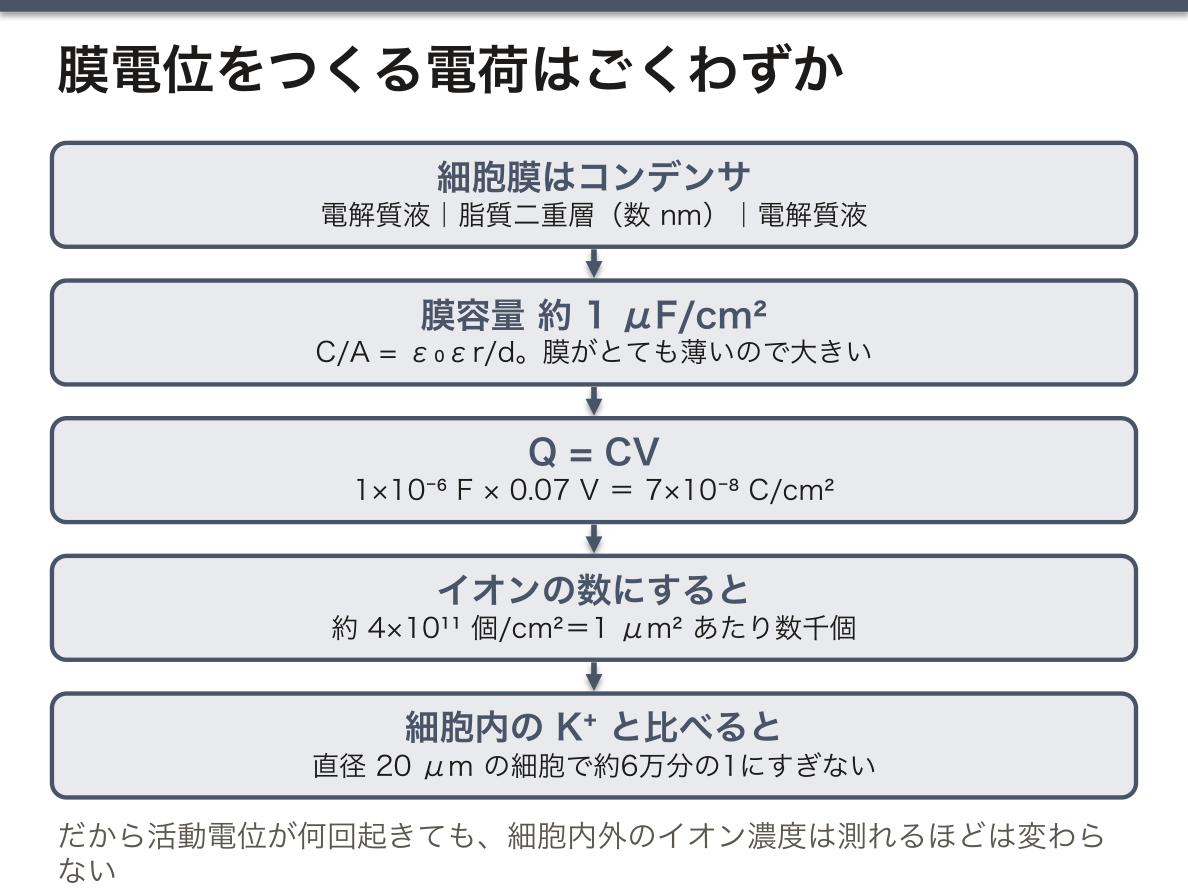
この数がどれほど小さいか。直径 20 μm の球形の細胞を考えると、膜の両側に偏るイオンは約 500 万個。一方、細胞内の K+(約 140 mM)はおよそ 3,500 億個ある。膜電位をつくるのに動く K+ は、細胞内の K+ の約 6 万分の 1 にすぎない。
ここから2つのことが言える。①活動電位が何回起きても、細胞内外のイオン濃度は測れるほどは変わらない。濃度差は Na+/K+-ATPase がゆっくり保てば足りる。②細胞内液も細胞外液も、膜のすぐそばを除けば電気的に中性とみなしてよい。偏った電荷は膜の表面に薄く張りついているだけである。
膜には容量と並んでイオンチャネルという抵抗もあるので、膜は RC 回路として振る舞う。電流を流しても膜電位はすぐには変わらず、時定数 τ = RC(ミリ秒のけた)で遅れて追いつく。神経の信号が伝わる速さは、この「膜を充電する時間」に強く左右される。
髄鞘(ミエリン)は、何重にも巻いた膜で「コンデンサの極板の間隔を広げる」構造である。膜が直列に重なると全体の容量は小さくなり(d が大きくなるのと同じ)、同時に漏れの抵抗は大きくなる。すると、1回の興奮で充電すべき電荷が少なくてすみ、電流がランビエ絞輪まで漏れずに届くので、跳躍伝導が速く、エネルギーも少なくてすむ。
多発性硬化症やギラン・バレー症候群などの脱髄では、この仕組みが壊れる。容量が増え、電流が途中で漏れるので、伝導が遅れたり途中で止まったりする(伝導ブロック)。神経伝導検査で伝導速度が大きく落ちるのは、まさにこの物理の変化を見ている。
English version
Core
The cell membrane is two conductors (the intracellular and extracellular fluids, both ion-containing electrolyte solutions) separated by a thin insulator (the lipid bilayer). That is exactly a capacitor.
The capacitance per unit area (membrane capacitance) is nearly the same in all cell types: about 1 μF/cm2. Putting the bilayer thickness (a few nm) and its relative permittivity (about 2–3) into the parallel-plate formula C/A = ε0εr/d gives a value of this order. Because the membrane is so thin, its capacitance is large.
Calculate the charge needed for a membrane potential of −70 mV with Q = CV: per cm2, 1×10−6 F × 0.07 V = 7×10⁻⁸ C. Dividing by the elementary charge gives about 4×10¹¹ ions — that is, only a few thousand ions per μm2 need to gather on either side of the membrane.
Going further
How small is this number? For a spherical cell 20 μm across, about 5 million ions gather at the membrane. The cell holds about 350 billion K+ ions (about 140 mM). The K+ that moves to create the membrane potential is only about 1/60,000 of the K+ inside.
Two things follow. (1) However many action potentials fire, the ion concentrations inside and outside do not change measurably. The Na+/K+-ATPase only needs to keep the gradients slowly. (2) Both intracellular and extracellular fluids can be treated as electrically neutral, except right next to the membrane. The separated charge is just a thin layer stuck to the membrane surfaces.
Besides capacitance, the membrane has resistance in the form of ion channels, so it behaves as an RC circuit. When current flows, the membrane potential does not change at once; it catches up with a delay set by the time constant τ = RC (milliseconds). How fast a nerve signal travels depends strongly on this "time to charge the membrane".
In the clinic
Myelin is many wrapped layers of membrane — a way of "widening the gap between capacitor plates". Membranes stacked in series give a smaller total capacitance (the same as a larger d) and a larger leak resistance. Less charge is needed for each excitation, and current reaches the nodes of Ranvier without leaking, so saltatory conduction is fast and uses little energy.
In demyelination, as in multiple sclerosis or Guillain–Barré syndrome, this breaks down. Capacitance rises and current leaks on the way, so conduction slows or stops (conduction block). The large drop in conduction velocity on nerve conduction studies shows exactly this change in physics.
まとめ
| 電荷と電荷保存則 — 電荷は作れず、移るだけ | 電荷(electric charge)は記号 Q(または q)、単位は C(クーロン)。 |
|---|---|
| クーロンの法則 — 電荷どうしの力は距離の2乗に反比例する | 2つの点電荷 q1・q2 が距離 r だけ離れているとき、互いに及ぼす力の大きさはF = k · q1q2 / r2である(クーロンの法則, Coulomb's law)。 |
| 電場(電界) — 電荷が周りの空間に作る「力の場」 | 離れた電荷どうしがなぜ力を及ぼし合えるのか。 |
| 電位と電圧 — 電圧とは「電荷1つあたりの仕事」 | 重力の場で物体を高さ h まで持ち上げると、位置エネルギー mgh がたまる(力 mg × 距離 h)。 |
| コンデンサと静電容量 — 電荷をためる装置 | コンデンサ(capacitor, キャパシタ)は、2枚の導体(極板)を絶縁体で隔てたもので、電荷をためる働きをする。 |
| 誘電体と誘電分極 — 絶縁体をはさむと容量が増える理由 | 誘電体(dielectric)は電気を通さない物質(絶縁体)で、電場の中に置くと誘電分極(dielectric polarization)を起こす。 |
| 細胞膜はコンデンサ — 膜電位をつくる電荷はごくわずか | 細胞膜は、導体(細胞内液と細胞外液。どちらもイオンを含む電解質溶液)を、薄い絶縁体(脂質二重層)で隔てた構造である。 |
このノートは医学生が授業の内容を自分の言葉でまとめたもので、診療の判断に使うものではありません。誤りに気づいたらお知らせください。