水はさらさら、蜂蜜はとろとろ——この違いが粘性、流体の中の「内部摩擦」である。流れる層どうしが互いを引きずり合う強さを数で表したのが粘度 η で、血液が血管を流れるときの抵抗、心臓の仕事量、赤沈の速さまでがこの量に左右される。
章の流れは3段。まず粘度の定義と、温度でどう変わるか。次に血液のように粘度が流れ方で変わる液体(非ニュートン流体)と、流れが層流か乱流かを決めるレイノルズ数。最後に粘度の測り方——球を落とす方法(ストークスの法則)と回転粘度計。
式は2本で足りる:η = (F/A)/(Δv/Δz)(定義)と、F = 6πηrv(ストークスの法則)。後者は赤沈と電気泳動にも出てくる。
- 粘性とは — 層どうしの摩擦を数にする
- 温度と粘度 — 液体は下がり、気体は上がる
- ニュートン流体と非ニュートン流体 — 血液は流れ方で粘度が変わる
- 層流と乱流 — レイノルズ数で決まる
- ストークスの法則と落球法 — 落ちる速さから粘度を求める
- 粘度計 — 回転・毛細管・落球
粘性とは — 層どうしの摩擦を数にする
流体を薄い層の重なりと考える。一番上の層に力をかけて動かすと、その層は下の層を引きずり、下の層はさらに下を引きずる。層から層へ運動量が受け渡され、下へいくほど遅くなる。この層間の摩擦が粘性である。
粘度(粘性係数)η は、ずり応力(層に沿ってかかる単位面積あたりの力 F/A)と、速度勾配(層と層の速さの差 Δv/Δz)の比である(ニュートンの粘性法則)。
η = (F/A)/(Δv/Δz) 単位 Pa·s
1 mPa·s = 1 cP(センチポアズ)。水は20 ℃で約1 mPa·s。粘性のない理想流体では層間に力ははたらかない。
粘度と動粘度:上の η を粘度(動的粘度、絶対粘度)といい、これを密度で割ったものを動粘度という。
ν = η/ρ 単位 m2/s(1 St = 10−4 m2/s)
粘度は「どれだけ流れに逆らうか」、動粘度は「重力で自然に流れるときの流れにくさ」で、慣性と粘性の両方が効く場面で使う。医学で「粘度」と言えばふつう η である。
粘度は分子の大きさと形で決まる。大きく複雑な形の分子(糖や油)は互いにすれ違いにくく、粘度が高い。水・油・蜂蜜の順に粘度が上がるのはこのためである。
English version
Core
Think of a fluid as a stack of thin layers. Push the top layer with a force and it drags the layer below, which drags the next one down. Momentum is handed from layer to layer, and the lower layers move more slowly. This friction between layers is viscosity.
Viscosity η is the ratio of the shear stress (force per unit area along the layer, F/A) to the velocity gradient (the difference in speed between layers, Δv/Δz) — Newton’s law of viscosity.
η = (F/A)/(Δv/Δz), unit Pa·s
1 mPa·s = 1 cP (centipoise). Water at 20 °C is about 1 mPa·s. In an ideal fluid without viscosity, no force acts between layers.
Going further
Dynamic versus kinematic viscosity: the η above is the dynamic (absolute) viscosity; dividing it by density gives the kinematic viscosity.
ν = η/ρ, unit m2/s (1 St = 10−4 m2/s)
Dynamic viscosity is “how much it resists flow”; kinematic viscosity is “how hard it is to flow under gravity alone”, used when both inertia and viscosity matter. In medicine, “viscosity” usually means η.
Viscosity depends on the size and shape of the molecules. Large, complex molecules (sugars, oils) pass each other with difficulty, so their viscosity is high. This is why viscosity rises from water to oil to honey.
温度と粘度 — 液体は下がり、気体は上がる
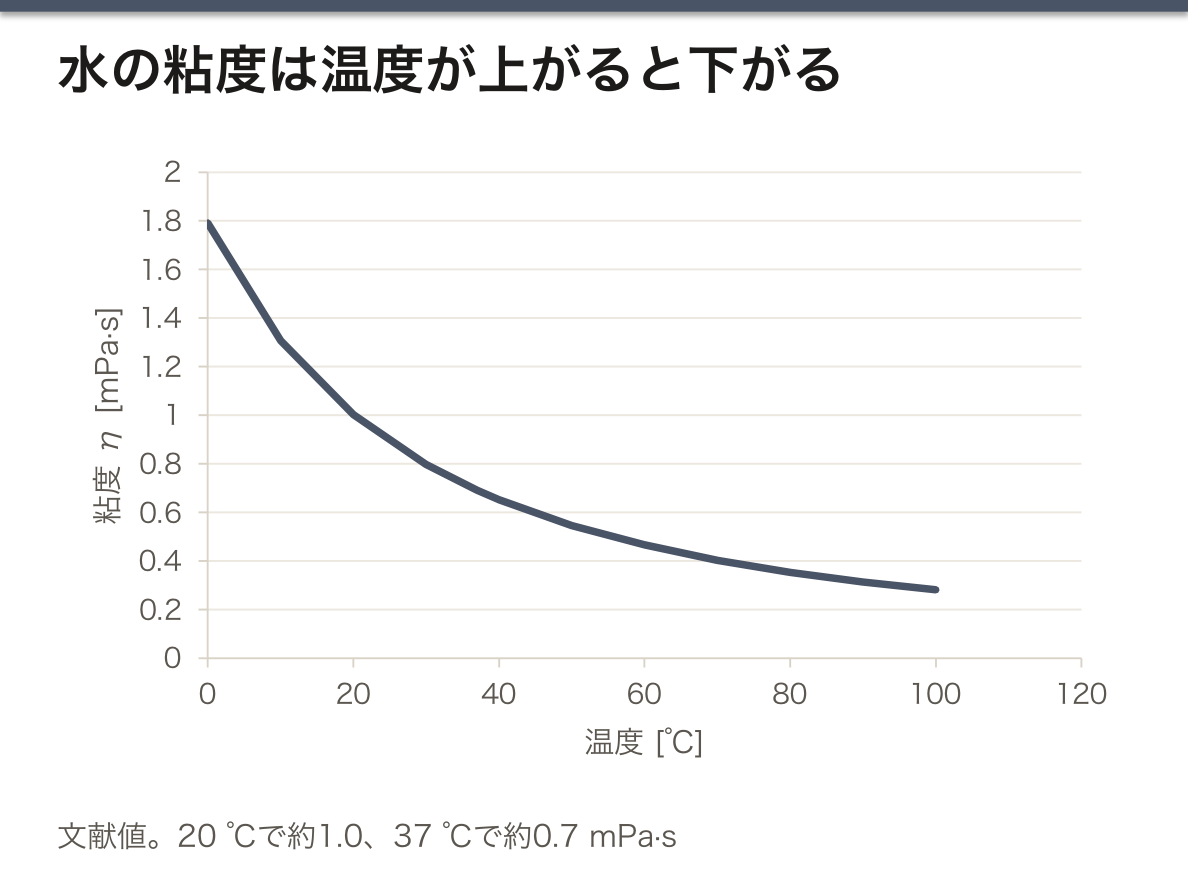
液体の粘度は温度が上がると下がる。蜂蜜を温めると流れやすくなる。水は20 ℃で約1.0 mPa·s、37 ℃で約0.7 mPa·s。
気体の粘度は逆に温度が上がると上がる。
粘度は温度に非常に敏感で、液体によっては5 ℃の違いで2倍近く変わる。だから粘度の測定値には必ず温度を添え、測定中の温度を一定に保つ。
なぜ液体と気体で逆なのか——粘性の源が違うからである。
液体では、粘性は分子間の引力から来る。温度が上がると分子の運動が激しくなって分子間の距離が開き、引き合っている時間も短くなる。層どうしの「くっつき」が弱まるので粘度が下がる。
気体では分子間の引力はほとんどなく、粘性は分子が層の間を飛び移って運動量を運ぶことから来る。温度が上がると分子が速く動き、衝突と運動量の受け渡しが増えるので粘度が上がる。
まとめると、粘度が下がる方向にはたらくのは、粒子の速さが増す・粒子の間隔が開く・熱エネルギーが増える(液体の場合)で、上がる方向は分子間の引力が強まることである。
寒いところでは血漿の粘度が上がり、赤血球も変形しにくくなって指先の血流が落ちる。逆に入浴やサウナで体が温まると血液は流れやすくなるが、長く続けて脱水になると血漿が減ってヘマトクリットが上がり、かえって粘度が上がる。高齢者の入浴後や夏の脱水で血栓症が増える一因である。
English version
Core
The viscosity of a liquid falls as temperature rises. Warmed honey flows more easily. Water is about 1.0 mPa·s at 20 °C and about 0.7 mPa·s at 37 °C.
The viscosity of a gas, in contrast, rises with temperature.
Viscosity is very sensitive to temperature; for some liquids a 5 °C difference almost doubles it. So a viscosity value must always come with its temperature, and the temperature must be kept constant during measurement.
Going further
Why opposite in liquids and gases? The source of viscosity is different.
In a liquid, viscosity comes from attraction between molecules. As temperature rises, molecules move harder, the distance between them grows and the time they stay attracted gets shorter. The “stickiness” between layers weakens, so viscosity falls.
In a gas, there is almost no attraction; viscosity comes from molecules jumping between layers and carrying momentum. As temperature rises, molecules move faster and collide and exchange momentum more, so viscosity rises.
In short, viscosity goes down when particles move faster, the spacing between them grows and heat energy increases (for liquids), and goes up when attraction between molecules gets stronger.
In the clinic
In the cold, plasma viscosity rises and red cells become less flexible, so blood flow in the fingers falls. When the body is warmed in a bath or sauna, blood flows more easily, but if it lasts long and causes dehydration, plasma volume falls and the hematocrit rises, so viscosity goes up instead. This is one reason thrombosis increases after bathing in older people and with summer dehydration.
ニュートン流体と非ニュートン流体 — 血液は流れ方で粘度が変わる
ニュートン流体:ずり応力と速度勾配が比例し、粘度が流れの速さによらず一定(水・アルコール・油・ガソリン・蜂蜜)。
非ニュートン流体:粘度がずり速度(流れの速さの勾配)で変わる(血液・ケチャップ・練り歯磨き・ペンキ・溶岩)。「線形の関係を示す」のはニュートン流体のほうである。
血液は非ニュートン流体で、ゆっくり流れるほど粘度が高い(ずり速度が下がると粘度が上がる)。37 ℃での粘度は水のおよそ3〜4倍で、主に赤血球の量(ヘマトクリット)と血漿蛋白質で決まる。
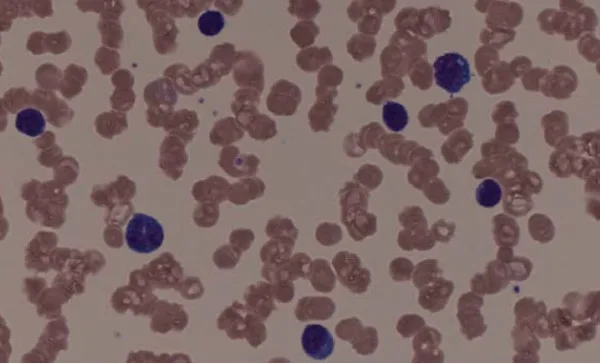
なぜ血液はゆっくり流れると粘くなるのか。流れが遅いと、赤血球どうしが血漿蛋白質(とくにフィブリノゲン)を介して積み重なり、連銭形成をつくる。大きな塊は流れを強く妨げる。速く流れると塊はほどけ、赤血球自身も流れの向きに変形して並ぶので、粘度が下がる(ずり流動化)。
細い血管(直径0.3 mm 以下程度)では、赤血球が血管の中心に集まり、壁の近くに血漿の層ができる。そのため見かけの粘度が下がる(Fåhræus–Lindqvist 効果)。微小循環が太い血管の常識より流れやすいのはこのためである。
多血症(真性多血症や脱水)ではヘマトクリットが上がって血液が粘くなり、血管抵抗の上昇・血栓・頭痛やめまいの原因になる。マクログロブリン血症や多発性骨髄腫では大量の免疫グロブリンが血漿の粘度を上げ、過粘稠度症候群(視力障害・神経症状・出血)を起こすことがある。
English version
Core
Newtonian fluids: shear stress and velocity gradient are proportional, and viscosity is constant whatever the flow speed (water, alcohol, oil, gasoline, honey).
Non-Newtonian fluids: viscosity changes with the shear rate (the gradient of flow speed) — blood, ketchup, toothpaste, paint, lava. The fluid with “a linear relationship” is the Newtonian one.
Blood is non-Newtonian: the slower it flows, the higher its viscosity (viscosity rises as shear rate falls). At 37 °C its viscosity is about 3–4 times that of water, set mainly by the amount of red cells (hematocrit) and plasma proteins.
Going further
Why does blood get thicker when it flows slowly? In slow flow, red cells stack together through plasma proteins (especially fibrinogen) and form rouleaux. Large clumps strongly resist flow. In fast flow the clumps come apart, and the red cells themselves deform and line up with the flow, so viscosity falls (shear thinning).
In thin vessels (below roughly 0.3 mm in diameter), red cells gather in the center and a plasma layer forms near the wall. This lowers the apparent viscosity (the Fåhræus–Lindqvist effect). This is why the microcirculation flows more easily than large-vessel rules would suggest.
In the clinic
In polycythemia (polycythemia vera or dehydration) the hematocrit rises and blood thickens, causing higher vascular resistance, thrombosis, headache and dizziness. In macroglobulinemia and multiple myeloma, large amounts of immunoglobulin raise plasma viscosity and can cause hyperviscosity syndrome (visual disturbance, neurological symptoms, bleeding).
層流と乱流 — レイノルズ数で決まる
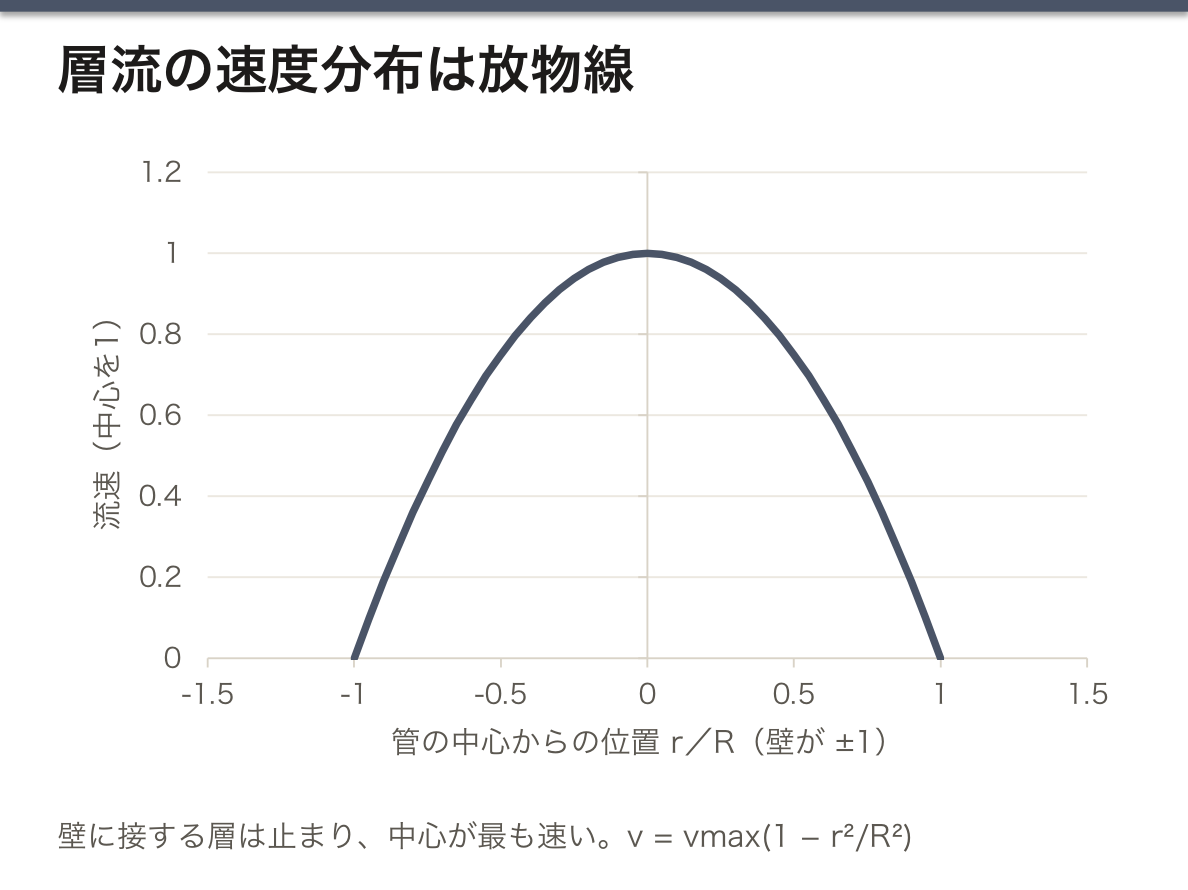
層流(laminar flow):流体が平行な層をなしてすべるように流れる。管の中心が最も速く、壁に近いほど遅い(放物線の速度分布)。静かで、エネルギー損失が小さい。
乱流(turbulent flow):渦ができ、流体の塊がいろいろな向きに乱れて動く。音を生じ、同じ流量を流すのにより大きな圧力が要る。
どちらになるかはレイノルズ数で決まる。
Re = ρvD/η(ρ:密度、v:流速、D:管の直径、η:粘度)
目安として Re < 2000 で層流、Re > 3000 で乱流。Re が大きいほど乱流になりやすい。
Re は「慣性力と粘性力の比」である。慣性は流れを勝手な向きに進ませようとし、粘性は層をそろえようとする。速く・太く・密度が高いほど慣性が勝ち、粘度が高いほど粘性が勝つ。
体の循環ではほとんどの場所で Re は小さく、血流は大部分が層流である。細動脈や毛細血管では Re は1よりずっと小さい。例外は上行大動脈で、収縮期のピークには Re が数千に達し、一時的に乱流に近づく。
乱流は音を出すので、聴診で聞こえる「雑音」は乱流のしるしである。弁の狭窄や逆流、血管の狭窄(頸動脈の血管雑音)、貧血(粘度が下がり流速が上がる)、発熱や甲状腺機能亢進症(流速が上がる)で雑音が聞こえやすくなるのは、どれも Re が上がるからである。血圧測定のコロトコフ音も、カフで狭められた動脈を流れる乱流の音である。
English version
Core
Laminar flow: the fluid slides along in parallel layers. The center of the tube is fastest and flow is slower near the wall (a parabolic velocity profile). It is quiet and loses little energy.
Turbulent flow: eddies form and parcels of fluid move irregularly in many directions. It makes sound and needs more pressure to carry the same flow.
Which one occurs is decided by the Reynolds number.
Re = ρvD/η (ρ: density, v: flow speed, D: tube diameter, η: viscosity)
As a guide, Re < 2000 is laminar and Re > 3000 is turbulent. The larger Re, the more likely turbulence is.
Going further
Re is “the ratio of inertial force to viscous force”. Inertia tends to carry the fluid off in any direction; viscosity tends to keep the layers in line. Fast, wide and dense flows let inertia win; high viscosity lets viscous forces win.
In most of the circulation Re is small and blood flow is mostly laminar. In arterioles and capillaries Re is far below 1. The exception is the ascending aorta, where Re reaches several thousand at peak systole and flow briefly approaches turbulence.
In the clinic
Turbulence makes sound, so a murmur heard with a stethoscope is a sign of turbulence. Valve stenosis or regurgitation, narrowed vessels (a carotid bruit), anemia (lower viscosity and faster flow), and fever or hyperthyroidism (faster flow) all make murmurs easier to hear because they raise Re. The Korotkoff sounds in blood pressure measurement are also the sound of turbulent flow through an artery narrowed by the cuff.
ストークスの法則と落球法 — 落ちる速さから粘度を求める
粘性流体の中を半径 r の球が速さ v で動くと、流れに逆らう抵抗力(ドラッグ)がはたらく。
Fd = 6πηrv(ストークスの法則)
粘度が高いほど、球が大きいほど、速いほど抵抗は大きい。
液中を落ちる球には3つの力がはたらく:重力 Fg = ρsVg(下向き)、浮力 Fb = ρLVg(上向き)、抵抗力 Fd(上向き)。球は加速し、抵抗が増えて3力がつり合うと一定の速さ(終端速度)で落ちる。
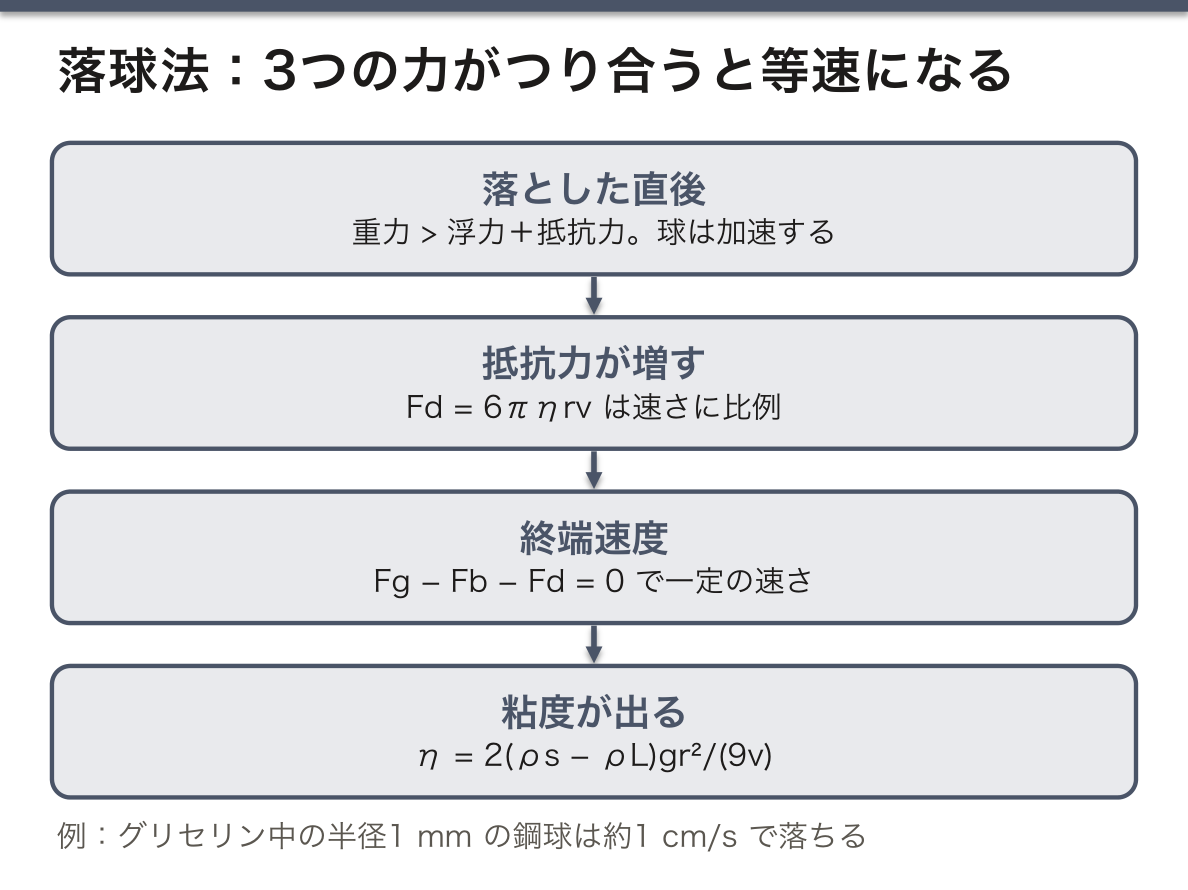
つり合いの式 Fg − Fb − Fd = 0 に V = (4/3)πr3 を入れて整理すると
η = 2(ρs − ρL)gr2/(9v)
球の半径と、一定区間を落ちる時間(→速さ)を測れば粘度が出る(落球法)。
例:グリセリン(ρL ≈ 1260 kg/m3、η ≈ 1.4 Pa·s)に半径1 mm の鋼球(7700 kg/m3)を落とすと、終端速度は約1 cm/s。
誤差の原因:まだ加速中に計時を始める(印を液面から十分下に付ける)、反応時間、容器の壁が近い、球の形と大きさの誤差、温度の変化(密度と粘度が変わる)。式が成り立つのは球がゆっくり動き、まわりの流れが層流のときに限られる。
赤血球沈降速度(赤沈)はストークスの法則そのものである。沈む速さは半径の2乗に比例するので、炎症でフィブリノゲンやグロブリンが増えて赤血球が連銭をつくり実効的な半径が大きくなると、赤沈は速くなる。貧血でも促進し、多血症では遅くなる。電気泳動で粒子が一定の速さで動くのも、電気の力とこの抵抗力のつり合いである。
English version
Core
When a sphere of radius r moves at speed v through a viscous fluid, a drag force opposes the motion.
Fd = 6πηrv (Stokes’ law)
The higher the viscosity, the larger the sphere and the faster it moves, the larger the drag.
Three forces act on a sphere falling through a liquid: gravity Fg = ρsVg (down), buoyancy Fb = ρLVg (up) and drag Fd (up). The sphere speeds up, drag grows, and when the three forces balance it falls at a constant speed (terminal velocity).
Going further
Putting V = (4/3)πr3 into the balance Fg − Fb − Fd = 0 gives
η = 2(ρs − ρL)gr2/(9v)
Measure the radius of the sphere and the time it takes to fall a fixed distance (→ speed), and you get the viscosity (the falling-sphere method).
Example: a steel ball (7700 kg/m3) of radius 1 mm in glycerol (ρL ≈ 1260 kg/m3, η ≈ 1.4 Pa·s) has a terminal velocity of about 1 cm/s.
Sources of error: starting the timing while the ball is still speeding up (put the mark well below the surface), reaction time, walls of the container too close, errors in the shape and size of the ball, and temperature changes (density and viscosity change). The formula holds only when the sphere moves slowly and the flow around it is laminar.
In the clinic
The erythrocyte sedimentation rate (ESR) is Stokes’ law itself. Sinking speed is proportional to the square of the radius, so when inflammation raises fibrinogen and globulins and red cells form rouleaux with a larger effective radius, the ESR becomes faster. It is also faster in anemia and slower in polycythemia. In electrophoresis, particles move at constant speed because the electric force balances this same drag.
粘度計 — 回転・毛細管・落球
粘度の主な測り方は次のとおり。
| 方法 | 何を測るか |
|---|---|
| 落球法(ストークス法) | 決まった密度の球が一定区間を落ちる時間 |
| 回転法 | 液中で回転子(スピンドル)を一定速度で回すのに要るトルク |
| 毛細管法(オストワルド粘度計) | 一定体積の液が細い管を流れ下る時間 |
| カップ法 | カップの底の小穴から液が流れ出る時間 |
| 振動法 | 液に浸した振動子の振動の減衰 |
回転粘度計は、粘い液ほど回転子を回すのに大きなトルクが要ることを利用する。回転速度・回転子の大きさと形・液の温度・ばねのトルクで測れる範囲が決まる。回転速度(ずり速度)を変えて測れるので、非ニュートン流体の「流れ方で変わる粘度」を調べられるのが強みである。正確に測るには既知の粘度の標準液で校正する。誤差の原因は、装置の傾きや振動、回転子の選び方、温度の変動、乱流、気泡、非ニュートン性など。
毛細管法はポアズイユの法則(流量が粘度に反比例する)にもとづき、水など基準液と流下時間を比べて求める。
2つの方法で同じ液を測って結果を比べると、それぞれの系統誤差の有無が見えてくる。
English version
Core
The main ways to measure viscosity are these.
| Method | What is measured |
|---|---|
| Falling sphere (Stokes) | The time for a ball of known density to fall a fixed distance |
| Rotational | The torque needed to turn a spindle at constant speed in the liquid |
| Capillary (Ostwald viscometer) | The time for a fixed volume to flow down a thin tube |
| Cup | The time for the liquid to run out of a small hole in the bottom of a cup |
| Vibrational | The damping of a vibrating rod dipped in the liquid |
Going further
A rotational viscometer uses the fact that a thicker liquid needs more torque to turn the spindle. Its range depends on the rotation speed, the size and shape of the spindle, the temperature of the liquid and the torque of the spring. Because it can measure at different rotation speeds (shear rates), its strength is that it can study how the viscosity of non-Newtonian fluids changes with flow. For accuracy it is calibrated with a standard liquid of known viscosity. Sources of error include tilt and vibration, the choice of spindle, temperature changes, turbulence, bubbles and non-Newtonian behavior.
The capillary method is based on Poiseuille’s law (flow rate is inversely proportional to viscosity), and compares the flow time with that of a reference liquid such as water.
Measuring the same liquid by two methods and comparing the results shows whether either has a systematic error.
まとめ
| 粘性とは — 層どうしの摩擦を数にする | 流体を薄い層の重なりと考える。一番上の層に力をかけて動かすと、その層は下の層を引きずり、下の層はさらに下を引きずる。 |
|---|---|
| 温度と粘度 — 液体は下がり、気体は上がる | 液体の粘度は温度が上がると下がる。蜂蜜を温めると流れやすくなる。 |
| ニュートン流体と非ニュートン流体 — 血液は流れ方で粘度が変わる | ニュートン流体:ずり応力と速度勾配が比例し、粘度が流れの速さによらず一定(水・アルコール・油・ガソリン・蜂蜜)。 |
| 層流と乱流 — レイノルズ数で決まる | 層流(laminar flow):流体が平行な層をなしてすべるように流れる。 |
| ストークスの法則と落球法 — 落ちる速さから粘度を求める | 粘性流体の中を半径 r の球が速さ v で動くと、流れに逆らう抵抗力(ドラッグ)がはたらく。 |
| 粘度計 — 回転・毛細管・落球 | 粘度の主な測り方は次のとおり。 |
このノートは医学生が授業の内容を自分の言葉でまとめたもので、診療の判断に使うものではありません。誤りに気づいたらお知らせください。