この章は、電流が磁場をつくり、磁場が動く電荷を曲げるという電磁気の基本から、物質の磁性、地磁気、一様な磁場をつくるヘルムホルツコイルの実験までを扱い、医学での応用として MRI と TMS(経頭蓋磁気刺激)を中心に置く。
MRI は「磁石で体を見る」のではなく、水素原子核の歳差運動の周波数を測っている。そして体に作用するのは磁場の強さではなく磁場の変化である——この2点を外すと全部の説明が曖昧になる。
- 磁場と磁気モーメント — Larmor 周波数
- 電磁誘導と磁気刺激 — TMS
- MRI の信号はどこから来るか — 緩和と T1・T2
- 電流がつくる磁場 — 直線電流・ソレノイド・電磁石
- ローレンツ力 — 動く電荷は磁場で曲げられる
- 物質の磁性 — 反磁性・常磁性・強磁性とキュリー温度
- 生体磁気と、MRI以外の磁場の医療応用 — 心磁図・脳磁図・磁気温熱療法
- 磁気療法を科学的に評価する — 効くもの・効かないもの
- 地磁気と磁気圏 — 地球のダイナモと、太陽風の盾
- ヘルムホルツコイルの実験 — 一様な磁場をつくって測る
磁場と磁気モーメント — Larmor 周波数
磁束密度 B(単位 T テスラ)の場に、磁気モーメントを持つ原子核を置くと、核は磁場の向きの周りをコマのように歳差運動する。その角周波数が
ω = γB (γ=磁気回転比。¹H では約 42.58 MHz/T)
1.5T の装置なら約 64 MHz、3T なら約 128 MHz——ラジオ波の帯域である。この周波数の電磁波を当てると共鳴して核が励起され、切ると元へ戻りながら同じ周波数の信号を出す。これが MRI の信号である。
¹H が使われる理由:体の約60%が水で、水素原子核は1個の陽子(スピン 1/2)を持ち、磁気回転比が大きく感度が高い。
「共鳴周波数が磁場に比例する」ことが、位置を決める方法そのものになっている。一様な磁場では体中の水素が同じ周波数で鳴ってしまうので、傾斜磁場(gradient)を重ねて場所ごとに磁場をわずかに変える。すると周波数と位相が座標を表すので、受信した信号をフーリエ変換すると画像になる。MRI が「周波数を空間に翻訳する装置」だと分かると、傾斜磁場コイルが3組ある理由(x・y・z)も自明になる。
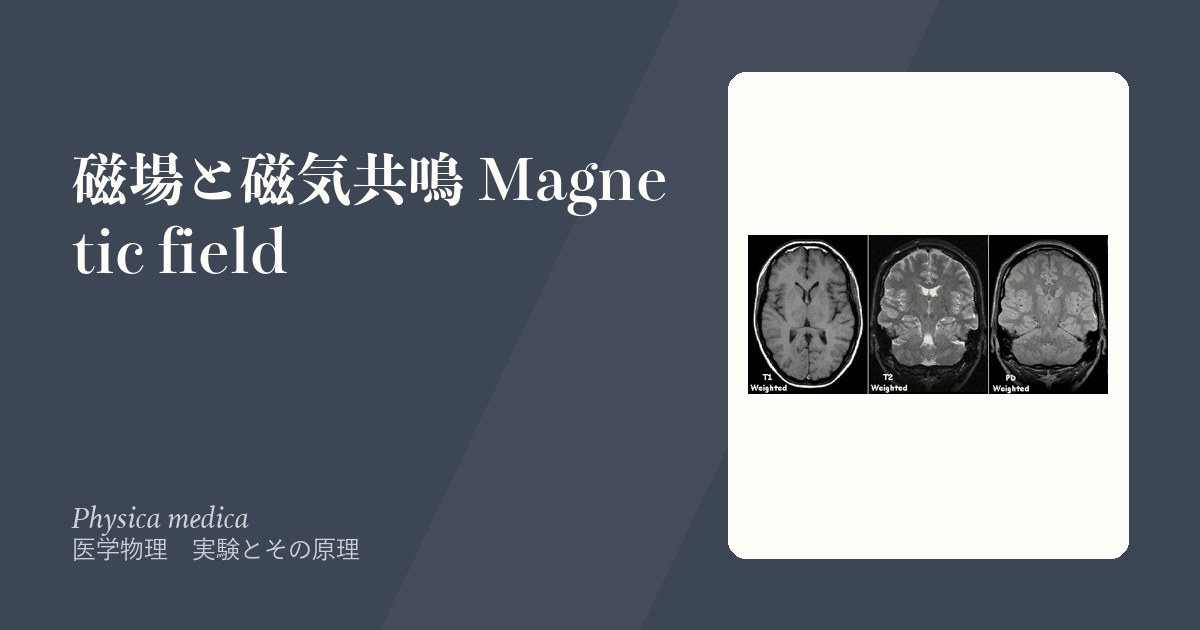
T1 と T2 は別の現象である。T1(縦緩和・スピン-格子)は磁化が元の向きへ戻る時間、T2(横緩和・スピン-スピン)は位相が揃った状態が崩れる時間。常に T2 ≦ T1。脂肪は T1 が短く(T1 強調で白)、水は T2 が長い(T2 強調で白)——この2つを覚えれば大半の画像は読める。
MRI に電離作用は無い。使うのはラジオ波と静磁場だけで、X 線 CT と違い電離放射線を伴わない。代わりの危険は強磁性体の吸引(missile effect)・体内金属・RF による発熱・騒音である。「被曝が無い代わりに、別の物理的危険がある」。
English version
Core
Put a nucleus with a magnetic moment into a field of flux density B (in T, tesla) and it precesses like a top about the direction of the field. Its angular frequency is
ω = γB (γ = the gyromagnetic ratio; for ¹H about 42.58 MHz/T)
On a 1.5 T machine that is about 64 MHz, on 3 T about 128 MHz — the radiofrequency band. Apply electromagnetic waves at this frequency and the nuclei are excited in resonance; switch it off and they return, emitting a signal at the same frequency. This is the MRI signal.
Why ¹H is used: about 60 per cent of the body is water, the hydrogen nucleus has a single proton (spin 1/2), and its gyromagnetic ratio is large, giving high sensitivity.
Going further
That the resonance frequency is proportional to the field is itself the method of locating position. In a uniform field all the hydrogen in the body would resonate at the same frequency, so gradient fields are superimposed to alter the field slightly from place to place. Then frequency and phase represent the coordinates, and a Fourier transform of the received signal gives the image. Understanding MRI as a machine that translates frequency into space makes it obvious why there are three sets of gradient coils (x, y, z).
T1 and T2 are different phenomena. T1 (longitudinal, spin–lattice) is the time for the magnetisation to return to its original direction; T2 (transverse, spin–spin) is the time for the state of aligned phase to break down. T2 ≤ T1 always. Fat has a short T1 (white on T1-weighting), water a long T2 (white on T2-weighting) — remember these two and most images can be read.
MRI has no ionising action. It uses only radiofrequency and a static field, and unlike X-ray CT involves no ionising radiation. The dangers instead are attraction of ferromagnetic objects (the missile effect), metal in the body, heating by RF, and noise. "No radiation dose, and other physical dangers in its place."
電磁誘導と磁気刺激 — TMS
Faraday の電磁誘導:磁束が時間的に変化すると起電力が生じる。
ε = −dΦ/dt
TMS(経頭蓋磁気刺激)はこれを使う。コイルに数千アンペアの電流を100マイクロ秒ほどで流すと、急激に変化する磁場が頭蓋骨を素通りして脳内に到達し、脳組織の中に渦電流を誘導して神経を脱分極させる。
骨と皮膚が高い電気抵抗を持つのに刺激できるのが最大の利点——電気刺激(経頭蓋直流電気刺激)と違い、頭皮の痛みがほとんど無い。
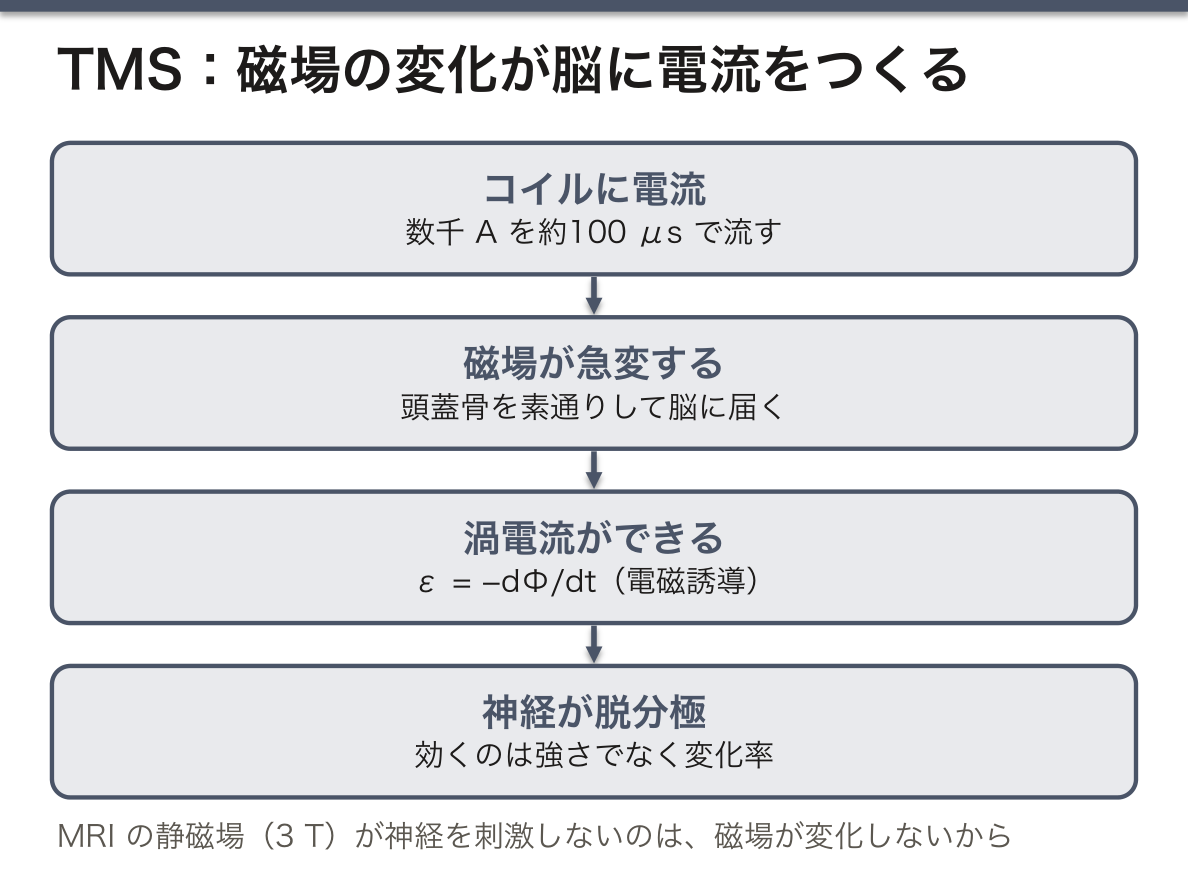
肝心なのは「磁場そのものではなく、その変化率が効く」ことである。静磁場(MRI の 3T)は神経を刺激しないが、TMS の 2T 弱の磁場は100 μs で立ち上がるので dΦ/dt が桁違いに大きい。MRI が安全で TMS が刺激になる理由は、強さではなく速さの差である。
コイルの形が集束度を決める。円形コイルは広く浅く、8の字(figure-of-eight)コイルは2つのループの電流が中央で重なるので、その一点に強い電場が集まる。運動野を狙って母指外転筋の運動誘発電位(MEP)を記録するといった局在の検査ができるのは、この形のためである。
臨床応用:①rTMS(反復刺激)——薬物抵抗性うつ病の治療として承認されている。②MEP による運動路の評価——多発性硬化症・脊髄症で中枢運動伝導時間を測る。③術前の機能マッピング。磁気けいれん療法(MST)は ECT の代替として研究されており、電流の広がりが限局するぶん認知機能への影響が少ないと期待されている。
最大の合併症はけいれん誘発で、頻度は低いが刺激強度と頻度に依存する。体内金属(人工内耳・深部脳刺激装置)が禁忌なのは、誘導電流がそこに集中するためである。
English version
Core
Faraday’s law of induction: a magnetic flux changing in time generates an electromotive force.
ε = −dΦ/dt
TMS (transcranial magnetic stimulation) uses this. Passing thousands of amperes through a coil in about 100 microseconds produces a rapidly changing magnetic field that passes straight through the skull, inducing eddy currents in the brain and depolarising neurons.
That it can stimulate although bone and skin have high electrical resistance is the great advantage — unlike electrical stimulation (transcranial direct current), there is almost no scalp pain.
Going further
The essential point is that what acts is not the field itself but its rate of change. A static field (the 3 T of MRI) does not stimulate nerves, while the somewhat under 2 T of TMS rises in 100 μs, so dΦ/dt is greater by orders of magnitude. The reason MRI is safe and TMS stimulates is a difference not of strength but of speed.
The shape of the coil sets the focus. A circular coil is broad and shallow; in a figure-of-eight coil the currents of the two loops overlap at the centre, so a strong field is concentrated at that one point. It is this shape that allows localised testing, such as aiming at the motor cortex and recording a motor evoked potential (MEP) from abductor pollicis.
Clinical applications: ① rTMS (repetitive stimulation) — approved as a treatment for drug-resistant depression. ② Assessment of the motor pathway by MEP — measuring central motor conduction time in multiple sclerosis and myelopathy. ③ Preoperative functional mapping. Magnetic seizure therapy (MST) is under study as an alternative to ECT, and is expected to have less effect on cognition because the spread of current is more confined.
The greatest complication is the induction of a seizure, infrequent but dependent on the intensity and frequency of stimulation. Metal in the body (a cochlear implant, a deep brain stimulator) is a contraindication because the induced current concentrates there.
MRI の信号はどこから来るか — 緩和と T1・T2
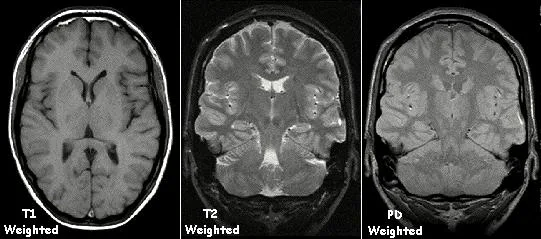
静磁場 B₀ の中で水素核の磁化がそろい(縦磁化)、Larmor 周波数の RF パルスを当てると倒れて横磁化になる。RF を切ると元に戻る——この戻り方(緩和)が2種類ある。
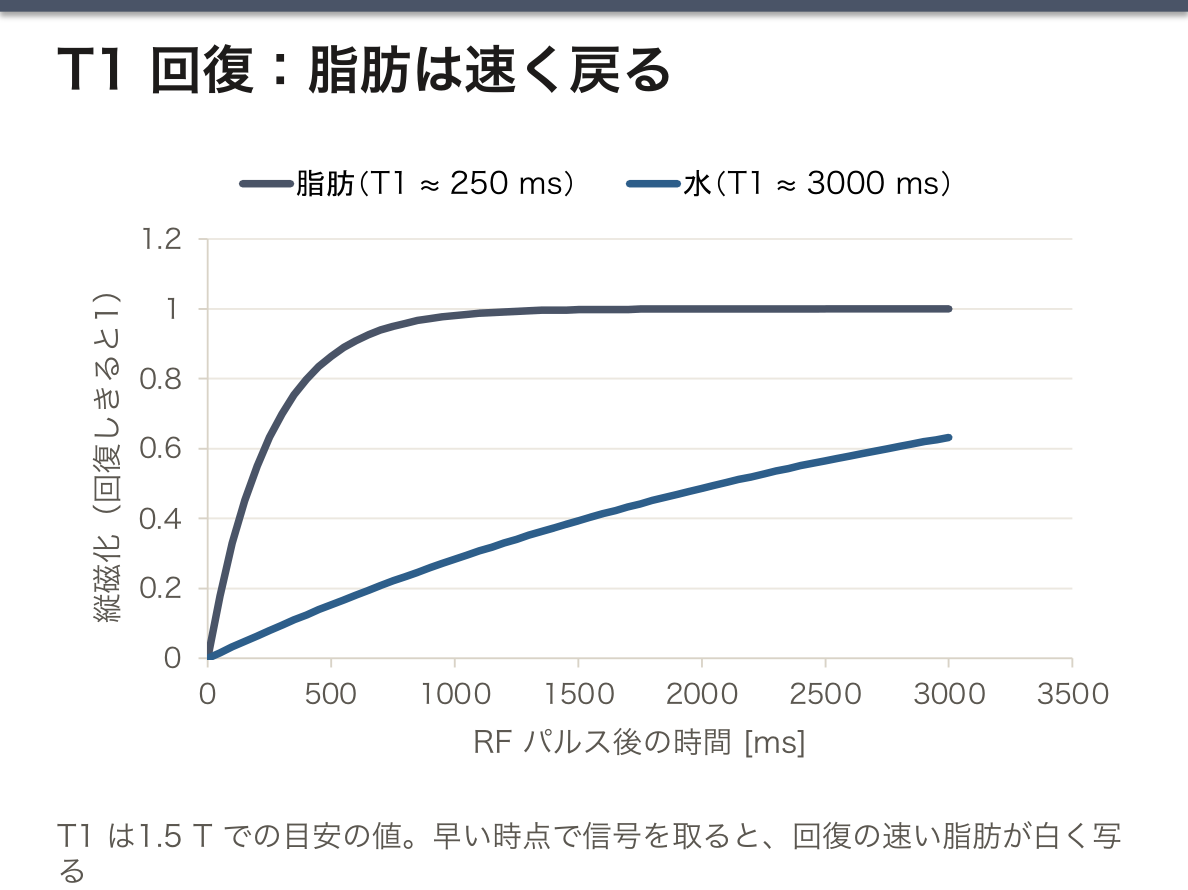
T1(縦緩和・スピン格子緩和)——縦磁化が回復する時定数。周囲の分子の運動が Larmor 周波数に近いほど速いので、脂肪は短く(明るい)、水は長い(暗い)。
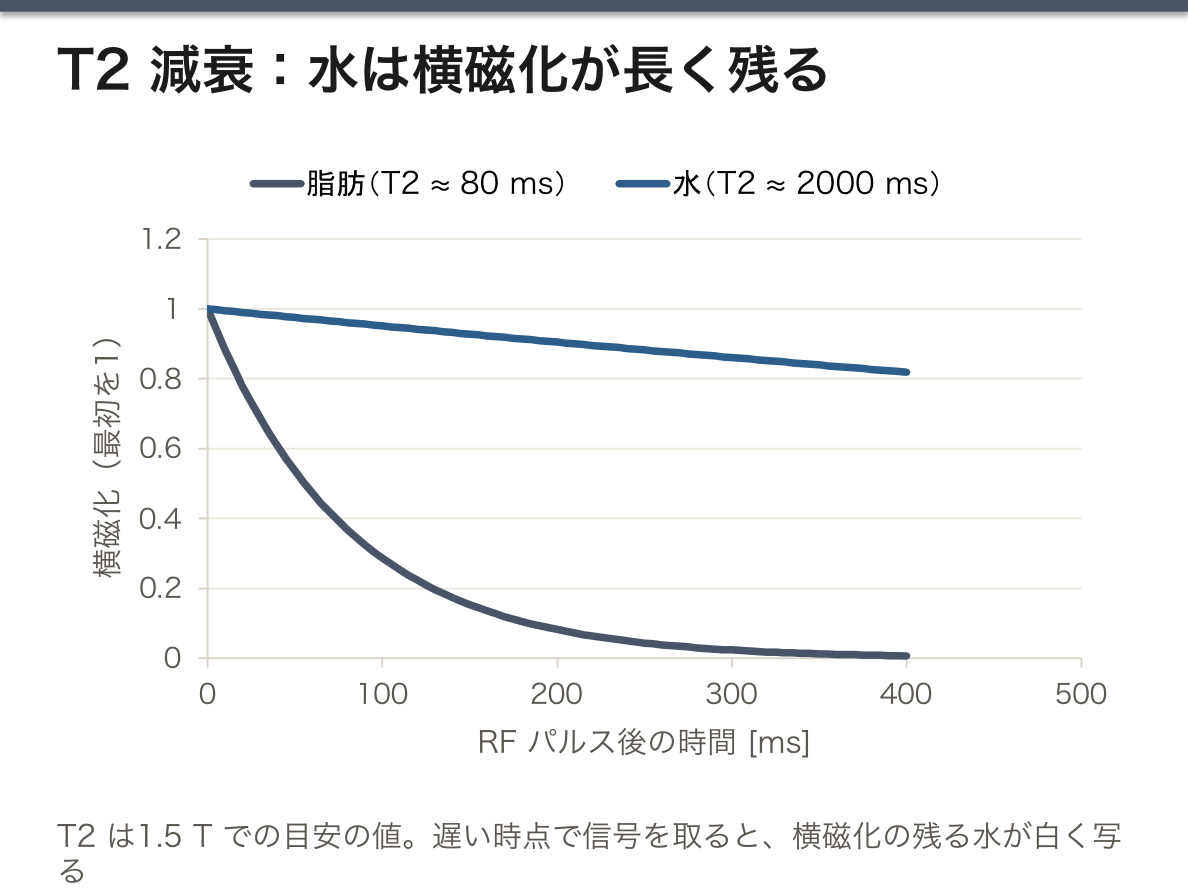
T2(横緩和・スピンスピン緩和)——横磁化が失われる時定数。スピン同士の位相がばらけることによる。水は長く(明るい)、固体成分は短い。
「T1 で脂肪が白い、T2 で水が白い」——これだけは即答できるようにする。T2 強調で病変が白く見えるのは、炎症・浮腫・腫瘍が水を含むから。
装置——超伝導磁石(1.5〜3 T)、傾斜磁場コイル(位置を周波数に対応づける)、RF 送受信コイル。
English version
Core
In the static field B₀ the magnetisation of the hydrogen nuclei aligns (longitudinal magnetisation), and an RF pulse at the Larmor frequency tips it into transverse magnetisation. When the RF is switched off it returns — and there are two kinds of return (relaxation).
T1 (longitudinal, spin–lattice relaxation) — the time constant for the recovery of longitudinal magnetisation. The nearer the motion of the surrounding molecules is to the Larmor frequency the faster it is, so fat is short (bright) and water long (dark).
T2 (transverse, spin–spin relaxation) — the time constant for the loss of transverse magnetisation, from the spins going out of phase with one another. Water is long (bright), solid components short.
"Fat white on T1, water white on T2" — have this ready to say at once. Lesions look white on T2-weighting because inflammation, oedema and tumour contain water.
The apparatus — a superconducting magnet (1.5–3 T), gradient coils (mapping position onto frequency), RF transmit and receive coils.
電流がつくる磁場 — 直線電流・ソレノイド・電磁石
1820年、Ørsted(エルステッド)は、導線に電流を流すとそばの方位磁針が振れることを見つけた。電荷が止まっていれば電場だけだが、電荷が動く(電流が流れる)と磁場ができる——電気と磁気がつながっていることを示した最初の発見である。
直線電流のまわりの磁場:磁力線は導線を中心とする同心円になる。向きは右ねじ(右手)の法則——親指を電流の向きに向けて導線を握ると、残りの指の巻く向きが磁場の向き。大きさは
B = μ0I / (2πr) (μ0 = 4π×10−7 T·m/A:真空の透磁率、r:導線からの距離)
で、電流に比例し、距離に反比例する。
ソレノイド(導線をばね状に何回も巻いたコイル)では、1巻きごとの磁場が中で足し合わされ、内部にほぼ一様な強い磁場ができる。十分長いソレノイドでは B = μ0nI(n:単位長さあたりの巻数)。外側の磁場は弱く、形は棒磁石の磁場とそっくりになる。中に鉄の芯を入れたものが電磁石である。
磁束密度 B(単位 T:テスラ)はベクトルで、面を貫く磁力線の「密度」にあたる。B × 面積が磁束 Φ(単位 Wb:ウェーバ、スカラー)。1 T = 1 Wb/m2。
磁力線で磁場を「見る」:紙の上に鉄粉をまくと、鉄粉が小さな磁石になって磁場の向きに並び、磁力線の形が浮かび上がる。磁力線は ①磁石の外では N極から出て S極に入り、②途中で途切れず閉じた輪になり、③互いに交わらず、④密なところほど磁場が強い。電気力線が正電荷から出て負電荷で終わるのと違い、磁力線に始まりと終わりがないのは、単独の N極・S極(磁気単極子)が見つかっていないからである。棒磁石を半分に切っても、それぞれに N極と S極ができる。
平行な2本の電流は、同じ向きなら引き合い、逆向きなら反発する。片方の電流がつくる磁場の中で、もう片方の電流が力を受けるためである(次の項のローレンツ力)。
電磁石は永久磁石より強くできるか:できる。電磁石の磁場は電流と巻数で上げられ、鉄芯を入れると鉄の磁区がそろって磁場が何百倍にもなる。さらに電流を止めれば磁場を消せる。ただし鉄芯は約 2 T で飽和するので、それ以上は鉄に頼らず、超伝導の導線に大電流を流して得る。身近な強い永久磁石(ネオジム磁石)でも 1 T 前後にとどまる。
MRI の主磁石は、超伝導のソレノイドである。患者が入るトンネル(ボア)は巨大なコイルの内側で、ここに 1.5〜3 T のほぼ一様な磁場ができている。超伝導状態では電気抵抗がほぼ 0 なので、一度流した電流は流れ続け、電源を切っても磁場は常にかかっている——だから検査をしていない夜間でも、金属を持ち込めば吸引事故が起きる。冷却が失われて超伝導が壊れ、蓄えたエネルギーが熱になって冷媒の液体ヘリウムが一気に気化する現象をクエンチという。
English version
Core
In 1820 Ørsted found that a compass needle near a wire swings when current flows. A charge at rest makes only an electric field, but moving charge (a current) makes a magnetic field — the first discovery showing that electricity and magnetism are linked.
Field around a straight current: the field lines are circles centred on the wire. The direction follows the right-hand grip rule — grip the wire with the thumb along the current, and the fingers curl in the direction of the field. The size is
B = μ0I / (2πr) (μ0 = 4π×10−7 T·m/A: permeability of free space; r: distance from the wire)
proportional to the current and inversely proportional to the distance.
In a solenoid (wire wound into a long coil like a spring), the fields of all the turns add up inside to give a strong, nearly uniform field. For a long solenoid, B = μ0nI (n: turns per unit length). The field outside is weak and looks just like that of a bar magnet. A solenoid with an iron core is an electromagnet.
Magnetic flux density B (unit T, tesla) is a vector: the "density" of field lines through a surface. B × area is the magnetic flux Φ (unit Wb, weber; a scalar). 1 T = 1 Wb/m2.
Going further
Seeing a field with field lines: sprinkle iron filings on paper and each becomes a tiny magnet that lines up with the field, showing the shape of the lines. Field lines (1) run from N to S outside a magnet, (2) never stop but form closed loops, (3) never cross, and (4) are dense where the field is strong. Unlike electric field lines, which start on positive and end on negative charges, magnetic field lines have no start or end because a single N or S pole (a magnetic monopole) has never been found. Cut a bar magnet in half and each half has its own N and S poles.
Two parallel currents attract if they flow the same way and repel if opposite. Each current feels a force in the field made by the other (the Lorentz force, next item).
Can an electromagnet be stronger than a permanent magnet? Yes. Its field rises with current and number of turns, and an iron core lines up the iron’s domains and multiplies the field hundreds of times. It can also be switched off. But iron saturates at about 2 T, so beyond that the field comes from large currents in superconducting wire, not from iron. Even strong everyday permanent magnets (neodymium magnets) reach only about 1 T.
In the clinic
The main magnet of an MRI scanner is a superconducting solenoid. The tunnel (bore) the patient lies in is inside a huge coil, where a nearly uniform field of 1.5–3 T is made. In the superconducting state the resistance is almost zero, so once started the current keeps flowing and the field is always on, even with the power off — which is why bringing metal in at night, with no scan running, can still cause a projectile accident. If cooling fails and superconductivity breaks down, the stored energy turns to heat and the liquid helium coolant boils off suddenly; this is a quench.
ローレンツ力 — 動く電荷は磁場で曲げられる
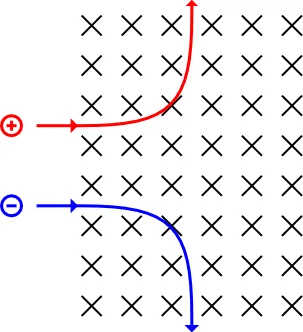
磁場の中を速度 v で動く電荷 q は、速度にも磁場にも垂直な向きに力を受ける。これがローレンツ力(Lorentz force)である。
F = qvB sinθ (θ:速度と磁場のなす角。ベクトルで書けば F = qv × B。電場もあれば qE が加わる)
①磁場に平行に動く電荷は力を受けない(sin 0 = 0)。②磁場に垂直に入った電荷は円運動をする。ローレンツ力が向心力になるので qvB = mv2/r、半径は r = mv / (qB)。③斜めに入ると、平行な成分はそのまま進み、垂直な成分は回るので、磁力線に巻きつくらせん運動になる。
導線の中の電荷が受けるローレンツ力を合計したものが、電流が磁場から受ける力(アンペール力)F = BIL(L:導線の長さ)で、モーターが回る原理である。向きはフレミングの左手の法則で覚えてもよい。導線を磁場の中で動かすと、中の電子がローレンツ力で押されて起電力が生じる——これが電磁誘導(発電機)のもう一つの見方になる。
ローレンツ力は仕事をしない。力がいつも速度に垂直なので、向きを変えるだけで速さ(運動エネルギー)は変えない。だから磁場は荷電粒子を「曲げる・閉じこめる」ことはできても、「加速する」ことはできない。加速するのは電場の役目である。
回る周期は速さによらない。円運動の周期は T = 2πr/v = 2πm/(qB) で、v が消える。速い粒子は大きな円を、遅い粒子は小さな円を、同じ時間で1周する。この性質を使い、一定の周期で電場をかけて少しずつ加速していく装置がサイクロトロンである。
ホール効果:電流が流れている板に垂直に磁場をかけると、中の電荷がローレンツ力で片側に寄り、板の両端に電圧が生じる。この電圧は磁場に比例するので、多くの磁場センサー(スマートフォンの電子コンパスを含む)はホール効果で磁場を測っている。
同じ速さなら、r は m/q に比例する——質量の違う粒子を磁場で曲げて分けるのが質量分析であり、電子の発見(電子の比電荷 e/m の測定)もこの原理によった。
PET で使う 18F は、病院や近くの施設のサイクロトロンでつくられる。陽子をサイクロトロンで加速して、酸素の同位体(18O)を含む水に当てると 18F ができる。半減期が約 110 分と短いので遠くから運べず、加速器が近くに必要になる。
MRI では、静磁場の中で血液(イオンを含む導体)が流れると、ローレンツ力でわずかな電圧が生じる。心電図の T 波付近に重なってゆがみとして見えることがあり(磁気流体力学効果)、MRI 内での心電図モニターが当てにならない理由の一つになっている。
English version
Core
A charge q moving at velocity v in a magnetic field feels a force perpendicular to both the velocity and the field. This is the Lorentz force.
F = qvB sinθ (θ: angle between velocity and field. As vectors, F = qv × B; if there is also an electric field, add qE.)
(1) A charge moving along the field feels no force (sin 0 = 0). (2) A charge entering at right angles moves in a circle. The Lorentz force is the centripetal force, so qvB = mv2/r and the radius is r = mv / (qB). (3) Entering at an angle, the parallel part continues while the perpendicular part circles, giving a spiral wound around the field lines.
Adding up the Lorentz forces on the charges in a wire gives the force on a current in a magnetic field (Ampère force), F = BIL (L: wire length) — the principle of the electric motor. Fleming’s left-hand rule is one way to remember the direction. If a wire is moved through a field, its electrons are pushed by the Lorentz force and an emf appears — another way to see electromagnetic induction (the generator).
Going further
The Lorentz force does no work. It is always perpendicular to the velocity, so it only changes direction, not speed (kinetic energy). A magnetic field can "bend" or "trap" charged particles but cannot "speed them up"; that is the electric field’s job.
The period of the circle does not depend on speed. T = 2πr/v = 2πm/(qB), and v drops out. A fast particle makes a large circle and a slow one a small circle, in the same time. A cyclotron uses this: an electric field applied at a fixed rhythm speeds the particles up little by little.
The Hall effect: put a magnetic field across a plate carrying current, and the Lorentz force pushes the charges to one side, making a voltage across the plate. The voltage is proportional to the field, so many magnetic sensors (including the electronic compass in smartphones) measure fields by the Hall effect.
At the same speed, r is proportional to m/q. Bending particles of different mass in a field to separate them is mass spectrometry, and the discovery of the electron (measuring its charge-to-mass ratio e/m) used the same principle.
In the clinic
The 18F used in PET is made in a cyclotron at or near the hospital. Protons accelerated in a cyclotron hit water containing the oxygen isotope 18O, producing 18F. Its half-life is only about 110 minutes, so it cannot travel far and an accelerator must be close by.
In MRI, blood (a conductor containing ions) flowing in the static field produces a small voltage by the Lorentz force. It can appear as distortion around the T wave of the ECG (the magnetohydrodynamic effect), one reason ECG monitoring inside an MRI scanner is unreliable.
物質の磁性 — 反磁性・常磁性・強磁性とキュリー温度
物質の磁性のもとは、電子のスピンと軌道運動がつくる小さな磁気モーメントである。それが打ち消し合うか、そろうかで3つに分かれる。
| 反磁性 diamagnetism | 常磁性 paramagnetism | 強磁性 ferromagnetism | |
|---|---|---|---|
| 電子 | すべて対になっている | 対になっていない電子(不対電子)がある | 不対電子があり、隣どうしが強くそろい合う |
| 外から磁場をかけると | 磁場と逆向きにわずかに磁化 → 弱く反発 | 磁場の向きにわずかにそろう → 弱く引かれる | 磁区がそろって強く磁化 → 強く引かれる |
| 磁場を切ると | 元に戻る | 熱運動でばらばらに戻る | 磁化が残る(残留磁化) |
| 例 | 水・ほとんどの生体組織・銅・超伝導体 | 酸素分子・アルミニウム・Gd3+・デオキシヘモグロビン | 鉄・コバルト・ニッケル |
強磁性体の中では、原子の磁気モーメントが同じ向きにそろった小さな領域(磁区, magnetic domain)ができている。ふだんは磁区どうしの向きがばらばらで全体として磁石にならないが、外から弱い磁場をかけるだけで磁区がそろい、強い磁石になる。電磁石に鉄芯を入れるのはこのためである。
キュリー温度(Curie temperature)は、強磁性が失われて常磁性に変わる温度である。熱運動が、隣どうしをそろえようとする力に勝つと、磁区の秩序が壊れる。鉄で約 770 °C、コバルトで約 1,115 °C、岩石に含まれる磁鉄鉱(マグネタイト)で約 580 °C。
ヒステリシス:強磁性体に磁場をかけて強め、弱め、逆向きにかけ…と一巡させると、磁化は行きと帰りで同じ道を通らず、輪(ヒステリシスループ)を描く。輪の面積は、1周ごとに熱として失われるエネルギーである。輪が細く、すぐ磁化が向きを変えるものが軟磁性体(変圧器の鉄芯)、輪が太く磁化が残りやすいものが硬磁性体(永久磁石・磁気記録媒体)になる。
キュリー温度が大事な理由:①溶岩が冷えてキュリー温度を下回るとき、その時の地磁気の向きに磁化が「凍結」される。これが過去の地磁気を記録する古地磁気で、地磁気の逆転の証拠になった。②地球の中心部の温度は鉄のキュリー温度よりはるかに高いので、地球は巨大な永久磁石ではありえない——地磁気には別の説明(ダイナモ)が必要になる。
反磁性はすべての物質が持っているが、とても弱いので、常磁性や強磁性があるとそちらに隠れる。体はほぼ水なので、全体としては弱い反磁性である。十分強い磁場(十数 T)をかけると、水を含む生き物が反磁性で浮き上がることが実験で示されている。
MRI の造影剤は常磁性を使う。ガドリニウムイオン Gd3+ は不対電子を7個持つ強い常磁性体で、まわりの水の水素核の緩和を速め、T1 を短くするので T1 強調像で白く写る。Gd3+ そのものは毒性が強いので、キレート剤で包んで使う。
酸素を離したヘモグロビン(デオキシヘモグロビン)は常磁性、酸素と結合したオキシヘモグロビンは反磁性である。脳のある部位が働くと血流が増えてデオキシヘモグロビンの割合が下がり、MRI の信号がわずかに変わる。これを画像にしたのが機能的 MRI(fMRI, BOLD 法)である。
体内の金属が MRI で危険かどうかは、強磁性かどうかでほぼ決まる。チタンなどの非強磁性の金属は引きつけられにくいが、強磁性のものは強い力で引かれたり回転したりする。
English version
Core
Magnetism in matter comes from tiny magnetic moments made by electron spin and orbital motion. Whether they cancel or line up gives three kinds.
| Diamagnetism | Paramagnetism | Ferromagnetism | |
|---|---|---|---|
| Electrons | All paired | Some unpaired electrons | Unpaired electrons, and neighbours line up strongly with each other |
| In an applied field | Slightly magnetised against the field → weakly repelled | Slightly lined up with the field → weakly attracted | Domains line up, strongly magnetised → strongly attracted |
| When the field is removed | Returns | Heat motion scatters the moments again | Magnetisation remains (remanence) |
| Examples | Water, most body tissue, copper, superconductors | Oxygen molecules, aluminium, Gd3+, deoxyhaemoglobin | Iron, cobalt, nickel |
Inside a ferromagnet there are small regions where the atomic moments all point the same way (magnetic domains). Usually the domains point in different directions, so the whole piece is not a magnet. A weak outside field is enough to line them up and make a strong magnet. That is why an electromagnet has an iron core.
The Curie temperature is the temperature at which ferromagnetism is lost and the material becomes paramagnetic. When heat motion beats the force lining up neighbours, the order of the domains breaks down. It is about 770 °C for iron, about 1,115 °C for cobalt and about 580 °C for magnetite in rocks.
Going further
Hysteresis: take a ferromagnet around a cycle — field up, down, reversed and back — and the magnetisation does not follow the same path both ways but draws a loop (hysteresis loop). The area of the loop is the energy lost as heat in each cycle. Materials with a thin loop that reverse easily are soft magnets (transformer cores); those with a fat loop that keep their magnetisation are hard magnets (permanent magnets, magnetic storage).
Why the Curie temperature matters: (1) When lava cools below the Curie temperature, the direction of Earth’s field at that moment is "frozen" into it. This is palaeomagnetism, which gave the evidence that Earth’s field reverses. (2) The centre of the Earth is far hotter than iron’s Curie temperature, so the Earth cannot be a giant permanent magnet — its field needs another explanation (the dynamo).
Every material is diamagnetic, but the effect is so weak that it is hidden whenever paramagnetism or ferromagnetism is present. The body is mostly water, so overall it is weakly diamagnetic. Experiments have shown that a strong enough field (over ten tesla) can lift water-containing living things by diamagnetism.
In the clinic
MRI contrast agents use paramagnetism. The gadolinium ion Gd3+ has seven unpaired electrons and is strongly paramagnetic. It speeds up relaxation of the hydrogen nuclei in nearby water and shortens T1, so it looks white on T1-weighted images. Free Gd3+ is very toxic, so it is wrapped in a chelating agent.
Haemoglobin without oxygen (deoxyhaemoglobin) is paramagnetic; oxyhaemoglobin is diamagnetic. When a brain area becomes active, blood flow rises, the share of deoxyhaemoglobin falls, and the MRI signal changes slightly. Imaging this is functional MRI (fMRI, the BOLD method).
Whether metal in the body is dangerous in MRI depends mostly on whether it is ferromagnetic. Non-ferromagnetic metals such as titanium are hardly attracted, but ferromagnetic objects can be pulled or twisted with great force.
生体磁気と、MRI以外の磁場の医療応用 — 心磁図・脳磁図・磁気温熱療法
人の体は磁石ではない(全体としては弱い反磁性)。しかし、体の中でイオンの電流が流れれば、そのまわりに必ず磁場ができる。心臓や脳の電気活動がつくるこの磁場が生体磁気(biomagnetism)である。
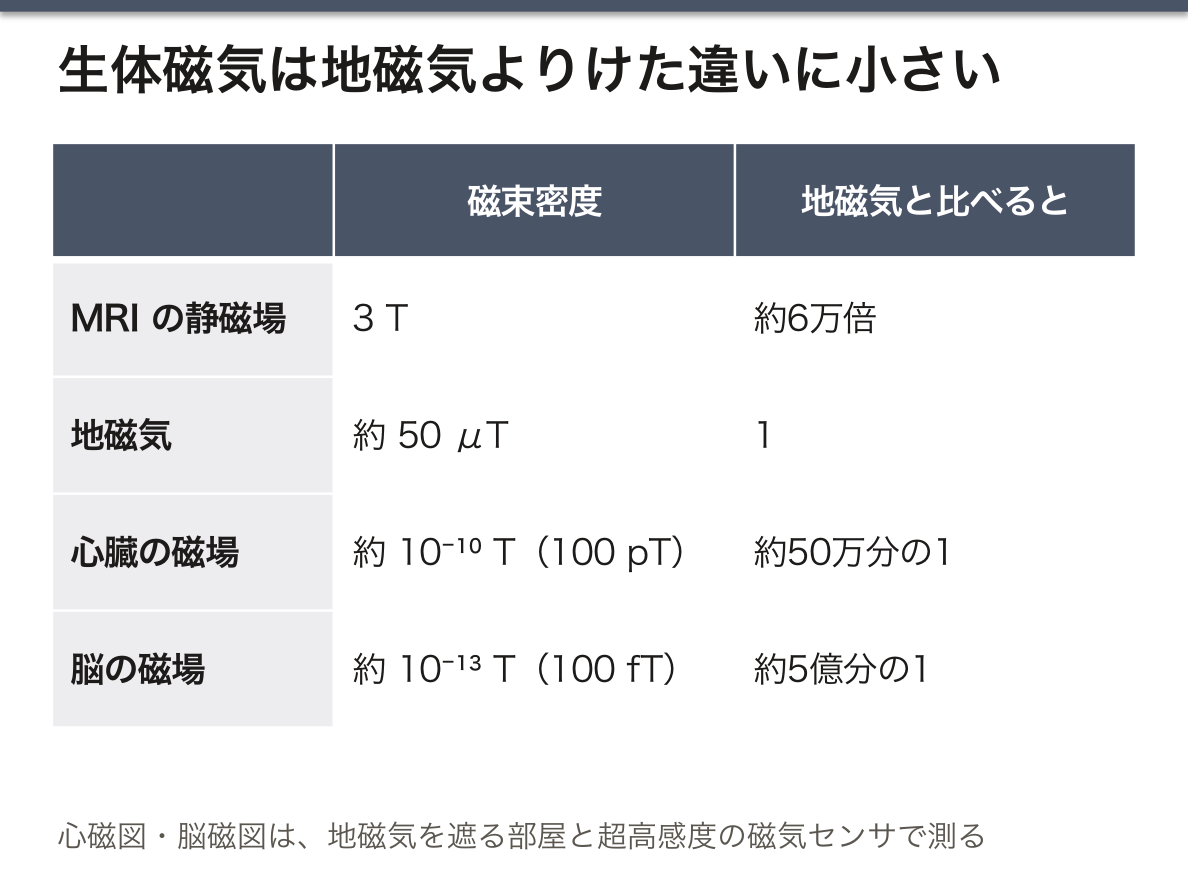
その大きさは非常に小さい。地磁気が約 5×10⁻⁵ T(50 μT)なのに対して、心臓の磁場は体表でおよそ 10−10 T(地磁気の約50万分の1)、脳の磁場は 10−13 T 前後で、さらに千分の1になる。これを測るには、SQUID(超伝導量子干渉素子)などの超高感度のセンサーと、外の磁場を遮る磁気シールドルームが必要になる。
心臓の磁場を記録したものが心磁図(MCG)、脳の磁場を記録したものが脳磁図(MEG)である。
MRI 以外に磁場を治療に使う例として、経頭蓋磁気刺激(TMS。前の項)と磁気温熱療法(magnetic hyperthermia)がある。後者は、酸化鉄などの磁性ナノ粒子を腫瘍に入れ、外から高い周波数(100 kHz 前後〜数百 kHz)で向きの変わる交流磁場をかけて、粒子を発熱させる方法である。
脳磁図は脳波より「場所」が分かる。脳波は頭皮の電位を測るが、電流は脳脊髄液・頭蓋骨・頭皮を通るあいだに広がってしまい、発生源の位置がぼやける。磁場は骨や皮膚の電気抵抗の影響をほとんど受けないので、発生源の位置を数 mm の精度で推定できる。一方、装置は大きく高価で、測れるのは主に脳の表面に平行な向きの電流である。
磁気温熱療法で粒子が熱くなる理由:交流磁場で粒子の磁化が1秒に十万回以上も向きを変えるたびに、ヒステリシスの損失や、磁化の向きが遅れてついていく損失(緩和損失)が熱になる。腫瘍の温度を 40〜45 °C 程度に上げると、腫瘍細胞は正常細胞より熱に弱いことが多く、放射線や抗がん薬も効きやすくなる。熱が出るのは粒子のあるところだけなので、深い場所でも狙って温められるのが利点である。
静かな磁場(静磁場)は、強くても体にほとんど作用しない(MRI の 3 T でも)。体に電流を流せるのは、時間的に変化する磁場だけである(ファラデーの法則)。
脳磁図はてんかんの手術前検査に使われる。発作のもとになる部位(てんかん焦点)がどこにあるかを推定し、手術で切除する範囲を決める助けにする。また、運動野・感覚野・言語野の位置を確かめる術前の機能マッピングにも使われる。
磁気温熱療法は、欧州では脳腫瘍に対して使える装置が認められた例があるが、まだ広く普及した治療ではない。MRI の傾斜磁場の速い切り替えで、手足がぴくっとする(末梢神経刺激)ことがあるのも、変化する磁場が体に電流を流す例である。
English version
Core
The human body is not a magnet (overall it is weakly diamagnetic). But wherever ionic current flows in the body, a magnetic field must form around it. The fields made by the electrical activity of the heart and brain are biomagnetism.
They are very small. Earth’s field is about 5×10⁻⁵ T (50 μT); the heart’s field at the body surface is about 10−10 T (about 1/500,000 of Earth’s field), and the brain’s is around 10−13 T, another thousand times smaller. Measuring them needs ultra-sensitive sensors such as the SQUID (superconducting quantum interference device) and a magnetically shielded room to block outside fields.
A recording of the heart’s field is a magnetocardiogram (MCG); of the brain’s field, a magnetoencephalogram (MEG).
Treatments using magnetic fields besides MRI include transcranial magnetic stimulation (TMS; earlier item) and magnetic hyperthermia. In the latter, magnetic nanoparticles such as iron oxide are placed in a tumour, and an alternating field that reverses at high frequency (about 100 kHz to a few hundred kHz) is applied from outside to heat the particles.
Going further
MEG shows "where" better than EEG. EEG measures scalp potentials, but the current spreads as it passes through cerebrospinal fluid, skull and scalp, blurring the source. Magnetic fields are hardly affected by the electrical resistance of bone and skin, so the source can be located to within a few mm. On the other hand, the machine is large and costly, and it mainly detects currents running parallel to the brain surface.
Why the particles heat up in magnetic hyperthermia: each time the alternating field flips the particles’ magnetisation — more than a hundred thousand times a second — hysteresis losses and losses from the magnetisation lagging behind (relaxation losses) turn into heat. Raising a tumour to about 40–45 °C harms tumour cells, which are often more heat-sensitive than normal cells, and makes radiation and anticancer drugs work better. Heat is produced only where the particles are, so even deep sites can be targeted.
A steady (static) field, even a strong one, has almost no action on the body (even the 3 T of MRI). Only a field that changes with time can drive current through the body (Faraday’s law).
In the clinic
MEG is used before epilepsy surgery. It helps estimate where the seizure focus is and decide what to remove. It is also used for pre-surgical functional mapping of motor, sensory and language areas.
For magnetic hyperthermia, a device for brain tumours has been approved in Europe, but it is not yet a widespread treatment. Fast switching of MRI gradient fields can make the arms or legs twitch (peripheral nerve stimulation) — another example of a changing field driving current in the body.
磁気療法を科学的に評価する — 効くもの・効かないもの
磁石を貼る・身につけると痛みや血行が良くなる、とうたう製品(磁気ネックレス・磁気ブレスレット・磁石入りの中敷きなど)は多い。こうした静磁場を使う「磁気療法」を評価した無作為化比較試験とそのメタアナリシスでは、偽の磁石(プラセボ)と比べて痛みを和らげる効果ははっきり示されていない。
一方で、医学で認められている磁場の治療もある。違いは「磁場の強さ」ではなく「時間的に変化するかどうか」と「証拠の質」である。
| 方法 | 物理 | 証拠 |
|---|---|---|
| 磁気ネックレスなどの静磁場 | 弱い静磁場。体に電流を流せない | プラセボを超える効果は示されていない |
| パルス電磁場(PEMF) | 変化する磁場で組織に弱い電流を流す | 骨折の偽関節などに使われるが、効果の証拠は限られ一定しない |
| 経頭蓋磁気刺激(TMS) | 強く速く変化する磁場で神経を脱分極させる | 偽刺激と比べた試験で効果が示され、うつ病の治療として承認されている |
電磁波を当てて病気を診断・治療できるとした20世紀前半の「ラジオニクス」は、科学的な根拠のない疑似科学の代表例である。
物理から見て、静的な磁石が効きにくい理由:①静磁場は電流を誘導しない(ファラデーの法則では磁場の「変化」が要る)ので、神経を刺激することも組織を温めることもない。②「磁石が血液中の鉄を引き寄せて血行を良くする」という説明は成り立たない。ヘモグロビンの鉄は強磁性ではなく、オキシヘモグロビンは反磁性、デオキシヘモグロビンも弱い常磁性にすぎない。3 T の MRI の中でさえ血液は引き寄せられない。③小さな磁石の磁場は距離とともに急に弱まり(およそ距離の3乗に反比例)、数 cm 離れればほとんど残らない。
それでも「効いた」と感じる理由:プラセボ効果、痛みが自然に軽くなる経過、症状の強いときに試すので次は平均に近づく(平均への回帰)。さらに磁石は、クリップを近づければ本物かどうか分かってしまうので、被験者に気づかれない盲検化が難しい——試験の設計そのものが評価の要点になる。
評価の手順はどの治療法でも同じで、「もっともらしい仕組みがあるか」と「プラセボ対照の比較試験で効果が再現されるか」の両方を見る。
患者が磁気製品を使っていたら:多くは無害だが、ペースメーカーや植込み型除細動器(ICD)の上に強い磁石を近づけると、機器の動作が変わる(ペースメーカーは決まったリズムで刺激する設定に、ICD は頻拍の治療が止まる)。胸元の磁石製品やスマートフォンなどの強い磁石を植込み機器に近づけないよう伝える。効果のない治療に頼って、必要な治療が遅れないようにすることも大事である。
English version
Core
Many products claim that sticking on or wearing magnets eases pain or improves circulation (magnetic necklaces, bracelets, magnetic insoles). Randomised controlled trials of such static-field "magnetotherapy" and their meta-analyses have not clearly shown pain relief compared with fake magnets (placebo).
On the other hand, some magnetic treatments are accepted in medicine. The difference is not "how strong the field is" but "whether it changes with time" and "the quality of the evidence".
| Method | Physics | Evidence |
|---|---|---|
| Static fields such as magnetic necklaces | Weak static field; cannot drive current in the body | No effect beyond placebo shown |
| Pulsed electromagnetic fields (PEMF) | A changing field drives weak currents in tissue | Used for fracture non-union and similar, but evidence is limited and mixed |
| Transcranial magnetic stimulation (TMS) | A strong, fast-changing field depolarises neurons | Effective in trials against sham stimulation; approved as a treatment for depression |
"Radionics", which claimed in the early 20th century that disease could be diagnosed and treated with electromagnetic radiation, is a classic example of pseudoscience with no scientific basis.
Going further
Why static magnets are unlikely to work, from physics: (1) A static field induces no current (Faraday’s law needs a change in the field), so it neither stimulates nerves nor heats tissue. (2) The idea that "the magnet pulls the iron in blood and improves circulation" fails. Haemoglobin iron is not ferromagnetic; oxyhaemoglobin is diamagnetic and deoxyhaemoglobin only weakly paramagnetic. Even inside a 3 T MRI scanner, blood is not pulled. (3) The field of a small magnet falls off quickly with distance (roughly as the cube of the distance) and is almost gone a few cm away.
Why people still feel it "worked": the placebo effect, pain easing naturally over time, and the fact that people try something when symptoms are worst, so next time they drift back toward average (regression to the mean). Also, a paperclip shows whether a magnet is real, so blinding the subjects is hard — the trial design itself is the key point of the evaluation.
The way to judge any treatment is the same: look both at "is there a plausible mechanism?" and "is the effect reproduced in placebo-controlled trials?".
In the clinic
If a patient uses magnetic products: most are harmless, but a strong magnet over a pacemaker or implantable cardioverter-defibrillator (ICD) changes how the device works (a pacemaker switches to pacing at a fixed rate; an ICD stops treating fast rhythms). Advise keeping magnetic jewellery and other strong magnets, such as in smartphones, away from implanted devices. It also matters that relying on a treatment that does not work does not delay needed treatment.
地磁気と磁気圏 — 地球のダイナモと、太陽風の盾
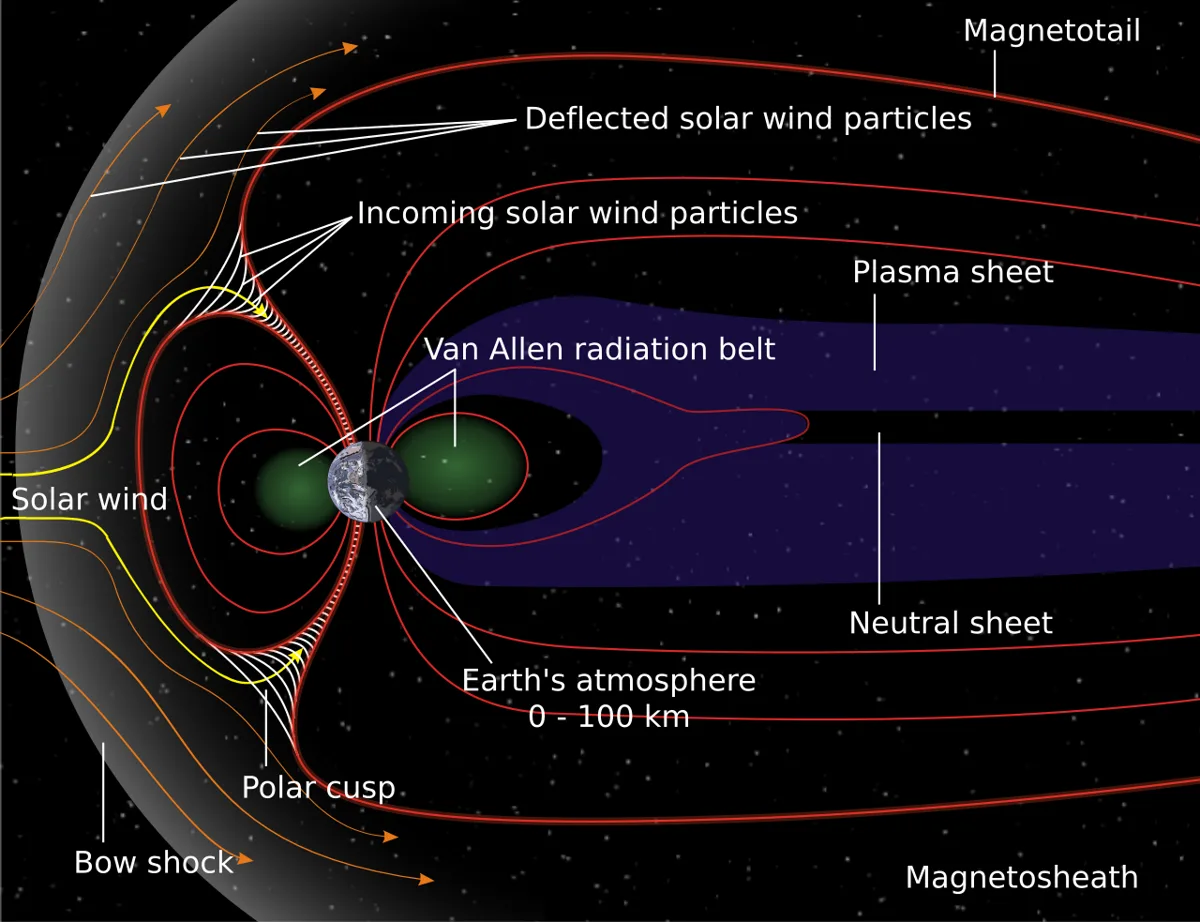
地球のまわりには、棒磁石に近い形の磁場(地磁気, geomagnetic field)がある。地表での強さは約 25〜65 μT(赤道付近で弱く、極付近で強い)。磁軸は自転軸から10°ほど傾いている。方位磁針の N極が北を指すのは、北極の近くに地磁気の S極があるからである。
起源:地球の外核は、高温で溶けた鉄(とニッケル)の液体である。この導体の液体が対流し、地球の自転の影響で渦を巻きながら流れると、電流が生じ、その電流がまた磁場をつくる。磁場の中を導体が動けば電流が誘導され(電磁誘導)、その電流が磁場を保つ——この自己維持の仕組みをダイナモ(地球ダイナモ)という。中心部はキュリー温度よりはるかに高温なので、永久磁石では説明できない。
磁気圏(magnetosphere)は、地磁気が支配する宇宙空間の領域である。太陽からは太陽風(陽子や電子などの荷電粒子の流れ)が吹きつけるが、荷電粒子は磁場の中でローレンツ力を受けて曲げられ、大部分は地球をよけて流れる。太陽風に押されて、磁気圏は太陽側で縮み(太陽側の境界=磁気圏界面は地球半径の約10倍)、反対側に長く尾を引く。
オーロラが極地方に出る理由:荷電粒子は磁力線に巻きつくらせん運動をする(ローレンツ力)。磁力線は極の近くで地表に向かって入っていくので、磁気圏に入りこんだ粒子は磁力線に沿って極地方の上空へ導かれ、大気の酸素や窒素にぶつかって光らせる。地球のまわりには、粒子が磁場に捕らえられて集まったドーナツ状の領域(ヴァン・アレン帯)もある。
太陽フレアとコロナ質量放出で大量の粒子が届くと、地磁気が大きく乱れる(磁気嵐)。送電網に誘導電流が流れて大規模停電を起こしたり(1989年カナダ・ケベック州)、人工衛星や通信・GPS が乱れたりする。
地磁気の逆転:海底の岩石に残る古地磁気から、地磁気の N と S は過去に何度も入れかわってきたことが分かっている。間隔は不規則で、最後の逆転は約78万年前。逆転のあいだは磁場が弱まり形が乱れると考えられているが、生物の大量絶滅と一致する証拠はない。観測が始まった19世紀から、地磁気(双極子成分)は約1割弱まったとされている。
測り方:方位磁針は向き(北からのずれ=偏角、水平からの傾き=伏角)を示す。強さは、フラックスゲート磁力計・プロトン磁力計・ホール素子などの磁力計で測り、地上の観測所と人工衛星で地球全体を監視している。
磁気圏と大気は、宇宙からの放射線の盾になっている。それでも一部は届き、宇宙線として自然放射線の一部になる(電離放射線の章)。宇宙線による被曝は高度が高いほど、また磁場の盾が弱い高緯度ほど大きいので、航空機の乗務員や宇宙飛行士では職業被曝として管理される。
English version
Core
Around the Earth there is a field shaped much like a bar magnet’s (the geomagnetic field). At the surface it is about 25–65 μT (weaker near the equator, stronger near the poles). The magnetic axis is tilted about 10° from the spin axis. A compass N pole points north because there is a magnetic S pole near the geographic North Pole.
Origin: Earth’s outer core is hot, molten iron (and nickel). As this conducting liquid convects and swirls under the effect of Earth’s rotation, currents arise, and the currents in turn make a magnetic field. A conductor moving in a field has current induced in it (electromagnetic induction), and that current keeps the field going — a self-sustaining system called the dynamo (geodynamo). The centre is far above the Curie temperature, so a permanent magnet cannot explain it.
The magnetosphere is the region of space controlled by Earth’s field. The Sun blows out the solar wind, a stream of charged particles such as protons and electrons. Charged particles are bent by the Lorentz force in the field, and most flow around the Earth. Pushed by the solar wind, the magnetosphere is squeezed on the Sun side (the boundary, the magnetopause, is about 10 Earth radii away) and stretches into a long tail on the other side.
Going further
Why auroras appear near the poles: charged particles spiral around field lines (Lorentz force). Near the poles the field lines dive into the Earth, so particles that enter the magnetosphere are guided along the field lines to the sky over the polar regions, where they hit oxygen and nitrogen in the air and make them glow. There are also doughnut-shaped regions where particles are trapped by the field (the Van Allen belts).
When solar flares and coronal mass ejections send large amounts of particles, Earth’s field is strongly disturbed (a geomagnetic storm). Induced currents in power grids can cause large blackouts (Québec, Canada, 1989), and satellites, communications and GPS can be disrupted.
Field reversals: palaeomagnetism in seafloor rocks shows that Earth’s N and S have swapped many times. The timing is irregular; the last reversal was about 780,000 years ago. During a reversal the field is thought to weaken and lose its shape, but there is no evidence that reversals match mass extinctions. Since measurements began in the 19th century, the field (its dipole part) is reported to have weakened by about 10%.
How it is measured: a compass gives direction (the angle from true north = declination; the tilt from horizontal = inclination, or dip). Strength is measured with magnetometers such as fluxgate, proton and Hall-effect sensors, and ground observatories and satellites monitor the whole Earth.
In the clinic
The magnetosphere and the atmosphere shield us from radiation from space. Some still gets through and forms part of natural background radiation as cosmic rays (ionizing radiation chapter). Cosmic-ray dose is larger at high altitude and at high latitudes, where the magnetic shield is weaker, so it is managed as occupational exposure for aircrew and astronauts.
ヘルムホルツコイルの実験 — 一様な磁場をつくって測る
ヘルムホルツコイル(Helmholtz coils)は、同じ大きさの2つの円形コイルを、半径 R と同じ距離だけ離して同じ軸上に置き、同じ向きに同じ電流を流したものである。2つのコイルのあいだの中央付近に、かなり広い範囲でほぼ一様な磁場ができる。
中心の磁束密度は
B = (4/5)3/2 · μ0NI / R ≈ 0.716 μ0NI / R (N:1つのコイルの巻数、I:電流)
で、電流と巻数に比例し、半径に反比例する。たとえば仮に N = 100、R = 10 cm、I = 0.3 A なら、B ≈ 0.716 × 4π×10−7 × 100 × 0.3 / 0.1 ≈ 2.7×10⁻⁴ T(約 270 μT)で、地磁気の数倍になる。
実験の流れ:コイルに一定の電流を流し、磁場センサーをコイルの軸に沿って一定の間隔(例えば 2 cm ごと)で動かして磁束密度を読む。位置に対して B をグラフにすると、中央に平らな台地(一様な領域)があり、コイルの外へ出ると急に下がる形になる。測定値を理論値と比べ、ずれの割合と誤差を評価する。
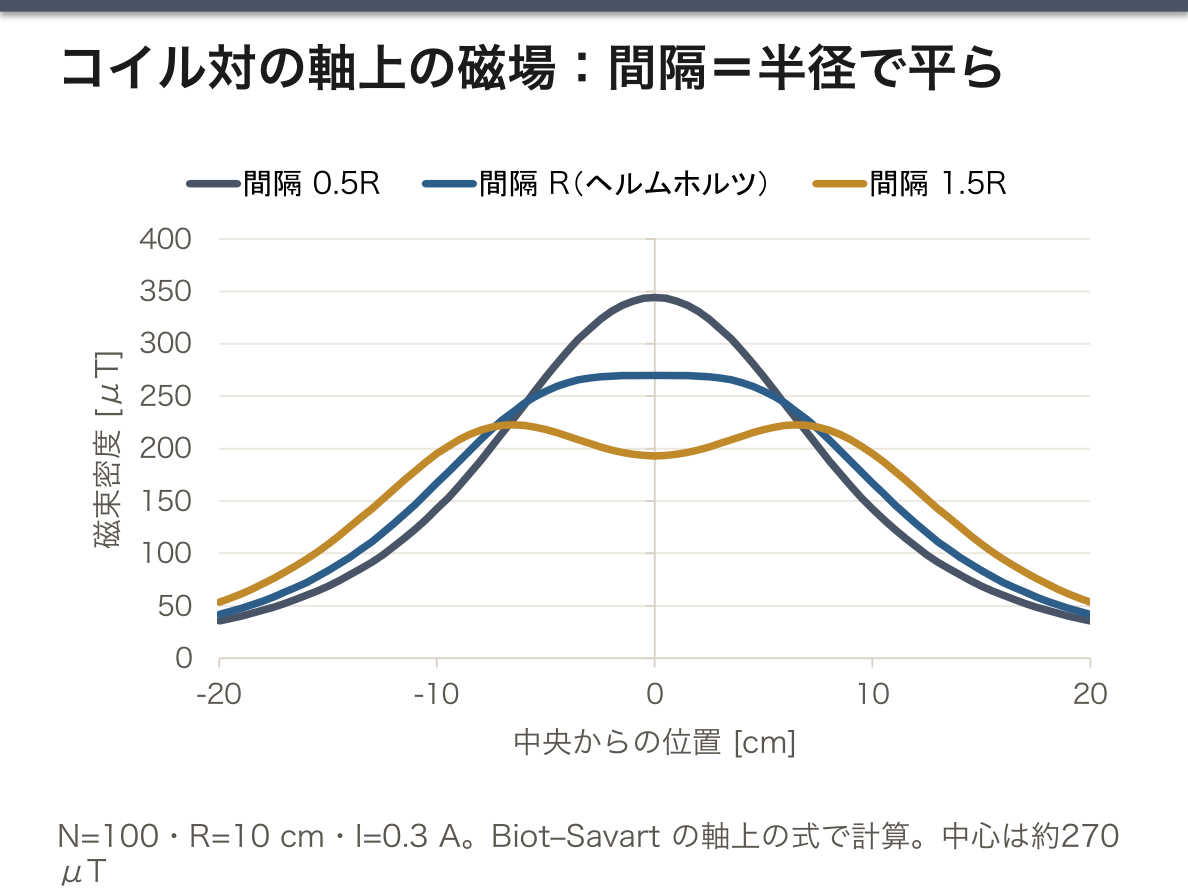
なぜ間隔を半径と同じにすると一様になるのか。1つの円形コイルの軸上の磁場は、中心で最大になり、離れるにつれて山形に下がる。2つのコイルの山を重ねると、間隔が狭すぎれば中央が盛り上がり、広すぎれば中央がへこむ。ちょうど間隔 = 半径のとき、片方の山の下り坂の曲がり具合ともう片方の曲がり具合が中央で打ち消し合い、最も平らになる。これがヘルムホルツの条件である。
磁場は足し算できる(重ね合わせ):2つのコイルの磁場はベクトルとして足される。センサーが読むのはその場所の合計の磁場なので、地磁気(約 50 μT)も含まれる。電流 0 で測ってセンサーをゼロに合わせるか、地磁気の分を引いて比べる必要がある。
方位磁針で地磁気を測る方法:コイルの軸を東西に向け、中央に方位磁針を置く。コイルの磁場 B と地磁気の水平成分 BE が直角に合成されるので、針が北から振れる角 α は tan α = B / BE を満たす。B は電流から計算できるので、角度から地磁気の水平成分が求まる。
2つのコイルに逆向きの電流を流すと、中央で磁場が 0 になり、そこを通って直線的に変化する磁場(傾斜磁場)ができる(アンチヘルムホルツ配置)。
MRI の装置にも、この2つの考え方がそのまま入っている。主磁場は「できるだけ一様に」つくる必要があり(一様でないと場所によって共鳴周波数がずれて画像がゆがむ)、位置を決める傾斜磁場コイルは「場所に比例して変化する磁場」をつくる。逆向き電流のコイル対が直線的な傾斜をつくることは、体軸方向の傾斜磁場コイルの基本形である。ヘルムホルツコイルそのものは、地磁気を打ち消した空間をつくる・磁気センサーを校正する・細胞や生物に一定の磁場をかける実験などに使われる。
English version
Core
Helmholtz coils are two identical circular coils placed on the same axis, a distance apart equal to their radius R, carrying the same current in the same direction. Around the centre between them there is a nearly uniform field over a fairly large region.
The flux density at the centre is
B = (4/5)3/2 · μ0NI / R ≈ 0.716 μ0NI / R (N: turns in one coil; I: current)
proportional to current and number of turns, and inversely proportional to the radius. For example, if N = 100, R = 10 cm and I = 0.3 A, then B ≈ 0.716 × 4π×10−7 × 100 × 0.3 / 0.1 ≈ 2.7×10⁻⁴ T (about 270 μT), several times Earth’s field.
How the experiment runs: a steady current flows in the coils, and a magnetic field sensor is moved along the coil axis in equal steps (for example every 2 cm) to read the flux density. Plotting B against position shows a flat plateau in the middle (the uniform region) that falls steeply outside the coils. The measured values are compared with theory, and the percentage difference and errors are assessed.
Going further
Why does spacing equal to the radius give a uniform field? On the axis of one circular coil, the field is largest at the centre and falls away like a hill. Overlap the hills of two coils: if they are too close, the middle bulges; too far apart, it dips. At spacing = radius, the curvature of one hill’s slope cancels that of the other at the centre, giving the flattest field. This is the Helmholtz condition.
Fields add (superposition): the fields of the two coils add as vectors. The sensor reads the total field at that point, which includes Earth’s field (about 50 μT). You must zero the sensor with the current off, or subtract Earth’s part before comparing.
Measuring Earth’s field with a compass: point the coil axis east–west and put a compass in the middle. The coil field B and the horizontal part of Earth’s field BE combine at right angles, so the angle α the needle swings from north obeys tan α = B / BE. Since B can be calculated from the current, the angle gives the horizontal part of Earth’s field.
With currents in opposite directions, the field is zero at the centre and changes in a straight line through it (a gradient field) — the anti-Helmholtz arrangement.
In the clinic
Both ideas are built into an MRI scanner. The main field must be "as uniform as possible" (if not, the resonance frequency shifts from place to place and the image is distorted), while the gradient coils that set position make "a field that changes in proportion to position". A coil pair with opposite currents giving a linear gradient is the basic form of the gradient coil along the body axis. Helmholtz coils themselves are used to make spaces where Earth’s field is cancelled, to calibrate magnetic sensors, and to apply a steady field to cells or organisms in experiments.
まとめ
| 磁場と磁気モーメント — Larmor 周波数 | 磁束密度 B(単位 T テスラ)の場に、磁気モーメントを持つ原子核を置くと、核は磁場の向きの周りをコマのように歳差運動する。 |
|---|---|
| 電磁誘導と磁気刺激 — TMS | Faraday の電磁誘導:磁束が時間的に変化すると起電力が生じる。 |
| MRI の信号はどこから来るか — 緩和と T1・T2 | 静磁場 B₀ の中で水素核の磁化がそろい(縦磁化)、Larmor 周波数の RF パルスを当てると倒れて横磁化になる。 |
| 電流がつくる磁場 — 直線電流・ソレノイド・電磁石 | 1820年、Ørsted(エルステッド)は、導線に電流を流すとそばの方位磁針が振れることを見つけた。 |
| ローレンツ力 — 動く電荷は磁場で曲げられる | 磁場の中を速度 v で動く電荷 q は、速度にも磁場にも垂直な向きに力を受ける。 |
| 物質の磁性 — 反磁性・常磁性・強磁性とキュリー温度 | 物質の磁性のもとは、電子のスピンと軌道運動がつくる小さな磁気モーメントである。 |
| 生体磁気と、MRI以外の磁場の医療応用 — 心磁図・脳磁図・磁気温熱療法 | 人の体は磁石ではない(全体としては弱い反磁性)。 |
| 磁気療法を科学的に評価する — 効くもの・効かないもの | 磁石を貼る・身につけると痛みや血行が良くなる、とうたう製品(磁気ネックレス・磁気ブレスレット・磁石入りの中敷きなど)は多い。 |
| 地磁気と磁気圏 — 地球のダイナモと、太陽風の盾 | 地球のまわりには、棒磁石に近い形の磁場(地磁気, geomagnetic field)がある。 |
| ヘルムホルツコイルの実験 — 一様な磁場をつくって測る | ヘルムホルツコイル(Helmholtz coils)は、同じ大きさの2つの円形コイルを、半径 R と同じ距離だけ離して同じ軸上に置き、同じ向きに同じ電流を流したものである。 |
このノートは医学生が授業の内容を自分の言葉でまとめたもので、診療の判断に使うものではありません。誤りに気づいたらお知らせください。