体を支え、動かしているのは骨・関節・筋・腱がつくる力学の仕組みである。この章は2つの話からなる。前半は静力学——止まっている物体で力とトルクがどうつり合うか、てことして体を見るとどうなるか。後半は弾性——力を加えた材料がどれだけ変形し、どこで壊れるか。
両方をつなぐキーワードは「力の大きさだけでなく、どこに・どの向きにかかるか」である。筋は関節の近くに付くので大きな力を出さねばならず、骨は引っ張り・圧縮・ねじりで壊れ方が違う。骨折の型も人工関節の設計も、ここから説明できる。
式は F = kΔx と E = σ/ε の2本が中心。ばね定数 k は「その物体」、ヤング率 E は「その材料」の性質——この区別が章全体の軸になる。
- 力のつり合い — 静止の条件は2つある
- てこ — 体は力より速さを選んでいる
- フックの法則 — 伸びは力に比例する
- 応力・ひずみ・ヤング率 — 物体ではなく材料の硬さ
- 応力–ひずみ曲線 — 弾性・塑性・破壊
- 材料の分類と生体材料 — 方向で性質が変わるか
- 骨の力学 — 荷重の種類で折れ方が決まる
力のつり合い — 静止の条件は2つある
物体が静止している(または等速で動いている)とき、はたらく力は打ち消し合っている。これを平衡(equilibrium)といい、条件は2つある。
①並進のつり合い:ΣF = 0(力のベクトル和がゼロ → 加速しない)
②回転のつり合い:Στ = 0(どの軸のまわりでもトルクの和がゼロ → 回り始めない)
トルク(力のモーメント)は τ = F·d。d は回転軸から力の作用線までの垂直距離(モーメントアーム)で、単位は N·m。
体の安定性は重心(CoG)、支持基底面(BoS)、重心から真下に下ろした重心線で決まる。重心線が支持基底面の中に落ちていれば倒れない。
なぜ条件が2つ要るのか。同じ大きさで逆向きの2つの力でも、作用線がずれていれば ΣF = 0 なのに物体は回る(偶力)。力の和だけでは回転を止められないので、トルクの条件が独立に必要になる。
安定性の3要素はどれも「重心線が支持基底面から出にくいか」の言い換えである。重心が低いほど、少し傾いても重心線が大きく動かない。支持基底面が広いほど、重心線が外に出るまでの余裕が大きい。足を開いて立つ、膝を曲げて腰を落とす——転ばないための動作はすべてこの2つを使っている。
高齢者が杖や歩行器を使うのは、支持基底面を広げるためである。片麻痺の患者が健側に杖を持つのも同じ理屈で、杖と健側の足でつくる面を広くとる。立っているときの脊柱は、体の前に落ちる重心線に対して背筋群のトルクで釣り合いをとっているので、前かがみで物を持ち上げると腰に大きな負荷がかかる。
English version
Core
When a body is at rest (or moves at constant velocity), the forces on it cancel. This is equilibrium, and it has two conditions.
(1) Translational equilibrium: ΣF = 0 (the vector sum of forces is zero → no acceleration)
(2) Rotational equilibrium: Στ = 0 (the sum of torques about any axis is zero → no start of rotation)
Torque (moment of force) is τ = F·d, where d is the perpendicular distance from the axis to the line of action of the force (the moment arm). Its unit is N·m.
The stability of the body depends on the center of gravity (CoG), the base of support (BoS), and the line of gravity drawn straight down from the CoG. If the line of gravity falls inside the base of support, the body does not fall.
Going further
Why two conditions? Two forces of equal size in opposite directions give ΣF = 0, but if their lines of action are offset, the body still turns (a couple). The sum of forces cannot stop rotation, so the torque condition is needed separately.
All three stability factors restate one question: how hard is it for the line of gravity to leave the base of support? The lower the CoG, the less the line moves when you tilt a little. The wider the base, the more margin before the line goes outside. Standing with feet apart, bending the knees and lowering the hips — every movement to avoid falling uses these two.
In the clinic
Older people use a cane or walker to widen the base of support. A patient with hemiplegia holds the cane on the healthy side for the same reason: the cane and the healthy foot make a wider base. When standing, the spine balances the line of gravity that falls in front of it with the torque of the back muscles, so lifting something while bent forward puts a large load on the lower back.
てこ — 体は力より速さを選んでいる
てこは、支点(fulcrum)のまわりで回る硬い棒に、力(effort)をかけて荷重(load)を動かす仕組み。体では関節が支点、筋が力、体の部分や持った物が荷重になる。並び順で3種類に分ける。
| 種類 | 並び | 得るもの | 体の例 |
|---|---|---|---|
| 第1種 | 力-支点-荷重 | 距離しだいで力にも速さにも | 頭を前後にうなずく(環椎後頭関節が支点) |
| 第2種 | 支点-荷重-力 | 力(速さと可動域を犠牲に) | つま先立ち(つま先が支点、下腿三頭筋が力) |
| 第3種 | 支点-力-荷重 | 速さと可動域(大きな力が要る) | 肘を曲げる(上腕二頭筋)。体で最も多い |
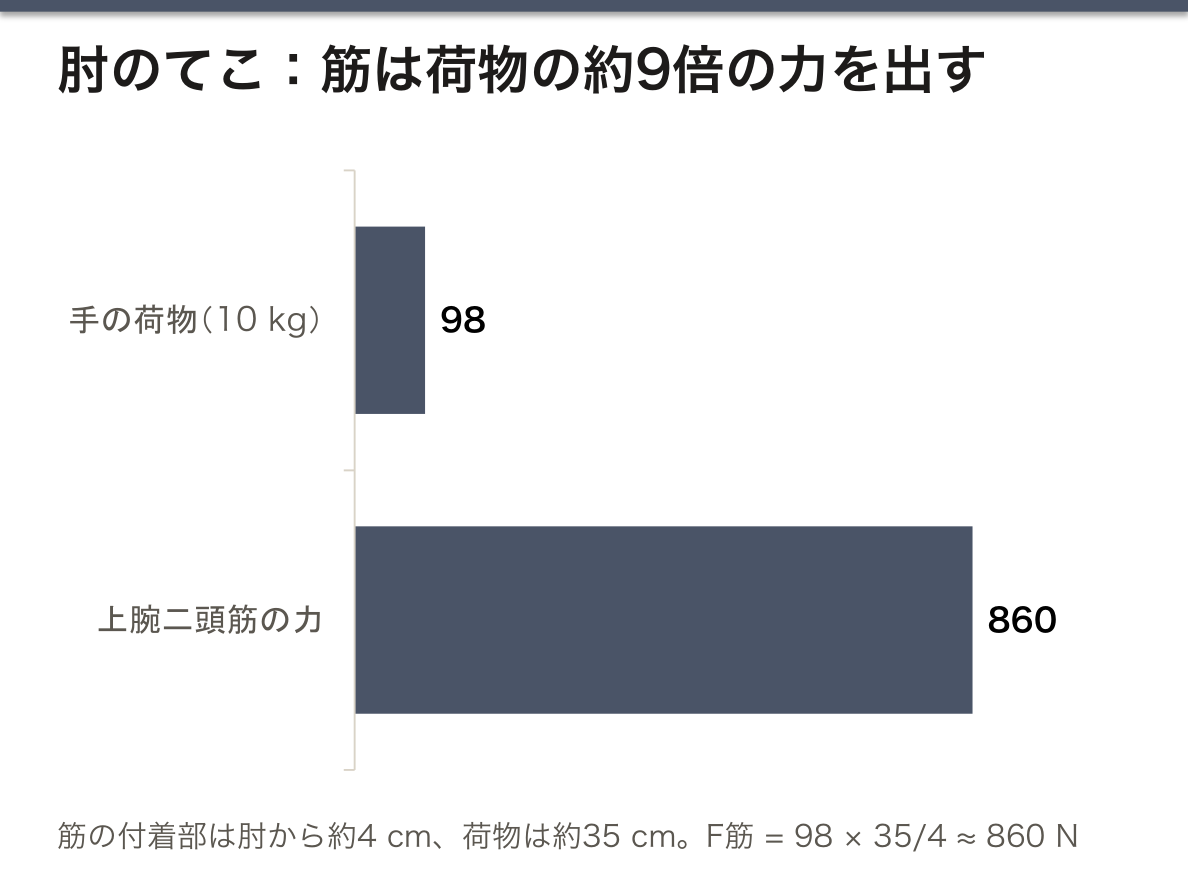
回転のつり合い(F筋·d筋 = F荷重·d荷重)から、筋に必要な力がすぐ出る。上腕二頭筋は肘から約4 cm に付き、手のひらの荷物は約35 cm 先にある。10 kg(約98 N)を持つなら、F筋 = 98 × 35/4 ≈ 860 N、荷物の約9倍の力を筋が出している。
なぜこんな「損な」設計なのか。筋は付着部の近くで少し縮むだけで、手先を大きく速く動かせるからである。力の比とちょうど逆の比で、手先の移動距離と速さは筋の約9倍になる。投げる・叩く・走るといった動作には、力より速さと可動域が必要だった。その代償として、関節には荷重の何倍もの力がかかる。
関節にかかる力は体重の数倍に達する。股関節では片脚立ちで外転筋が骨盤を水平に保つため、関節反力は体重の約3倍になる。股関節の痛む人が患側と反対の手に杖を持つと、杖が長いモーメントアームで外転筋の仕事を肩代わりし、関節の負担が大きく減る。
English version
Core
A lever is a rigid bar that turns about a fulcrum; an effort applied to it moves a load. In the body, the joint is the fulcrum, the muscle is the effort, and the body part or held object is the load. Levers are divided into three classes by order.
| Class | Order | What you gain | Example in the body |
|---|---|---|---|
| First | effort–fulcrum–load | Force or speed, depending on distances | Nodding the head (atlanto-occipital joint as fulcrum) |
| Second | fulcrum–load–effort | Force (at the cost of speed and range) | Standing on tiptoe (toes as fulcrum, calf muscles as effort) |
| Third | fulcrum–effort–load | Speed and range (needs a large force) | Bending the elbow (biceps). The most common in the body |
Going further
Rotational balance (Fmuscle·dmuscle = Fload·dload) gives the muscle force at once. The biceps attaches about 4 cm from the elbow, and an object in the hand is about 35 cm away. To hold 10 kg (about 98 N), Fmuscle = 98 × 35/4 ≈ 860 N — about nine times the load.
Why such a “bad” design? Because a small shortening of the muscle near its attachment moves the hand far and fast. In exactly the reverse ratio, the hand moves about nine times as far and as fast as the muscle. Throwing, striking and running needed speed and range more than force. The price is that joints carry forces many times the load.
In the clinic
Forces on joints reach several times body weight. In the hip, standing on one leg requires the abductor muscles to keep the pelvis level, so the joint reaction force is about three times body weight. When a person with a painful hip holds a cane in the opposite hand, the cane takes over the abductors’ work through a long moment arm, and the load on the joint falls a great deal.
フックの法則 — 伸びは力に比例する
弾性体を伸ばす(縮める)と、変形 Δx に比例して元に戻ろうとする力が生じる。
F = k·Δx(復元力は変形と逆向きなので Fばね = −kΔx とも書く)
k はばね定数(剛性)で、単位は N/m。たとえば k = 500 N/m のばねに 50 N をかけると 0.1 m 伸びる。この比例関係が成り立つのは弾性限界までである。
同じばねを2本つなぐと:直列なら全体の伸びが2倍になるので k は半分、並列なら1本あたりの力が半分になるので k は2倍。
ばねの長さを2倍にすると、ばね定数は半分になる。長いばねは「短いばねを2本直列にしたもの」と同じだからである。同じ力をかけると、各部分が同じだけ伸び、伸びの合計は2倍になる。
同じ考えで、太さを2倍(断面積を2倍)にすると「並列に2本」と同じなので k は2倍になる。まとめると k は断面積に比例し、長さに反比例する。つまり k は材料だけでなく物体の形と大きさで決まる量で、材料そのものの硬さを表すには別の量(ヤング率)が要る。これが次の項目につながる。
腱や靭帯も同じで、長く細い腱ほど伸びやすい。アキレス腱(tendo calcaneus)は走るときに伸ばされて弾性エネルギーをため、蹴り出しで返す——ばねとして働くことで筋の仕事を節約している。
English version
Core
When an elastic body is stretched (or compressed), a restoring force arises in proportion to the deformation Δx.
F = k·Δx (the restoring force points opposite to the deformation, so it is also written Fspring = −kΔx)
k is the spring constant (stiffness), unit N/m. For example, 50 N on a spring with k = 500 N/m stretches it by 0.1 m. This proportionality holds only up to the elastic limit.
Joining two identical springs: in series, the total extension doubles, so k is halved; in parallel, each spring carries half the force, so k doubles.
Going further
Doubling the length of a spring halves its spring constant. A long spring is the same as two short springs in series. Under the same force, each part stretches by the same amount, so the total extension doubles.
By the same idea, doubling the thickness (twice the cross-section) is like two in parallel, so k doubles. In short, k is proportional to the cross-sectional area and inversely proportional to the length. So k depends not only on the material but on the shape and size of the object, and a different quantity (Young’s modulus) is needed for the stiffness of the material itself. This leads to the next item.
In the clinic
Tendons and ligaments are the same: a long, thin tendon stretches more easily. The Achilles tendon (tendo calcaneus) is stretched while running, stores elastic energy and returns it at push-off — by working as a spring, it saves muscle work.
応力・ひずみ・ヤング率 — 物体ではなく材料の硬さ
形や大きさによらない比較をするため、力と変形を「割合」に直す。
応力(stress)σ = F/A:断面積あたりの力。単位 Pa(N/m2)。
ひずみ(strain)ε = ΔL/L:元の長さあたりの変形。単位なし。
弾性限界の内側では応力とひずみは比例し、その比がヤング率(縦弾性係数)である。
E = σ/ε = F·L/(A·ΔL) 単位 Pa(ふつう GPa)
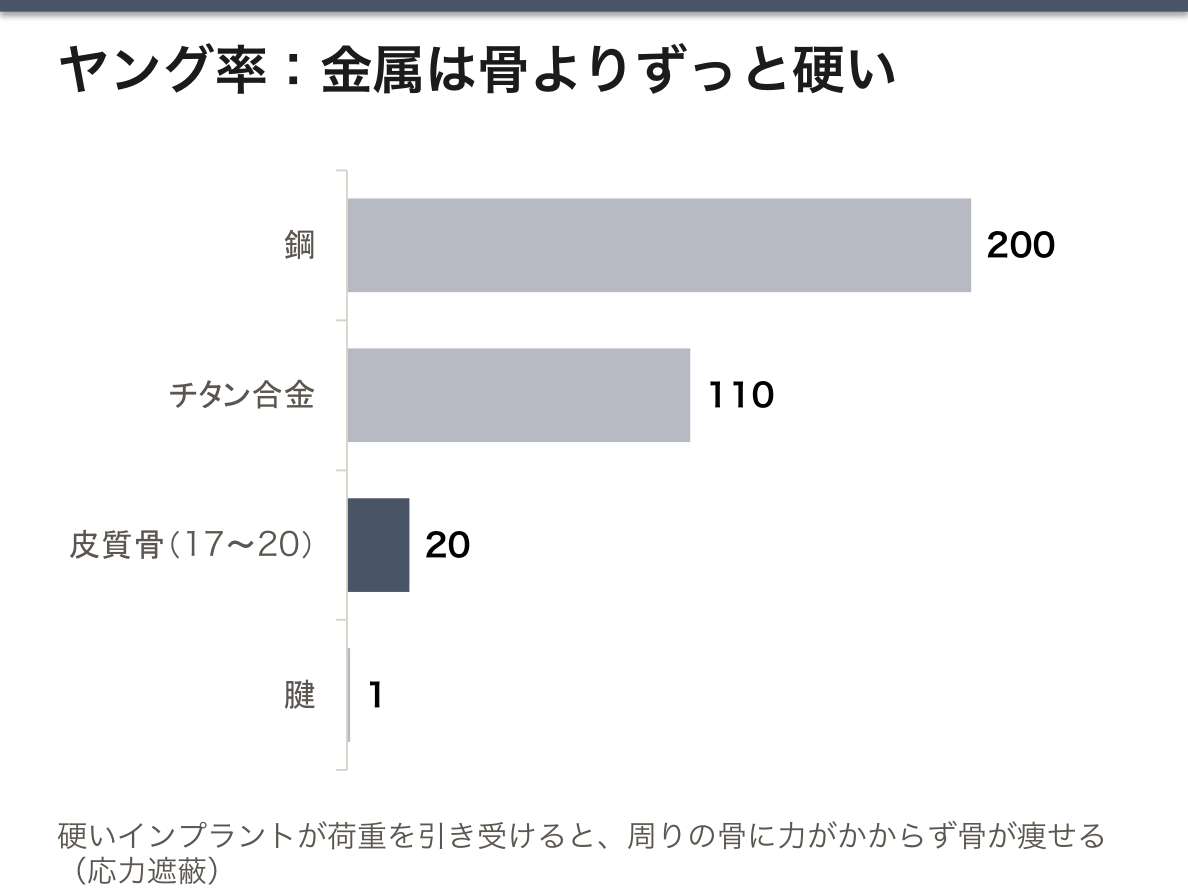
目安:鋼 約200 GPa、骨(皮質骨・長軸方向)約17〜20 GPa、腱 約1 GPa、軟骨は MPa の桁。
式を並べ替えると k = E·A/L。前の項目で見た「k は断面積に比例し長さに反比例する」は、この式そのものである。k は物体(形×材料)、E は材料だけ——同じ鋼でも太い棒と細い針金で k は違うが、E は同じ。
ヤング率は引っ張り試験のほか三点曲げ試験でも測れる。幅 b・厚さ a の板を間隔 L の2点で支え、中央に力 F をかけると、たわみは h = L3F/(4Ea3b)。F と h の直線の傾きから E が出る。厚さが3乗で効くので、板を2倍厚くするとたわみは1/8になる——厚さの測定誤差が結果に最も大きく響く理由でもある。
骨は形が不規則で式に乗せにくいので、基礎実験では金属棒で原理を確かめる。しかし考え方は同じで、骨の強さは「材料の質(E)」と「形・量(断面積や皮質の厚さ)」の積で決まる。骨粗鬆症は主に量と構造が失われる病気であり、骨密度検査は後者を測っている。
English version
Core
To compare without depending on shape or size, force and deformation are turned into ratios.
Stress σ = F/A: force per cross-sectional area. Unit Pa (N/m2).
Strain ε = ΔL/L: deformation per original length. No unit.
Inside the elastic limit, stress and strain are proportional, and their ratio is Young’s modulus (modulus of elasticity).
E = σ/ε = F·L/(A·ΔL), unit Pa (usually GPa)
Typical values: steel about 200 GPa, bone (cortical, along the long axis) about 17–20 GPa, tendon about 1 GPa, cartilage in the MPa range.
Going further
Rearranging gives k = E·A/L. “k is proportional to area and inversely proportional to length” from the last item is exactly this formula. k belongs to the object (shape × material); E belongs to the material only. A thick steel bar and a thin steel wire have different k but the same E.
Young’s modulus can be measured by a tensile test or by a three-point bending test. Support a bar of width b and thickness a at two points a distance L apart and push in the middle with force F; the deflection is h = L3F/(4Ea3b). E comes from the slope of the F–h line. Thickness enters as a cube, so a bar twice as thick bends only 1/8 as much — which is also why an error in measuring thickness affects the result most.
In the clinic
Bone has an irregular shape that is hard to put into a formula, so basic experiments test the principle on a metal bar. But the idea is the same: bone strength is the product of material quality (E) and shape and amount (cross-section, cortical thickness). Osteoporosis mainly loses amount and structure, and bone density testing measures the latter.
応力–ひずみ曲線 — 弾性・塑性・破壊
材料を引っ張り続けると、応力とひずみの関係は次の順にたどる。
①比例限界まで:直線(フックの法則が成り立つ)。
②弾性限界まで:力を除けば元の長さに戻る(弾性変形)。
③降伏点を越えると:力を除いても元に戻らない(塑性変形、永久変形)。
④最大応力(引っ張り強さ)を過ぎて破断する。
塑性域が広い材料を延性材料(金属)、ほとんどなく突然割れる材料を脆性材料(セラミック・ガラス)という。
生体組織の多くは粘弾性(viscoelasticity)を持つ。変形が時間と速さに依存し、負荷と除荷で曲線が一致しない(ヒステリシス)。
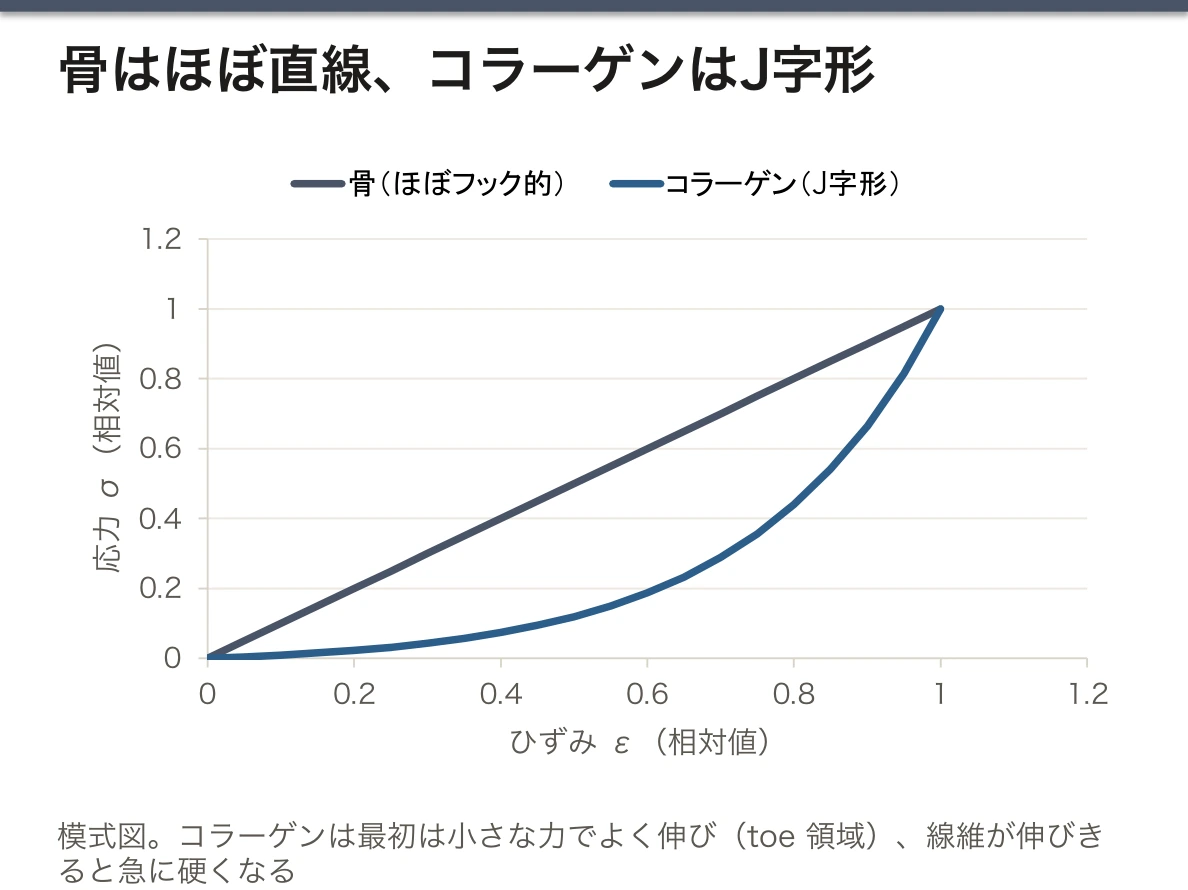
ヒステリシスのループの面積は、1回の負荷・除荷で熱として失われたエネルギーである。完全な弾性体ならループはできず、ためたエネルギーをすべて返す。
コラーゲンの曲線はJ字形になる。最初は波打った線維がまっすぐになるだけなので、小さな力でよく伸びる(toe 領域)。線維が伸びきると急に硬くなる。小さな動きは柔らかく受け、大きな力では伸びすぎを防ぐ——皮膚・血管・腱に都合のよい性質である。これに対して骨の無機成分はセラミックで、ほぼ直線(フック的)にふるまう。
粘弾性のため、同じ材料でも速くかけた力には硬く強くふるまう。骨の性質が負荷の持続時間や速さで変わるのはこのためである。
動脈壁もJ字形の曲線を持ち、血圧が上がるほど硬くなる。捻挫は靭帯が降伏点を越えて塑性変形した状態で、伸びた靭帯は元に戻らないため関節の不安定性が残ることがある。
English version
Core
If you keep pulling a material, the stress–strain relation goes through these stages.
(1) Up to the proportional limit: a straight line (Hooke’s law holds).
(2) Up to the elastic limit: it returns to its original length when the force is removed (elastic deformation).
(3) Beyond the yield point: it does not return when the force is removed (plastic deformation, permanent).
(4) After the maximum stress (tensile strength) it fractures.
A material with a wide plastic region is ductile (metals); one with almost none that cracks suddenly is brittle (ceramics, glass).
Most biological tissues are viscoelastic: deformation depends on time and rate, and loading and unloading follow different curves (hysteresis).
Going further
The area inside the hysteresis loop is the energy lost as heat in one cycle of loading and unloading. A perfectly elastic body makes no loop and returns all the stored energy.
Collagen gives a J-shaped curve. At first the wavy fibers only straighten, so it stretches easily under small forces (the toe region). Once the fibers are straight, it suddenly becomes stiff. It accepts small movements softly and prevents over-stretching under large forces — a useful property for skin, vessels and tendons. The mineral part of bone, in contrast, is a ceramic and behaves almost linearly (Hookean).
Because of viscoelasticity, the same material is stiffer and stronger under fast loading. This is why bone properties change with the duration and rate of the load.
In the clinic
The arterial wall also has a J-shaped curve and gets stiffer as blood pressure rises. A sprain is a ligament that has gone past its yield point and deformed plastically; a stretched ligament does not return, so the joint may remain unstable.
材料の分類と生体材料 — 方向で性質が変わるか
材料は2つの観点で分類する。
均質か:どこを取っても組成と性質が同じなら均質(homogeneous)、場所で違えば不均質。
方向で性質が変わるか:どの向きに測っても同じなら等方性(isotropic)、向きで違えば異方性(anisotropic)。異方性のうち、互いに直交する3方向にそれぞれ別の性質を持つものを直交異方性(orthotropic)という(木材、繊維強化プラスチック、骨)。
生体材料(biomaterial)は生体と接して働く材料の総称。大きく分けてセラミック(硬く強いが脆い、腐食に強い)、金属(強く粘り強い、変形できるが腐食しうる)、高分子(柔らかく軽い、弾性率が低い)がある。
なぜ骨は異方性なのか——力のかかる方向に合わせて構造をつくるからである。長骨の骨単位とコラーゲン線維は長軸に沿って並ぶので、長軸方向に最も硬く強い。骨は日常で受ける荷重の方向に最適化された材料と言える。
生体材料の選択は「何に置き換えるか」で決まる。荷重を受ける人工関節の軸には金属(チタン合金・コバルトクロム)、摩耗に強い骨頭や歯にはセラミック、柔らかさが要る軟部組織や関節の摺動面には高分子(超高分子量ポリエチレン)が使われる。
金属インプラントは骨より何倍も硬い(チタン合金でおよそ110 GPa)。そのため荷重の多くを金属が引き受け、周りの骨に力がかからなくなる。骨は使われないと吸収されるので(Wolff の法則)、インプラント周囲の骨が痩せることがある——応力遮蔽(stress shielding)である。人工関節の設計で「骨に近い硬さ」が求められるのはこのためである。
English version
Core
Materials are classified from two points of view.
Is it uniform? If composition and properties are the same everywhere, it is homogeneous; if they vary from place to place, inhomogeneous.
Do properties change with direction? If they are the same in every direction, it is isotropic; if not, anisotropic. An anisotropic material with different properties along three mutually perpendicular axes is orthotropic (wood, fiber-reinforced plastics, bone).
A biomaterial is any material that works in contact with living tissue. The main groups are ceramics (hard and strong but brittle, resist corrosion), metals (strong and tough, can deform, may corrode) and polymers (soft and light, low elastic modulus).
Going further
Why is bone anisotropic? Because it builds its structure along the directions of load. Osteons and collagen fibers in long bones run along the long axis, so the bone is stiffest and strongest in that direction. Bone is a material optimized for the directions of everyday loads.
The choice of biomaterial depends on what it replaces. Metals (titanium alloy, cobalt–chromium) for load-bearing stems of joint replacements, ceramics for wear-resistant femoral heads and teeth, and polymers (ultra-high-molecular-weight polyethylene) for soft tissues and joint bearing surfaces.
In the clinic
A metal implant is many times stiffer than bone (about 110 GPa for titanium alloy). So the metal takes most of the load and the surrounding bone carries little force. Bone that is not used is resorbed (Wolff’s law), so the bone around the implant can thin — this is stress shielding. This is why joint replacement design aims for “stiffness close to bone”.
骨の力学 — 荷重の種類で折れ方が決まる
骨は2つの成分の複合材料である。コラーゲン線維(柔軟で引っ張りに強い高分子)と、カルシウムを含むヒドロキシアパタイト(硬いが脆いセラミック)。片方だけでは足りない性質を、組み合わせで補い合っている。
骨の強さは荷重の種類で違う。圧縮に最も強く、引っ張りにはそれより弱く、せん断に最も弱い。また長軸方向に強く、横方向に弱い(異方性)。
弾性に影響する因子:負荷の持続時間(速さ)・標本の水分量・温度・血管の分布。加齢では骨量が減り脆くなる。
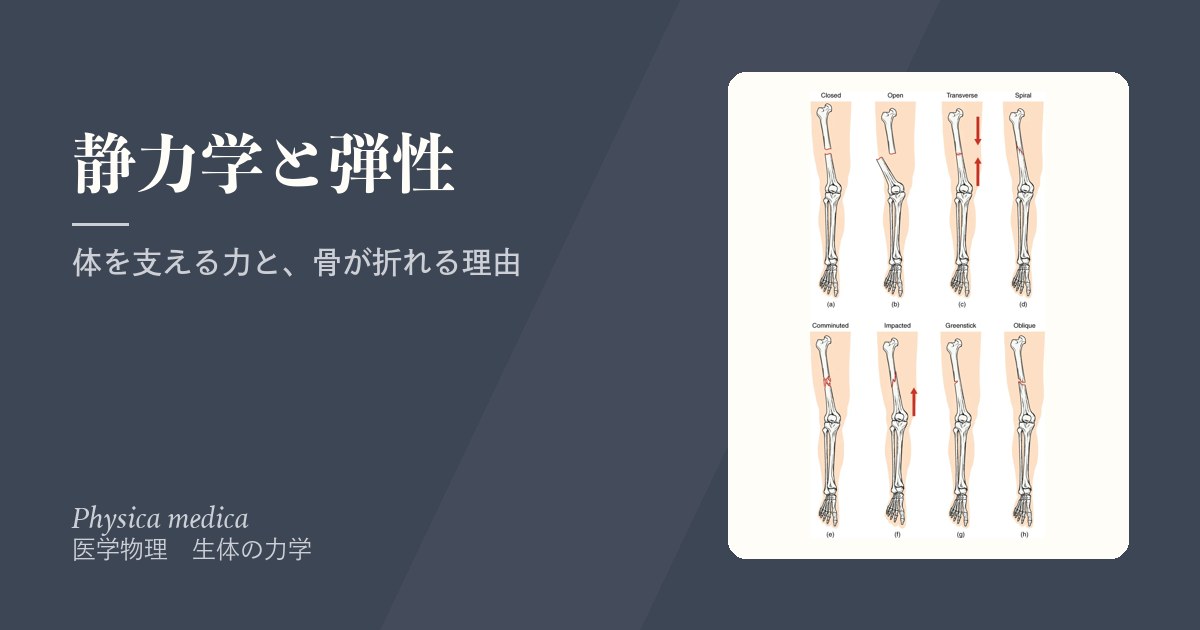
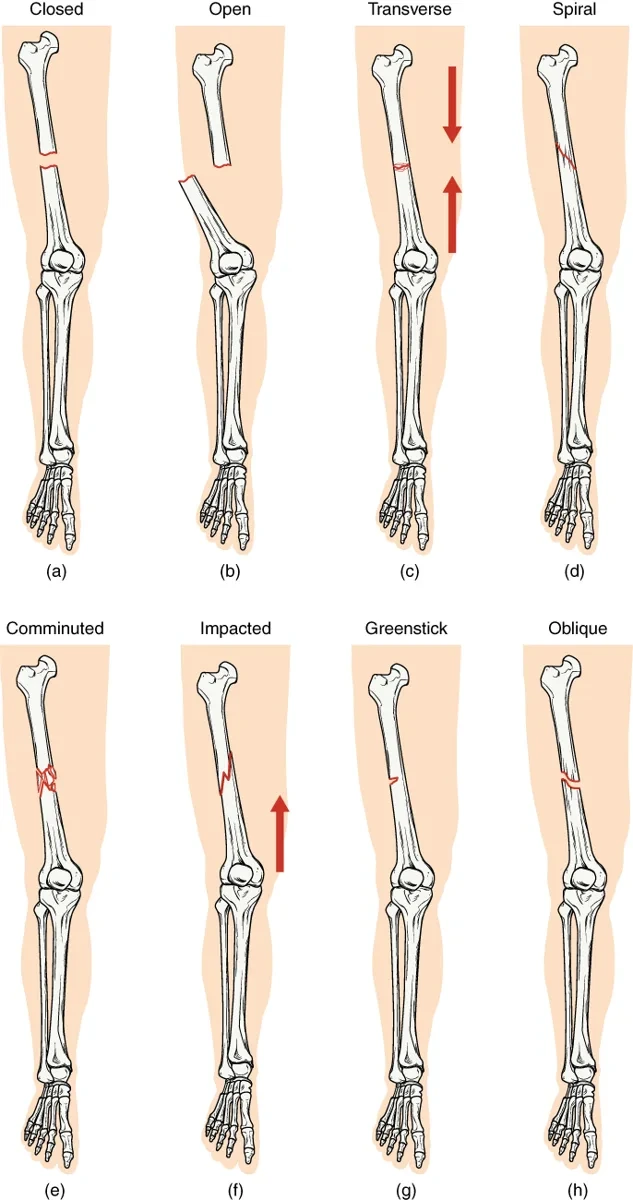
荷重の型から骨折の型が読める。
| 荷重 | 典型的な骨折 |
|---|---|
| 引っ張り | 横骨折。腱・靭帯の付着部が引きちぎられる裂離骨折 |
| 圧縮 | 押しつぶされる圧迫骨折(椎体) |
| 曲げ | 凸側(引っ張り側)から割れて横骨折。凹側に第3骨片(蝶形骨片)が出やすい |
| ねじり | らせん骨折(スキーでの脛骨など) |
曲げで凸側から割れるのは、骨が引っ張りに弱いからである。脱水した骨や冷えた骨が脆くなるのも、コラーゲンの粘り(エネルギー吸収)が落ちるためである。
骨粗鬆症(osteoporosis)は骨量と微細構造が失われ、わずかな力で折れる状態である。好発部位は椎体の圧迫骨折・大腿骨近位部骨折・橈骨遠位端骨折・上腕骨近位部骨折。椎体は海綿骨が多く圧縮を受けるので、立ち上がりや軽い尻もちで潰れる。転倒による大腿骨近位部骨折は寝たきりの入口になるため、整形外科で最も重い骨折の一つである。
English version
Core
Bone is a composite of two components: collagen fibers (a flexible polymer, strong in tension) and calcium-containing hydroxyapatite (a hard but brittle ceramic). Each covers what the other lacks.
Bone strength depends on the type of load. It is strongest in compression, weaker in tension, and weakest in shear. It is also stronger along the long axis than across it (anisotropy).
Factors affecting its elasticity: the duration (rate) of loading, the water content of the specimen, temperature, and the vascular pattern. With age, bone mass falls and bone becomes brittle.
Going further
The type of load tells you the type of fracture.
| Load | Typical fracture |
|---|---|
| Tension | Transverse fracture; avulsion fracture where a tendon or ligament pulls off its attachment |
| Compression | Crushing compression fracture (vertebral body) |
| Bending | Breaks from the convex (tension) side as a transverse fracture; a butterfly fragment often forms on the concave side |
| Torsion | Spiral fracture (e.g., the tibia in skiing) |
Bending breaks from the convex side because bone is weak in tension. Dehydrated or cold bone becomes brittle because the toughness of collagen (its energy absorption) falls.
In the clinic
Osteoporosis is loss of bone mass and microstructure so that bone breaks under small forces. Typical sites are vertebral compression fractures, proximal femur fractures, distal radius fractures and proximal humerus fractures. The vertebral body is mostly cancellous bone under compression, so it collapses when standing up or after a light fall onto the buttocks. A proximal femur fracture from a fall often leads to becoming bedridden, so it is one of the most serious fractures in orthopedics.
まとめ
| 力のつり合い — 静止の条件は2つある | 物体が静止している(または等速で動いている)とき、はたらく力は打ち消し合っている。 |
|---|---|
| てこ — 体は力より速さを選んでいる | てこは、支点(fulcrum)のまわりで回る硬い棒に、力(effort)をかけて荷重(load)を動かす仕組み。 |
| フックの法則 — 伸びは力に比例する | 弾性体を伸ばす(縮める)と、変形 Δx に比例して元に戻ろうとする力が生じる。 |
| 応力・ひずみ・ヤング率 — 物体ではなく材料の硬さ | 形や大きさによらない比較をするため、力と変形を「割合」に直す。 |
| 応力–ひずみ曲線 — 弾性・塑性・破壊 | 材料を引っ張り続けると、応力とひずみの関係は次の順にたどる。 |
| 材料の分類と生体材料 — 方向で性質が変わるか | 材料は2つの観点で分類する。均質か:どこを取っても組成と性質が同じなら均質(homogeneous)、場所で違えば不均質。 |
| 骨の力学 — 荷重の種類で折れ方が決まる | 骨は2つの成分の複合材料である。コラーゲン線維(柔軟で引っ張りに強い高分子)と、カルシウムを含むヒドロキシアパタイト(硬いが脆いセラミック)。 |
このノートは医学生が授業の内容を自分の言葉でまとめたもので、診療の判断に使うものではありません。誤りに気づいたらお知らせください。