
心拍・呼吸・歩行・声帯・超音波——体と医療機器はくり返す運動であふれている。くり返しを数で表す道具が振動の物理である。
中心にあるのは単振動ただ1つ。「ずれに比例して元に戻そうとする力」があれば、ばねでも振り子でも同じ式(正弦波)で動く。周期はばね振り子では質量とばね定数、単振り子では長さと重力加速度だけで決まり、振れ幅にはよらない——この不思議な性質が時計や測定に使える理由である。
実際の振動は必ずエネルギーを失って小さくなる(減衰)。外から周期的に押し続けると振動は続き、押す周期が固有の周期と合うと大きく揺れる(共振)。この3つの区別で、生体のリズムも医療機器もだいたい説明がつく。
- 振動を表す量 — 周期・振動数・角振動数・位相
- 単振動 — ずれに比例して戻す力があれば正弦波になる
- ばね振り子 — 周期は質量とばね定数で決まる
- 単振り子 — 周期は長さと重力加速度で決まる
- 振動のエネルギーと減衰 — 実際の振動は必ず小さくなる
- 強制振動と共振 — 固有振動数で押すと大きく揺れる
振動を表す量 — 周期・振動数・角振動数・位相
振動(oscillation)は、つり合いの位置のまわりを行き来するくり返し運動である。表す量は次のとおり。
| 量 | 記号・式 | 単位 |
|---|---|---|
| 振幅(つり合いからの最大のずれ) | A | m |
| 周期(1往復の時間) | T | s |
| 振動数(1秒あたりの往復数) | f = 1/T | Hz |
| 角振動数 | ω = 2πf = 2π/T | rad/s |
| 位相 | ωt + φ0 | rad |
1往復で位相は 2π rad(360°)進む。φ0 は t = 0 での位相(初期位相)である。
なぜ角度で数えるのか。単振動は、円周上を等速で回る点を真横から見た影と同じ動きになる。1周が 2π rad なので、1往復=2π と数えると式がいちばん簡単になる。角振動数 ω は「1秒に何ラジアン回るか」で、単位は rad/s。Hz と次元は同じだが、ω = 2πf の 2π を忘れると答えが約6倍ずれる。
位相が役に立つのは2つの振動を比べるときである。位相が π/2 ずれた2つの正弦波は、一方が最大のとき他方はゼロを通る。
心拍数 72 回/分は振動数 1.2 Hz、周期 0.83 s にあたる。交流の電源(50 Hz)は心電図にのる雑音の代表で、その周期 20 ms の細かい波は体の信号とは違うリズムなので見分けられる。
English version
Core
An oscillation is a repeating motion back and forth around an equilibrium position. It is described by these quantities.
| Quantity | Symbol / formula | Unit |
|---|---|---|
| Amplitude (maximum displacement from equilibrium) | A | m |
| Period (time for one cycle) | T | s |
| Frequency (cycles per second) | f = 1/T | Hz |
| Angular frequency | ω = 2πf = 2π/T | rad/s |
| Phase | ωt + φ0 | rad |
In one full cycle the phase advances by 2π rad (360°). φ0 is the phase at t = 0 (the initial phase).
Going further
Why count in angles? Simple harmonic motion is the same as the shadow, seen from the side, of a point moving at constant speed around a circle. One turn is 2π rad, so counting one cycle as 2π makes the formulas simplest. The angular frequency ω is “how many radians per second”; its unit is rad/s. It has the same dimension as Hz, but forgetting the 2π in ω = 2πf makes the answer off by about six times.
Phase is useful when comparing two oscillations. Two sine waves π/2 out of phase: when one is at its maximum, the other passes through zero.
In the clinic
A heart rate of 72 per minute is a frequency of 1.2 Hz and a period of 0.83 s. Mains power (50 Hz) is a typical source of noise on the ECG; its fine 20 ms waves have a rhythm unlike the body’s signals, so they can be recognized.
単振動 — ずれに比例して戻す力があれば正弦波になる
単振動(simple harmonic motion, SHM)は、復元力がつり合いからのずれに比例し、逆向きにはたらく振動である。
F = −kx → 加速度 a = −ω2x
このとき位置は時間の正弦関数になる。
x = A·cos(ωt + φ0)
速さと加速度の大きさは場所で違う。速さはつり合いの位置で最大、端でゼロ。加速度は端で最大、つり合いの位置でゼロ。
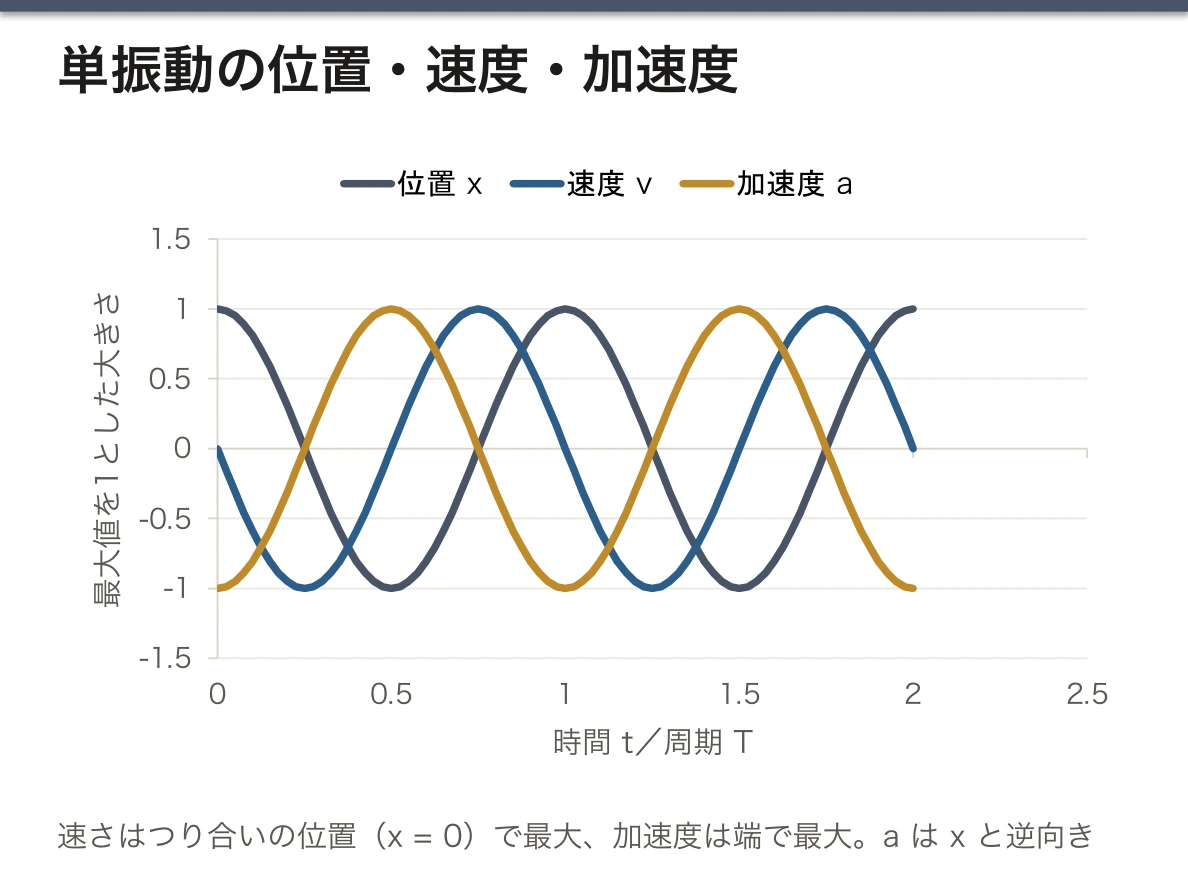
なぜそうなるかは力を考えればわかる。端では、ずれが最大なので復元力(=加速度)が最大だが、向きを変える瞬間なので速さはゼロ。つり合いの位置では、ずれがゼロなので力もゼロだが、そこまでずっと加速されてきたので速さは最大になる。速さと加速度は「片方が最大のとき他方はゼロ」で、位相が π/2 ずれている。
式でも確かめられる。x を時間で微分すると速度 v = −Aω sin(ωt + φ0)、もう一度微分すると a = −Aω2 cos(ωt + φ0) = −ω2x。最大の速さは Aω、最大の加速度は Aω2 である。
例:ばねにつけたおもり、小さく振れる振り子、弦楽器の弦。
立って体を静止させているときも、体の重心は前後にわずかに揺れている(重心動揺)。歩行では重心が上下に周期的に動き、その軌跡は正弦波に近い。重心動揺計は、この揺れの大きさで平衡機能を評価する。
English version
Core
Simple harmonic motion (SHM) is oscillation in which the restoring force is proportional to the displacement from equilibrium and points the opposite way.
F = −kx → acceleration a = −ω2x
The position is then a sine function of time.
x = A·cos(ωt + φ0)
Speed and acceleration depend on position. Speed is greatest at equilibrium and zero at the ends. Acceleration is greatest at the ends and zero at equilibrium.
Going further
Think about the force to see why. At the ends, the displacement is greatest, so the restoring force (and acceleration) is greatest, but this is the moment of turning, so the speed is zero. At equilibrium, the displacement and force are zero, but the body has been speeding up all the way there, so the speed is greatest. When one of speed and acceleration is maximum, the other is zero; they are π/2 out of phase.
The formula confirms it. Differentiating x gives velocity v = −Aω sin(ωt + φ0); differentiating again gives a = −Aω2 cos(ωt + φ0) = −ω2x. The maximum speed is Aω and the maximum acceleration is Aω2.
Examples: a mass on a spring, a pendulum swinging through small angles, the string of an instrument.
In the clinic
Even when you stand still, your center of mass sways slightly back and forth (postural sway). In walking, the center of mass moves up and down periodically, and its path is close to a sine wave. A stabilometer judges balance function from the size of this sway.
ばね振り子 — 周期は質量とばね定数で決まる
ばね定数 k のばねに質量 m のおもりをつけて振らせると、周期は
T = 2π√(m/k) (ω = √(k/m))
周期は振幅にも重力にもよらない。重いおもりほどゆっくり、硬いばねほど速く振れる。
逆に周期を測れば k が求まる:k = 4π2m/T2。質量を変えて T2 と m のグラフを描くと直線になり、傾きは 4π2/k である。
なぜ振幅によらないのか。大きく引っぱると、戻る距離は長くなるが、そのぶん復元力も比例して大きくなり速く戻る。距離と速さが同じ割合で増えるので、かかる時間は変わらない。これが「ずれに比例する力」の特別な性質である。
なぜ重力によらないのか。ばねを縦に吊ると、重力はつり合いの位置を下にずらすだけで、そこからのずれに対する復元力 −kx は変わらない。月の上でも同じ周期で振れる。
例:m = 0.2 kg で T = 0.5 s なら、k = 4π2 × 0.2/0.25 ≈ 32 N/m。
無重力の宇宙では体重計が使えないので、ばねに体をつないで振動の周期から質量を測る装置が使われてきた。重力によらずに質量がわかる、この式の性質をそのまま利用している。
English version
Core
When a mass m on a spring of constant k oscillates, the period is
T = 2π√(m/k) (ω = √(k/m))
The period does not depend on the amplitude or on gravity. A heavier mass swings more slowly; a stiffer spring swings faster.
In reverse, measuring the period gives k: k = 4π2m/T2. Plotting T2 against m for different masses gives a straight line with slope 4π2/k.
Going further
Why no dependence on amplitude? If you pull further, the distance back is longer, but the restoring force grows in proportion, so the mass returns faster. Distance and speed grow by the same factor, so the time stays the same. This is the special property of “a force proportional to the displacement”.
Why no dependence on gravity? When the spring hangs vertically, gravity only shifts the equilibrium position down; the restoring force −kx for displacement from there is unchanged. It would swing with the same period on the Moon.
Example: with m = 0.2 kg and T = 0.5 s, k = 4π2 × 0.2/0.25 ≈ 32 N/m.
In the clinic
In weightless space a normal scale does not work, so devices have been used that attach the body to a spring and measure mass from the period of oscillation. It uses exactly this property of the formula: mass can be found without gravity.
単振り子 — 周期は長さと重力加速度で決まる
長さ L の糸におもりを吊って小さく振らせると、周期は
T = 2π√(L/g) (ω0 = √(g/L))
周期はおもりの質量によらず、長さが4倍になると周期は2倍になる。L は支点からおもりの重心までの距離である。
この式が成り立つのは振れの角が小さいとき(およそ15°以下)に限られる。周期を測れば重力加速度が求まる:g = 4π2L/T2。
なぜ質量によらないのか。おもりを戻す力は重力の糸に垂直な成分 mg sinθ。重いおもりは強く引かれるが、そのぶん動かしにくい(慣性も大きい)。両方に m が入って打ち消し合う。
なぜ角が小さくなければいけないのか。復元力は sinθ に比例し、θ そのものには比例しない。θ が小さいときだけ sinθ ≈ θ と近似でき、「ずれに比例する力」=単振動になる。15°でも周期のずれは0.5%未満だが、大きく振るほど周期は長くなる。
測定のコツ:1往復を測るとストップウォッチを押す反応時間(0.1〜0.2 s)がそのまま誤差になる。10往復をまとめて測って10で割れば、その誤差は1/10になる。
歩くとき、振り出す脚は股関節を支点とする振り子に近い。脚の長い人ほど自然な歩調はゆっくりになり、人は筋のエネルギーが最も少なくてすむ、脚の固有周期に近い歩調を選んでいる。
English version
Core
When a mass hangs on a string of length L and swings through small angles, the period is
T = 2π√(L/g) (ω0 = √(g/L))
The period does not depend on the mass; four times the length gives twice the period. L is the distance from the pivot to the center of mass of the bob.
The formula holds only for small angles (about 15° or less). Measuring the period gives the acceleration of gravity: g = 4π2L/T2.
Going further
Why no dependence on mass? The force pulling the bob back is the part of gravity perpendicular to the string, mg sinθ. A heavier bob is pulled harder, but it is also harder to move (more inertia). m appears on both sides and cancels.
Why must the angle be small? The restoring force is proportional to sinθ, not to θ itself. Only for small θ can we use sinθ ≈ θ, which gives “force proportional to displacement” — simple harmonic motion. At 15° the period error is under 0.5%, but larger swings make the period longer.
Measurement tip: timing one swing makes your reaction time on the stopwatch (0.1–0.2 s) a direct error. Time ten swings and divide by ten, and that error becomes one tenth.
In the clinic
In walking, the swinging leg is close to a pendulum with the hip as its pivot. People with longer legs have a slower natural step rate, and people choose a step rate close to the natural period of the leg, where the least muscle energy is needed.
振動のエネルギーと減衰 — 実際の振動は必ず小さくなる
単振動では運動エネルギーと位置エネルギーが入れかわる。端では全部が位置エネルギー、つり合いの位置では全部が運動エネルギーになる。ばね振り子の全エネルギーは
E = ½kA2(振幅の2乗に比例)
摩擦や空気抵抗がなければ E は一定で、振幅は変わらない(減衰しない振動)。
実際には抵抗がエネルギーを熱として奪い、振幅はしだいに小さくなる。これが減衰振動(damped oscillation)で、振幅はふつう指数関数的に減っていく。
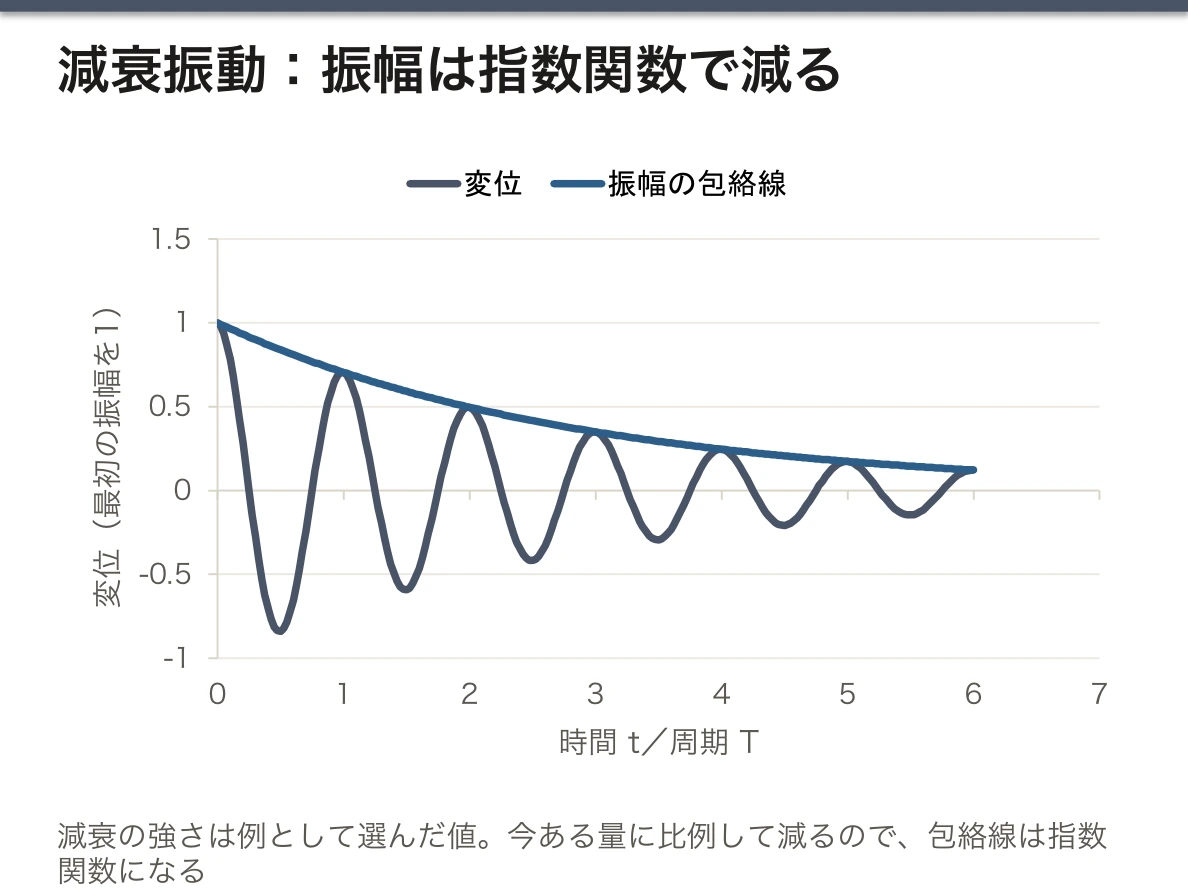
なぜ指数関数的なのか。抵抗力は速さにほぼ比例するので、大きく振れているときほど1周期で失うエネルギーも大きい。「今ある量に比例して減る」ものは必ず指数関数で減る——放射性崩壊やニュートンの冷却則と同じ形である。
減衰が強すぎると振動せずにゆっくり戻り、ちょうどよい強さ(臨界減衰)だと行き過ぎずに最も速くつり合いに戻る。計器の針や扉の閉まり具合は臨界減衰に近く設計される。
体の調節にも減衰振動の形が現れる。急に立ち上がった後の心拍数や、運動後の血圧は、一度大きく振れてから数回揺れつつ元の値に落ち着く。組織に振動を加えて応答を見る検査では、組織の粘弾性が振動を減衰させるので、その減り方から硬さや性質がわかる。
English version
Core
In simple harmonic motion, kinetic and potential energy trade places. At the ends, all of it is potential energy; at equilibrium, all of it is kinetic. The total energy of a spring pendulum is
E = ½kA2 (proportional to the square of the amplitude)
Without friction or air resistance, E stays constant and the amplitude does not change (undamped oscillation).
In reality, resistance takes energy away as heat, and the amplitude slowly gets smaller. This is damped oscillation, and the amplitude usually falls exponentially.
Going further
Why exponential? The resistive force is roughly proportional to speed, so the larger the swing, the more energy is lost in each period. Anything that “decreases in proportion to how much there is” always falls exponentially — the same form as radioactive decay and Newton’s law of cooling.
If damping is too strong, the system returns slowly without oscillating; at just the right strength (critical damping) it returns fastest without overshooting. Instrument needles and door closers are designed close to critical damping.
In the clinic
Body regulation also shows the shape of damped oscillation. Heart rate after standing up quickly, or blood pressure after exercise, swings strongly once and then settles to its original value with a few smaller swings. In tests that vibrate tissue and watch the response, the viscoelasticity of the tissue damps the vibration, and the way it decays tells about stiffness and other properties.
強制振動と共振 — 固有振動数で押すと大きく揺れる
振動は、外からの力のかかり方で分けられる。
| 種類 | 中身 |
|---|---|
| 自由振動 | 最初に動かしただけで、あとは系自身の復元力だけで振れる。固有振動数で振れる |
| 減衰振動 | 抵抗でエネルギーを失い、しだいに小さくなる |
| 強制振動 | 外から周期的な力をかけ続ける。系は押す側の振動数で振れる |
| 共振(共鳴) | 押す振動数が固有振動数に一致したとき、振幅が非常に大きくなる |
エネルギーの種類で見ると、力学的振動(ばね・振り子)、電気振動(コイルとコンデンサの回路)、電磁振動(電磁波)がある。
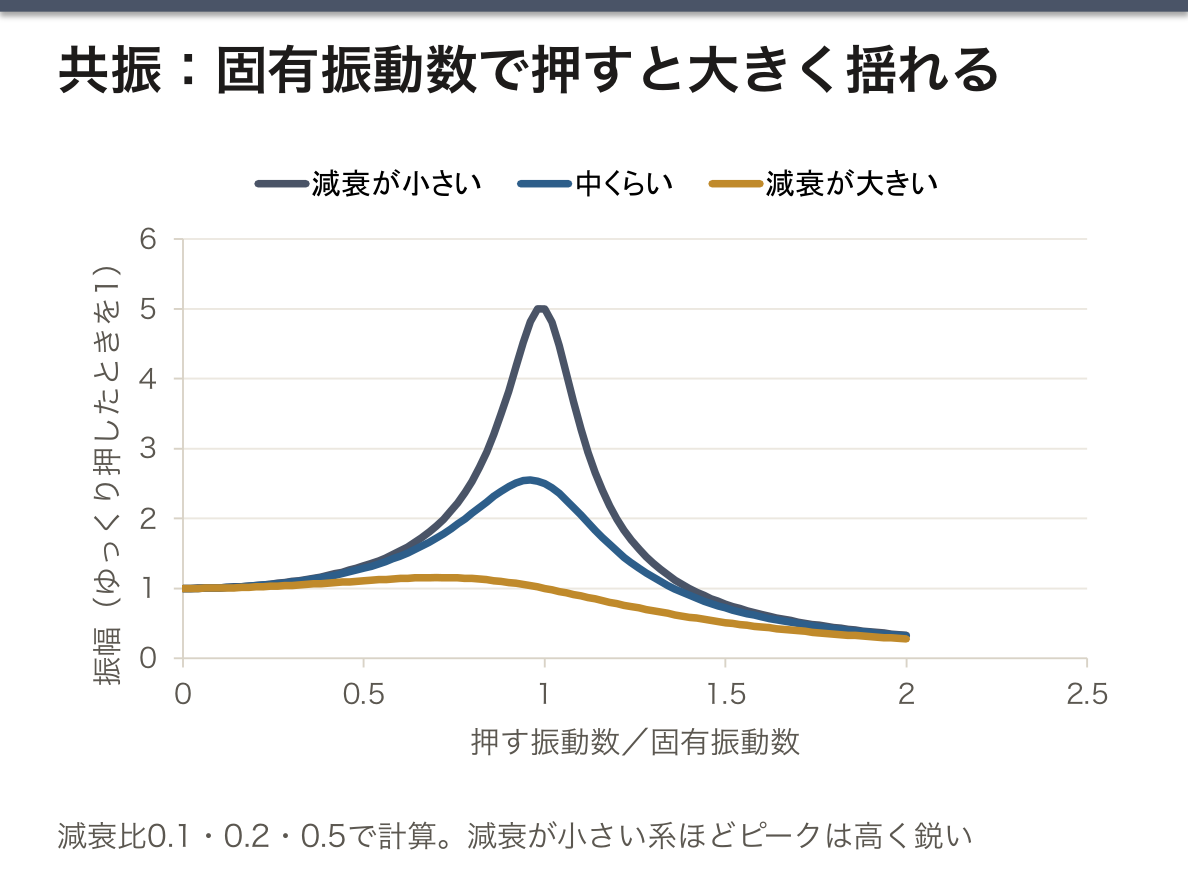
なぜ共振で大きくなるのか。ブランコを押すのと同じで、押すタイミングが振動と合っていれば、毎回押すたびにエネルギーが足し込まれる。タイミングがずれていると、押す力が動きを止める向きにはたらく回もあって、エネルギーはたまらない。減衰が小さい系ほど共振のピークは高く鋭い。
心臓の拍動は単純な単振動ではない。洞結節が自分でリズムをつくり(自励振動)、神経やホルモンが外から振動数と振幅を変える。血液の粘性や組織の摩擦でエネルギーは失われ続けるが、毎拍の収縮がそれを補っている——「減衰のある系の中で自ら持続する振動」と見るのが正確である。
高頻度振動換気(HFOV)は、1回換気量をごく小さくして毎秒10回前後の高い振動数で肺に空気を送り、肺を一定の膨らみに保つ人工呼吸である。サーファクタントの足りない早産児の肺で、圧や容量による肺損傷や、肺胞が開閉をくり返すことによる損傷を減らすために使われる。ペースメーカーは減衰しない一定周期の電気刺激で心臓のリズムをつくる。
English version
Core
Oscillations are divided by how outside forces act.
| Type | What it is |
|---|---|
| Free | Started once, then moves only by the system’s own restoring force, at its natural frequency |
| Damped | Loses energy to resistance and gradually gets smaller |
| Forced | A periodic force keeps acting from outside; the system moves at the driving frequency |
| Resonance | When the driving frequency matches the natural frequency, the amplitude becomes very large |
By type of energy, there are mechanical oscillations (springs, pendulums), electrical oscillations (circuits with a coil and a capacitor) and electromagnetic oscillations (electromagnetic waves).
Going further
Why does resonance make it large? It is like pushing a swing: if the timing of each push matches the motion, every push adds energy. If the timing is off, some pushes work against the motion, and energy does not build up. The smaller the damping, the higher and sharper the resonance peak.
The heartbeat is not simple harmonic motion. The sinoatrial node makes its own rhythm (self-sustained oscillation), and nerves and hormones change its frequency and amplitude from outside. Energy is lost all the time through blood viscosity and tissue friction, but each contraction makes up for it — it is best seen as “a self-sustained oscillation inside a damped system”.
In the clinic
High-frequency oscillatory ventilation (HFOV) sends very small tidal volumes into the lungs at a high frequency of around ten per second and keeps the lungs at a constant inflation. It is used in preterm infants whose lungs lack surfactant, to reduce lung injury from pressure and volume and from alveoli opening and closing again and again. A pacemaker creates the heart rhythm with undamped electrical pulses at a constant period.
まとめ
| 振動を表す量 — 周期・振動数・角振動数・位相 | 振動(oscillation)は、つり合いの位置のまわりを行き来するくり返し運動である。 |
|---|---|
| 単振動 — ずれに比例して戻す力があれば正弦波になる | 単振動(simple harmonic motion, SHM)は、復元力がつり合いからのずれに比例し、逆向きにはたらく振動である。 |
| ばね振り子 — 周期は質量とばね定数で決まる | ばね定数 k のばねに質量 m のおもりをつけて振らせると、周期はT = 2π√(m/k) (ω = √(k/m))周期は振幅にも重力にもよらない。 |
| 単振り子 — 周期は長さと重力加速度で決まる | 長さ L の糸におもりを吊って小さく振らせると、周期はT = 2π√(L/g) (ω0 = √(g/L))周期はおもりの質量によらず、長さが4倍になると周期は2倍になる。 |
| 振動のエネルギーと減衰 — 実際の振動は必ず小さくなる | 単振動では運動エネルギーと位置エネルギーが入れかわる。 |
| 強制振動と共振 — 固有振動数で押すと大きく揺れる | 振動は、外からの力のかかり方で分けられる。 |
このノートは医学生が授業の内容を自分の言葉でまとめたもので、診療の判断に使うものではありません。誤りに気づいたらお知らせください。