光の量を測る2つの体系(放射量測定と測光)の違いが主題である。同じ光でも「物理的なエネルギー」と「人が感じる明るさ」は別物で、単位系がまるごと2つある。
W(ワット)で測るのが放射量測定、lm(ルーメン)で測るのが測光。この対応表を持っていれば、単位の問題は落とさない。
- 放射量測定と測光 — 2つの単位系
- 測光量の定義 — 何が「明るさ」なのか
- 放射量と測光量の違い — なぜ2つの単位系があるか
- 炎の色 — ろうそくはなぜ黄色く、炎色反応はなぜ元素で決まるか
- ランプの選び方 — 光束・発光効率・色温度・演色性
放射量測定と測光 — 2つの単位系
放射量測定 radiometry は電磁波のエネルギーそのものを測る。測光 photometry は同じ量に人の目の感度(比視感度曲線 V(λ))で重みを付ける。
| 量 | 放射量測定 | 測光 |
|---|---|---|
| 全出力 | 放射束 W | 光束 lm(ルーメン) |
| 単位立体角あたり | 放射強度 W/sr | 光度 cd(カンデラ) |
| 単位面積に届く量 | 放射照度 W/m² | 照度 lx(ルクス)=lm/m² |
| 面から出る量 | 放射輝度 W/(sr·m²) | 輝度 cd/m² |
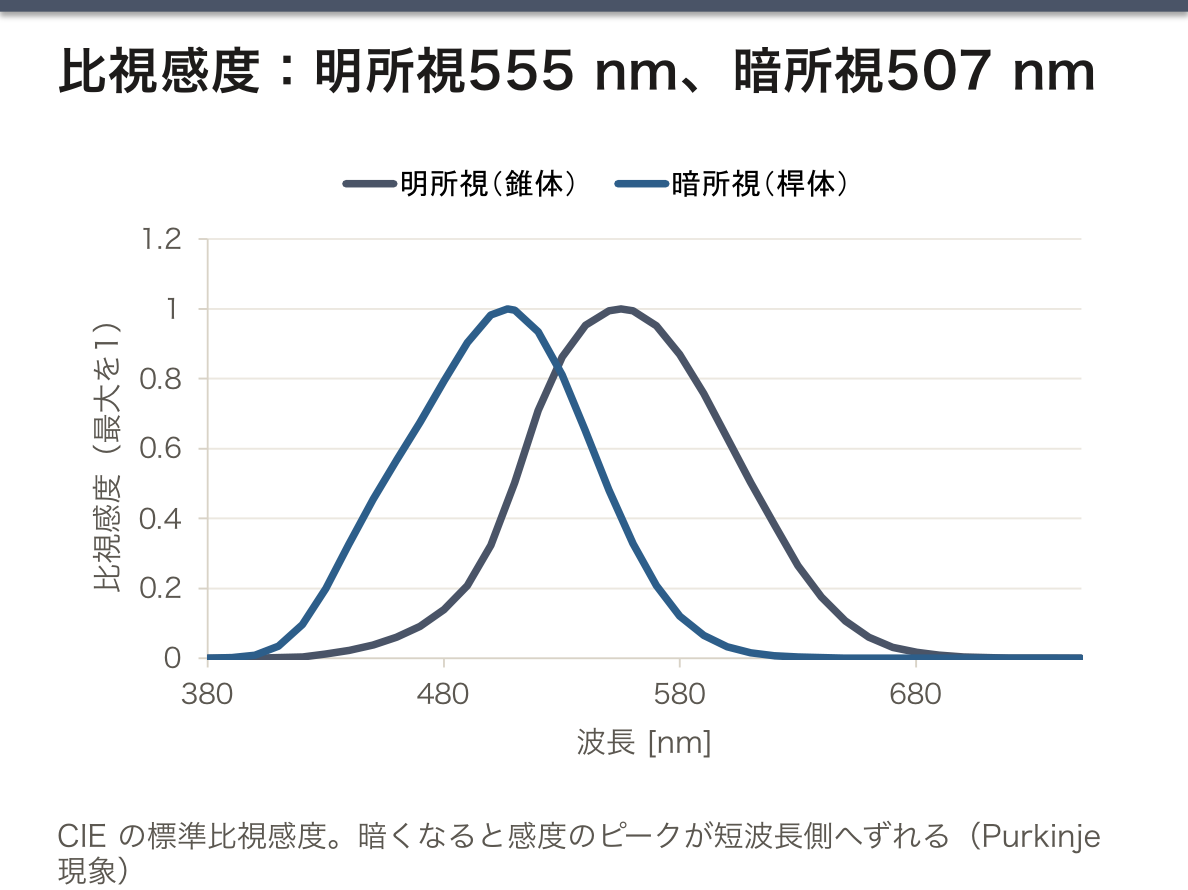
比視感度は 555 nm(黄緑)で最大。同じ 1 W でも黄緑の光は最も明るく感じ、赤や青は暗く感じる。赤外線と紫外線は、放射束はあっても光束は 0 である。
逆二乗の法則:点光源からの照度は距離の2乗に反比例する(E = I/d²)。距離を2倍にすると明るさは1/4。これは光に限らず、点源から等方的に広がるすべての量(放射線量も)に成り立つ——電離放射線の放射線防護の「距離」の原則と同じ式である。
暗所視では比視感度が短波長側へずれる(Purkinje 現象)。錐体(明所視・最大 555 nm)から桿体(暗所視・最大 507 nm)へ主役が交代するためで、薄暗がりでは赤い花が黒ずみ、青い花が明るく見える。単位系の話が、そのまま網膜の生理学に接続する。
臨床での照度の目安:手術野 10,000〜100,000 lx、診察室 500〜1,000 lx、病室 100〜200 lx。光線療法(新生児黄疸)では 460〜490 nm の青色光の放射照度(μW/cm²/nm)で管理する——効くのは目の感度ではなくビリルビンの吸収なので、測光ではなく放射量測定を使う。「何が受け取るか」で使う単位系が決まる。
English version
Core
Radiometry measures the energy of the electromagnetic wave itself. Photometry weights the same quantities by the sensitivity of the human eye (the luminous efficiency function V(λ)).
| Quantity | Radiometry | Photometry |
|---|---|---|
| Total output | Radiant flux, W | Luminous flux, lm (lumen) |
| Per unit solid angle | Radiant intensity, W/sr | Luminous intensity, cd (candela) |
| Arriving per unit area | Irradiance, W/m² | Illuminance, lx (lux) = lm/m² |
| Leaving a surface | Radiance, W/(sr·m²) | Luminance, cd/m² |
The luminous efficiency is greatest at 555 nm (yellow-green). The same 1 W of yellow-green light looks brightest and red or blue darker. Infrared and ultraviolet have radiant flux and zero luminous flux.
Going further
The inverse square law: the illuminance from a point source is inversely proportional to the square of the distance (E = I/d²). Double the distance and the brightness is a quarter. This holds not only for light but for every quantity spreading isotropically from a point source (radiation dose included) — the same equation as the "distance" principle of radiation protection in ionizing radiation.
In scotopic vision the luminous efficiency shifts to shorter wavelengths (the Purkinje phenomenon). The leading part passes from the cones (photopic, maximum 555 nm) to the rods (scotopic, maximum 507 nm), so in dim light a red flower darkens and a blue one looks brighter. A matter of units connecting directly to the physiology of the retina.
Guides to illuminance in the clinic: an operative field 10,000–100,000 lx, a consulting room 500–1,000 lx, a ward 100–200 lx. Phototherapy (neonatal jaundice) is managed by the irradiance (μW/cm²/nm) of blue light at 460–490 nm — what matters is the absorption of bilirubin, not the sensitivity of the eye, so radiometry is used rather than photometry. Which system of units to use is decided by what receives the light.
測光量の定義 — 何が「明るさ」なのか
4つを区別する。
①光束 luminous flux[lm ルーメン]——光源が全方向へ出す光の量。
②光度 luminous intensity[cd カンデラ]——ある方向の単位立体角あたりの光束。SI 基本単位はこれ。
③照度 illuminance[lx ルクス]——照らされる面の単位面積あたりの光束。診療で問題になるのはこれ(手術野・診察室)。
④輝度 luminance[cd/m²]——面から出る(見える)明るさ。ディスプレイと画像診断のモニタで規定されるのはこれ。
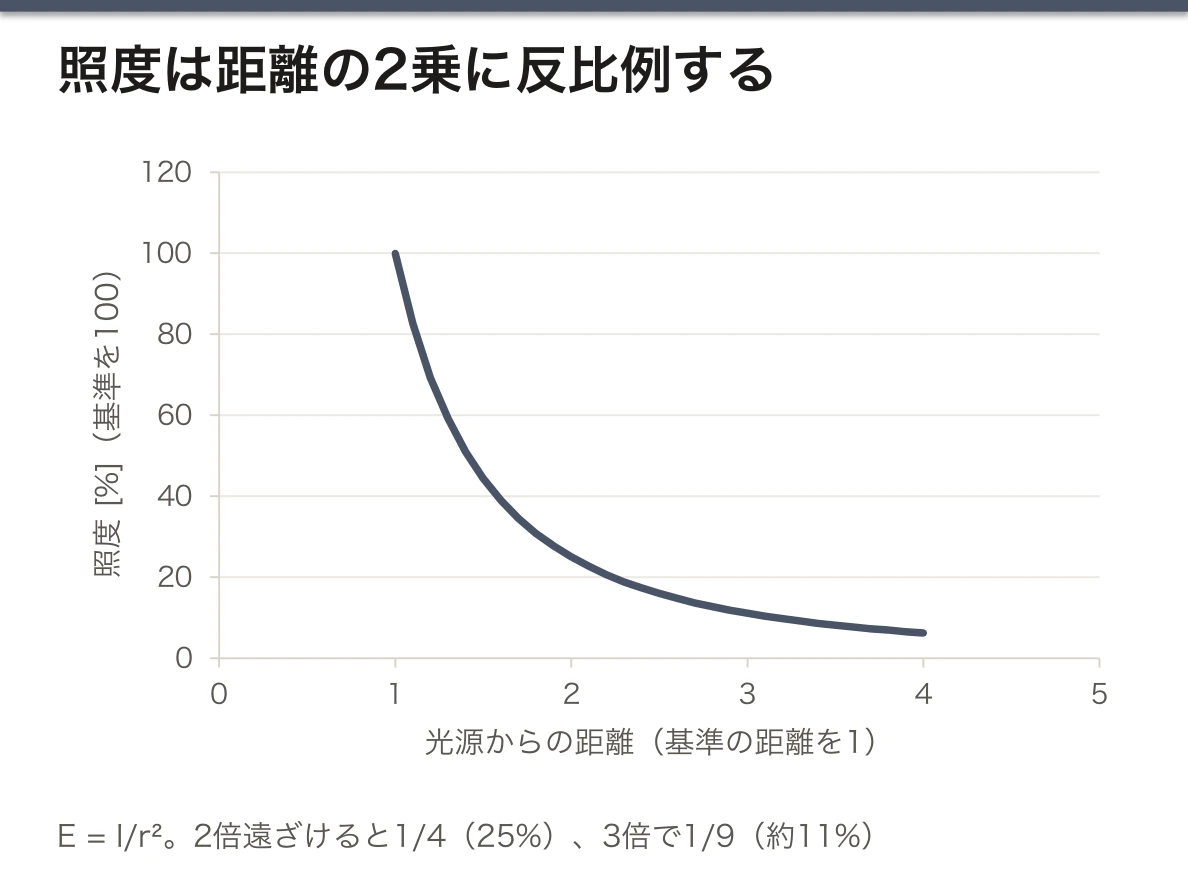
照度の距離依存——点光源なら E = I/r²(逆二乗則)。斜めに当たれば E = I cosθ/r²(Lambert の余弦則)。「手術灯を2倍遠ざけると照度は1/4」と即答できるようにする。
English version
Core
Distinguish four.
① Luminous flux [lm, lumen] — the amount of light a source emits in all directions.
② Luminous intensity [cd, candela] — the luminous flux per unit solid angle in a given direction. This is the SI base unit.
③ Illuminance [lx, lux] — the luminous flux per unit area of the surface lit. This is what matters in practice (the operative field, the consulting room).
④ Luminance [cd/m²] — the brightness leaving (seen from) a surface. This is what is specified for displays and diagnostic-imaging monitors.
Dependence of illuminance on distance — for a point source, E = I/r² (the inverse square law). Striking obliquely, E = I cosθ/r² (Lambert’s cosine law). Be able to answer at once that "move the operating light twice as far away and the illuminance is a quarter".
放射量と測光量の違い — なぜ2つの単位系があるか
放射量は物理的なエネルギーをそのまま測る(放射束 [W]、放射照度 [W/m²])。波長によらず等しく扱う。
測光量はヒトの目が感じる明るさで重みづけしたもの。重みが比視感度曲線 V(λ) で、明所視では 555 nm(黄緑)で最大。1 W の 555 nm の光=683 lm と定義されている。
だから同じ 1 W でも、赤外線は 0 lm(見えない)、緑は明るい。
医学での使い分け——危険を評価するときは放射量(レーザーの被曝、紫外線の皮膚障害、光線力学療法の線量)。見え方を評価するときは測光量(照度基準、モニタの輝度、視覚検査)。この使い分けが要点である。
暗所視では感度のピークが 507 nm へ寄る(Purkinje 現象)——桿体と錐体で感度曲線が違うため。
English version
Core
Radiometric quantities measure the physical energy directly (radiant flux [W], irradiance [W/m²]). They treat every wavelength alike.
Photometric quantities are weighted by the brightness the human eye perceives. The weighting is the luminous efficiency function V(λ), maximal at 555 nm (yellow-green) in photopic vision. 1 W at 555 nm = 683 lm by definition.
So for the same 1 W, infrared is 0 lm (invisible) and green is bright.
The use in medicine — radiometric quantities when assessing danger (exposure to a laser, ultraviolet damage to skin, the dose in photodynamic therapy). Photometric quantities when assessing how something is seen (illuminance standards, monitor luminance, tests of vision). This distinction is the point.
In scotopic vision the peak of sensitivity moves towards 507 nm (the Purkinje phenomenon) — because rods and cones have different sensitivity curves.
炎の色 — ろうそくはなぜ黄色く、炎色反応はなぜ元素で決まるか
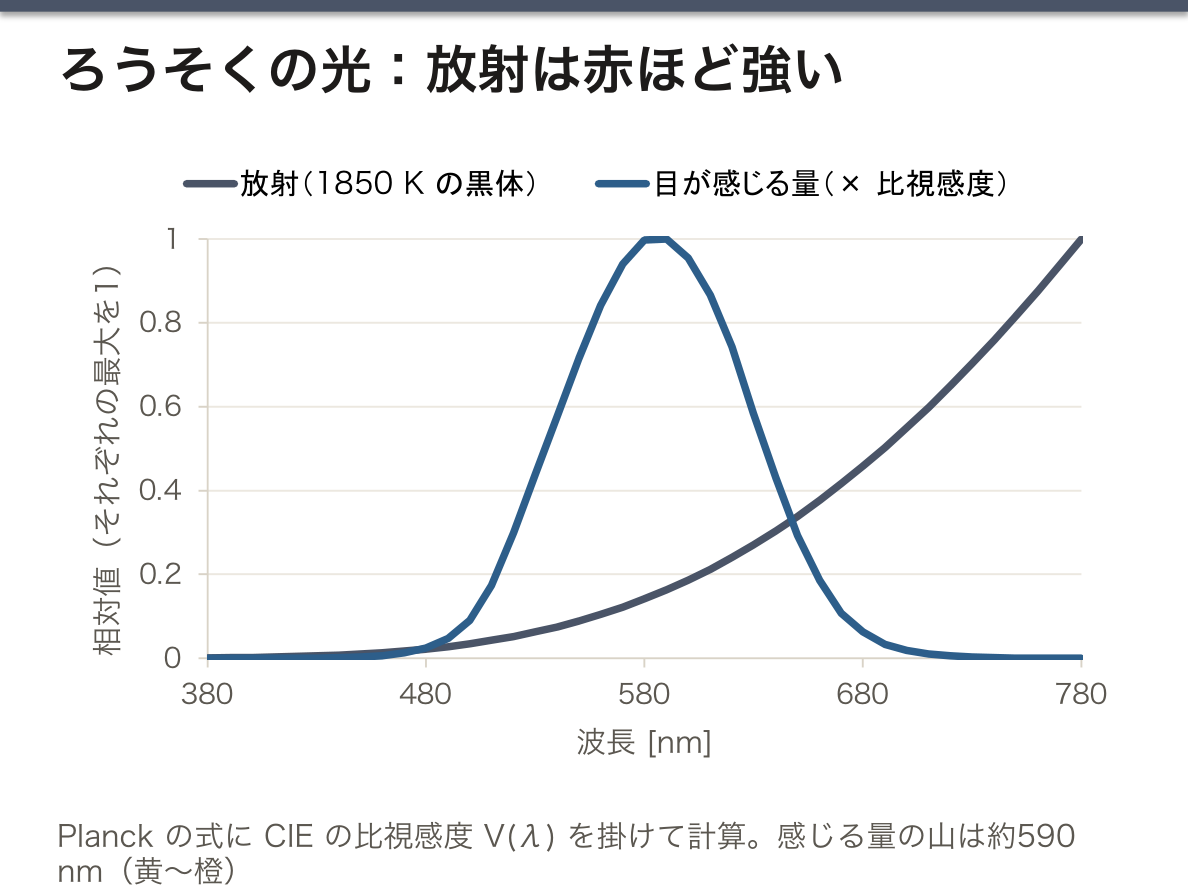
ろうそくの炎の黄色く明るい部分は、燃えきらなかったすす(炭素の微粒子)が千数百 ℃に熱せられて光っているものである。熱い物体が温度に応じた連続スペクトルの光を出す熱放射(黒体放射に近い)で、ろうそくの炎(色温度で約 1850 K)では放射の山は赤外にあり、可視光の中では波長の長い赤のほうへ行くほど強い。
それでも赤ではなく黄色に見えるのは、目の感度が掛かるからである。比視感度は 555 nm(黄緑)で最大で、赤に向かって急に下がる。「赤ほど強い放射」に「黄緑ほど高い感度」を掛け合わせると、感じる光の山は黄〜橙に来る。目がすべての波長に同じ感度を持っていれば、炎は赤く見えるはずである——放射量と測光量の違いが、そのまま色に出る例である。
炎の根元の青い部分は、酸素が十分にあって完全燃焼している所で、すすはほとんど無い。ここで光っているのは、燃焼の途中にできる C₂ や CH などの分子の断片が励起されて出す決まった波長の光で、熱放射ではない。
炎色反応は、金属の塩を炎に入れると元素ごとに決まった色が出る現象で、こちらは熱放射ではなく輝線スペクトルである。炎の熱で金属原子の電子が励起され、元の準位に戻るときに、その元素に固有の波長の光を出す。
| 元素 | 色 |
|---|---|
| リチウム Li | 赤(671 nm) |
| ナトリウム Na | 黄(589 nm、D 線) |
| カリウム K | 赤紫(766・770 nm の赤と、404 nm の紫) |
| カルシウム Ca | 橙赤 |
| ストロンチウム Sr | 紅 |
| バリウム Ba | 黄緑 |
| 銅 Cu | 青緑 |
ナトリウムの黄色はとくに強く、指で触れた汗の塩分だけでも炎が黄色くなる。589 nm が比視感度の山に近いことも、目立つ理由である。同じ 589 nm の線は、太陽光の中に暗線としても現れる——吸収と放出が同じ準位の差を使うからである。
光度の単位にろうそくの名が残っている理由——カンデラ(candela はラテン語で「ろうそく」)は、もともと材料・太さ・燃える速さを決めた標準ろうそく1本の明るさだった。のちに基準は白金の凝固点の黒体へ、さらに今の「540×10¹² Hz の単色光で、放射強度が 1/683 W/sr」という定義へ置き換えられたが、そのたびに大きさは昔の値に合わせてきた。だから今でも、ふつうのろうそくの光度は約 1 cd である。
炎色反応の原理は臨床検査にも使われてきた。血清の Na⁺・K⁺ は、かつて炎の中で出る光の強さから測っていた(炎光光度法)。今はイオン選択電極が主流だが、鉛などの微量金属は、決まった輝線の光がどれだけ吸収されるかで測る原子吸光法で定量されることがある。屈折率の基準にナトリウムの D 線(589 nm)が使われるのも、同じ線である。
English version
Core
The bright yellow part of a candle flame is soot (tiny carbon particles) that has not burned yet, glowing at over a thousand degrees Celsius. This is thermal radiation (close to black-body radiation): a hot body gives off a continuous spectrum that depends on its temperature. For a candle flame (colour temperature about 1850 K) the peak lies in the infrared, and within visible light the emission gets stronger towards the long-wavelength red end.
It still looks yellow rather than red because the sensitivity of the eye is multiplied in. Luminous efficiency is highest at 555 nm (yellow-green) and falls steeply towards red. Multiply “emission strongest in the red” by “sensitivity highest in the yellow-green”, and the peak of what we perceive falls in the yellow to orange. If the eye were equally sensitive to all wavelengths, the flame would look red. This is the difference between radiometric and photometric quantities showing up as a colour.
The blue part at the base of the flame is where there is enough oxygen for complete burning, so there is almost no soot. The light there comes from excited molecular fragments such as C₂ and CH formed during burning, at fixed wavelengths; it is not thermal radiation.
Going further
In a flame test, a metal salt put into a flame gives a colour typical of the element. This is not thermal radiation but a line spectrum. The heat of the flame excites electrons of the metal atoms, and as they fall back they emit light at wavelengths unique to that element.
| Element | Colour |
|---|---|
| Lithium Li | Red (671 nm) |
| Sodium Na | Yellow (589 nm, the D line) |
| Potassium K | Lilac (red lines at 766 and 770 nm plus violet at 404 nm) |
| Calcium Ca | Orange-red |
| Strontium Sr | Crimson |
| Barium Ba | Yellow-green |
| Copper Cu | Blue-green |
The sodium yellow is especially strong: the salt from sweat on a finger is enough to colour a flame. That 589 nm lies close to the peak of eye sensitivity also makes it stand out. The same 589 nm line also appears as a dark line in sunlight, because absorption and emission use the same energy gap.
Why the unit of luminous intensity still carries the name of a candle. The candela (Latin for “candle”) was originally the brightness of one standard candle of fixed material, size and burning rate. The standard was later replaced by a black body at the freezing point of platinum, and then by today’s definition, “monochromatic radiation of 540×10¹² Hz with a radiant intensity of 1/683 W/sr”. Each time, the size of the unit was matched to the old value, so an ordinary candle still has a luminous intensity of about 1 cd.
In the clinic
The principle of the flame test has also been used in clinical laboratories. Serum Na⁺ and K⁺ were once measured from the intensity of light emitted in a flame (flame photometry). Today ion-selective electrodes are standard, but trace metals such as lead may be measured by atomic absorption spectrometry, which measures how much light of a specific line is absorbed. The sodium D line (589 nm) used as the reference wavelength for refractive index is the same line.
ランプの選び方 — 光束・発光効率・色温度・演色性
ランプを比べるときに見るのは、ワット数ではなく次の4つである。
①光束(lm)——どれだけの光が出るか。ワット(W)は消費する電力で、明るさではない。100 W の白熱電球の光束は約 1700 lm である。
②発光効率(lm/W)——1 W あたり何 lm の光になるか。白熱電球は 1700 lm ÷ 100 W で約 17 lm/W しかなく、電力のほとんどが目に見えない赤外(熱)になっている。蛍光灯はその数倍、LED はさらに高く、100 lm/W 前後かそれ以上になる。
③色温度(K)——光の色を、同じ色に見える黒体の温度で表したもの。数字が低いほど赤み(電球色 約 2700〜3000 K)、高いほど青み(昼白色 約 5000 K、昼光色 約 6500 K)がかる。「暖かい色」ほど温度は低い。
④演色性(演色評価数 Ra、最大 100)——その光の下で物の色が、基準の光の下と比べてどれだけ自然に見えるか。
ほかに、光の広がる角度(ビーム角)、寿命、口金の形、価格も比べる。
なぜ赤い光ほど色温度が低いのか。熱い物体は温度が上がるほど放射の山が短い波長へ移る(Wien の変位則)。鉄を熱すると赤 → 橙 → 白と変わるのと同じで、低温の黒体は赤っぽく、高温の黒体は青白い。白熱電球のフィラメント(約 2800〜3000 K)は放射の山が赤外にあるので、効率が悪い。
LED や蛍光灯のスペクトルは黒体の形ではないので、「いちばん色の近い黒体の温度」(相関色温度)で表す。だから色温度が同じでも演色性は違うことがある。スペクトルに深い赤の成分が足りない光の下では、肌や血液の赤がくすんで見える。極端な例が低圧ナトリウムランプで、ほぼ 589 nm の1色しか出さないので、照らされた物は黄色と灰色にしか見えない。
夜の青白い光は、網膜のメラノプシン(感度の山は約 480 nm)を通じてメラトニンの分泌を抑え、眠りを妨げる。病室の夜間の照明が暖色で暗めなのはこのためである。
診察では肌の色が所見になる——黄疸の黄色、チアノーゼの青紫、貧血の蒼白。演色性の低い光や色の偏った照明の下ではこれを見落としうるので、診察室や処置室には演色性の高い照明を使う。手術灯はさらに、影を作らないように複数の光源を組み合わせ、組織を乾かさないように熱(赤外)を抑え、術野に合わせて色温度を変えられるように作られている。
English version
Core
When comparing lamps, look at these four things, not at the wattage.
① Luminous flux (lm): how much light comes out. Watts (W) are the electrical power used, not brightness. A 100 W incandescent bulb gives about 1700 lm.
② Luminous efficacy (lm/W): how many lumens of light per watt. An incandescent bulb gives only 1700 lm ÷ 100 W ≈ 17 lm/W; most of the power becomes invisible infrared (heat). Fluorescent lamps give several times more, and LEDs more still, around 100 lm/W or higher.
③ Colour temperature (K): the colour of the light, given as the temperature of a black body that looks the same colour. Lower numbers are redder (warm white, about 2700–3000 K) and higher numbers are bluer (neutral white about 5000 K, daylight about 6500 K). The “warmer” the colour, the lower the temperature.
④ Colour rendering (colour rendering index Ra, maximum 100): how natural the colours of objects look under the lamp compared with a reference light.
Beam angle, lifetime, socket type and price are also compared.
Going further
Why is redder light a lower colour temperature? As a hot body gets hotter, the peak of its emission moves to shorter wavelengths (Wien’s displacement law). Like iron that glows red, then orange, then white as it is heated, a cooler black body looks reddish and a hotter one bluish white. An incandescent filament (about 2800–3000 K) has its emission peak in the infrared, so it is inefficient.
The spectra of LEDs and fluorescent lamps do not have a black-body shape, so they are described by the temperature of the black body with the closest colour (correlated colour temperature). This is why two lamps with the same colour temperature can render colours differently. Under light that lacks deep red, skin and blood look dull. An extreme case is the low-pressure sodium lamp, which gives almost only one colour, 589 nm, so everything it lights looks only yellow and grey.
Bluish light at night suppresses melatonin through melanopsin in the retina (peak sensitivity about 480 nm) and disturbs sleep. This is why night lighting in hospital wards is warm and dim.
In the clinic
In a physical examination, skin colour is a finding: the yellow of jaundice, the bluish purple of cyanosis, the pallor of anaemia. These can be missed under light with poor colour rendering or a strong colour cast, so examination and treatment rooms use lighting with high colour rendering. Surgical lights go further: they combine several sources so that they cast no shadows, limit heat (infrared) so that tissue does not dry out, and let the surgeon change the colour temperature to suit the field.
まとめ
| 放射量測定と測光 — 2つの単位系 | 放射量測定 radiometry は電磁波のエネルギーそのものを測る。 |
|---|---|
| 測光量の定義 — 何が「明るさ」なのか | 4つを区別する。①光束 luminous flux[lm ルーメン]——光源が全方向へ出す光の量。 |
| 放射量と測光量の違い — なぜ2つの単位系があるか | 放射量は物理的なエネルギーをそのまま測る(放射束 [W]、放射照度 [W/m²])。 |
| 炎の色 — ろうそくはなぜ黄色く、炎色反応はなぜ元素で決まるか | ろうそくの炎の黄色く明るい部分は、燃えきらなかったすす(炭素の微粒子)が千数百 ℃に熱せられて光っているものである。 |
| ランプの選び方 — 光束・発光効率・色温度・演色性 | ランプを比べるときに見るのは、ワット数ではなく次の4つである。 |
このノートは医学生が授業の内容を自分の言葉でまとめたもので、診療の判断に使うものではありません。誤りに気づいたらお知らせください。