自律尊重の原則を臨床の手続きにしたものがインフォームド・コンセントである。けれども同意書に署名をもらうことと、有効な同意を得ることは違う。同意が成り立つには、判断能力・理解・自発性がそろい、何をどこまで説明すべきかの基準を満たしている必要がある。
この章では、パターナリズムから共同意思決定への流れを確認したうえで、同意の3要件、開示の基準と4要素、同意が要らないとされる3つの例外、そして判断能力のない患者の代理意思決定までを順に見る。日本の判例(説明義務、輸血拒否)も合わせて押さえる。
- 自律と自律的な人 — 「客体」ではなく「主体」として
- 医師のパターナリズムから共同意思決定へ
- インフォームド・コンセントの3つの要件 — 能力・理解・自発性
- 開示の基準 — 医師の慣行か、患者の立場か
- 開示の4要素 — 何を・なぜ・ほかに何が
- 同意が要らない3つの例外 — 緊急・放棄・治療上の特権
- 判断能力のない患者 — 代わりに誰が、何を基準に決めるか
自律と自律的な人 — 「客体」ではなく「主体」としてAutonomia
自律とは、自分で自分を律すること、すなわち自分の理由と価値観に基づいて、他人に支配されずに決め、その決定に沿って生きる能力である。自律的な人とは、職業・生き方・価値観について自分なりの人生の計画をもち、それに従って行動する人のことだ。バーリンの言葉を借りれば、外の力に動かされる「もの」ではなく、自分の理由と意図で動く「主体」でありたいと願う人である。
現代医療では、自己決定は人格の尊重と人間の尊厳の中心的な根拠とされ、インフォームド・コンセントの法的・道徳的な土台になっている。治療を受け、その結果を身に引き受けるのは患者本人の身体だからである。
2つの区別を押さえておく。1つは自律的な人と自律的な選択の区別である。ふだんは自律的な人でも、激しい痛みや恐怖の中では十分に自律的な選択ができないことがある。逆に、全般的には判断力が落ちている人でも、ある具体的な選択については自律的に決められることがある。評価すべきはその場面での、その選択である。
もう1つは、自律の尊重は、賢い選択だけを尊重することではないという点である。判断能力のある患者が、医学的に見て愚かな、本人の価値観に照らしてすら得にならない選択をすることはある。それでも、その多くは尊重されなければならない。「正しい選択をしたときだけ自由」というのでは、自由とは言えない。
臨床で「この患者は自律的か」と問うとき、実際に確かめているのは次の項目の判断能力・理解・自発性である。拒否の理由が医療者に理解できないことは、それだけでは判断能力がない証拠にならない。説明を変える、時間をおく、家族や通訳を交えるなど、まず自律を支える努力をするのが先である。
English version
Core
Autonomy means self-rule: the capacity to decide by one’s own reasons and values, free from control by others, and to live by those decisions. An autonomous person has a life plan — career, lifestyle, values — and acts on it. In Berlin’s words, such a person wants to be a subject moved by their own reasons and purposes, not an object moved by outside forces.
In modern medicine, self-determination is seen as the central basis of respect for persons and of human dignity, and it is the legal and moral foundation of informed consent. It is the patient’s body that receives the treatment and lives with the results.
Going further
Know two distinctions. The first is between an autonomous person and an autonomous choice. A normally autonomous person may not make an autonomous choice under severe pain or fear. A person with generally reduced judgement may still decide one concrete matter autonomously. What we assess is this choice, in this situation.
The second: respecting autonomy does not mean respecting only wise choices. Competent patients sometimes choose what seems medically foolish, even against their own values. Most of these choices must still be respected. Freedom only for ‘correct’ choices is not freedom.
In the clinic
When we ask in clinic whether a patient is autonomous, we are really checking capacity, understanding and voluntariness (next item). The fact that clinicians cannot understand the reason for a refusal is not, by itself, evidence of incapacity. First try to support autonomy: explain differently, allow time, involve family or an interpreter.
医師のパターナリズムから共同意思決定へ
ほとんどの国で、伝統的には医師が主たる意思決定者だった。病状・予後・治療について医師の知識と経験が患者より圧倒的に勝るからである。これを医師のパターナリズムという。パターナリズム的な医療慣行とは、患者の健康上の利益を、患者の自己決定の利益より優先する慣行で、情報を伏せる、欺く、本人の意思に反して治療する、といった形をとる。
ここ数十年でこれは退けられ、共同意思決定(shared decision-making)が主流になった。医師は医学的な根拠と選択肢を、患者は自分の価値観と生活の目標を持ち寄り、一緒に治療を決める。
なぜ変わったのか。外的な要因としては、消費者の権利運動など、既存の権威への挑戦がある。しかしより根本的なのは、医療の目標の捉え方の変化だ。かつて目標は「生命と健康の維持」とされ、これは生物医学が判定する客観的な事柄で、医師が専門家だった。新しい考え方では、目標は患者の福祉(well-being)と自己決定の尊重の2つになる。福祉は一部主観的で、どの治療(または治療しないこと)が最善かは、その人の価値観と人生の計画によって決まる。健康に最善のものが、福祉に最善とは限らない。
さらに、同じ病気に対してリスクと利益の組み合わせの違う治療法がいくつもある時代には、すべての患者に最善の一つの治療は存在しない。だから患者の参加が医学的にも必要になる。
典型例が限局性前立腺癌である。手術・放射線治療・監視療法はいずれも妥当な選択肢で、尿失禁や性機能障害のリスク、通院の負担、再発への不安の感じ方は人によって違う。どれを選ぶかは医学だけでは決まらない。日本でも、意思決定を助ける資料(ディシジョンエイド)や、将来の医療について前もって話し合うACP(人生会議)が広まっている。
English version
Core
In most countries, the physician was traditionally the main decision-maker, because his or her knowledge of the condition, prognosis and treatments was far greater than the patient’s. This is physician paternalism. Paternalistic health-care practices put the patient’s health interests above the patient’s interest in self-determination: withholding information, deceiving, or treating against the patient’s will.
In recent decades this has been rejected in favour of shared decision-making. The doctor brings medical evidence and options; the patient brings values and life goals; they decide together.
Going further
Why the change? External factors include consumer rights movements and challenges to authority. More basic is a change in how the goals of medicine are understood. The old goal was ‘preserving life and health’ — an objective matter judged by biomedical science, where the doctor was the expert. The new view has two goals: the patient’s well-being and respect for self-determination. Well-being is partly subjective: which treatment (or no treatment) is best depends on the person’s values and life plan. What is best for health is not always best for well-being.
Also, when one disease has several treatments with different mixes of risks and benefits, no single treatment is best for every patient. So the patient’s participation is needed even for medical reasons.
In the clinic
A typical example is localised prostate cancer. Surgery, radiotherapy and active surveillance are all reasonable. People differ in how they weigh the risk of incontinence or sexual dysfunction, the burden of hospital visits, and worry about recurrence. Medicine alone cannot decide. In Japan, decision aids and ACP (advance care planning, ‘jinsei kaigi’) — talking in advance about future care — are spreading.
インフォームド・コンセントの3つの要件 — 能力・理解・自発性Consensus informatus
同意が倫理的に有効であるためには、少なくとも3つの要件がそろう必要がある。
| 要件 | 中身 | 欠けている例 |
|---|---|---|
| 判断能力(competence) | その決定をする精神的な力がある | 重いせん妄・意識障害 |
| 理解(understanding) | 開示された情報を理解し、それが自分にとってどういう意味をもつかまで分かっている | 説明を聞いたが、自分の場合のリスクだと受けとめていない |
| 自発性(voluntariness) | 強制・操作・不当な誘因なしに、自由に同意している | 家族や医療者の圧力で署名した |
これに情報の開示(次の項目以下)と、決定と承認(同意の意思表示)が加わって、インフォームド・コンセントが成り立つ。同意書への署名は同意そのものではない。署名があっても、3つの要件のどれかが欠けていれば同意は無効である。
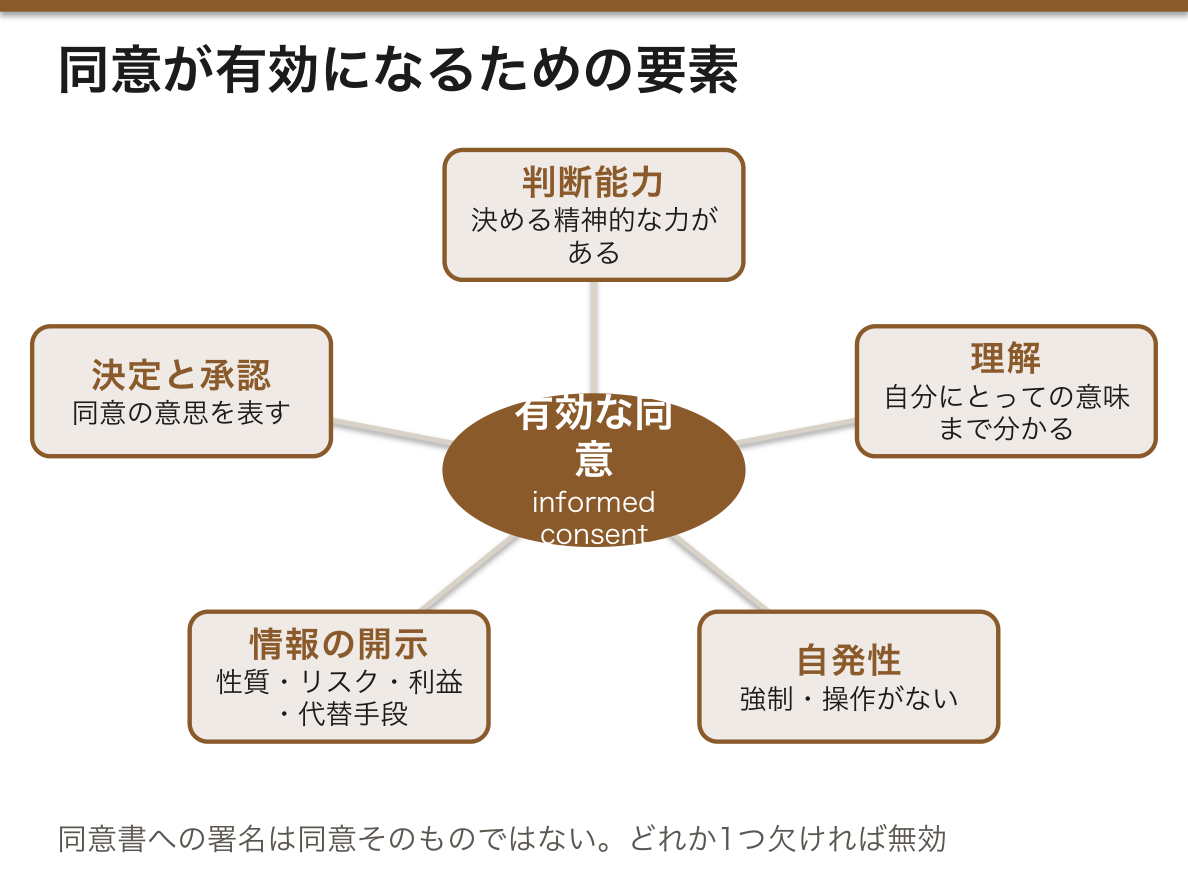
判断能力の評価でよく使われるのが、アッペルバウムとグリッソが整理した4つの能力である。①情報を理解する、②それを自分の状況に当てはめて認識する、③選択肢を比べて論理的に考える、④選択を表明する。ここから2つの性質が出てくる。
第一に、判断能力は課題ごとに判定する。認知症があっても「今日の昼食」は決められるが、「リスクの大きな手術」は決められない、ということがある。第二に、判断能力は変動しうる。せん妄は時間帯で変わり、薬や脱水の補正で回復することもある。また、求められる能力の水準は決定の重さに応じて変わる(スライディング・スケール)という考え方もある。危険の小さい治療への同意より、命に関わる治療の拒否の方に、より確かな判断能力を求める。
日本でも高齢化とともに、判断能力が揺らぐ患者の意思決定は日常の問題になった。厚生労働省は2018年に認知症の人の意思決定支援のガイドラインを示し、「能力がないから代わりに決める」前に、本人が決められるよう支援することを求めている。情報を小分けにする、図を使う、本人の調子のよい時間を選ぶ、といった工夫がそれに当たる。
English version
Core
For consent to be ethically valid, at least three requirements must be met.
| Requirement | Content | Example of failure |
|---|---|---|
| Competence | The mental capacity to make this decision | Severe delirium, impaired consciousness |
| Understanding | Understanding the disclosed information, including what it means for oneself | Heard the explanation but does not see the risk as applying to them |
| Voluntariness | Agreeing freely, without coercion, manipulation or undue inducement | Signed under pressure from family or staff |
Add disclosure of information (next items) and decision and authorisation (expressing consent), and informed consent is complete. A signature on a form is not consent itself. If any of the three requirements is missing, the consent is invalid even with a signature.
Going further
Capacity is often assessed with the four abilities set out by Appelbaum and Grisso: (1) understand the information, (2) appreciate how it applies to one’s own situation, (3) reason by comparing options, (4) express a choice. Two features follow.
First, capacity is judged task by task. A person with dementia may decide what to eat for lunch but not whether to have high-risk surgery. Second, capacity can fluctuate. Delirium changes over the day and may improve when drugs or dehydration are corrected. Some also argue that the level of capacity required depends on the weight of the decision (a sliding scale): refusing a life-saving treatment needs more certain capacity than accepting a low-risk one.
In the clinic
With an ageing population, decisions by patients with uncertain capacity are an everyday issue in Japan. In 2018 the Ministry of Health issued guidelines on decision support for people with dementia. They ask clinicians to help the person decide before deciding for them — giving information in small parts, using pictures, choosing the time of day when the person is at their best.
開示の基準 — 医師の慣行か、患者の立場か
「どこまで説明すれば十分か」を決める基準は、大きく2つある。
| 基準 | 何を開示するか | 代表的な判例 |
|---|---|---|
| 専門家の慣行基準 | 合理的な医療者が同じ状況で通常開示する情報 | 英国 Bolam 事件(1957年) |
| 合理的な患者(人)の基準 | 患者の立場にいる合理的な人が、決定に重要だと考える情報 | 米国 Canterbury v. Spence(1972年)、豪州 Rogers v. Whitaker(1992年) |
専門家の慣行基準では、たとえば町の医師の多くが1%の合併症を説明していなければ、説明しなかった医師も過失を問われにくい。合理的な患者の基準では、まれなリスクでも、普通の患者なら決定を左右されるような重大なものなら説明しなければならない。
なぜ専門家の基準は退けられていったのか。医師が自分の義務の範囲を自分で決めることになるからである。医療界の慣行が説明に消極的なら、患者の知る権利はそれ以上に守られない。結果を身に受けるのは患者なので、何が重要かは患者の側から決めるべきだ、という論理である。
豪州の Rogers v. Whitaker 事件では、片眼がほぼ失明していた患者が、もう一方の眼に交感性眼炎が起きて両眼の視力を失う、約1万4千分の1という低い危険を説明されなかった。患者は「眼のことは何でも知りたい」と繰り返し尋ねていた。裁判所は、その危険がこの患者にとって重要だったとして医師の責任を認めた。英国も2015年の Montgomery 事件で、患者の立場を基準とする方向に転じている。さらに一歩進めて、その患者個人が知りたいことを基準にする「主観的基準」もある。
日本では1997年の医療法改正で、医療者は適切な説明を行い医療を受ける者の理解を得るよう努めることが定められた。判例では、最高裁が2001年に、当時まだ確立していなかった乳房温存療法について、患者が強い関心を示していた以上、医師は知っている範囲で説明すべきだったと判断した。日本の判例も、その患者が何を重視しているかを説明義務の範囲に入れる方向に動いている。
English version
Core
There are two main standards for ‘how much explanation is enough’.
| Standard | What must be disclosed | Leading cases |
|---|---|---|
| Professional practice standard | What a reasonable practitioner would usually disclose in the same situation | Bolam (UK, 1957) |
| Reasonable person (patient) standard | What a reasonable person in the patient’s position would think important for the decision | Canterbury v. Spence (US, 1972); Rogers v. Whitaker (Australia, 1992) |
Under the professional standard, if most local doctors do not mention a 1% complication, a doctor who did not mention it is unlikely to be found negligent. Under the reasonable person standard, even a rare risk must be disclosed if an ordinary patient’s decision would be affected by it.
Going further
Why was the professional standard abandoned? Because doctors would decide the limits of their own duty. If the profession tends to say little, the patient’s right to know is protected no further. The patient bears the results, so what is important should be decided from the patient’s side.
In Rogers v. Whitaker, a patient almost blind in one eye was not told of a risk of about 1 in 14,000 that sympathetic ophthalmia could develop and leave her blind in both eyes. She had repeatedly asked to know everything about her eyes. The court held the risk was material to this patient and found the doctor liable. The UK moved to a patient-based standard in the Montgomery case (2015). A further step is the ‘subjective standard’: what this particular patient wants to know.
In the clinic
In Japan, the 1997 revision of the Medical Care Act requires clinicians to try to give appropriate explanations and gain the patient’s understanding. In 2001 the Supreme Court held that a doctor should have explained breast-conserving therapy, which was not yet established at the time, as far as he knew, because the patient had shown strong interest in it. Japanese case law is also moving towards including what the particular patient values in the duty to explain.
開示の4要素 — 何を・なぜ・ほかに何が
開示すべき情報は、次の4つの要素にまとめられる。
| 要素 | 伝える内容 | 落としやすい点 |
|---|---|---|
| 処置の性質 | 何をするのか、どんな手順か、目的は何か | 検査・治療の名前だけで中身を伝えない |
| リスク | 起こりうる害、その重さと頻度 | 重いがまれなリスクを省く |
| 利益 | 期待できる効果とその確からしさ | 効果を実際より大きく見せる |
| 代替手段 | ほかの選択肢と、何もしない場合の見通し | 「何もしない」を選択肢として示さない |
4つのうち最も落とされやすいのが代替手段、とくに「治療しない」という選択肢である。医師が勧める一つの治療だけを説明して同意を求めるのは、選ぶ機会を奪うことになる。
リスクの伝え方には2つの軸がある。頻度と重さである。頻度が高く軽いもの(術後の痛み)と、まれでも重大なもの(死亡・失明・麻痺)は、どちらも説明が要る。前の項目の Rogers v. Whitaker 事件は、まさに「まれだが重大」なリスクの省略が問われた例だった。
伝えることと伝わることは違う。「1%」と「100人に1人」では受けとめ方が変わり、「生存率90%」と「死亡率10%」でも選択が変わる(フレーミング効果)。だから開示の後に、患者が自分の言葉で説明し直せるかを確かめるティーチバックが勧められる。開示の4要素は、前の項目で見た理解の要件を満たすための材料であり、並べるだけでは足りない。
研究への参加を求める場合は、開示の範囲がさらに広い。ヘルシンキ宣言は、研究の目的・方法・資金源・利益相反・研究者の所属・期待される利益と危険・研究終了後の措置・不利益なく参加を拒否し、いつでも撤回できる権利などを伝えるよう求めている(研究倫理の章)。治療の説明と研究の説明を混同しないことが大切である。
English version
Core
The information to disclose can be grouped into four elements.
| Element | What to tell | Common omissions |
|---|---|---|
| Nature of the procedure | What will be done, how, and why | Giving only the name of the test or treatment |
| Risks | Possible harms, their severity and frequency | Leaving out serious but rare risks |
| Benefits | Expected effects and how certain they are | Making the effect look bigger than it is |
| Alternatives | Other options and the outlook if nothing is done | Not offering ‘no treatment’ as an option |
The element most often missed is alternatives, especially the option of no treatment. Explaining only the doctor’s preferred treatment and asking for consent takes away the chance to choose.
Going further
Risks have two axes: frequency and severity. Frequent but minor harms (post-operative pain) and rare but serious ones (death, blindness, paralysis) both need explaining. Rogers v. Whitaker (previous item) was about leaving out a rare but serious risk.
Telling is not the same as being understood. ‘1%’ and ‘1 in 100’ are received differently, and ‘90% survival’ and ‘10% mortality’ change choices (the framing effect). So after disclosure, the teach-back method is recommended: ask the patient to explain it back in their own words. The four elements are material for meeting the understanding requirement; listing them is not enough.
In the clinic
When asking someone to join research, disclosure must be wider. The Declaration of Helsinki asks researchers to explain the aims, methods, funding, conflicts of interest, the researcher’s affiliation, expected benefits and risks, post-trial provisions, and the right to refuse or withdraw at any time without reprisal (see the research ethics chapter). Do not confuse explaining a treatment with explaining research.
同意が要らない3つの例外 — 緊急・放棄・治療上の特権
判断能力のある患者からも同意を得なくてよい、とされる例外が3つある。
| 例外 | 中身 | 限界 |
|---|---|---|
| 緊急 | 生命に関わる状況で、同意を得る時間がない | 本人の既知の拒否は覆せない |
| 権利の放棄(waiver) | 患者自身が、説明を受けることや決定することを自ら望まない | 放棄そのものが自発的で、知る権利があると分かったうえでの選択であること |
| 治療上の特権 | 情報を伝えること自体が患者に重大な害を与えると医師が判断する | 最も濫用されやすく、ごく狭く解釈すべき |
3つの例外は、自律尊重と善行の釣り合いをとる仕組みだと理解するとよい。緊急の例外の根拠は、多くの人は命を救う処置に同意するだろうという推定同意である。だから、本人が前もってはっきり拒否していた場合には推定が働かない。
治療上の特権がいちばん危うい。歴史的には、がんの告知を避ける口実として広く使われてきた。「本人が動揺するから」では足りず、伝えれば判断能力そのものが失われるほどの重大な害が見込まれる場合に限られる。それすら、伝え方・時機を工夫する努力をしたうえでの最後の手段である。一方、権利の放棄は患者の自律の一つの使い方であり、「知りたくない、家族と相談して決めてほしい」という希望も尊重されうる。ただし医師の側から放棄を誘導してはならない。
日本の重要判例が、2000年の最高裁のエホバの証人輸血拒否事件である。輸血を拒む意思を明らかにしていた患者に、手術中に必要なら輸血するという病院の方針を説明しないまま手術し、輸血した。最高裁は、輸血を拒否する意思決定をする権利は人格権の一内容として尊重されなければならないとし、方針を説明しなかったことで患者の意思決定の機会を奪ったと判断した。「緊急だから」「命を救うためだから」は、知られていた拒否を覆す理由にならない。
English version
Core
There are three exceptions in which consent is not required even from a competent patient.
| Exception | Content | Limits |
|---|---|---|
| Emergency | A life-threatening situation with no time to obtain consent | Cannot override a known refusal |
| Waiver | The patient chooses not to receive information or to make the decision | The waiver itself must be voluntary and made knowing one has the right to know |
| Therapeutic privilege | The doctor judges that the information itself would cause the patient serious harm | Most easily abused; must be read very narrowly |
Going further
Think of the three exceptions as ways to balance respect for autonomy with beneficence. The emergency exception rests on presumed consent: most people would agree to life-saving treatment. So the presumption fails when the person has clearly refused in advance.
Therapeutic privilege is the most dangerous. Historically it was widely used as an excuse not to tell patients they had cancer. ‘The patient will be upset’ is not enough; it applies only when telling would cause harm so serious that the patient’s very capacity would be lost — and even then only as a last resort after trying different timing and ways of telling. Waiver, by contrast, is one way of using autonomy: the wish ‘I don’t want to know; please decide with my family’ can be respected. But the doctor must not steer the patient towards waiving.
In the clinic
A key Japanese case is the Supreme Court’s 2000 judgment on a Jehovah’s Witness who refused blood. The patient had made her refusal clear, but the hospital did not explain its policy of transfusing if necessary during surgery, and then transfused. The court held that the right to decide to refuse transfusion must be respected as part of the right of personality, and that by not explaining the policy the hospital took away her chance to decide. ‘It was an emergency’ or ‘it saved her life’ does not override a known refusal.
判断能力のない患者 — 代わりに誰が、何を基準に決めるか
患者に判断能力がないとき、誰かが代わりに決めなければならない。多くの場合、近しい家族が代理意思決定者になる。理由は3つある。本人がそれを望むことが多い、本人の望みを最もよく知り最も気にかけている、そして多くの社会で家族が依存状態の成員の世話に主な責任を負っている。
以前は判断能力があった成人について、代理人が従う原則は3段階で考える。
| 順 | 原則 | 中身 |
|---|---|---|
| 1 | 事前指示の原則 | 本人の事前指示(書面など)があれば、それに従う |
| 2 | 代行判断の原則 | 事前指示がなければ、本人をよく知る者として「本人ならどう決めたか」を推し量る |
| 3 | 最善の利益の原則 | 本人の価値観を知る手がかりがなければ、合理的な人の多くが望むことを基準にする |
一度も判断能力をもったことのない人(重い障害をもって生まれた子など)には、尊重すべき本人の価値観がないので、最善の利益の原則によるほかない。
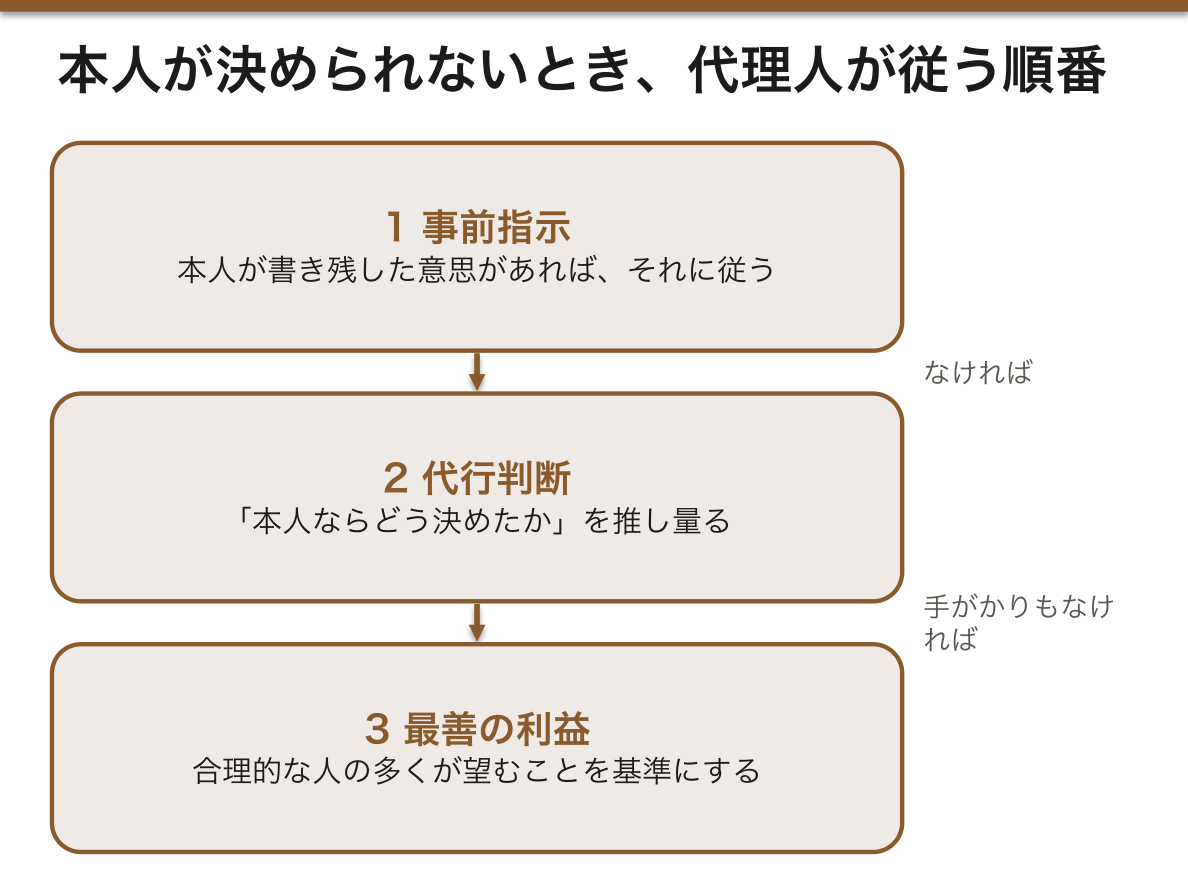
この順序には理由がある。1と2は、本人が決められない状態でも、できる限り本人の自己決定を尊重するための原則である。3が最後に来るのは、それを使う場面では「この人がふつうの人と違う考えをもっていた」という証拠がないからだ。実際の症例では、事前指示が今の状況にぴったり当てはまることは少なく、複数の原則を組み合わせて考えることになる。
注意すべきは、代行判断は「家族が望むこと」ではないという点だ。代理人に問うべきは「あなたはどうしたいか」ではなく「ご本人なら何と言うと思うか」である。家族自身の悲しみや罪悪感から、本人が望まなかった延命を求めることは珍しくない。
日本には、医療に関する代理人を定める一般的な法律がない。成年後見人にも、手術などの医療行為に同意する権限はないとされている。そのため実務では、厚生労働省の人生の最終段階における医療・ケアの決定プロセスに関するガイドラインに沿い、本人の意思が確認できないときは家族等が本人の推定意思を尊重し、医療・ケアチームとともに本人にとって最善の方針を話し合う。元気なうちに価値観を話し合っておく ACP は、代行判断の手がかりを残す作業でもある。
English version
Core
When a patient lacks capacity, someone must decide for them. Usually a close family member is the surrogate, for three reasons: the patient would usually want this; the family usually knows best what the patient would want and cares most; and in most societies the family has the main responsibility for dependent members.
For a previously competent adult, surrogates follow three principles in order.
| Order | Principle | Content |
|---|---|---|
| 1 | Advance directive | Follow the patient’s advance directive (written or otherwise), if there is one |
| 2 | Substituted judgement | If there is none, use knowledge of the patient to decide as the patient would have decided |
| 3 | Best interests | If nothing is known of the patient’s values, decide by what most reasonable people would want |
For someone who has never been competent (such as a child born with a severe disability), there are no personal values to respect, so only the best interests principle can be used.
Going further
The order has a reason. Principles 1 and 2 respect the patient’s self-determination as far as possible even when they cannot decide. Principle 3 comes last because, when we use it, we have no evidence that this person differed from most people. In real cases an advance directive rarely fits the situation exactly, so we combine principles.
Note that substituted judgement is not ‘what the family wants’. Ask the surrogate not ‘what do you want?’ but ‘what would the patient say?‘ Families often ask for life-prolonging treatment the patient would not have wanted, out of their own grief or guilt.
In the clinic
Japan has no general law that appoints a medical surrogate. Even an adult guardian is generally held to have no power to consent to medical procedures such as surgery. In practice, clinicians follow the Ministry of Health’s guidelines on decision-making for end-of-life care: when the patient’s will cannot be confirmed, the family respects the patient’s presumed wishes and discusses the best plan with the care team. ACP while the person is well also leaves clues for substituted judgement.
まとめ
| 自律と自律的な人 — 「客体」ではなく「主体」として | 自律とは、自分で自分を律すること、すなわち自分の理由と価値観に基づいて、他人に支配されずに決め、その決定に沿って生きる能力である。 |
|---|---|
| 医師のパターナリズムから共同意思決定へ | ほとんどの国で、伝統的には医師が主たる意思決定者だった。 |
| インフォームド・コンセントの3つの要件 — 能力・理解・自発性 | 同意が倫理的に有効であるためには、少なくとも3つの要件がそろう必要がある。 |
| 開示の基準 — 医師の慣行か、患者の立場か | 「どこまで説明すれば十分か」を決める基準は、大きく2つある。 |
| 開示の4要素 — 何を・なぜ・ほかに何が | 開示すべき情報は、次の4つの要素にまとめられる。 |
| 同意が要らない3つの例外 — 緊急・放棄・治療上の特権 | 判断能力のある患者からも同意を得なくてよい、とされる例外が3つある。 |
| 判断能力のない患者 — 代わりに誰が、何を基準に決めるか | 患者に判断能力がないとき、誰かが代わりに決めなければならない。 |
このノートは医学生が授業の内容を自分の言葉でまとめたもので、診療の判断に使うものではありません。誤りに気づいたらお知らせください。