- Max Weber の3つの貢献
- なぜ健康ライフスタイル理論が必要だったのか — 健康を「作る」時代
- 機会と選択の均衡 — Bourdieu と Giddens
Max Weber の3つの貢献
Cockerham の健康ライフスタイル理論は Weber を土台にする。
①階級 class と身分 status の区別——階級は経済的な位置、身分は社会的な威信と生活様式。健康行動は所得より身分集団に強く結びつく。
②生活選択(Lebensführung)と生活機会(Lebenschancen)の対——選択は個人の行為、機会は構造が与える可能性の幅。選択は機会の枠内でしかできない。
③生活様式は集団的である——ライフスタイルは個人の趣味ではなく、身分集団の成員であることを示す実践。喫煙・食事・運動は所属の記号として機能する。
ここから「健康ライフスタイルは個人の選択であると同時に構造の産物である」という結論が出る。
Weber の Lebensstil を健康研究に持ち込んだのが Cockerham の功績。「健康行動を個人の責任に帰す議論への、理論的な反論」として使える。
English version
Core
Cockerham’s health lifestyle theory is founded on Weber.
① The distinction of class and status — class is an economic position, status social prestige and a way of living. Health behaviour is bound more strongly to the status group than to income.
② The pair of life conduct (Lebensführung) and life chances (Lebenschancen) — conduct is the individual’s action, chances the range of possibility the structure grants. Choice can be made only within the frame of chances.
③ A way of life is collective — a lifestyle is not individual taste but a practice that displays membership of a status group. Smoking, diet and exercise function as signs of belonging.
From here follows the conclusion that a health lifestyle is at once an individual choice and a product of structure.
Going further
Bringing Weber’s Lebensstil into health research is Cockerham’s contribution. It can be used as a theoretical rebuttal to arguments that attribute health behaviour to individual responsibility.
なぜ健康ライフスタイル理論が必要だったのか — 健康を「作る」時代
Cockerham は、人が健康を作り出す(manufacture)のも、逆に損ない、壊すのも、主にライフスタイルを通してだと述べる。運動するか、何を食べ飲むか、喫煙・飲酒・薬物、健診や予防のための受診——これらの健康行動の集まりが健康ライフスタイルで、良い方向にも悪い方向にも働き、誰もが何かしらのライフスタイルを持っている。
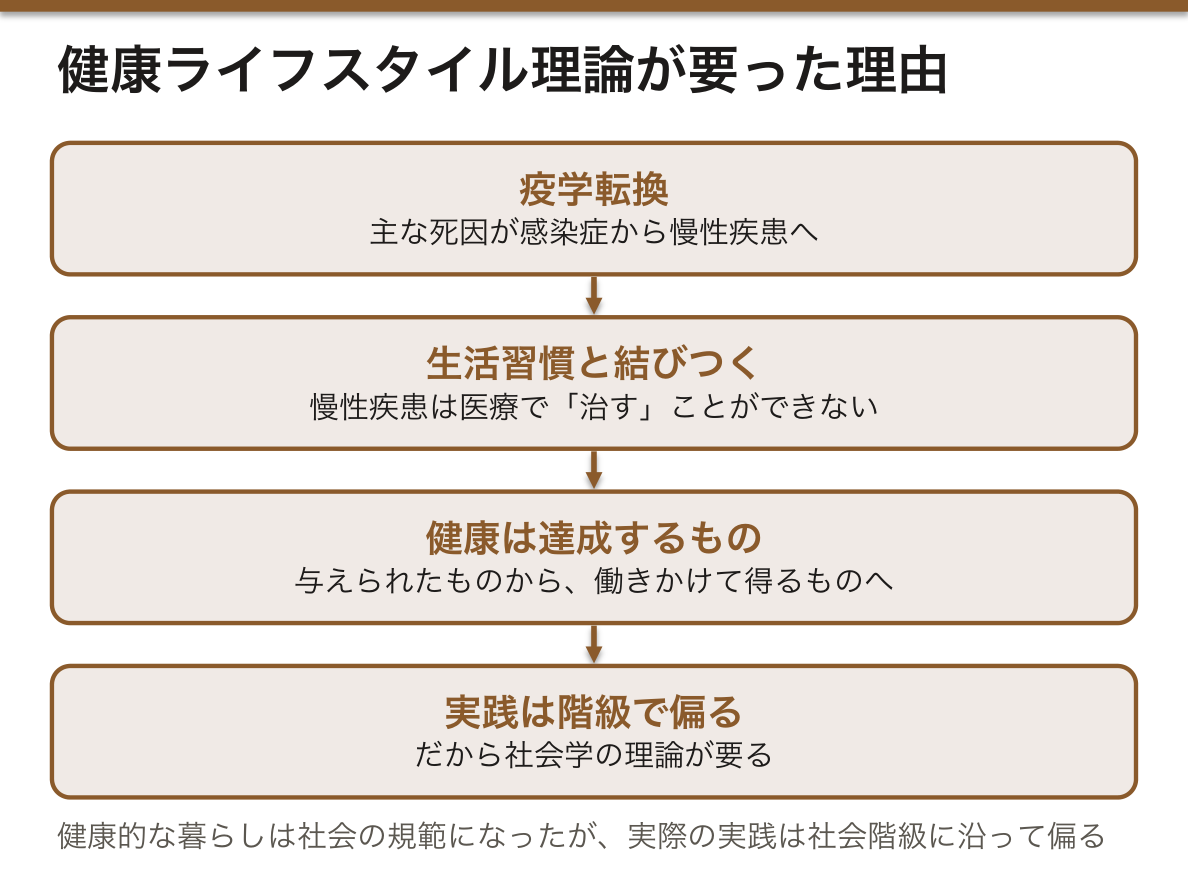
この理論が作られる前、健康ライフスタイルを説明する理論は存在しなかった。必要になった理由は疫学転換である。20世紀に主な死因が感染症から慢性疾患(心疾患・がん・糖尿病)へ移り、その多くが生活習慣と結びついていた。慢性疾患は医療で「治す」ことができず、悪い習慣は病気と早すぎる死を招く。こうして健康は「生まれつき与えられたもの」から「働きかけて達成するもの」になった。健康的な暮らしは社会の規範になったが、実際の実践は社会階級に沿ってはっきり偏っている——ここに社会学の理論が要る理由がある。
象徴的相互作用論との関係——相互作用論は、人は状況をどう定義し解釈するかにもとづいて行為を組み立てる、と考える(Blumer)。行為主体性(agency)を重く見る立場で、Cockerham 自身もこの伝統で学び、はじめは構造より行為を重視していた。ところが各国の調査で、健康行動が階級ごとにまとまった型を作り、しかも同じ階級なら国が違っても似ていることが分かった。自由な選択だけなら、こうはならない。
そこで理論は、ライフスタイルは構造によって上から型づけられ、人はそれを自分のものとして取り込む、という立場をとる。人は選べるが、選択肢の量と質は構造が限る。それでも個人は型を受け入れ、拒み、修正できる——つまり相互作用論の「解釈する主体」は残しつつ、構造を組み込んだのである。社会の型は「個人が必ずそうする」ことではなく「そうする確率が高い」ことを指すので、自由意志と矛盾しない。理論の検証の場として、男性の平均寿命が長く下がり続けたロシアが「自然の実験室」として使われた。
生活習慣病の指導で「本人のやる気」だけを問題にすると、この理論が乗り越えようとした行き詰まりに戻ってしまう。どの階層・職場・家族の型の中で暮らしているかを聞くことが、実行できる助言の前提になる。
English version
Core
Cockerham says that people manufacture health, or undermine and destroy it, mainly through their lifestyle: exercise, food and drink, smoking, alcohol, drugs, check-ups and preventive visits. The set of these health behaviours is a health lifestyle; it can be positive or negative, and everyone has one.
Before this theory, no theory of health lifestyles existed. It was needed because of the epidemiological transition. In the 20th century the main causes of death moved from infections to chronic diseases (heart disease, cancer, diabetes), many linked to lifestyle. Chronic diseases cannot be cured by medicine, and bad habits lead to illness and early death. So health changed from something given at birth to something to work for and achieve. Healthy living became a social norm, but actual practice follows social class clearly — this is why a sociological theory is needed.
Going further
Link to symbolic interactionism: interactionism says people build their actions on how they define and interpret situations (Blumer). It stresses agency, and Cockerham himself was trained in this tradition and first favoured agency over structure. But surveys in several countries showed that health behaviours form patterns by class, and the same class looks similar across countries. Free choice alone would not produce this.
So the theory says lifestyles are shaped from the top down by structure, and people adopt them as their own. People can choose, but structure limits the number and quality of options. Individuals can still accept, reject or change the pattern — the “interpreting actor” of interactionism stays, but structure is built in. A social pattern means a high probability, not a certainty for each person, so it does not deny free will. Russia, where male life expectancy fell for a long time, served as a “natural laboratory” to test the theory.
In the clinic
If lifestyle advice looks only at the patient’s motivation, we return to the dead end this theory tried to escape. Asking about the class, workplace and family patterns a person lives in is the basis for advice they can actually follow.
機会と選択の均衡 — Bourdieu と Giddens
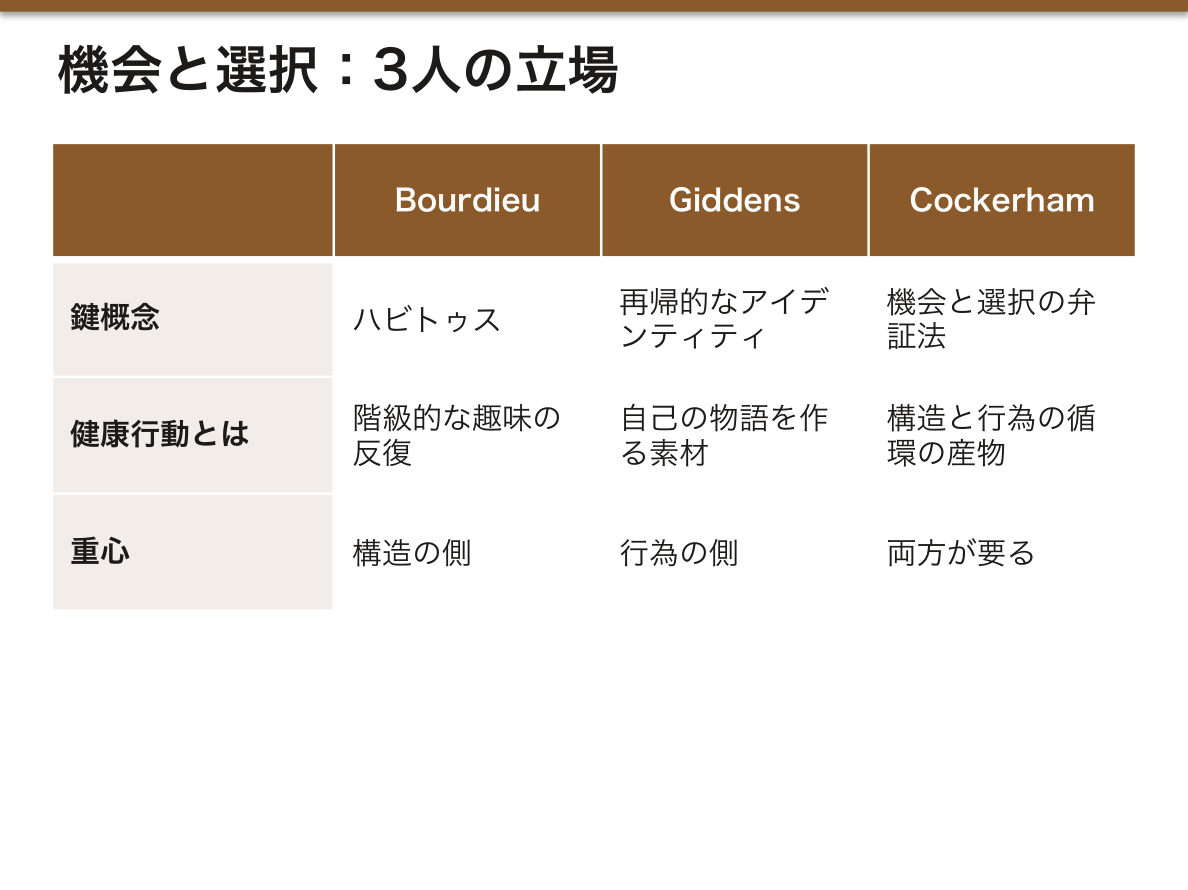
Bourdieu——ハビトゥス:階級的な環境の中で身体に刻み込まれた持続する性向。選択は自由に見えて、実は階級的な趣味の反復である。構造の側に重心がある。「労働者階級は必要の趣味、上流階級は自由の趣味を持つ」。
Giddens——後期近代では伝統が弱まり、人は自らのアイデンティティを再帰的に作らねばならない。健康行動は自己の物語を作る素材。行為の側に重心がある。
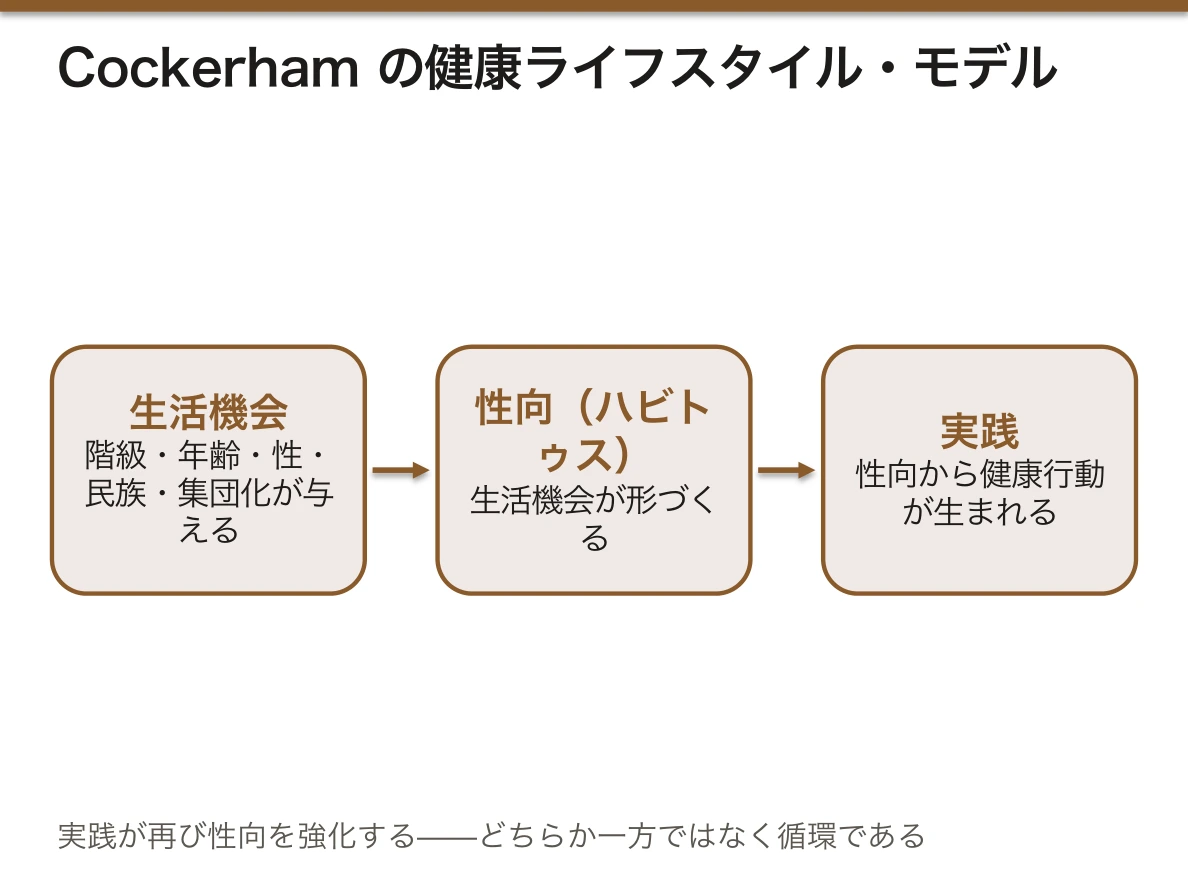
Cockerham の立場——両方が要る。健康ライフスタイルは「機会(構造)と選択(行為)の弁証法」から生まれる。彼のモデルでは、階級・年齢・性・民族・集団化が生活機会を与え、それが性向(ハビトゥス)を形づくり、そこから実践が生まれ、実践が再び性向を強化するという循環になる。
答えの核は「どちらか一方ではなく、循環である」。
「医学の黄金時代」の章の批判的実在論も同じ論争への別の答え。Giddens=一体、Bourdieu=構造優位、批判的実在論=つながるが分けて分析、と3つ並べられると強い。
English version
Core
Bourdieu — habitus: the durable dispositions inscribed on the body within a class environment. Choice looks free and is in fact the repetition of a class taste. The weight lies on the side of structure. "The working class has a taste for the necessary, the upper class a taste for freedom."
Giddens — in late modernity tradition weakens and one must make one’s identity reflexively. Health behaviour is material for making the story of the self. The weight lies on the side of agency.
Cockerham’s position — both are needed. A health lifestyle arises from "the dialectic of chances (structure) and choices (agency)". In his model there is a circle: class, age, sex, ethnicity and collectivity give life chances; those shape dispositions (habitus); from these come practices; and practices reinforce the dispositions again.
The core of the answer is "not one or the other, but a circle".
Going further
Critical realism in the chapter on the golden age of medicine is another answer to the same debate. Being able to line up all three — Giddens = fused, Bourdieu = structure dominant, critical realism = connected but analysed separately — is strong.
まとめ
| Max Weber の3つの貢献 | Cockerham の健康ライフスタイル理論は Weber を土台にする。 |
|---|---|
| なぜ健康ライフスタイル理論が必要だったのか — 健康を「作る」時代 | Cockerham は、人が健康を作り出す(manufacture)のも、逆に損ない、壊すのも、主にライフスタイルを通してだと述べる。 |
| 機会と選択の均衡 — Bourdieu と Giddens | Bourdieu——ハビトゥス:階級的な環境の中で身体に刻み込まれた持続する性向。 |
このノートは医学生が授業の内容を自分の言葉でまとめたもので、診療の判断に使うものではありません。誤りに気づいたらお知らせください。