- 精神保健をどう概念化し、どう測るか
- 交差性 — 社会的地位は足し算ではなく、掛け合わさる
- Thoits — 支援の2つの区別と「似た立場の他者」
- 生物学的指標のない分類 — DSM の妥当性と、障害モデル
- 精神疾患のスティグマ — 公衆のスティグマと自己スティグマ
- 精神保健のケア — 医療化・リカバリー・エンパワメント
精神保健をどう概念化し、どう測るか
概念化——精神的健康を「疾患が無いこと」とするか「積極的な well-being」とするかで、測るものが変わる。Keyes は両者を独立の次元とし、flourishing(充実)と languishing(衰弱)を区別した。疾患が無くても languishing はありうる。
操作化——①診断カテゴリー(DSM に基づく有無)②症状尺度(連続量として測る)。カテゴリーは臨床と保険に、連続量は疫学に向く。
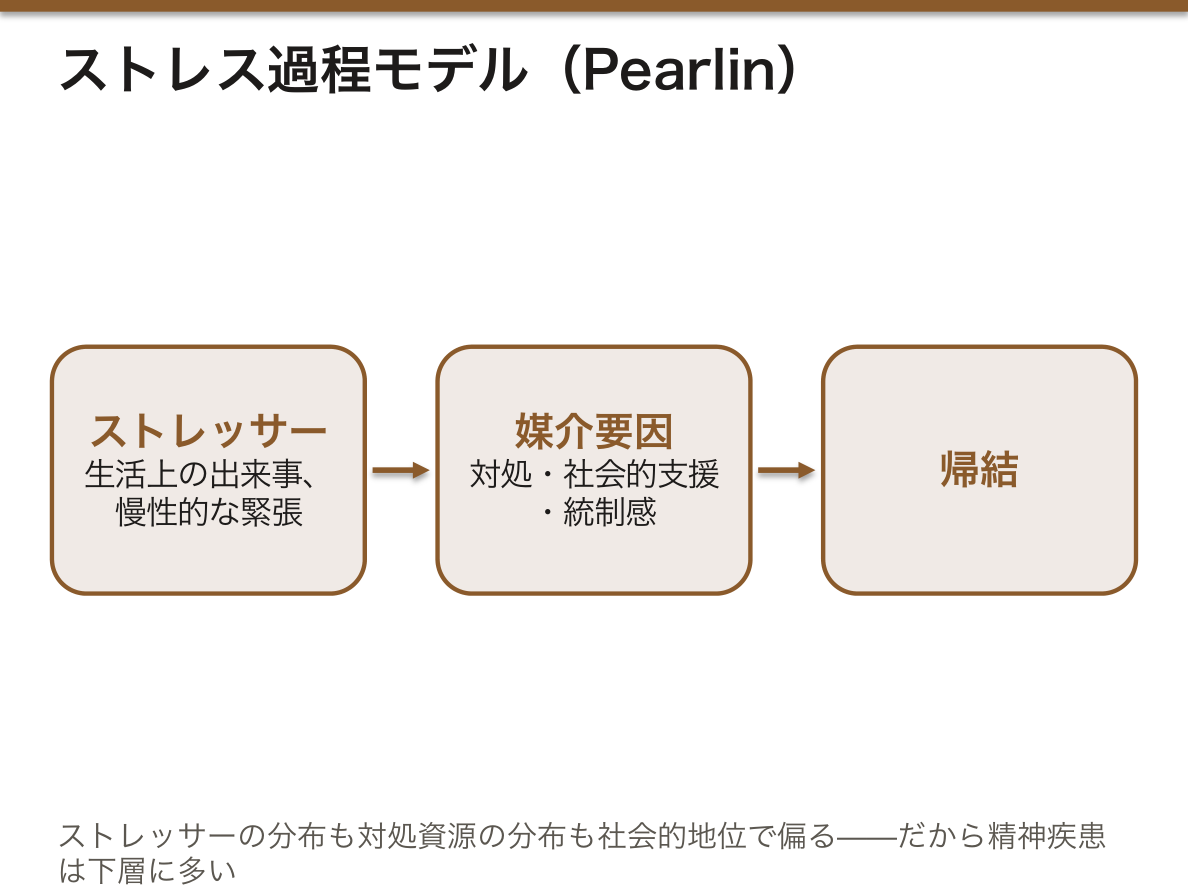
社会的文脈と社会的ストレス——ストレス過程モデル(Pearlin):ストレッサー(生活上の出来事、慢性的な緊張)→ 媒介要因(対処、社会的支援、統制感)→ 帰結。ストレッサーの分布も、対処資源の分布も社会的地位で偏る——だから精神疾患は下層に多い。
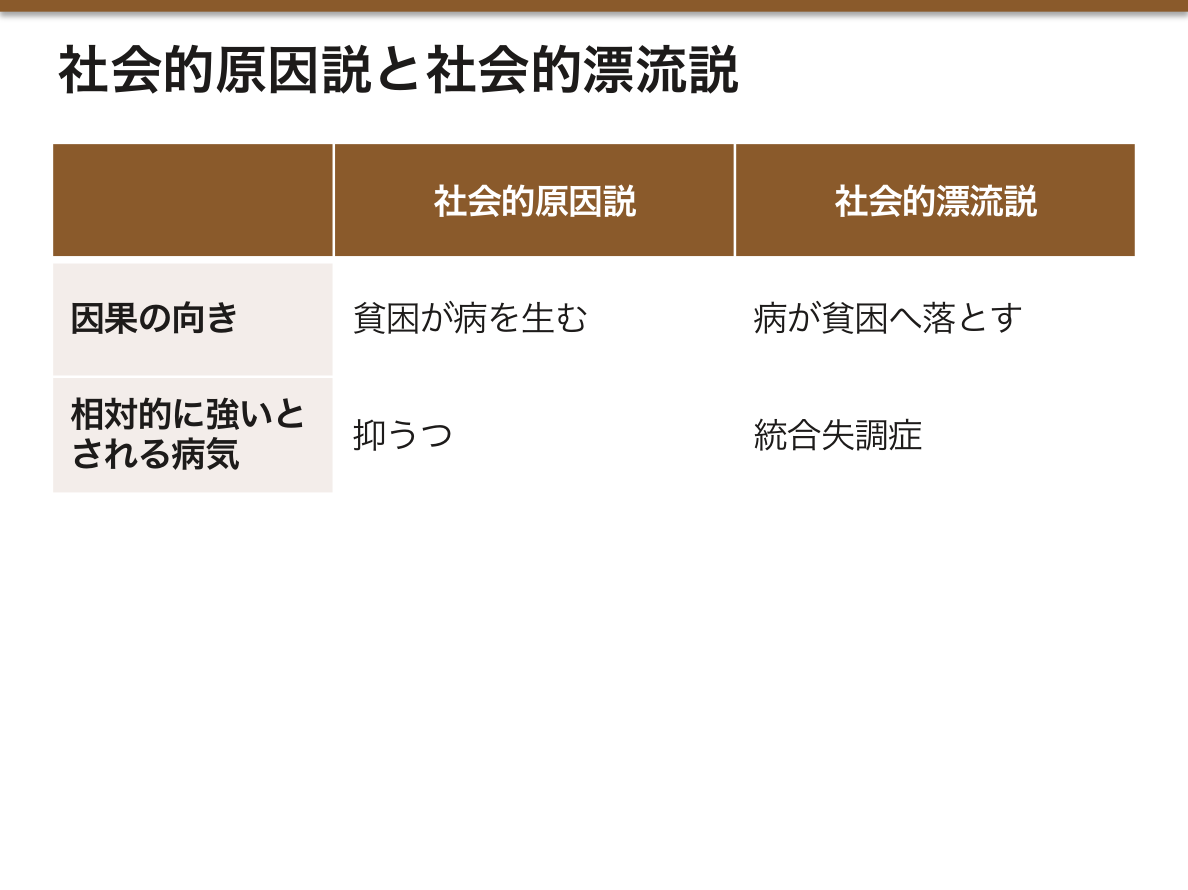
社会的原因説(貧困が病を生む)と社会的漂流説(病が貧困へ落とす)の論争。現在は統合失調症では漂流が、抑うつでは原因が相対的に強いと考えられている。
English version
Core
Conceptualisation — what is measured changes according to whether mental health is taken as "the absence of disorder" or as "positive well-being". Keyes treated the two as independent dimensions and distinguished flourishing and languishing. One can be languishing without disorder.
Operationalisation — ① diagnostic categories (present or absent by the DSM) ② symptom scales (measured as a continuum). Categories suit the clinic and insurance, continua suit epidemiology.
Social context and social stress — the stress process model (Pearlin): stressors (life events, chronic strains) → mediators (coping, social support, sense of control) → outcomes. Both the distribution of stressors and the distribution of coping resources are skewed by social position — hence mental disorder is commoner lower down.
Going further
The debate between social causation (poverty produces illness) and social drift (illness pushes one into poverty). At present drift is thought relatively stronger in schizophrenia and causation in depression.
交差性 — 社会的地位は足し算ではなく、掛け合わさる
交差性 intersectionality=人は階級・性別・人種や民族・性的指向・年齢といった複数の社会的地位を同時に生きており、それらが互いに絡み合って(interlocking)経験を形づくる、という見方である。法学者 Crenshaw が黒人女性への差別を論じるために作った語(1989)で、精神保健の社会学では「複数の少数派の地位が重なったときに何が起きるか」を問う枠組みとして使われる。
土台はストレス過程モデルである。社会的地位は、①ストレスにさらされる量、②社会的資源(支援・人のつながり)、③個人的資源(統制感 mastery・自尊心・回復力)の3つを同時に決める。なかでも社会経済的地位(SES)は、ストレスへの曝露とストレスへの反応の両方を決める最大の要因とされる。低い SES の人は慢性的なストレス(貧困・不安定な仕事・危険な地域)に長くさらされ、しかも対処に使える資源が少ない。単発の出来事より、続く慢性ストレスのほうが精神的健康を強く左右する。
交差性が付け加えるのは、地位ごとの影響を1つずつ足しても全体は分からないという点である。米国の黒人女性を例にとると、女性であること・黒人であることはどちらも社会的に低く評価される地位で、白人女性より貧困に陥りやすい。さらに、本来は支えになるはずの家族や友人のつながりが、頼られる負担の大きいストレスの源として働くことがある。同じ資源が、地位の組み合わせによって逆の意味を持つのである。
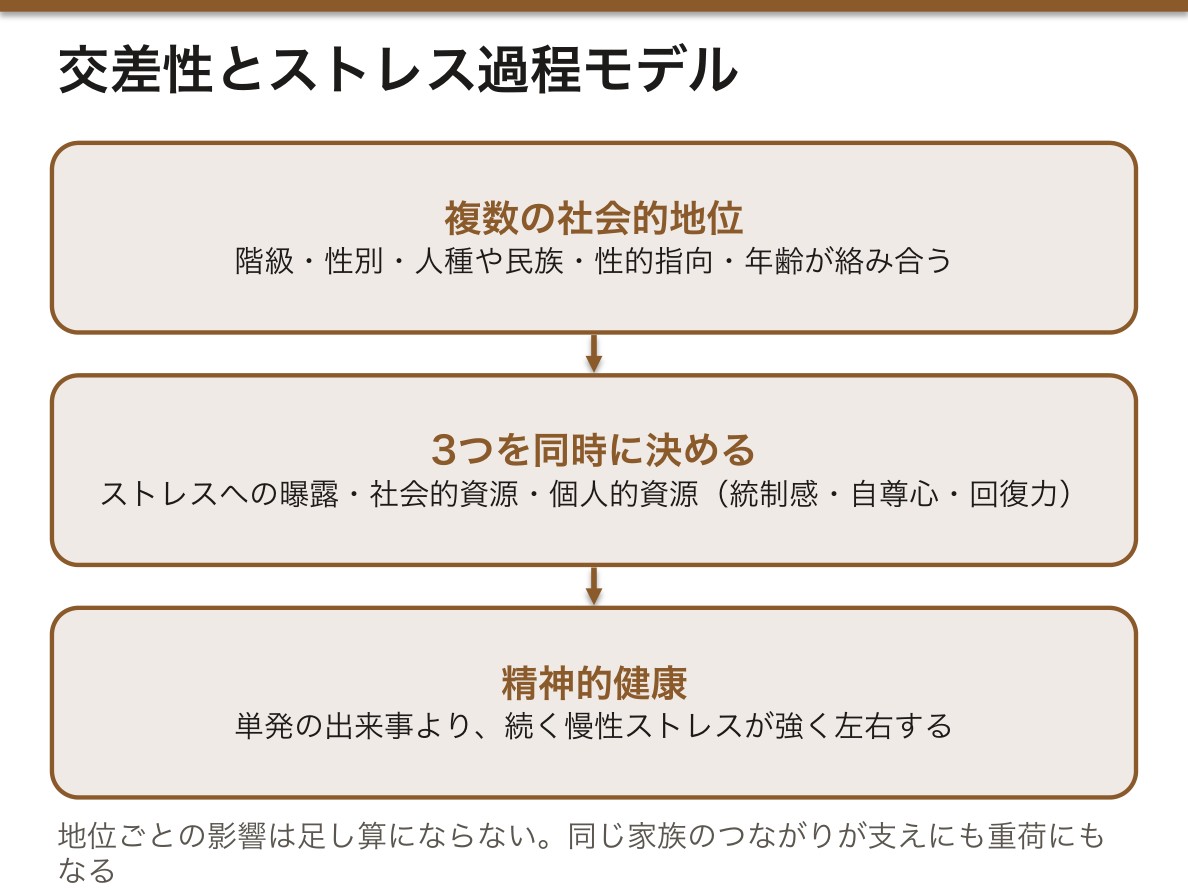
なぜ足し算にならないのか。地位どうしが原因として絡み合っているからである。階級と人種は重なって分布するので、どちらの影響かを切り分けにくい。また、地位は資源の「意味」まで変える。移民研究では、国外生まれのヒスパニック系は SES が低いのに、米国生まれより精神的健康が良いという逆説が知られる。家族との親密さは抑うつと不安を減らすが、家族への責任の重さはかえって苦痛を増やしていた。同じ「家族」が守りにも重荷にもなる。
差別の影響も、本人のアイデンティティで変わる。人種や民族が自分の中心的なアイデンティティである人ほど、差別による苦痛が小さいという報告がある。
もう1つ大事なのは、ストレスが支援そのものを壊すことである。離婚や失業はつらい出来事であるだけでなく、人間関係の網を作り替え、支えてくれる人を減らす。いちばん支援が要る人が、いちばん支援を失いやすい。だから介入は個人の治療だけでは足りず、ストレスへの曝露を生む格差そのものに向ける必要がある——これが社会学の結論である。
臨床では、患者の背景を1つの属性で見ないことにつながる。たとえば低所得の移民女性が抑うつを訴えたとき、「家族がいるから支援は十分」とは言えない。家族が支えなのか負担なのかを聞いてはじめて評価になる。健康の社会的決定要因と健康格差の考え方(公衆衛生)の延長として理解しておくとよい。
English version
Core
Intersectionality means that people live several social statuses at the same time (class, gender, race and ethnicity, sexual orientation, age), and these statuses are interlocking. The legal scholar Crenshaw created the term in 1989 to describe discrimination against Black women. In the sociology of mental health it asks what happens when several minority statuses come together.
The base is the stress process model. Social status decides three things at once: (1) how much stress a person is exposed to, (2) social resources (support, networks), and (3) personal resources (mastery, self-esteem, resilience). Socioeconomic status (SES) is the most important factor for both exposure to stress and the response to it. People with low SES live longer with chronic stress (poverty, unstable work, unsafe neighbourhoods) and have fewer resources to cope. Chronic stress matters more than single events.
Intersectionality adds one point: you cannot get the whole picture by adding the effect of each status one by one. For example, in the US, being female and being Black are both socially devalued statuses, and Black women are more likely to live in poverty than white women. Their family and friend networks can also be demanding, so the network can become a source of stress rather than a resource. The same resource can have the opposite meaning for a different combination of statuses.
Going further
Why is it not simple addition? Because the statuses are tangled as causes. Class and race overlap, so it is hard to separate their effects. Status also changes the meaning of a resource. Studies of immigrants show a paradox: foreign-born Hispanics in the US have better mental health than US-born Hispanics, even with lower SES. Feeling close to family reduced depression and anxiety, but heavy family responsibility increased distress. The same family can protect and burden.
The effect of discrimination also depends on identity. People for whom race or ethnicity is a central identity report less distress from discrimination.
Another key point: stress can destroy support itself. Divorce or unemployment are not only painful events; they also change a person’s network and reduce the people who can help. Those who need support most are the most likely to lose it. So intervention cannot target only the individual; it must also reduce the inequalities that create exposure to stress.
In the clinic
In clinical work this means: do not judge a patient’s background by one attribute. If a low-income migrant woman reports depression, you cannot say “she has family, so support is enough.” You need to ask whether the family is a support or a burden. Read this as an extension of the social determinants of health and health inequalities.
Thoits — 支援の2つの区別と「似た立場の他者」
Peggy Thoits は精神保健の社会学を代表する研究者で、ここでは3つの論点で引かれる。
①ラベリング理論は「根本から社会学的」である——精神疾患を、社会の反応によって作られ、維持されるものと見るからである(ラベリング理論そのものは「精神保健の社会学」の章の Scheff の項を参照)。
②ソーシャルサポートには2つの区別が要る。1つ目は日常的な支援とストレス関連の支援の区別。日常的な支援は積み重なるもので、ストレスになる出来事そのものを減らし、「支えられている」という感覚・自尊心・well-being を育てる。ストレス関連の支援は、起きた問題に焦点を当てた支援である。2つ目は、支える人を重要な他者 significant others と似た立場の他者 similar others に分けること。重要な他者(家族・パートナー)はお金や住まいを含む支援をくれるが、ストレスの中身をよく知らないことがある。似た立場の他者は同じストレッサーを経験しているので、共感・情報・助言をくれる。離婚なら、家族は経済面で助けてくれても気持ちは分かってくれないことがあり、同じく離婚を経験した人や同僚のほうが理解してくれる。
③スティグマへの抵抗の2つの戦略——挑戦 challenging(他者の見方を変えようとする。当事者団体の活動として公衆のスティグマを崩しうる)と、かわす deflecting(「自分はそういう人ではない」とラベルから距離をとる。自己スティグマを減らす)。
なぜ似た立場の他者が効くのか。共感には経験の共有が要るからである。同じ経験をした人は、教科書にない「経験から得た知識」を持ち、どう乗り越えたかの手本にもなる。そして「こんな目に遭っているのは自分だけではない」と分かること自体が、孤立と「自分はおかしい」という感覚を和らげる。
Thoits は以前から、支援が「効く」ことは分かっても、どういう仕組みで効くのか(対処法の選び方、自尊心や統制感への影響、受診行動への影響)が調べられていないと批判していた。家族の恥の感覚や精神疾患への無知が専門家への相談を妨げることもあれば、専門職との良い経験がある家族はためらわず受診につなげることもある。支援は量だけでなく、中身と向きで評価すべきだという主張である。
この考え方を形にしたのが、自助グループ(アルコール依存の断酒会や AA)や患者会、精神保健のピアサポート(当事者経験のある人が支援者として関わる)である。主治医や家族がどれだけ支えても代わりにならない部分を、似た立場の他者が埋める。患者に自助グループを紹介するとき、その根拠を説明できる。
English version
Core
Peggy Thoits is a leading sociologist of mental health. She is cited for three points.
(1) Labelling theory is “radically sociological” because it sees mental illness as created and kept alive by society’s reaction. (For labelling theory itself, see Scheff in the chapter on the sociology of mental health.)
(2) Social support needs two distinctions. First, everyday support versus stress-related support. Everyday support builds up over time; it reduces stressful events, and it builds a sense of being supported, self-esteem and well-being. Stress-related support focuses on the problem that has happened. Second, supporters are either significant others or similar others. Significant others (family, partner) can give help, including money or housing, but may not understand the stressor. Similar others have experienced the same stressor, so they can give empathy, information and advice. In a divorce, family may help with money but not understand the feelings; other divorced people or co-workers may understand better.
(3) Two strategies of stigma resistance: challenging (trying to change other people’s views; advocacy groups can reduce public stigma) and deflecting (keeping distance from the label: “I am not like that”; this reduces self-stigma).
Going further
Why do similar others help? Empathy needs shared experience. People with the same experience have practical knowledge that is not in textbooks, and they show how to cope. Knowing “I am not the only one” also reduces isolation and the feeling of being abnormal.
Thoits also criticised earlier research: we know that support helps, but not how it works (choice of coping, effects on self-esteem and mastery, effects on help-seeking). A family’s shame or lack of knowledge can block professional help, while a family with good experience of professionals may seek care early. Support should be judged by its content and direction, not only its amount.
In the clinic
This idea is put into practice in self-help groups (for example Alcoholics Anonymous), patient groups, and peer support in mental health (people with lived experience working as supporters). Similar others fill a gap that doctors and family cannot fill. You can use this to explain why you refer a patient to a self-help group.
生物学的指標のない分類 — DSM の妥当性と、障害モデル
精神疾患には、診断を決める生物学的指標(バイオマーカー)がない。心臓病なら心電図や酵素、糖尿病なら血糖で線を引けるが、うつ病にはそれに当たる物差しがない。DSM のようなカテゴリー診断は、病気が自然の中に「本質」として存在し、それを見つければよいという前提に立つ。しかし基準となる正解(gold standard)がないので、妥当性 validity(それが本当に病気か)は争いになる。一方で信頼性 reliability(誰が測っても同じ結果になるか)は、DSM の基準でおおむね保たれている。問題は「一致して診断できるか」ではなく「診断しているものが病気か」である。
代わりの考え方が連続体で測ることである。誰もが時期によって、健康と苦痛のあいだを行き来する。重いうつ病と軽いうつ病の違いは質ではなく量だという研究もある。
症状の現れ方は文化で変わる。うつの経験(悲しみ・失敗・喪失の感じ方)は文化によって違うことが比較研究で示されてきた。同じ症状でも、米国では黒人男性は統合失調症、白人男性は双極性障害と診断されやすかったという報告もある。普遍的な診断マニュアルは比較と共通言語をくれるが、文化差を「異常」と読み違える危険を抱える。
ここから2つの理論が出てくる。社会反応理論(ラベリング)は、誰が「精神疾患」とラベルを貼られ、その結果どうなるかを問う。これに対して障害モデル disability model は、障害の根を個人ではなく社会の関係と構造に置く。原因が何であれ、精神の不調は長く続く機能の低下を伴うことが多い。そして周囲が支えになる環境を用意できないことが、障害を重くする。
医学モデルが「診断・治療・治癒」を目標にするのに対し、障害モデルは「長く続く制約を前提に、社会の側を変えて本人の力を生かす」ことを目標にする。なぜこれがスティグマを減らしうるのか——問題が「生物学的に違う人」から「支えが足りない社会」へ移るからである。この考え方はリカバリーの考え方と重なる。
文化と社会の結びつきの例として、WHO の調査では統合失調症の経過は、先進国より途上国のほうが良かった。共同体の結束と支えが強い社会ほど、再発が少なく回復しやすいと説明されている。
障害モデルを政策にすると、職場の合理的配慮、住まいと就労の支援、地域の相談の場といった「社会の側の資源」を増やすことになる。日本でも精神障害は障害者施策の対象で、合理的配慮の提供が法律で求められている。診察室で診断名を付けるだけでなく、生活を支える資源につなげるところまでが医療の仕事になる。
English version
Core
Mental illness has no biological marker that decides the diagnosis. Heart disease has the ECG and enzymes, diabetes has blood glucose, but depression has no such measure. Categorical diagnosis such as the DSM assumes that each illness has an “essence” in nature that we only need to find. Without a gold standard, validity (is it really an illness?) is disputed. Reliability (do different raters get the same result?) is mostly good with DSM criteria. The problem is not whether we agree on the diagnosis, but whether what we diagnose is an illness.
An alternative is to measure on a continuum. Everyone moves between health and distress over time. Some research shows that major and minor depression differ in amount, not in kind.
Symptoms vary by culture. Comparative studies show that the experience of depression (sadness, failure, loss) differs between cultures. In the US, with the same symptoms, Black men were more often diagnosed with schizophrenia and white men with bipolar disorder. A universal manual gives a shared language, but it risks reading cultural difference as abnormality.
Going further
Two theories follow. Social reaction (labelling) theory asks who is labelled mentally ill and what happens as a result. The disability model puts the roots of disability in social relations and structures, not in the individual. Whatever the cause, mental health problems often bring long-term loss of function, and a society that does not provide supportive environments makes the disability worse.
The medical model aims at diagnosis, treatment and cure. The disability model accepts long-term limits and aims to change society so that the person’s strengths can be used. Why can this reduce stigma? Because the problem moves from “a biologically different person” to “a society with too little support.” This fits the idea of recovery.
As an example of social context, WHO studies found that people with schizophrenia did better in less developed countries than in developed ones. Stronger community ties and support are thought to reduce relapse and help recovery.
In the clinic
As policy, the disability model means more resources on the side of society: reasonable accommodation at work, support for housing and jobs, and community services. In Japan, mental disorders are also covered by disability policy, and reasonable accommodation is required by law. Medical work does not end with a diagnosis; it includes connecting the patient to resources for daily life.
精神疾患のスティグマ — 公衆のスティグマと自己スティグマ
スティグマ=その人の信用を落とす属性で、ステレオタイプを伴い、実際の差別にまでつながるもの(Goffman の概念は「病いの経験」の章の Goffman の項を参照)。精神疾患については、「危険」「何をするか分からない」「普通には戻れない」「話が通じない」「良い働き手にならない」という見方が、繰り返し調査で確かめられてきた。
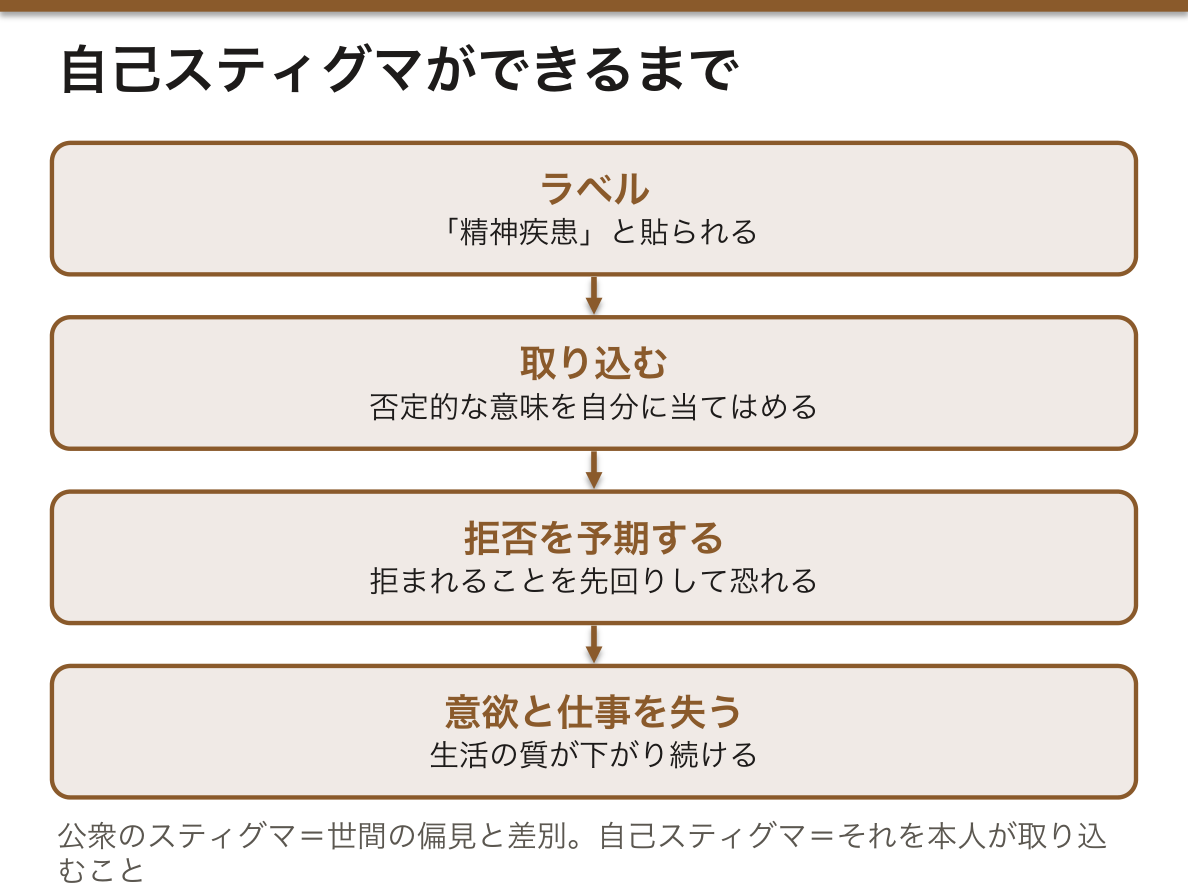
社会学は2つを区別する。公衆のスティグマ public stigma=世間のステレオタイプ・偏見・差別。自己スティグマ self-stigma=それを本人が取り込み、自分を価値の低い存在と感じること。「精神疾患」とラベルを貼られた人は、ラベルに付いた否定的な意味を自分に当てはめ、拒まれることを予期するようになる。その結果、意欲を失い、仕事を失いやすくなる。ラベルには治療やサービスを受けられるという良い面もあるが、追跡研究では治療の利益が時間とともに薄れる一方、「精神医療の利用者」というスティグマが生活の質を下げ続けた。
一般の人の見方の研究から言えることは4つある。①精神的な問題を認め、治療を受けることには以前より開かれてきた。②しかしスティグマそのものはあまり変わらず、「危険」との結びつきはむしろ強まった。③ラベルに対しても、行動に対しても、スティグマは生じる。④遺伝や脳の病気として説明すると、薬物療法への支持は増えるが、スティグマはむしろ強い。
なぜ「脳の病気だ」という説明がスティグマを減らさないのか。本人の落ち度ではないと伝わる一方で、「根本的に違う人」「変わらない人」「予測できない人」という印象を強めるからである。距離を置きたい気持ちは、責める気持ちとは別に働く。
スティグマは政策も動かす。精神保健政策が進まない理由の1つがスティグマで、「危険な人」というステレオタイプは、強制的な治療(地域での治療命令など)への支持を高め、地域で暮らすための支援への予算を細らせる。精神疾患とは何かについて社会の合意がないことも、政策がまとまらない原因である。
交差性の視点を足すと、精神疾患のスティグマは、人種・性別・貧困などの別のスティグマと重なって経験される。重なりが大きい人ほど、受診をためらい、支援から遠ざかる。
スティグマは受診の遅れ・治療の中断・家族が相談をためらうことの大きな理由である。日本は人口あたりの精神科病床が多く、入院が長いことが国際的に指摘されてきた。地域で暮らす支援を厚くすることが、スティグマを減らす政策としても意味を持つ。診察室では、ラベルを貼ることの重みを意識して、病名の伝え方に気を配りたい。
English version
Core
Stigma is an attribute that discredits a person, comes with stereotypes, and can lead to real discrimination (for Goffman’s concept, see Goffman in the chapter on the experience of illness). Surveys show again and again that people see those with mental illness as dangerous, unpredictable, never normal, impossible to talk with, and poor workers.
Sociologists separate two kinds. Public stigma is stereotypes, prejudice and discrimination in society. Self-stigma is when the person takes this in and feels less valuable. People labelled “mentally ill” apply the negative meaning to themselves and expect rejection, which leads to demoralisation and job loss. The label can also bring treatment and services, but follow-up research found that the benefit of treatment faded over time while the stigma of being a mental health service user kept lowering quality of life.
Research on public views gives four findings. (1) People are more open to recognising mental health problems and to treatment. (2) But stigma has changed little, and the link with dangerousness has become stronger. (3) Stigma appears both for the label and for the behaviour. (4) Genetic or brain explanations increase support for medication, but people who hold them show more stigma.
Going further
Why does “it is a brain disease” not reduce stigma? It says the person is not to blame, but it also suggests a person who is basically different, unchanging and unpredictable. The wish to keep distance works separately from blame.
Stigma also shapes policy. It is one reason why mental health policy moves slowly. The stereotype of dangerousness increases support for coercive treatment (such as mandated community treatment) and reduces funding for the support people need to live in the community. Lack of agreement about what mental illness is also blocks clear policy.
With an intersectional view, the stigma of mental illness is experienced together with other stigmas (race, gender, poverty). The more they overlap, the more a person hesitates to seek help.
In the clinic
Stigma is a major reason for late help-seeking, stopping treatment, and families not asking for help. Japan has been noted internationally for many psychiatric beds per person and long stays. Stronger support for life in the community is also a policy against stigma. In the clinic, remember the weight of a label and take care in how you tell a diagnosis.
精神保健のケア — 医療化・リカバリー・エンパワメント
医療化——悲嘆・シャイネス・子どもの落ち着きのなさが診断名を得た。DSM の版を重ねるごとに診断名が増えたことがしばしば批判される。推進役として製薬企業が挙げられる。
リカバリー——症状が消えることではなく、症状があっても意味のある人生を送れるようになること。当事者運動から生まれた概念で、希望・自己決定・社会参加を軸にする。専門家が定義する「治癒」からの転換。
エンパワメント——当事者が自分の治療とサービスの設計に決定権を持つこと。ピアサポート(同じ経験を持つ者による支援)が具体的な形。
脱施設化——1960年代以降、地域ケアへ移行した。ただし受け皿が用意されなかった国では、ホームレス化と刑務所への流入を招いた——この失敗まで述べるのが正解の形。
Goffman の全制的施設と Rosenhan の実験が、脱施設化を後押しした知的背景である。「精神保健の社会学」の章と結びつけて読める。
English version
Core
Medicalisation — grief, shyness and restlessness in children have acquired diagnostic names. That the number of diagnoses grew with each edition of the DSM is frequently criticised. Pharmaceutical companies are named as a driver.
Recovery — not the disappearance of symptoms but coming to live a meaningful life with them. A concept born of the service-user movement, turning on hope, self-determination and social participation. A shift away from "cure" as defined by professionals.
Empowerment — that service users have decision-making power over their own treatment and the design of services. Peer support (support by those with the same experience) is its concrete form.
Deinstitutionalisation — from the 1960s, care moved into the community. But in countries where no provision was made to receive people, it led to homelessness and an influx into prisons — stating this failure too is the form of the correct answer.
Going further
Goffman’s total institution and Rosenhan’s experiment are the intellectual background that drove deinstitutionalisation. They can be read in connection with the chapter on the sociology of mental health.
まとめ
| 精神保健をどう概念化し、どう測るか | 概念化——精神的健康を「疾患が無いこと」とするか「積極的な well-being」とするかで、測るものが変わる。 |
|---|---|
| 交差性 — 社会的地位は足し算ではなく、掛け合わさる | 交差性 intersectionality=人は階級・性別・人種や民族・性的指向・年齢といった複数の社会的地位を同時に生きており、それらが互いに絡み合って(interlocking… |
| Thoits — 支援の2つの区別と「似た立場の他者」 | Peggy Thoits は精神保健の社会学を代表する研究者で、ここでは3つの論点で引かれる。 |
| 生物学的指標のない分類 — DSM の妥当性と、障害モデル | 精神疾患には、診断を決める生物学的指標(バイオマーカー)がない。 |
| 精神疾患のスティグマ — 公衆のスティグマと自己スティグマ | スティグマ=その人の信用を落とす属性で、ステレオタイプを伴い、実際の差別にまでつながるもの(Goffman の概念は「病いの経験」の章の Goffman の項を参照)。 |
| 精神保健のケア — 医療化・リカバリー・エンパワメント | 医療化——悲嘆・シャイネス・子どもの落ち着きのなさが診断名を得た。 |
このノートは医学生が授業の内容を自分の言葉でまとめたもので、診療の判断に使うものではありません。誤りに気づいたらお知らせください。