- CAM の定義と、主流医療への参入の歴史
- 人はなぜ CAM に向かうのか(1) — 受け身の患者役割への不満とホリズム
- 人はなぜ CAM に向かうのか(2) — 新自由主義・階級・ジェンダー、そして「良い施術者」
- CAM による治癒をどう社会学的に読むか
CAM の定義と、主流医療への参入の歴史
定義の難しさ——CAM は内容ではなく「主流でないこと」によって定義される残余カテゴリーである。何が CAM かは時代と国で変わる(鍼はかつて CAM、いまは多くの国で保険適用)。
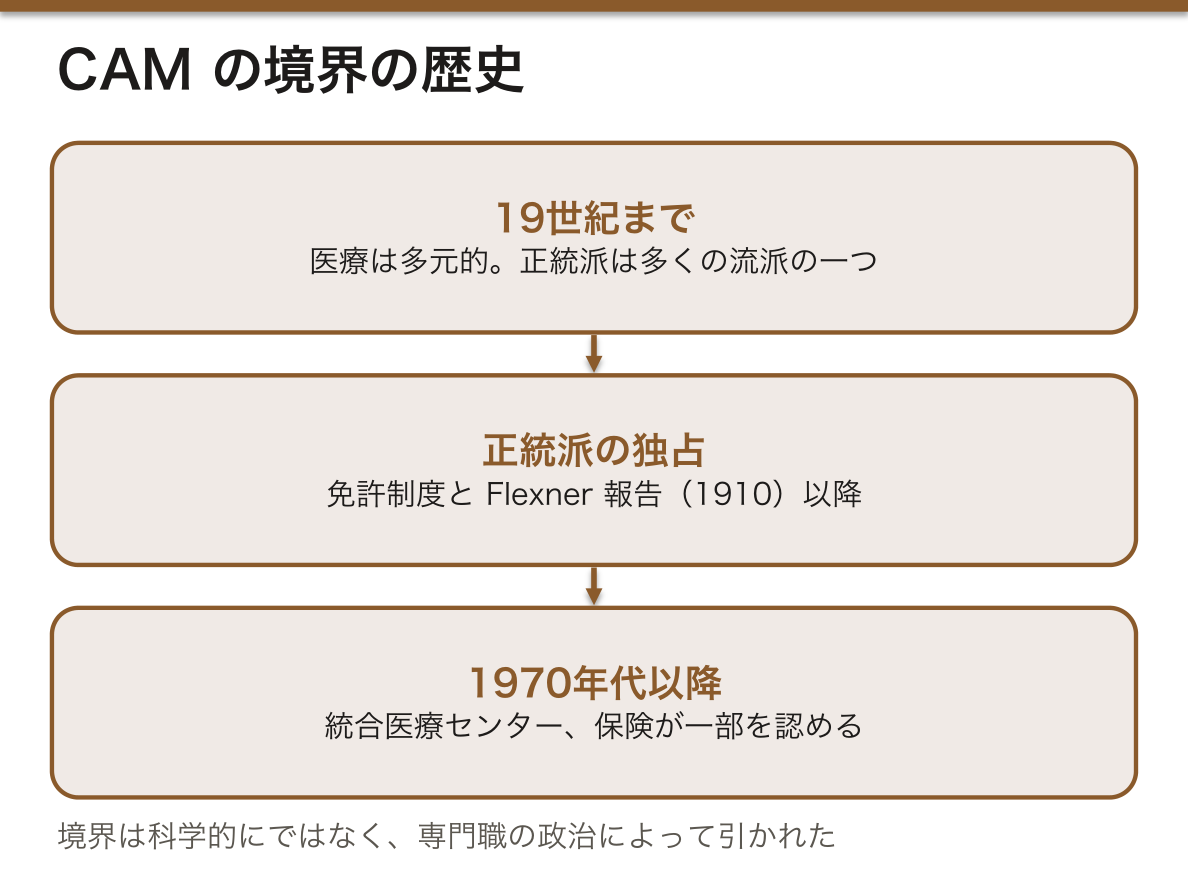
歴史——19世紀まで医療は多元的で、正統派は多くの流派の一つにすぎなかった。正統派が独占を得たのは、免許制度と Flexner 報告(1910) による医学教育の標準化以降。ホメオパシーや整骨は周縁へ追いやられた。
再参入——1970年代以降、①慢性疾患に対する通常医療の限界②患者の消費者化③対抗文化と自然志向④需要の大きさが重なり、大学に統合医療センターが置かれ、保険が一部を認めるようになった。
Soointu の要点は「境界は科学的に引かれたのではなく、専門職の政治によって引かれた」ということ。
この見方は Freidson の専門職支配の応用である。境界を引く権力そのものが、専門職の権力である。
English version
Core
The difficulty of definition — CAM is a residual category defined not by its content but by not being mainstream. What counts as CAM changes with the age and the country (acupuncture was once CAM and is now covered by insurance in many countries).
The history — until the nineteenth century medicine was plural and the orthodox school was only one among many. Orthodoxy gained its monopoly only after licensing and the standardisation of medical education by the Flexner Report (1910). Homeopathy and osteopathy were pushed to the margins.
Re-entry — from the 1970s, ① the limits of conventional medicine in chronic disease ② the consumerisation of patients ③ counterculture and a turn to the natural ④ the size of the demand came together, and centres of integrative medicine were placed in universities and insurance began to admit some of it.
Sointu’s point is that the boundary was drawn not scientifically but by the politics of the profession.
Going further
This view is an application of Freidson’s professional dominance. The power to draw the boundary is itself the power of the profession.
人はなぜ CAM に向かうのか(1) — 受け身の患者役割への不満とホリズム
CAM が広がった理由として、まず挙げられるのは通常医療への不満である。とくに、通常医療が十分に和らげられない慢性の不調をどうにかしたいという動機が大きい。
社会学的にもっと重要なのは、CAM の利用が Parsons の病人役割への批判として読めることである。病人役割の患者は、医師の専門知を受け取る受け身の存在だった。CAM の利用者は、自分の健康管理で主体性(agency)を持ち、治療と予防により能動的で責任ある役割を担いたいと考える。受け身の役割への不満が、人を CAM へ向かわせるのである。これは医師の専門職支配(medical dominance)が弱まった流れとも重なる。米国では、医療の場での人種差別を経験した黒人が、自分の選択を取り戻す行為として CAM を選ぶ場合もある。
次にホリズム(全体論)の魅力がある。体と心、ときに霊性までを1つとして扱い、心理と身体を結ぶ「より深い説明」を与える。物質だけを見る生物医学は「なぜ私が、なぜ今、この先どうなる」という問いに答えないが、CAM は病気に意味を与え、一人ひとりの違いに合わせて施術する。標準化された医療への対抗軸になる。
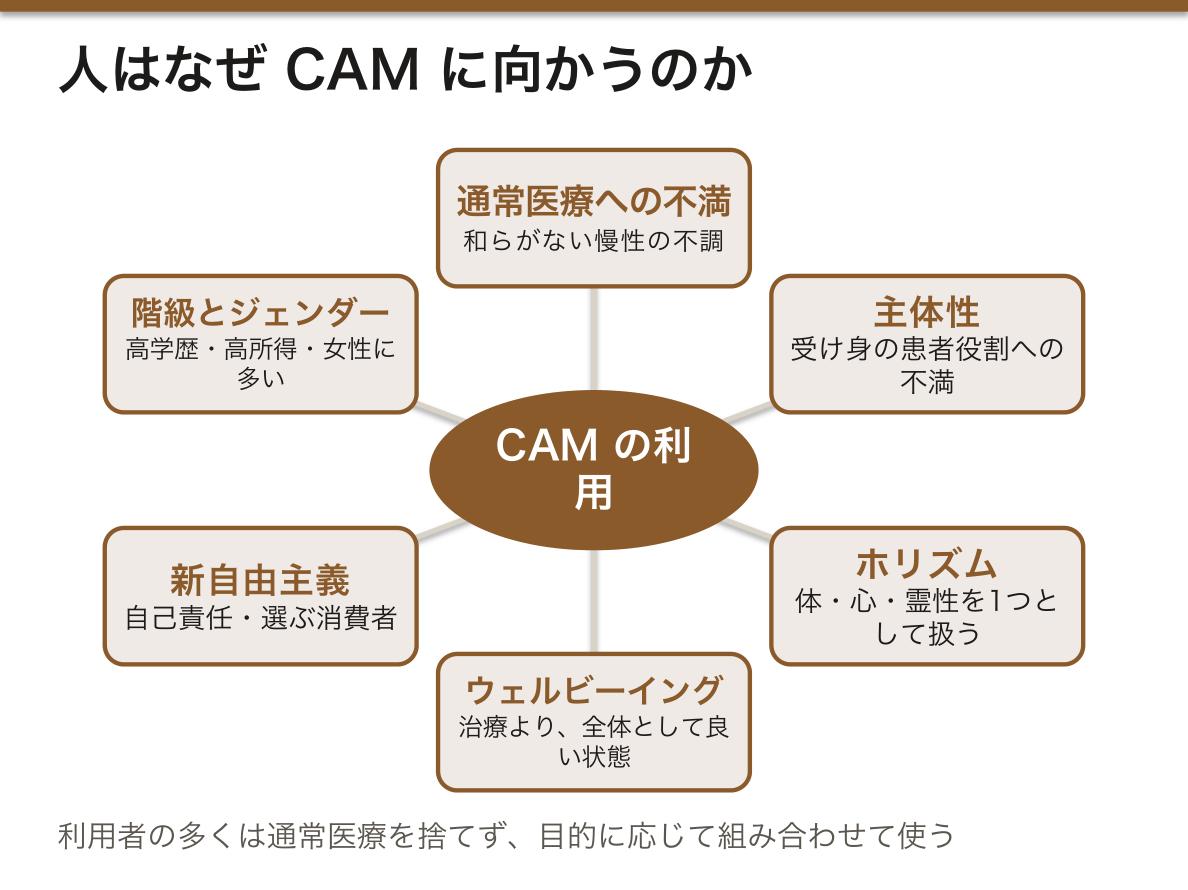
ただし、CAM の利用者は通常医療を捨てているわけではない。多くは目的を持って実用的に、通常医療と CAM を組み合わせて使い分ける(pragmatic mixing and matching)。風邪や筋骨格の痛み、慢性痛、医学的に説明のつかない症状に加えて、人生の困難や喪失への対処のためにも使われる。動機は1つではなく、同時にいくつもある。
そして CAM の利用の多くは、病気の治療よりwell-being(健康の維持と、全体としての良い状態)を目指している。ここでの well-being は、生理的な健康を超えて、充実感・幸福感・困難に対処できる力・楽観・自分の人生を統制している感覚・調和と均衡を含む。それは「自分に正直であること」「内なる声を聞くこと」という自己への気づきに支えられると考えられている。この well-being は科学的に測りにくく、病気を定義する権威を、医師から利用者と非医療の専門家の側へ移す。
患者が CAM を使っていると分かったとき、否定から入ると、患者は使っていることを話さなくなる。何を求めて使っているのか(意味づけか、主体性か、慢性症状への対処か)を聞くと、通常医療に足りないものが見える。薬との相互作用の確認のためにも、責めずに尋ねる姿勢が要る。
English version
Core
The first reason for the rise of CAM is dissatisfaction with conventional medicine, especially the wish to manage chronic problems that conventional medicine has not relieved.
More important sociologically, CAM use can be read as a critique of Parsons’s sick role. In the sick role, the patient is a passive receiver of the doctor’s expertise. CAM users want agency in their health care and a more active, responsible role in treatment and prevention. Dissatisfaction with the passive role pushes people to CAM. This also fits the decline of medical dominance. In the US, some Black people who have met racial discrimination in health care use CAM to take back control of their choices.
Next is the appeal of holism: treating body, mind and sometimes spirit as one, and giving “deeper” explanations that link mind and body. A physicalist biomedicine does not answer “Why me? Why now? What next?”, but CAM gives illness meaning and tailors treatment to each person. It is a counterpoint to standardised medicine.
Going further
But CAM users do not reject conventional medicine. Most are purposeful and pragmatic, mixing and matching both. They use CAM for colds, musculoskeletal pain, chronic pain and medically unexplained symptoms, and also to cope with life problems and losses. Several motives can exist at the same time.
Much CAM use aims at well-being (health maintenance and an overall good state), not at treating disease. Here well-being goes beyond physical health: fulfilment, happiness, the ability to cope, optimism, a sense of control over one’s life, harmony and balance. It is thought to rest on self-awareness — “being true to yourself,” “listening to the wisdom within.” This well-being is hard to measure scientifically, and it moves the authority to define illness from doctors toward users and non-medical practitioners.
In the clinic
If you start by rejecting a patient’s CAM use, the patient will stop telling you about it. Ask what they are looking for (meaning, agency, help with chronic symptoms); this shows what conventional care is missing. You also need to ask without blame to check for drug interactions.
人はなぜ CAM に向かうのか(2) — 新自由主義・階級・ジェンダー、そして「良い施術者」
新自由主義の気風——CAM が掲げる well-being は、個人の独自性・自己実現・自己責任という価値を体現している。自分を律し、自分を見張り、自律した自己を良しとする新自由主義の考え方が、CAM の領域にも染みこんでいる。患者は「選ぶ消費者」として治療を探し回ることができ、CAM はこの消費社会の枠にぴったり合う。一方で CAM は、巨大製薬企業の利益追求から自由な「商業的でない」医療だとも見られている。ただし、この「責任の物語」は病気を個人の問題にし、その背後の社会的・経済的な原因を見えなくするという批判がある。
階級——CAM の利用は、教育と所得の高い層に多い。治療費が自費になりやすいこと、そして CAM が重んじる内省と自己探求が中流階級の感情の文化と重なることが理由である。自分に向き合うには時間とお金という資源が要る。CAM を使いこなすことは、それ自体が一種の文化的健康資本である。
ジェンダー——利用者も施術者も女性が多い。女性は医療全般をよく使うこと、そして歴史的に正統医学から締め出された女性が、ホメオパシーなどの非正統の医療で学び働いてきたことが背景にある。直観や共感という「女性的」とされる資質が CAM の場で評価されてきた。
良い施術者の条件として利用者が語るのは、心から関心を持ってくれること、判断を下さず受け入れてくれること、思いやりがあること、そして施術者自身が落ち着いて「地に足がついている」ことである。これらは、時間が短く、症状と検査値に集中しがちな通常医療の診察で、患者が得にくいものでもある。
文化的には共鳴しながら、制度的には周縁にある——CAM はこう要約される。ヨーロッパでは鍼・ホメオパシー・カイロプラクティック・ハーブ療法・自然療法の多くが合法的に行われている。国や療法によっては公的保険が一部を払うこともあるが、多くは利用者の自費か民間の追加保険である。CAM は「自分に正直に」「全体として健康に」「自分で選ぶ」という現代の文化的な信念と深く響き合う。それでも制度の中で周縁にとどまるのは、生物医学の根拠の基準(科学的に測れる効果)で評価されにくいこと、そして医学の専門職が境界を引く力を持っていることによる。なぜ周縁なのに廃れないのか——人々が CAM に求めているのが、生物医学の言う「健康」ではなく、意味と自己のあり方だからである。
日本でも、鍼灸・柔道整復・あん摩マッサージ指圧は国家資格で、一部は保険の対象になる一方、多くの CAM は自費である。「誰が使えて、誰が使えないか」という階級の視点で見ると、CAM の利用は健康格差の1つの現れでもある。
English version
Core
Neoliberal ethos: the well-being promoted by CAM reflects individual uniqueness, self-fulfilment and self-responsibility. Neoliberal thinking values the self-regulating, self-watching, autonomous self, and this runs through CAM. Patients can shop around as “choosing consumers,” and CAM fits consumer society well. At the same time, CAM is often seen as non-commercial, free from the profit motive of “Big Pharma”. Critics say that this “narrative of responsibility” makes illness an individual matter and hides its social and economic causes.
Class: CAM use is more common among the more educated and affluent. Treatments are often paid out of pocket, and CAM’s stress on introspection and self-exploration matches middle-class emotional culture. Working on the self needs time and money. Using CAM well is itself a form of cultural health capital.
Gender: most users and practitioners are women. Women use health care more in general, and historically women excluded from regular medicine studied and worked in irregular healing such as homeopathy. “Feminine” qualities such as intuition and empathy have been valued in CAM.
Going further
Users describe a good practitioner as someone who is genuinely interested, non-judgemental and accepting, compassionate, and personally calm and “grounded”. These are things patients often do not get in short conventional visits focused on symptoms and test values.
CAM is summed up as culturally resonant but institutionally marginal. In Europe, acupuncture, homeopathy, chiropractic, herbal medicine and naturopathy are often legal. Depending on the country and the therapy, public insurance may pay part, but most costs are paid by users or by private extra insurance. CAM resonates with modern cultural beliefs: “be true to yourself,” “be healthy as a whole,” “choose for yourself.” It stays marginal because it is hard to judge by biomedical standards of evidence (measurable effects), and because the medical profession has the power to draw boundaries. Why does it not disappear? Because what people seek in CAM is meaning and a way of being oneself, not “health” in the biomedical sense.
In the clinic
In Japan, acupuncture and moxibustion, judo therapy, and massage therapy are national licences and some are covered by insurance, but most CAM is self-paid. Seen through class (who can use it and who cannot), CAM use is also one form of health inequality.
CAM による治癒をどう社会学的に読むか
「効かないのに、なぜ人は良くなったと感じるのか」への社会学的な答え。
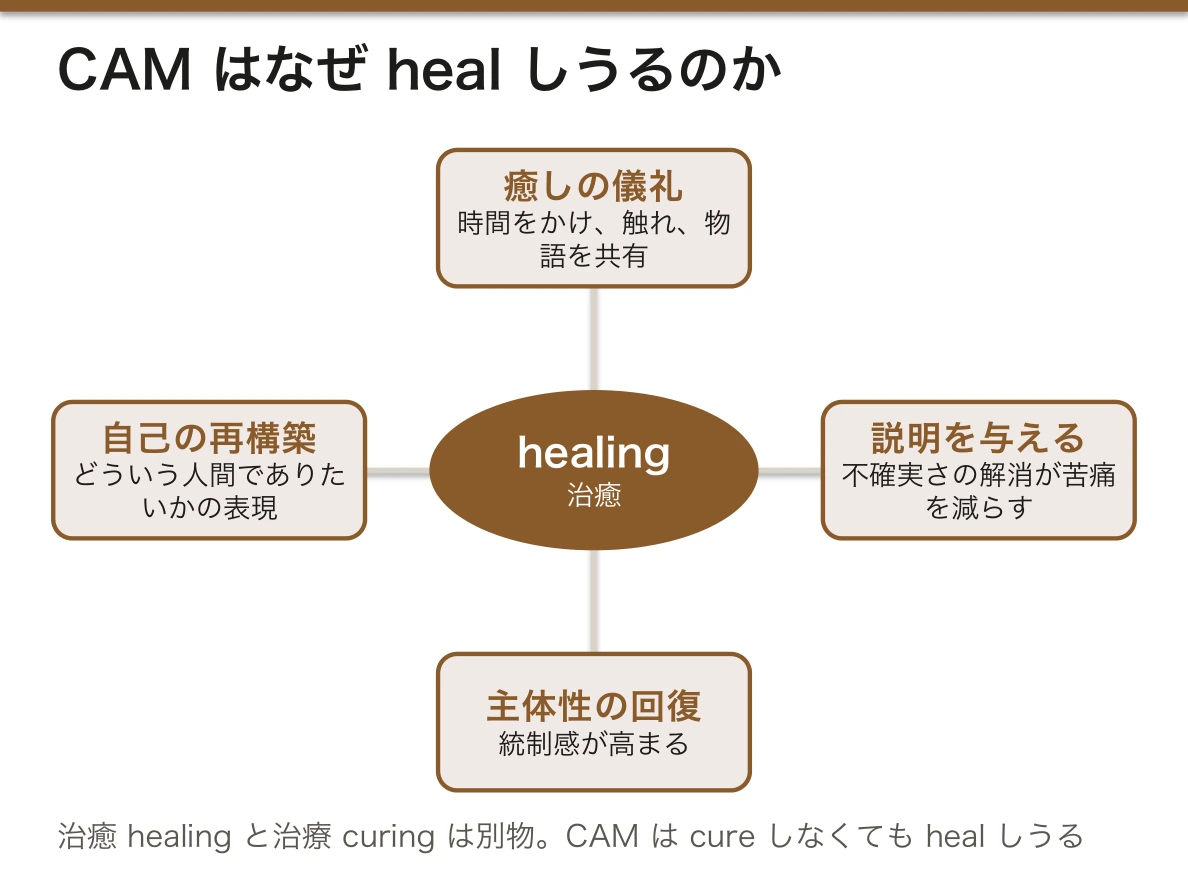
①癒しの儀礼としての側面——時間をかけ、触れ、物語を共有する。治療関係そのものが効果を持つ(meaning response)。
②説明を与えること——通常医療が「原因不明」と言う場面で、CAM は納得できる説明を与える。不確実さの解消それ自体が苦痛を減らす。
③主体性の回復——受動的な患者から、自分の健康を管理する主体へ。統制感の回復が well-being を上げる。
④自己アイデンティティの再構築——CAM の実践は「どういう人間でありたいか」の表現になる(Shilling の身体という企て)。
要点は「治癒 healing と治療 curing は別物だ」——CAM は cure しなくても heal しうる。そしてそれは通常医療が学ぶべき点でもある。
ここから通常医療は cure に強く heal に弱いという批判が導かれ、「医学の黄金時代」の章の統合医療と患者中心のケアへつながる。
English version
Core
The sociological answer to "if it does not work, why do people feel better?"
① The aspect of a healing ritual — time is taken, there is touch, a narrative is shared. The therapeutic relationship itself has an effect (the meaning response).
② Giving an explanation — where conventional medicine says "cause unknown", CAM offers an explanation that satisfies. Removing uncertainty itself reduces suffering.
③ The recovery of agency — from a passive patient to an agent managing one’s own health. The recovery of a sense of control raises well-being.
④ The reconstruction of self-identity — the practice of CAM becomes an expression of "what kind of person I want to be" (Shilling’s body as a project).
The point is that healing and curing are different things — CAM may heal without curing. And that is also what conventional medicine ought to learn.
Going further
From this follows the criticism that conventional medicine is strong at curing and weak at healing, leading to integrative medicine and patient-centred care in the chapter on the golden age of medicine.
まとめ
| CAM の定義と、主流医療への参入の歴史 | 定義の難しさ——CAM は内容ではなく「主流でないこと」によって定義される残余カテゴリーである。 |
|---|---|
| 人はなぜ CAM に向かうのか(1) — 受け身の患者役割への不満とホリズム | CAM が広がった理由として、まず挙げられるのは通常医療への不満である。 |
| 人はなぜ CAM に向かうのか(2) — 新自由主義・階級・ジェンダー、そして「良い施術者」 | 新自由主義の気風——CAM が掲げる well-being は、個人の独自性・自己実現・自己責任という価値を体現している。 |
| CAM による治癒をどう社会学的に読むか | 「効かないのに、なぜ人は良くなったと感じるのか」への社会学的な答え。 |
このノートは医学生が授業の内容を自分の言葉でまとめたもので、診療の判断に使うものではありません。誤りに気づいたらお知らせください。