名詞の格と数の章では主格と属格だけを見た。解剖用語ならそれで足りるが、臨床の言い回しには前置詞のあとに来る対格と奪格も要る。この章では第1変化と第2変化の4つの格を、単数・複数ともそろえる。
この2つの変化は数がいちばん多く、しかも第1群の形容詞(-us, -a, -um)がまったく同じ語尾で変化する。名詞の表を2枚覚えれば、形容詞の大半も一緒に片づく。
- 第1変化 — -a で終わる女性名詞
- 第2変化 — 男性 -us と中性 -um
- 複数の属格 — 「〜たちの」は -arum・-orum
- 第1群の形容詞 — 名詞と同じ語尾で変化する
- 略号と筋の名前 — 1文字なら単数、2文字なら複数
第1変化 — -a で終わる女性名詞Declinatio prima
主格単数が -a、属格単数が -ae の名詞で、ほぼすべて女性である。
| 格 | 単数 | 複数 |
|---|---|---|
| 主格 Nom. | vertebra | vertebrae |
| 属格 Gen. | vertebrae | vertebrarum |
| 対格 Acc. | vertebram | vertebras |
| 奪格 Abl. | vertebra | vertebris |
解剖では costa, vena, arteria, scapula, fossa, glandula, mandibula, maxilla, tibia, fibula, ulna、臨床では -ia で終わる病名・処置名(pneumonia, anaemia, therapia, hernia)と -ura(fractura, ruptura)がここに入る。
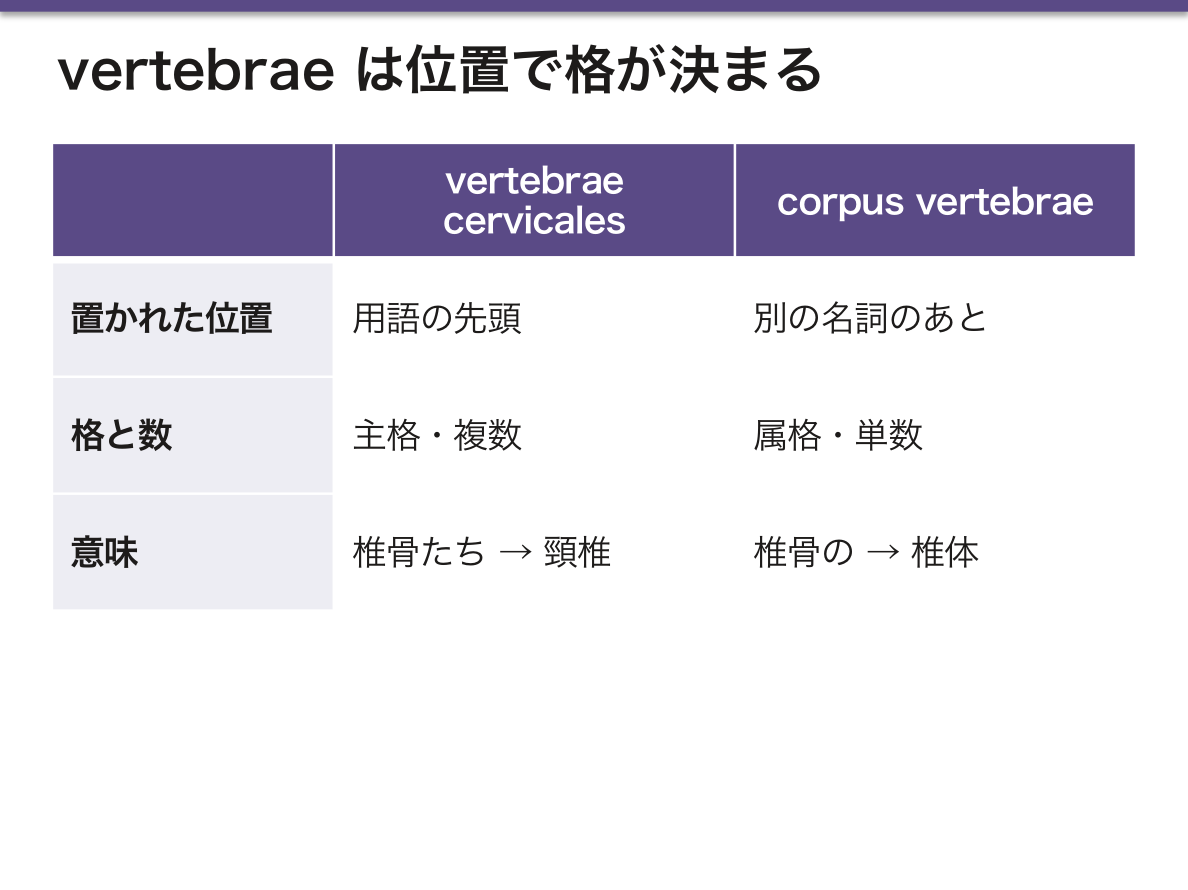
属格単数と主格複数が同じ -ae である。vertebrae だけを見ても「椎骨の」か「椎骨たち」かは決まらない。決め手は語順で、用語の先頭にあれば主格(複数)、別の名詞のあとにあれば属格と読む——vertebrae cervicales(頸椎、主格複数)と corpus vertebrae(椎体、属格単数)。
奪格単数は主格と同じ -a に見える。本来は長い ā だが、ふつうは書き分けない。奪格は前置詞のあとにしか出てこないので、前置詞があれば奪格と考えてよい(対格と奪格の章)。
-ia の病名は女性名詞なので、付く形容詞も -a になる。pneumonia acuta(急性肺炎)、anaemia perniciosa(悪性貧血)、gangraena sicca / humida(乾性・湿性壊疽)、fractura completa(完全骨折)。英語の pernicious anemia、dry gangrene は語順を逆にしただけである。
English version
Core
Nouns with nominative singular -a and genitive singular -ae. Almost all are feminine.
| Case | Singular | Plural |
|---|---|---|
| Nom. | vertebra | vertebrae |
| Gen. | vertebrae | vertebrarum |
| Acc. | vertebram | vertebras |
| Abl. | vertebra | vertebris |
In anatomy: costa, vena, arteria, scapula, fossa, glandula, mandibula, maxilla, tibia, fibula, ulna. In clinical language: names of diseases and procedures in -ia (pneumonia, anaemia, therapia, hernia) and in -ura (fractura, ruptura).
Going further
Genitive singular and nominative plural are both -ae. Vertebrae alone can mean “of the vertebra” or “vertebrae”. Word order decides: at the start of a term it is nominative (plural); after another noun it is genitive — vertebrae cervicales (cervical vertebrae, nom. pl.) and corpus vertebrae (body of the vertebra, gen. sg.).
The ablative singular looks like the nominative, -a. It was originally a long ā, but the length is not normally written. The ablative appears only after prepositions, so if there is a preposition, read it as ablative (chapter on accusative and ablative).
In the clinic
Disease names in -ia are feminine, so their adjectives end in -a: pneumonia acuta (acute pneumonia), anaemia perniciosa (pernicious anaemia), gangraena sicca / humida (dry / wet gangrene), fractura completa (complete fracture). English pernicious anemia and dry gangrene simply reverse the order.
第2変化 — 男性 -us と中性 -umDeclinatio secunda
属格単数が -i の名詞。-us(男性)と -um(中性)の2種類があり、複数で形が分かれる。
| 格 | 男性 単数 | 男性 複数 | 中性 単数 | 中性 複数 |
|---|---|---|---|---|
| 主格 | musculus | musculi | ligamentum | ligamenta |
| 属格 | musculi | musculorum | ligamenti | ligamentorum |
| 対格 | musculum | musculos | ligamentum | ligamenta |
| 奪格 | musculo | musculis | ligamento | ligamentis |
中性は主格と対格がいつも同じ形で、複数は -a になる。これは第3・第4変化の中性名詞にも共通する、中性の大原則である。
男性:nervus, musculus, humerus, digitus, ramus, lobus, nodus, sulcus, bronchus。中性:septum, sternum, cranium, cerebrum, labium, brachium, collum, dorsum, tuberculum。
例外的な形が2つある。①-er で終わる男性名詞:cancer, cancri(e が落ちる)/puer, pueri(e が残る)。どちらになるかは属格を見ないとわからない。②-on で終わるギリシャ語の中性名詞:ganglion, ganglii(複数 ganglia)、colon, coli。対格も -on のままである。
見間違えやすい組——中性複数の -a は第1変化の女性単数と同じ形に見える。ligamenta flava(黄色靱帯、中性複数)と vena cava(大静脈、女性単数)は語尾だけでは区別できず、名詞の辞書形で判断する。また -ius / -ium の語の属格は -ii になる:basis cranii(頭蓋底)、processus styloideus radii(橈骨茎状突起)。
胃潰瘍は ulcus ventriculi、十二指腸潰瘍は ulcus duodeniである。ventriculi・duodeni はどちらも第2変化の属格(-i)で、「胃の潰瘍」「十二指腸の潰瘍」と読む。ドイツ語圏や北欧の医学では、こうしたラテン語の病名を語尾ごとそのまま使う伝統が強い。
English version
Core
Nouns with genitive singular -i. There are two kinds, -us (masculine) and -um (neuter), which part ways in the plural.
| Case | Masc. sg. | Masc. pl. | Neut. sg. | Neut. pl. |
|---|---|---|---|---|
| Nom. | musculus | musculi | ligamentum | ligamenta |
| Gen. | musculi | musculorum | ligamenti | ligamentorum |
| Acc. | musculum | musculos | ligamentum | ligamenta |
| Abl. | musculo | musculis | ligamento | ligamentis |
In neuters the nominative and accusative are always the same, and the plural ends in -a. This is the basic law of the neuter and holds in the third and fourth declensions too.
Masculine: nervus, musculus, humerus, digitus, ramus, lobus, nodus, sulcus, bronchus. Neuter: septum, sternum, cranium, cerebrum, labium, brachium, collum, dorsum, tuberculum.
Going further
Two irregular types. (1) Masculines in -er: cancer, cancri (the e drops) and puer, pueri (the e stays). Only the genitive tells you which. (2) Greek neuters in -on: ganglion, ganglii (plural ganglia), colon, coli. Their accusative also stays -on.
A pair that is easy to confuse: the neuter plural -a looks like a first-declension feminine singular. Ligamenta flava (neuter plural) and vena cava (feminine singular) cannot be told apart by the ending; the noun’s dictionary form decides. Also, words in -ius / -ium have the genitive -ii: basis cranii (base of the skull), processus styloideus radii (styloid process of the radius).
In the clinic
Gastric ulcer is ulcus ventriculi; duodenal ulcer is ulcus duodeni. Ventriculi and duodeni are second-declension genitives (-i): “ulcer of the stomach”, “ulcer of the duodenum”. German-speaking and Nordic medicine have a strong tradition of using such Latin disease names with their endings intact.
複数の属格 — 「〜たちの」は -arum・-orumGenetivus pluralis
「複数のものの〜」を言うときは属格の複数を使う。第1変化は -arum、第2変化は -orum である。
| 用語 | 分解 | 日本語 |
|---|---|---|
| Musculus flexor digitorum profundus | digitus の属格複数 | 深指屈筋(指たちの深い屈筋) |
| Musculus extensor digitorum | 同上 | 指伸筋 |
| Ossa digitorum | 同上 | 指骨 |
| Musculus quadratus lumborum | lumbus の属格複数 | 腰方形筋 |
| Musculi levatores costarum | costa の属格複数 | 肋骨挙筋 |
単数の属格と並べると違いがはっきりする。Musculus abductor digiti minimi(小指外転筋)は1本の指(単数 digiti)、Musculus flexor digitorum は複数の指を動かす筋である。語尾が筋の作用範囲を教えている。
-arum・-orum の a・o は長いので、強勢は必ずそこに来る:cos-TA-rum、digi-TO-rum。カタカナではコスタールム・ディギトールムになる。
5つの変化の属格複数を並べると、-rum を持つのは第1・第2・第5だけである。
| 変化 | 属格複数 | 例 |
|---|---|---|
| 第1 | -arum | costarum |
| 第2 | -orum | digitorum, nervorum |
| 第3 | -um / -ium | capitum, ossium |
| 第4 | -uum | ductuum |
| 第5 | -erum | facierum |
第3変化の -um と -ium の使い分けは第3変化の章で扱う。
English version
Core
To say “of the (several) …”, use the genitive plural: -arum in the first declension and -orum in the second.
| Term | Analysis | Meaning |
|---|---|---|
| Musculus flexor digitorum profundus | gen. pl. of digitus | flexor digitorum profundus (deep flexor of the fingers) |
| Musculus extensor digitorum | same | extensor digitorum |
| Ossa digitorum | same | phalanges (bones of the digits) |
| Musculus quadratus lumborum | gen. pl. of lumbus | quadratus lumborum |
| Musculi levatores costarum | gen. pl. of costa | levatores costarum |
Comparing with the singular genitive makes the difference clear. Musculus abductor digiti minimi acts on one finger (singular digiti); musculus flexor digitorum moves several. The ending tells you the muscle’s range of action.
Going further
The a and o of -arum and -orum are long, so the stress always falls on them: cos-TA-rum, digi-TO-rum. In katakana: コスタールム, ディギトールム.
Setting out the genitive plurals of all five declensions shows that only the first, second and fifth have -rum.
| Declension | Gen. pl. | Example |
|---|---|---|
| 1st | -arum | costarum |
| 2nd | -orum | digitorum, nervorum |
| 3rd | -um / -ium | capitum, ossium |
| 4th | -uum | ductuum |
| 5th | -erum | facierum |
The choice between -um and -ium in the third declension is covered in the third-declension chapter.
第1群の形容詞 — 名詞と同じ語尾で変化するDexter, dextra, dextrum
辞書形は longus, a, um のように、男性形を全部書き、女性・中性は語尾だけを示す。男性と中性は第2変化、女性は第1変化とまったく同じ語尾で変わる。
| 男性 | 女性 | 中性 | |
|---|---|---|---|
| 主格単数 | longus | longa | longum |
| 属格単数 | longi | longae | longi |
| 主格複数 | longi | longae | longa |
| 属格複数 | longorum | longarum | longorum |
例:Musculus longus colli(頸長筋)、Arteria profunda femoris(大腿深動脈)、Ligamenta flava(黄色靱帯)、Sinus rectus(直静脈洞)、Substantia alba(白質)、Corpus luteum(黄体)。
-er で終わる形容詞は、e が落ちるものと残るものがある。
| 辞書形 | 女性形 | 使われる用語 |
|---|---|---|
| dexter, tra, trum(右の) | dextra | manus dextra |
| sinister, tra, trum(左の) | sinistra | vena renalis sinistra |
| ruber, bra, brum(赤い) | rubra | nucleus ruber(赤核) |
| niger, gra, grum(黒い) | nigra | substantia nigra(黒質) |
| asper, era, erum(粗い) | aspera | linea aspera(大腿骨の粗線) |
linea aspera だけ e が残るのは、asper がもともと e を落とさない形容詞だからである。辞書形の「, a, um」か「, tra, trum」かを見れば区別できる。
名詞がどの変化でも、形容詞は性に合わせるだけである。ductus thoracicus(胸管:第4変化の男性)の属格は ductus thoracici——名詞は -us のまま、形容詞だけが -i に変わる。
Parkinson 病で変性するのは substantia nigra(黒質)のドパミン神経細胞である。nigra(黒い)はメラニンを含む細胞が肉眼で黒く見えることから付いた名前で、Parkinson 病の脳ではこの黒さが薄くなるのが肉眼でもわかる。形容詞の意味がそのまま病理所見になっている例である。
English version
Core
The dictionary form, such as longus, a, um, gives the full masculine and only the endings for feminine and neuter. Masculine and neuter decline exactly like the second declension, and feminine like the first.
| Masc. | Fem. | Neut. | |
|---|---|---|---|
| Nom. sg. | longus | longa | longum |
| Gen. sg. | longi | longae | longi |
| Nom. pl. | longi | longae | longa |
| Gen. pl. | longorum | longarum | longorum |
Examples: Musculus longus colli (longus colli), Arteria profunda femoris (deep femoral artery), Ligamenta flava (ligamenta flava), Sinus rectus (straight sinus), Substantia alba (white matter), Corpus luteum (corpus luteum).
Going further
Adjectives in -er either drop the e or keep it.
| Dictionary form | Feminine | Term |
|---|---|---|
| dexter, tra, trum (right) | dextra | manus dextra |
| sinister, tra, trum (left) | sinistra | vena renalis sinistra |
| ruber, bra, brum (red) | rubra | nucleus ruber (red nucleus) |
| niger, gra, grum (black) | nigra | substantia nigra |
| asper, era, erum (rough) | aspera | linea aspera (of the femur) |
Only linea aspera keeps the e, because asper is one of the adjectives that never drops it. The dictionary form (“, a, um” or “, tra, trum”) tells you which.
Whatever the noun’s declension, the adjective only matches its gender. The genitive of ductus thoracicus (thoracic duct; fourth declension, masculine) is ductus thoracici: the noun stays -us and only the adjective changes to -i.
In the clinic
In Parkinson’s disease the dopaminergic neurons of the substantia nigra degenerate. Nigra (“black”) was named for the melanin-containing cells that look black to the naked eye, and in a Parkinsonian brain this blackness fades visibly. Here the meaning of an adjective is itself a pathological finding.
略号と筋の名前 — 1文字なら単数、2文字なら複数Abbreviationes
解剖用語の略号は、同じ文字を2つ重ねると複数になる。
| 単数 | 複数 | 意味 |
|---|---|---|
| A. | Aa. | arteria / arteriae(動脈) |
| V. | Vv. | vena / venae(静脈) |
| N. | Nn. | nervus / nervi(神経) |
| M. | Mm. | musculus / musculi(筋) |
| R. | Rr. | ramus / rami(枝) |
| Lig. | Ligg. | ligamentum / ligamenta(靱帯) |
| Gl. | Gll. | glandula / glandulae(腺) |
例:Aa. intercostales posteriores(肋間動脈)、Nn. intercostales、Mm. interossei(骨間筋)。
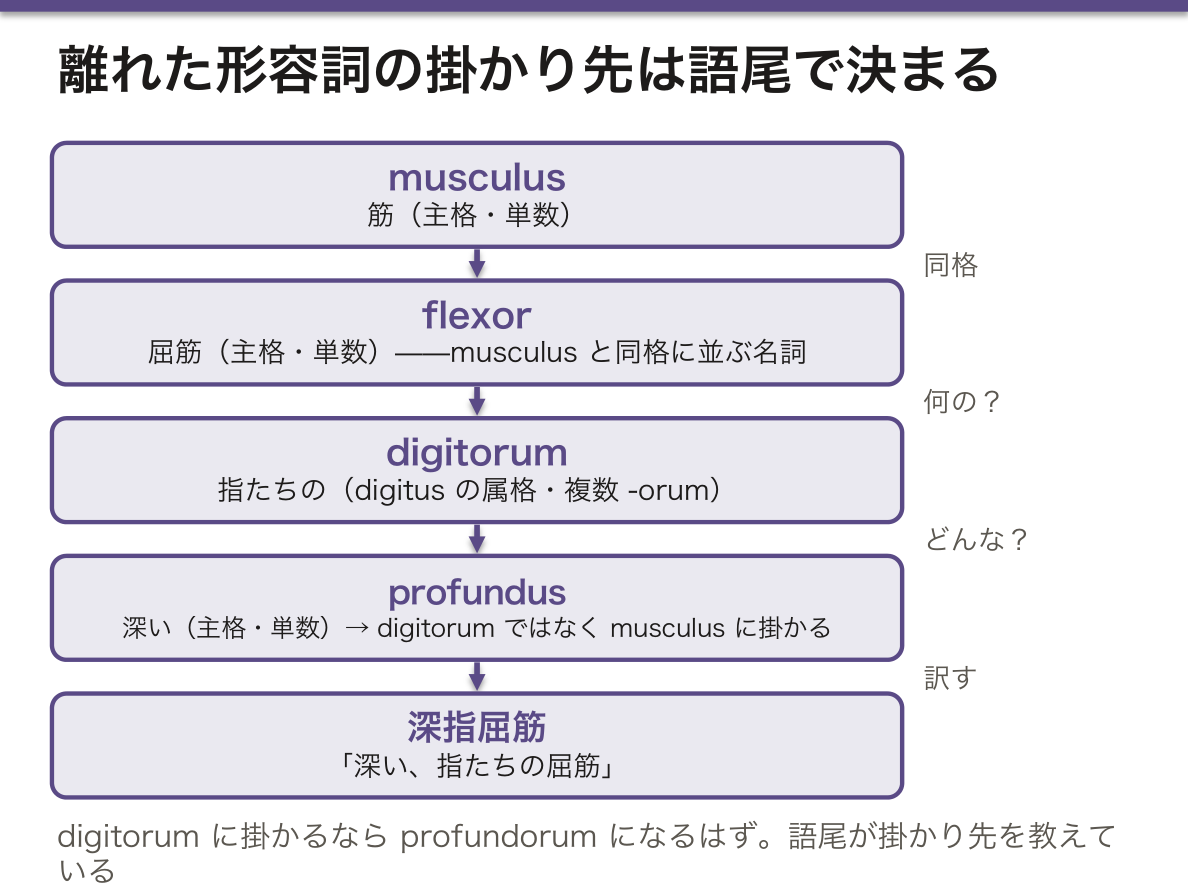
筋の名前には「名詞+名詞」が並ぶものがある。flexor(曲げるもの)・extensor・abductor・adductor・levator・depressor はそれ自体が第3変化の男性名詞で、musculus と同格に並ぶ。だから格を変えるときは2つとも変わる:musculus flexor → 属格 musculi flexoris、複数 musculi flexores、複数属格 musculorum flexorum。
Musculus flexor digitorum profundus の語順の謎もこれで解ける。profundus は digitorum(属格複数)に掛かるなら profundorum になるはずなので、主格の musculus に掛かっている——「深い、指たちの屈筋」である。語尾を見れば、離れた形容詞がどの名詞に掛かるかがわかる。
手術記録や画像の報告書では、a. femoralis・v. saphena magna・n. medianus のように小文字の略号で書くことが多い。aa.・nn. と重なっていれば複数という規則はここでも同じである。
English version
Core
In anatomical abbreviations, doubling the letter makes a plural.
| Singular | Plural | Meaning |
|---|---|---|
| A. | Aa. | arteria / arteriae |
| V. | Vv. | vena / venae |
| N. | Nn. | nervus / nervi |
| M. | Mm. | musculus / musculi |
| R. | Rr. | ramus / rami |
| Lig. | Ligg. | ligamentum / ligamenta |
| Gl. | Gll. | glandula / glandulae |
Examples: Aa. intercostales posteriores, Nn. intercostales, Mm. interossei.
Going further
Some muscle names put two nouns side by side. Flexor (“one that bends”), extensor, abductor, adductor, levator and depressor are themselves third-declension masculine nouns, standing in apposition to musculus. So when the case changes, both change: musculus flexor → gen. musculi flexoris, pl. musculi flexores, gen. pl. musculorum flexorum.
This also solves the word order of Musculus flexor digitorum profundus. If profundus belonged to digitorum (gen. pl.), it would be profundorum. So it belongs to the nominative musculus: “the deep flexor of the fingers”. The ending shows which noun a distant adjective belongs to.
In the clinic
Operation notes and imaging reports often use lower-case abbreviations: a. femoralis, v. saphena magna, n. medianus. The rule is the same: doubled letters (aa., nn.) mean plural.
まとめ
| 第1変化 — -a で終わる女性名詞 | 主格単数が -a、属格単数が -ae の名詞で、ほぼすべて女性である。 |
|---|---|
| 第2変化 — 男性 -us と中性 -um | 属格単数が -i の名詞。-us(男性)と -um(中性)の2種類があり、複数で形が分かれる。 |
| 複数の属格 — 「〜たちの」は -arum・-orum | 「複数のものの〜」を言うときは属格の複数を使う。 |
| 第1群の形容詞 — 名詞と同じ語尾で変化する | 辞書形は longus, a, um のように、男性形を全部書き、女性・中性は語尾だけを示す。 |
| 略号と筋の名前 — 1文字なら単数、2文字なら複数 | 解剖用語の略号は、同じ文字を2つ重ねると複数になる。 |
このノートは医学生が授業の内容を自分の言葉でまとめたもので、診療の判断に使うものではありません。誤りに気づいたらお知らせください。