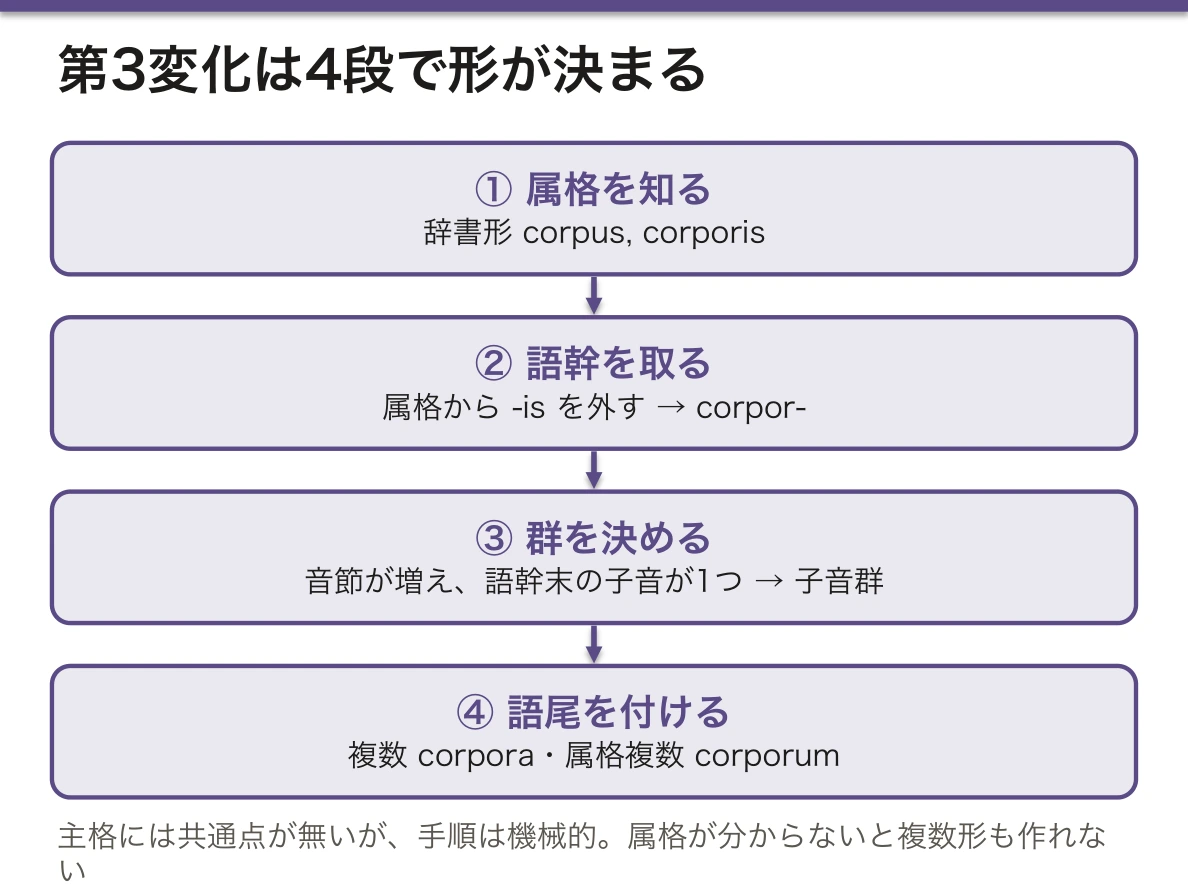
第3変化は語数がいちばん多く、主格の形がいちばんばらばらである。pulmo, radix, os, caput, femur, foramen——主格を見ても共通点が無い。だが手順は機械的で、①属格を知る → ②語幹を取り出す → ③3つの群のどれかを決める → ④語尾を付けるの4段で必ず決まる。
この章は名詞を扱う。第3変化の形容詞(-alis, -aris など)と比較級は次の章にある。
- 語幹 — 属格から -is を外したもの
- 性 — 語尾の規則と、解剖で出る例外
- 3つの群 — 違いは複数属格の -um か -ium か
- 不規則な名詞 — 語幹が臨床用語にそのまま出る
- -ma の中性名詞 — 語幹は -mat-
- -io の名詞 — 処置と出来事の名前
語幹 — 属格から -is を外したものDeclinatio tertia
第3変化の名詞は属格単数がすべて -isで、-is を外した残りが語幹である。主格以外の格は、すべてこの語幹に語尾を付けて作る。
| 主格の語尾 | 属格 | 例 |
|---|---|---|
| -o | -onis / -inis | pulmo, pulmonis/tendo, tendinis/margo, marginis |
| -or | -oris | flexor, flexoris |
| -er | -eris / -ris | trochanter, trochanteris/venter, ventris |
| -es | -edis / -etis | pes, pedis/paries, parietis |
| -ex / -ix | -icis | apex, apicis/cortex, corticis/radix, radicis |
| -io | -ionis | regio, regionis |
| -as | -atis | cavitas, cavitatis |
| -ns / -rs | -ntis / -rtis | dens, dentis/pars, partis |
| -yx / -nx | -ygis / -ngis | coccyx, coccygis/larynx, laryngis |
| -ax / -ux | -acis / -ucis | thorax, thoracis/hallux, hallucis |
| -ut | -itis | caput, capitis/occiput, occipitis |
| -ur | -oris | femur, femoris |
| -en | -inis | foramen, foraminis/abdomen, abdominis |
| -us(中性) | -oris / -eris | corpus, corporis/tempus, temporis/ulcus, ulceris |
なぜ主格は語幹を隠すのか。語末で子音がぶつかって形が崩れたからである。radic-+s が radix(c と s が合わさって x)、coccyg-+s が coccyx、laryng-+s が larynx、dent-+s が dens(t が落ちる)、ped-+s が pes(d が落ちる)。だから本当の形は属格のほうにあり、辞書は必ず属格を添える。
語幹は形容詞と英語の派生語に生きている。pulmon- → pulmonalis/cervic- → cervicalis/tempor- → temporalis/occipit- → occipitalis/femor- → femoralis/cortic- → corticalis。英語でも radical, dental, pedal, corporal, marginal は語幹から作られている。形容詞を見て元の名詞を逆算できるのはこのためである。
English version
Core
Every third-declension noun has the genitive singular -is, and what remains when you remove -is is the stem. Every case except the nominative is made by adding an ending to this stem.
| Nom. ending | Genitive | Example |
|---|---|---|
| -o | -onis / -inis | pulmo, pulmonis / tendo, tendinis / margo, marginis |
| -or | -oris | flexor, flexoris |
| -er | -eris / -ris | trochanter, trochanteris / venter, ventris |
| -es | -edis / -etis | pes, pedis / paries, parietis |
| -ex / -ix | -icis | apex, apicis / cortex, corticis / radix, radicis |
| -io | -ionis | regio, regionis |
| -as | -atis | cavitas, cavitatis |
| -ns / -rs | -ntis / -rtis | dens, dentis / pars, partis |
| -yx / -nx | -ygis / -ngis | coccyx, coccygis / larynx, laryngis |
| -ax / -ux | -acis / -ucis | thorax, thoracis / hallux, hallucis |
| -ut | -itis | caput, capitis / occiput, occipitis |
| -ur | -oris | femur, femoris |
| -en | -inis | foramen, foraminis / abdomen, abdominis |
| -us (neuter) | -oris / -eris | corpus, corporis / tempus, temporis / ulcus, ulceris |
Going further
Why does the nominative hide the stem? Because consonants collided at the end of the word and the form wore down. Radic- + s gives radix (c and s merge into x), coccyg- + s gives coccyx, laryng- + s gives larynx, dent- + s gives dens (the t drops), ped- + s gives pes (the d drops). So the true form is in the genitive, and dictionaries always give it.
The stem lives on in adjectives and English derivatives. Pulmon- → pulmonalis, cervic- → cervicalis, tempor- → temporalis, occipit- → occipitalis, femor- → femoralis, cortic- → corticalis. In English, radical, dental, pedal, corporal and marginal are built on the stem too. This is why you can work back from an adjective to its noun.
性 — 語尾の規則と、解剖で出る例外Exceptiones
第3変化の性は主格の語尾でおおよそ決まる。
| 性 | 主格の語尾 |
|---|---|
| 男性 | -o, -or, -os, -er, -es, -ex |
| 女性 | -io, -go, -do, -as, -is, -ix, -ux, -yx, -ax, -nx, -rs, -ns |
| 中性 | -ur, -us, -ut, -en, -ma, -c, -l, -ar, -al, -e |
ところが解剖でよく使う語ほど例外が多い。
| 規則では | 実際は | 語 |
|---|---|---|
| 女性 | 男性 | tendo, margo, dens, canalis, sanguis, unguis, thorax, larynx, pharynx, hallux, coccyx |
| 男性 | 中性 | cor(心臓), os(骨・口), tuber, cadaver |
| 男性 | 女性 | gaster(胃), mater(髄膜の「母」) |
| 中性 | 男性 | ren(腎), lien・splen(脾) |
例外が問題になるのは、第1群の形容詞を付けたときである。-alis のような第3変化の形容詞は男女同形なので、名詞の性を間違えても見た目は変わらない(canalis vertebralis、margo lateralis)。だが -us/-a/-um の形容詞は性をはっきり見せる。
| 用語 | 見える性 | 日本語 |
|---|---|---|
| Tendo calcaneus | 男性(tendo は女性ではない) | 踵骨腱(アキレス腱) |
| Dura mater/Pia mater | 女性(dura, pia) | 硬膜・軟膜 |
| Ren dexter | 男性 | 右腎 |
| Lien accessorius | 男性 | 副脾 |
| Os longum/Os coxae | 中性 | 長骨・寛骨 |
「-do は女性」の規則どおりに tendo calcanea と書くのが典型的な誤りである。よく使う例外は、形容詞と組にして覚えるのがいちばん確実である。
肺性心は cor pulmonale——形容詞の語尾 -e が、cor が中性であることを示している(男性・女性なら pulmonalis)。肺疾患による肺高血圧で右心室が肥大・拡張した状態で、英語でも日本語の論文でもラテン語のまま使われる。
English version
Core
In the third declension, gender can roughly be read from the nominative ending.
| Gender | Nominative endings |
|---|---|
| Masculine | -o, -or, -os, -er, -es, -ex |
| Feminine | -io, -go, -do, -as, -is, -ix, -ux, -yx, -ax, -nx, -rs, -ns |
| Neuter | -ur, -us, -ut, -en, -ma, -c, -l, -ar, -al, -e |
However, the words used most in anatomy have the most exceptions.
| Rule says | Actually | Words |
|---|---|---|
| feminine | masculine | tendo, margo, dens, canalis, sanguis, unguis, thorax, larynx, pharynx, hallux, coccyx |
| masculine | neuter | cor (heart), os (bone; mouth), tuber, cadaver |
| masculine | feminine | gaster (stomach), mater (“mother” of the meninges) |
| neuter | masculine | ren (kidney), lien and splen (spleen) |
Going further
Exceptions matter when a first-group adjective is attached. Third-declension adjectives such as -alis have one form for masculine and feminine, so a wrong gender is invisible (canalis vertebralis, margo lateralis). But -us/-a/-um adjectives show the gender plainly.
| Term | Gender shown | Meaning |
|---|---|---|
| Tendo calcaneus | masculine (tendo is not feminine) | calcaneal (Achilles) tendon |
| Dura mater / Pia mater | feminine (dura, pia) | dura mater, pia mater |
| Ren dexter | masculine | right kidney |
| Lien accessorius | masculine | accessory spleen |
| Os longum / Os coxae | neuter | long bone, hip bone |
Writing tendo calcanea because “-do is feminine” is the typical mistake. Learn the common exceptions paired with an adjective; that is the safest way.
In the clinic
Pulmonary heart disease is cor pulmonale. The adjective’s ending -e shows that cor is neuter (masculine or feminine would be pulmonalis). It is enlargement of the right ventricle caused by pulmonary hypertension from lung disease, and the Latin form is used as is in English and Japanese papers alike.
3つの群 — 違いは複数属格の -um か -ium かOs, ossis
第3変化の名詞は子音群・母音群・混合群に分かれる。語尾の表は次のとおりで、違いが出るのはごく一部である。
| 子音群 | 混合群 | 母音群 | |
|---|---|---|---|
| 主格複数(男・女) | -es | -es | -es |
| 主格複数(中性) | -a | -a | -ia |
| 属格複数 | -um | -ium | -ium |
| 対格単数(男・女) | -em | -em | -im(ギリシャ語の -is) |
| 奪格単数 | -e | -e | -i |
| 奪格複数 | -ibus | -ibus | -ibus |
| 群 | どんな語か | 例 |
|---|---|---|
| 子音群 | 主格より属格の音節が多く、語幹末の子音が1つ | caput → capita, capitum/foramen → foramina, foraminum/pulmo → pulmones, pulmonum |
| 混合群 | ①主格と属格の音節数が同じ、または②語幹末に子音が2つ | cutis, canalis, auris/dens → dentium、pars → partium、os → ossa, ossium |
| 母音群 | -ar・-al・-e の中性、ギリシャ語の -is(女性)、febris・pelvis・tussis | rete → retia, retium/calcar/basis, dosis, diagnosis |
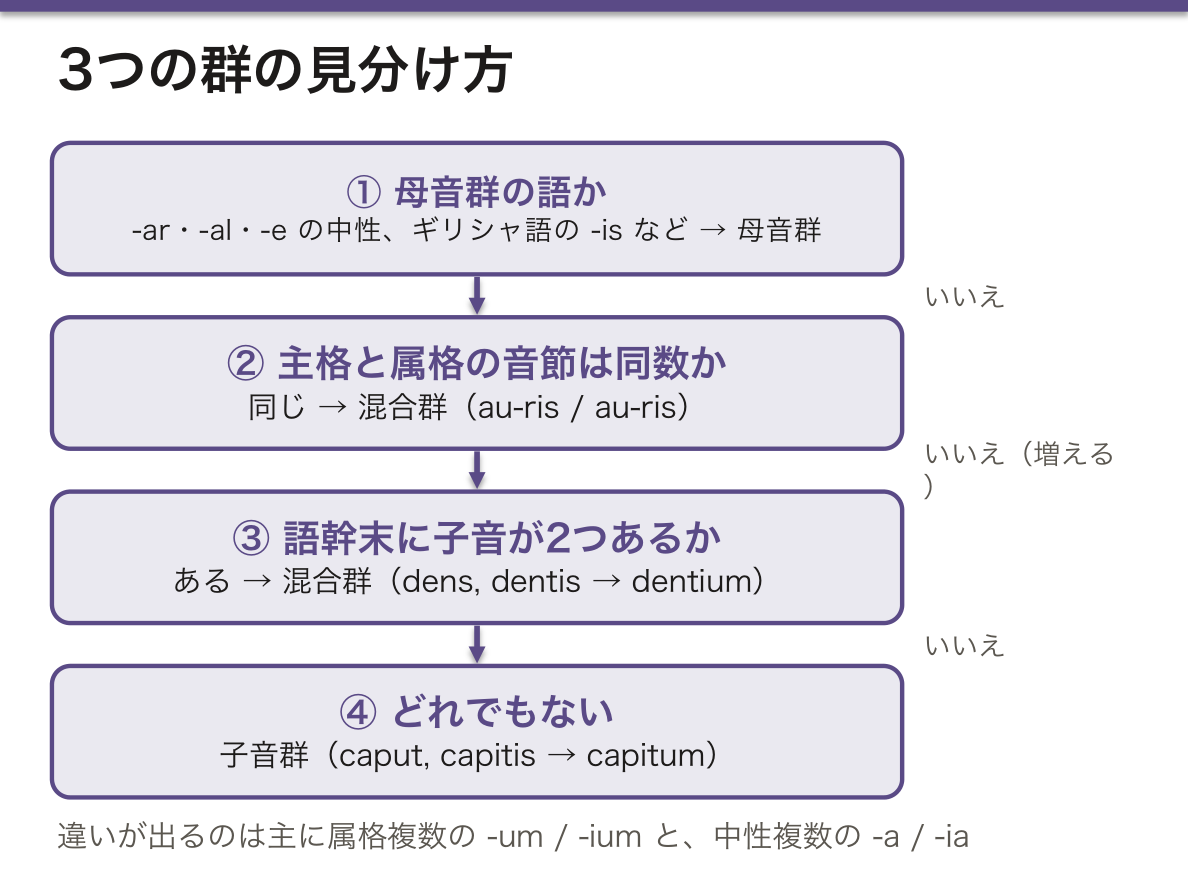
主格と属格の音節を数えれば群が決まる。au-ris / au-ris は同数なので混合群、dens / den-tis は音節が増えるが語幹 dent- の末尾に子音が2つ(n と t)あるので混合群、ca-put / ca-pi-tis は音節が増えて語幹末の子音が t 1つなので子音群である。
母音群の中性が -ia になるのは、語幹がもともと i で終わっていた名残である。だから rete testis(精巣網)の複数は reta ではなく retia になる。os(骨)の複数が ossa で、属格複数が ossium なのは混合群だからで、中性の主格複数は -a、属格複数だけ -ium という組み合わせになる。
English version
Core
Third-declension nouns fall into a consonant group, a mixed group and a vowel group. The endings are below; they differ in only a few places.
| Consonant | Mixed | Vowel | |
|---|---|---|---|
| Nom. pl. (m., f.) | -es | -es | -es |
| Nom. pl. (n.) | -a | -a | -ia |
| Gen. pl. | -um | -ium | -ium |
| Acc. sg. (m., f.) | -em | -em | -im (Greek -is) |
| Abl. sg. | -e | -e | -i |
| Abl. pl. | -ibus | -ibus | -ibus |
| Group | What kind of word | Examples |
|---|---|---|
| Consonant | more syllables in the genitive than the nominative, and one consonant at the end of the stem | caput → capita, capitum / foramen → foramina, foraminum / pulmo → pulmones, pulmonum |
| Mixed | (1) same number of syllables in nom. and gen., or (2) two consonants at the end of the stem | cutis, canalis, auris / dens → dentium, pars → partium, os → ossa, ossium |
| Vowel | neuters in -ar, -al, -e; Greek feminines in -is; febris, pelvis, tussis | rete → retia, retium / calcar / basis, dosis, diagnosis |
Going further
Count the syllables of the nominative and genitive and the group follows. Au-ris / au-ris has the same number, so it is mixed. Dens / den-tis gains a syllable, but its stem dent- ends in two consonants (n and t), so it is mixed too. Ca-put / ca-pi-tis gains a syllable and its stem ends in one consonant (t), so it is consonant-group.
Vowel-group neuters take -ia because their stems once ended in i. So the plural of rete testis is not reta but retia. Os (bone) has the plural ossa and the genitive plural ossium because it is mixed-group: a neuter nominative plural in -a, but a genitive plural in -ium.
不規則な名詞 — 語幹が臨床用語にそのまま出るVasa vasorum
vas, vasis(中性、血管・管)は、単数は第3変化、複数は第2変化で変わる。
| 格 | 単数 | 複数 |
|---|---|---|
| 主格 | vas | vasa |
| 属格 | vasis | vasorum |
| 対格 | vas | vasa |
| 奪格 | vase | vasis |
Vasa vasorum(脈管の脈管)は、大きな血管の壁を養う細い血管のことで、vasa(主格複数)と vasorum(属格複数)の2語とも vas である。ほかに vas lymphaticum(リンパ管)、vasa recta(直細血管)。
ほかにも主格から語幹が読めない語がある。
| 辞書形 | 語幹 | 注意 |
|---|---|---|
| hepar, hepatis n | hepat- | -ar なのに子音群・中性 |
| pancreas, pancreatis n | pancreat- | -as なのに中性 |
| gaster, gastris f | gastr- | -er なのに女性 |
| cor, cordis n | cord- | 語幹に d が現れる |
こうした語の語幹は、そのまま臨床用語の語根になっている。hepar → hepatitis・hepaticus、pancreas → pancreatitis(pancreitis ではない)、gaster → gastritis・gastricus、cor → cordis(apex cordis 心尖)。属格を知っていれば、病名の綴りを間違えない。
cor はラテン語の名詞として解剖用語(apex cordis, basis cordis)に使われ、病名や検査名ではギリシャ語の cardi-(cardiologia, electrocardiogramma)に替わる。この二本立てはギリシャ語の語根の章で扱う。
vasa vasorum は大動脈の病気で名前が出る。梅毒性大動脈炎では vasa vasorum が炎症で狭くなり、壁の中膜が栄養を失って弱り、大動脈瘤になる。高安動脈炎のような大血管炎でも、炎症は外膜の vasa vasorum の周りから始まると考えられている。
English version
Core
Vas, vasis (neuter; vessel, duct) is third-declension in the singular and second-declension in the plural.
| Case | Singular | Plural |
|---|---|---|
| Nom. | vas | vasa |
| Gen. | vasis | vasorum |
| Acc. | vas | vasa |
| Abl. | vase | vasis |
Vasa vasorum (“vessels of the vessels”) are the small vessels that nourish the wall of a large vessel; both words, vasa (nom. pl.) and vasorum (gen. pl.), are vas. Also vas lymphaticum (lymphatic vessel) and vasa recta.
Some other words do not show their stem in the nominative.
| Dictionary form | Stem | Note |
|---|---|---|
| hepar, hepatis n | hepat- | ends in -ar but is consonant-group and neuter |
| pancreas, pancreatis n | pancreat- | ends in -as but is neuter |
| gaster, gastris f | gastr- | ends in -er but is feminine |
| cor, cordis n | cord- | a d appears in the stem |
Going further
The stems of these words are the roots of clinical terms. Hepar → hepatitis, hepaticus; pancreas → pancreatitis (not “pancreitis”); gaster → gastritis, gastricus; cor → cordis (apex cordis). If you know the genitive, you will not misspell the disease.
Cor is used as a Latin noun in anatomical terms (apex cordis, basis cordis), while names of diseases and tests switch to the Greek cardi- (cardiologia, electrocardiogramma). This double system is covered in the chapter on Greek roots.
In the clinic
Vasa vasorum come up in aortic disease. In syphilitic aortitis, inflammation narrows the vasa vasorum, the media loses its blood supply and weakens, and an aneurysm forms. In large-vessel vasculitis such as Takayasu arteritis, too, inflammation is thought to begin around the vasa vasorum of the adventitia.
-ma の中性名詞 — 語幹は -mat-Trauma, traumatis
-ma で終わるギリシャ語由来の名詞は中性で、属格は -matis、複数は -mata になる。
| 格 | 単数 | 複数 |
|---|---|---|
| 主格 | trauma | traumata |
| 属格 | traumatis | traumatum |
| 対格 | trauma | traumata |
| 奪格 | traumate | traumatibus |
このグループ:trauma, carcinoma, adenoma, oedema, eczema, erythema, symptoma, syndroma, systema, asthma, coma, diaphragma, stroma。
第1変化の -a(女性)と見た目が同じなので、語尾だけで判断すると性を間違える。angina pectoris(狭心症)の angina は第1変化の女性、pectoris は pectus, pectoris(中性・第3変化)の属格である。
なぜ -mat- か。ギリシャ語の語幹がもともと -mat- で、主格だけが短くなっている。英語の形容詞はどれも語幹から作られている:traumatic, symptomatic, systematic, oedematous, erythematous, carcinomatous。ラテン語の形容詞も同じで、traumaticus, systematicus になる。
複数は -mata が正式だが、英語では carcinomas のように英語式の複数もよく使う。古い文献や病理の記述で carcinomata・stigmata を見たら、これのことである。
中性なので、付く形容詞は -um・-eになる。皮膚科ではこれがそのまま病名になっている:erythema nodosum(結節性紅斑)、erythema multiforme(多形紅斑)。ほかに asthma bronchiale(気管支喘息)、systema nervosum centrale(中枢神経系)。-oma(腫瘍)もすべて中性で、lymphoma malignum・melanoma malignum であって maligna ではない。
English version
Core
Greek nouns ending in -ma are neuter, with the genitive -matis and the plural -mata.
| Case | Singular | Plural |
|---|---|---|
| Nom. | trauma | traumata |
| Gen. | traumatis | traumatum |
| Acc. | trauma | traumata |
| Abl. | traumate | traumatibus |
This group: trauma, carcinoma, adenoma, oedema, eczema, erythema, symptoma, syndroma, systema, asthma, coma, diaphragma, stroma.
They look like first-declension feminines in -a, so judging by the ending alone gives the wrong gender. In angina pectoris, angina is a first-declension feminine, and pectoris is the genitive of pectus, pectoris (neuter, third declension).
Going further
Why -mat-? The Greek stem was -mat- all along; only the nominative is shortened. English adjectives are all built on the stem: traumatic, symptomatic, systematic, oedematous, erythematous, carcinomatous. Latin adjectives do the same: traumaticus, systematicus.
The proper plural is -mata, though English often uses its own plural, as in carcinomas. If you meet carcinomata or stigmata in older texts or pathology reports, this is what they are.
In the clinic
Because they are neuter, their adjectives end in -um or -e. In dermatology these are the disease names themselves: erythema nodosum, erythema multiforme. Also asthma bronchiale (bronchial asthma) and systema nervosum centrale (central nervous system). Every -oma (tumour) is neuter too: lymphoma malignum, melanoma malignum, not maligna.
-io の名詞 — 処置と出来事の名前Commotio cerebri
-tio・-sio で終わる名詞は女性・子音群で、属格は -ionis、複数は -iones になる。動詞から作った「〜すること」の名詞で、英語の -tion・-sion に当たる。
| 名詞 | 元の動詞 | 意味 |
|---|---|---|
| amputatio | amputare(切り取る) | 切断 |
| incisio | incidere(切り込む) | 切開 |
| punctio | pungere(刺す) | 穿刺 |
| luxatio | luxare(外す) | 脱臼 |
| transfusio | transfundere(移し注ぐ) | 輸血・輸液 |
| commotio | commovere(揺り動かす) | 振盪 |
| contusio | contundere(打ち砕く) | 挫傷 |
女性なので形容詞も女性形:punctio lumbalis(腰椎穿刺)、transfusio sanguinis(輸血:sanguis の属格)、commotio cerebri(脳振盪)、contusio cerebri(脳挫傷)。
強勢は -ti-o の直前に来る(ti が母音の前で短いため):ampu-TA-tio、articu-LA-tio。属格 -ionis では長い ō に強勢が移って ampu-ta-ti-O-nis になる。カタカナではアンプターツィオ。
commotio と contusio は別の状態である。commotio cerebri(脳振盪)は画像で見える構造の損傷が無い一過性の機能障害、contusio cerebri(脳挫傷)は脳実質そのものの損傷である。「揺り動かす」と「打ち砕く」という元の動詞の違いが、そのまま病態の違いになっている。
日本の整形外科には、ラテン語の略号が残っている。LCC は luxatio coxae congenita(先天性股関節脱臼)の頭文字で、luxatio(脱臼)+ coxae(coxa の属格「股関節の」)+ congenita(先天性の、女性形)と読める。現在は発育の過程で起こるという考えから DDH(発育性股関節形成不全)と呼ぶことが勧められているが、LCC という言い方もまだ耳にする。
English version
Core
Nouns in -tio and -sio are feminine and consonant-group, with the genitive -ionis and the plural -iones. They are nouns of action made from verbs, matching English -tion and -sion.
| Noun | Verb | Meaning |
|---|---|---|
| amputatio | amputare (cut off) | amputation |
| incisio | incidere (cut into) | incision |
| punctio | pungere (prick) | puncture |
| luxatio | luxare (put out of joint) | dislocation |
| transfusio | transfundere (pour across) | transfusion |
| commotio | commovere (shake) | concussion |
| contusio | contundere (crush) | contusion |
Being feminine, they take feminine adjectives: punctio lumbalis (lumbar puncture), transfusio sanguinis (blood transfusion; genitive of sanguis), commotio cerebri (concussion), contusio cerebri (cerebral contusion).
Going further
The stress falls just before -ti-o (the ti is short before a vowel): ampu-TA-tio, articu-LA-tio. In the genitive -ionis it moves to the long ō: ampu-ta-ti-O-nis. In katakana: アンプターツィオ.
Commotio and contusio are different conditions. Commotio cerebri (concussion) is a transient loss of function without structural damage visible on imaging; contusio cerebri is damage to the brain tissue itself. The difference between the original verbs, “shake” and “crush”, is the difference in pathology.
In the clinic
Japanese orthopaedics still uses a Latin abbreviation: LCC stands for luxatio coxae congenita (congenital dislocation of the hip) — luxatio (dislocation) + coxae (genitive of coxa, “of the hip”) + congenita (congenital, feminine). The term DDH (developmental dysplasia of the hip) is now recommended, because the condition develops over time, but LCC is still heard.
まとめ
| 語幹 — 属格から -is を外したもの | 第3変化の名詞は属格単数がすべて -isで、-is を外した残りが語幹である。 |
|---|---|
| 性 — 語尾の規則と、解剖で出る例外 | 第3変化の性は主格の語尾でおおよそ決まる。 |
| 3つの群 — 違いは複数属格の -um か -ium か | 第3変化の名詞は子音群・母音群・混合群に分かれる。 |
| 不規則な名詞 — 語幹が臨床用語にそのまま出る | vas, vasis(中性、血管・管)は、単数は第3変化、複数は第2変化で変わる。 |
| -ma の中性名詞 — 語幹は -mat- | -ma で終わるギリシャ語由来の名詞は中性で、属格は -matis、複数は -mata になる。 |
| -io の名詞 — 処置と出来事の名前 | -tio・-sio で終わる名詞は女性・子音群で、属格は -ionis、複数は -iones になる。 |
このノートは医学生が授業の内容を自分の言葉でまとめたもので、診療の判断に使うものではありません。誤りに気づいたらお知らせください。