形容詞には2つの群がある。第1群(-us, -a, -um)は第1・第2変化の章で済ませた。この章は第2群=第3変化の形容詞と、比較級・最上級を扱う。
解剖用語の形容詞でいちばん多いのは -alis・-aris で、これが第2群である。比較級(superior, major)と最上級(maximus)も、どれが対になっているかがわかると、用語の意味が立体的に見えてくる。
- 2語尾の形容詞 — 男女が -is、中性が -e
- 形容詞の接尾辞 — 語尾で意味の種類がわかる
- 1語尾の形容詞 — 3つの性で同じ形、語幹は属格に
- 比較級 — 中性の -ius を見落とさない
- 最上級と不規則な比較 — major と maximus が並ぶ理由
2語尾の形容詞 — 男女が -is、中性が -eBrevis, breve
辞書形は brevis, e のように書く。男性と女性が -is、中性だけが -e である。変化は第3変化の母音群に従う。
| 男性・女性 | 中性 | |
|---|---|---|
| 主格単数 | vertebralis | vertebrale |
| 属格単数 | vertebralis | vertebralis |
| 主格複数 | vertebrales | vertebralia |
| 属格複数 | vertebralium | vertebralium |
| 奪格単数 | vertebrali | vertebrali |
canalis vertebralis(男)・columna vertebralis(女)・foramen vertebrale(中)。複数では musculi intercostales(男)・vertebrae cervicales(女)・spatia intercostalia(中、肋間隙)・ossa brevia(中、短骨)。
中性単数の -e を奪格と間違えない。os occipitale、foramen ovale(卵円孔)、septum nasale、ligamentum inguinale(鼠径靱帯)の -e は主格である。また男女が同じ形なので、この形容詞からは名詞が男性か女性かはわからない(margo lateralis/pars lateralis)。
なぜ -ia・-ium なのか。母音群で変化するので、名詞の os が ossa(-a)なのに形容詞は brevia(-ia)という食い違いが起きる。Nuclei nervorum cranialium(脳神経核)は、nervorum(第2変化の属格複数 -orum)と cranialium(第3変化形容詞の属格複数 -ium)が並ぶ例である。
3語尾の形容詞(acer, acris, acre/celer, celeris, celere)もあるが、解剖用語ではほとんど使わない。
臨床の形容詞も -alis が多い:hernia inguinalis(鼠径ヘルニア)、diagnosis differentialis(鑑別診断)、hepatitis viralis(ウイルス性肝炎)、punctio lumbalis(腰椎穿刺)。病名の多くが女性名詞なので、-is のまま変わらないことが多い。
English version
Core
The dictionary form is written brevis, e. Masculine and feminine end in -is; only the neuter ends in -e. They decline like the vowel group of the third declension.
| Masc. / Fem. | Neut. | |
|---|---|---|
| Nom. sg. | vertebralis | vertebrale |
| Gen. sg. | vertebralis | vertebralis |
| Nom. pl. | vertebrales | vertebralia |
| Gen. pl. | vertebralium | vertebralium |
| Abl. sg. | vertebrali | vertebrali |
Canalis vertebralis (m.), columna vertebralis (f.), foramen vertebrale (n.). In the plural: musculi intercostales (m.), vertebrae cervicales (f.), spatia intercostalia (n., intercostal spaces), ossa brevia (n., short bones).
Going further
Do not mistake the neuter singular -e for an ablative. The -e in os occipitale, foramen ovale, septum nasale and ligamentum inguinale is nominative. And because masculine and feminine are the same, these adjectives do not tell you the noun’s gender (margo lateralis / pars lateralis).
Why -ia and -ium? Because they decline like the vowel group, you get the mismatch ossa (-a) for the noun but brevia (-ia) for the adjective. Nuclei nervorum cranialium (nuclei of the cranial nerves) shows nervorum (second-declension gen. pl. -orum) next to cranialium (third-declension adjective gen. pl. -ium).
There are also three-ending adjectives (acer, acris, acre; celer, celeris, celere), but anatomy hardly uses them.
In the clinic
Clinical adjectives are often -alis too: hernia inguinalis (inguinal hernia), diagnosis differentialis (differential diagnosis), hepatitis viralis (viral hepatitis), punctio lumbalis (lumbar puncture). Since most disease names are feminine, the -is form usually stays unchanged.
形容詞の接尾辞 — 語尾で意味の種類がわかるSuffixa adiectivorum
形容詞の接尾辞にはそれぞれ決まった意味の方向がある。知らない形容詞でも、語尾でおおよその意味がつかめる。
| 接尾辞 | 意味 | 例 |
|---|---|---|
| -alis / -aris | 〜に関する | costalis, vertebralis, articularis, palmaris |
| -eus | 〜でできた | osseus(骨性の), cartilagineus, cutaneus |
| -osus | 〜に富む・〜の多い | venosus, fibrosus, spinosus, mucosus |
| -icus(ギ) | 〜の | gastricus, thoracicus, hepaticus |
| -inus | 〜に属する | palatinus, uterinus, caninus |
| -oideus / -oidalis(ギ) | 〜の形をした | deltoideus, mastoideus, xiphoideus, sphenoidalis |
| -formis | 〜の形をした | piriformis(洋梨形), cruciformis(十字形) |
| -atus | 〜を備えた | dentatus(歯のある), serratus(鋸歯のある) |
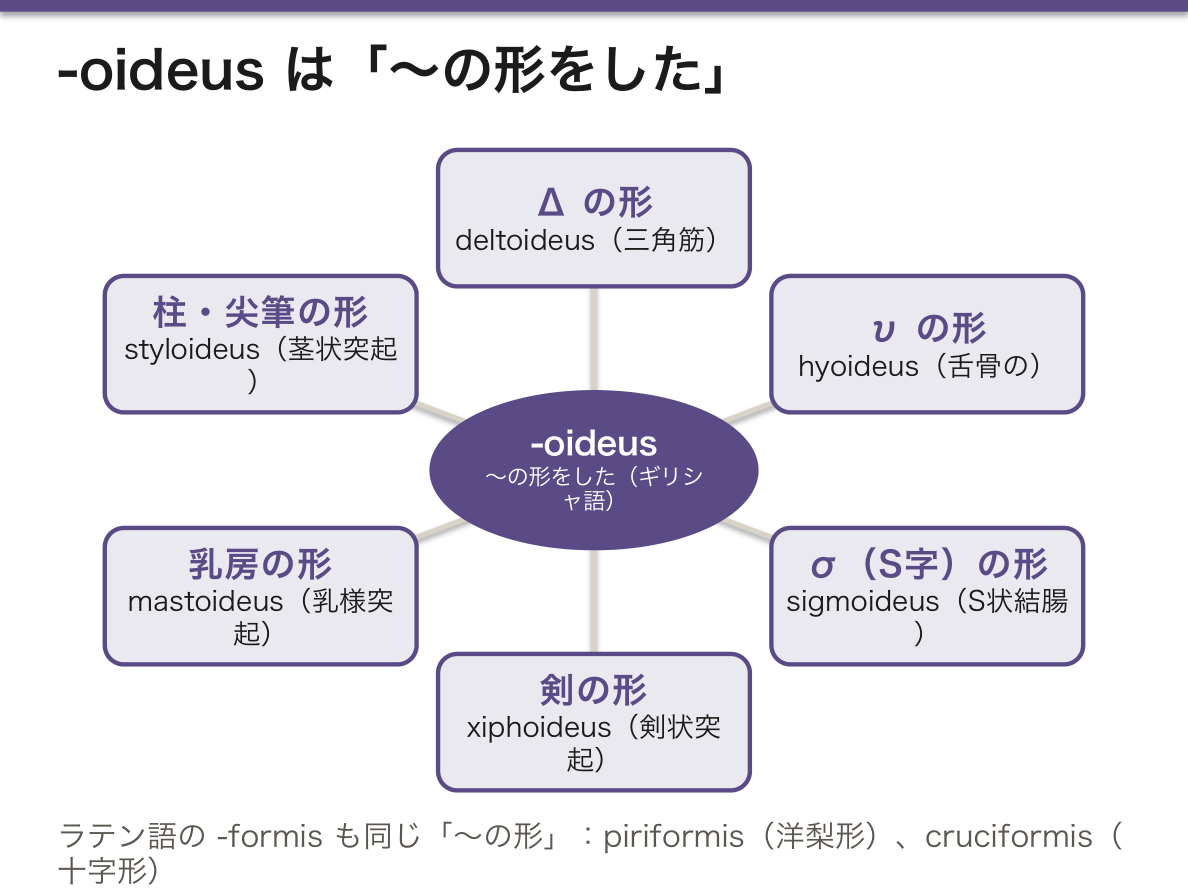
-oideus(ギリシャ語)と -formis(ラテン語)は同じ「〜の形」である。-oideus の形は覚えておくと用語の絵が浮かぶ:deltoideus(Δ の形)、hyoideus(υ の形)、sigmoideus(σ=S字の形:colon sigmoideum)、xiphoideus(剣の形)、mastoideus(乳房の形)、ethmoidalis(篩の形)、sphenoidalis(楔の形)、styloideus(柱・尖筆の形)。
-alis と -aris の使い分けには目安がある。語幹に l があると -arisになりやすい(同じ音の繰り返しを避けるため):articul-aris、mandibul-aris、maxill-aris、palm-aris、scapul-aris、capill-aris。l が無ければ -alis:vertebr-alis、cost-alis、femor-alis。ただし lingualis・lateralis のように例外もあるので、最後は辞書形で確かめる。
-osus(形容詞)と -osis(名詞)を混同しない。fibrosus は「線維に富む」(anulus fibrosus 線維輪)、fibrosis は「線維化という状態」である。
病名につく形容詞もこの語尾で読める。colitis ulcerosa(潰瘍性大腸炎:潰瘍の多い大腸炎)、erythema nodosum(結節の多い紅斑)、status epilepticus(てんかん性の状態)、nephropathia diabetica(糖尿病性腎症)。英語の ulcerative colitis, nodular erythema と並べると、語順が逆なだけだとわかる。
English version
Core
Each adjective suffix points to a particular kind of meaning. Even with an unfamiliar adjective, the ending gives you the rough sense.
| Suffix | Meaning | Examples |
|---|---|---|
| -alis / -aris | relating to | costalis, vertebralis, articularis, palmaris |
| -eus | made of | osseus (bony), cartilagineus, cutaneus |
| -osus | full of, rich in | venosus, fibrosus, spinosus, mucosus |
| -icus (Gk.) | of, belonging to | gastricus, thoracicus, hepaticus |
| -inus | belonging to | palatinus, uterinus, caninus |
| -oideus / -oidalis (Gk.) | shaped like | deltoideus, mastoideus, xiphoideus, sphenoidalis |
| -formis | shaped like | piriformis (pear-shaped), cruciformis (cross-shaped) |
| -atus | provided with | dentatus (toothed), serratus (saw-toothed) |
Going further
-oideus (Greek) and -formis (Latin) both mean “shaped like”. The shapes behind -oideus help you picture the term: deltoideus (like Δ), hyoideus (like υ), sigmoideus (like σ, an S: colon sigmoideum), xiphoideus (like a sword), mastoideus (like a breast), ethmoidalis (like a sieve), sphenoidalis (like a wedge), styloideus (like a pillar or stylus).
There is a guide for choosing -alis or -aris. If the stem contains an l, -aris is likely (to avoid repeating the same sound): articul-aris, mandibul-aris, maxill-aris, palm-aris, scapul-aris, capill-aris. Without an l, -alis: vertebr-alis, cost-alis, femor-alis. But there are exceptions such as lingualis and lateralis, so check the dictionary form in the end.
Do not confuse -osus (adjective) with -osis (noun). Fibrosus means “rich in fibres” (anulus fibrosus); fibrosis is “the state of fibrosis”.
In the clinic
The adjectives in disease names read the same way: colitis ulcerosa (ulcerative colitis: colitis full of ulcers), erythema nodosum (erythema with many nodules), status epilepticus, nephropathia diabetica (diabetic nephropathy). Set next to English ulcerative colitis or diabetic nephropathy, they differ only in word order.
1語尾の形容詞 — 3つの性で同じ形、語幹は属格にTeres, teretis
主格単数が男・女・中性で同じ形の形容詞。辞書形は名詞と同じく主格と属格を並べる(teres, teretis)。属格から語幹を取り、母音群で変化させる。
| 辞書形 | 意味 | 用語 |
|---|---|---|
| teres, teretis | 丸い | Musculus teres major(大円筋)、Ligamentum teres hepatis(肝円索) |
| biceps, bicipitis | 2つの頭をもつ | Musculus biceps brachii(上腕二頭筋) |
| triceps, tricipitis | 3つの頭をもつ | Musculus triceps surae(下腿三頭筋) |
| quadriceps, quadricipitis | 4つの頭をもつ | Musculus quadriceps femoris(大腿四頭筋) |
| impar, imparis | 対をなさない | Ganglion impar(不対神経節) |
| simplex, simplicis | 単純な | — |
| multiplex, multiplicis | 多数の | — |
Musculus teres(男)でも Ligamentum teres(中)でも teres のまま変わらない。
-ceps は caput(頭)から来ている。bi-ceps=2つの頭。だから属格の語幹 -cipit- の中に caput の語幹 capit- が見える(複合語の中で a が i に弱まった形)。Caput longum musculi bicipitis brachii(上腕二頭筋の長頭)は、caput と bicipitis の両方に「頭」が入っている用語である。
surae は sura(ふくらはぎ、第1変化)の属格である。下腿三頭筋は「ふくらはぎの三頭筋」で、腓腹筋の2頭とヒラメ筋の1頭を合わせて3頭と数える。
臨床でも1語尾の形容詞はよく出る。sclerosis multiplex(多発性硬化症)、myeloma multiplex(多発性骨髄腫)、pubertas praecox(思春期早発症)。英語の multiple sclerosis, multiple myeloma は語順を逆にして英語化した形で、略称 MS・MM もここから来ている。
English version
Core
Adjectives whose nominative singular is the same for masculine, feminine and neuter. Like nouns, the dictionary form gives the nominative and the genitive (teres, teretis). Take the stem from the genitive and decline it like the vowel group.
| Dictionary form | Meaning | Term |
|---|---|---|
| teres, teretis | round | Musculus teres major (teres major), Ligamentum teres hepatis (round ligament of the liver) |
| biceps, bicipitis | two-headed | Musculus biceps brachii |
| triceps, tricipitis | three-headed | Musculus triceps surae |
| quadriceps, quadricipitis | four-headed | Musculus quadriceps femoris |
| impar, imparis | unpaired | Ganglion impar |
| simplex, simplicis | simple | — |
| multiplex, multiplicis | multiple | — |
Teres stays teres with musculus teres (m.) and with ligamentum teres (n.).
Going further
-ceps comes from caput (head). Bi-ceps = two heads. That is why the genitive stem -cipit- contains capit-, the stem of caput (the a weakened to i inside a compound). Caput longum musculi bicipitis brachii (long head of biceps brachii) has “head” in both caput and bicipitis.
Surae is the genitive of sura (calf; first declension). Triceps surae is “the three-headed muscle of the calf”: the two heads of gastrocnemius and the one of soleus.
In the clinic
One-ending adjectives appear in clinical terms too: sclerosis multiplex (multiple sclerosis), myeloma multiplex (multiple myeloma), pubertas praecox (precocious puberty). English multiple sclerosis and multiple myeloma reverse the order, and the abbreviations MS and MM come from them.
比較級 — 中性の -ius を見落とさないMajor, majus
比較級は語幹に -ior(男性・女性)/-ius(中性)を付ける。変化は第3変化の子音群である。
| 男性・女性 | 中性 | |
|---|---|---|
| 主格単数 | superior | superius |
| 属格単数 | superioris | superioris |
| 主格複数 | superiores | superiora |
| 属格複数 | superiorum | superiorum |
中性の -ius がいちばんの落とし穴である。第2変化の -us に見えるが、比較級の中性単数である。
| 中性(-ius) | 男性・女性(-ior) |
|---|---|
| Tuberculum majus / minus(大結節・小結節) | Trochanter major / minor(大転子・小転子) |
| Omentum majus / minus(大網・小網) | Musculus pectoralis major / minor |
| Labium superius / inferius(上唇・下唇) | Vena cava superior / inferior |
| Cornu anterius / posterius(前角・後角) | Ala major / minor(蝶形骨の大翼・小翼) |
属格は -ioris になる:Crista tuberculi majoris(大結節稜)、Musculus levator labii superioris(上唇挙筋)。主格の majus・superius とは形が大きく変わるので、属格の形も覚えておく。
なぜ子音群か。語幹が superior- のように r 1つで終わり、属格で音節が増えるからである。だから中性複数は -a(anteriora)で、-alis 型の -ia(brevia)とは違う。同じ第3変化の形容詞でも、比較級だけは子音群になる。
比較級は「より〜」なので、必ず対で存在する。majus があれば minus があり、superior があれば inferior がある。用語に比較級を見たら、もう片方がどこにあるかを思い浮かべると位置関係が整理できる。
脳梗塞の責任血管を言うときに比較級が並ぶ:arteria cerebri anterior / media / posterior(前・中・後大脳動脈)。arteria が女性なので anterior・posterior は男女同形の -ior、media は第1群の女性形である。中大脳動脈が最も梗塞の多い血管で、その名前の media は比較級ではなく「中間の」という普通の形容詞である。
English version
Core
The comparative adds -ior (masculine and feminine) / -ius (neuter) to the stem and declines like the consonant group of the third declension.
| Masc. / Fem. | Neut. | |
|---|---|---|
| Nom. sg. | superior | superius |
| Gen. sg. | superioris | superioris |
| Nom. pl. | superiores | superiora |
| Gen. pl. | superiorum | superiorum |
The neuter -ius is the main trap. It looks like a second-declension -us, but it is the neuter singular of the comparative.
| Neuter (-ius) | Masc. / Fem. (-ior) |
|---|---|
| Tuberculum majus / minus (greater / lesser tubercle) | Trochanter major / minor |
| Omentum majus / minus (greater / lesser omentum) | Musculus pectoralis major / minor |
| Labium superius / inferius (upper / lower lip) | Vena cava superior / inferior |
| Cornu anterius / posterius (anterior / posterior horn) | Ala major / minor (greater / lesser wing of the sphenoid) |
Going further
The genitive is -ioris: Crista tuberculi majoris (crest of the greater tubercle), Musculus levator labii superioris. It looks very different from the nominative majus or superius, so learn the genitive as well.
Why the consonant group? Because the stem, like superior-, ends in a single r, and the genitive adds a syllable. So the neuter plural is -a (anteriora), not the -ia of the -alis type (brevia). Among third-declension adjectives, only comparatives follow the consonant group.
A comparative means “more …”, so it always comes in a pair. If there is majus there is minus; if there is superior there is inferior. When you see a comparative in a term, picture where its partner is; this sorts out the spatial relations.
In the clinic
Comparatives line up when you name the artery responsible for a stroke: arteria cerebri anterior / media / posterior. Arteria is feminine, so anterior and posterior are the shared masculine–feminine -ior form, while media is a first-group feminine. The middle cerebral artery is the commonest site of infarction, and its media is not a comparative but an ordinary adjective meaning “middle”.
最上級と不規則な比較 — major と maximus が並ぶ理由Maximus, minimus
最上級は -issimus, -a, -um で、第1群の形容詞と同じに変化する。latus(広い)→ latissimus(Musculus latissimus dorsi 広背筋:「背中の最も広い筋」)、longus → longissimus(Musculus longissimus 最長筋)。
ところが解剖でよく使う形容詞は比較が不規則である。
| 原級 | 比較級 | 最上級 | 用語 |
|---|---|---|---|
| magnus(大きい) | major | maximus | Musculus gluteus maximus |
| parvus(小さい) | minor | minimus | Digitus minimus(小指) |
| superus(上の) | superior | supremus | Concha nasalis suprema(最上鼻甲介) |
| inferus(下の) | inferior | infimus | — |
| posterus(後の) | posterior | postremus | Area postrema(最後野) |
magnum と majus と maximum がまったく違う形なのに同じ語の3段階だとわかれば、foramen magnum(大孔)・tuberculum majus・gluteus maximus を1つの系列として読める。
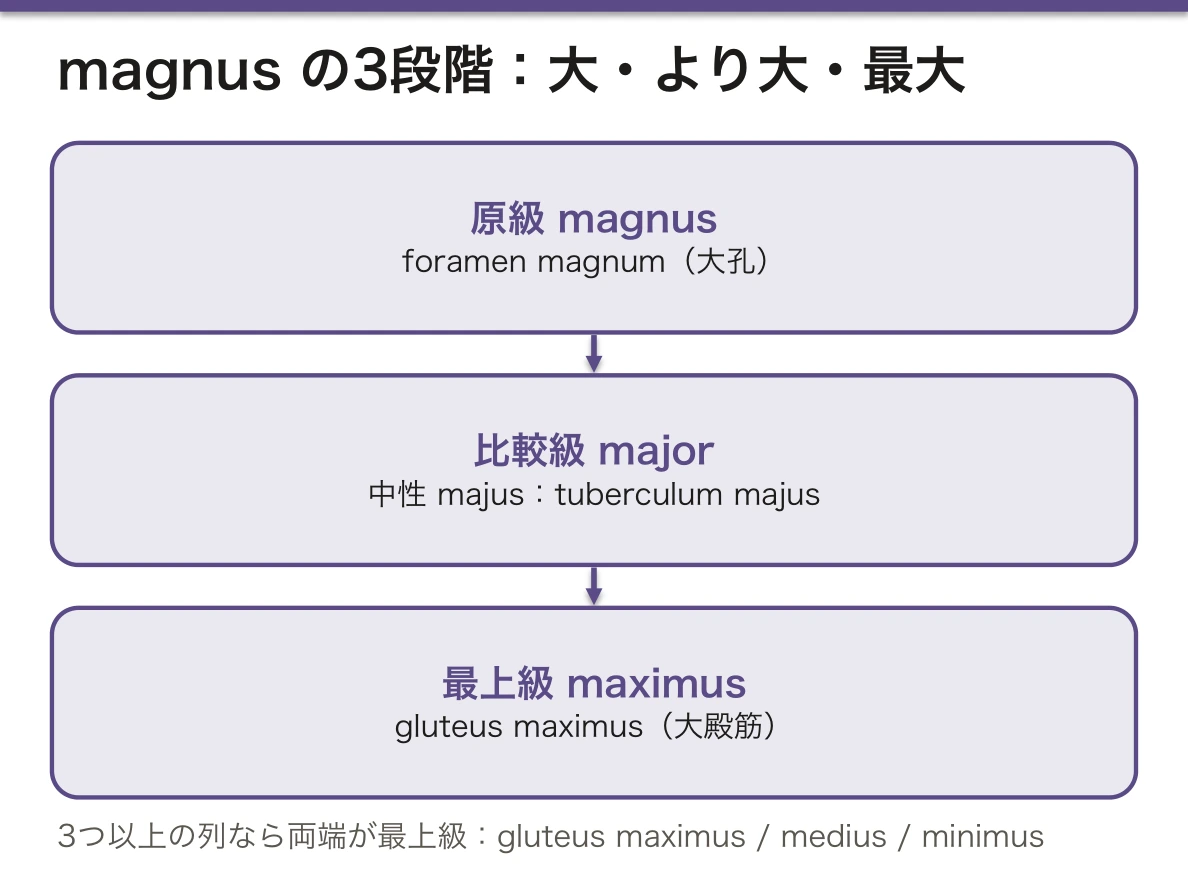
解剖では、2つなら比較級、3つ以上の列なら最上級を使う。殿筋は gluteus maximus / medius / minimus の3つで、両端が最上級、間が medius(中間の)である。鼻甲介は下から inferior / media / superior、さらにその上にあるときだけ suprema と呼ぶ。
Musculus abductor digiti minimi(小指外転筋)の minimi は digitus minimus の属格(第2変化 -i)。「最も小さい指」が小指である。
area postrema(最後野)は第四脳室の底の最も後ろにある部位で、血液脳関門が無い。そのため血中の薬物や毒素を直接感知して嘔吐を起こす(化学受容器引き金帯 CTZ)。抗癌薬の悪心にドパミン D2 受容体拮抗薬やセロトニン 5-HT3 受容体拮抗薬が使われるのは、この経路を遮るためである。
English version
Core
The superlative is -issimus, -a, -um and declines like a first-group adjective. Latus (wide) → latissimus (Musculus latissimus dorsi, “the widest muscle of the back”), longus → longissimus (Musculus longissimus).
But the adjectives anatomy uses most are compared irregularly.
| Positive | Comparative | Superlative | Term |
|---|---|---|---|
| magnus (large) | major | maximus | Musculus gluteus maximus |
| parvus (small) | minor | minimus | Digitus minimus (little finger) |
| superus (upper) | superior | supremus | Concha nasalis suprema (highest nasal concha) |
| inferus (lower) | inferior | infimus | — |
| posterus (rear) | posterior | postremus | Area postrema |
Once you see that magnum, majus and maximum look nothing alike but are three degrees of one word, foramen magnum, tuberculum majus and gluteus maximus read as one series.
Going further
Anatomy uses the comparative for two items and the superlative for a row of three or more. The gluteal muscles are gluteus maximus / medius / minimus: superlatives at the ends and medius (“middle”) between. The nasal conchae are inferior / media / superior from below, and only one above those is called suprema.
In Musculus abductor digiti minimi, minimi is the genitive (second declension -i) of digitus minimus. “The smallest finger” is the little finger.
In the clinic
The area postrema lies at the very back of the floor of the fourth ventricle and has no blood–brain barrier. So it senses drugs and toxins in the blood directly and triggers vomiting (the chemoreceptor trigger zone, CTZ). Dopamine D2 and serotonin 5-HT3 receptor antagonists are used against chemotherapy-induced nausea because they block this pathway.
まとめ
| 2語尾の形容詞 — 男女が -is、中性が -e | 辞書形は brevis, e のように書く。 |
|---|---|
| 形容詞の接尾辞 — 語尾で意味の種類がわかる | 形容詞の接尾辞にはそれぞれ決まった意味の方向がある。 |
| 1語尾の形容詞 — 3つの性で同じ形、語幹は属格に | 主格単数が男・女・中性で同じ形の形容詞。 |
| 比較級 — 中性の -ius を見落とさない | 比較級は語幹に -ior(男性・女性)/-ius(中性)を付ける。 |
| 最上級と不規則な比較 — major と maximus が並ぶ理由 | 最上級は -issimus, -a, -um で、第1群の形容詞と同じに変化する。 |
このノートは医学生が授業の内容を自分の言葉でまとめたもので、診療の判断に使うものではありません。誤りに気づいたらお知らせください。