ラトビア語の名詞には男性と女性の2つの性(中性は無い)と6つの変化がある。処格・与格・対格など、あとで習う格はすべて主格で性と変化型がわかっていることを前提にしている。
この章では主格だけを扱う:単数と複数の語尾、人を表す名詞の男女の組、それに合わせて形が変わる指示詞・所有代名詞・形容詞。土台の章の処格や「持つ」構文は、ここで決めた性と変化型の上に乗る。
- 6つの変化 — 主格の語尾で性がわかる
- 複数形 — 第2変化は子音が柔らかくなる
- 人を表す名詞 — 男性形と女性形が組になる
- 指示詞と所有代名詞 — 名詞の性と数に合わせる
- 形容詞の一致 — -s・-a・-i・-as の4つ
6つの変化 — 主格の語尾で性がわかるSešas deklinācijas
第1〜第3変化が男性、第4〜第6変化が女性である。主格単数の語尾で、どの変化かがほぼ決まる。
| 変化 | 性 | 単数 | 複数 | 例 |
|---|---|---|---|---|
| 第1 | 男性 | -s, -š | -i | ārsts → ārsti(医師)、kaimiņš → kaimiņi |
| 第2 | 男性 | -is | -i | brālis → brāļi(兄弟)、muskulis → muskuļi(筋肉) |
| 第3 | 男性 | -us | -i | tirgus → tirgi(市場)、klepus(咳) |
| 第4 | 女性 | -a | -as | māsa → māsas(姉妹)、galva(頭) |
| 第5 | 女性 | -e | -es | mute → mutes(口)、diagnoze |
| 第6 | 女性 | -s | -is | nakts → naktis(夜)、sirds(心臓) |
ラテン語と同じく形容詞は名詞の性に合わせるので、性を間違えると後ろの語がすべて崩れる。
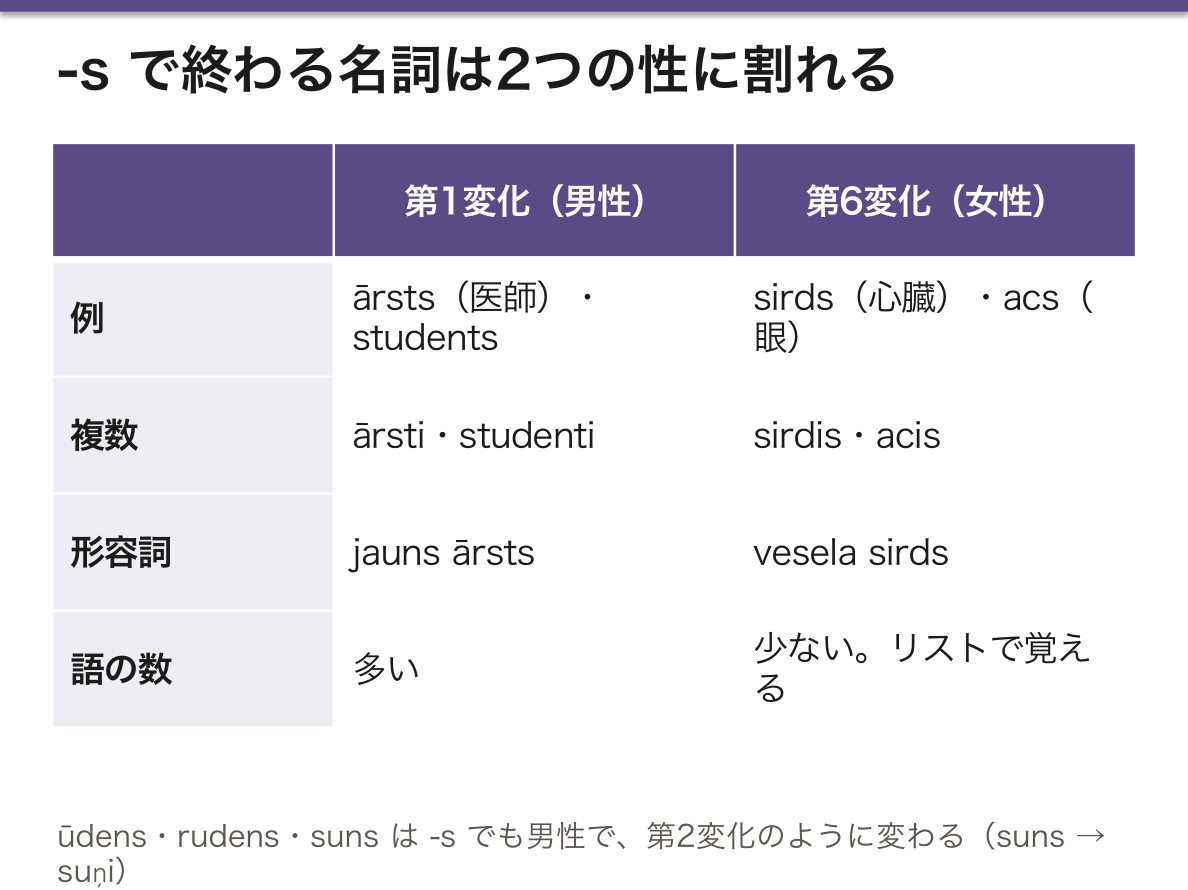
-s で終わる語が2つの性に割れるのがいちばんの罠である。ārsts(医師)は第1変化の男性、sirds(心臓)・acs(眼)は第6変化の女性。第6変化は数が少ないので、リストで覚えてしまうのが早い:nakts(夜)、pils(城)、valsts(国)、sirds(心臓)、acs(眼)、auss(耳)、krūtis(胸)、asinis(血)、durvis(扉)、uguns(火)、zivs(魚)。体の語が多いので、医学では避けて通れない。
逆の例外もある。ūdens(水)・rudens(秋)・suns(犬)は -s で終わるが男性で、第2変化のように変わる(suns → suņi)。
English version
Core
Declensions 1–3 are masculine; 4–6 are feminine. The nominative singular ending almost always tells you which.
| Declension | Gender | Singular | Plural | Examples |
|---|---|---|---|---|
| 1st | masc. | -s, -š | -i | ārsts → ārsti (doctor), kaimiņš → kaimiņi |
| 2nd | masc. | -is | -i | brālis → brāļi (brother), muskulis → muskuļi (muscle) |
| 3rd | masc. | -us | -i | tirgus → tirgi (market), klepus (cough) |
| 4th | fem. | -a | -as | māsa → māsas (sister), galva (head) |
| 5th | fem. | -e | -es | mute → mutes (mouth), diagnoze |
| 6th | fem. | -s | -is | nakts → naktis (night), sirds (heart) |
As in Latin, adjectives follow the noun’s gender, so a wrong gender spoils every word after it.
Going further
Nouns in -s split between the two genders — the biggest trap. Ārsts (doctor) is first-declension masculine; sirds (heart) and acs (eye) are sixth-declension feminine. The sixth declension is small, so learn it as a list: nakts (night), pils (castle), valsts (country), sirds (heart), acs (eye), auss (ear), krūtis (chest), asinis (blood), durvis (door), uguns (fire), zivs (fish). Many are body words, so medicine cannot avoid them.
There are exceptions the other way. Ūdens (water), rudens (autumn) and suns (dog) end in -s but are masculine and decline like the second declension (suns → suņi).
複数形 — 第2変化は子音が柔らかくなるBrālis – brāļi
複数の語尾は男性 -i、女性 -as・-es・-is(第4・第5・第6変化)である。
第2変化(-is)だけは、複数で語尾の前の子音が柔らかくなる(軟子音化)。
| 単数 | 複数 | 変わる子音 |
|---|---|---|
| brālis(兄弟) | brāļi | l → ļ |
| muskulis(筋肉) | muskuļi | l → ļ |
| dzīvoklis(住居) | dzīvokļi | l → ļ |
| suns(犬) | suņi | n → ņ |
| vīrietis(男性) | vīrieši | t → š |
| latvietis(ラトビア人) | latvieši | t → š |
柔らかくなった子音は、ほかの格でも残る。土台の章の sāpes muskuļos(筋肉の痛み)の ļ はこれである。だから複数形を作るときに一度覚えれば、処格・与格の複数でも同じ形を使える。
複数形しかない名詞がある。医学でいちばん大事なのは zāles(薬)・sāpes(痛み)・asinis(血)で、1つの薬でも「zāles」と言う。形容詞も複数・女性形になる:Kādas zāles jūs lietojat?(どんな薬を飲んでいますか)。ほかに mati(髪)、vecāki(両親)、durvis(扉)。
English version
Core
Plural endings are -i for masculine, -as, -es, -is for feminine (fourth, fifth, sixth declensions).
Only in the second declension (-is) does the consonant before the ending soften in the plural.
| Singular | Plural | Change |
|---|---|---|
| brālis (brother) | brāļi | l → ļ |
| muskulis (muscle) | muskuļi | l → ļ |
| dzīvoklis (flat) | dzīvokļi | l → ļ |
| suns (dog) | suņi | n → ņ |
| vīrietis (man) | vīrieši | t → š |
| latvietis (Latvian) | latvieši | t → š |
Going further
The softened consonant stays in other cases. The ļ in sāpes muskuļos (pain in the muscles) in the foundation chapter is this one. So once you learn the plural, the same form serves for the locative and dative plural.
Some nouns exist only in the plural. The most important in medicine are zāles (medicine), sāpes (pain) and asinis (blood); even one medicine is “zāles”. Adjectives become plural and feminine too: Kādas zāles jūs lietojat? (What medicine are you taking?). Others: mati (hair), vecāki (parents), durvis (door).
人を表す名詞 — 男性形と女性形が組になるĀrsts un ārste
職業・役割・国籍を表す名詞は、男性形と女性形が組になっている。
| 男性 | 女性 | 意味 |
|---|---|---|
| ārsts | ārste | 医師 |
| students | studente | 学生 |
| pacients | paciente | 患者 |
| profesors | profesore | 教授 |
| kardiologs | kardioloģe | 循環器内科医 |
| pediatrs | pediatre | 小児科医 |
| kolēģis | kolēģe | 同僚 |
| skolotājs | skolotāja | 教師 |
| latvietis | latviete | ラトビア人 |
| japānis | japāniete | 日本人 |
男性の第1・第2変化 → 女性は多くが第5変化の -e、一部が第4変化の -a(skolotāja)になる。medmāsa(看護師)のように女性形しか習わない語もある。
g は e の前で ģ になる(kardiologs → kardioloģe)。綴りの見た目は変わるが、規則的な変化である。
患者の性別は文全体に響く。男性患者なら pacients、女性なら paciente で、与格も pacientam / pacientei と分かれる(土台の章の Pacientei sāp kāja)。自己紹介でも Es esmu medicīnas students(男性)/studente(女性)、Es esmu japānis / japāniete と、自分の性に合わせて言い分ける。
English version
Core
Nouns for jobs, roles and nationalities come in masculine–feminine pairs.
| Masculine | Feminine | Meaning |
|---|---|---|
| ārsts | ārste | doctor |
| students | studente | student |
| pacients | paciente | patient |
| profesors | profesore | professor |
| kardiologs | kardioloģe | cardiologist |
| pediatrs | pediatre | paediatrician |
| kolēģis | kolēģe | colleague |
| skolotājs | skolotāja | teacher |
| latvietis | latviete | Latvian |
| japānis | japāniete | Japanese |
Masculine first and second declension → feminine mostly fifth-declension -e, sometimes fourth-declension -a (skolotāja). Some words, such as medmāsa (nurse), are usually learned only in the feminine.
Going further
G becomes ģ before e (kardiologs → kardioloģe). The spelling looks different, but the change is regular.
The patient’s sex echoes through the whole sentence. A male patient is pacients, a female one paciente, and the dative splits too: pacientam / pacientei (Pacientei sāp kāja in the foundation chapter). When you introduce yourself, choose to match your own gender: Es esmu medicīnas students (male) / studente (female), Es esmu japānis / japāniete.
指示詞と所有代名詞 — 名詞の性と数に合わせるTas, tā, tie, tās
「これは〜です」の tas(それ・これ)も、「私の」の mans も、名詞の性と数に合わせて4つの形を取る。
| 男性単数 | 女性単数 | 男性複数 | 女性複数 | |
|---|---|---|---|---|
| これ・それ | tas | tā | tie | tās |
| 私の | mans | mana | mani | manas |
| 君の | tavs | tava | tavi | tavas |
Kas tas ir? — Tas ir mans brālis.(これは何?——私の兄弟だ)/Tā ir mana māsa./Tie ir mani vecāki./Tās ir manas acis.(acis は第6変化・女性複数)。
否定は nav:Nē, tā nav lekcija.(いいえ、それは講義ではない)。はい・いいえで答える疑問文は vai で始める:Vai tas ir jūsu dators?
mūsu(私たちの)・jūsu(あなたの・あなたがたの)・viņa(彼の)・viņas(彼女の)・viņu(彼らの)は形が変わらない:jūsu ārsts、jūsu zāles、mūsu māte。
なぜ変わらないのか。これらはもともと人称代名詞の属格(「私たちの」「あなたの」)だからである。ラテン語の解剖用語で属格の名詞が前の名詞に合わせて変わらないのと同じ理屈で、属格は修飾する名詞の性・数と一致しない。
受付や問診の最初に聞くことは、ほぼ jūsu で始まる:Kāds ir jūsu vārds un uzvārds?(お名前は)、Kāds ir jūsu personas kods?(個人番号は)、Kāds ir jūsu telefona numurs?。患者には必ず jūsu を使う(次の章の tu と jūs)。
English version
Core
Both tas (“it, this”) in “this is …” and mans (“my”) take four forms to match the noun’s gender and number.
| Masc. sg. | Fem. sg. | Masc. pl. | Fem. pl. | |
|---|---|---|---|---|
| this, it | tas | tā | tie | tās |
| my | mans | mana | mani | manas |
| your (informal) | tavs | tava | tavi | tavas |
Kas tas ir? — Tas ir mans brālis. (What is this? — It is my brother.) / Tā ir mana māsa. / Tie ir mani vecāki. / Tās ir manas acis. (acis: sixth declension, feminine plural).
The negative is nav: Nē, tā nav lekcija. (No, it is not a lecture.) Yes–no questions begin with vai: Vai tas ir jūsu dators?
Going further
Mūsu (our), jūsu (your), viņa (his), viņas (her) and viņu (their) never change: jūsu ārsts, jūsu zāles, mūsu māte.
Why not? They were originally the genitive of the personal pronouns (“of us”, “of you”). By the same logic as the Latin anatomical terms, where a genitive noun does not change to match the noun before it, a genitive does not agree with the gender and number of what it describes.
In the clinic
The first questions at reception or in history-taking almost all start with jūsu: Kāds ir jūsu vārds un uzvārds? (your name), Kāds ir jūsu personas kods? (your personal code), Kāds ir jūsu telefona numurs? Always use jūsu with patients (tu and jūs in the next chapter).
形容詞の一致 — -s・-a・-i・-as の4つKāds, kāda, kādi, kādas
形容詞(不定形)の主格の語尾は4つだけで、名詞の性と数に合わせる。疑問詞 kāds?(どんな)も同じ語尾で変わる。
| 男性 | 女性 | |
|---|---|---|
| 単数 | -s(-š):jauns ārsts | -a:jauna ārste |
| 複数 | -i:jauni ārsti | -as:jaunas ārstes |
一致するのは性であって、名詞の語尾ではない。sirds(第6変化・女性)には vesela sirds(健康な心臓)、klepus(第3変化・男性)には sauss klepus(乾いた咳)、zāles(女性・複数のみ)には jaunas zāles(新しい薬)。ラテン語の foramen magnum と同じで、語尾がそろわなくても正しい。
医療でよく使う形容詞は反対の組で覚える:vesels / slims(健康な/病気の)、stiprs / viegls(強い/軽い:痛みにも使う)、liels / mazs(大きい/小さい)、auksts / silts(冷たい/温かい)、labs / slikts(良い/悪い)、jauns / vecs(新しい・若い/古い・年老いた)。
kas と kāds は聞くものが違う。kas は「何か」(物そのもの)、kāds は「どんな」(性質)である:Kas jums sāp?(何が痛みますか)と Kādas ir sāpes?(痛みはどんな感じですか:sāpes が女性複数なので kādas)。
処格では形容詞も名詞と同じ語尾になる:lielā slimnīcā(大きな病院で)、jaunā mājā(新しい家で)。
English version
Core
An (indefinite) adjective has only four nominative endings, chosen to match the noun’s gender and number. The question word kāds? (what kind?) changes the same way.
| Masculine | Feminine | |
|---|---|---|
| Singular | -s (-š): jauns ārsts | -a: jauna ārste |
| Plural | -i: jauni ārsti | -as: jaunas ārstes |
Agreement is in gender, not in the noun’s ending. Sirds (sixth declension, feminine) takes vesela sirds (a healthy heart); klepus (third declension, masculine) takes sauss klepus (a dry cough); zāles (feminine, plural only) takes jaunas zāles (new medicine). As with Latin foramen magnum, the endings need not look alike to be correct.
Going further
Learn the adjectives common in medicine as pairs of opposites: vesels / slims (healthy / ill), stiprs / viegls (strong / light; also of pain), liels / mazs (big / small), auksts / silts (cold / warm), labs / slikts (good / bad), jauns / vecs (new, young / old).
Kas and kāds ask different things. Kas asks “what” (the thing itself); kāds asks “what kind” (its quality): Kas jums sāp? (What hurts?) and Kādas ir sāpes? (What is the pain like? — kādas because sāpes is feminine plural).
In the locative the adjective takes the same ending as the noun: lielā slimnīcā (in a big hospital), jaunā mājā (in a new house).
まとめ
| 6つの変化 — 主格の語尾で性がわかる | 第1〜第3変化が男性、第4〜第6変化が女性である。 |
|---|---|
| 複数形 — 第2変化は子音が柔らかくなる | 複数の語尾は男性 -i、女性 -as・-es・-is(第4・第5・第6変化)である。 |
| 人を表す名詞 — 男性形と女性形が組になる | 職業・役割・国籍を表す名詞は、男性形と女性形が組になっている。 |
| 指示詞と所有代名詞 — 名詞の性と数に合わせる | 「これは〜です」の tas(それ・これ)も、「私の」の mans も、名詞の性と数に合わせて4つの形を取る。 |
| 形容詞の一致 — -s・-a・-i・-as の4つ | 形容詞(不定形)の主格の語尾は4つだけで、名詞の性と数に合わせる。 |
このノートは医学生が授業の内容を自分の言葉でまとめたもので、診療の判断に使うものではありません。誤りに気づいたらお知らせください。