ここからはラトビア語(Latviešu valoda medicīnā=医療のラトビア語)である。ヨーロッパの医学部で学び、ラトビアの医療現場に出る人のための入門として読める。
この先の章は教科書の Chapter 4 以降を扱う。だが4以降は1〜3で習う3つの仕組みを前提にして書かれていて、そこが抜けていると新しい文法が全部ぼやける。その3つ——処格・与格の「持つ」構文・第2活用——をここに置く。Review Chapter 1〜3 がその復習用の資料である。
出典: Čeirane, Tetere, Žibala Latviešu valoda medicīnā(2021/2025)の 1.–3. NODAĻA と Grammar overview。
- 処格 — 「どこで」「いつ」を語尾だけで言う
- 「持つ」という動詞が無い — 持ち主は与格に立つ
- 好きだ・美味しい — どちらも「誰に」で言う
- 痛む — 問診でいちばん多く聞く形
- 第2活用 — いちばん数が多く、いちばん規則的
- 綴りと発音 — 読めば書ける言語だが、罠が3つある
- 字母 — 33字、3種類の記号、使わない4字
処格 — 「どこで」「いつ」を語尾だけで言うLokatīvs
ラトビア語には「〜で」に当たる前置詞が無い。場所も時も、名詞の語尾を変えるだけで表す。これが日本語話者にも英語話者にもいちばん馴染まないところで、しかも毎回出てくる。
Es esmu Rīgā.(私はリガにいる)/Es studēju universitātē.(大学で学ぶ)/Nodarbība ir septembrī.(授業は9月にある)
| 変化型 | 主格(単数) | 処格(単数) | 処格(複数) |
|---|---|---|---|
| 第1(男性 -s) | koncerts | koncertā | koncertos |
| 第2(男性 -is) | teātris | teātrī | teātros |
| 第3(男性 -us) | tirgus | tirgū | tirgos |
| 第4(女性 -a) | skola | skolā | skolās |
| 第5(女性 -e) | mute | mutē | mutēs |
| 第6(女性 -s) | acs | acī | acīs |
語尾は足すのではなく置き換える。skola → skolā であって skolaā ではない。
処格は「いつ」も引き受ける。ここが英語と決定的に違う——英語は in September、at six、on Monday と前置詞を使い分けるが、ラトビア語は全部処格1つで済ませる。
| 言いたいこと | 例 | 訳 |
|---|---|---|
| 月・季節 | decembrī、vasarā | 12月に、夏に |
| 時刻 | sešos、divpadsmitos | 6時に、12時に |
| 何回目の授業・何階 | trešajā nodarbībā、pirmajā stāvā | 3回目の授業で、1階に |
| 食事の場面 | brokastīs、pusdienās、vakariņās | 朝食に、昼食に、夕食に |
| 繰り返す曜日 | pirmdienās、vakaros | 月曜はいつも、夜はいつも |
brokastis・pusdienas・vakariņas は元から複数形の名詞である。だから「朝食に」は必ず複数の処格 brokastīs になる。単数形は存在しない。
⚠️ 前置詞が付いたら処格の出番は消える。ラトビア語の規則は「前置詞があれば、前置詞が格を決める」で、これが他の全ての規則に優先する。Es esmu mājās(家にいる・処格)だが Es braucu uz mājām(家へ帰る・前置詞 uz +複数なので与格)。
English version
Core
Latvian has no preposition corresponding to "in" or "at". Place and time alike are expressed by changing the ending of the noun. This is what suits neither a Japanese nor an English speaker, and it comes up every time.
Es esmu Rīgā. (I am in Riga) / Es studēju universitātē. (I study at the university) / Nodarbība ir septembrī. (The class is in September)
| Declension | Nominative (sg.) | Locative (sg.) | Locative (pl.) |
|---|---|---|---|
| 1st (masc. -s) | koncerts | koncertā | koncertos |
| 2nd (masc. -is) | teātris | teātrī | teātros |
| 3rd (masc. -us) | tirgus | tirgū | tirgos |
| 4th (fem. -a) | skola | skolā | skolās |
| 5th (fem. -e) | mute | mutē | mutēs |
| 6th (fem. -s) | acs | acī | acīs |
The ending replaces, it is not added. skola → skolā, not skolaā.
Going further
The locative takes on "when" as well. Here it differs decisively from English, which distinguishes in September, at six, on Monday, while Latvian settles it all with the one locative.
| What is said | Example | Meaning |
|---|---|---|
| Months and seasons | decembrī, vasarā | in December, in summer |
| Clock times | sešos, divpadsmitos | at six, at twelve |
| Which class, which floor | trešajā nodarbībā, pirmajā stāvā | in the third class, on the first floor |
| Meals | brokastīs, pusdienās, vakariņās | at breakfast, at lunch, at dinner |
| Recurring days | pirmdienās, vakaros | on Mondays, in the evenings |
brokastis, pusdienas and vakariņas are nouns that are plural to begin with. So "at breakfast" is necessarily the plural locative brokastīs. There is no singular.
⚠️ Add a preposition and the locative disappears. The Latvian rule is "if there is a preposition, the preposition decides the case", and it overrides every other rule. Es esmu mājās (I am at home, locative) but Es braucu uz mājām (I am going home; the preposition uz with a plural takes the dative).
「持つ」という動詞が無い — 持ち主は与格に立つMan ir
ラトビア語に to have に当たる動詞は無い。代わりに「〜にとって、…が存在する」と言う。持ち主が与格、持ち物が主格になる。
Man ir dators.=直訳「私にとってパソコンが在る」=私はパソコンを持っている。主語は「私」ではなく「パソコン」のほうである。
| 誰が(与格) | ある | 無い |
|---|---|---|
| man(私) | man ir | man nav |
| tev(君) | tev ir | tev nav |
| viņam / viņai(彼/彼女) | viņam ir | viņam nav |
| mums(私たち) | mums ir | mums nav |
| jums(あなた/あなたがた) | jums ir | jums nav |
| viņiem / viņām(彼ら/彼女ら) | viņiem ir | viņiem nav |
否定は nav であって neir ではない。ir だけ形が変わるので覚え切ること。
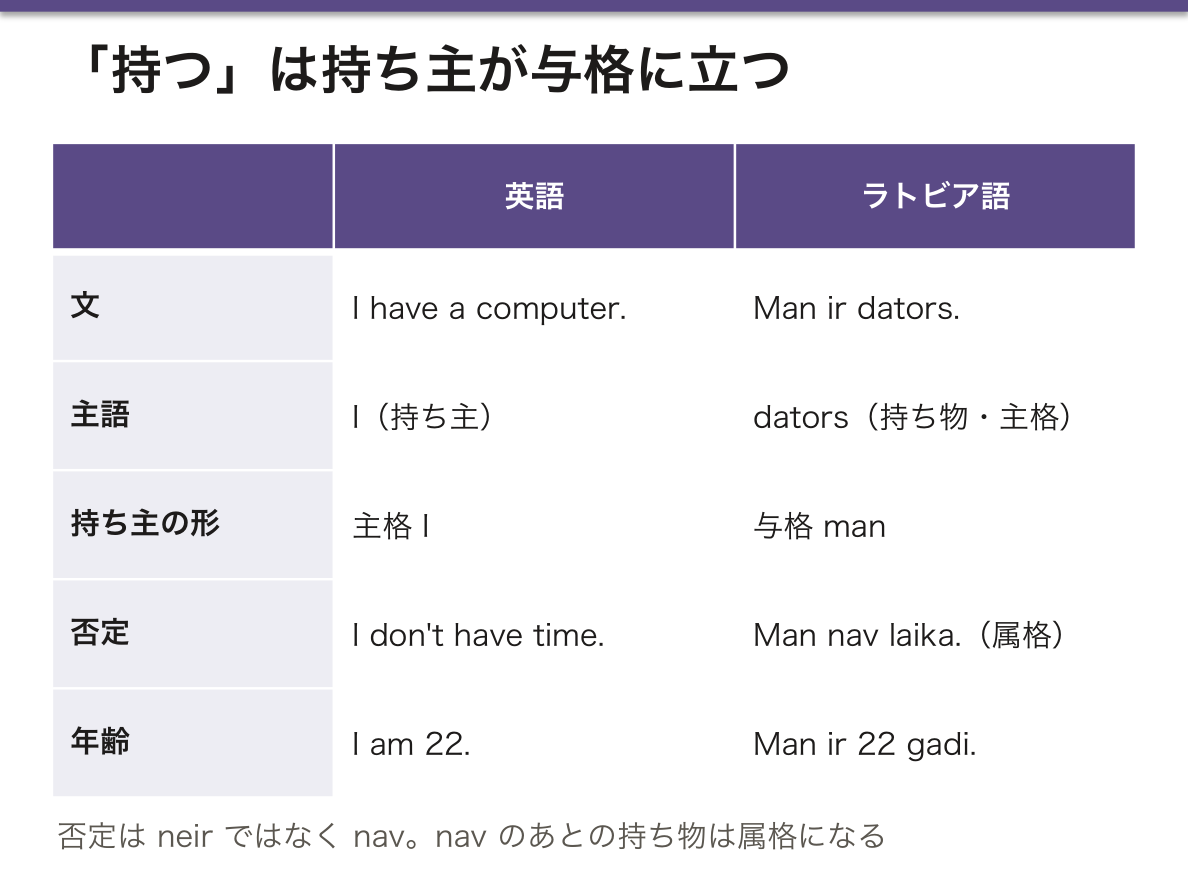
年齢もこの構文で言う。「私は22歳です」は Man ir 22 gadi.=「私に22の年がある」。英語の I am 22 の癖で Es esmu 22 と言うと通じない。
否定 nav のあとは属格になる。これは見落としやすい:
| 肯定(主格) | 否定(属格) | 訳 |
|---|---|---|
| Man ir nauda. | Man nav naudas. | お金がある/無い |
| Man ir laiks. | Man nav laika. | 時間がある/無い |
| Man ir māsa. | Man nav māsas. | 姉妹がいる/いない |
同じ理屈で daudz(多い)・maz(少ない)・cik(いくつ)のあとも属格になる: Man ir daudz pacientu.(患者が多い)/Cik studentu ir tavā grupā?(君の班に学生は何人?)
臨床では毎日使う。Vai jums ir alerģija?(アレルギーはありますか)/Man ir temperatūra.(熱があります)/Vai jums ir klepus?(咳はありますか)
English version
Core
Latvian has no verb corresponding to to have. Instead one says "to someone, something exists". The possessor stands in the dative and the thing possessed in the nominative.
Man ir dators. = literally "to me there is a computer" = I have a computer. The subject is not "I" but "the computer".
| Who (dative) | has | has not |
|---|---|---|
| man (I) | man ir | man nav |
| tev (you sg.) | tev ir | tev nav |
| viņam / viņai (he / she) | viņam ir | viņam nav |
| mums (we) | mums ir | mums nav |
| jums (you pl./polite) | jums ir | jums nav |
| viņiem / viņām (they) | viņiem ir | viņiem nav |
The negative is nav, not neir. Only ir changes shape, so learn it thoroughly.
Going further
Age is said with this construction too. "I am 22" is Man ir 22 gadi. = "to me there are 22 years". Say Es esmu 22 from the habit of English I am 22 and it does not communicate.
After the negative nav the genitive follows. This is readily missed:
| Positive (nominative) | Negative (genitive) | Meaning |
|---|---|---|
| Man ir nauda. | Man nav naudas. | I have / have no money |
| Man ir laiks. | Man nav laika. | I have / have no time |
| Man ir māsa. | Man nav māsas. | I have / have no sister |
By the same reasoning the genitive follows daudz (many), maz (few) and cik (how many): Man ir daudz pacientu. (I have many patients) / Cik studentu ir tavā grupā? (How many students are in your group?)
It is used every day in the clinic. Vai jums ir alerģija? (Do you have an allergy?) / Man ir temperatūra. (I have a fever) / Vai jums ir klepus? (Do you have a cough?)
好きだ・美味しい — どちらも「誰に」で言うPatīk un garšo
patīk(好きだ)も garšo(口に合う)も、Man ir と同じ形を取る。好きな人が与格、好かれるものが主格である。
Man patīk anatomija.(解剖学が好きだ)/Viņai garšo pica.(彼女はピザが好きだ)
| 動詞 | 意味 | 使うところ | 否定 |
|---|---|---|---|
| ir | 持っている・ある | もの・症状・予定 | nav |
| patīk | 好きだ | もの・こと・すること全般 | nepatīk |
| garšo | 口に合う・美味しい | 食べ物と飲み物だけ | negaršo |
| sāp | 痛む | 体の部位 | nesāp |
garšo は食べ物専用である。音楽や映画に garšo は使えない——そこは patīk。
patīk のあとには不定詞も置ける。Man patīk gatavot.(料理をするのが好きだ)/Viņai patīk braukt ar divriteni.(自転車で行くのが好きだ)。これは自分のことを話すときに必ず要る形である。
主語が複数なら動詞も複数になる。patīk / garšo は形が変わらないように見えるが、実際は3人称の形で、単複同形なだけである。だから語尾を合わせるのは名詞のほう:
| 単数 | 複数 |
|---|---|
| Man garšo ābols.(りんごが好き) | Man garšo āboli.(りんご類が好き) |
| Viņam patīk filma. | Viņam patīk filmas. |
⚠️ いちばん間違えやすいのは、与格と主格の取り違えである。Brāli / Brālim / Brālis negaršo sīpoli. の正解は Brālim——玉ねぎ(sīpoli)が主語で、兄は「誰にとって」だからである(7. NODAĻA 演習18)。
English version
Core
patīk (to like) and garšo (to taste good) take the same shape as Man ir. The person who likes is in the dative and the thing liked in the nominative.
Man patīk anatomija. (I like anatomy) / Viņai garšo pica. (She likes pizza)
| Verb | Meaning | Where it is used | Negative |
|---|---|---|---|
| ir | have, there is | Things, symptoms, plans | nav |
| patīk | like | Things, matters, activities generally | nepatīk |
| garšo | taste good | Food and drink only | negaršo |
| sāp | hurt | Parts of the body | nesāp |
garšo is for food alone. It cannot be used of music or films — that is patīk.
Going further
An infinitive can follow patīk. Man patīk gatavot. (I like cooking) / Viņai patīk braukt ar divriteni. (She likes going by bicycle). This form is needed without fail when talking about oneself.
If the subject is plural the verb goes plural too. patīk and garšo look invariant, but they are in fact the third person, which is simply the same in singular and plural. So what has to agree is the noun:
| Singular | Plural |
|---|---|
| Man garšo ābols. (I like the apple) | Man garšo āboli. (I like apples) |
| Viņam patīk filma. | Viņam patīk filmas. |
⚠️ The commonest mistake is confusing dative and nominative. In Brāli / Brālim / Brālis negaršo sīpoli. the answer is Brālim — the onions (sīpoli) are the subject and the brother is the one "to whom" (7. NODAĻA, exercise 18).
痛む — 問診でいちばん多く聞く形Sāp
sāp も与格で言う。痛む部位が主語、痛む人が与格である。
Man sāp galva.(頭が痛い)/Pacientei sāp kāja.(その患者〈女性〉は脚が痛い)
| 質問 | 訳 |
|---|---|
| Kas jums sāp? | どこが痛みますか(直訳: 何があなたに痛みますか) |
| Kur jums sāp? | どこが痛みますか(場所として聞く) |
| Cik ilgi jums jau sāp? | いつから痛みますか |
| Vai jums tagad arī sāp? | 今も痛みますか |
答えは Man sāp … か、痛くなければ Man nesāp / Man nekas nesāp.(どこも痛くない)。
sāp と sāpes は別物である。sāp は動詞(痛む)、sāpes は名詞(痛み・複数形)。名詞にすると形容詞を付けられるので、痛みの質を言えるようになる:
| ラトビア語 | 意味 |
|---|---|
| asas sāpes | 鋭い痛み |
| dedzinošas sāpes | 焼けるような痛み |
| stipras sāpes | 強い痛み |
| sāpju lēkme | 痛みの発作 |
| sāpes krūtīs | 胸の痛み(krūtis は第6変化の複数) |
| sāpes muskuļos | 筋肉痛 |
部位は処格で置く——sāpes krūtīs/muskuļos/vēderā。「胸に痛みがある」という言い方で、これは日本語の感覚に近い。
過去形は sāpēja(第3活用 -ēt)。Man sāpēja galva un muskuļi.(頭と筋肉が痛かった)——7. NODAĻA の病歴の文章はこの形で書かれている。
English version
Core
sāp too is said with the dative. The part that hurts is the subject and the person in the dative.
Man sāp galva. (I have a headache) / Pacientei sāp kāja. (The patient’s [f.] leg hurts)
| Question | Meaning |
|---|---|
| Kas jums sāp? | What hurts? (literally: what hurts to you?) |
| Kur jums sāp? | Where does it hurt? (asked as a place) |
| Cik ilgi jums jau sāp? | How long has it hurt? |
| Vai jums tagad arī sāp? | Does it hurt now too? |
The answer is Man sāp …, or if nothing hurts Man nesāp / Man nekas nesāp. (Nothing hurts.)
Going further
sāp and sāpes are different words. sāp is the verb (to hurt); sāpes is the noun (pain, plural in form). As a noun it can take an adjective, so the quality of the pain can be stated:
| Latvian | Meaning |
|---|---|
| asas sāpes | sharp pain |
| dedzinošas sāpes | burning pain |
| stipras sāpes | severe pain |
| sāpju lēkme | an attack of pain |
| sāpes krūtīs | chest pain (krūtis is a sixth-declension plural) |
| sāpes muskuļos | muscle pain |
The site is put in the locative — sāpes krūtīs / muskuļos / vēderā. A way of saying "there is pain in the chest", close to the Japanese sense.
The past tense is sāpēja (third conjugation, -ēt). Man sāpēja galva un muskuļi. (My head and muscles hurt) — the case histories in 7. NODAĻA are written in this form.
第2活用 — いちばん数が多く、いちばん規則的Otrā konjugācija
ラトビア語の動詞は3つの活用に分かれる。第2活用がいちばん多く、いちばん素直で、-ot / -āt / -ēt で終わる動詞の大半がここに入る。最初に習う dzīvot・runāt・strādāt がこれである。
| 人称 | dzīvot(住む) | runāt(話す) | studēt(学ぶ) |
|---|---|---|---|
| es | dzīvoju | runāju | studēju |
| tu | dzīvo | runā | studē |
| viņš / viņa / viņi / viņas | dzīvo | runā | studē |
| mēs | dzīvojam | runājam | studējam |
| jūs | dzīvojat | runājat | studējat |
tu と3人称は同じ形(=不定詞から -t を取っただけ)。es・mēs・jūs だけ -j- が入る——この1つを押さえれば第2活用は終わる。
-ot で終わる動詞は全部第2活用である。例外が無いので、見た瞬間に形が決まる:
apciemot(訪ねる)・ceļot(旅する)・gatavot(料理する)・lietot(服用する)・slēpot(スキーをする)・slimot(病気である)・sportot(運動する)・asiņot(出血する)・pusdienot(昼食をとる)・nokārtot(試験に受かる)
-āt も全部第2活用。ただし -ināt は違う(そちらは第3活用)。domāt・maksāt・mazgāt・runāt・staigāt・strādāt は第2、turpināt・zināt・rēķināt・aicināt は第3である。-ināt を見たら第3と覚える。
-ēt は割れる。ここだけは丸暗記が要る:
| 第2活用の -ēt | 第3活用の -ēt |
|---|---|
| studēt、apmeklēt、meklēt、izmeklēt、operēt、ārstēt、smēķēt、spēlēt、plombēt、injicēt | gribēt、varēt、drīkstēt、gulēt、redzēt、dzirdēt、palīdzēt、peldēt、sēdēt、cerēt、mīlēt |
否定は ne- を頭に付けるだけで、人称は変わらない: es dzīvoju → es nedzīvoju。ただし ir → nav だけは別形になる。
English version
Core
Latvian verbs fall into three conjugations. The second is the largest and the most straightforward, and most verbs ending in -ot / -āt / -ēt belong to it. The dzīvot, runāt and strādāt learned first are these.
| Person | dzīvot (live) | runāt (speak) | studēt (study) |
|---|---|---|---|
| es | dzīvoju | runāju | studēju |
| tu | dzīvo | runā | studē |
| viņš / viņa / viņi / viņas | dzīvo | runā | studē |
| mēs | dzīvojam | runājam | studējam |
| jūs | dzīvojat | runājat | studējat |
tu and the third person have the same form (the infinitive minus -t). Only es, mēs and jūs take the -j- — hold this one point and the second conjugation is finished.
Going further
Every verb ending in -ot is second conjugation. There are no exceptions, so the forms are settled at sight: apciemot (visit), ceļot (travel), gatavot (cook), lietot (take, use), slēpot (ski), slimot (be ill), sportot (do sport), asiņot (bleed), pusdienot (have lunch), nokārtot (pass an examination).
Every -āt is second conjugation too. But -ināt is not (that is third). domāt, maksāt, mazgāt, runāt, staigāt and strādāt are second; turpināt, zināt, rēķināt and aicināt are third. Seeing -ināt, think third.
-ēt splits. Here alone rote learning is required:
| Second conjugation -ēt | Third conjugation -ēt |
|---|---|
| studēt, apmeklēt, meklēt, izmeklēt, operēt, ārstēt, smēķēt, spēlēt, plombēt, injicēt | gribēt, varēt, drīkstēt, gulēt, redzēt, dzirdēt, palīdzēt, peldēt, sēdēt, cerēt, mīlēt |
The negative simply prefixes ne- and the person does not change: es dzīvoju → es nedzīvoju. Only ir → nav takes a separate form.
綴りと発音 — 読めば書ける言語だが、罠が3つあるIzruna
ラトビア語の綴りはほぼ音素どおりである。書いてあるとおりに読めばよく、英語のような例外の山は無い。だから発音は最初の1回で片づけてしまえる。
| 字 | 音 | 注意 |
|---|---|---|
| c | /ts/ ツ | 英語の c ではない。cimdi, centi, ēdnīca |
| č | /tʃ/ チ | 英語 ch。četri(4), čība |
| š | /ʃ/ シュ | 英語 sh。seši(6), latvieši |
| ž | /ʒ/ ジュ | 英語 seizure の s。žurnāls |
| z | /z/ ズ | ラテン語と違って「ツ」ではない。zāles(薬) |
| j | /j/ ヤ行 | 英語の j ではない。jūs(あなた)=ユース |
| ķ ģ ļ ņ | 硬口蓋音 | ķermenis(体), ģimene(家族), ļoti(とても), ņemt(取る) |
| dz dž | /dz/ /dʒ/ | 1つの音。dzīvoklis, džemperis |
長音符(ā ē ī ū)は意味を変える。ラトビア語では母音の長短がそのまま別の語になるので、見た目の飾りではない。書き落とすと綴りの誤りになる。
罠その1: e と ē は2通りに読む。広い音(英語 bad)と狭い音(英語 bed)があり、綴りは区別しない。es(私)は狭い、ēst(食べる)は広い。規則で決まるが、まずは聞いて覚えるほうが早い。
罠その2: o は3通りある。本来のラトビア語の語では二重母音 /uo/(roka=腕、doma=考え、šodien=今日)、外来語では単なる /o/ か /oː/(opera, kino, novembris, telefons)。つまり roka は「ルォカ」に近く、opera は「オペラ」でよい。医学用語はほぼ外来語なので /o/ で読めるが、日常語では /uo/ が出る。
罠その3: 二重母音は切らない。次の6つは1音として続けて読む——ai(laiks, maize)・au(jauks, draugs)・ie(iela, sniegs)・ei(meita, veikals)・ui・oi。ie を「イエ」と切らずに一息で出すのがいちばん難しい。
アクセントは常に第1音節にある。例外は数語だけなので、迷ったら頭を強く読めばよい。これはラテン語(後ろから2番目か3番目)と正反対なので、切り替えを意識すること。
English version
Core
Latvian spelling is nearly phonemic. Read it as it is written; there is no mountain of exceptions as in English. So pronunciation can be settled once at the start.
| Letter | Sound | Note |
|---|---|---|
| c | /ts/ | Not the English c. cimdi, centi, ēdnīca |
| č | /tʃ/ | English ch. četri (4), čība |
| š | /ʃ/ | English sh. seši (6), latvieši |
| ž | /ʒ/ | The s of English "seizure". žurnāls |
| z | /z/ | Not "ts" as in Latin. zāles (medicine) |
| j | /j/ | Not the English j. jūs (you) |
| ķ ģ ļ ņ | Palatals | ķermenis (body), ģimene (family), ļoti (very), ņemt (take) |
| dz dž | /dz/ /dʒ/ | One sound each. dzīvoklis, džemperis |
The macron (ā ē ī ū) changes the meaning. Vowel length makes a different word in Latvian, so it is not decoration. Omit it and the spelling is wrong.
Going further
Trap 1: e and ē are read two ways. There is an open sound (English "bad") and a close one (English "bed"), and the spelling does not distinguish them. es (I) is close, ēst (to eat) open. Rules exist, but hearing and remembering is faster.
Trap 2: o has three values. In native Latvian words it is the diphthong /uo/ (roka = arm, doma = thought, šodien = today), and in loanwords a plain /o/ or /oː/ (opera, kino, novembris, telefons). That is, roka is close to "ruo-ka" and opera may be read "o-pe-ra". Medical terms are almost all loanwords and can be read with /o/, while everyday words give /uo/.
Trap 3: do not break the diphthongs. These six are read as one continuous sound — ai (laiks, maize), au (jauks, draugs), ie (iela, sniegs), ei (meita, veikals), ui, oi. Producing ie in one breath, without splitting it, is the hardest.
The stress is always on the first syllable. There are only a few exceptions, so when in doubt stress the beginning. This is the exact opposite of Latin (the second or third from the end), so be conscious of the switch.
字母 — 33字、3種類の記号、使わない4字Alfabēts
ラトビア語の字母は33字である。ラテン文字の基本の字から q・w・x・y の4字を除いた22字に、記号の付いた11字を足したものと見ると覚えやすい。
| 種類 | 字 |
|---|---|
| もとの字(22) | a b c d e f g h i j k l m n o p r s t u v z |
| 長音符 garumzīme(4) | ā ē ī ū |
| 軟音符 mīkstinājuma zīme(4) | ģ ķ ļ ņ |
| 屋根 jumtiņš(3) | č š ž |
記号は3種類で、それぞれ働きが違う。長音符(横棒)は母音を長くする。軟音符(字の下、ģ だけは上に付く小さなコンマ)は子音を舌の中ほどで出す柔らかい音にする。屋根(č š ž の上の小さな v)は「チ・シュ・ジュ」の音にする。
記号の付いた字は、飾りではなく別の字である。だから辞書や教科書の語彙表では、ā は a の語が全部終わったあと、ķ は k のあとに独立して並ぶ(語彙表の見出しが「A, Ā」「K, Ķ」と組になっているのはこのため)。katrs のあとに kāposts が来るのは、2文字目の a と ā が別の字として順番を持つからである。
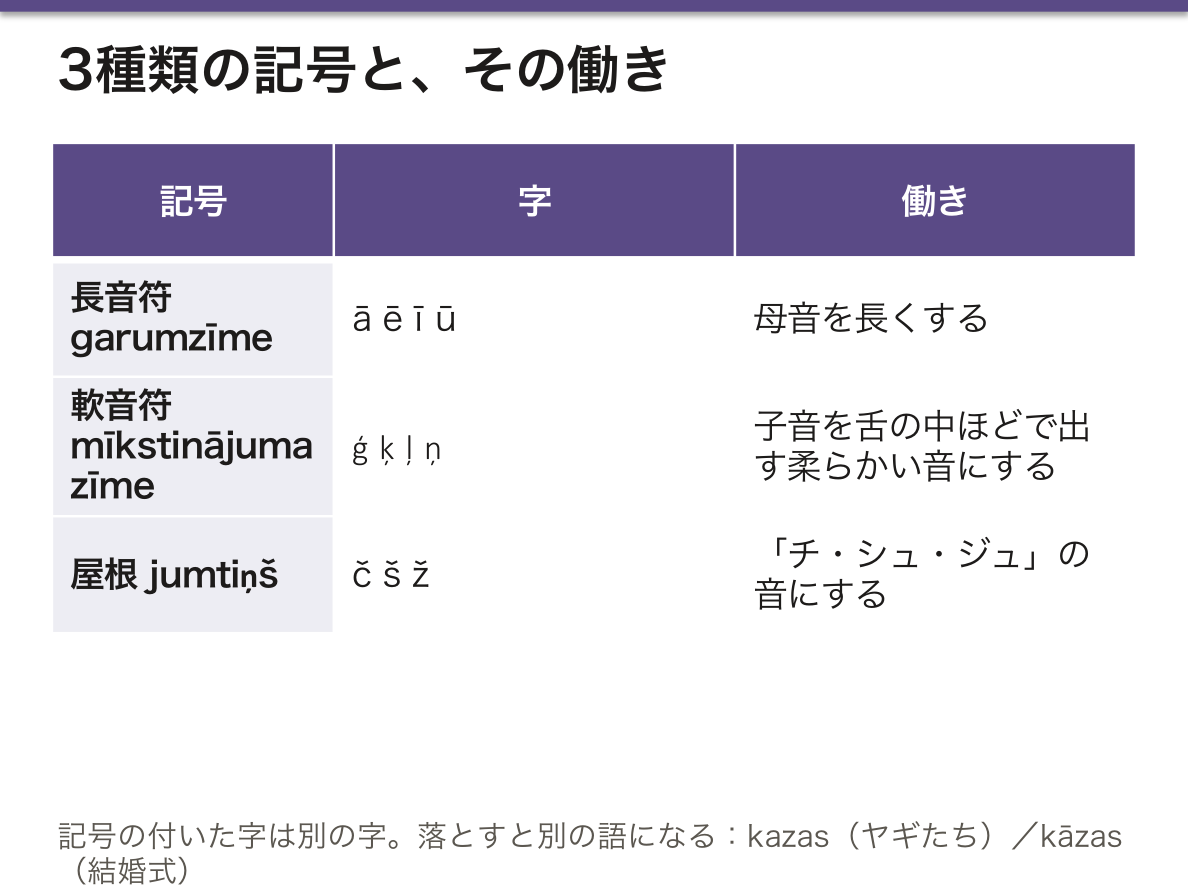
なぜ記号を落としてはいけないのか。長さや柔らかさの違いがそのまま別の語を作るからである。よく例に出るのが kazas(ヤギたち)と kāzas(結婚式)。記号を抜いた文は「なんとなく読める」が、綴りとしては誤りになる。
使わない4字(q w x y)を含む外来語は、音に合わせて書き直す。x は ks になり(eksāmens=試験、taksometrs=タクシー)、y は j(jogurts)、w は v になる。地名・人名も同じで、Ņujorka(ニューヨーク)、Tokija(東京)、Dženifera のように、音を写したうえで性に合った語尾まで付ける。
o にだけ長音符が無い。そのため o が /uo/ なのか /o/ なのかは綴りから分からず、語ごとに覚えることになる(土台の章「綴りと発音」の罠その2)。逆に言えば、それ以外の母音は記号を見れば長さが決まる。
パソコンでは、ラトビア語の配列を入れて アポストロフィ(’)を先に押してから字を打つ方式がよく使われる——’a → ā、’c → č、’s → š。スマートフォンなら字を長押しすれば選べる。
臨床で記号がいちばん効くのは患者の名前である。ラトビアの姓は男女で語尾が変わり(Kalniņš/Kalniņa)、ņ を n と書けば記録上は別の名前になる。カルテや紹介状で患者を取り違えないためにも、名前は記号まで写す。
English version
Core
The Latvian alphabet has 33 letters. An easy way to remember it: take the basic Latin letters, remove q, w, x and y (22 letters left), and add 11 letters with marks.
| Type | Letters |
|---|---|
| Base letters (22) | a b c d e f g h i j k l m n o p r s t u v z |
| Length mark, garumzīme (4) | ā ē ī ū |
| Softening mark, mīkstinājuma zīme (4) | ģ ķ ļ ņ |
| Little roof, jumtiņš (3) | č š ž |
There are three marks, and each does a different job. The length mark (a bar) makes a vowel long. The softening mark (a small comma below the letter; on ģ it sits above) makes the consonant soft, said with the middle of the tongue. The little roof (a small v on č, š, ž) gives the sounds ‘ch’, ‘sh’ and ‘zh’.
A letter with a mark is a separate letter, not decoration. So in dictionaries and word lists, ā comes after all the a-words, and ķ comes after k. This is why word lists have headings like ‘A, Ā’ and ‘K, Ķ’, and why kāposts comes after katrs.
Going further
Why you must not drop the marks: a difference in length or softness makes a different word. A common example is kazas (goats) and kāzas (a wedding). A text without marks is still readable, but it is misspelled.
Foreign words with q, w, x or y are re-spelled by sound: x becomes ks (eksāmens, taksometrs), y becomes j (jogurts), w becomes v. Place names and personal names follow the same rule and also get an ending that fits their gender: Ņujorka (New York), Tokija (Tokyo), Dženifera.
Only o has no length mark. So the spelling does not tell you whether o is /uo/ or /o/; you learn it word by word (trap 2 in the item on spelling and pronunciation). For all other vowels, the mark tells you the length.
On a computer, a common method is the Latvian keyboard layout where you press the apostrophe (‘) first and then the letter: ‘a → ā, ‘c → č, ‘s → š. On a smartphone, hold the letter down to choose.
In the clinic
In the clinic, the marks matter most in patients’ names. Latvian surnames change their ending for men and women (Kalniņš / Kalniņa), and writing ņ as n makes a different name in the record. Copy names with all their marks, so that patients are not mixed up in notes and referral letters.
まとめ
| 処格 — 「どこで」「いつ」を語尾だけで言う | ラトビア語には「〜で」に当たる前置詞が無い。 |
|---|---|
| 「持つ」という動詞が無い — 持ち主は与格に立つ | ラトビア語に to have に当たる動詞は無い。 |
| 好きだ・美味しい — どちらも「誰に」で言う | patīk(好きだ)も garšo(口に合う)も、Man ir と同じ形を取る。 |
| 痛む — 問診でいちばん多く聞く形 | sāp も与格で言う。痛む部位が主語、痛む人が与格である。 |
| 第2活用 — いちばん数が多く、いちばん規則的 | ラトビア語の動詞は3つの活用に分かれる。 |
| 綴りと発音 — 読めば書ける言語だが、罠が3つある | ラトビア語の綴りはほぼ音素どおりである。 |
| 字母 — 33字、3種類の記号、使わない4字 | ラトビア語の字母は33字である。ラテン文字の基本の字から q・w・x・y の4字を除いた22字に、記号の付いた11字を足したものと見ると覚えやすい。 |
このノートは医学生が授業の内容を自分の言葉でまとめたもので、診療の判断に使うものではありません。誤りに気づいたらお知らせください。