7. NODAĻA「ES PALĪDZĒŠU PACIENTIEM」。この課では、これまで現在形でしか使えなかった動詞を、過去と未来に伸ばす。
「主格で与えられた語から文を作る」ときは時制を自分で選んで作文するので、ここは形を覚えるだけでは足りず、使い分けまで要る。
- 過去と未来 — 未来は全活用で共通
- 診察の動詞 — ほぼ全部が第2活用
過去と未来 — 未来は全活用で共通Pagātne un nākotne
未来は救いである。どの活用でも不定詞の語幹+-šu / -si / -s / -sim / -siet で作る。覚えるのは語尾5つだけである。
| 過去(iet / braukt) | 過去(第2・第3活用) | 未来(全部) | |
|---|---|---|---|
| es | gāju、braucu | -ju domāju、gribēju | -šu iešu、braukšu、domāšu |
| tu | gāji、brauci | -ji domāji | -si iesi、brauksi |
| viņš / viņi | gāja、brauca | -ja domāja | -s ies、brauks |
| mēs | gājām、braucām | -jām domājām | -sim iesim |
| jūs | gājāt、braucāt | -jāt domājāt | -siet iesiet |
過去も語尾は -ju / -ji / -ja / -jām / -jāt の1組だけである(第1活用の不規則な動詞を除く)。-j- が入るのが過去と覚えるとよい。
語幹の作り方だけが活用ごとに違う。ここが実際の作業になる:
| 不定詞 | 過去 es | 未来 es | 語幹の作り方 |
|---|---|---|---|
| domāt(第2) | domāju | domāšu | -t を取るだけ → domā- |
| studēt(第2) | studēju | studēšu | studē- |
| dzīvot(第2) | dzīvoju | dzīvošu | dzīvo- |
| lasīt(第3 -īt) | lasīju | lasīšu | lasī- |
| gribēt(第3 -ēt) | gribēju | gribēšu | gribē- |
| turpināt(第3 -ināt) | turpināju | turpināšu | turpinā- |
| iet(第1) | gāju | iešu | 過去だけ語幹が化ける |
| braukt(第1) | braucu | braukšu | 過去は現在と同形 |
⚠️ 第1活用は過去が読めない。iet → gāju、ēst → ēdu、dzert → dzēru。ここだけは丸暗記で、数が少ないので現実的である。
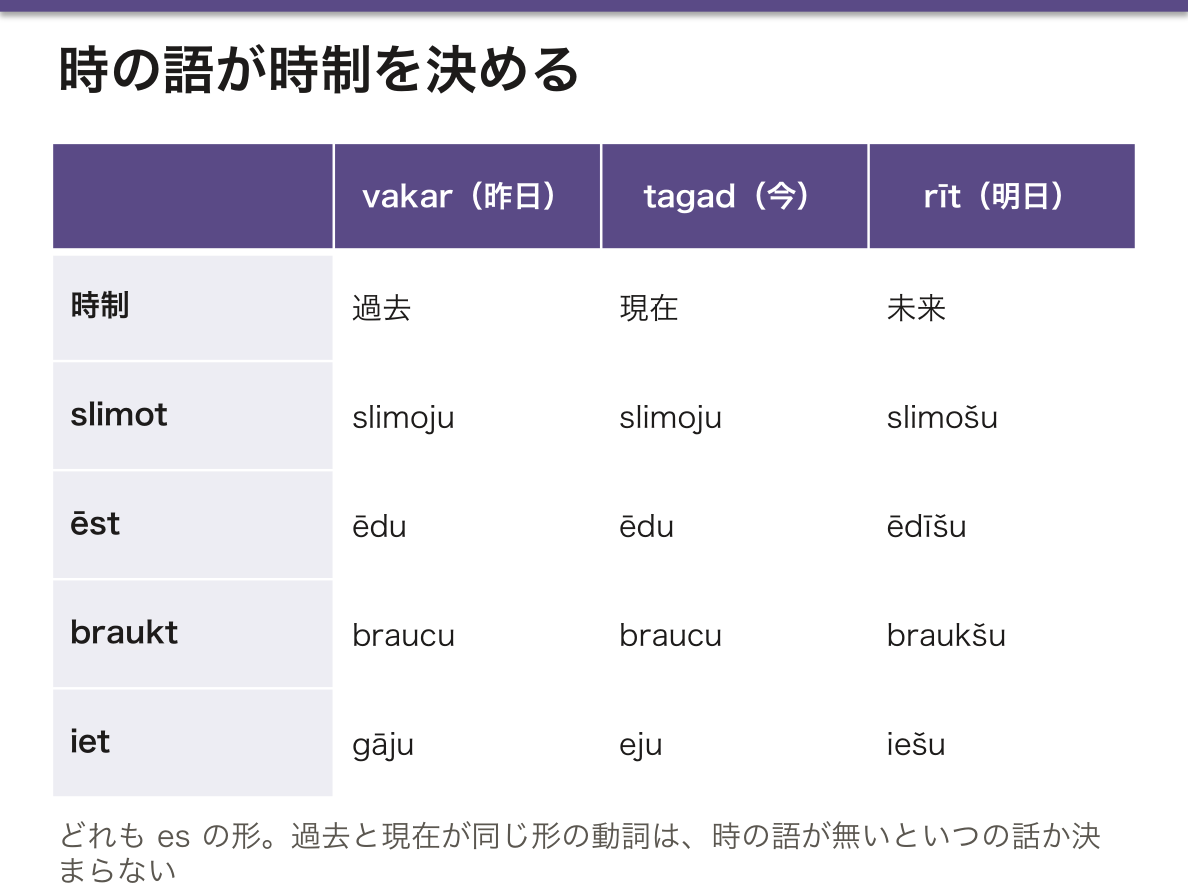
時制を決めるのは、文中の時を表す語である。7. NODAĻA 演習1はvakar / tagad / rīt の3語だけを与えて、動詞の形から正しい語を選ばせる——4. NODAĻA で覚えた時の副詞が、そのまま時制の判別に使われるという作りである。
vairs(もはや〜ない)は否定と組む: Viņš vairs nesmēķē.(彼はもう吸っていない)/Es agrāk smēķēju, bet jau 3 gadus vairs nesmēķēju.(以前は吸っていたが、3年前からやめている)——喫煙歴を聞き取るときの答えとしてそのまま出る。
English version
Core
The future is the relief. In every conjugation it is formed from the infinitive stem plus -šu / -si / -s / -sim / -siet. There are only five endings to learn.
| Past (iet / braukt) | Past (2nd and 3rd conj.) | Future (all) | |
|---|---|---|---|
| es | gāju, braucu | -ju domāju, gribēju | -šu iešu, braukšu, domāšu |
| tu | gāji, brauci | -ji domāji | -si iesi, brauksi |
| viņš / viņi | gāja, brauca | -ja domāja | -s ies, brauks |
| mēs | gājām, braucām | -jām domājām | -sim iesim |
| jūs | gājāt, braucāt | -jāt domājāt | -siet iesiet |
The past too has only one set of endings, -ju / -ji / -ja / -jām / -jāt (apart from the irregular first-conjugation verbs). It helps to remember that the -j- marks the past.
Going further
Only how the stem is made differs by conjugation. This is the actual work:
| Infinitive | Past es | Future es | How the stem is made |
|---|---|---|---|
| domāt (2nd) | domāju | domāšu | Just drop -t → domā- |
| studēt (2nd) | studēju | studēšu | studē- |
| dzīvot (2nd) | dzīvoju | dzīvošu | dzīvo- |
| lasīt (3rd -īt) | lasīju | lasīšu | lasī- |
| gribēt (3rd -ēt) | gribēju | gribēšu | gribē- |
| turpināt (3rd -ināt) | turpināju | turpināšu | turpinā- |
| iet (1st) | gāju | iešu | The stem transforms in the past only |
| braukt (1st) | braucu | braukšu | The past is the same as the present |
⚠️ The first conjugation’s past cannot be read off. iet → gāju, ēst → ēdu, dzert → dzēru. Here alone it is rote learning, and the numbers are few enough to make that realistic.
What decides the tense is the time word in the sentence. Exercise 1 of 7. NODAĻA gives only the three words vakar / tagad / rīt and has the right one chosen from the form of the verb — the time adverbs learned in 4. NODAĻA used directly to identify the tense.
vairs (no longer) pairs with a negative: Viņš vairs nesmēķē. (He no longer smokes) / Es agrāk smēķēju, bet jau 3 gadus vairs nesmēķēju. (I used to smoke, but I have not smoked for three years) — used as it stands when taking a smoking history.
診察の動詞 — ほぼ全部が第2活用Slimot un klepot
7. NODAĻA で出る医学の動詞はほとんど -ot / -ēt の第2活用で、つまり規則的に3時制へ伸ばせる。ここは楽なところである。
| 動詞 | 意味 | 現在 es | 過去 es | 未来 es |
|---|---|---|---|---|
| slimot | 病気である | slimoju | slimoju | slimošu |
| klepot | 咳をする | klepoju | klepoju | klepošu |
| elpot | 呼吸する | elpoju | elpoju | elpošu |
| operēt | 手術する | operēju | operēju | operēšu |
| izmeklēt | 診察する | izmeklēju | izmeklēju | izmeklēšu |
| ārstēt | 治療する | ārstēju | ārstēju | ārstēšu |
| smēķēt | 喫煙する | smēķēju | smēķēju | smēķēšu |
| lietot | 服用する | lietoju | lietoju | lietošu |
| mērīt(第3 -īt) | 測る | mēru | mērīju | mērīšu |
| izrakstīt(第3 -īt) | 処方する | izrakstu | izrakstīju | izrakstīšu |
⚠️ 第2活用は現在の es と過去の es が同じ形になる(slimoju / slimoju)。だから時を表す語が無いと、いつの話か分からない。Es slimoju だけでは「病気だ」とも「病気だった」とも取れる。
mērīt と izrakstīt は第3活用(-īt)なので、現在形だけ短くなる: es mēru(測る)/es izrakstu(処方する)。過去・未来は -ī- が戻る(mērīju / mērīšu)。現在形だけが例外という形なので、そこだけ意識する。
接頭辞は完了の意味を足す。ラトビア語の動詞は接頭辞で対になっていることが多い:
| 基本形 | 接頭辞つき | 差 |
|---|---|---|
| mērīt 測る | izmērīt 測り終える | 1回の完了した動作 |
| meklēt 探す | izmeklēt 診察する | 意味自体が変わる |
| rakstīt 書く | izrakstīt 処方する | 同上 |
| operēt 手術する | izoperēt 摘出する | 同上 |
iz- は「外へ・すっかり」という意味で、izmeklēt(隅々まで探す=診察する)・izrakstīt(書き出す=処方する)・izoperēt(手術で取り出す)と、意味の筋が通っている。ラテン語の ex- と同じ発想なので、そこはラテン語の知識が効く。
医師の未来形は診察の締めで使う: Es jums izrakstīšu zāles.(お薬を処方します)/Šeit būs recepte.(こちらが処方せんです)。
English version
Core
The medical verbs of 7. NODAĻA are almost all second conjugation in -ot / -ēt, that is, they extend regularly into three tenses. This is the easy part.
| Verb | Meaning | Present es | Past es | Future es |
|---|---|---|---|---|
| slimot | be ill | slimoju | slimoju | slimošu |
| klepot | cough | klepoju | klepoju | klepošu |
| elpot | breathe | elpoju | elpoju | elpošu |
| operēt | operate | operēju | operēju | operēšu |
| izmeklēt | examine | izmeklēju | izmeklēju | izmeklēšu |
| ārstēt | treat | ārstēju | ārstēju | ārstēšu |
| smēķēt | smoke | smēķēju | smēķēju | smēķēšu |
| lietot | take (medicine) | lietoju | lietoju | lietošu |
| mērīt (3rd, -īt) | measure | mēru | mērīju | mērīšu |
| izrakstīt (3rd, -īt) | prescribe | izrakstu | izrakstīju | izrakstīšu |
⚠️ In the second conjugation the present es and the past es are the same (slimoju / slimoju). So without a time word one cannot tell which is meant. Es slimoju alone can be "I am ill" or "I was ill".
Going further
mērīt and izrakstīt are third conjugation (-īt), so only the present shortens: es mēru (I measure) / es izrakstu (I prescribe). The past and future restore the -ī- (mērīju / mērīšu). Only the present is the exception, so that is what to watch.
A prefix adds the sense of completion. Latvian verbs often come in pairs formed with a prefix:
| Base | With prefix | The difference |
|---|---|---|
| mērīt to measure | izmērīt to finish measuring | One completed action |
| meklēt to look for | izmeklēt to examine | The meaning itself changes |
| rakstīt to write | izrakstīt to prescribe | The same |
| operēt to operate | izoperēt to excise | The same |
iz- means "out, thoroughly", and the sense runs through — izmeklēt (search through = examine), izrakstīt (write out = prescribe), izoperēt (take out by operation). The same idea as the Latin ex-, so the knowledge of Latin tells here.
The doctor’s future tense is used to close a consultation: Es jums izrakstīšu zāles. (I will prescribe you some medicine) / Šeit būs recepte. (Here is the prescription.)
まとめ
| 過去と未来 — 未来は全活用で共通 | 未来は救いである。どの活用でも不定詞の語幹+-šu / -si / -s / -sim / -siet で作る。 |
|---|---|
| 診察の動詞 — ほぼ全部が第2活用 | 7. NODAĻA で出る医学の動詞はほとんど -ot / -ēt の第2活用で、つまり規則的に3時制へ伸ばせる。 |
このノートは医学生が授業の内容を自分の言葉でまとめたもので、診療の判断に使うものではありません。誤りに気づいたらお知らせください。