ラテン語は綴りと音の対応がほぼ一定である。英語のように同じ綴りが語ごとに違う音になることは少なく、10個ほどの規則で初めて見る用語も声に出せる。最初に外すべきなのは英語読みの癖——cervix を「サーヴィクス」、gingiva を「ジンジャイヴァ」と読む癖である。
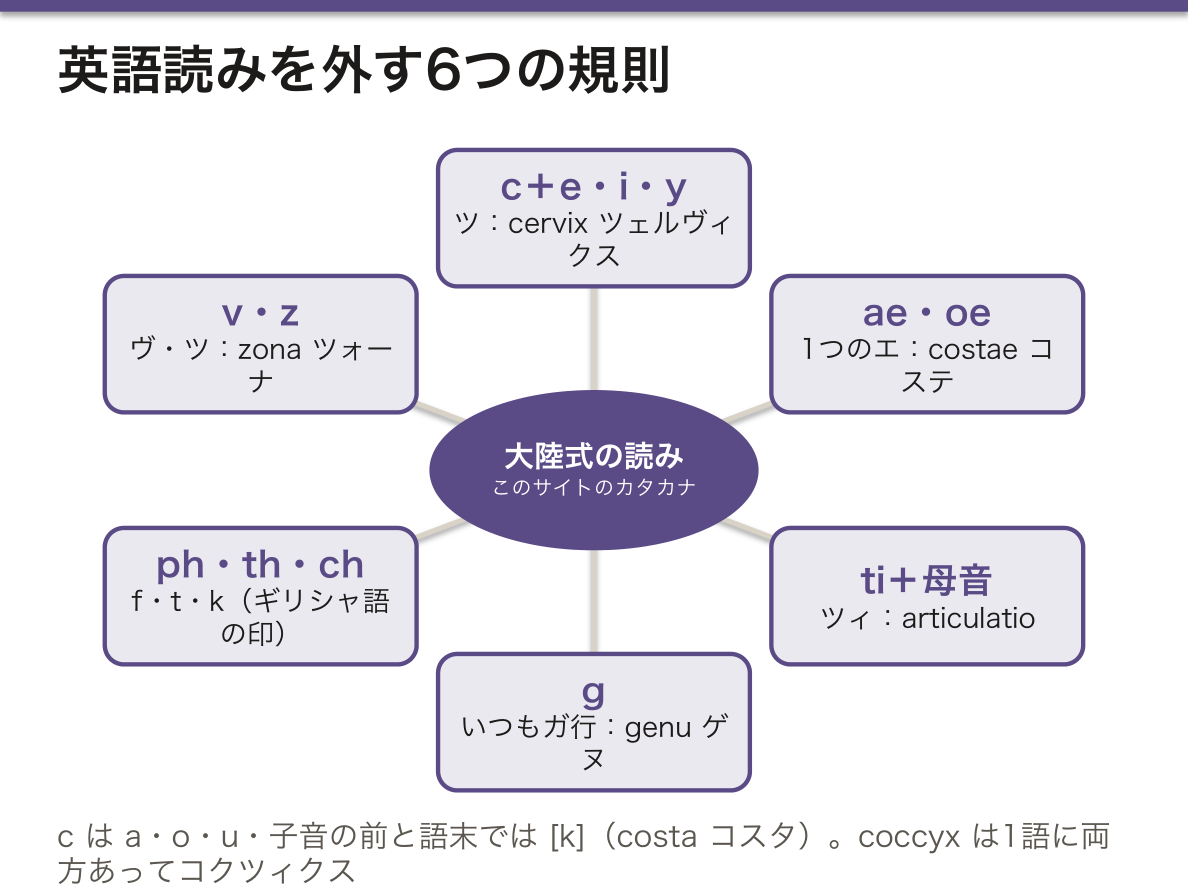
読み方には古典式・教会式・各国の医学式があり、完全に一つには決まらない。このサイトのカタカナはドイツ語圏・北欧の医学部で使われる大陸式に揃えてある:c は e・i・y・ae・oe の前で「ツ」、v は「ヴ」、z は「ツ」、ae・oe は「エ」。教科書の発音表と食い違うところ(ch・s・z)は、各項目で両方を書いておく。
- 24文字 — 英語より2文字少ない
- c の2つの音 — 後ろの文字で決まる
- 二重母音 — ae と oe は1つの「エ」
- s・x・z・ti — 英語と違う4つの子音
- ch・ph・th・rh・y — ギリシャ語から来た印
24文字 — 英語より2文字少ないLitterae Latinae
ラテン語のアルファベットは24文字で、母音6つ(a, e, i, o, u, y)と子音18からなる。英語の26文字と比べるとj と w が無い。
その代わり、i が母音 [i] と子音 [j] を兼ねる。母音の前で同じ音節に入る i と、母音にはさまれた i は [j] になる——iuventus(ユヴェントゥス)、maior(マヨル)。医学の文献ではこの子音の i を j で書くことが多く、major・majus・juxta・juvenilis のような綴りが普通に出てくる。maior と major は同じ語である。
| 文字 | 注意点 | 例 |
|---|---|---|
| k | ほとんど使わない | Kalium(カリウム) |
| y | ギリシャ語由来の語だけ。音は [i] | pyramis, typhus |
| z | ギリシャ語由来の語だけ | zona, zygomaticus |
| i / j | 同じ文字。子音なら [j] | major = maior |
y と z と k は、本来のラテン語の語にはほとんど現れない。y・z はギリシャ語を写すために後から借りた文字で、だからy や z を含む語はギリシャ語由来だと見当がつく——zygoma、pyramis、cystis、hypophysis。ギリシャ語由来だとわかれば、その語の部品は臨床用語の語根(ギリシャ語の語根の章)で読める。
母音には長短がある(ā と a、ī と i)。長音の印(マクロン ¯)はふつう書かれないが、辞書や教科書には付いていることがある。これは飾りではなく、強勢の位置を決める情報である(強勢の章)。
元素記号の多くはラテン語名の頭文字である。血液検査の電解質に並ぶ Na(natrium)・K(kalium)、さらに Fe(ferrum 鉄)・Cu(cuprum 銅)・Ag(argentum 銀)・Au(aurum 金)・Hg(hydrargyrum 水銀)・Pb(plumbum 鉛)。英語名(sodium, potassium, iron)から記号が出てこないのはこのためで、K という珍しい文字がわざわざ残っているのも Kalium のおかげである。
English version
Core
The Latin alphabet has 24 letters: six vowels (a, e, i, o, u, y) and eighteen consonants. Compared with the 26 letters of English, there is no j and no w.
Instead, i serves both as the vowel [i] and the consonant [j]. An i that stands before a vowel in the same syllable, or between two vowels, is [j]: iuventus, maior. Medical texts often write this consonant i as j, so spellings such as major, majus, juxta, juvenilis are normal. Maior and major are the same word.
| Letter | Point to note | Example |
|---|---|---|
| k | Almost never used | Kalium (potassium) |
| y | Only in words of Greek origin; sounds [i] | pyramis, typhus |
| z | Only in words of Greek origin | zona, zygomaticus |
| i / j | The same letter; [j] when a consonant | major = maior |
Going further
Y, z and k hardly appear in native Latin words. Y and z were borrowed later to write Greek, so a word with y or z is very likely Greek: zygoma, pyramis, cystis, hypophysis. Once you know a word is Greek, you can read its parts with the clinical roots (chapter on Greek roots).
Vowels can be long or short (ā and a, ī and i). The long mark (macron ¯) is usually not written, but dictionaries and textbooks sometimes show it. It is not decoration: it decides where the stress falls (chapter on stress).
In the clinic
Many chemical symbols are the first letters of Latin names. The electrolytes on a blood test, Na (natrium) and K (kalium), and also Fe (ferrum, iron), Cu (cuprum, copper), Ag (argentum, silver), Au (aurum, gold), Hg (hydrargyrum, mercury), Pb (plumbum, lead). This is why the symbols cannot be guessed from the English names (sodium, potassium, iron), and why the rare letter K survives at all.
c の2つの音 — 後ろの文字で決まるCoccyx
c はすぐ後ろの文字で音が決まる。e・i・y・ae・oe の前では [ts](ツ行)、それ以外——a・o・u の前、子音の前、語末——では [k](カ行)である。
| [ts] になる | 読み | [k] になる | 読み |
|---|---|---|---|
| cervix | ツェルヴィクス | costa | コスタ |
| cerebrum | ツェレブルム | cavum | カヴム |
| cystis | ツィスティス | cubitus | クビトゥス |
| caecum | ツェクム | crista | クリスタ |
| facies | ファツィエス | sacrum | サクルム |
coccyx(尾骨)は1語の中に両方を持つ。coc-cyx の最初の2つの c は o と c の前なので [k]、最後の c は y の前なので [ts]——コクツィクスになる。
g はいつも [g] で、e・i の前でも濁ったまま変わらない。genu はゲヌ、gingiva はギンギヴァであって、英語風のジェ・ジンにはならない。
同じ語幹の c でも、語尾が変われば音が変わる。これがこの規則のいちばん役に立つところである。coccus(球菌)はコックス、複数の cocci はコクツィ——staphylococcus(ブドウ球菌)の複数は staphylococci で、最後だけツィになる。cervix はツェルヴィクスだが、cervicalis はツェルヴィカーリス(2つ目の c は a の前なので [k])。綴りを見ずに音だけで覚えていると、ここで混乱する。
仕組み自体は英語にもある。英語でも c は e・i・y の前で柔らかくなる(cell, city, cycle と cat, cot, cut)。違うのは柔らかくなったときの音が英語では [s]、この方式では [ts] だという点だけで、境目のつけ方は同じである。
English version
Core
The sound of c depends on the letter right after it. Before e, i, y, ae and oe it is [ts]; everywhere else — before a, o, u, before a consonant, and at the end of a word — it is [k].
| [ts] | Katakana | [k] | Katakana |
|---|---|---|---|
| cervix | ツェルヴィクス | costa | コスタ |
| cerebrum | ツェレブルム | cavum | カヴム |
| cystis | ツィスティス | cubitus | クビトゥス |
| caecum | ツェクム | crista | クリスタ |
| facies | ファツィエス | sacrum | サクルム |
Coccyx has both in one word. In coc-cyx the first two c’s stand before o and c, so they are [k]; the last c stands before y, so it is [ts]: kok-tsiks.
G is always hard [g], even before e and i. Genu is “genu” and gingiva is “gin-gi-va”, never the English “je-” or “jin-“.
Going further
The same c in the same stem changes its sound when the ending changes. This is where the rule is most useful. Coccus is “kok-kus”, but the plural cocci is “kok-tsi” — the plural of staphylococcus is staphylococci, and only the end changes. Cervix starts with [ts], and so does cervicalis, but its second c stands before a and is [k]. If you learn the sound without looking at the spelling, this is where you get lost.
English has the same mechanism. In English, too, c becomes soft before e, i and y (cell, city, cycle against cat, cot, cut). The only difference is that the soft sound is [s] in English and [ts] in this system; the dividing line is the same.
二重母音 — ae と oe は1つの「エ」Oedema
ラテン語の二重母音はae・oe・au・eu の4つで、どれも2文字で1つの音節として読む。
| 二重母音 | 音 | 例 | 読み |
|---|---|---|---|
| ae | [e](エ) | vertebrae, aegrotus | ヴェルテブレ、エグロトゥス |
| oe | [ø](独語の ö。カタカナでは エ) | oedema, oesophagus | エデマ、エソファグス |
| au | [au](アウ) | auris | アウリス |
| eu | [eu](エウ) | pleura, pneumonia | プレウラ、プネウモニア |
ae を「アエ」と2つに切らないのが要点である。vertebrae は「ヴェルテブラエ」ではなくヴェルテブレ、costae はコステになる。
ただし2つ目の母音に点が2つ付いていれば(ë)、別々に読む。aër(空気)はアエル、dyspnoë(呼吸困難)はディスプノエ。
英国式と米国式で綴りが違うのは、この二重母音のせいである。英語はラテン語の綴りをそのまま借りたが、米国式は ae・oe を e に縮めた。anaemia / anemia、haemoglobin / hemoglobin、oedema / edema、oesophagus / esophagus、paediatrics / pediatrics、foetus / fetus。ドイツ語は同じ音を ä・ö で書く(Anämie, Ödem, Ösophagus)。どの綴りでも音は「エ」に揃っているので、ae・oe をエと読むのは理にかなっている。
並んだ母音がすべて二重母音とは限らない。oi・ea・ia・io などは別々の音節である——deltoideus はデル-ト-イ-デ-ウス、tibia はティ-ビ-ア、fovea はフォ-ヴェ-ア。-oideus(〜の形の)の oi を1音にしないこと。
英国・欧州の教科書や論文では haemorrhage・oesophagus・paediatric のような綴りが普通に使われる。辞書や検索で見つからないときは、ae・oe を e に置き換えて米国式でも引くとよい。逆に、ラテン語の用語として書くときは ae・oe を残すのが正しい(anaemia perniciosa, oedema pulmonum)。
English version
Core
Latin has four diphthongs: ae, oe, au, eu. Each is read as two letters, one syllable.
| Diphthong | Sound | Example | Katakana |
|---|---|---|---|
| ae | [e] | vertebrae, aegrotus | ヴェルテブレ、エグロトゥス |
| oe | [ø] (German ö; written エ in katakana) | oedema, oesophagus | エデマ、エソファグス |
| au | [au] | auris | アウリス |
| eu | [eu] | pleura, pneumonia | プレウラ、プネウモニア |
Do not split ae into “a-e”. Vertebrae is not “ver-te-bra-e” but “ver-te-bre”, and costae is “kos-te”.
But if the second vowel carries two dots (ë), read the vowels separately: aër (air) is “a-er”, dyspnoë (shortness of breath) is “dis-pno-e”.
Going further
British and American spellings differ because of these diphthongs. English borrowed the Latin spelling, and American English shortened ae and oe to e: anaemia / anemia, haemoglobin / hemoglobin, oedema / edema, oesophagus / esophagus, paediatrics / pediatrics, foetus / fetus. German writes the same sound with ä and ö (Anämie, Ödem, Ösophagus). In every spelling the sound is [e], which is why reading ae and oe as [e] makes sense.
Not every pair of vowels is a diphthong. Oi, ea, ia, io and so on belong to separate syllables: deltoideus is del-to-i-de-us, tibia is ti-bi-a, fovea is fo-ve-a. Do not merge the oi of -oideus (“shaped like”) into one sound.
In the clinic
British and European textbooks and papers use spellings such as haemorrhage, oesophagus, paediatric as a matter of course. If a word is not found in a dictionary or search, replace ae or oe with e and try the American spelling. When you write a Latin term, on the other hand, keep ae and oe (anaemia perniciosa, oedema pulmonum).
s・x・z・ti — 英語と違う4つの子音Articulatio
| 綴り | 音 | 例 |
|---|---|---|
| ti +母音 | [tsi](ツィ) | articulatio, solutio, substantia, spatium |
| s・x・t の後の ti | ostium, mixtio | |
| x | [ks](クス) | radix, reflexus, thorax |
| qu | [kv](クヴ) | aqua, quadriceps |
| ng の後の u+母音 | [v](ヴ) | lingua(リングヴァ) |
| s | [s]。母音の間・m の前・n の後では [z] とも | basis, plasma, mensis |
| z | 教科書は [z]。独語圏の医学読みは [ts] | zona, zygoma |
ti+母音の [tsi] がいちばん多く出る。-tio で終わる名詞(処置や状態の名前)はすべてこれで、articulatio はアルティクラーツィオ、solutio はソルーツィオと読む。
カタカナの書き方:s はサ行で書き([z] になる位置でもザ行にはしない)、z は「ツ」で書く(zona → ツォーナ)。教科書の発音表とは z の扱いが違うが、どちらも実際に使われている読みである。
ti が ツィ になるのは、ラテン語の後の時代に起きた音の変化の名残で、同じ変化が各国語にも残っている。英語の -tion が「ション」、イタリア語では -zione、ドイツ語では -tion を「ツィオーン」と読む。articulatio・articulation・articolazione は同じ語で、ti の部分がそれぞれの言語で柔らかくなっている。
x は「2つの子音」として数える。だから x の前の母音は長い音節になり、強勢を引きつける——reflexus はre-FLE-xus(レフレクスス)。強勢の章でこの規則を使う。
身体診察の4つの手技は、どれも -tio の名詞である。inspectio(視診)・palpatio(触診)・percussio(打診)・auscultatio(聴診)——読みはインスペクツィオ・パルパーツィオ・ペルクッシオ・アウスクルターツィオ。英語の inspection, palpation, percussion, auscultation はここから来ている。
English version
Core
| Spelling | Sound | Example |
|---|---|---|
| ti + vowel | [tsi] | articulatio, solutio, substantia, spatium |
| ti after s, x, t | stays | ostium, mixtio |
| x | [ks] | radix, reflexus, thorax |
| qu | [kv] | aqua, quadriceps |
| u + vowel after ng | [v] | lingua (“lin-gva”) |
| s | [s]; also [z] between vowels, before m, after n | basis, plasma, mensis |
| z | [z] in the textbook; [ts] in the German medical tradition | zona, zygoma |
Ti + vowel = [tsi] is by far the most frequent. Every noun ending in -tio (names of procedures and states) has it: articulatio is “ar-ti-ku-LA-tsi-o”, solutio is “so-LU-tsi-o”.
Katakana conventions on this site: s is written with the s-row (not the z-row, even where it is voiced), and z is written ツ (zona → ツォーナ). This differs from the textbook table for z, but both readings are in real use.
Going further
Ti becoming [tsi] is the trace of a sound change in later Latin, and the same change survives in modern languages. English -tion is “-shun”, Italian has -zione, and German reads -tion as “-tsion”. Articulatio, articulation and articolazione are one word, with the ti softened in each language.
X counts as two consonants. So the vowel before x makes a long syllable and attracts the stress: reflexus is re-FLE-xus. The chapter on stress uses this rule.
In the clinic
The four techniques of physical examination are all -tio nouns: inspectio, palpatio, percussio, auscultatio — read “in-SPEK-tsi-o, pal-PA-tsi-o, per-KUS-si-o, aus-kul-TA-tsi-o”. English inspection, palpation, percussion and auscultation come from them.
ch・ph・th・rh・y — ギリシャ語から来た印Diaphragma
この5つはギリシャ文字をラテン文字で写した綴りで、本来のラテン語の語には出てこない。だから見えた時点でギリシャ語由来の語だとわかる。
| 綴り | 元のギリシャ文字 | 音 | 例 |
|---|---|---|---|
| ph | φ | [f] | diaphragma, phalanx |
| th | θ | [t] | thorax, therapia |
| rh | 語頭の ρ | [r] | rhinitis, rheumatismus |
| ch | χ | 教科書は [x](独語 Bach の ch)。英語・日本語の慣用は [k] | chondrocytus, chirurgia |
| y | υ | [i](カタカナではイ・ユの両方が使われる) | typhus, hypophysis |
ch はカ行で書くのがこのサイトの方式である(chondrocytus → コンドロツィトゥス)。h は書かれていても音としては1つの子音で、ph・th・rh・ch はどれも子音1つとして数える。
-rrh- という綴りにも理由がある。ギリシャ語では語頭の ρ(rh)が、母音のあとに付けられると rr に重なる。だから「流れる」の rhoea が dia- のあとでは diarrhoea、rhin- のあとでは rhinorrhoea になる。-rrhagia(出血)・-rrhoea(流出)・-rrhaphia(縫合)・-rrhexis(破裂)の4つの接尾辞がすべて rrh で始まるのはこのためで、意味の違いはギリシャ語の語根の章で扱う。
なぜギリシャ語由来だと知る必要があるか。解剖用語の多くはラテン語の名詞だが、病名と術式の多くはギリシャ語の部品の組み合わせである。ph・th・ch・y が見えたら、ラテン語の辞書ではなくギリシャ語の語根の表を引くほうが早い。
日本語の医学用語にも、この綴りの音がそのまま入っている。リウマチ(rheumatismus:rh → r)、ジフテリア(diphtheria:ph → f、th → t)、チフス(typhus:ドイツ語経由)、コレラ(cholera:ch → k)、カテーテル(ドイツ語 Katheter:th → t)。ph はフ、th はト、rh はル——日本語に入った形を思い出せば、読み方の確認になる。
English version
Core
These five spellings are Greek letters written in the Latin alphabet, and they do not occur in native Latin words. So as soon as you see one, you know the word is Greek.
| Spelling | Greek letter | Sound | Example |
|---|---|---|---|
| ph | φ | [f] | diaphragma, phalanx |
| th | θ | [t] | thorax, therapia |
| rh | initial ρ | [r] | rhinitis, rheumatismus |
| ch | χ | [x] in the textbook (German Bach); [k] in English and Japanese usage | chondrocytus, chirurgia |
| y | υ | [i] (katakana uses both イ and ユ) | typhus, hypophysis |
On this site ch is written with the k-row (chondrocytus → コンドロツィトゥス). The h is written, but each of ph, th, rh, ch counts as one consonant.
Going further
The spelling -rrh- has a reason too. In Greek, an initial ρ (rh) doubles to rr when it follows a vowel. So rhoea (“flow”) becomes diarrhoea after dia- and rhinorrhoea after rhin-. That is why the four suffixes -rrhagia (bleeding), -rrhoea (discharge), -rrhaphia (suture) and -rrhexis (rupture) all begin with rrh; their meanings are covered in the chapter on Greek roots.
Why it helps to know a word is Greek: most anatomical terms are Latin nouns, but most names of diseases and operations are built from Greek parts. When you see ph, th, ch or y, it is quicker to look in the table of Greek roots than in a Latin dictionary.
In the clinic
Japanese medical words keep these sounds. Riumachi (rheumatismus: rh → r), jifuteria (diphtheria: ph → f, th → t), chifusu (typhus, via German), korera (cholera: ch → k), kateteru (German Katheter: th → t). Ph is f, th is t, rh is r — the Japanese loanwords are a handy check.
まとめ
| 24文字 — 英語より2文字少ない | ラテン語のアルファベットは24文字で、母音6つ(a, e, i, o, u, y)と子音18からなる。 |
|---|---|
| c の2つの音 — 後ろの文字で決まる | c はすぐ後ろの文字で音が決まる。e・i・y・ae・oe の前では [ts](ツ行)、それ以外——a・o・u の前、子音の前、語末——では [k](カ行)である。 |
| 二重母音 — ae と oe は1つの「エ」 | ラテン語の二重母音はae・oe・au・eu の4つで、どれも2文字で1つの音節として読む。 |
| s・x・z・ti — 英語と違う4つの子音 | 綴り音例ti +母音[tsi](ツィ)articulatio, solutio, substantia, spatiums・x・t の後の ti |
| ch・ph・th・rh・y — ギリシャ語から来た印 | この5つはギリシャ文字をラテン文字で写した綴りで、本来のラテン語の語には出てこない。 |
このノートは医学生が授業の内容を自分の言葉でまとめたもので、診療の判断に使うものではありません。誤りに気づいたらお知らせください。