多くの反応は最後まで進みきらず、正反応と逆反応が釣り合ったところで止まって見える。これが化学平衡で、止まっているのではなく、両向きの反応が同じ速さで続いている動的な状態である。
この章では、平衡の位置を数字にする平衡定数 K、条件を変えたときの動き方を予想するルシャトリエの原理、そしてその応用として弱電解質の電離平衡、溶けにくい塩の溶解度積、錯体の生成と解離を扱う。血液の CO2 と HCO3− の釣り合い、歯のエナメル質の溶解と再石灰化、重金属中毒のキレート療法は、どれも平衡の話である。
- 動的平衡 — 止まって見えるが両向きに進んでいる
- 平衡定数 K — 平衡の位置を1つの数で表す
- ルシャトリエの原理 — 加えられた変化を打ち消す向きに動く
- 弱電解質の電離平衡 — 電離度・電離定数とオストワルトの希釈律
- 溶解度積と共通イオン効果 — 溶けにくい塩の平衡
- 錯体(配位化合物)の構造 — 中心イオン・配位子・配位数
- 錯体の安定性とキレート — 不安定度定数・錯体を壊す方法
動的平衡 — 止まって見えるが両向きに進んでいる
可逆反応 aA + bB ⇄ cC + dD では、反応物から生成物ができる正反応と、生成物が反応物に戻る逆反応が同時に起こる。初めは正反応が速いが、反応物が減ると遅くなり、生成物が増えると逆反応が速くなる。やがて両者の速さが等しくなり、各物質の量が一定になる。これが化学平衡である。
平衡の特徴は、①閉じた系で成り立つ、②反応物と生成物の量は一定(等しいとは限らない)、③反応は止まっておらず両向きに続く(動的)、④どちらの側から出発しても同じ平衡に達する、の4つである。
すべての物質が同じ相にある平衡を均一系の平衡(Fe3+(aq) + SCN−(aq) ⇄ [FeSCN]2+(aq))、固体と溶液のように相が異なるものを不均一系の平衡(CaCO3(s) ⇄ Ca2+(aq) + CO32−(aq))という。固体の融解・蒸発のような物理変化にも平衡がある(氷と水が 0 °C で共存する)。
「量が一定」と「反応が止まった」は違う。平衡にある溶液に同位体で印をつけた分子を少し加えると、印はやがて反応物にも生成物にも広がる。両向きの反応が続いている証拠である。また平衡は熱力学的には ΔG = 0 の状態で、どちらの向きにも進む「得」がない点である。
体内の多くの過程は平衡そのものではなく、物質が絶えず出入りする定常状態である。それでも、肺胞と血液の間のガス交換、ヘモグロビンと O2 の結合、血液中の CO2 + H2O ⇄ H+ + HCO3− のように、局所では平衡の考え方でよく説明できる反応が多い。
English version
Core
In a reversible reaction aA + bB ⇄ cC + dD, the forward reaction (reactants to products) and the reverse reaction (products back to reactants) happen at the same time. At first the forward reaction is fast. As reactants are used up it slows, and as products build up the reverse reaction speeds up. Finally the two rates become equal and the amount of each substance stays constant. This is chemical equilibrium.
Its features: ① it holds in a closed system; ② the amounts of reactants and products are constant (not necessarily equal); ③ the reactions have not stopped but continue both ways (dynamic); ④ the same equilibrium is reached from either side.
Going further
When all substances are in one phase it is a homogeneous equilibrium (Fe3+(aq) + SCN−(aq) ⇄ [FeSCN]2+(aq)). When phases differ, such as a solid and a solution, it is a heterogeneous equilibrium (CaCO3(s) ⇄ Ca2+(aq) + CO32−(aq)). Physical changes such as melting and evaporation also have equilibria (ice and water coexist at 0 °C).
“Constant amounts” is not “the reaction has stopped”. If you add a few isotope-labelled molecules to a solution at equilibrium, the label soon spreads into both reactants and products — proof that both reactions continue. In thermodynamic terms, equilibrium is the state where ΔG = 0: there is no gain in going either way.
In the clinic
Most processes in the body are not true equilibria but steady states, with matter constantly entering and leaving. Still, many local reactions are well explained by equilibrium: gas exchange between alveoli and blood, the binding of O2 to haemoglobin, and CO2 + H2O ⇄ H+ + HCO3− in blood.
平衡定数 K — 平衡の位置を1つの数で表す
aA + bB ⇄ cC + dD が平衡にあるとき、温度が一定なら次の値は一定になる(化学平衡の法則)。
K = [C]c[D]d / ([A]a[B]b)([ ] は平衡時のモル濃度、指数は係数)
例:H2(g) + I2(g) ⇄ 2HI(g) なら K = [HI]2 / ([H2][I2])。固体と純粋な液体(溶媒の水)は式に入れない。濃度が一定とみなせるからである。
| K の大きさ | 意味 |
|---|---|
| K ≫ 1(目安 1010 以上) | ほぼ完全に生成物側へ進む |
| K ≈ 1 | 反応物と生成物が同程度 |
| K ≪ 1(目安 10−10 以下) | ほとんど進まない |
平衡に達していない任意の時点で同じ式に濃度を入れた値を反応商 Q という。Q < K なら正反応が進み、Q > K なら逆反応が進み、Q = K で平衡。今どちらへ動くかを判定できる。
K は熱力学とつながっている:ΔG° = −RT ln K。K = 1 なら ΔG° = 0、K > 1 なら ΔG° < 0。25 °C では ΔG° が 5.7 kJ/mol 負になるごとに K が10倍になる(RT ln 10 ≈ 5.7 kJ/mol)。ただし K は「どこまで進むか」を示すだけで、どれだけ速く平衡に着くかは示さない。速さは速度論の問題である。
K を変えるのは温度だけである。濃度や圧力を変えると平衡の位置は動くが K は変わらず、触媒は平衡に着く速さを上げるだけで位置も K も変えない。
English version
Core
When aA + bB ⇄ cC + dD is at equilibrium, at constant temperature the following value is constant (the law of chemical equilibrium):
K = [C]c[D]d / ([A]a[B]b) ([ ] are molar concentrations at equilibrium; the powers are the coefficients)
Example: for H2(g) + I2(g) ⇄ 2HI(g), K = [HI]2 / ([H2][I2]). Solids and pure liquids (water as solvent) are left out, because their concentration can be taken as constant.
| Size of K | Meaning |
|---|---|
| K ≫ 1 (about 1010 or more) | goes almost completely to products |
| K ≈ 1 | reactants and products at similar levels |
| K ≪ 1 (about 10−10 or less) | hardly goes at all |
Going further
Putting the concentrations at any moment, before equilibrium, into the same expression gives the reaction quotient Q. If Q < K the forward reaction goes; if Q > K the reverse goes; Q = K is equilibrium. It tells you which way the system will move now.
K is linked to thermodynamics: ΔG° = −RT ln K. K = 1 means ΔG° = 0; K > 1 means ΔG° < 0. At 25 °C, each 5.7 kJ/mol more negative ΔG° makes K ten times larger (RT ln 10 ≈ 5.7 kJ/mol). But K only says how far a reaction goes, not how fast it gets there. Speed is a question of kinetics.
Only temperature changes K. Changing concentration or pressure moves the position of equilibrium but not K; a catalyst only speeds up the approach and changes neither the position nor K.
ルシャトリエの原理 — 加えられた変化を打ち消す向きに動く
ルシャトリエの原理:平衡にある系の条件(濃度・圧力・温度)を変えると、系はその変化をできるだけ打ち消す向きに平衡の位置を移す。
| 変化 | 平衡の動き | K |
|---|---|---|
| 反応物を加える/生成物を除く | 生成物側(右)へ | 変わらない |
| 生成物を加える/反応物を除く | 反応物側(左)へ | 変わらない |
| 加圧(体積を減らす) | 気体分子の数が少ない側へ | 変わらない |
| 温度を上げる | 吸熱の向きへ | 変わる |
| 温度を下げる | 発熱の向きへ | 変わる |
| 触媒を加える | 動かない(早く着くだけ) | 変わらない |
例を3つ。N2O4(無色)⇄ 2NO2(褐色)ΔH = +57 kJ/mol:正反応は吸熱なので、温めると右へ動いて褐色が濃くなり、氷水で冷やすと薄くなる。注射器で押し縮めると、一瞬濃くなったあと分子の少ない左へ動いて薄くなる。
2CrO42−(黄)+ 2H+ ⇄ Cr2O72−(橙)+ H2O:酸を加えると H+ を減らす向き(右)へ動いて橙色に、塩基を加えると OH− が H+ を奪うので左へ動いて黄色に戻る。
Fe3+ + SCN− ⇄ [FeSCN]2+(血赤色):Fe3+ や SCN− を加えると赤が濃くなる。反応に関わらないイオンを加えても、ほとんど変わらない。
温度だけが K を変えるのは、K が ΔG°(=ΔH° − TΔS°)を通じて温度の関数だからである。吸熱反応の K は温度とともに大きくなり、発熱反応の K は小さくなる。
血液の CO2 + H2O ⇄ H2CO3 ⇄ H+ + HCO3− は、ルシャトリエの原理の教材そのものである。過換気で CO2 が吐き出されると平衡は左へ動き、H+ が減って pH が上がる(呼吸性アルカローシス)。逆に換気が足りず CO2 がたまると右へ動いて H+ が増える(呼吸性アシドーシス)。血液ガスの読み方は、この1本の平衡式の動きで説明できる。
English version
Core
Le Chatelier’s principle: if you change a condition (concentration, pressure, temperature) of a system at equilibrium, the system shifts its position to oppose the change as far as possible.
| Change | Shift | K |
|---|---|---|
| Add reactant / remove product | towards products (right) | no change |
| Add product / remove reactant | towards reactants (left) | no change |
| Increase pressure (smaller volume) | towards fewer gas molecules | no change |
| Raise temperature | in the endothermic direction | changes |
| Lower temperature | in the exothermic direction | changes |
| Add catalyst | no shift (only faster) | no change |
Going further
Three examples. N2O4 (colourless) ⇄ 2NO2 (brown), ΔH = +57 kJ/mol: the forward reaction is endothermic, so warming shifts it right and the brown deepens; cooling in ice water makes it paler. Compressing in a syringe darkens it for a moment, then it shifts left (fewer molecules) and gets paler.
2CrO42− (yellow) + 2H+ ⇄ Cr2O72− (orange) + H2O: adding acid shifts it right to use up H+, giving orange; adding base lets OH− remove H+, so it shifts left back to yellow.
Fe3+ + SCN− ⇄ [FeSCN]2+ (blood red): adding Fe3+ or SCN− deepens the red. Adding ions that take no part hardly changes it.
Only temperature changes K because K depends on temperature through ΔG° (= ΔH° − TΔS°). K of an endothermic reaction grows with temperature; K of an exothermic one falls.
In the clinic
Blood’s CO2 + H2O ⇄ H2CO3 ⇄ H+ + HCO3− is a textbook case of Le Chatelier’s principle. When hyperventilation blows off CO2, the equilibrium shifts left, H+ falls and pH rises (respiratory alkalosis). When breathing is too weak and CO2 builds up, it shifts right and H+ rises (respiratory acidosis). Reading blood gases can be explained by the movement of this one equation.
弱電解質の電離平衡 — 電離度・電離定数とオストワルトの希釈律
弱電解質は溶液中で分子とイオンが平衡になる。酢酸なら CH3COOH ⇄ CH3COO− + H+ で、その平衡定数が電離定数 Ka = [CH3COO−][H+] / [CH3COOH](塩基なら Kb)である。
電離度 α は「電離した分子 ÷ 溶かした分子」。濃度 c の弱酸では、[H+] = [A−] = cα、[HA] = c(1 − α) だから
K = cα2 / (1 − α) α が小さければ(目安 5% 未満)K ≈ cα2、α ≈ √(K / c)
これがオストワルトの希釈律で、薄めるほど α は大きくなる。
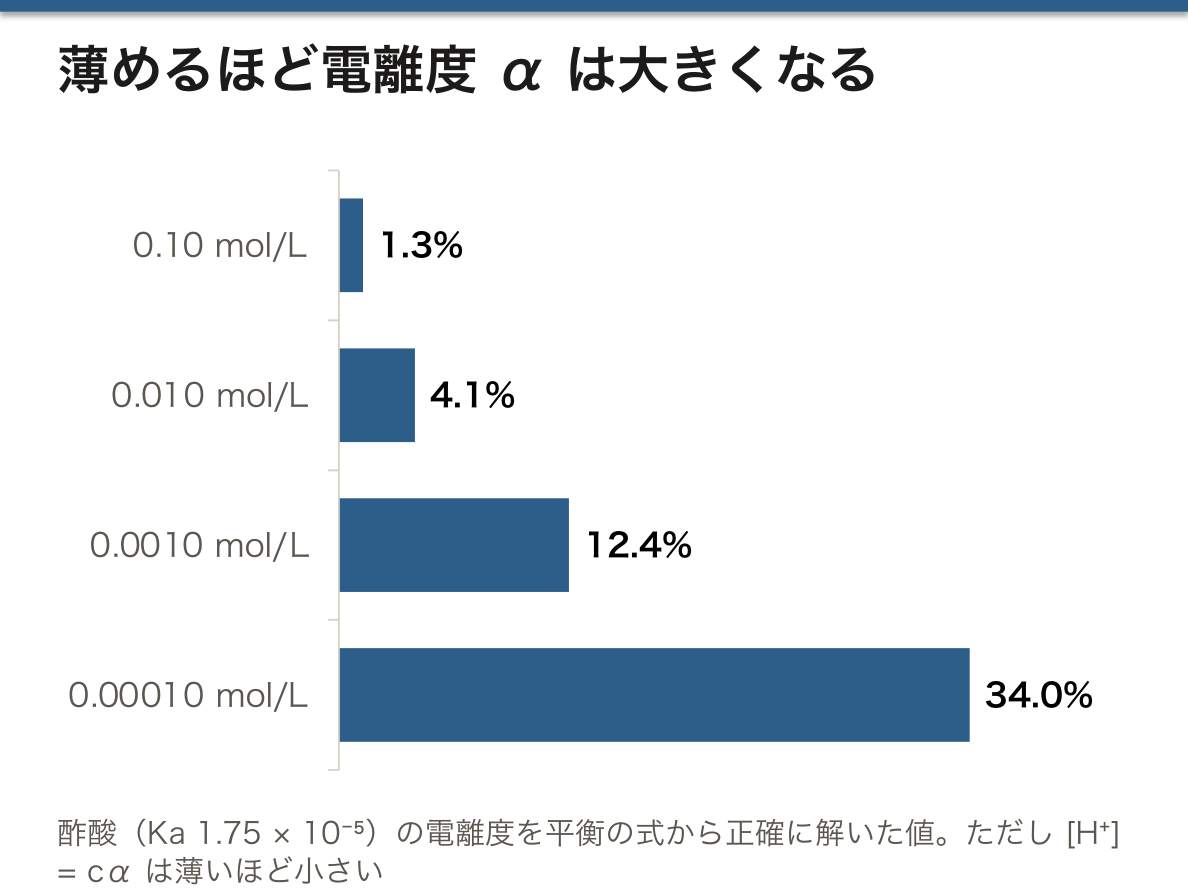
例:酢酸(Ka = 1.75 × 10⁻⁵)0.10 mol/L では α ≈ √(1.75 × 10⁻⁴) ≈ 0.013、つまり 約1.3% しか電離していない。0.0010 mol/L まで薄めると約12%(近似式では13%)になる。
なぜ薄めると電離が進むのか。ルシャトリエの原理で考える。水を加えると溶質の粒子はすべて薄まるが、右辺はイオン2個、左辺は分子1個なので、粒子の数が増える向き(電離の向き)に平衡が動いて薄まりを打ち消す。ただし α が大きくなっても [H+] = cα 自体は小さくなるので、薄めれば pH は上がる。
強電解質では α ≈ 1 で分母の (1 − α) が0に近づき、K は非常に大きくなるので、この法則は弱電解質にだけ使う。K は物質ごと・温度ごとに一定、α は濃度で変わる——酸の強さを比べるときは α ではなく K(pKa)を使う理由である。
English version
Core
A weak electrolyte in solution is in equilibrium between molecules and ions. For acetic acid, CH3COOH ⇄ CH3COO− + H+, and its equilibrium constant is the dissociation constant Ka = [CH3COO−][H+] / [CH3COOH] (Kb for a base).
The degree of dissociation α is “molecules dissociated ÷ molecules dissolved”. For a weak acid of concentration c, [H+] = [A−] = cα and [HA] = c(1 − α), so
K = cα2 / (1 − α); if α is small (below about 5%), K ≈ cα2 and α ≈ √(K / c)
This is Ostwald’s dilution law: the more dilute, the larger α.
Going further
Example: in 0.10 mol/L acetic acid (Ka = 1.75 × 10⁻⁵), α ≈ √(1.75 × 10⁻⁴) ≈ 0.013 — only about 1.3% is dissociated. Diluted to 0.0010 mol/L it is about 12% (13% by the approximate formula).
Why does dilution increase dissociation? Use Le Chatelier. Adding water dilutes all particles, but the right side has two ions and the left one molecule, so the equilibrium moves towards more particles (dissociation) to oppose the dilution. Even so, [H+] = cα itself becomes smaller, so dilution raises the pH.
For strong electrolytes α ≈ 1, so (1 − α) approaches 0 and K becomes huge; the law is used only for weak electrolytes. K is constant for a substance at a given temperature; α changes with concentration — this is why acid strength is compared by K (pKa), not α.
溶解度積と共通イオン効果 — 溶けにくい塩の平衡
溶けにくい塩の飽和溶液では、固体と溶けたイオンが平衡になる。MxAy(s) ⇄ xMy+ + yAx− で、固体は式に入れないので
Ksp = [My+]x [Ax−]y(溶解度積)
例:Ca3(PO4)2 なら Ksp = [Ca2+]3[PO43−]2。Ksp が小さいほど溶けにくい(同じ型の塩どうしで比べる)。イオン濃度の積が Ksp を超えると沈殿ができ、下回ると固体が溶ける。
共通イオン効果:塩を構成するイオンの一方を含む別の物質を加えると、平衡が固体の側へ動いて溶解度が下がる。
計算例:AgCl(Ksp = 1.8 × 10⁻¹⁰)の溶解度を s とすると [Ag+] = [Cl−] = s、s2 = 1.8 × 10⁻¹⁰、s ≈ 1.3 × 10⁻⁵ mol/L。これを 0.10 mol/L の NaCl 水溶液に溶かすと [Cl−] ≈ 0.10 なので、s = 1.8 × 10⁻¹⁰ / 0.10 = 1.8 × 10⁻⁹ mol/L。共通イオンのせいで溶解度は約1万分の1に下がる。
同じ理屈で、飽和した CaCO3 の溶液に Ca(NO3)2 や K2CO3 を加えると CaCO3 は溶けにくくなり、共通イオンをもたない KNO3 ではほとんど変わらない。共通イオン効果は弱電解質にも働く。酢酸に酢酸ナトリウムを加えると、CH3COO− が増えて酢酸の電離が抑えられる(緩衝液の章の出発点)。
歯や骨の無機質の主成分はヒドロキシアパタイト Ca10(PO4)6(OH)2 で、唾液との間で溶解と再沈着の平衡にある。プラークの細菌が糖から酸を作り pH が約5.5より下がると、PO43− や OH− が H+ に奪われて平衡が溶ける側へ動き、エナメル質が脱灰する(う蝕)。フッ化物があるとより溶けにくいフルオロアパタイトが取り込まれ、酸に強くなる。また X 線造影剤の 硫酸バリウムは Ksp が非常に小さく(約 10−10)、毒性のある Ba2+ がほとんど溶け出さないので経口で使える。
English version
Core
In a saturated solution of a poorly soluble salt, the solid and the dissolved ions are in equilibrium. For MxAy(s) ⇄ xMy+ + yAx−, the solid is left out, so
Ksp = [My+]x [Ax−]y (solubility product)
Example: for Ca3(PO4)2, Ksp = [Ca2+]3[PO43−]2. The smaller Ksp, the less soluble (compare salts of the same type). If the product of ion concentrations exceeds Ksp, a precipitate forms; if it is lower, the solid dissolves.
The common ion effect: adding another substance that contains one of the salt’s ions shifts the equilibrium towards the solid and lowers the solubility.
Going further
Example: let the solubility of AgCl (Ksp = 1.8 × 10⁻¹⁰) be s. [Ag+] = [Cl−] = s, s2 = 1.8 × 10⁻¹⁰, s ≈ 1.3 × 10⁻⁵ mol/L. In 0.10 mol/L NaCl, [Cl−] ≈ 0.10, so s = 1.8 × 10⁻¹⁰ / 0.10 = 1.8 × 10⁻⁹ mol/L. The common ion lowers the solubility about ten-thousand-fold.
In the same way, adding Ca(NO3)2 or K2CO3 to saturated CaCO3 makes CaCO3 less soluble, while KNO3, with no common ion, hardly changes it. The common ion effect also works on weak electrolytes: adding sodium acetate to acetic acid raises CH3COO− and suppresses the acid’s dissociation (the starting point of the buffer chapter).
In the clinic
The main mineral of teeth and bone is hydroxyapatite Ca10(PO4)6(OH)2, in an equilibrium of dissolving and re-depositing with saliva. When plaque bacteria make acid from sugar and the pH falls below about 5.5, H+ removes PO43− and OH−, the equilibrium shifts towards dissolving, and enamel demineralises (caries). With fluoride, the less soluble fluorapatite is built in and the tooth resists acid better. The X-ray contrast agent barium sulfate has a very small Ksp (about 10−10), so hardly any toxic Ba2+ dissolves and it can be swallowed safely.
錯体(配位化合物)の構造 — 中心イオン・配位子・配位数
錯体は、金属イオン(中心イオン)のまわりに、非共有電子対をもつ分子やイオン(配位子)が配位結合でついた化合物である。中心イオンが電子対を受け取り、配位子が差し出す。
| 例 | 中心イオン | 配位子 | 配位数 | 内圏(錯イオン) | 外圏 |
|---|---|---|---|---|---|
| K4[Fe(CN)6] | Fe2+ | CN− | 6 | [Fe(CN)6]4− | 4K+ |
| [Cu(NH3)4]SO4 | Cu2+ | NH3 | 4 | [Cu(NH3)4]2+ | SO42− |
| [Ag(NH3)2]Cl | Ag+ | NH3 | 2 | [Ag(NH3)2]+ | Cl− |
配位数は中心イオンが作る配位結合の数で、目安として中心イオンの電荷の2倍になることが多い(Ag+ → 2、Cu2+・Zn2+ → 4、Fe3+・Al3+・Cr3+ → 6)。例外もある(Fe2+ は 6)。
錯体には2種類の結合がある。内圏(中心イオン+配位子)の中は配位結合(共有結合の一種)、内圏と外圏の間はイオン結合である。だから錯体の電離は2段階で起こる。
第1段階(一次解離):イオン結合が切れ、強電解質としてほぼ完全に電離する。[Ag(NH3)2]Cl → [Ag(NH3)2]+ + Cl−
第2段階(二次解離):錯イオン自体が弱電解質として、わずかだけ解離する。[Ag(NH3)2]+ ⇄ Ag+ + 2NH3
中心イオンの電荷は、錯イオンの電荷から配位子の電荷を引いて求める。[Fe(CN)6]4− なら x + 6 × (−1) = −4 で Fe は +2。配位結合の作り方は、電子対の受け手(ルイス酸)と出し手(ルイス塩基)の反応と同じで、錯体は酸・塩基の考え方を広げたものとも言える。
English version
Core
A complex is a compound in which molecules or ions with lone pairs (ligands) are attached to a metal ion (the central ion) by coordinate bonds. The central ion accepts the electron pair; the ligand donates it.
| Example | Central ion | Ligand | Coordination number | Inner sphere (complex ion) | Outer sphere |
|---|---|---|---|---|---|
| K4[Fe(CN)6] | Fe2+ | CN− | 6 | [Fe(CN)6]4− | 4K+ |
| [Cu(NH3)4]SO4 | Cu2+ | NH3 | 4 | [Cu(NH3)4]2+ | SO42− |
| [Ag(NH3)2]Cl | Ag+ | NH3 | 2 | [Ag(NH3)2]+ | Cl− |
The coordination number is the number of coordinate bonds the central ion forms. As a rule of thumb it is often twice the charge of the central ion (Ag+ → 2; Cu2+, Zn2+ → 4; Fe3+, Al3+, Cr3+ → 6). There are exceptions (Fe2+ is 6).
Going further
A complex has two kinds of bond. Inside the inner sphere (central ion + ligands) they are coordinate bonds (a kind of covalent bond); between the inner and outer spheres there is an ionic bond. So a complex dissociates in two steps.
Primary dissociation: the ionic bond breaks and it dissociates almost completely, like a strong electrolyte. [Ag(NH3)2]Cl → [Ag(NH3)2]+ + Cl−
Secondary dissociation: the complex ion itself dissociates only slightly, like a weak electrolyte. [Ag(NH3)2]+ ⇄ Ag+ + 2NH3
Find the charge of the central ion by subtracting the ligands’ charge from the complex ion’s charge: for [Fe(CN)6]4−, x + 6 × (−1) = −4, so Fe is +2. Forming a coordinate bond is the reaction of an electron-pair acceptor (Lewis acid) with a donor (Lewis base), so complexes can be seen as a wider form of acid–base chemistry.
錯体の安定性とキレート — 不安定度定数・錯体を壊す方法
錯イオンの二次解離の平衡定数を不安定度定数 Kinst という。[Ag(NH3)2]+ ⇄ Ag+ + 2NH3 なら Kinst = [Ag+][NH3]2 / [[Ag(NH3)2]+]。Kinst が小さいほど解離しにくく、安定な錯体である(逆数を安定度定数と呼ぶ)。安定性は中心イオンと配位子の組み合わせで決まる。
錯体を壊す(中心イオンや配位子を取り出す)方法は3つある。①中心イオンをもっと溶けにくい沈殿にする(Cu2+ + S2− → CuS↓)。②配位子の電子対をH+ でふさぐ(NH3 + H+ → NH4+ は配位子になれない)。③より強い配位子に置き換える。
1つの配位子が2か所以上で同じ中心イオンにつかみかかる錯体をキレート(ギリシャ語の「カニのはさみ」)という。代表の EDTA(エチレンジアミン四酢酸)は1分子で6か所から配位し、金属イオンを包み込むように 1 : 1 で結合する。1か所ずつ配位する配位子をたくさん使うより、多座の配位子1つのほうがずっと安定である(キレート効果)。いったん1か所が外れても残りが押さえているので、完全には離れにくいからである。EDTA が Ca2+・Mg2+ の定量(水の硬度)に使われるのはこのためである。
錯体は医療のあちこちにある。ヘムは Fe2+ のポルフィリン錯体で、CO は O2 の約200倍以上強く結合するので少量でも中毒になる。鉛中毒には Ca-EDTA などのキレート剤で鉛を錯体にして尿へ出し、血算の採血管には EDTA 塩が入っていて Ca2+ を捕まえて凝固を止める(同じ理由で、この管の血液で Ca は測れない)。抗がん薬シスプラチンは白金錯体で、DNA に配位して働く。銀を長く摂ると皮膚に沈着して灰青色になる(銀皮症)。
English version
Core
The equilibrium constant of the secondary dissociation of a complex ion is the instability constant Kinst. For [Ag(NH3)2]+ ⇄ Ag+ + 2NH3, Kinst = [Ag+][NH3]2 / [[Ag(NH3)2]+]. The smaller Kinst, the less it dissociates and the more stable the complex (the inverse is called the stability constant). Stability depends on the pair of central ion and ligand.
There are three ways to break a complex (to free the central ion or the ligands): ① turn the central ion into a less soluble precipitate (Cu2+ + S2− → CuS↓); ② block the ligand’s lone pair with H+ (NH4+ from NH3 + H+ cannot be a ligand); ③ replace it with a stronger ligand.
Going further
A complex in which one ligand grips the same central ion at two or more points is a chelate (from the Greek for “crab’s claw”). The typical example, EDTA (ethylenediaminetetraacetic acid), binds through six points in one molecule and wraps round the metal ion in a 1 : 1 ratio. One multi-point ligand is much more stable than many single-point ligands (the chelate effect): if one point lets go, the others still hold it, so it rarely comes off completely. This is why EDTA is used to measure Ca2+ and Mg2+ (water hardness).
In the clinic
Complexes are everywhere in medicine. Haem is a porphyrin complex of Fe2+, and CO binds to it about 200 or more times more strongly than O2, so even small amounts are poisonous. Lead poisoning is treated with chelating agents such as calcium EDTA, which make a complex with lead that leaves in urine. Blood-count tubes contain an EDTA salt, which catches Ca2+ and stops clotting (for the same reason, Ca cannot be measured in blood from this tube). The anticancer drug cisplatin is a platinum complex that works by binding to DNA. Long-term intake of silver deposits it in the skin and turns it grey-blue (argyria).
まとめ
| 動的平衡 — 止まって見えるが両向きに進んでいる | 可逆反応 aA + bB ⇄ cC + dD では、反応物から生成物ができる正反応と、生成物が反応物に戻る逆反応が同時に起こる。 |
|---|---|
| 平衡定数 K — 平衡の位置を1つの数で表す | aA + bB ⇄ cC + dD が平衡にあるとき、温度が一定なら次の値は一定になる(化学平衡の法則)。 |
| ルシャトリエの原理 — 加えられた変化を打ち消す向きに動く | ルシャトリエの原理:平衡にある系の条件(濃度・圧力・温度)を変えると、系はその変化をできるだけ打ち消す向きに平衡の位置を移す。 |
| 弱電解質の電離平衡 — 電離度・電離定数とオストワルトの希釈律 | 弱電解質は溶液中で分子とイオンが平衡になる。 |
| 溶解度積と共通イオン効果 — 溶けにくい塩の平衡 | 溶けにくい塩の飽和溶液では、固体と溶けたイオンが平衡になる。 |
| 錯体(配位化合物)の構造 — 中心イオン・配位子・配位数 | 錯体は、金属イオン(中心イオン)のまわりに、非共有電子対をもつ分子やイオン(配位子)が配位結合でついた化合物である。 |
| 錯体の安定性とキレート — 不安定度定数・錯体を壊す方法 | 錯イオンの二次解離の平衡定数を不安定度定数 Kinst という。 |
このノートは医学生が授業の内容を自分の言葉でまとめたもので、診療の判断に使うものではありません。誤りに気づいたらお知らせください。