医化学の出発点は、水に何かが溶けた状態(溶液)を正しく言葉にできることである。体重の約6割は水で、血漿も細胞内液も尿も、すべて「水を溶媒とする溶液」だ。そこに溶けている粒子が分子のままか、イオンに分かれているかで、電気の通しやすさも浸透圧も pH も変わる。
この章では、物質の分類(酸・塩基・塩・酸化物)、電解質と電離、反応式の書き方、そして反応式の係数を物質量の比として読む化学量論を扱う。以後のすべての章(濃度・滴定・浸透圧・緩衝液)は、ここで決めた「何がどれだけの粒子になるか」の数え方の上に立つ。
- 混合物と溶液 — 溶質・溶媒と「似たものは似たものに溶ける」
- 原子・イオン・分子と化学結合 — イオン結合・共有結合・配位結合
- 化合物の分類 — 酸・塩基・塩・酸化物
- 電解質と電離 — 強電解質・弱電解質・非電解質
- 化学反応の種類と反応式 — 分子式・イオン式・正味のイオン反応式
- 化学量論 — 係数は物質量(mol)の比である
混合物と溶液 — 溶質・溶媒と「似たものは似たものに溶ける」
混合物は2種類以上の物質が化学的に結合せずに混ざったもので、成分を目や弱い拡大で見分けられない均一混合物と、見分けられる不均一混合物に分かれる。ある物質(分散相)が細かい粒子になって別の物質(分散媒)の中に散らばった状態を分散系と呼び、粒子が分子・イオンの大きさまで小さくなったものが溶液である。
溶液は溶質(溶けているもの)と溶媒(溶かしているもの)からなる。溶けるかどうかの目安は極性で、極性の溶質は極性の溶媒に、無極性の溶質は無極性の溶媒に溶けやすい。水は代表的な極性溶媒、エタノールは極性と無極性の部分を両方もつ。
なぜ「似たもの同士」なのか。溶けるとは、溶質どうし・溶媒どうしの引き合いをいったん切って、溶質と溶媒の間に新しい引き合いを作ることである。水分子は O が部分的に負、H が部分的に正に偏っているので、Na+ や Cl− のようなイオンや、−OH をもつ糖をよく取り囲める(水和)。一方、油の分子には偏りがほとんどなく、水との間に強い引き合いを作れないので、水どうしの水素結合を壊してまで割り込む得がない。だから分離する。
体液は水が溶媒なので、水溶性の物質は血漿にそのまま溶けて運ばれ、脂溶性の物質は蛋白(アルブミン・リポ蛋白)に乗って運ばれる。薬でも同じで、脂溶性の高い薬は細胞膜や血液脳関門を通りやすく、水溶性の高い薬は腎臓からそのまま排泄されやすい。薬理学で「脂溶性か水溶性か」が分布と排泄を決めると習うのは、この極性の話の延長である。
English version
Core
A mixture is two or more substances mixed without chemical bonding. In a homogeneous mixture you cannot see the parts by eye or with weak magnification; in a heterogeneous mixture you can. When one substance (the dispersed phase) is spread as small particles in another (the dispersion medium), it is a dispersion system. When the particles are as small as molecules or ions, it is a solution.
A solution has a solute (what dissolves) and a solvent (what dissolves it). The rule of thumb is polarity: polar solutes dissolve in polar solvents, non-polar solutes in non-polar solvents. Water is the typical polar solvent; ethanol has both polar and non-polar parts.
Going further
Why “like dissolves like”? To dissolve, the solute–solute and solvent–solvent attractions must break, and new solute–solvent attractions must form. In water, O carries a partial negative charge and H a partial positive charge, so water can surround ions such as Na+ and Cl− and sugars with −OH groups (hydration). Oil molecules have almost no charge separation. They cannot attract water strongly, so there is no gain in breaking the hydrogen bonds between water molecules. The two phases separate.
In the clinic
Body fluids use water as the solvent. So water-soluble substances travel dissolved in plasma, and fat-soluble substances travel on proteins (albumin, lipoproteins). Drugs follow the same rule: very fat-soluble drugs cross cell membranes and the blood–brain barrier easily, and very water-soluble drugs are often excreted unchanged by the kidney. The pharmacology idea that lipid solubility controls distribution and excretion comes directly from polarity.
原子・イオン・分子と化学結合 — イオン結合・共有結合・配位結合
原子は元素の最小単位(O、Cl など)、イオンは電子を失うか得て電荷をもった粒子(Na+、Fe3+、OH−、CO32− など)、分子は原子が共有結合でまとまった電気的に中性な粒子(H2、CO2、CH4、グルコース C6H12O6 など)である。
結合は大きく3つに分けて考える。
| 結合 | 何が起きているか | 例 |
|---|---|---|
| イオン結合 | 金属が電子を渡し、陽イオンと陰イオンが静電気で引き合う | NaCl、LiF、Al2S3 |
| 共有結合(極性) | 異なる原子が電子対を共有するが、電気陰性度の大きい側に偏る | H2O、HF、CO |
| 共有結合(無極性) | 同じ原子どうし、または偏りが打ち消し合う | F2、N2、CH4、CO2 |
| 配位結合(供与–受容) | 一方の原子だけが電子対を差し出して共有する | NH4+、錯イオン [Cu(NH3)4]2+ |
結合の種類は電気陰性度(電子を引きつける強さ)の差で連続的に変わる。差がほぼ0なら無極性共有結合、中くらいなら極性共有結合、非常に大きいと電子が完全に移ってイオン結合になる。CO2 は C=O 結合それぞれは極性をもつが、直線形で左右の偏りが打ち消し合うので分子全体としては無極性になる。H2O は折れ曲がった形なので打ち消されず、極性分子になる。「結合の極性」と「分子の極性」を分けて考えるのがポイントである。
配位結合はでき方が違うだけで、できてしまえば普通の共有結合と区別できない。NH4+ の4本の N–H は、どれが配位結合だったか見分けられない。
配位結合は生体で重要な役割を担う。ヘモグロビンのヘムでは、Fe2+ にポルフィリンの窒素とヒスチジンが配位し、残った位置に O2 が配位する。CO はこの位置に O2 よりはるかに強く配位するので、一酸化炭素中毒では酸素が運べなくなる(錯体の章で詳しく扱う)。
English version
Core
An atom is the smallest unit of an element (O, Cl). An ion is a particle with a charge after losing or gaining electrons (Na+, Fe3+, OH−, CO32−). A molecule is a neutral particle of atoms held by covalent bonds (H2, CO2, CH4, glucose C6H12O6).
Think of three main kinds of bond:
| Bond | What happens | Examples |
|---|---|---|
| Ionic | A metal gives electrons; cations and anions attract each other electrostatically | NaCl, LiF, Al2S3 |
| Polar covalent | Different atoms share an electron pair, pulled toward the more electronegative atom | H2O, HF, CO |
| Non-polar covalent | Same atoms, or the pulls cancel out | F2, N2, CH4, CO2 |
| Coordinate (donor–acceptor) | Only one atom gives the shared electron pair | NH4+, complex ion [Cu(NH3)4]2+ |
Going further
The type of bond changes gradually with the difference in electronegativity (how strongly an atom pulls electrons). Almost no difference gives a non-polar covalent bond, a medium difference a polar covalent bond, and a very large difference moves the electron completely, giving an ionic bond. Each C=O bond in CO2 is polar, but the molecule is linear, so the two pulls cancel and the whole molecule is non-polar. H2O is bent, so the pulls do not cancel and it is polar. Keep “polar bond” and “polar molecule” separate.
A coordinate bond only forms differently. Once formed, it is the same as any covalent bond: in NH4+ you cannot tell which N–H bond was the coordinate one.
In the clinic
Coordinate bonds matter in the body. In the haem of haemoglobin, nitrogen atoms of porphyrin and a histidine coordinate to Fe2+, and O2 binds at the free position. CO binds to this position much more strongly than O2, so in carbon monoxide poisoning oxygen cannot be carried (see the chapter on complexes).
化合物の分類 — 酸・塩基・塩・酸化物
無機化合物はまず4つに分ける。
| 分類 | 見分け方 | 例 |
|---|---|---|
| 酸 | 水中で H+ を出す。H で始まる式が多い | HCl、HNO3、H2SO4、H3PO4、CH3COOH |
| 塩基 | 水中で OH− を出す(金属+OH) | NaOH、KOH、Ca(OH)2、Mg(OH)2、Al(OH)3 |
| 塩 | 酸の陰イオンと塩基の陽イオンからなる | NaCl、K3PO4、CuCO3、Al2(SO4)3 |
| 酸化物 | 元素と酸素の2元素からなる | CaO、Al2O3、SO2、CO2 |
酸と塩基が反応すると塩と水ができる(中和)。HCl + NaOH → NaCl + H2O。
酸化物は水との反応で性格が分かれる。非金属の酸化物は水と反応して酸になる(酸性酸化物):CO2 + H2O ⇄ H2CO3、SO2 + H2O → H2SO3。金属の酸化物は塩基になる(塩基性酸化物):CaO + H2O → Ca(OH)2。Al2O3 や ZnO のように酸にも塩基にも反応するものは両性酸化物と呼ぶ。周期表の左(金属)ほど塩基性、右(非金属)ほど酸性という傾向で整理すると覚えやすい。
ここでの酸・塩基の定義は H+ と OH− を出すかどうか(アレニウスの定義)である。後の章では、H+ を渡すか受け取るかで考えるブレンステッド–ローリーの定義に広げる。
CO2 が酸性酸化物であることは、生理学の酸塩基平衡そのものである。換気が落ちて CO2 が溜まると H2CO3 を経て H+ が増え、呼吸性アシドーシスになる。また胃酸は HCl であり、制酸薬には Mg(OH)2・Al(OH)3・NaHCO3 のような塩基や塩基性の塩が使われる。これらが胃の中で起こしているのは中和反応である。
English version
Core
Sort inorganic compounds into four classes first.
| Class | How to recognise | Examples |
|---|---|---|
| Acid | Gives H+ in water; formula often starts with H | HCl, HNO3, H2SO4, H3PO4, CH3COOH |
| Base | Gives OH− in water (metal + OH) | NaOH, KOH, Ca(OH)2, Mg(OH)2, Al(OH)3 |
| Salt | Cation of a base + anion of an acid | NaCl, K3PO4, CuCO3, Al2(SO4)3 |
| Oxide | Two elements, one of them oxygen | CaO, Al2O3, SO2, CO2 |
An acid and a base react to give a salt and water (neutralisation): HCl + NaOH → NaCl + H2O.
Going further
Oxides differ in how they react with water. Oxides of non-metals give acids (acidic oxides): CO2 + H2O ⇄ H2CO3, SO2 + H2O → H2SO3. Oxides of metals give bases (basic oxides): CaO + H2O → Ca(OH)2. Oxides such as Al2O3 and ZnO react with both acids and bases; they are amphoteric. A simple pattern helps: the left of the periodic table (metals) is basic, the right (non-metals) is acidic.
Here, an acid gives H+ and a base gives OH− (the Arrhenius definition). A later chapter widens this to the Brønsted–Lowry definition, where an acid gives H+ and a base accepts it.
In the clinic
CO2 is an acidic oxide — and this is the basis of acid–base physiology. When breathing is too weak, CO2 builds up, H2CO3 forms and H+ rises: this is respiratory acidosis. Gastric acid is HCl, and antacids are bases or basic salts such as Mg(OH)2, Al(OH)3 and NaHCO3. In the stomach they simply neutralise the acid.
電解質と電離 — 強電解質・弱電解質・非電解質
水に溶けたとき(または融けたとき)イオンに分かれて電気を通す物質を電解質、イオンを作らず電気を通さない物質を非電解質という。イオンに分かれることを電離(解離)と呼び、溶けた分子のうち電離したものの割合を電離度 α(0〜1)で表す。
| 強電解質(α ≈ 1) | 弱電解質(α < 1) | 非電解質(α = 0) | |
|---|---|---|---|
| 例 | 強酸 HCl・HNO3・H2SO4、強塩基 NaOH・KOH・Ca(OH)2・Ba(OH)2、水に溶ける塩 | それ以外の酸(CH3COOH、H2S)・塩基(NH4OH)、水に溶けにくい塩 | グルコース、スクロース、エタノール、O2 などの気体、単体 |
| 電離式 | →(一方向) | ⇄(両方向・平衡) | 電離しない |
電離式は係数まで書く。Al2(SO4)3 → 2Al3+ + 3SO42−、CH3COOH ⇄ CH3COO− + H+。
強酸として扱うのは HCl・HNO3・H2SO4 の3つで、それ以外の酸は弱酸と考えてよい(H3PO4 も第1段階はやや強いが弱酸の側に入る)。塩基も NaOH・KOH・Ca(OH)2・Ba(OH)2 以外は弱塩基として扱う。
塩は溶解度表で判断する。水に溶ける塩はほぼ完全に電離する強電解質だが、BaSO4、AgCl、Ca3(PO4)2 のように溶けにくい塩は、溶けたごく一部だけがイオンになり、固体と溶液中のイオンが平衡になる(不均一系の平衡)。「電解質の強さ」は溶けた分のうち何割がイオンになるかの話であり、「溶けやすさ」とは別の性質である点に注意する。
臨床で「電解質」と言えば、血漿中の Na+・K+・Cl−・HCO3−・Ca2+・Mg2+ などのイオンを指す。浸透圧は溶けている粒子の数で決まるので、NaCl 1 mol は Na+ と Cl− の2 mol 分の粒子として効き、グルコース 1 mol は1 mol 分にしかならない。血漿浸透圧の概算式で Na を2倍するのは、この電離の数え方による。
English version
Core
A substance that splits into ions and conducts electricity when dissolved in water (or melted) is an electrolyte. A substance that forms no ions and does not conduct is a non-electrolyte. Splitting into ions is dissociation, and the fraction of dissolved molecules that split is the degree of dissociation α (0 to 1).
| Strong electrolyte (α ≈ 1) | Weak electrolyte (α < 1) | Non-electrolyte (α = 0) | |
|---|---|---|---|
| Examples | Strong acids HCl, HNO3, H2SO4; strong bases NaOH, KOH, Ca(OH)2, Ba(OH)2; soluble salts | Other acids (CH3COOH, H2S) and bases (NH4OH); poorly soluble salts | Glucose, sucrose, ethanol, gases such as O2, elements |
| Equation | → (one way) | ⇄ (both ways, equilibrium) | no dissociation |
Write dissociation equations with coefficients: Al2(SO4)3 → 2Al3+ + 3SO42−; CH3COOH ⇄ CH3COO− + H+.
Going further
Treat only HCl, HNO3 and H2SO4 as strong acids; other acids can be treated as weak (H3PO4 is fairly strong in its first step but still counts as weak). For bases, all except NaOH, KOH, Ca(OH)2 and Ba(OH)2 are treated as weak.
For salts, use a solubility table. Soluble salts dissociate almost completely and are strong electrolytes. Poorly soluble salts such as BaSO4, AgCl and Ca3(PO4)2 give ions only from the very small amount that dissolves, and the solid and the ions are in equilibrium (a heterogeneous equilibrium). Note that “strength” is about what fraction of the dissolved substance becomes ions. It is a different property from solubility.
In the clinic
In the clinic, “electrolytes” means plasma ions such as Na+, K+, Cl−, HCO3−, Ca2+ and Mg2+. Osmotic pressure depends on the number of dissolved particles, so 1 mol of NaCl acts as 2 mol of particles (Na+ and Cl−), while 1 mol of glucose acts as only 1 mol. This is why the bedside formula for plasma osmolality doubles the sodium value.
化学反応の種類と反応式 — 分子式・イオン式・正味のイオン反応式
反応物と生成物の組み立て方で、反応はおもに4つに分ける。
| 型 | 形 | 例 |
|---|---|---|
| 化合(合成) | A + B → AB | CO2 + CaO → CaCO3 |
| 分解 | AB → A + B | CaCO3 → CaO + CO2 |
| 単置換 | A + BC → AC + B | Mg + 2HCl → MgCl2 + H2 |
| 二重置換(複分解) | AB + CD → AD + CB | Ba(NO3)2 + Na2SO4 → BaSO4↓ + 2NaNO3 |
電子の移動を伴う酸化還元反応は別の切り口として扱う。単置換はすべて酸化還元で、化合・分解にも酸化還元のものがある(Zn + Cl2 → ZnCl2)。二重置換と中和は酸化数が変わらない。さらにエネルギーの出入りで発熱反応・吸熱反応、進み方で完全に進む反応・可逆反応にも分ける。
同じ反応を3通りに書ける。
分子反応式:2NaOH + H2SO4 → Na2SO4 + 2H2O
イオン反応式:強電解質をイオンに分けて書く。2Na+ + 2OH− + 2H+ + SO42− → 2Na+ + SO42− + 2H2O
正味のイオン反応式:両辺に同じ形で残るイオン(傍観イオン)を消す。H+ + OH− → H2O
イオンに分けて書くのは強電解質だけで、弱電解質・沈殿・気体・水は分子のまま書く。正味の式まで落とすと、強酸と強塩基の中和はどの組み合わせでも H+ + OH− → H2O という同じ反応だとわかる。だから中和熱がどの組み合わせでもほぼ同じ値になる(熱力学の章)。状態は (s) 固体、(l) 液体、(g) 気体、(aq) 水溶液で添える。
English version
Core
By how reactants and products are built, there are four main types.
| Type | Pattern | Example |
|---|---|---|
| Combination (synthesis) | A + B → AB | CO2 + CaO → CaCO3 |
| Decomposition | AB → A + B | CaCO3 → CaO + CO2 |
| Single displacement | A + BC → AC + B | Mg + 2HCl → MgCl2 + H2 |
| Double displacement | AB + CD → AD + CB | Ba(NO3)2 + Na2SO4 → BaSO4↓ + 2NaNO3 |
Oxidation–reduction (redox), where electrons move, is a separate way of looking at reactions. Every single displacement is a redox reaction, and some combinations and decompositions are too (Zn + Cl2 → ZnCl2). Double displacement and neutralisation do not change oxidation numbers. Reactions are also exothermic or endothermic by energy, and complete or reversible by how far they go.
Going further
The same reaction can be written in three ways.
Molecular equation: 2NaOH + H2SO4 → Na2SO4 + 2H2O
Ionic equation: split strong electrolytes into ions. 2Na+ + 2OH− + 2H+ + SO42− → 2Na+ + SO42− + 2H2O
Net ionic equation: remove the ions that appear unchanged on both sides (spectator ions). H+ + OH− → H2O
Split only strong electrolytes into ions; keep weak electrolytes, precipitates, gases and water as molecules. The net ionic equation shows that every strong acid–strong base neutralisation is the same reaction, H+ + OH− → H2O. That is why the heat of neutralisation is almost the same for any pair (see thermodynamics). Add states: (s) solid, (l) liquid, (g) gas, (aq) aqueous.
化学量論 — 係数は物質量(mol)の比である
質量保存の法則により、反応の前後で各原子の数は変わらない。反応式に係数を付けるのはこのためで、係数がそろった式からは反応する物質量の比が直接読める。
2NaOH + H2SO4 → Na2SO4 + 2H2O なら、NaOH : H2SO4 : Na2SO4 : H2O = 2 : 1 : 1 : 2(mol)。NaOH 6 mol を中和するには H2SO4 が 3 mol 要り、Na2SO4 が 3 mol できる。
電離式も同じように読む。Na3PO4 → 3Na+ + PO43− なので、Na3PO4 2 mol からは Na+ 6 mol と PO43− 2 mol が生じる。
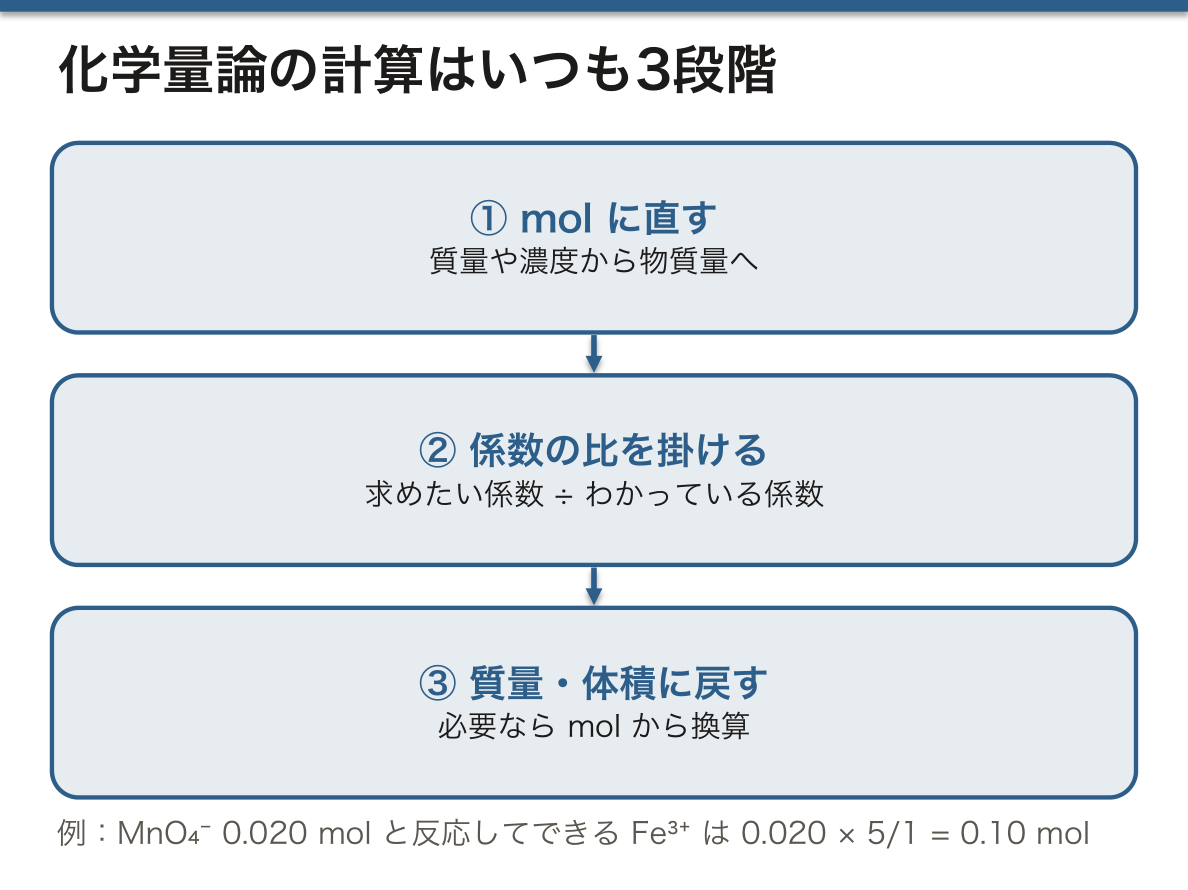
計算の手順はいつも同じで、①質量や濃度を mol に直す → ②係数の比で相手の mol を出す → ③必要なら質量や体積に戻す。比は「求めたい物質の係数 ÷ わかっている物質の係数」を掛ければよい。5Fe2+ + MnO4− + 8H+ → 5Fe3+ + Mn2+ + 4H2O で MnO4− を 0.020 mol 使えば、Fe3+ は 0.020 × 5/1 = 0.10 mol できる。
反応物の量が係数の比どおりでないときは、先になくなる方(限定反応物)が生成物の量を決める。NaOH 1 mol と HCl 2 mol を混ぜても NaCl は 1 mol しかできず、HCl が 1 mol 余る。余った HCl が溶液を酸性にする——この考え方は、後で中和後の pH や緩衝液の計算でそのまま使う。
臨床で使う当量(Eq、mEq)は、電荷の数まで含めた化学量論である。1 mEq は電荷 1 mmol 分を表すので、Na+ 1 mmol = 1 mEq、Ca2+ 1 mmol = 2 mEq となる。陽イオンと陰イオンの電荷の総和が釣り合うという考え方(電気的中性)は、血液ガスで使うアニオンギャップの基礎でもある。
English version
Core
By the law of conservation of mass, the number of each kind of atom does not change in a reaction. That is why we balance equations, and a balanced equation shows the ratio of moles that react directly.
In 2NaOH + H2SO4 → Na2SO4 + 2H2O, NaOH : H2SO4 : Na2SO4 : H2O = 2 : 1 : 1 : 2 (mol). To neutralise 6 mol of NaOH you need 3 mol of H2SO4, and 3 mol of Na2SO4 form.
Read dissociation equations the same way. Na3PO4 → 3Na+ + PO43−, so 2 mol of Na3PO4 give 6 mol of Na+ and 2 mol of PO43−.
Going further
The steps are always the same: ① change mass or concentration into moles → ② use the ratio of coefficients to get the moles of the other substance → ③ change back to mass or volume if needed. The factor is “coefficient of the wanted substance ÷ coefficient of the known substance”. In 5Fe2+ + MnO4− + 8H+ → 5Fe3+ + Mn2+ + 4H2O, using 0.020 mol of MnO4− gives 0.020 × 5/1 = 0.10 mol of Fe3+.
When the reactants are not in the ratio of the coefficients, the one that runs out first (the limiting reactant) decides how much product forms. Mixing 1 mol of NaOH with 2 mol of HCl gives only 1 mol of NaCl, and 1 mol of HCl is left over. The excess HCl makes the solution acidic — the same idea is used later for pH after neutralisation and for buffers.
In the clinic
The clinical unit equivalent (Eq, mEq) is stoichiometry that also counts charge. 1 mEq means 1 mmol of charge, so 1 mmol of Na+ = 1 mEq, and 1 mmol of Ca2+ = 2 mEq. The idea that total positive and negative charges balance (electroneutrality) is also the basis of the anion gap used with blood gases.
まとめ
| 混合物と溶液 — 溶質・溶媒と「似たものは似たものに溶ける」 | 混合物は2種類以上の物質が化学的に結合せずに混ざったもので、成分を目や弱い拡大で見分けられない均一混合物と、見分けられる不均一混合物に分かれる。 |
|---|---|
| 原子・イオン・分子と化学結合 — イオン結合・共有結合・配位結合 | 原子は元素の最小単位(O、Cl など)、イオンは電子を失うか得て電荷をもった粒子(Na+、Fe3+、OH−、CO32− など)、分子は原子が共有結合でまとまった電気的に中性な粒子(… |
| 化合物の分類 — 酸・塩基・塩・酸化物 | 無機化合物はまず4つに分ける。分類見分け方例酸水中で H+ を出す。 |
| 電解質と電離 — 強電解質・弱電解質・非電解質 | 水に溶けたとき(または融けたとき)イオンに分かれて電気を通す物質を電解質、イオンを作らず電気を通さない物質を非電解質という。 |
| 化学反応の種類と反応式 — 分子式・イオン式・正味のイオン反応式 | 反応物と生成物の組み立て方で、反応はおもに4つに分ける。 |
| 化学量論 — 係数は物質量(mol)の比である | 質量保存の法則により、反応の前後で各原子の数は変わらない。 |
このノートは医学生が授業の内容を自分の言葉でまとめたもので、診療の判断に使うものではありません。誤りに気づいたらお知らせください。