アミノ酸は他の栄養素と決定的に違う点がある——窒素を持っている。糖と脂肪は炭素・水素・酸素だけなので燃やせばCO₂と水になるが、アミノ酸を燃やすとアンモニアという毒が残る。
だからアミノ酸代謝は必ず2本立てになる。①アミノ基をどう捨てるか(尿素回路)と②残った炭素骨格をどう使うか(糖新生かケトン体か)。この2本を分けて考えると、複雑に見える経路が整理される。
そして体はアミノ酸を貯蔵しない。余れば燃やすか脂肪に変え、足りなければ筋を壊す。「アミノ酸プール」はあっても「アミノ酸の貯金」は無い——飢餓で筋肉が落ちるのはこのためである。
先天代謝異常は「経路のどこが詰まり、何が溜まるか」で症状が決まる。新生児マススクリーニングの対象疾患は、ほぼこの章から出る。
- アミノ基の外し方 — アミノ基転移と酸化的脱アミノ
- 尿素回路 — アンモニアを無毒化する
- 炭素骨格の行き先 — 糖原性かケト原性か
- アミノ酸代謝異常症 — 詰まると何が溜まるか
- 血中アンモニアは、採り方で数字が変わる
- 体は L 型のアミノ酸しか使わない — その例外が、薬になっている
アミノ基の外し方 — アミノ基転移と酸化的脱アミノ
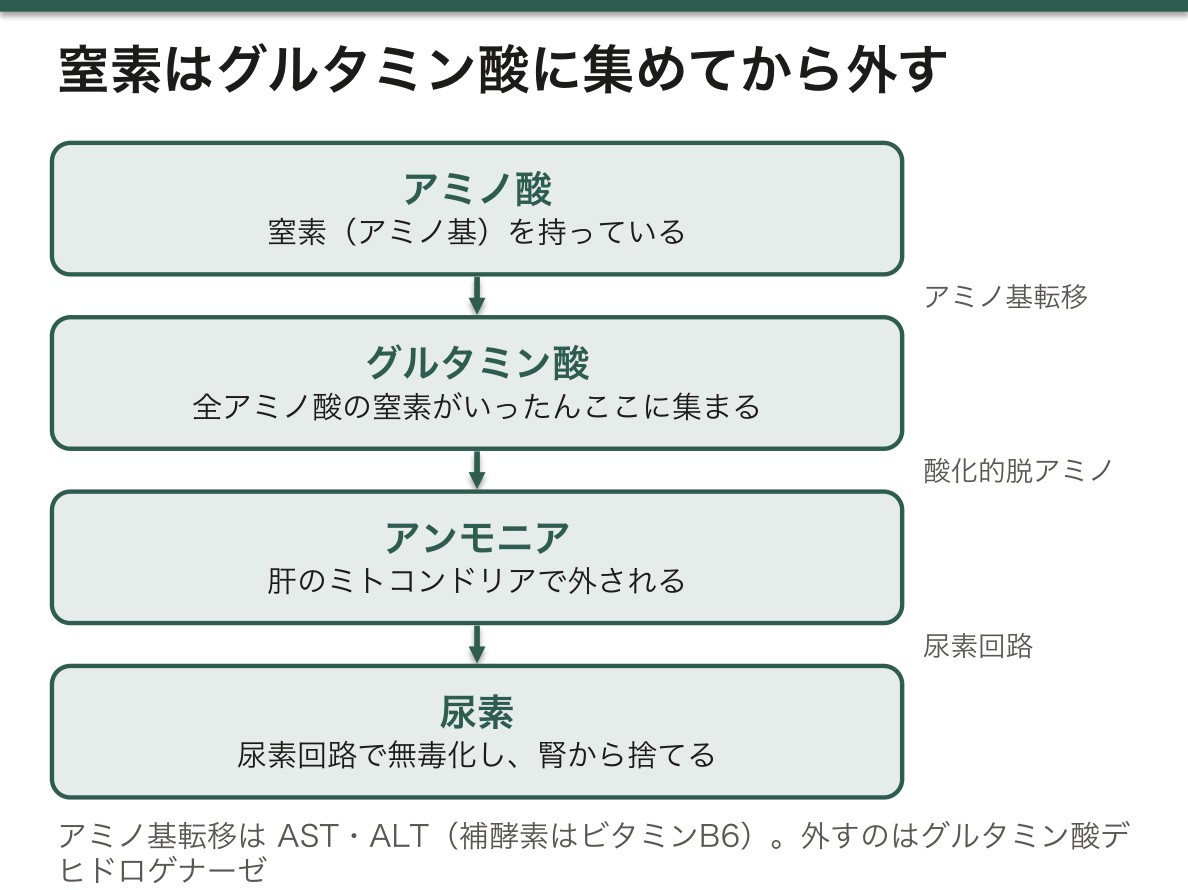
2段階でアンモニアに集約する。
- アミノ基転移——アミノ酸のアミノ基をα-ケトグルタル酸へ渡し、グルタミン酸を作る。触媒はAST・ALT などのトランスアミナーゼで、補酵素はビタミンB6(ピリドキサールリン酸)
- 酸化的脱アミノ——グルタミン酸からグルタミン酸デヒドロゲナーゼがアミノ基をアンモニアとして外す。肝のミトコンドリアで起きる
つまり全アミノ酸の窒素がいったんグルタミン酸に集められ、そこから一気に外される。
窒素の運び方は組織で違う。
- 筋——ピルビン酸に載せてアラニンとして肝へ(アラニン回路)
- 脳・その他——グルタミン酸にもう1つ載せてグルタミンとして運ぶ。血中で最も多い遊離アミノ酸
グルタミンは無毒な運搬形であると同時に、腎でアンモニアを作ってH⁺を捨てる材料でもある(代謝性アシドーシスで腎のグルタミナーゼが誘導され、NH₄⁺として酸を排泄する)。窒素処理と酸塩基平衡が同じ分子で繋がっている。
ビタミンB6 が補酵素である帰結として、イソニアジド(抗結核薬)はB6を消費し、末梢神経障害を起こす。だから予防的にB6を併用する。同じ理由で、B6欠乏ではヘム合成(ALA合成酵素もB6要求)も落ち、鉄芽球性貧血を伴いうる。
English version
Core
Two steps concentrate everything into ammonia.
- Transamination — the amino group of an amino acid is handed to α-ketoglutarate, making glutamate. Catalysed by transaminases such as AST and ALT, with vitamin B6 (pyridoxal phosphate) as coenzyme.
- Oxidative deamination — glutamate dehydrogenase removes the amino group from glutamate as ammonia. In the mitochondria of the liver.
That is, the nitrogen of every amino acid is first collected onto glutamate and then removed at a stroke.
Going further
How the nitrogen is carried differs between tissues.
- Muscle — loaded onto pyruvate and sent to the liver as alanine (the alanine cycle).
- Brain and elsewhere — a second amino group is loaded onto glutamate and it travels as glutamine, the commonest free amino acid in the blood.
Glutamine is both a non-toxic carrier and the raw material from which the kidney makes ammonia to excrete H⁺ (in metabolic acidosis renal glutaminase is induced and acid is excreted as NH₄⁺). The handling of nitrogen and acid–base balance are joined in the same molecule.
Because vitamin B6 is the coenzyme, isoniazid (an antituberculous drug) consumes B6 and causes a peripheral neuropathy. Hence B6 is given prophylactically with it. For the same reason B6 deficiency also reduces haem synthesis (ALA synthase requires B6) and may be accompanied by sideroblastic anaemia.
尿素回路 — アンモニアを無毒化する
肝だけが持つ回路。アンモニアを尿素に変えて腎から捨てる。
ミトコンドリアで始まり、細胞質で終わる——2つの区画にまたがる。
- カルバミルリン酸合成酵素I(CPS-I)——NH₃ + CO₂ → カルバミルリン酸。律速。N-アセチルグルタミン酸で活性化される
- オルニチントランスカルバミラーゼ(OTC)→ シトルリン(ここで細胞質へ)
- アルギニノコハク酸合成酵素 → 開裂酵素
- アルギナーゼ——アルギニン → 尿素 + オルニチン(オルニチンが回路に戻る)
尿素の2つの窒素はアンモニア由来が1つ、アスパラギン酸由来が1つ。
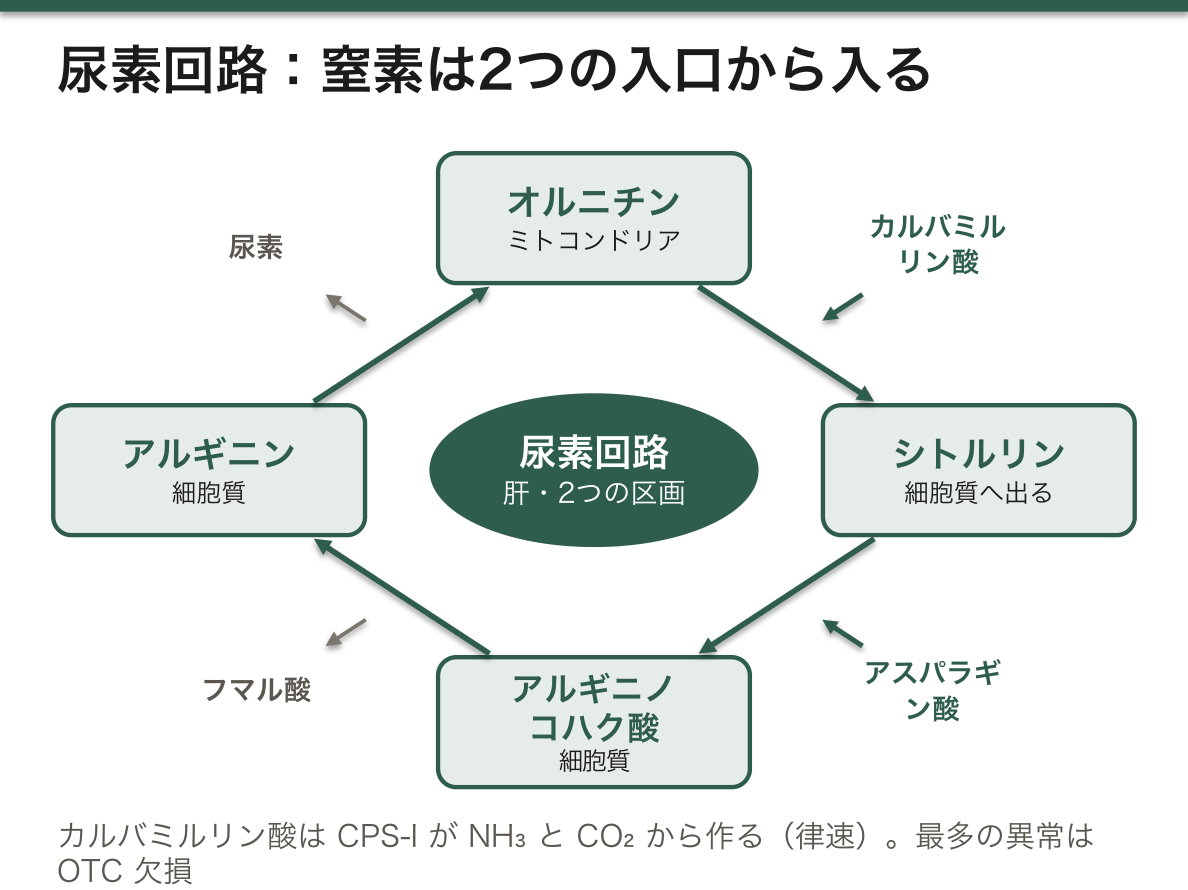
尿素回路異常症は、詰まった場所より手前に何が溜まるかで見分ける。
- 共通——高アンモニア血症と、それによる呼吸性アルカローシス(アンモニアが呼吸中枢を刺激する)。新生児期の哺乳不良・嘔吐・意識障害・けいれん
- OTC欠損症——最多。X連鎖(他は常染色体潜性)。カルバミルリン酸が行き場を失ってピリミジン合成へ流れ、尿中オロト酸が増える。この所見が CPS-I 欠損症との決め手になる(CPS-I欠損ではオロト酸は増えない)
高アンモニア血症の毒性は、アンモニアがα-ケトグルタル酸と結合してグルタミン酸・グルタミンになるためTCA回路の中間体が枯渇することと、星状膠細胞にグルタミンが溜まって脳浮腫を起こすことによる。
肝硬変の肝性脳症も同じ枠組みである。肝機能低下と門脈大循環シャントでアンモニアが処理されない。だから治療はラクツロース(腸内を酸性にしてNH₃をNH₄⁺に変え吸収を防ぎ、排便も促す)とリファキシミン(アンモニア産生菌を減らす)——「作らせない・吸わせない・出す」という3方向になる。
English version
Core
A cycle possessed by the liver alone, converting ammonia to urea for excretion by the kidney. It begins in the mitochondrion and ends in the cytosol — spanning two compartments.
- Carbamoyl phosphate synthetase I (CPS-I) — NH₃ + CO₂ → carbamoyl phosphate. Rate-limiting; activated by N-acetylglutamate.
- Ornithine transcarbamylase (OTC) → citrulline (which then leaves for the cytosol).
- Argininosuccinate synthetase → argininosuccinate lyase.
- Arginase — arginine → urea + ornithine (the ornithine returning to the cycle).
Of the two nitrogens of urea, one comes from ammonia and one from aspartate.
Going further
The urea cycle disorders are told apart by what accumulates before the block.
In common — hyperammonaemia and, with it, a respiratory alkalosis (ammonia stimulates the respiratory centre). In the newborn: poor feeding, vomiting, impaired consciousness, seizures.
OTC deficiency — the commonest, and X-linked (the others are autosomal recessive). Carbamoyl phosphate has nowhere to go and flows into pyrimidine synthesis, so urinary orotic acid rises. This finding is what distinguishes it from CPS-I deficiency (in which orotic acid does not rise).
The toxicity of hyperammonaemia arises because ammonia combines with α-ketoglutarate to make glutamate and glutamine, depleting the intermediates of the TCA cycle, and because glutamine accumulates in astrocytes and causes cerebral oedema.
Hepatic encephalopathy in cirrhosis fits the same framework — with poor liver function and portosystemic shunting, ammonia is not processed. So the treatment is lactulose (acidifying the gut to convert NH₃ to NH₄⁺, preventing absorption and promoting defaecation) and rifaximin (reducing the ammonia-producing flora) — in three directions: do not make it, do not absorb it, get it out.
炭素骨格の行き先 — 糖原性かケト原性か
アミノ基を外したあとの炭素骨格は2方向へ。
- 糖原性——ピルビン酸かTCA中間体になる。糖新生の材料になれる。大多数のアミノ酸
- ケト原性——アセチルCoA かアセトアセチルCoA になる。糖にはならない
純粋にケト原性なのは2つだけ——ロイシンとリジン(「Leucine と Lysine」で覚える)。
両方の性質を持つのがイソロイシン・フェニルアラニン・チロシン・トリプトファン・スレオニン。
必須アミノ酸(体内で作れない9つ)——フェニルアラニン・バリン・トリプトファン・スレオニン・イソロイシン・メチオニン・ヒスチジン・アルギニン*・ロイシン・リジン(*アルギニンは小児で必須)。
アミノ酸から作られる重要な分子を押さえると、欠乏症の説明ができる。
- トリプトファン → セロトニン・メラトニン・ナイアシン(B3)
- チロシン → ドパミン・ノルアドレナリン・アドレナリン/メラニン/甲状腺ホルモン
- グリシン → ヘム・グルタチオン・クレアチン
- アルギニン → NO・クレアチン・尿素
- ヒスチジン → ヒスタミン
- グルタミン酸 → GABA(ビタミンB6要求)
Hartnup 病(中性アミノ酸トランスポーターの異常)でペラグラ様症状が出るのは、トリプトファンが吸収されずナイアシンが作れないためである。ペラグラの三徴は皮膚炎・下痢・認知症(dermatitis, diarrhoea, dementia)。カルチノイド症候群でも、トリプトファンがセロトニン合成に大量消費されて同じことが起きる。
English version
Core
After the amino group has been removed the carbon skeleton goes one of two ways.
- Glucogenic — becomes pyruvate or a TCA intermediate and can be substrate for gluconeogenesis. The great majority.
- Ketogenic — becomes acetyl-CoA or acetoacetyl-CoA. Cannot become sugar.
Only two are purely ketogenic — leucine and lysine (both begin with L). Those with both properties are isoleucine, phenylalanine, tyrosine, tryptophan and threonine.
Going further
The essential amino acids (the nine that cannot be made) — phenylalanine, valine, tryptophan, threonine, isoleucine, methionine, histidine, arginine*, leucine, lysine (*arginine is essential in childhood).
Fix the important molecules made from amino acids and the deficiency states explain themselves.
- Tryptophan → serotonin, melatonin, niacin (B3)
- Tyrosine → dopamine, noradrenaline, adrenaline / melanin / thyroid hormone
- Glycine → haem, glutathione, creatine
- Arginine → NO, creatine, urea
- Histidine → histamine
- Glutamate → GABA (requiring B6)
Hartnup disease (a defect of the neutral amino acid transporter) gives pellagra-like symptoms because tryptophan is not absorbed and niacin cannot be made. The triad of pellagra is dermatitis, diarrhoea and dementia. The same happens in carcinoid syndrome, tryptophan being consumed in serotonin synthesis.
アミノ酸代謝異常症 — 詰まると何が溜まるか
新生児マススクリーニングの中心。詰まった手前に溜まったものが毒になるという共通の型を持つ。
- フェニルケトン尿症(PKU)——フェニルアラニン水酸化酵素欠損。フェニルアラニンが蓄積し、チロシンが不足する
- メープルシロップ尿症——分枝鎖α-ケト酸デヒドロゲナーゼ欠損。バリン・ロイシン・イソロイシンとそのケト酸が蓄積
- ホモシスチン尿症——シスタチオニンβ合成酵素欠損。ホモシステインが蓄積
- アルカプトン尿症——ホモゲンチジン酸酸化酵素欠損。尿が空気に触れて黒くなる
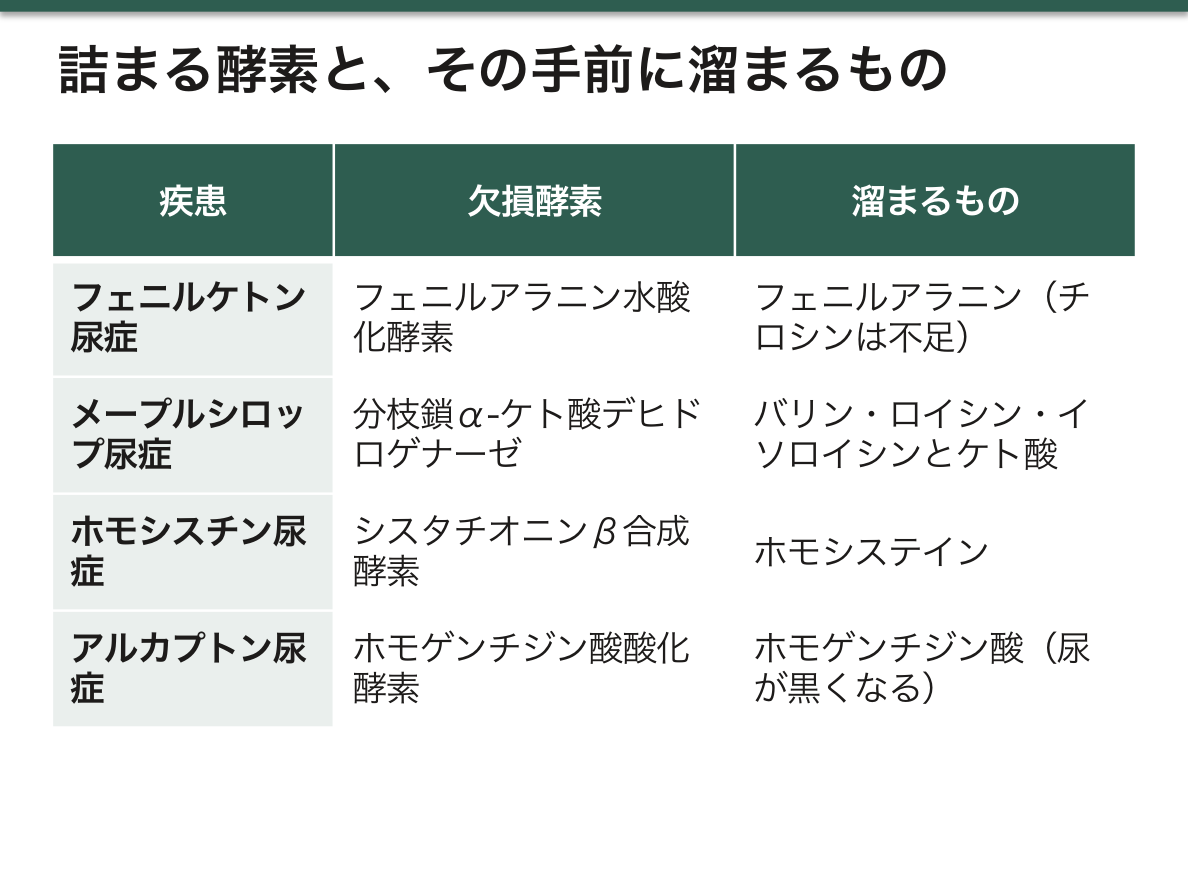
PKU は「溜まる害」と「足りない害」が両方出る好例である。
- 溜まる——フェニルアラニンが脳を障害し、放置すれば重度知的障害。副経路でフェニルピルビン酸が生じ、尿がネズミ臭になる
- 足りない——チロシンが作れずメラニンが減るので、色白・金髪・碧眼になる。チロシンは後天的に必須アミノ酸になる
治療はフェニルアラニン制限+チロシン補充。人工甘味料アスパルテームはフェニルアラニンを含むため禁忌である。母体PKU——治療を中断した母から生まれる児は、自身がPKUでなくても胎内でフェニルアラニンに曝され小頭症・心奇形をきたすので、妊娠前からの食事管理が要る。
ホモシスチン尿症は Marfan 症候群と紛らわしい——高身長・くも状指・水晶体亜脱臼が共通する。区別は2点、水晶体のずれる向き(ホモシスチン尿症は下方、Marfan は上方)と、血栓症を起こすか(ホモシスチン尿症は起こす)。約半数はビタミンB6大量投与に反応する(酵素の補酵素がB6のため)。
English version
Core
The centre of newborn screening. They share a common form: what accumulates before the block is the poison.
- Phenylketonuria (PKU) — phenylalanine hydroxylase deficiency. Phenylalanine accumulates and tyrosine runs short.
- Maple syrup urine disease — branched-chain α-keto acid dehydrogenase deficiency. Valine, leucine, isoleucine and their keto acids accumulate.
- Homocystinuria — cystathionine β-synthase deficiency. Homocysteine accumulates.
- Alkaptonuria — homogentisate oxidase deficiency. The urine blackens on standing in air.
Going further
PKU is the model in which both the harm of accumulation and the harm of shortage appear.
- Accumulation — phenylalanine damages the brain and, untreated, gives severe intellectual disability. By a side pathway phenylpyruvate is formed and the urine smells mousy.
- Shortage — tyrosine cannot be made, melanin falls, and the child is pale with fair hair and blue eyes. Tyrosine becomes an acquired essential amino acid.
Treatment is restriction of phenylalanine with tyrosine supplementation. The sweetener aspartame contains phenylalanine and is contraindicated.
Maternal PKU — a child born to a mother who has stopped her diet is exposed in utero to phenylalanine and develops microcephaly and cardiac malformation even without having PKU itself, so dietary control is required from before conception.
Homocystinuria is confusable with Marfan syndrome — tall stature, arachnodactyly and lens dislocation are shared. Two things distinguish them: the direction of the lens dislocation (downwards in homocystinuria, upwards in Marfan) and whether thrombosis occurs (it does in homocystinuria). About half respond to large doses of vitamin B6 (B6 being the coenzyme of the enzyme).
血中アンモニアは、採り方で数字が変わる
アンモニアは採血してから測るまでのあいだにも増え続ける。赤血球の中のアンモニア濃度は血漿の 2〜3 倍あり、白血球もグルタミンを分解してアンモニアを作る。だから採血の手技そのものが結果を作ってしまう。
- 駆血帯を長く締めない・手を握らせない——筋からアンモニアが出る
- 溶血させない——赤血球の中身が漏れれば、それだけで上がる
- 氷で冷やして運び、30 分以内に遠心する——室温放置は 1 時間で数十 μg/dL の上昇になりうる
- 喫煙直後を避ける——喫煙で上がる
「原因不明の高アンモニア血症」の相当数が、この段階で作られた偽の値である。
値そのものの解釈も、思われているほど素直ではない。
肝性脳症の重症度とアンモニア値はよく相関しない。脳症の本体はアンモニアが星状膠細胞でグルタミンに変えられ、グルタミンが浸透圧物質として細胞を膨らませることにあるので、血中濃度より「どれだけ長く曝されたか」「炎症が重なっているか」が効く。アンモニアが正常でも肝性脳症は否定できず、高くても脳症とは限らない。
だから臨床では、アンモニアは診断の確認ではなく、鑑別を広げるために測る。意識障害で肝疾患がはっきりしない場面——成人発症の尿素回路異常症、バルプロ酸、門脈大循環シャント、尿路の感染(ウレアーゼ産生菌)——を拾うのに役立つ。
⚠️ アシドーシスを伴うかどうかで方向が変わる。アンモニアが高くてアシドーシスが無いなら尿素回路異常症、アシドーシスがあるなら有機酸血症を先に考える(→ この科目の尿素回路異常症の項)。
結果が高すぎて臨床像と合わないときは、まず採り直す。検査室に「氷冷・至急」と伝えるだけで、無用な精査を減らせる。
English version
Core
Ammonia goes on rising between the taking of the sample and its measurement. The concentration inside red cells is two or three times that of plasma, and white cells also break down glutamine to ammonia. So the technique of venepuncture itself creates the result.
- Do not leave the tourniquet on, and do not have the patient clench the fist — ammonia comes out of muscle.
- Do not haemolyse — the contents of the red cells leaking is enough to raise it.
- Transport on ice and centrifuge within 30 minutes — left at room temperature it can rise by tens of µg/dL in an hour.
- Avoid immediately after smoking — smoking raises it.
A considerable proportion of "unexplained hyperammonaemia" is a false value manufactured at this stage.
Going further
The interpretation of the value itself is less straightforward than is supposed.
The ammonia level correlates poorly with the severity of hepatic encephalopathy. The substance of the encephalopathy is that ammonia is converted to glutamine in astrocytes and the glutamine swells the cells as an osmolyte, so how long the exposure has lasted and whether inflammation is superimposed count for more than the blood level. A normal ammonia does not exclude encephalopathy, and a high one does not prove it.
So in practice ammonia is measured not to confirm a diagnosis but to widen the differential. It helps to pick up impaired consciousness where liver disease is not obvious — adult-onset urea cycle disorders, valproate, portosystemic shunt, urinary infection with urease-producing organisms.
⚠️ The direction changes according to whether there is acidosis. High ammonia without acidosis suggests a urea cycle disorder; with acidosis, think first of an organic acidaemia.
In the clinic
When the result is too high to fit the clinical picture, take the sample again. Simply telling the laboratory "on ice, urgent" saves a great deal of needless investigation.
体は L 型のアミノ酸しか使わない — その例外が、薬になっている
アミノ酸には鏡像の関係にある2つの型(L 型と D 型)がある。ヒトの蛋白質は、20 種すべてが L 型でできている(グリシンだけは不斉炭素が無く区別が無い)。
理由は酵素の側にある。酵素の活性部位は立体的な形で基質を掴むので、鏡像は同じ鍵穴に入らない。片方だけが使われる仕組みが、生命の最初期に固定されたと考えられている。
ただし例外があり、そこが臨床に効いてくる。
- D-セリン・D-アスパラギン酸——ヒトの脳に存在する。D-セリンは NMDA 受容体の補助作動物質として働く
- D-アラニン・D-グルタミン酸——細菌の細胞壁のペプチドグリカンに使われている
細菌が D 型を使っていることが、抗菌薬の的になっている。
| バンコマイシン | ペプチドグリカン前駆体の末端 D-Ala-D-Ala に結合する | 基質のほうを覆って架橋させない。耐性菌は末端を D-Ala-D-Lac に変えて逃げる |
| β-ラクタム | D-Ala-D-Ala に形が似ているので、架橋酵素が間違えて掴む | 酵素と共有結合して離れない。ペニシリン結合蛋白の名はここから |
| サイクロセリン | D-アラニンを作る/繋ぐ酵素を止める | 抗結核薬 |
ヒトが D-アミノ酸を蛋白に使わないからこそ、これらの薬は選択毒性を持てる。「細菌にあって、ヒトに無いもの」を狙うという抗菌薬の設計原理の、最も分かりやすい例である。
鏡像の話は薬そのものにも及ぶ。2つの鏡像体で作用がまったく違う薬があり、サリドマイドはその歴史的な例である(体内で相互に変換されるため、片方だけ製剤化しても解決しない)。レボドパ、レボフロキサシン、エスシタロプラムの「レボ」「エス」は、効くほうの鏡像体だけを取り出したという意味である。
薬の名前に付く l-/d-/レボ/デキストロ/エス/アール は飾りではなく、どちらの鏡像体かを示している。効果も副作用も別物になりうる。
English version
Core
Amino acids exist in two mirror-image forms, L and D. Every one of the twenty in human protein is L (glycine alone has no asymmetric carbon and no distinction).
The reason lies with the enzymes. The active site grips the substrate by its shape in three dimensions, so the mirror image does not fit the same lock. The arrangement by which only one is used is thought to have been fixed at the very beginning of life.
There are exceptions, and they tell in the clinic.
- D-serine and D-aspartate — present in the human brain. D-serine acts as a co-agonist at the NMDA receptor.
- D-alanine and D-glutamate — used in the peptidoglycan of bacterial cell walls.
Going further
That bacteria use the D form is the target of antibiotics.
| Drug | What it binds | How it works |
|---|---|---|
| Vancomycin | The terminal D-Ala-D-Ala of the peptidoglycan precursor | Covers the substrate so it cannot be cross-linked. Resistant organisms escape by changing the terminus to D-Ala-D-Lac |
| β-lactams | Resemble D-Ala-D-Ala in shape, so the cross-linking enzyme grasps them by mistake | Bind covalently and do not let go. Hence the name penicillin-binding protein |
| Cycloserine | The enzymes that make and join D-alanine | An antituberculous drug |
These drugs can be selectively toxic precisely because humans do not use D-amino acids in protein. The clearest example of the design principle of antibiotics — aim at what the bacterium has and we do not.
Mirror images bear on drugs themselves too. Some drugs act quite differently as their two enantiomers, thalidomide being the historical example (they interconvert in the body, so formulating one alone does not solve it). The "levo-", "es-" of levodopa, levofloxacin and escitalopram mean that only the effective enantiomer has been isolated.
In the clinic
The l-, d-, levo-, dextro-, es- and ar- attached to a drug name are not decoration: they say which enantiomer it is. Both the effect and the adverse effects can be entirely different.
まとめ
| アミノ基の外し方 — アミノ基転移と酸化的脱アミノ | 2段階でアンモニアに集約する。アミノ基転移——アミノ酸のアミノ基をα-ケトグルタル酸へ渡し、グルタミン酸を作る。 |
|---|---|
| 尿素回路 — アンモニアを無毒化する | 肝だけが持つ回路。アンモニアを尿素に変えて腎から捨てる。 |
| 炭素骨格の行き先 — 糖原性かケト原性か | アミノ基を外したあとの炭素骨格は2方向へ。 |
| アミノ酸代謝異常症 — 詰まると何が溜まるか | 新生児マススクリーニングの中心。詰まった手前に溜まったものが毒になるという共通の型を持つ。 |
| 血中アンモニアは、採り方で数字が変わる | アンモニアは採血してから測るまでのあいだにも増え続ける。 |
| 体は L 型のアミノ酸しか使わない — その例外が、薬になっている | アミノ酸には鏡像の関係にある2つの型(L 型と D 型)がある。 |
このノートは医学生が授業の内容を自分の言葉でまとめたもので、診療の判断に使うものではありません。誤りに気づいたらお知らせください。