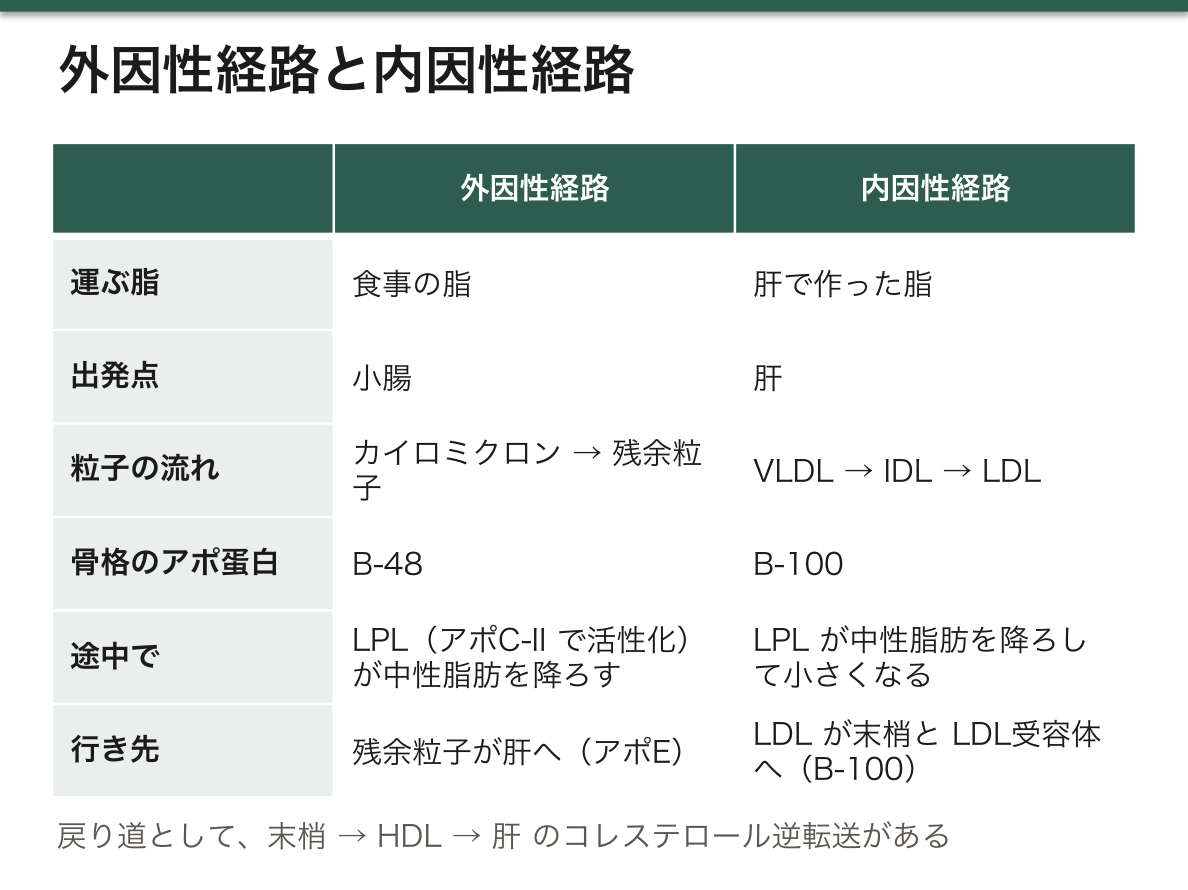
脂質は水に溶けないので、蛋白でくるんだ粒子として運ばれる。粒子の性格を決めるのは表面のアポ蛋白で、これが行き先の鍵と酵素のスイッチを兼ねている。
経路は2本ある。外因性経路(食事の脂を小腸から運ぶ)と内因性経路(肝で作った脂を末梢へ運ぶ)、そして戻り道としてのコレステロール逆転送である。
- アポ蛋白と2つの経路 — 誰が鍵を持っているか
- コレステロール逆転送と、高比重リポ蛋白が「善玉」と呼ばれた理由
- 脂質異常症の型と、薬がどこに効くか
- 中性脂肪が高いとき、何が起きているのか
- Lp(a) — 測る意味のある、もう1つのリポ蛋白
アポ蛋白と2つの経路 — 誰が鍵を持っているか
| アポ蛋白 | 働き | 載っている粒子 |
|---|---|---|
| B-48 | カイロミクロンの骨格 | カイロミクロン |
| B-100 | LDL受容体の鍵 | 超低比重リポ蛋白・中間比重リポ蛋白・低比重リポ蛋白 |
| C-II | リポ蛋白リパーゼの活性化 | カイロミクロン・超低比重リポ蛋白 |
| E | 残余粒子の肝への取り込み | カイロミクロン残余・中間比重リポ蛋白 |
| A-I | レシチンコレステロールアシルトランスフェラーゼの活性化 | 高比重リポ蛋白 |
- 外因性:小腸 → カイロミクロン → リポ蛋白リパーゼで中性脂肪を降ろす → 残余粒子 → 肝
- 内因性:肝 → 超低比重リポ蛋白 → 中間比重リポ蛋白 → 低比重リポ蛋白 → 末梢とLDL受容体
- 逆転送:末梢 → 高比重リポ蛋白 → 肝
アポ蛋白の名前を覚える意味は、欠損症が症状を直接に説明するからである。
- アポC-II欠損/リポ蛋白リパーゼ欠損——中性脂肪を降ろせずカイロミクロンが血中に残る。乳び血清・発疹性黄色腫・急性膵炎。コレステロールはさほど上がらない
- アポE2ホモ接合(III型高脂血症)——残余粒子が肝に取り込まれず溜まる。手掌線条黄色腫が特徴的で、コレステロールと中性脂肪が同程度に上がる
- LDL受容体の異常(家族性高コレステロール血症)——アキレス腱肥厚・眼瞼黄色腫・角膜輪と若年の冠動脈疾患
粒子は「中性脂肪が多いほど軽い」——比重の名前はそのまま組成を表している。カイロミクロンは中性脂肪が約85%で最も軽く、高比重リポ蛋白は蛋白が約50%で最も重い。採血した血清を放置したときに上層に浮くのはカイロミクロンで、全体が濁るのは超低比重リポ蛋白——ベッドサイドで型を推定できる。
Friedewaldの式:LDLコレステロール = 総コレステロール − HDLコレステロール − 中性脂肪÷5。中性脂肪が400 mg/dL以上では使えない(超低比重リポ蛋白の組成の仮定が崩れるため)。食後採血でも使えない。この2点は実務で頻繁に効く。
English version
Core
| Apolipoprotein | Function | Particle |
|---|---|---|
| B-48 | The scaffold of the chylomicron | Chylomicron |
| B-100 | The key to the LDL receptor | VLDL, IDL, LDL |
| C-II | Activates lipoprotein lipase | Chylomicron, VLDL |
| E | Hepatic uptake of remnant particles | Chylomicron remnant, IDL |
| A-I | Activates LCAT | HDL |
Exogenous: intestine → chylomicron → LPL unloads the triglyceride → remnant → liver.
Endogenous: liver → VLDL → IDL → LDL → the periphery and the LDL receptor.
Reverse transport: periphery → HDL → liver.
Going further
The point of learning the names is that the deficiencies explain the symptoms directly.
- Apo C-II or LPL deficiency — the triglyceride cannot be unloaded and chylomicrons remain in the blood. Lipaemic serum, eruptive xanthomas, acute pancreatitis. The cholesterol does not rise much.
- Apo E2 homozygosity (type III hyperlipidaemia) — remnants are not taken up by the liver and accumulate. Palmar striated xanthomas are characteristic, and cholesterol and triglyceride rise to a similar degree.
- LDL receptor defects (familial hypercholesterolaemia) — thickened Achilles tendons, xanthelasma, corneal arcus and premature coronary disease.
The more triglyceride, the lighter the particle — the names of the densities state the composition. A chylomicron is about 85 per cent triglyceride and the lightest; HDL is about 50 per cent protein and the densest. Serum left to stand shows a creamy top layer with chylomicrons and turbidity throughout with VLDL — the type can be guessed at the bedside.
The Friedewald equation: LDL-C = total cholesterol − HDL-C − triglyceride ÷ 5. It cannot be used above a triglyceride of 400 mg/dL (the assumption about the composition of VLDL breaks down) nor on a non-fasting sample. These two points tell frequently in practice.
コレステロール逆転送と、高比重リポ蛋白が「善玉」と呼ばれた理由
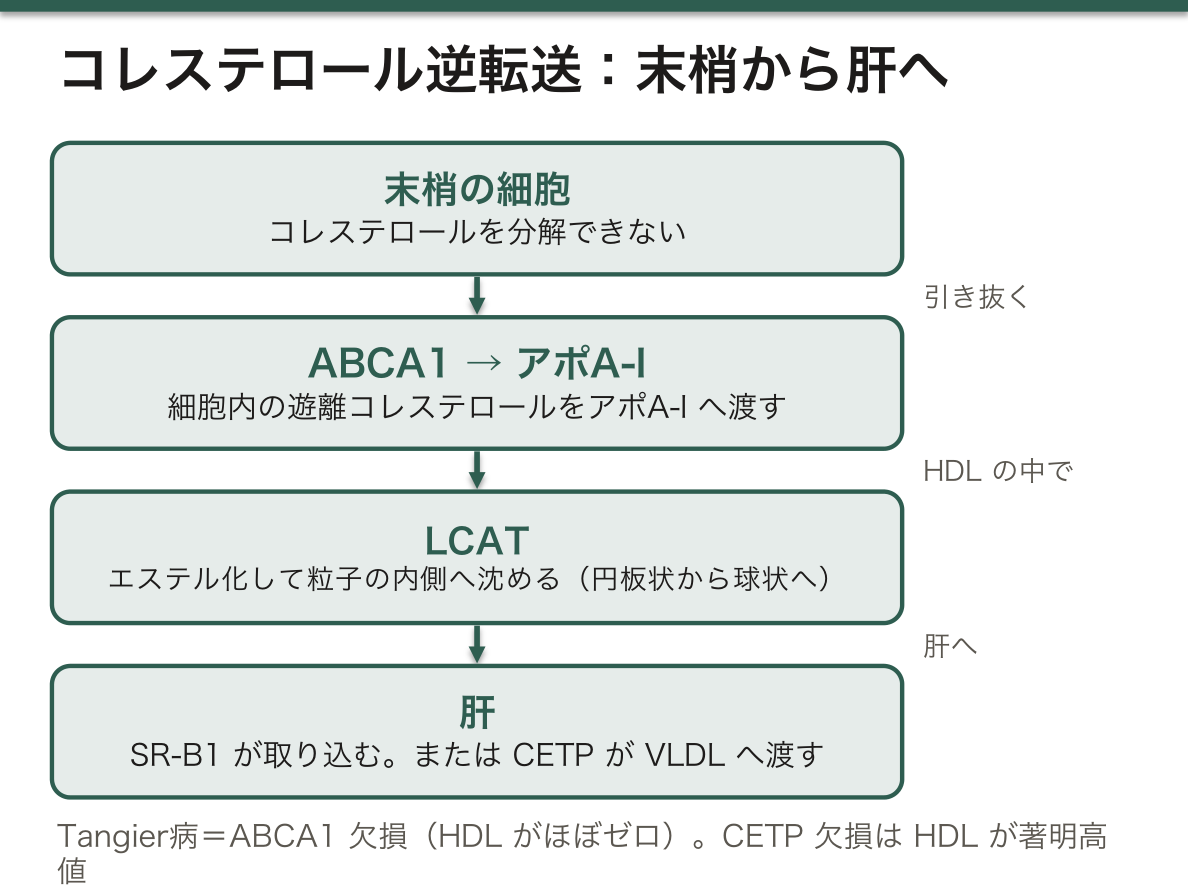
末梢の細胞はコレステロールを分解できない。使い切れない分を肝へ返す唯一の道が逆転送である。
- ATP結合カセット輸送体A1が、細胞内の遊離コレステロールをアポA-Iへ渡す
- レシチンコレステロールアシルトランスフェラーゼがエステル化し、粒子の内側へ沈める(円板状から球状へ)
- 肝のスカベンジャー受容体B1が取り込む、またはコレステリルエステル転送蛋白が超低比重リポ蛋白へ渡す
- Tangier病——ATP結合カセット輸送体A1の欠損。高比重リポ蛋白がほぼゼロ、橙色の扁桃が特徴
- コレステリルエステル転送蛋白欠損——高比重リポ蛋白が著明高値。日本人に比較的多い
「善玉・悪玉」という言い方は、機序としては正しく、治療標的としては誤っていた。ここは現代医学の重要な教訓である。
疫学的には高比重リポ蛋白が高いほど冠動脈疾患が少ないという関連が一貫して見られた。ところが高比重リポ蛋白を薬で上げても、心血管イベントは減らなかった——コレステリルエステル転送蛋白阻害薬の一連の試験がそれを示した。関連があることと、上げれば良くなることは別であるという、交絡と因果の教科書的な例になっている。
現在の理解では、量ではなく機能が問題である。同じ高比重リポ蛋白でも、実際にコレステロールを引き抜く能力(コレステロール引き抜き能)には個人差があり、そちらのほうが心血管イベントとよく相関する。炎症下では高比重リポ蛋白が変質し、むしろ酸化を促す側に回ることも分かっている。
低比重リポ蛋白のほうは、逆に因果が確立している。遺伝的に低比重リポ蛋白が低い人(PCSK9機能喪失変異など)は生涯にわたり冠動脈疾患が少ない——遺伝子が生まれつき決まっている以上、生活習慣による交絡が入らない。だから低比重リポ蛋白は「下げれば減る」。同じ脂質でも、証拠の強さがまったく違う。
English version
Core
Peripheral cells cannot break down cholesterol. Reverse transport is the only road by which what they cannot use is returned to the liver.
- ABCA1 hands free intracellular cholesterol to apo A-I.
- LCAT esterifies it and sinks it into the interior of the particle (discoidal becoming spherical).
- The hepatic scavenger receptor B1 takes it up, or CETP transfers it to VLDL.
- Tangier disease — ABCA1 deficiency. HDL near zero; orange tonsils are characteristic.
- CETP deficiency — a markedly high HDL. Relatively common in Japanese people.
Going further
"Good and bad cholesterol" was right as mechanism and wrong as a target of treatment. This is an important lesson of modern medicine.
Epidemiologically the association was consistent: the higher the HDL, the less coronary disease. Yet raising HDL with a drug did not reduce cardiovascular events — a series of trials of CETP inhibitors showed as much. A textbook example of the difference between association and causation, and of confounding.
The present understanding is that it is not the quantity but the function that matters. Even at the same HDL, the capacity actually to extract cholesterol (cholesterol efflux capacity) varies between individuals, and that correlates better with cardiovascular events. Under inflammation the HDL is altered and may even turn to promoting oxidation.
For LDL, by contrast, causation is established. People with genetically low LDL (loss-of-function variants of PCSK9, for instance) have less coronary disease throughout life — and since the genotype is fixed at birth, lifestyle cannot confound it. So LDL does fall and the risk falls with it. With the same lipids, the strength of the evidence is entirely different.
脂質異常症の型と、薬がどこに効くか
| 型 | 増える粒子 | コレステロール | 中性脂肪 | 代表 |
|---|---|---|---|---|
| I | カイロミクロン | → | ↑↑↑ | リポ蛋白リパーゼ欠損 |
| IIa | 低比重リポ蛋白 | ↑↑ | → | 家族性高コレステロール血症 |
| IIb | 低比重+超低比重 | ↑ | ↑ | 家族性複合型高脂血症 |
| III | 中間比重リポ蛋白 | ↑↑ | ↑↑ | アポE2ホモ |
| IV | 超低比重リポ蛋白 | → | ↑↑ | 肥満・飲酒・糖尿病 |
| V | カイロミクロン+超低比重 | ↑ | ↑↑↑ | — |
| 薬 | 作用点 | 主に下げるもの |
|---|---|---|
| スタチン | HMG-CoA還元酵素を阻害 → LDL受容体が増える | 低比重リポ蛋白 |
| エゼチミブ | 小腸のNPC1L1を阻害 | 低比重リポ蛋白 |
| PCSK9阻害薬 | LDL受容体の分解を止める | 低比重リポ蛋白(強力) |
| フィブラート | PPARαを刺激 → リポ蛋白リパーゼを増やす | 中性脂肪 |
スタチンの効き方は、直感と逆の順序で理解する必要がある。コレステロール合成を止めることそのものより、肝細胞内のコレステロールが減った結果としてLDL受容体が増え、血中から取り込む力が上がることが主効果である。だからLDL受容体が両方とも壊れているホモ接合体の家族性高コレステロール血症には、スタチンがほとんど効かない——受け皿が無いからである。この場合は低比重リポ蛋白アフェレシスが必要になる。
PCSK9はLDL受容体を分解へ回す蛋白である。阻害すれば受容体が再利用され、取り込みが持続する。スタチンはPCSK9を増やしてしまうため、併用の相性が理論的にも良い。
スタチンとフィブラートの併用は横紋筋融解症の危険が上がる——どちらも筋障害を起こしうるうえ、フィブラートがスタチンのグルクロン酸抱合を妨げるためである。腎機能低下例では特に注意する。
中性脂肪が500 mg/dLを超えたら、目標は動脈硬化ではなく急性膵炎の予防に切り替わる。カイロミクロンが膵の毛細血管で分解され、遊離脂肪酸が局所を傷害するのが機序である。この閾値は治療方針を変える数字なので覚えておく。
English version
Core
| Type | Particle raised | Cholesterol | Triglyceride | Typical cause |
|---|---|---|---|---|
| I | Chylomicron | → | ↑↑↑ | LPL deficiency |
| IIa | LDL | ↑↑ | → | Familial hypercholesterolaemia |
| IIb | LDL + VLDL | ↑ | ↑ | Familial combined hyperlipidaemia |
| III | IDL | ↑↑ | ↑↑ | Apo E2 homozygosity |
| IV | VLDL | → | ↑↑ | Obesity, alcohol, diabetes |
| V | Chylomicron + VLDL | ↑ | ↑↑↑ | — |
| Drug | Site of action | Chiefly lowers |
|---|---|---|
| Statin | Inhibits HMG-CoA reductase → LDL receptors increase | LDL |
| Ezetimibe | Inhibits intestinal NPC1L1 | LDL |
| PCSK9 inhibitor | Stops the degradation of the LDL receptor | LDL (powerfully) |
| Fibrate | Stimulates PPARα → increases LPL | Triglyceride |
Going further
The action of a statin must be understood in the reverse of the intuitive order. More than the blocking of cholesterol synthesis itself, the main effect is that the fall in intracellular cholesterol increases the LDL receptors and raises the capacity to take LDL out of the blood.
So in homozygous familial hypercholesterolaemia, with both LDL receptors broken, statins scarcely work — there is nothing to receive it. Such a patient needs LDL apheresis.
PCSK9 is the protein that sends the LDL receptor for degradation. Inhibit it and the receptor is recycled and uptake is sustained. Statins increase PCSK9, so the combination makes theoretical sense.
Combining a statin with a fibrate raises the risk of rhabdomyolysis — both can injure muscle, and the fibrate interferes with the glucuronidation of the statin. Take particular care with impaired renal function.
Above a triglyceride of 500 mg/dL the objective changes from atherosclerosis to the prevention of acute pancreatitis. The mechanism is that chylomicrons are broken down in the pancreatic capillaries and the free fatty acids injure the tissue locally. This threshold changes the policy of treatment, so remember the number.
中性脂肪が高いとき、何が起きているのか
中性脂肪を運ぶのは、カイロミクロンと VLDL になる。どちらも血管内皮のリポ蛋白リパーゼ(LPL)で分解される。
LPL が働くには2つが要る——アポ C-II(活性化する鍵)と、GPIHBP1(内皮に係留する台)。アポ C-III は逆に抑制する。
| 中性脂肪の値 | 意味 |
|---|---|
| 150〜500 mg/dL | 多くは二次性(肥満・糖尿病・飲酒・薬) |
| 500 以上 | 急性膵炎の危険が出てくる |
| 1000 以上 | 発疹性黄色腫・網膜脂血症・乳び血漿 |
レムナント(中間の粒子)は動脈硬化を起こす——だから中性脂肪の高値は、粒子そのものより残骸が問題になる。
「中性脂肪そのものが血管を詰まらせるのではない」という点が要点になる。動脈壁に入るのは、分解の途中で残ったレムナントやスモールデンス LDL になる(この章のアポ蛋白と2つの経路の項)——「中性脂肪が高い人で LDL が正常でも、危険が下がっていない理由がここにある」。
だから non-HDL コレステロール(総コレステロール − HDL)が指標として使われる(代謝症候群の章)——「動脈硬化を起こす粒子を、まとめて数えている」。
極端な高値では、まず膵炎を防ぐことが目的になる(膵の章)——「LPL が処理しきれず、膵の毛細血管で遊離脂肪酸が放出されて組織を傷める」。
家族性カイロミクロン血症症候群は、LPL 系のどこかが壊れている(単一遺伝子病の章)——「幼少期からの反復性膵炎。食事の脂肪制限が治療の中心で、薬は効きにくい」。
アポ C-III を標的にする薬が、この領域を変えつつある(分子標的薬の章)——「抑制する側の分子を減らせば、分解が進む」。
English version
Core
Triglyceride is carried by chylomicrons and VLDL, both broken down by lipoprotein lipase (LPL) on the vascular endothelium.
LPL needs two things — apo C-II (the key that activates it) and GPIHBP1 (the platform that tethers it to the endothelium). Apo C-III, conversely, inhibits it.
| Triglyceride | Meaning |
|---|---|
| 150–500 mg/dL | Usually secondary (obesity, diabetes, alcohol, drugs) |
| Above 500 | The risk of acute pancreatitis appears |
| Above 1000 | Eruptive xanthomas, lipaemia retinalis, lipaemic plasma |
The remnants (the intermediate particles) cause atherosclerosis — so a high triglyceride is a problem less of the particle itself than of the debris.
Going further
The point is that triglyceride itself does not block the artery. What enters the arterial wall are the remnants left part way through the breakdown, and small dense LDL — here is why the risk is not reduced in a person with a high triglyceride even when the LDL is normal.
So non-HDL cholesterol (total − HDL) is used as the index — counting together all the particles that cause atherosclerosis.
At extreme values the object becomes preventing pancreatitis — LPL cannot cope, free fatty acids are released in the pancreatic capillaries and injure the tissue.
Familial chylomicronaemia syndrome is a break somewhere in the LPL system — recurrent pancreatitis from childhood. Dietary fat restriction is the mainstay and drugs work poorly.
Drugs targeting apo C-III are changing this field — reduce the molecule that inhibits, and the breakdown proceeds.
Lp(a) — 測る意味のある、もう1つのリポ蛋白
LDL に、アポリポ蛋白(a) がジスルフィド結合で付いた粒子になる。
アポ(a) は、プラスミノゲンとよく似た構造を持つ(クリングルドメイン)——だから線溶を邪魔する。
| 性質 | 内容 |
|---|---|
| 血中濃度 | ほぼ遺伝で決まる(LPA 遺伝子)。生活習慣でほとんど動かない |
| 危険 | 動脈硬化性疾患と、大動脈弁狭窄症の独立した危険因子 |
| 薬 | スタチンでは下がらない(むしろ少し上がる) |
| 測る回数 | 生涯に1回でよいとされる |
「動脈硬化を起こす」性質と「血栓を溶けにくくする」性質を、1つの粒子が併せ持つ。
「変わらない危険因子を、なぜ測るのか」が、この項の考えどころになる。下げられなくても、他の因子をどこまで厳しく管理するかの判断が変わる(検査の性能の章)——「介入できない検査値にも、意思決定を変える価値がありうる」。
若年の心筋梗塞や、家族歴が濃いのに脂質が正常な人で、特に意味を持つ(虚血性心疾患の章)——「説明のつかない家族集積の一部を、これが説明する」。
プラスミノゲンに似ていることが、血栓の側の危険を作っている(線溶の章)——「似た分子が、本物の場所を占領してしまう」。
大動脈弁狭窄症との関連は、比較的新しく確立した(弁膜症の章)——「弁の石灰化が、脂質の沈着から始まるという見方につながる」。
アポ(a) を減らす核酸医薬の試験が進んでいる(分子標的薬の章)——「まだ日常診療の選択肢ではない、という線を引いておく」。
English version
Core
A particle in which apolipoprotein(a) is attached to LDL by a disulphide bond. Apo(a) closely resembles plasminogen in structure (the kringle domains) — so it interferes with fibrinolysis.
| Property | |
|---|---|
| Blood concentration | Almost entirely genetic (the LPA gene). Scarcely moved by lifestyle |
| Risk | An independent risk factor for atherosclerotic disease and for aortic stenosis |
| Drugs | Not lowered by statins (it may rise slightly) |
| How often to measure | Once in a lifetime is considered sufficient |
One particle combining the property of causing atherosclerosis with the property of making clot harder to dissolve.
Going further
"Why measure a risk factor that cannot be changed?" is the thing to think about here. Even if it cannot be lowered, it changes how strictly the other factors are controlled — a test that cannot be acted on directly may still have value in changing a decision.
It matters particularly in premature myocardial infarction, and in a person with a strong family history but normal lipids — it explains part of an otherwise unexplained familial clustering.
Its resemblance to plasminogen creates the thrombotic side of the risk — a similar molecule occupying the place of the real one.
The association with aortic stenosis was established relatively recently — leading to the view that calcification of the valve begins with the deposition of lipid.
Trials of nucleic acid drugs that reduce apo(a) are in progress — draw the line that this is not yet an option in daily practice.
まとめ
| アポ蛋白と2つの経路 — 誰が鍵を持っているか | アポ蛋白働き載っている粒子B-48カイロミクロンの骨格カイロミクロンB-100LDL受容体の鍵超低比重リポ蛋白・中間比重リポ蛋白・低比重リポ蛋白C-IIリポ蛋白リパーゼの活性化カイ… |
|---|---|
| コレステロール逆転送と、高比重リポ蛋白が「善玉」と呼ばれた理由 | 末梢の細胞はコレステロールを分解できない。 |
| 脂質異常症の型と、薬がどこに効くか | 型増える粒子コレステロール中性脂肪代表Iカイロミクロン→↑↑↑リポ蛋白リパーゼ欠損IIa低比重リポ蛋白↑↑→家族性高コレステロール血症IIb低比重+超低比重↑↑家族性複合型高脂血症… |
| 中性脂肪が高いとき、何が起きているのか | 中性脂肪を運ぶのは、カイロミクロンと VLDL になる。 |
| Lp(a) — 測る意味のある、もう1つのリポ蛋白 | LDL に、アポリポ蛋白(a) がジスルフィド結合で付いた粒子になる。 |
このノートは医学生が授業の内容を自分の言葉でまとめたもので、診療の判断に使うものではありません。誤りに気づいたらお知らせください。