アイソザイムとは、同じ反応を触媒するが分子として別物である酵素のことである。臓器ごとに構成比が違うので、血中に漏れ出した酵素の型を見れば、どこが壊れたかが分かる。
逸脱酵素を測る意味は「肝が悪い」で終わらない。いつ壊れたか(時間経過)、どこが壊れたか(アイソザイム)、どれくらい壊れたか(絶対値)——3つを読み分ける。
- 乳酸脱水素酵素とクレアチンキナーゼ — 型で臓器を当てる
- 肝胆道系酵素 — 壊れているのか、詰まっているのか
- アミラーゼとリパーゼ — 膵を疑ったときに測る2つ
- 酵素を測るときの落とし穴 — 数字が動く理由は、体の外にもある
- 心筋トロポニン — 値そのものより、動き方を見る
- 検査値が「変わった」と言えるのは、どれだけ動いたときか
乳酸脱水素酵素とクレアチンキナーゼ — 型で臓器を当てる
乳酸脱水素酵素はH鎖とM鎖の4量体で、組み合わせにより5型ある。
| 型 | 組成 | 多い臓器 |
|---|---|---|
| LD1・LD2 | H優位 | 心筋・赤血球・腎 |
| LD3 | 中間 | 肺・脾・リンパ節 |
| LD4・LD5 | M優位 | 肝・骨格筋 |
クレアチンキナーゼはMとBの2量体。
- CK-MM——骨格筋(血中の大半)
- CK-MB——心筋。心筋梗塞で上昇
- CK-BB——脳・平滑筋
心筋逸脱の指標としては、現在はトロポニンが第一である(感度・特異度ともに高い)。
時間経過を読むことが、酵素検査の本質である。心筋梗塞の各マーカーは、上がる速さと消える速さが違う。
| マーカー | 上昇 | ピーク | 正常化 | 使いどころ |
|---|---|---|---|---|
| 心筋トロポニン | 3〜4時間 | 12〜24時間 | 1〜2週 | 診断の第一選択。長く残るので遅れて来た例にも使える |
| ミオグロビン | 1〜2時間 | 6〜9時間 | 24時間 | 最も早いが特異度が低い |
| CK-MB | 4〜6時間 | 12〜24時間 | 2〜3日 | 正常化が早いので再梗塞の判定に使える |
トロポニンが長く残るのが利点であり欠点である——再梗塞を起こしても、もともと高いので判定できない。そこでCK-MBが今も使われる。「古い検査だから不要」ではない。
乳酸脱水素酵素が単独で著明高値なら、赤血球か腫瘍を疑う。赤血球には乳酸脱水素酵素が血漿の100倍以上含まれるので、溶血性貧血・巨赤芽球性貧血で著明に上がる。採血手技による溶血でも上がる——駆血が長い、細い針を使った、強く吸引した。カリウムも同時に高ければ、検体溶血をまず疑う。
マクロ酵素も知っておくと役に立つ。免疫グロブリンと結合した酵素は腎から除去されず血中に留まるので、症状が無いのに特定の酵素だけが持続高値になる。マクロアミラーゼ血症が代表で、不要な膵炎の検索を防ぐために覚えておく。
English version
Core
Lactate dehydrogenase is a tetramer of H and M chains and has five forms according to the combination.
| Form | Composition | Organs rich in it |
|---|---|---|
| LD1, LD2 | H predominant | Myocardium, red cell, kidney |
| LD3 | Intermediate | Lung, spleen, lymph node |
| LD4, LD5 | M predominant | Liver, skeletal muscle |
Creatine kinase is a dimer of M and B.
- CK-MM — skeletal muscle (most of that in blood).
- CK-MB — myocardium. Rises in myocardial infarction.
- CK-BB — brain, smooth muscle.
As an index of myocardial leak, troponin now comes first (high in both sensitivity and specificity).
Going further
Reading the time course is the essence of enzyme testing. The markers of myocardial infarction differ in how fast they rise and how fast they disappear.
| Marker | Rise | Peak | Normalisation | Where it is used |
|---|---|---|---|---|
| Cardiac troponin | 3–4 hours | 12–24 hours | 1–2 weeks | The first choice for diagnosis. Remaining long, it serves for a patient who presents late |
| Myoglobin | 1–2 hours | 6–9 hours | 24 hours | The earliest but of low specificity |
| CK-MB | 4–6 hours | 12–24 hours | 2–3 days | Normalising early, it serves to judge reinfarction |
That troponin remains long is both its merit and its fault — with a reinfarction it is already high and cannot decide. Hence CK-MB is still used. It is not "unnecessary because it is an old test".
A markedly high lactate dehydrogenase alone should raise the red cell or a tumour. The red cell contains over a hundred times the LDH of plasma, so it rises markedly in haemolytic anaemia and megaloblastic anaemia. It also rises with haemolysis from the technique of venepuncture — a long tourniquet, a fine needle, hard aspiration. If the potassium is high at the same time, suspect haemolysis of the sample first.
Macroenzymes are worth knowing too. An enzyme bound to immunoglobulin is not removed by the kidney and stays in the blood, so one enzyme alone is persistently high without symptoms. Macroamylasaemia is the representative, worth remembering to avoid a needless search for pancreatitis.
肝胆道系酵素 — 壊れているのか、詰まっているのか
| 酵素 | 局在 | 上がる状況 |
|---|---|---|
| アスパラギン酸アミノトランスフェラーゼ | 肝・心筋・骨格筋・赤血球 | 肝細胞障害+筋・溶血 |
| アラニンアミノトランスフェラーゼ | ほぼ肝に限局 | 肝細胞障害に特異的 |
| アルカリホスファターゼ | 肝・骨・胎盤・小腸 | 胆汁うっ滞・骨形成 |
| γグルタミルトランスペプチダーゼ | 肝・胆管・腎・膵 | 胆汁うっ滞・アルコール・薬剤 |
- 肝細胞障害型——アミノトランスフェラーゼ優位
- 胆汁うっ滞型——アルカリホスファターゼとγグルタミルトランスペプチダーゼが優位
- アルカリホスファターゼだけ高い → γグルタミルトランスペプチダーゼが正常なら骨由来
アルカリホスファターゼが高いとき、まず「肝か骨か」を分ける——この一手で無駄な検索を避けられる。γグルタミルトランスペプチダーゼが一緒に上がっていれば肝胆道系、正常なら骨である。成長期の小児と妊娠後期では生理的に高い(骨形成と胎盤由来)ので、異常と扱わない。
比を見る習慣も要点になる。
- アスパラギン酸/アラニン比が2を超える——アルコール性肝障害を示唆。アルコールでピリドキサールリン酸が枯れ、アラニンアミノトランスフェラーゼのほうが強く低下するためである
- この比は肝硬変でも上がる(線維化により肝細胞のアラニンアミノトランスフェラーゼが減る)
- 非アルコール性脂肪性肝疾患では通常1未満だが、線維化が進むと逆転する
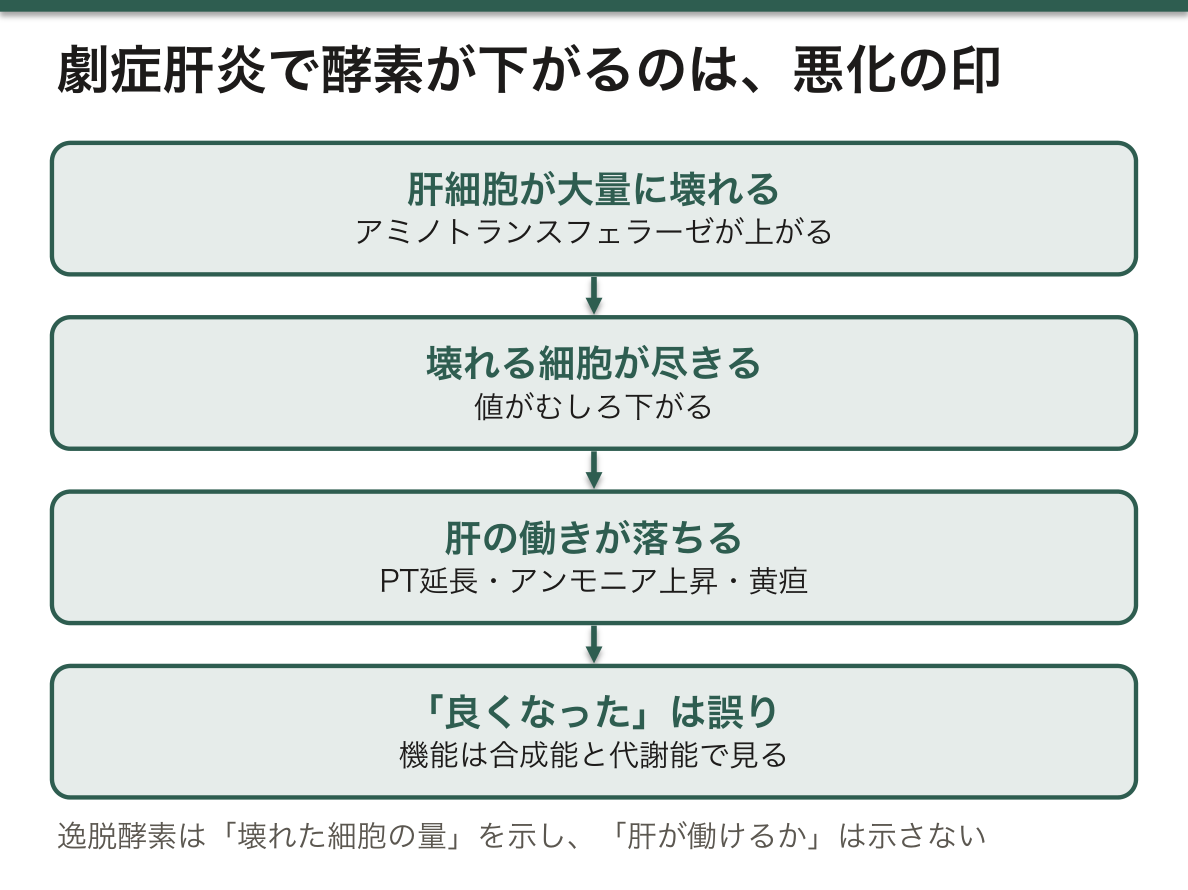
酵素の値と重症度を混同しない。アミノトランスフェラーゼは「壊れた細胞の量」を示すのであって、「肝が働けるか」を示さない。劇症肝炎では、壊れる細胞が尽きて値がむしろ下がる——このときプロトロンビン時間が延び、アンモニアが上がり、黄疸が進む。「酵素が下がってきたので良くなった」と読むのが、最も危険な誤りである。
肝機能そのものを見るのは、合成能(アルブミン・プロトロンビン時間・コリンエステラーゼ)と代謝能(ビリルビン・アンモニア)である。逸脱酵素は「機能」ではない——この区別を、言葉として持っておく。
English version
Core
| Enzyme | Location | When it rises |
|---|---|---|
| Aspartate aminotransferase | Liver, myocardium, skeletal muscle, red cell | Hepatocellular injury plus muscle and haemolysis |
| Alanine aminotransferase | Almost confined to the liver | Specific for hepatocellular injury |
| Alkaline phosphatase | Liver, bone, placenta, small intestine | Cholestasis, bone formation |
| γ-Glutamyl transpeptidase | Liver, bile duct, kidney, pancreas | Cholestasis, alcohol, drugs |
- Hepatocellular pattern — the aminotransferases predominate.
- Cholestatic pattern — alkaline phosphatase and γ-GT predominate.
- Alkaline phosphatase high alone → if γ-GT is normal, it is of bone origin.
Going further
When the alkaline phosphatase is high, first separate "liver or bone" — this one move avoids a wasted search. If γ-GT is raised with it, it is hepatobiliary; if normal, bone. It is physiologically high in a growing child and in late pregnancy (from bone formation and the placenta), so it is not treated as abnormal.
The habit of looking at ratios is another key point.
- An aspartate/alanine ratio above 2 — suggests alcoholic liver injury. Alcohol exhausts pyridoxal phosphate and the alanine aminotransferase falls the more strongly.
- This ratio also rises in cirrhosis (fibrosis reduces the hepatocellular ALT).
- In non-alcoholic fatty liver disease it is usually below 1, but it inverts as fibrosis advances.
Do not confuse the value of the enzyme with the severity. The aminotransferases show "the amount of cells destroyed", not "whether the liver can work". In fulminant hepatitis the cells left to break run out and the value falls instead — and at that point the prothrombin time lengthens, ammonia rises and jaundice deepens. Reading it as "the enzymes have come down, so it is improving" is the most dangerous error.
What shows liver function itself is synthetic capacity (albumin, prothrombin time, cholinesterase) and metabolic capacity (bilirubin, ammonia). The leaked enzymes are not "function" — hold that distinction as a form of words.
アミラーゼとリパーゼ — 膵を疑ったときに測る2つ
| アミラーゼ | リパーゼ | |
|---|---|---|
| 出どころ | 膵型(P型)と唾液腺型(S型) | ほぼ膵に限られる |
| 上がり始め | 発症 2〜12 時間 | 4〜8 時間 |
| 戻る | 3〜5 日(速い) | 8〜14 日(遅い) |
| 特異度 | 低い | 高い |
アミラーゼが上がる膵炎以外の原因——唾液腺炎・耳下腺炎・腸管穿孔/虚血・腎不全・異所性妊娠・アルコール・マクロアミラーゼ血症。
数値の高さは重症度と相関しない——重症度は臓器障害と全身状態で決める。
逆に高トリグリセリド血症による膵炎では、測定を妨げてアミラーゼが上がらないことがある。
「アイソザイムがある酵素は、特異度が低い」という一般則の典型例になる。アミラーゼは膵と唾液腺の2か所から出るので、上がっただけでは場所が決まらない——「型を分けて初めて、どの臓器の話かが言える」。
だから膵型アミラーゼかリパーゼを見る。リパーゼは実質的に膵だけから出るので、腹痛の鑑別では優先される(膵の章)——「出どころが1か所の酵素ほど、答えがはっきりする」。
戻る速さの差は、受診が遅れた患者で効いてくる。発症から数日たつとアミラーゼは正常化しているが、リパーゼはまだ高い——「いつ痛みが始まったかを聞かずに、数字だけを読まない」。
マクロアミラーゼ血症は、酵素が免疫グロブリンと結合して腎から捨てられなくなった状態になる。症状が無いのにアミラーゼだけが持続して高く、尿中アミラーゼは低い——「血中と尿中を比べれば、作りすぎと捨てられないが分けられる」。
腎不全でどちらも上がるのは、排泄の側の問題になる(腎機能の章)——「酵素の値は、産生・逸脱・排泄の3つの掛け算として読む」。
English version
Core
| Amylase | Lipase | |
|---|---|---|
| Origin | Pancreatic (P) and salivary (S) types | Almost confined to the pancreas |
| Begins to rise | 2–12 hours from onset | 4–8 hours |
| Returns | 3–5 days (fast) | 8–14 days (slow) |
| Specificity | Low | High |
Causes of a raised amylase other than pancreatitis — sialadenitis, parotitis, perforation or ischaemia of the gut, renal failure, ectopic pregnancy, alcohol, macroamylasaemia.
The height of the number does not correlate with severity — severity is decided by organ dysfunction and the general state.
Conversely, in pancreatitis from hypertriglyceridaemia the assay may be interfered with and the amylase not rise.
Going further
- It is the typical case of the general rule that an enzyme with isozymes has low specificity. Amylase comes from two places, pancreas and salivary gland, so a rise alone does not settle the place — only by separating the forms can one say which organ is in question.
- Hence pancreatic amylase or lipase is looked at. Lipase comes essentially from the pancreas alone, so it is preferred in the differential of abdominal pain (the chapter on the pancreas) — the fewer the sources of an enzyme, the clearer the answer.
- The difference in how fast they return tells in a patient who presents late. Some days from onset the amylase has normalised while the lipase is still high — do not read the numbers without asking when the pain began.
- Macroamylasaemia is the state in which the enzyme is bound to immunoglobulin and can no longer be discarded by the kidney. The amylase alone is persistently high without symptoms and the urinary amylase is low — comparing blood and urine separates making too much from failing to discard.
- That both rise in renal failure is a matter of the excretion side (the chapter on renal function) — read the value of an enzyme as the product of three things: production, leak and excretion.
酵素を測るときの落とし穴 — 数字が動く理由は、体の外にもある
採血と検体の扱いだけで、値が変わる酵素がある。
| 原因 | 影響を受けるもの | 向き |
|---|---|---|
| 溶血 | LDH・AST・カリウム | 偽高値(赤血球内に多い) |
| 駆血が長い・手を握らせる | カリウム・乳酸 | 偽高値 |
| 採血後の放置 | 血糖 | 偽低値(解糖が続く) |
| 激しい運動・筋注・転倒 | CK | 真の上昇(心筋ではない) |
| 妊娠・小児 | ALP | 生理的な高値(胎盤・骨由来) |
酵素の単位は活性(U/L)であって、量ではない——測定温度と基質が違えば、同じ検体でも数字が変わる。
だから施設ごとに基準範囲が違う。数値は、必ず添えられた基準範囲と一緒に読む。
「酵素を測る」とは、実は「反応の速さを測る」ことである。だから条件を揃えなければ比較できない(酵素の章)——「濃度ではなく速度を報告している、という一点を押さえる」。
溶血の影響は、細胞内外の濃度差から予測できる。赤血球の中に多いものが、壊れた分だけ血漿へ出る(カリウムの章)——「LDH と AST とカリウムが揃って高ければ、まず検体を疑う」。
ALP は、由来を分けなければ意味が出ない。肝胆道・骨・胎盤・小腸のアイソザイムがあり、γ-GT が一緒に上がっていれば肝胆道由来になる(黄疸の章)——「2つの酵素を組にして、由来を絞る」。
2020 年から日本の ALP と LD は国際基準(IFCC 法)に変わり、ALP の数値は約 1/3 になった——「古い基準値のまま読むと、正常を異常と読む」。
CK が高いときは、まず出どころを分ける。運動・筋注・転倒・けいれん・甲状腺機能低下症・スタチンでも上がる(横紋筋融解症の章)——「心筋を疑うならトロポニンを見る、が原則になる」。
English version
Core
There are enzymes whose values change from the venepuncture and the handling of the sample alone.
| Cause | What is affected | Direction |
|---|---|---|
| Haemolysis | LDH, AST, potassium | Falsely high (abundant within the red cell) |
| A long tourniquet, clenching the fist | Potassium, lactate | Falsely high |
| Standing after collection | Blood glucose | Falsely low (glycolysis continues) |
| Hard exercise, intramuscular injection, a fall | CK | A true rise (not myocardial) |
| Pregnancy, childhood | ALP | Physiologically high (placental and bone origin) |
The unit of an enzyme is activity (U/L), not amount — with a different temperature and substrate the same sample gives a different number.
Hence the reference range differs between laboratories. Always read a value together with the reference range that accompanies it.
Going further
- Measuring an enzyme is in fact measuring the speed of a reaction. So the conditions must be aligned for a comparison to hold (the chapter on enzymes) — hold the single point that what is reported is a rate, not a concentration.
- The effect of haemolysis can be predicted from the concentration difference across the cell. What is abundant within the red cell comes out into the plasma in proportion to what has broken (the chapter on potassium) — if LDH, AST and potassium are all high together, suspect the sample first.
- ALP means nothing until the origin is separated. There are hepatobiliary, bone, placental and intestinal isozymes, and a rise with γ-GT is hepatobiliary (the chapter on jaundice) — pair two enzymes to narrow the origin.
- From 2020 the Japanese ALP and LD changed to the international standard (the IFCC method) and the ALP figure became about one third — read with the old reference range and the normal is read as abnormal.
- When CK is high, separate the origin first. It rises with exercise, intramuscular injection, a fall, seizures, hypothyroidism and statins (the chapter on rhabdomyolysis) — the principle is to look at troponin if the myocardium is suspected.
心筋トロポニン — 値そのものより、動き方を見る
トロポニンは心筋にしかない収縮蛋白で、心筋細胞が壊れると血中に出る。臓器特異性が非常に高いので、CK-MB に取って代わった。
時間の形を知らないと使えない。
- 上がり始め——発症から 2〜4 時間(高感度法では 1 時間程度から)
- 頂点——12〜24 時間
- 戻るまで——7〜14 日。長く残る
だから発症直後の 1 回の陰性で、心筋梗塞は否定できない。高感度トロポニンでは0 時間と 1〜3 時間の 2 点を測り、値そのものと「変化量」の両方で判定するアルゴリズムが使われる。
上がっていても心筋梗塞とは限らない。トロポニンは「心筋が傷んだ」ことしか言っていない——原因が冠動脈の閉塞かどうかは、別の情報で決める。
| 心臓が原因 | 心不全・心筋炎・たこつぼ型心筋症・頻脈性不整脈・心臓手術・除細動 | 需要と供給の不均衡、あるいは直接の傷害 |
| 心臓以外 | 腎不全・敗血症・肺塞栓・脳出血・横紋筋融解症・高度の貧血 | 腎不全では排泄が落ちて慢性的に高い |
慢性的に高い患者を、どう扱うかが実務上いちばん難しい。腎不全や慢性心不全では基礎値が高いので、「その人のいつもの値からどれだけ動いたか」で急性の事象を判断する。1 点の値だけでは、慢性の高値と急性の梗塞を区別できない。
高感度化がもたらした2つの帰結を押さえておく。
- 早く否定できるようになった——検出限界以下なら、その場で帰宅を検討できる(陰性的中率が高い)。救急の滞在時間が短縮された
- 陽性の意味が薄まった——微小な上昇を拾うので、心筋梗塞でない上昇が大量に見つかる。特異度は下がった
感度を上げれば特異度は下がる——検査を高感度化したときに必ず起きる交換であり、トロポニンはその最も分かりやすい実例になっている。
「トロポニンが陽性です」と報告を受けたら、いつからの症状か・前回の値・腎機能を先に確認する。数字だけでは判断できない。
English version
Core
Troponin is a contractile protein found only in the myocardium, released into the blood when a myocyte breaks. Its organ specificity being very high, it has replaced CK-MB.
It cannot be used without knowing the shape in time.
- Begins to rise — 2–4 hours from onset (from about an hour with the high-sensitivity assay).
- Peak — 12–24 hours.
- Return — 7–14 days. It remains long.
So a single negative immediately after onset does not exclude infarction. With high-sensitivity troponin an algorithm is used measuring two points, 0 hours and 1–3 hours, and judging on both the value itself and the change.
Going further
A rise does not necessarily mean infarction. Troponin says only that "the myocardium has been damaged" — whether the cause is occlusion of a coronary artery is decided from other information.
| Cardiac causes | Heart failure, myocarditis, takotsubo cardiomyopathy, tachyarrhythmia, cardiac surgery, defibrillation | Imbalance of supply and demand, or direct injury |
| Non-cardiac | Renal failure, sepsis, pulmonary embolism, intracerebral haemorrhage, rhabdomyolysis, severe anaemia | In renal failure excretion falls and it is chronically high |
How to handle the patient who is chronically high is the hardest part in practice. In renal failure and chronic heart failure the baseline is high, so an acute event is judged on how far it has moved from that person’s usual value. A single value cannot separate a chronic elevation from an acute infarct.
Note the two consequences of high-sensitivity assays.
- It can be excluded sooner — below the limit of detection, discharge can be considered on the spot (the negative predictive value is high). Time in the emergency department has been shortened.
- The meaning of a positive has been diluted — picking up minute rises, a great many elevations that are not infarction are found. Specificity has fallen.
Raise the sensitivity and the specificity falls — the trade that always occurs when a test is made more sensitive, and troponin is its plainest example.
In the clinic
Told "the troponin is positive", first check how long the symptoms have lasted, the previous value and the renal function. The number alone cannot decide.
検査値が「変わった」と言えるのは、どれだけ動いたときか
同じ人を同じ日に 2 回測っても、値は一致しない。ばらつきには 2 つの出どころがある。
- 測定のばらつき——機器と試薬による誤差
- 個人内の生理的変動——日内変動・食事・運動・姿勢による揺れ
この 2 つを合わせた大きさを超えて初めて、「本当に変わった」と言える。その閾値を基準変化値という。
項目によって、必要な変化の大きさがまるで違う。
| ナトリウム・カルシウム | 変動が小さい | 数 % 動けば意味がある。だから基準範囲が狭い |
| クレアチニン | 中くらい | おおむね 15〜20% 以上の変化を見る |
| 中性脂肪・PSA・フェリチン | 変動が大きい | 50% 以上動いても、生理的変動の範囲でありうる |
もう1つ、基準範囲の使い方そのものに落とし穴がある。
個人内の変動が個人間の変動よりずっと小さい項目では、基準範囲に入っていても、その人にとっては異常ということが起こる。クレアチニンが典型で、もともと 0.5 mg/dL の人が 1.0 になれば腎機能は半減しているが、検査値は「基準範囲内」と表示される。
だから急性腎障害の定義は、基準範囲ではなく変化で書かれている——48 時間以内に 0.3 mg/dL 以上の上昇、または 7 日以内に 1.5 倍。「前の値と比べる」ことが、基準範囲を見ることより優先される。
実務での使いどころ。
- 前回値と比べる習慣を持つ——電子カルテの推移グラフを開く
- 採取条件を揃える——同じ時刻・同じ姿勢・同じ絶食条件。揃っていない比較は、変化を見誤らせる
- 小さな変動で薬を動かさない——1 回の値に反応して増減すると、ばらつきを追いかけるだけの調整になる
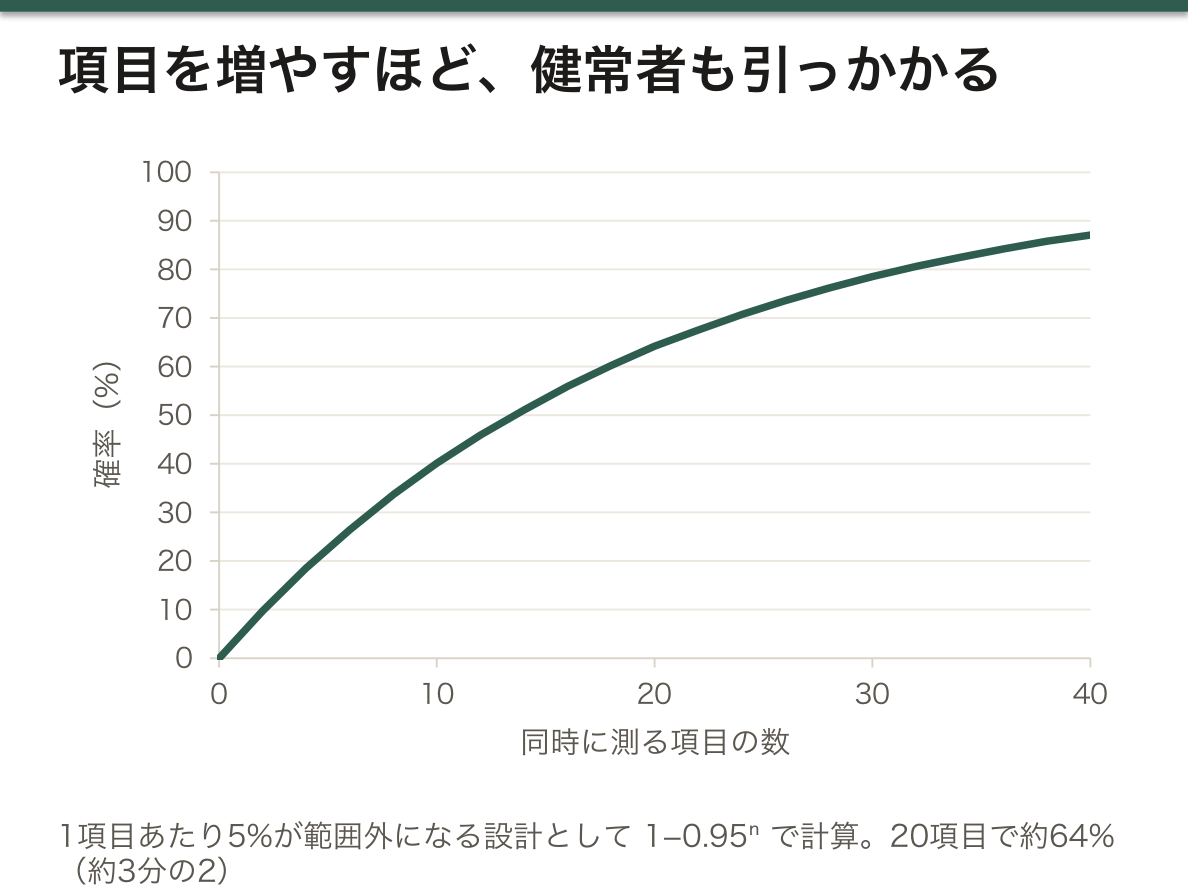
健診で「多項目を一度に測ると、健康な人でも何かは引っかかる」のも同じ数学から出る。1 項目あたり 5% が範囲外になる設計なので、20 項目測れば、健常者の約 3 分の 2 で少なくとも 1 つは異常値が出る。
1 回の異常値で慌てず、条件を揃えて測り直すのが基本になる。特に中性脂肪・PSA・フェリチンは 1 点で判断しない。
English version
Core
Measure the same person twice on the same day and the values do not agree. The scatter has two sources.
- Analytical scatter — the error of the instrument and reagent.
- Within-person physiological variation — the swing from time of day, food, exercise and posture.
Only beyond the size of these two combined can one say it has really changed. That threshold is the reference change value.
The size of change needed differs entirely between tests.
| Sodium, calcium | Little variation | A few per cent is meaningful. Hence the narrow reference range |
| Creatinine | Intermediate | Look for a change of roughly 15–20 per cent or more |
| Triglyceride, PSA, ferritin | Wide variation | A move of 50 per cent or more can still be within physiological variation |
Going further
There is another pitfall in the very use of the reference range.
For tests where the within-person variation is much smaller than the between-person variation, a value inside the reference range can still be abnormal for that person. Creatinine is the type: a person whose baseline is 0.5 mg/dL reaching 1.0 has lost half their renal function, and the report still says "within the reference range".
Hence the definition of acute kidney injury is written in terms of change, not the reference range — a rise of 0.3 mg/dL or more within 48 hours, or 1.5-fold within 7 days. Comparing with the previous value takes priority over looking at the reference range.
How to use this in practice.
- Keep the habit of comparing with the previous value — open the trend graph in the record.
- Align the conditions of collection — the same hour, the same posture, the same fasting state. A comparison that is not aligned misleads about change.
- Do not move the drug on a small fluctuation — reacting to a single value gives an adjustment that merely chases the scatter.
That "measuring many tests at once catches something even in a healthy person" comes out of the same mathematics. Designed so that 5 per cent fall outside the range per test, measure 20 and about two thirds of healthy people will have at least one abnormal value.
In the clinic
Do not be alarmed by a single abnormal value; repeat it with the conditions aligned. Triglyceride, PSA and ferritin especially are not to be judged on one point.
まとめ
| 乳酸脱水素酵素とクレアチンキナーゼ — 型で臓器を当てる | 乳酸脱水素酵素はH鎖とM鎖の4量体で、組み合わせにより5型ある。 |
|---|---|
| 肝胆道系酵素 — 壊れているのか、詰まっているのか | 酵素局在上がる状況アスパラギン酸アミノトランスフェラーゼ肝・心筋・骨格筋・赤血球肝細胞障害+筋・溶血アラニンアミノトランスフェラーゼほぼ肝に限局肝細胞障害に特異的アルカリホスファタ… |
| アミラーゼとリパーゼ — 膵を疑ったときに測る2つ | アミラーゼリパーゼ出どころ膵型(P型)と唾液腺型(S型)ほぼ膵に限られる上がり始め発症 2〜12 時間4〜8 時間戻る3〜5 日(速い)8〜14 日(遅い)特異度低い高いアミラーゼ… |
| 酵素を測るときの落とし穴 — 数字が動く理由は、体の外にもある | 採血と検体の扱いだけで、値が変わる酵素がある。 |
| 心筋トロポニン — 値そのものより、動き方を見る | トロポニンは心筋にしかない収縮蛋白で、心筋細胞が壊れると血中に出る。 |
| 検査値が「変わった」と言えるのは、どれだけ動いたときか | 同じ人を同じ日に 2 回測っても、値は一致しない。 |
このノートは医学生が授業の内容を自分の言葉でまとめたもので、診療の判断に使うものではありません。誤りに気づいたらお知らせください。