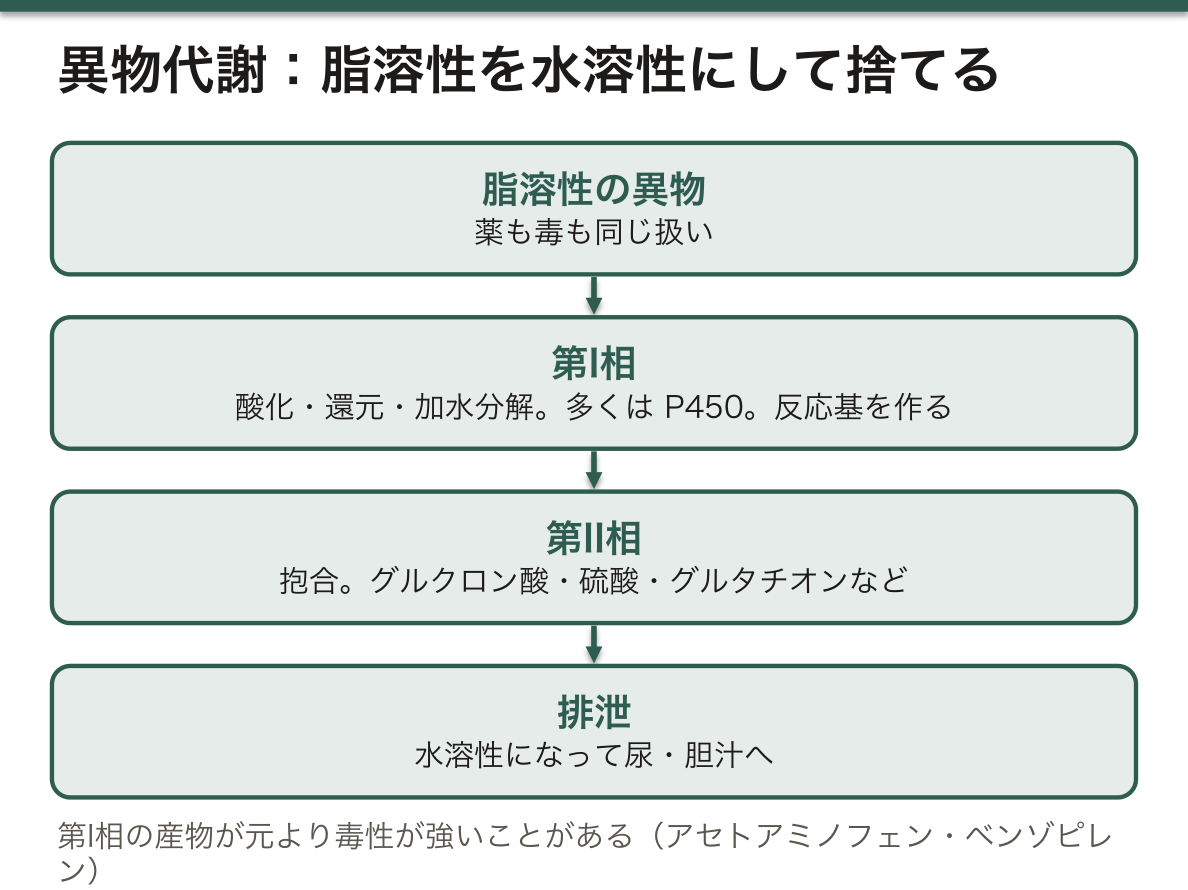
体には「薬」という概念が無い。あるのは「脂溶性の異物を、水溶性にして捨てる」という一本の仕組みだけになる。
- 第I相——酸化・還元・加水分解。多くは P450。反応基を作る(または露出させる)
- 第II相——抱合。グルクロン酸・硫酸・グルタチオン・アセチル・メチル。水溶性にして排泄する
だから第I相の産物が、元の薬より毒性が強いことがある——「代謝は解毒とは限らない」。アセトアミノフェンとベンゾピレンがその例になる。
そして P450 は、誘導と阻害を受ける——これが薬物相互作用のほとんどを説明する。
個体差も大きい。遺伝多型(CYP2C19・CYP2D6・NAT2・UGT1A1)が、効き方と副作用を分ける。
薬物動態は薬物動態の章、相互作用と個体差は代謝と個体差の章、ビリルビン代謝はヘムとビリルビンの章にある。
- 第I相と第II相 — 解毒が毒に変わるとき
- 誘導と阻害 — 相互作用は、時間の向きが逆になる
- アセトアミノフェン中毒 — 解毒の在庫が尽きた先で何が起きるか
- 薬物代謝の個人差 — 遺伝子の型が、同じ量の意味を変える
- 腎から出るか、胆汁から出るか — 排泄の道が、減量の判断を決める
- 化学発癌 — 発癌物質の多くは、代謝されて初めて発癌物質になる
第I相と第II相 — 解毒が毒に変わるとき
第I相(主にチトクロムP450)——滑面小胞体にある。NADPHと酸素を使い、水酸化・脱アルキル・脱アミノを行う。
- 主なもの——CYP3A4(薬の半数以上)・CYP2D6・CYP2C9・CYP2C19・CYP1A2・CYP2E1
第II相(抱合)。
| 抱合 | 例 |
|---|---|
| グルクロン酸 | ビリルビン・モルヒネ・多くの薬 |
| 硫酸 | ステロイド・アセトアミノフェン(少量時) |
| グルタチオン | NAPQI・エポキシド |
| アセチル | イソニアジド・ヒドララジン・スルファメトキサゾール |
アセトアミノフェン——通常は硫酸・グルクロン酸抱合。過量では CYP2E1 が NAPQI を作り、グルタチオンが尽きると肝壊死になる。
アルコールは CYP2E1 を誘導する——だから常習飲酒者では、より少ない量で肝障害が起きる。
アセトアミノフェンの肝毒性は、量ではなく「グルタチオンが尽きたかどうか」で決まる。だから飲酒・低栄養・絶食が閾値を下げる(中毒の章)——「同じ量が、同じ結果にならない」。
そして肝障害は、飲んだ直後には出ない。24〜72時間後にトランスアミナーゼが上がる——「元気に見える時間帯に、治療を始めなければならない」。
だから血中濃度と時間から治療を決める(Rumack-Matthew ノモグラム)(急性中毒の初期対応の章)——「症状ではなく、時間軸で判断する中毒がある」。
アセチル化の速度は遺伝で決まる(NAT2)。遅い型ではイソニアジドの副作用(末梢神経障害・薬剤性ループス)が出やすい(遺伝多型の章)——「同じ処方で、人によって副作用の確率が違う」。
イソニアジドの末梢神経障害は、ビタミンB6の消費による。イソニアジドがピリドキサール5-リン酸と結合して、一緒に排泄されるからになる(抗結核薬の章)——「予防にB6を併用する理由が、生化学にある」。
グルクロン酸抱合の酵素(UGT1A1)の多型が、Gilbert 症候群になる。絶食やストレスで間接ビリルビンが軽く上がるだけで、無害になる(黄疸の鑑別の章)——「健診で見つかる異常の、最も多い良性の理由の1つになる」。
English version
Core
Phase I (chiefly cytochrome P450) — in the smooth endoplasmic reticulum. Using NADPH and oxygen it hydroxylates, dealkylates and deaminates.
- The principal ones — CYP3A4 (more than half of drugs), CYP2D6, CYP2C9, CYP2C19, CYP1A2, CYP2E1.
Phase II (conjugation).
| Conjugate | Examples |
|---|---|
| Glucuronic acid | Bilirubin, morphine, many drugs |
| Sulphate | Steroids, paracetamol (at low doses) |
| Glutathione | NAPQI, epoxides |
| Acetyl | Isoniazid, hydralazine, sulfamethoxazole |
Paracetamol — usually conjugated with sulphate and glucuronic acid. In overdose CYP2E1 makes NAPQI, and when glutathione runs out there is hepatic necrosis.
Alcohol induces CYP2E1 — so in a habitual drinker liver injury occurs at a smaller dose.
Going further
- The hepatotoxicity of paracetamol is decided not by the dose but by whether the glutathione has run out. Hence alcohol, undernutrition and fasting lower the threshold (the chapter on poisoning) — the same dose does not give the same result.
- And the liver injury does not appear immediately after ingestion. The transaminases rise at 24–72 hours — treatment must be begun during the hours in which the patient looks well.
- Hence treatment is decided from the blood level and the time (the Rumack–Matthew nomogram) (the chapter on the initial response in acute poisoning) — there are poisonings judged on a time axis rather than on symptoms.
- The rate of acetylation is genetically determined (NAT2). In slow acetylators the adverse effects of isoniazid (peripheral neuropathy, drug-induced lupus) occur readily (the chapter on genetic polymorphism) — the same prescription carrying a different probability of adverse effects in different people.
- The peripheral neuropathy of isoniazid comes from the consumption of vitamin B6. Isoniazid binds pyridoxal 5′-phosphate and they are excreted together (the chapter on antituberculous drugs) — the reason B6 is given alongside lies in biochemistry.
- A polymorphism of the glucuronidating enzyme (UGT1A1) gives Gilbert’s syndrome. Unconjugated bilirubin rises slightly with fasting or stress, and it is harmless (the chapter on the differential of jaundice) — one of the commonest benign reasons for an abnormality found at a health check.
誘導と阻害 — 相互作用は、時間の向きが逆になる
誘導——核内受容体を介して酵素の量を増やす。効果が出るまで数日〜2週間、切れるのも遅い。
- 誘導するもの——リファンピシン・カルバマゼピン・フェニトイン・フェノバルビタール・セント・ジョーンズ・ワート・喫煙(CYP1A2)・慢性のアルコール
- 結果——併用薬の血中濃度が下がる。経口避妊薬・ワルファリン・免疫抑制薬が効かなくなる
阻害——酵素そのものを塞ぐ。数時間〜数日で効く。速い。
- 阻害するもの——マクロライド(クラリスロマイシン)・アゾール系抗真菌薬・シメチジン・グレープフルーツジュース・急性のアルコール
- 結果——併用薬の血中濃度が上がり、中毒になる
P糖蛋白(ABC輸送体)——薬を細胞外へ汲み出す。誘導・阻害を受ける。腸管吸収と血液脳関門と腫瘍の多剤耐性に関わる。
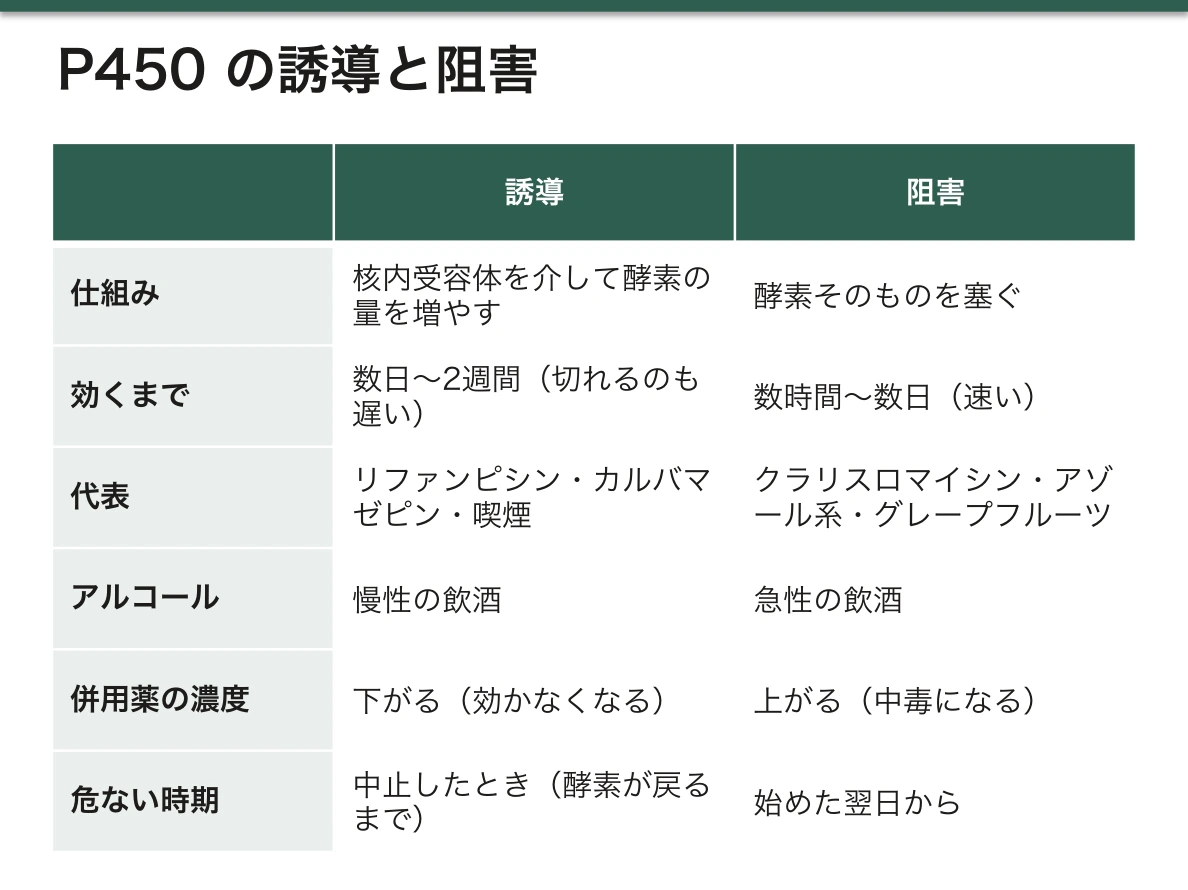
誘導と阻害では、時間の向きが違うことが実務で効く。阻害は始めた翌日から、誘導は1〜2週後から問題になる(相互作用の章)——「薬を足したときと、やめたときの両方で監視する期間が違う」。
特に誘導薬を中止したときが危ない。酵素の量が戻るまでの間に、併用薬が過量になる——「やめたことによる中毒が起きる」。
リファンピシンが経口避妊薬を無効にすることは、結核治療で必ず伝える(結核治療の章)——「薬の説明が、避妊の説明を含む」。
グレープフルーツジュースは、腸管の CYP3A4 を不可逆に阻害する。だから時間をずらしても意味が無く、数日効果が続く(初回通過効果の章)——「食品が、薬の血中濃度を数倍にする」。
ワルファリンは、相互作用が最も集中する薬になる。CYP2C9・ビタミンK・蛋白結合・腸内細菌のすべてで影響を受ける(抗凝固療法の章)——「だから DOAC への切り替えが進んだ」。
P糖蛋白が血液脳関門で働くことが、中枢移行の少ない薬を作っている(血液脳関門の章)——「入れないのではなく、入ったものを汲み出している」。
English version
Core
Induction — the amount of enzyme is increased through a nuclear receptor. It takes days to two weeks to appear and is slow to wear off.
- Inducers — rifampicin, carbamazepine, phenytoin, phenobarbital, St John’s wort, smoking (CYP1A2), chronic alcohol.
- Result — the level of the co-administered drug falls. Oral contraceptives, warfarin and immunosuppressants stop working.
Inhibition — the enzyme itself is blocked. It works in hours to days. Fast.
- Inhibitors — macrolides (clarithromycin), azole antifungals, cimetidine, grapefruit juice, acute alcohol.
- Result — the level of the co-administered drug rises and there is toxicity.
P-glycoprotein (an ABC transporter) — pumps drugs out of the cell. It is induced and inhibited. It bears on intestinal absorption, the blood–brain barrier and multidrug resistance in tumours.
Going further
- That induction and inhibition run in different directions in time tells in practice. Inhibition becomes a problem from the day after starting; induction from one to two weeks later (the chapter on interactions) — the period of monitoring differs between adding a drug and stopping one.
- Stopping an inducer is especially dangerous. While the amount of enzyme returns, the co-administered drug becomes an overdose — a toxicity caused by stopping something.
- That rifampicin makes oral contraceptives ineffective must always be conveyed in treating tuberculosis (the chapter on the treatment of tuberculosis) — the explanation of the drug includes the explanation of contraception.
- Grapefruit juice inhibits intestinal CYP3A4 irreversibly. So separating the timing is no use and the effect lasts days (the chapter on the first-pass effect) — a food raising a drug level several-fold.
- Warfarin is the drug on which interactions concentrate most. It is affected through CYP2C9, vitamin K, protein binding and the gut flora, all of them (the chapter on anticoagulation) — hence the move to the DOACs.
- That P-glycoprotein works at the blood–brain barrier creates drugs with little central penetration (the chapter on the blood–brain barrier) — not keeping them out but pumping out what has entered.
アセトアミノフェン中毒 — 解毒の在庫が尽きた先で何が起きるか
常用量では、大半がグルクロン酸抱合と硫酸抱合で処理される(第II相)。
数%だけが CYP2E1 で酸化され、反応性の高い NAPQI になる。NAPQI はグルタチオンと結合して無毒化される。
過量では抱合が飽和し、NAPQI が増え、グルタチオンが枯渇する。残った NAPQI が肝細胞の蛋白と結合し、中心静脈周囲(3帯)の壊死を起こす。
経過——①0〜24時間:無症状か嘔気 ②24〜72時間:AST・ALT が上がる ③72〜96時間:肝不全が完成 ④回復期。
解毒薬は N-アセチルシステイン——グルタチオンの材料(システイン)を供給する。8〜10 時間以内の投与が最も有効になる。
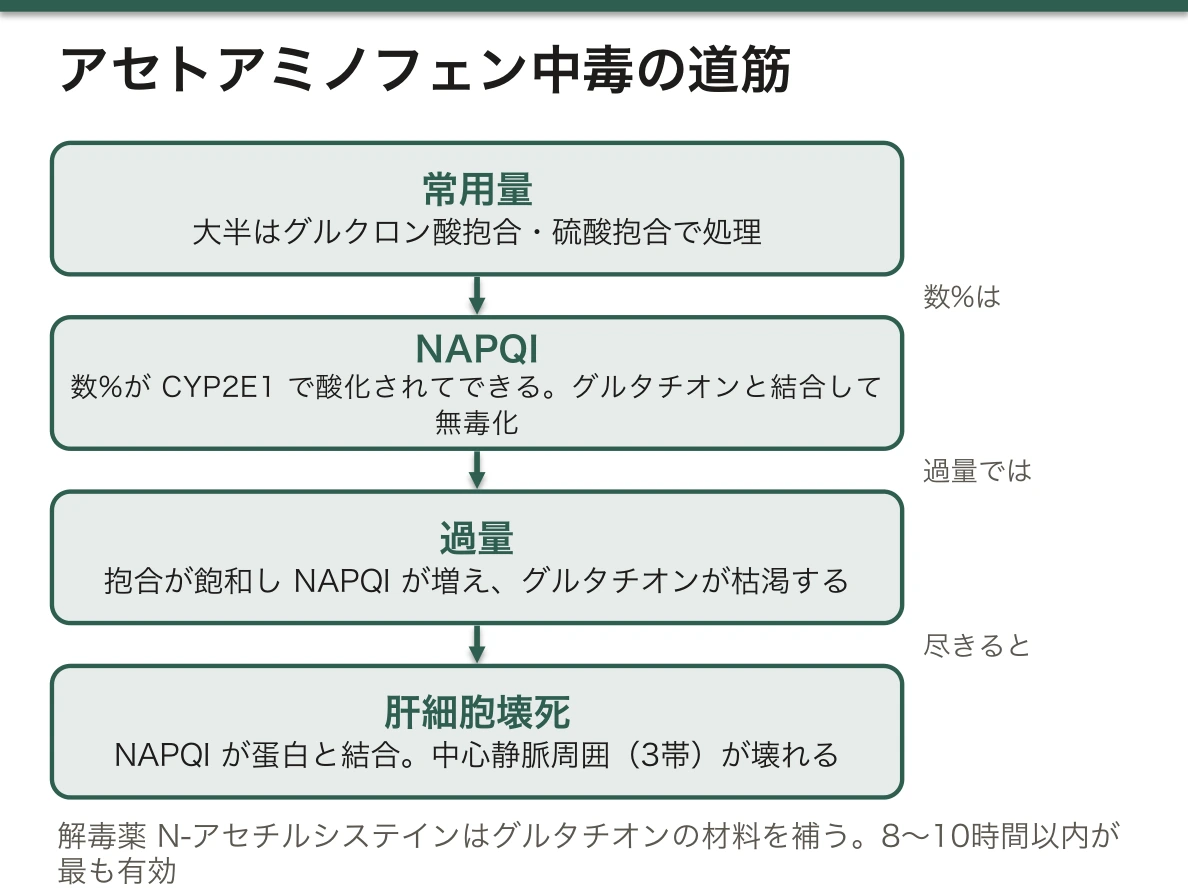
この中毒の怖さは「最初の1日、患者が元気に見える」ことにある。症状が出る頃には、治療の窓が閉じかけている(中毒の章)——「症状ではなく、血中濃度と時刻で判断する(Rumack-Matthew ノモグラム)」。
3帯が壊れるのは、代謝の地図がそのまま現れているためになる。CYP は中心静脈周囲に多く、酸素は最も乏しい(肝小葉の章)——「作る場所と、耐えられない場所が一致している」。
危険を高める背景が2つある。①慢性のアルコール摂取で CYP2E1 が誘導される ②低栄養・飢餓・神経性やせ症でグルタチオンの在庫が少ない(アルコール代謝の章)——「同じ量でも、人によって毒になる境目が違う」。
ただし急性のアルコール摂取は、逆に CYP を競合的に占有して保護的に働きうる——「慢性と急性で、向きが逆になる」。
N-アセチルシステインが「材料を足す」薬であることは、他の場面にも通じる。足りないのは酵素ではなく基質なので、早く入れるほど効く(グルタチオンの章)——「壊れた後では、材料を足しても間に合わない」。
複数の市販薬に含まれることが、意図しない過量を生む(処方という実務の章)——「総量を、成分名で数える習慣が要る」。
English version
Core
At ordinary doses most is handled by glucuronide and sulphate conjugation (phase II).
Only a few per cent is oxidised by CYP2E1 into the highly reactive NAPQI. NAPQI is detoxified by binding glutathione.
In overdose the conjugation saturates, NAPQI increases and glutathione is exhausted. The NAPQI left binds the proteins of hepatocytes and causes necrosis around the central vein (zone 3).
The course — ① 0–24 hours: asymptomatic or nausea ② 24–72 hours: AST and ALT rise ③ 72–96 hours: liver failure is complete ④ recovery.
The antidote is N-acetylcysteine — it supplies the material of glutathione (cysteine). It is most effective given within 8–10 hours.
Going further
- The danger of this poisoning is that for the first day the patient looks well. By the time symptoms appear, the window for treatment is closing (the chapter on poisoning) — judge on the blood level and the hour, not on symptoms (the Rumack–Matthew nomogram).
- Zone 3 breaks because the map of metabolism appears directly. CYP is abundant around the central vein, and the oxygen is scarcest there (the chapter on the hepatic lobule) — the place that makes it and the place that cannot withstand it coinciding.
- Two backgrounds raise the danger. ① Chronic alcohol induces CYP2E1 ② undernutrition, starvation and anorexia nervosa leave a small stock of glutathione (the chapter on alcohol metabolism) — the same dose, and the boundary of toxicity differing between people.
- Acute alcohol, however, can be protective by competitively occupying CYP — chronic and acute running in opposite directions.
- That N-acetylcysteine is a drug that "adds material" carries over to other settings. What is short is not the enzyme but the substrate, so the sooner it is given the better it works (the chapter on glutathione) — after the damage is done, adding material is too late.
- Its presence in several over-the-counter preparations creates unintended overdose (the chapter on prescribing in practice) — the habit of counting the total by the name of the ingredient is needed.
薬物代謝の個人差 — 遺伝子の型が、同じ量の意味を変える
同じ量を投与しても、代謝の速さは人によって違う。代謝が遅い人(poor metabolizer)では効きすぎ、速い人では効かない。
| 酵素・分子 | 関わる薬 | 起こること |
|---|---|---|
| CYP2C19 | クロピドグレル・プロトンポンプ阻害薬・ボリコナゾール | 日本人に低活性型が多い。クロピドグレルは活性化されず効かない |
| CYP2D6 | コデイン・タモキシフェン・抗精神病薬 | コデインはモルヒネへ変換されないと効かない |
| NAT2 | イソニアジド | 遅い人で末梢神経障害と肝障害 |
| UGT1A1 | イリノテカン | *6/*28 で重篤な骨髄抑制と下痢 |
| TPMT・NUDT15 | アザチオプリン・6-メルカプトプリン | NUDT15 の変異で高度の骨髄抑制と脱毛 |
| アルデヒド脱水素酵素2 | アルコール | 顔面紅潮・悪心(日本人の約4割) |
「薬そのものが効くのか、代謝物が効くのか」で、遅い代謝の意味が正反対になる。
- 活性体を投与する薬(多く)——代謝が遅い=効きすぎる・副作用
- プロドラッグ(クロピドグレル・コデイン・タモキシフェン)——代謝が遅い=効かない
(個体差の章)——「同じ『代謝が遅い』が、逆の結果になる」。
日本で最も実務に食い込んでいるのが NUDT15 になる。炎症性腸疾患や自己免疫疾患でチオプリンを始める前に測ることが標準になっている(免疫抑制薬の章)——「投与前に測る検査が、実際に保険で行われている」。
イソニアジドの代謝速度は、副作用の予防法まで決める。遅い人ではピリドキシン(ビタミンB6)の消費が進み、末梢神経障害が出る(抗酸菌の章)——「だからビタミンB6 を併用する」。
アルデヒド脱水素酵素2 の多型は、日本人に固有の頻度を持つ。低活性型では飲酒で食道癌のリスクが上がる(アルコール代謝の章)——「飲めるようになった人ほど危ない、という疫学の根拠になる」。
そして HLA の型は、代謝ではなく免疫を介した副作用を決める(この章の第I相と第II相の項)——「カルバマゼピンと HLA-B*15:02、アロプリノールと HLA-B*58:01」。
English version
Core
Give the same dose and the speed of metabolism differs between people. In a poor metaboliser it works too well; in a fast one it does not work.
| Enzyme or molecule | Drugs involved | What happens |
|---|---|---|
| CYP2C19 | Clopidogrel, proton pump inhibitors, voriconazole | The low-activity form is common in Japanese people. Clopidogrel is not activated and does not work |
| CYP2D6 | Codeine, tamoxifen, antipsychotics | Codeine does not work unless converted to morphine |
| NAT2 | Isoniazid | Peripheral neuropathy and liver injury in slow acetylators |
| UGT1A1 | Irinotecan | *6/*28 give severe marrow suppression and diarrhoea |
| TPMT, NUDT15 | Azathioprine, 6-mercaptopurine | A NUDT15 variant gives severe marrow suppression and alopecia |
| Aldehyde dehydrogenase 2 | Alcohol | Flushing and nausea (about 40 per cent of Japanese people) |
Going further
- Whether the drug itself acts or its metabolite acts reverses the meaning of slow metabolism.
- Drugs given as the active form (most) — slow metabolism = too much effect and adverse effects.
- Prodrugs (clopidogrel, codeine, tamoxifen) — slow metabolism = no effect.
- The one most embedded in practice in Japan is NUDT15. Measuring it before starting a thiopurine in inflammatory bowel disease or autoimmune disease is standard (the chapter on immunosuppressants) — a test done before administration and actually covered by insurance.
- The rate of isoniazid metabolism decides even how the adverse effect is prevented. In slow acetylators the consumption of pyridoxine (vitamin B6) advances and peripheral neuropathy appears (the chapter on the mycobacteria) — hence vitamin B6 is given alongside.
- The polymorphism of aldehyde dehydrogenase 2 has a frequency peculiar to Japanese people. In the low-activity form, drinking raises the risk of oesophageal cancer (the chapter on alcohol metabolism) — the epidemiological ground for "the more someone has come to be able to drink, the greater the danger".
- And the HLA type decides adverse effects mediated by immunity rather than metabolism (the section on phase I and phase II in this chapter) — carbamazepine with HLA-B*15:02, allopurinol with HLA-B*58:01.
腎から出るか、胆汁から出るか — 排泄の道が、減量の判断を決める
薬が体から出ていく道はおおむね2つで、分子の性質でどちらを通るかが決まる。
| 腎から出る | 水に溶けやすい・分子量が小さい | 糸球体濾過+尿細管分泌。腎機能が落ちたら減量する |
| 胆汁から出る | 分子量が大きい(およそ 500 以上)・抱合を受けた形 | 肝の輸送体で胆汁へ。便へ出る |
第 II 相の抱合は「水に溶けやすくする」ためだけでなく、どちらの道へ振り分けるかを決める工程でもある。
腎排泄型の薬は暗記に値する——リチウム・ジゴキシン・アミノグリコシド・バンコマイシン・メトホルミン・多くのβラクタム・DOAC の一部。高齢者では血清クレアチニンが正常でも腎機能は落ちている(筋肉量が少ないため)ので、推算 GFR で確認する。
胆汁へ出た薬が、そのまま体を出るとは限らない。グルクロン酸抱合体は腸へ出た後、腸内細菌のβ-グルクロニダーゼで抱合が外され、再び吸収される(腸肝循環)。この往復が薬の作用時間を延ばしている。
臨床で問題になる形が3つある。
- 抗菌薬で経口避妊薬が効かなくなる——腸内細菌が減ると再吸収が減り、エストロゲンの濃度が下がるという説明がされてきた。実際の影響の大きさには議論があるが、リファンピシンだけは酵素誘導で明確に効果を落とす
- イリノテカンの下痢——活性代謝物 SN-38 の抱合体が腸で脱抱合され、腸管上皮を直接傷める。UGT1A1 の型が弱い人で強く出る
- 吸着薬で中断させる——活性炭を繰り返し投与して腸肝循環を断ち切り、薬物中毒の排泄を早める(テオフィリン・カルバマゼピンなど)
⚠️ 透析で抜ける薬と抜けない薬の違いは、分子量・蛋白結合率・分布容積で決まる。蛋白に強く結合する薬や、組織へ広く分布する薬は透析で抜けない。中毒の治療方針が変わるので、この3つを確認する。
高齢者に薬を出すときは、体重と推算 GFRを見てから用量を決める。「クレアチニンが正常だから常用量」が、最も多い医原性の中毒の入口になる。
English version
Core
There are broadly two routes by which a drug leaves the body, and the properties of the molecule decide which it takes.
| Renal | Readily water-soluble, low molecular weight | Glomerular filtration plus tubular secretion. Reduce the dose when renal function falls |
| Biliary | High molecular weight (roughly over 500), conjugated forms | Into the bile by hepatic transporters. Out in the stool |
Phase II conjugation is not only for "making it water-soluble" but also a step deciding which of the two routes it is sorted into.
The renally excreted drugs are worth memorising — lithium, digoxin, aminoglycosides, vancomycin, metformin, many β-lactams, some DOACs. In the elderly the renal function has fallen even with a normal serum creatinine (because muscle mass is small), so confirm with the estimated GFR.
Going further
A drug that goes into the bile does not necessarily leave the body. A glucuronide, once in the gut, has the conjugate removed by bacterial β-glucuronidase and is reabsorbed (enterohepatic circulation). This round trip lengthens the drug’s duration of action.
Three forms of this become clinical problems.
- Antibiotics making an oral contraceptive ineffective — the explanation has been that with fewer gut bacteria less is reabsorbed and the oestrogen level falls. The size of the actual effect is debated, but rifampicin alone clearly reduces the effect through enzyme induction.
- The diarrhoea of irinotecan — the conjugate of the active metabolite SN-38 is deconjugated in the gut and injures the intestinal epithelium directly. It is severe in those with a weak UGT1A1 genotype.
- Interrupting it with an adsorbent — repeated activated charcoal cuts the enterohepatic circulation and speeds elimination in poisoning (theophylline, carbamazepine and others).
⚠️ Whether a drug is removed by dialysis is decided by molecular weight, protein binding and volume of distribution. A drug strongly bound to protein, or widely distributed into tissue, is not removed by dialysis. It changes the plan in poisoning, so check these three.
In the clinic
When prescribing for an older person, decide the dose after looking at the body weight and the estimated GFR. "The creatinine is normal, so the usual dose" is the commonest entrance to iatrogenic poisoning.
化学発癌 — 発癌物質の多くは、代謝されて初めて発癌物質になる
体に入った時点では反応性の無い物質が、第 I 相の代謝で反応性の高い形に変えられ、DNA に結合する。解毒のつもりの反応が、発癌の入口になっている。
| ベンゾ[a]ピレン | P450 でエポキシドになる | 喫煙・焼け焦げ。肺癌。p53 の特定の部位に変異を作る |
| アフラトキシン B1 | P450 でエポキシドになる | カビ毒(ナッツ・穀物)。肝細胞癌。p53 の 249 番コドンに特徴的な変異 |
| 芳香族アミン | 肝で N-水酸化+抱合 → 尿中で分解して活性化 | 染料・ゴム工業。膀胱の尿路上皮癌 |
| ニトロソアミン | P450 でアルキル化剤になる | 加工肉・胃内で生成。胃癌・食道癌 |
| 塩化ビニル | P450 でエポキシドになる | 肝の血管肉腫 |
芳香族アミンが膀胱を選ぶ理由が、この分野で最も美しい説明になっている。
肝で N-水酸化された後、グルクロン酸抱合を受けていったん無毒化されて腎から尿へ出る。ところが尿は酸性なので、膀胱の中で抱合が外れて活性型に戻る。しかも尿は膀胱に数時間溜まる。活性化された発癌物質が、尿路上皮に長時間接触することになる。
つまり標的臓器は「毒が作られた場所」ではなく「毒が濃縮されて留まる場所」で決まる。腎盂・尿管・膀胱のどこにでも癌ができ、多発性・再発性になりやすい(field defect)のも同じ理由である。
個人差は第 II 相の側で出る。NAT2 の代謝が遅い型の人は活性型が長く残り、芳香族アミンによる膀胱癌の危険が高い。逆にグルタチオン S-転移酵素(GSTM1)が欠損している人は解毒が弱い。同じ量に曝露しても発癌するかどうかが分かれる。
⚠️ 職業歴を聞くこと自体が診断の技術である。膀胱癌では染料・塗料・ゴム・皮革、肝血管肉腫では塩化ビニル、中皮腫では石綿。曝露から発症まで数十年あるので、今の職業ではなく若い頃の職業を聞く。
膀胱癌・肺癌・中皮腫を診断したら、職業歴と喫煙歴を必ず記録する。労災の認定に関わるので、診療録の記載がそのまま患者の権利に直結する。
English version
Core
A substance that is unreactive when it enters the body is converted by phase I metabolism into a highly reactive form and binds DNA. A reaction meant as detoxification is the entrance to carcinogenesis.
| Benzo[a]pyrene | P450 makes an epoxide | Smoking, charred food. Lung cancer. It makes mutations at particular sites of p53 |
| Aflatoxin B1 | P450 makes an epoxide | A mould toxin (nuts, grain). Hepatocellular carcinoma. A characteristic mutation at codon 249 of p53 |
| Aromatic amines | N-hydroxylation and conjugation in the liver → deconjugation and activation in the urine | Dyes, the rubber industry. Urothelial carcinoma of the bladder |
| Nitrosamines | P450 makes an alkylating agent | Processed meat, formed in the stomach. Gastric and oesophageal cancer |
| Vinyl chloride | P450 makes an epoxide | Angiosarcoma of the liver |
Going further
Why aromatic amines choose the bladder is the most elegant explanation in this field.
After N-hydroxylation in the liver they are glucuronidated, detoxified for the time being and excreted by the kidney into the urine. But the urine is acid, so the conjugate comes off within the bladder and the active form returns. And the urine stands in the bladder for hours. The activated carcinogen is thus in contact with the urothelium for a long time.
That is, the target organ is decided not by "where the poison was made" but by "where the poison is concentrated and stays". That cancer can arise anywhere in the renal pelvis, ureter or bladder, and that it is multiple and recurrent (a field defect), follows from the same reason.
Individual variation appears on the phase II side. A person with the slow NAT2 genotype keeps the active form longer and has a higher risk of bladder cancer from aromatic amines. Conversely, a person lacking glutathione S-transferase (GSTM1) detoxifies poorly. With the same exposure, whether cancer arises divides.
⚠️ Taking the occupational history is itself a diagnostic skill. For bladder cancer, dyes, paints, rubber, leather; for hepatic angiosarcoma, vinyl chloride; for mesothelioma, asbestos. Decades pass between exposure and onset, so ask about the occupation of their youth, not their present one.
In the clinic
On diagnosing bladder cancer, lung cancer or mesothelioma, always record the occupational and smoking history. It bears on recognition as industrial injury, so what is written in the record connects directly to the patient’s rights.
まとめ
| 第I相と第II相 — 解毒が毒に変わるとき | 第I相(主にチトクロムP450)——滑面小胞体にある。 |
|---|---|
| 誘導と阻害 — 相互作用は、時間の向きが逆になる | 誘導——核内受容体を介して酵素の量を増やす。 |
| アセトアミノフェン中毒 — 解毒の在庫が尽きた先で何が起きるか | 常用量では、大半がグルクロン酸抱合と硫酸抱合で処理される(第II相)。 |
| 薬物代謝の個人差 — 遺伝子の型が、同じ量の意味を変える | 同じ量を投与しても、代謝の速さは人によって違う。 |
| 腎から出るか、胆汁から出るか — 排泄の道が、減量の判断を決める | 薬が体から出ていく道はおおむね2つで、分子の性質でどちらを通るかが決まる。 |
| 化学発癌 — 発癌物質の多くは、代謝されて初めて発癌物質になる | 体に入った時点では反応性の無い物質が、第 I 相の代謝で反応性の高い形に変えられ、DNA に結合する。 |
このノートは医学生が授業の内容を自分の言葉でまとめたもので、診療の判断に使うものではありません。誤りに気づいたらお知らせください。