ビタミンの欠乏症は、丸暗記するものではない。そのビタミンが補酵素として支えている酵素が止まった結果として症状が出る。だから「どの反応に使われるか」を1つ覚えれば、症状はそこから導ける。
大きな区別は水溶性か脂溶性かである。
- 水溶性(B群・C)——蓄積しないので欠乏が早く出る(B12を除く)。過剰も尿へ抜けるため中毒は稀
- 脂溶性(A・D・E・K)——肝や脂肪に蓄積するので欠乏は遅いが、過剰症が問題になる。吸収に胆汁とミセルが要るため、脂肪吸収障害でまとめて欠乏する
国試では①どの酵素の補酵素か ②欠乏症の名前と症状 ③吸収に何が要るかの3点で問われる。とくに脂溶性は「胆汁が要る」という一点から、胆道閉塞・膵外分泌不全・短腸症候群での欠乏が予測できる。
- 水溶性ビタミン B群 — どの反応を支えているか
- 脂溶性ビタミン A・D・E・K
- ヘムとビリルビン — 作る道と壊す道
- ビタミンB12と葉酸 — 同じ血算になるのに、対応が違う
- ビタミンCと銅 — コラーゲンが作れないということ
水溶性ビタミン B群 — どの反応を支えているか
- B1 チアミン——PDH・α-KGDH・トランスケトラーゼ。欠乏=脚気(心不全・末梢神経障害)・Wernicke脳症・Korsakoff症候群
- B2 リボフラビン——FAD/FMN。欠乏=口角炎・舌炎・脂漏性皮膚炎
- B3 ナイアシン——NAD/NADP。トリプトファンから作れる。欠乏=ペラグラ(皮膚炎・下痢・認知症)
- B5 パントテン酸——CoA。欠乏は稀
- B6 ピリドキシン——アミノ基転移・ALA合成・GABA合成。欠乏=末梢神経障害・けいれん・鉄芽球性貧血
- B7 ビオチン——カルボキシラーゼ(ピルビン酸カルボキシラーゼ・アセチルCoAカルボキシラーゼ)
- B9 葉酸——1炭素単位。欠乏=巨赤芽球性貧血・胎児神経管閉鎖障害
- B12 コバラミン——メチオニン合成・メチルマロニルCoAムターゼ。欠乏=巨赤芽球性貧血+神経症状
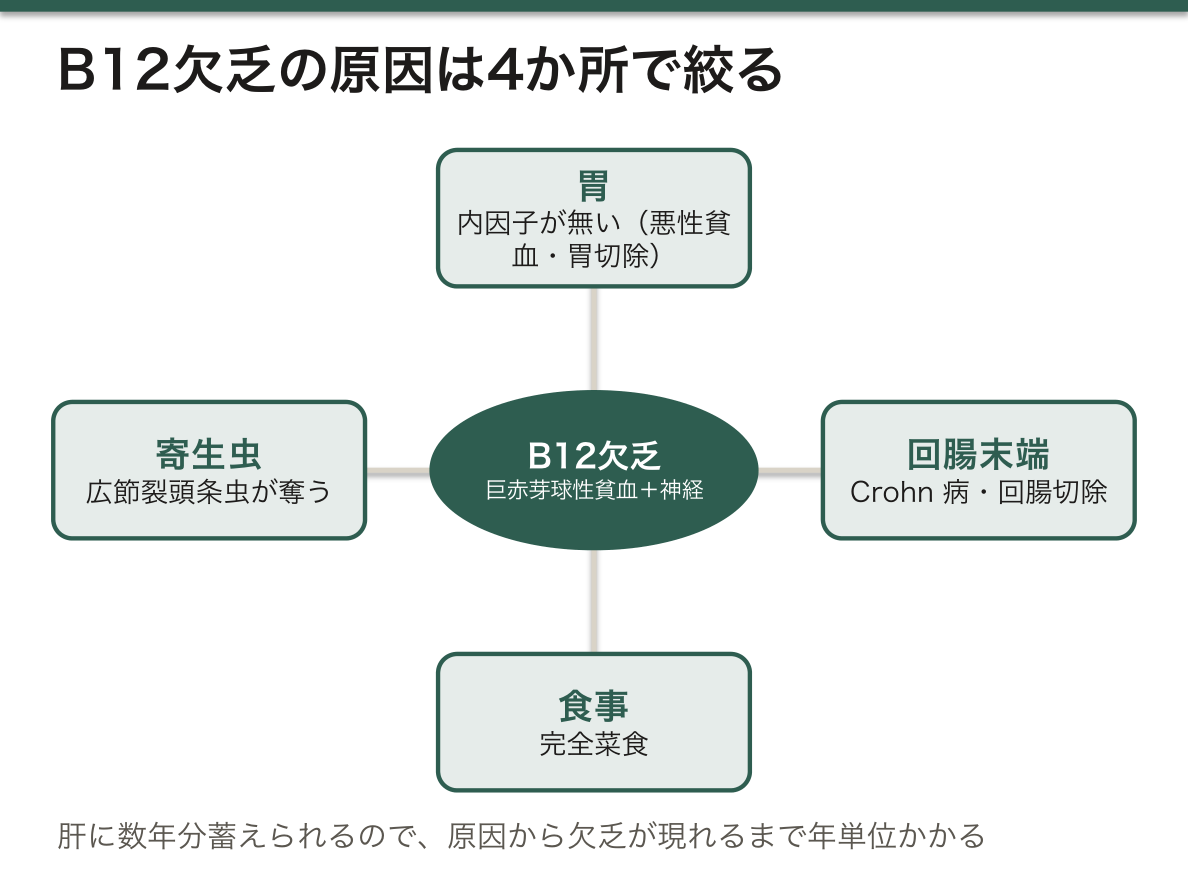
B12 だけが例外だらけなので、そこを重点的に押さえる。
- 肝に数年分蓄えられる——水溶性なのに欠乏が現れるまで年単位かかる
- 吸収に胃の内因子が要る——胃全摘・悪性貧血(自己免疫性萎縮性胃炎)で欠乏
- 吸収部位は回腸末端——Crohn 病・回腸切除で欠乏
- 動物性食品にしか無い——完全菜食で欠乏
- 広節裂頭条虫が奪う
「胃・回腸・食事・寄生虫」の4点で原因が絞れる。Schilling 試験はこの吸収経路のどこで止まっているかを調べる検査だった。
B3 ナイアシンはトリプトファンから作れるため、トリプトファンが足りない状況で欠乏する——Hartnup 病(吸収障害)、カルチノイド症候群(セロトニン合成に消費)、そしてイソニアジド(B6を消費し、トリプトファン→ナイアシンの変換にもB6が要る)。「ペラグラを見たら食事だけでなくこの3つを思い出す」。
English version
Core
- B1 thiamine — PDH, α-KGDH, transketolase. Deficiency = beriberi (heart failure, peripheral neuropathy), Wernicke’s encephalopathy, Korsakoff syndrome.
- B2 riboflavin — FAD/FMN. Deficiency = angular stomatitis, glossitis, seborrhoeic dermatitis.
- B3 niacin — NAD/NADP. Can be made from tryptophan. Deficiency = pellagra (dermatitis, diarrhoea, dementia).
- B5 pantothenate — CoA. Deficiency rare.
- B6 pyridoxine — transamination, ALA synthesis, GABA synthesis. Deficiency = peripheral neuropathy, seizures, sideroblastic anaemia.
- B7 biotin — the carboxylases (pyruvate carboxylase, acetyl-CoA carboxylase).
- B9 folate — one-carbon units. Deficiency = megaloblastic anaemia, fetal neural tube defects.
- B12 cobalamin — methionine synthase, methylmalonyl-CoA mutase. Deficiency = megaloblastic anaemia plus neurological disease.
Going further
B12 is the exception at every point, so concentrate there.
- Years’ worth is stored in the liver — water-soluble, yet deficiency takes years to appear.
- Absorption requires gastric intrinsic factor — deficiency after gastrectomy and in pernicious anaemia (autoimmune atrophic gastritis).
- It is absorbed in the terminal ileum — deficiency in Crohn’s disease and after ileal resection.
- It occurs only in animal foods — deficiency in a strict vegan diet.
- The fish tapeworm Diphyllobothrium takes it.
The cause can be narrowed by four points: stomach, ileum, diet, parasite. The Schilling test was designed to find where along that route the absorption stopped.
Niacin can be made from tryptophan, so deficiency occurs where tryptophan is short — Hartnup disease (malabsorption), carcinoid syndrome (consumed in serotonin synthesis), and isoniazid (which consumes B6, and B6 is needed for the conversion of tryptophan to niacin). On seeing pellagra, think not only of the diet but of these three.
脂溶性ビタミン A・D・E・K
- A レチノール——視覚(レチナール)・上皮の分化・免疫。欠乏=夜盲症・眼球乾燥症・Bitot斑。過剰=頭蓋内圧亢進・肝障害・催奇形性
- D——Ca・P の吸収。欠乏=くる病(小児)・骨軟化症(成人)。過剰=高Ca血症・腎結石
- E トコフェロール——抗酸化(膜脂質を守る)。欠乏=溶血性貧血・脊髄小脳失調
- K——凝固因子 II・VII・IX・X とプロテインC・S のγ-カルボキシル化。欠乏=出血傾向・PT延長
いずれも吸収に胆汁酸とミセルが要る。
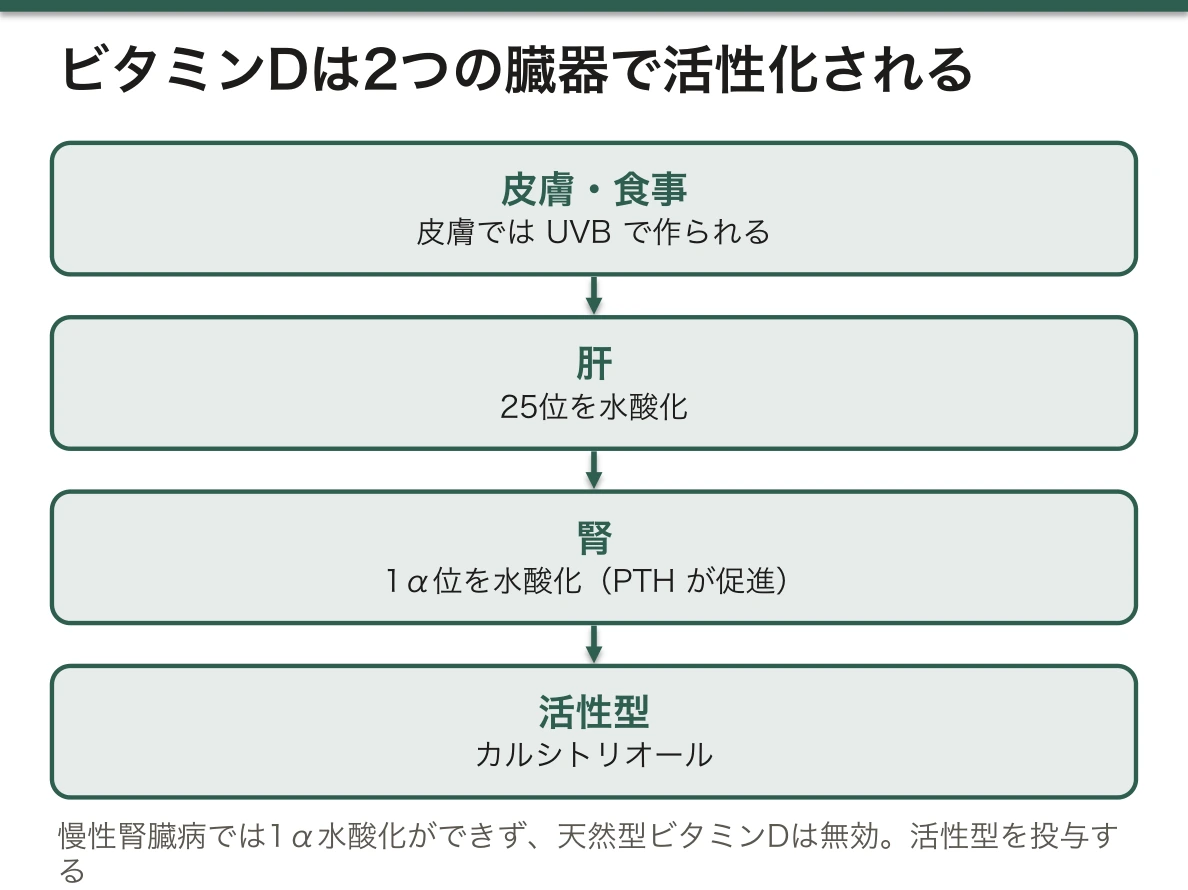
ビタミンD の活性化は2臓器を経る——皮膚(UVB)または食事 → 肝で25位水酸化 → 腎で1α位水酸化(PTHが促進)→ 活性型(カルシトリオール)。
だからどこが壊れたかで欠乏の型が変わる。慢性腎臓病では1α水酸化ができず、低Ca → PTH上昇 → 二次性副甲状腺機能亢進症 → 線維性骨炎という連鎖(CKD-MBD)が起きる。この場合天然型ビタミンDでは無効で、活性型を投与する必要がある——代謝の段階を知らないと治療を誤る。
ビタミンK は臨床上とくに重要である。
- 新生児出血症——胎盤通過が悪く、母乳に少なく、腸内細菌叢が未熟。だから出生時にビタミンK₂シロップを投与する
- ワルファリン——ビタミンKエポキシド還元酵素を阻害。半減期の短い第VII因子から先に落ちるので、PT(外因系)が先に延長する
- ワルファリン開始直後はプロテインC/S も先に落ちるため一過性に凝固に傾き、皮膚壊死を起こしうる(ヘパリンとの重複投与が要る理由)
脂肪吸収障害では A・D・E・K がまとめて欠乏する——閉塞性黄疸・慢性膵炎・嚢胞性線維症・短腸症候群で必ず思い出す。
English version
Core
- A retinol — vision (retinal), epithelial differentiation, immunity. Deficiency = night blindness, xerophthalmia, Bitot’s spots. Excess = raised intracranial pressure, hepatic injury, teratogenicity.
- D — absorption of Ca and P. Deficiency = rickets (child), osteomalacia (adult). Excess = hypercalcaemia, renal stones.
- E tocopherol — antioxidant (protects membrane lipid). Deficiency = haemolytic anaemia, spinocerebellar ataxia.
- K — γ-carboxylation of factors II, VII, IX, X and of proteins C and S. Deficiency = bleeding, prolonged PT.
All require bile acids and micelles for absorption.
Going further
The activation of vitamin D passes through two organs — skin (UVB) or diet → 25-hydroxylation in the liver → 1α-hydroxylation in the kidney (promoted by PTH) → the active form (calcitriol). So the type of deficiency depends on where the break is.
In chronic kidney disease 1α-hydroxylation fails, and the chain of low calcium → raised PTH → secondary hyperparathyroidism → osteitis fibrosa (CKD-MBD) follows. Native vitamin D is ineffective here and the active form must be given — not knowing the stages of the metabolism leads to the wrong treatment.
Vitamin K is especially important clinically.
- Haemorrhagic disease of the newborn — it crosses the placenta poorly, breast milk contains little, and the gut flora is immature. Hence vitamin K₂ syrup at birth.
- Warfarin — inhibits vitamin K epoxide reductase. Factor VII, with the shortest half-life, falls first, so the PT (extrinsic) is prolonged first.
- Just after warfarin is started, proteins C and S also fall first, so there is a transient prothrombotic state and skin necrosis can occur (the reason for overlapping with heparin).
In fat malabsorption A, D, E and K are deficient together — always think of it in obstructive jaundice, chronic pancreatitis, cystic fibrosis and short bowel syndrome.
ヘムとビリルビン — 作る道と壊す道
合成——ミトコンドリアで スクシニルCoA + グリシン から始まる。律速は ALA合成酵素(ビタミンB6 要求、ヘムによるフィードバック阻害)。細胞質とミトコンドリアを行き来して完成する。
分解——老化赤血球が脾で壊され、ヘム →(ヘムオキシゲナーゼ)→ ビリベルジン → 間接ビリルビン(非抱合型)。
- 間接型——水に溶けずアルブミンと結合して運ばれる。尿に出ない
- 肝で UDP-グルクロン酸転移酵素 がグルクロン酸を付ける → 直接ビリルビン(抱合型)
- 直接型——水溶性。胆汁へ排泄され、尿にも出る
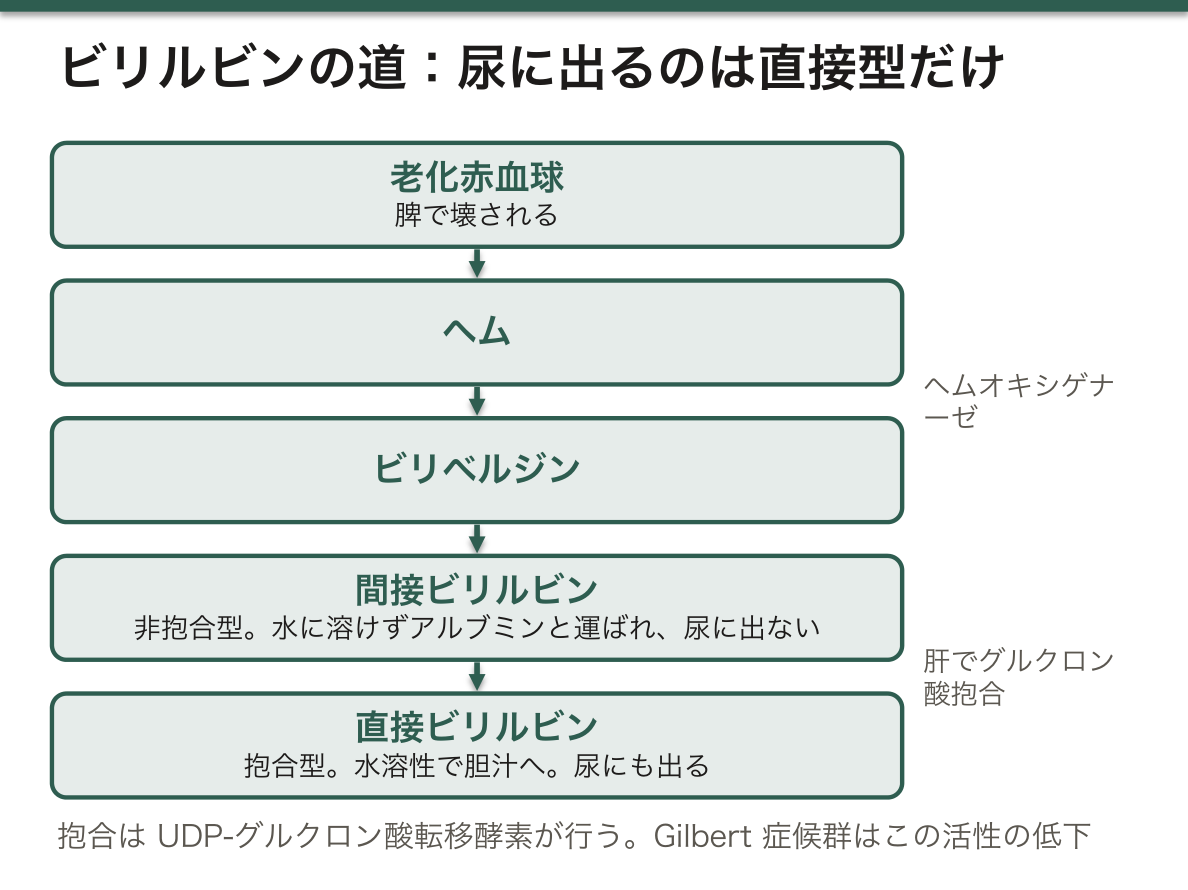
「尿に出るのは直接型だけ」——この一点で黄疸の場所が絞れる。
- 間接型優位+尿ビリルビン陰性——肝前性(溶血)または抱合の障害。溶血なら尿ウロビリノゲンは増加
- 直接型優位+尿ビリルビン陽性——肝細胞性または肝後性(閉塞)。完全閉塞なら腸へ胆汁が行かず灰白色便・尿ウロビリノゲン消失
体質性黄疸も酵素の理解で並ぶ。Gilbert 症候群(グルクロン酸転移酵素の活性低下、健常者の数%。絶食・ストレスで軽度の間接型高ビリルビン血症、無害)、Crigler-Najjar I型(同酵素の完全欠損、核黄疸で致死的)、Dubin-Johnson 症候群(排泄障害、直接型上昇、肝が黒い)。
新生児黄疸は複数の理由が重なる——酵素が未熟、赤血球寿命が短い、腸肝循環が盛ん。光線療法は間接ビリルビンを異性化して水溶性に変え、抱合を経ずに排泄させる治療である。危険なのは核黄疸で、間接型は脂溶性ゆえ血液脳関門を越えて基底核に沈着する——「なぜ間接型だけが脳を侵すのか」の答えは溶解性にある。
急性間欠性ポルフィリン症——ポルホビリノゲンデアミナーゼの欠損。ヘムが不足するとALA合成酵素のフィードバック阻害が外れて暴走し、前駆物質(ALA・ポルホビリノゲン)が蓄積する。激しい腹痛・精神症状・末梢神経障害という「説明のつかない腹痛」の代表で、皮膚症状は出ない(皮膚症状が出るのはポルフィリン環まで進む晩発性皮膚ポルフィリン症)。
誘因はCYP を誘導する薬(バルビツール酸・フェニトイン・リファンピシン)・飲酒・絶食・感染——いずれも肝がヘムを消費して不足させる。治療はヘム製剤とブドウ糖でALA合成酵素を抑えること。「暴走している律速酵素を、産物を与えて止める」という論理そのものが治療になっている。
English version
Core
Synthesis — begins in the mitochondrion from succinyl-CoA + glycine. Rate-limiting: ALA synthase (requiring B6, feedback-inhibited by haem). It shuttles between cytosol and mitochondrion to completion.
Breakdown — aged red cells are destroyed in the spleen: haem → (haem oxygenase) → biliverdin → unconjugated (indirect) bilirubin.
- Indirect — insoluble in water, carried bound to albumin. Does not appear in the urine.
- In the liver UDP-glucuronosyltransferase adds glucuronic acid → conjugated (direct) bilirubin.
- Direct — water-soluble. Excreted in bile and appears in the urine.
Going further
"Only the direct form appears in the urine" — with that one point the site of a jaundice is narrowed.
- Indirect predominant with no urinary bilirubin — prehepatic (haemolysis) or a defect of conjugation. In haemolysis the urinary urobilinogen is increased.
- Direct predominant with urinary bilirubin — hepatocellular or posthepatic (obstruction). In complete obstruction no bile reaches the gut: pale stools and no urinary urobilinogen.
The constitutional jaundices line up by the same understanding of the enzymes. Gilbert’s syndrome (reduced activity of the transferase; a few per cent of healthy people; mild unconjugated hyperbilirubinaemia on fasting or stress; harmless), Crigler–Najjar type I (complete absence of the same enzyme; fatal kernicterus), Dubin–Johnson syndrome (a defect of excretion; raised direct bilirubin; a black liver).
Neonatal jaundice has several overlapping reasons — the enzyme is immature, the red cell lifespan is short, and the enterohepatic circulation is active. Phototherapy isomerises the unconjugated bilirubin to a water-soluble form so that it can be excreted without conjugation.
The danger is kernicterus: being lipid-soluble, the indirect form crosses the blood–brain barrier and deposits in the basal ganglia. The answer to "why does only the indirect form damage the brain?" is solubility.
In the clinic
Acute intermittent porphyria — deficiency of porphobilinogen deaminase. When haem runs short the feedback inhibition of ALA synthase is released, it runs away, and the precursors (ALA, porphobilinogen) accumulate.
Severe abdominal pain, psychiatric symptoms and peripheral neuropathy — the classic "unexplained abdominal pain". There are no skin symptoms (they appear in porphyria cutanea tarda, in which the pathway proceeds as far as the porphyrin ring).
The triggers are drugs that induce CYP (barbiturates, phenytoin, rifampicin), alcohol, fasting and infection — all of which make the liver consume haem and run short.
The treatment is haem preparations and glucose, to suppress ALA synthase. The logic itself — stop a runaway rate-limiting enzyme by supplying its product — is the treatment.
ビタミンB12と葉酸 — 同じ血算になるのに、対応が違う
どちらも DNA 合成に必要で、欠乏すると巨赤芽球性貧血になる。
交わる場所は1つ——ホモシステイン → メチオニン の反応。メチルテトラヒドロ葉酸がメチル基を渡し、B12(メチルコバラミン)が受け渡しを仲介する。
B12 にしかできない反応がもう1つある——メチルマロニル CoA → スクシニル CoA(アデノシルコバラミン)。
| ビタミンB12 | 葉酸 | |
|---|---|---|
| 体内の貯蔵 | 3〜5 年 | 数か月 |
| 吸収 | 内因子と結合し回腸末端で | 空腸で |
| ホモシステイン | 上がる | 上がる |
| メチルマロン酸 | 上がる | 上がらない |
| 神経症状 | 出る(亜急性連合性脊髄変性症) | 出ない |
「メチルマロン酸が上がるかどうか」が、2つを分ける唯一確実な指標になる。B12 だけが関わる反応が、体内に1つ残されている(ホモシステインの章)——「共通の指標では分けられないので、片方にしか無い反応を見る」。
そして神経症状の有無が、臨床上いちばん重い違いになる。葉酸だけを補うと、血算は改善するのに神経障害だけが進む(貧血の各論の章)——「巨赤芽球性貧血に、B12 を測らずに葉酸を出してはいけない」。
貯蔵量の差は、欠乏の出方の差になる。胃全摘後の B12 欠乏は数年してから出るが、アルコール依存や妊娠での葉酸欠乏は数か月で出る(胃を切る手術の章)——「手術と症状のあいだが空くので、結び付けにくい」。
吸収の場所を知っていると、原因が列挙できる。内因子が作れない(悪性貧血・胃切除)・回腸末端が働かない(Crohn 病・回腸切除・広節裂頭条虫)(炎症性腸疾患の章)——「1つの経路の、どの駅で止まったかを聞く」。
葉酸は妊娠前から必要になる。神経管の閉鎖は受胎後 4 週までに終わるので、妊娠が分かってからでは間に合わない(妊娠前からの医療の章)——「妊娠を計画する時点で始める、という指導の根拠になる」。
English version
Core
Both are needed for DNA synthesis, and deficiency of either gives a megaloblastic anaemia. They meet at one place — the reaction homocysteine → methionine. Methyl-THF hands over the methyl group and B12 (methylcobalamin) mediates the transfer.
B12 has one further reaction of its own — methylmalonyl-CoA → succinyl-CoA (adenosylcobalamin).
| Vitamin B12 | Folate | |
|---|---|---|
| Body store | 3–5 years | Some months |
| Absorption | Bound to intrinsic factor, in the terminal ileum | In the jejunum |
| Homocysteine | Rises | Rises |
| Methylmalonic acid | Rises | Does not rise |
| Neurological disease | Yes (subacute combined degeneration) | No |
Going further
Whether the methylmalonic acid rises is the only certain way of separating the two — one reaction involving B12 alone remains in the body, so where the common index cannot separate them, look at the reaction only one of them has.
And the presence or absence of neurological disease is the clinically weightiest difference. Supply folate alone and the blood count improves while the neuropathy alone advances — never prescribe folate for a megaloblastic anaemia without measuring B12.
The difference in stores is the difference in how the deficiency appears. B12 deficiency after gastrectomy appears years later, whereas folate deficiency in alcohol dependence or pregnancy appears within months — the gap between the operation and the symptom makes them hard to connect.
Know where they are absorbed and the causes can be listed: no intrinsic factor (pernicious anaemia, gastrectomy); a terminal ileum that does not work (Crohn’s disease, ileal resection, Diphyllobothrium) — ask at which station of one route it stopped.
Folate is needed from before pregnancy. The neural tube closes by four weeks after conception, so starting when the pregnancy is known is too late — the basis for advising it from the time a pregnancy is planned.
ビタミンCと銅 — コラーゲンが作れないということ
コラーゲンは、作られた後の修飾がなければ機能しない。
- プロリンとリジンの水酸化——ビタミンC が補因子(鉄を還元して保つ)。水酸化されないと三重らせんが安定せず、分解される
- リジンの酸化的脱アミノ化による架橋——リシルオキシダーゼが行う。銅を必要とする
ビタミンC欠乏=壊血病——毛包周囲の点状出血・らせん状の体毛・歯肉出血・創が治らない・骨形成の障害。
銅欠乏——貧血(鉄剤に反応しない)・好中球減少・骨の異常・神経症状。
ビタミンC はもう1つ働きがある——非ヘム鉄を三価から二価へ還元し、吸収を助ける。
壊血病の症状は、すべて「血管と結合組織が弱い」の一言で導ける。血管の壁が支えられないので出血し、創が塞がらず、骨も作れない(細胞外基質の章)——「症状を覚えるのではなく、1つの分子の欠陥から並べる」。
出血が毛包の周りに出ることには理由がある。毛包を囲む毛細血管が最も支えを必要とするので、そこから漏れる(皮膚から全身を読む章)——「らせん状の体毛と点状出血が並ぶ像が、そのまま診断になる」。
銅の欠乏は、意外な場面で起こる。亜鉛の過剰摂取が腸のメタロチオネインを誘導し、銅の吸収を妨げる(微量元素の章)——「良かれと思って続けた亜鉛が、貧血と歩行障害を作ることがある」。
だから鉄剤に反応しない貧血と好中球減少が並んだら、銅を測る(貧血の各論の章)——「長期の経腸栄養・胃切除後・亜鉛の常用が背景にある」。
Menkes 病は、銅の輸送体(ATP7A)の異常になる。捻れた毛髪・進行性の神経障害・血管の蛇行が、リシルオキシダーゼが働かないことで説明できる(Wilson 病の項)——「同じ元素で、溜まる病気と足りない病気が対になっている」。
English version
Core
Collagen does not function without modification after it is made.
- Hydroxylation of proline and lysine — vitamin C is the cofactor (keeping the iron reduced). Unhydroxylated, the triple helix is unstable and is degraded.
- Cross-linking by oxidative deamination of lysine — performed by lysyl oxidase, which requires copper.
Vitamin C deficiency = scurvy — perifollicular petechiae, corkscrew hairs, bleeding gums, wounds that will not heal, defective bone formation.
Copper deficiency — anaemia (not responsive to iron), neutropenia, bone abnormality, neurological disease.
Vitamin C has one further action — it reduces non-haem iron from ferric to ferrous and aids its absorption.
Going further
Every symptom of scurvy can be derived from the single sentence that the vessels and the connective tissue are weak. The vessel walls are unsupported and bleed, wounds do not close, and bone cannot be formed — list them from one molecular defect rather than memorising the symptoms.
There is a reason the bleeding is perifollicular: the capillaries around a follicle need the most support and leak there — corkscrew hairs beside petechiae is itself the diagnosis.
Copper deficiency occurs in unexpected circumstances. Excess zinc induces intestinal metallothionein and blocks copper absorption — zinc taken with the best of intentions can produce anaemia and difficulty in walking.
So when an anaemia unresponsive to iron is accompanied by neutropenia, measure the copper — long-term enteral feeding, previous gastrectomy or habitual zinc are the background.
Menkes disease is a defect of the copper transporter (ATP7A). Kinky hair, progressive neurological disease and tortuous vessels are explained by lysyl oxidase not working — with the same element, a disease of accumulation and a disease of shortage make a pair.
まとめ
| 水溶性ビタミン B群 — どの反応を支えているか | B1 チアミン——PDH・α-KGDH・トランスケトラーゼ。 |
|---|---|
| 脂溶性ビタミン A・D・E・K | A レチノール——視覚(レチナール)・上皮の分化・免疫。 |
| ヘムとビリルビン — 作る道と壊す道 | 合成——ミトコンドリアで スクシニルCoA + グリシン から始まる。 |
| ビタミンB12と葉酸 — 同じ血算になるのに、対応が違う | どちらも DNA 合成に必要で、欠乏すると巨赤芽球性貧血になる。 |
| ビタミンCと銅 — コラーゲンが作れないということ | コラーゲンは、作られた後の修飾がなければ機能しない。 |
このノートは医学生が授業の内容を自分の言葉でまとめたもので、診療の判断に使うものではありません。誤りに気づいたらお知らせください。