コレステロールはヒトの体で分解できない。炭素骨格を二酸化炭素まで燃やす酵素が無いからである。だから体は作り変えて捨てるか、そのまま胆汁へ出すしかない。
作り変えた先が3つある——胆汁酸・ステロイドホルモン・ビタミンD。いずれも生存に必須で、コレステロールが「悪玉」なのではなく、多すぎることだけが問題だという事実がここから分かる。
- 胆汁酸 — 唯一の大量廃棄路であり、洗剤である
- ステロイドとビタミンD — 同じ骨格から、まったく違う仕事へ
- コレステロール合成とスタチン — 律速酵素を止めるということ
- コレステロールの吸収 — もう1つの入口を止める
- HDL を上げる薬は、なぜ効かなかったのか
- コレステロールの酸化物が、合成を止める信号になっている
胆汁酸 — 唯一の大量廃棄路であり、洗剤である
一次胆汁酸:肝でコレステロールから合成。コール酸とケノデオキシコール酸。律速酵素はコレステロール7αヒドロキシラーゼ。
抱合:グリシンまたはタウリンと結合し、水溶性が上がる。
二次胆汁酸:腸内細菌が脱抱合・脱水酸化してデオキシコール酸・リトコール酸に変える。
腸肝循環:回腸末端で約95%が再吸収され、門脈から肝へ戻る。1日に数回まわる。
- 回腸末端の切除やCrohn病では胆汁酸が失われる → 脂肪吸収障害と胆汁酸性下痢
- 再吸収された胆汁酸は核内受容体FXRを介して自分の合成を抑える(負のフィードバック)
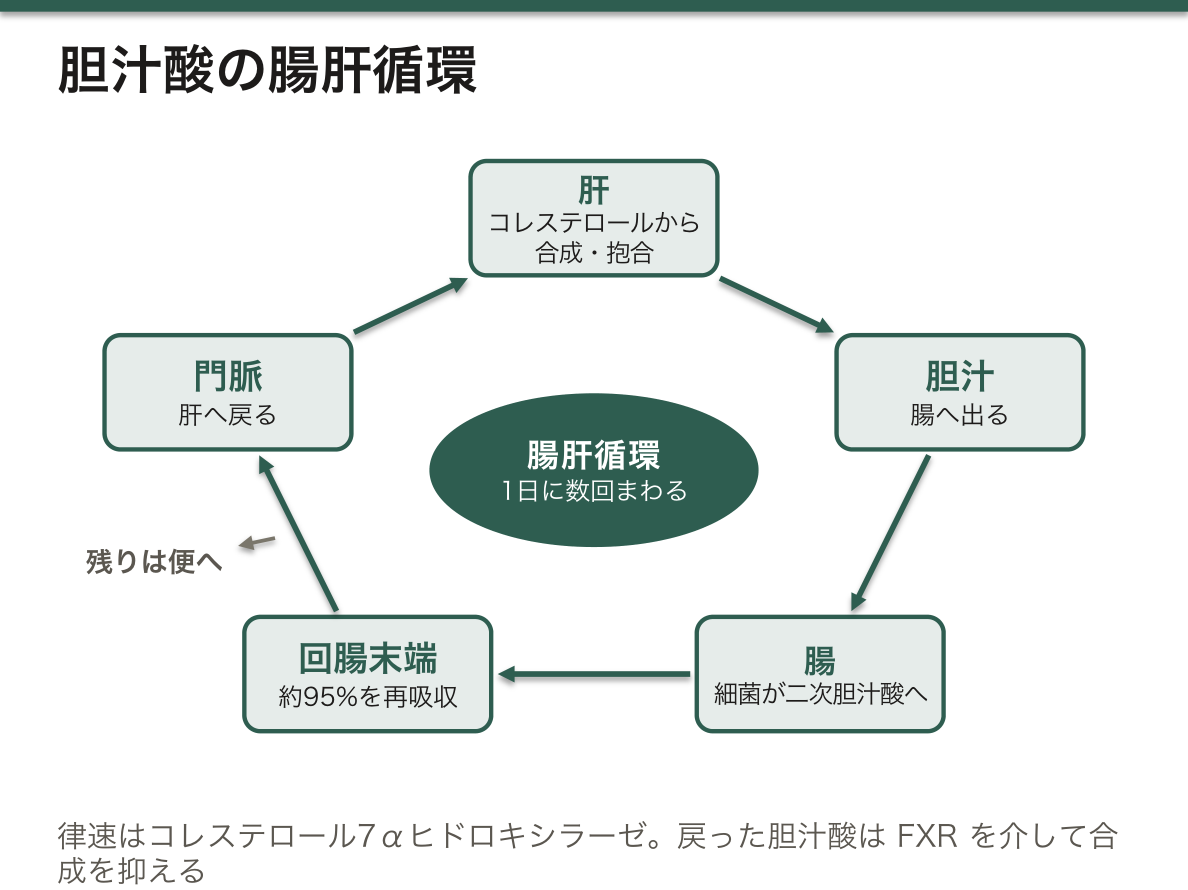
陰イオン交換樹脂(コレスチラミン)がコレステロールを下げる理屈は、この循環を断つことにある。腸で胆汁酸を捕まえて便へ出すと、肝は失った分を作り直さねばならず、材料としてコレステロールを消費する。細胞内コレステロールが減ればLDL受容体が増え、血中から取り込む——結果として低比重リポ蛋白が下がる。スタチンとは入り口が違うが、行き着く機序は同じである。
回腸末端が特別である理由も押さえる。胆汁酸の再吸収は能動輸送で、回腸末端にしかない。ビタミンB12の吸収も同じ場所である。だから回腸末端の病変では、脂溶性ビタミンの吸収障害とビタミンB12欠乏が同時に起きうる——Crohn病の栄養管理で必ず問われる点である。
切除の長さで下痢の型が変わる。
- 短い切除——胆汁酸が大腸へ流れ込み、大腸を刺激する(胆汁酸性下痢)。コレスチラミンが効く
- 長い切除——胆汁酸プールそのものが枯れ、脂肪が消化できず脂肪性下痢になる。コレスチラミンはかえって悪化させる
同じ「切除後の下痢」でも治療が正反対になる。機序を知らずに薬を選べない典型例である。
English version
Core
Primary bile acids: synthesised in the liver from cholesterol. Cholic acid and chenodeoxycholic acid. The rate-limiting enzyme is cholesterol 7α-hydroxylase.
Conjugation: bound to glycine or taurine, raising their water solubility.
Secondary bile acids: gut bacteria deconjugate and dehydroxylate them into deoxycholic and lithocholic acid.
The enterohepatic circulation: about 95 per cent is reabsorbed in the terminal ileum and returns to the liver by the portal vein. It goes round several times a day.
- With resection of the terminal ileum or in Crohn’s disease, bile acids are lost → fat malabsorption and bile acid diarrhoea.
- Reabsorbed bile acid suppresses its own synthesis through the nuclear receptor FXR (negative feedback).
Going further
The reasoning by which an anion exchange resin (cholestyramine) lowers cholesterol lies in cutting this circulation. Trap the bile acids in the gut and pass them into the stool, and the liver must remake what it has lost, consuming cholesterol as material. As intracellular cholesterol falls, LDL receptors increase and take it up from the blood — the low-density lipoprotein falls as a result. The entrance differs from that of a statin, but the mechanism arrived at is the same.
Why the terminal ileum is special should be held too. Reabsorption of bile acid is by active transport and exists only in the terminal ileum. The absorption of vitamin B12 is in the same place. So a lesion of the terminal ileum can give malabsorption of the fat-soluble vitamins and vitamin B12 deficiency at once — a point always asked in the nutritional management of Crohn’s disease.
The type of diarrhoea changes with the length resected.
- A short resection — bile acids flow into the colon and irritate it (bile acid diarrhoea). Cholestyramine works.
- A long resection — the bile acid pool itself is exhausted and fat cannot be digested, giving steatorrhoea. Cholestyramine makes it worse.
With the same "diarrhoea after resection", the treatments are opposite. The classic case in which the drug cannot be chosen without knowing the mechanism.
ステロイドとビタミンD — 同じ骨格から、まったく違う仕事へ
ステロイドホルモンの出発点はすべて同じである。コレステロール →(側鎖切断酵素)→ プレグネノロン。ここが律速で、副腎皮質刺激ホルモンが促進する。以後は樹形図のように分かれる(ステロイド合成の章)。
ビタミンDは2回水酸化されて初めて働く。
- 皮膚:7デヒドロコレステロール →(紫外線)→ ビタミンD₃
- 肝:25位を水酸化 → 25ヒドロキシビタミンD(貯蔵型。体内量の指標はこれ)
- 腎:1α位を水酸化 → 1,25ジヒドロキシビタミンD(活性型)。副甲状腺ホルモンが促進、線維芽細胞増殖因子23が抑制
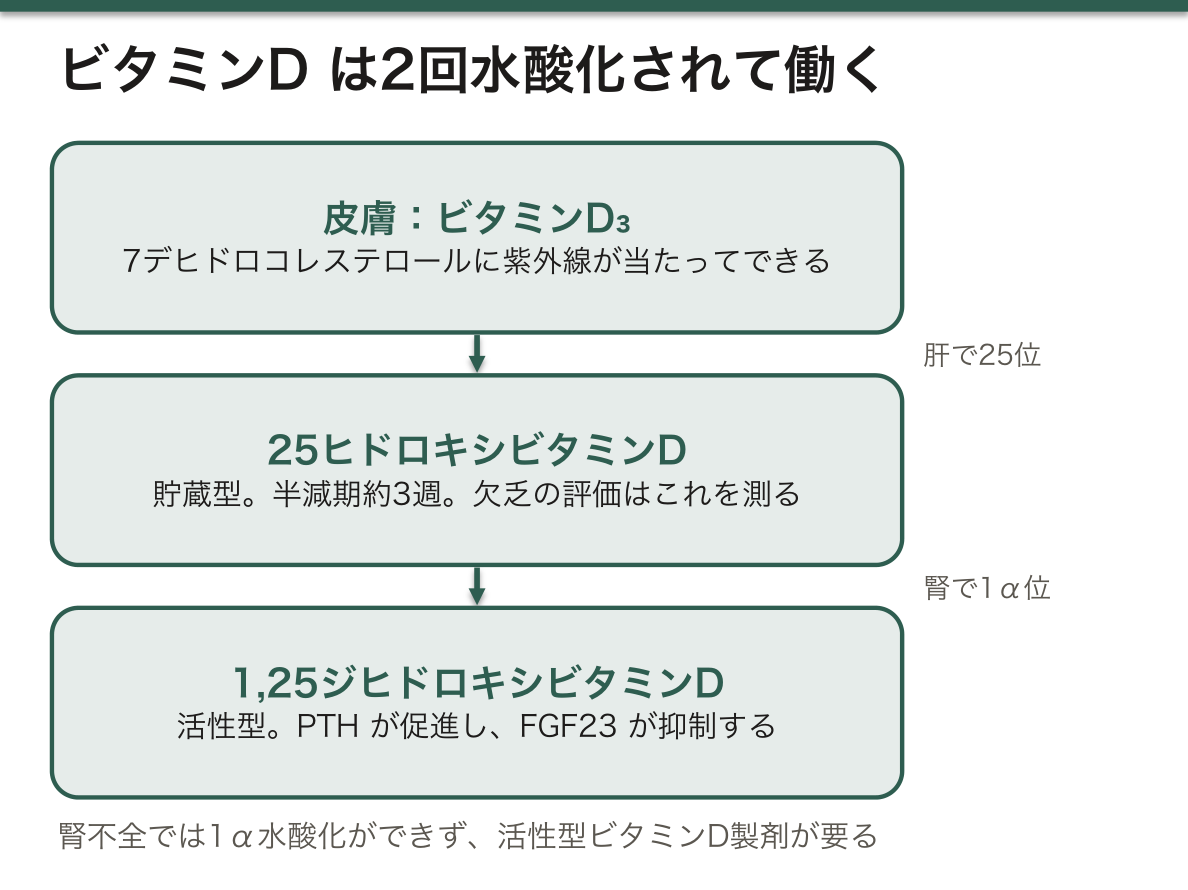
測るのは25位、効くのは1,25位——この使い分けが臨床で頻繁に問われる。
- ビタミンD欠乏の評価には25ヒドロキシビタミンDを測る。半減期が長く(約3週)、量を反映する
- 1,25ジヒドロキシビタミンDは欠乏していても正常〜高値になりうる。副甲状腺ホルモンが上がって1α水酸化を押し上げるからで、これを測ると欠乏を見逃す
1α水酸化酵素が腎にあることが、腎不全の病態を決めている。慢性腎臓病では活性型ビタミンDが作れず、腸からのカルシウム吸収が落ちる。低カルシウム血症が副甲状腺ホルモンを押し上げ、二次性副甲状腺機能亢進症となり、骨から動員される。だから腎不全では活性型ビタミンD製剤を使う——普通のビタミンDを与えても、1α水酸化できないので効かない。
例外として、1α水酸化酵素はマクロファージにもある。だからサルコイドーシス・結核・悪性リンパ腫では、肉芽腫のマクロファージが勝手に活性型を作って高カルシウム血症を起こす。副甲状腺ホルモンが抑制されているのに高カルシウム血症という組み合わせを見たら、この機序を思い出す。
English version
Core
The steroid hormones all have the same starting point. Cholesterol → (side-chain cleavage enzyme) → pregnenolone. This is rate-limiting and ACTH promotes it. Beyond it the paths branch like a tree (the chapter on steroid synthesis).
Vitamin D works only after two hydroxylations.
- Skin: 7-dehydrocholesterol → (ultraviolet light) → vitamin D₃
- Liver: hydroxylation at position 25 → 25-hydroxyvitamin D (the storage form. This is the index of body stores)
- Kidney: hydroxylation at 1α → 1,25-dihydroxyvitamin D (the active form). Promoted by parathyroid hormone, suppressed by fibroblast growth factor 23.
Going further
Measure the 25, act with the 1,25 — this distinction is asked constantly in practice.
- To assess vitamin D deficiency, measure 25-hydroxyvitamin D. Its half-life is long (about three weeks) and it reflects the amount.
- 1,25-Dihydroxyvitamin D can be normal or high even in deficiency. Parathyroid hormone rises and drives the 1α-hydroxylation, so measuring it misses the deficiency.
That the 1α-hydroxylase is in the kidney determines the disease of renal failure. In chronic kidney disease the active vitamin D cannot be made and calcium absorption from the gut falls. Hypocalcaemia drives up the parathyroid hormone, giving secondary hyperparathyroidism, and calcium is mobilised from bone. Hence active vitamin D preparations are used in renal failure — giving plain vitamin D does not work, because it cannot be 1α-hydroxylated.
As an exception, the 1α-hydroxylase is also present in macrophages. So in sarcoidosis, tuberculosis and malignant lymphoma the macrophages of the granuloma make the active form on their own and cause hypercalcaemia. Seeing the combination of hypercalcaemia with a suppressed parathyroid hormone, recall this mechanism.
コレステロール合成とスタチン — 律速酵素を止めるということ
アセチルCoA から、約30段階を経て作られる。律速は HMG-CoA 還元酵素。
経路の途中で、コレステロール以外のものも分岐して作られる——ユビキノン(コエンザイムQ10)・ドリコール・イソプレノイド(蛋白のプレニル化に使う)。
合成は主に肝で、夜間に多い——だから半減期の短いスタチンは就寝前に飲む。
スタチンの本当の効き方は、合成を止めることではない——肝細胞内のコレステロールが減る → SREBP-2 が活性化 → LDL 受容体が増える → 血中の LDL を取り込む。
副作用——筋症状(筋痛・CK 上昇・横紋筋融解症)・肝逸脱酵素の上昇・血糖の上昇。
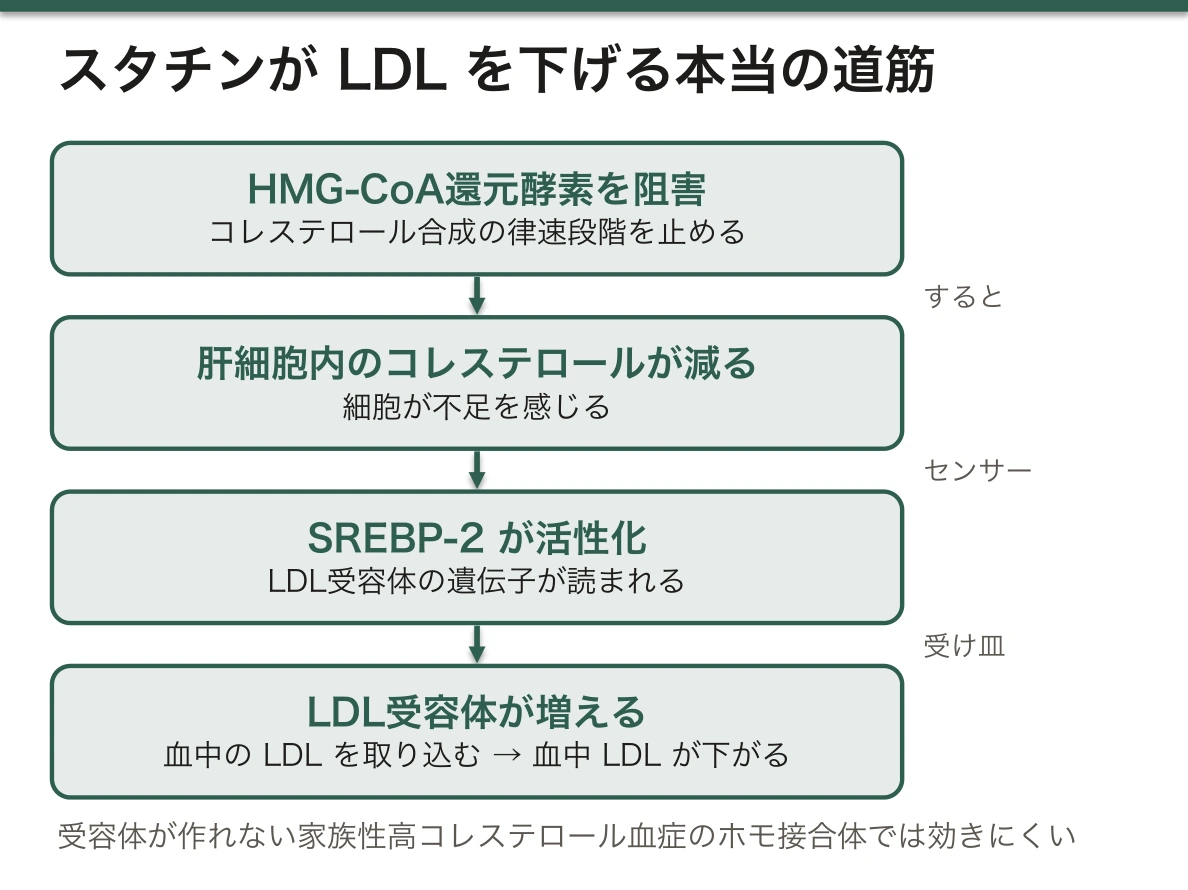
「合成を止める薬なのに、効果は受容体の増加で出る」という二段構えが、この薬の要点になる。だから受容体が作れない病態では効きが悪い(リポ蛋白代謝の章)——「家族性高コレステロール血症のホモ接合体では、スタチンが十分に効かない」。
PCSK9 阻害薬は、同じ受容体を別の側から増やす。PCSK9 は LDL 受容体を分解へ導く蛋白で、それを止めれば受容体が長持ちする(分子標的薬の章)——「作らせるのではなく、壊させないという発想になる」。
分岐路が減ることが、副作用の説明の一つになっている。ユビキノンの低下や、蛋白のプレニル化の減少が筋症状に関わるという説がある(電子伝達系の章)——「本流を止めると、支流も細くなる」。
筋症状は、相互作用で強くなる(相互作用の章)——「フィブラート・マクロライド・アゾール系抗真菌薬・グレープフルーツと組み合わせない」。
妊娠中は禁忌になる(妊婦の薬の章)——「コレステロールは細胞膜とステロイドの材料で、胎児の発生に必要になる」。
English version
Core
Made from acetyl-CoA through some thirty steps. Rate-limiting is HMG-CoA reductase.
Partway along the pathway, things other than cholesterol branch off — ubiquinone (coenzyme Q10), dolichol, isoprenoids (used for the prenylation of proteins).
Synthesis is chiefly hepatic and greatest at night — hence a statin with a short half-life is taken at bedtime.
The real way a statin works is not by stopping synthesis — cholesterol within the hepatocyte falls → SREBP-2 is activated → LDL receptors increase → LDL is taken up from the blood.
Adverse effects — muscle symptoms (myalgia, raised CK, rhabdomyolysis), raised hepatic enzymes, raised blood glucose.
Going further
- The two-stage structure — a drug that stops synthesis whose effect appears through an increase of receptors — is the crux of this drug. So it works poorly where receptors cannot be made (the chapter on lipoprotein metabolism) — in homozygous familial hypercholesterolaemia a statin does not work adequately.
- PCSK9 inhibitors increase the same receptor from another side. PCSK9 is the protein that directs the LDL receptor to degradation, and stopping it makes the receptor last (the chapter on molecularly targeted drugs) — not making more but preventing destruction.
- The narrowing of the branch paths is one explanation of the adverse effects. A fall in ubiquinone, and reduced prenylation of proteins, have been proposed as involved in the muscle symptoms (the chapter on the electron transport chain) — stop the main stream and the tributaries thin too.
- The muscle symptoms are worsened by interactions (the chapter on interactions) — do not combine with a fibrate, a macrolide, an azole antifungal or grapefruit.
- Contraindicated in pregnancy (the chapter on drugs in pregnancy) — cholesterol is the material of membranes and steroids and is needed for fetal development.
コレステロールの吸収 — もう1つの入口を止める
体内のコレステロールは、合成(約 2/3)と吸収(約 1/3)の2つから来る。
腸管でコレステロールを取り込むのは NPC1L1 という輸送体になる。エゼチミブがこれを阻害する。
取り込まれた植物ステロールは、ABCG5/G8 によって腸管腔へ押し戻される——だから植物ステロールはほとんど体内に入らない。
シトステロール血症——ABCG5/G8 の異常。植物ステロールが溜まり、若年で腱黄色腫と動脈硬化を起こす。
食事中のコレステロールの寄与は限定的で、吸収率にも大きな個人差がある。
「入口が2つある」ことが、併用療法の根拠になっている。スタチンで合成を止めると、代償的に吸収が増える。だから吸収も同時に止めると相乗する(この章のスタチンの項)——「片方を止めると、もう片方が代わりに働く」。
エゼチミブは、スタチンで目標に届かないときや、スタチンが使えないときの選択肢になる(代謝症候群の章)——「作用点が違うので、副作用も重ならない」。
植物ステロールを押し戻す仕組みがあることは、「体はコレステロールだけを選んで取り込んでいる」ことを示す(吸収の章)——「似た分子を排除する能動的な仕組みが、腸に組み込まれている」。
シトステロール血症は、家族性高コレステロール血症と紛らわしい(単一遺伝子病の章)——「治療は植物ステロールの制限とエゼチミブで、スタチンは効きにくい」。
胆汁酸を捕まえる薬も、この入口を細くしている(この章の胆汁酸の項)——「胆汁酸が無ければミセルが作れず、脂も吸えない」。
English version
Core
The cholesterol in the body comes from two sources, synthesis (about two thirds) and absorption (about one third).
What takes cholesterol up in the gut is a transporter called NPC1L1. Ezetimibe inhibits it.
Plant sterols taken up are pushed back into the lumen by ABCG5/G8 — so plant sterols scarcely enter the body.
Sitosterolaemia — an abnormality of ABCG5/G8. Plant sterols accumulate, giving tendon xanthomas and atherosclerosis at a young age.
The contribution of dietary cholesterol is limited, and the fraction absorbed varies greatly between individuals.
Going further
- That there are two entrances is the ground for combination therapy. Stop synthesis with a statin and absorption increases compensatorily. So stopping absorption at the same time is synergistic (the section on statins in this chapter) — block one and the other works in its place.
- Ezetimibe is the option when a statin does not reach the target, or when a statin cannot be used (the chapter on the metabolic syndrome) — the point of action differs, so the adverse effects do not overlap either.
- That there is machinery pushing plant sterols back shows that the body takes up cholesterol selectively (the chapter on absorption) — an active mechanism excluding similar molecules built into the gut.
- Sitosterolaemia is confusable with familial hypercholesterolaemia (the chapter on monogenic disease) — treatment is restriction of plant sterols and ezetimibe; statins work poorly.
- Drugs that trap bile acids also narrow this entrance (the section on bile acids in this chapter) — without bile acids no micelle forms and fat cannot be absorbed either.
HDL を上げる薬は、なぜ効かなかったのか
HDL コレステロールが低いことは、心血管疾患の強い独立した危険因子である。機序も説明できる——末梢からコレステロールを回収し(逆転送)、抗炎症・抗酸化作用をもつ。
だから「HDL を上げれば良い」と考えられ、薬が開発された。結果は否定的だった。
| CETP 阻害薬 | HDL が 1.3〜2 倍に上がった | イベントは減らなかった。1 剤は死亡が増えて中止された |
| ナイアシン | HDL が上がり、中性脂肪も下がった | スタチンに追加しても上乗せ効果は無く、副作用が増えた |
さらに強い証拠が遺伝学から出た。生まれつき HDL が高い遺伝子型をもつ人でも、心筋梗塞は減っていなかった(メンデル無作為化)。LDL では、同じ手法で明確に因果が示されているのと対照的である。
結論として、HDL コレステロール値は「原因」ではなく「指標」である可能性が高い。低 HDL は、インスリン抵抗性・高中性脂肪血症・内臓脂肪・喫煙・運動不足と強く結びついている。本当の危険因子はそちらで、HDL はその影を映していたという説明になる。
いま重視されているのは「量」ではなく「働き」である。コレステロール引き抜き能(HDL がどれだけ細胞からコレステロールを受け取れるか)は、HDL コレステロール値とは独立にイベントと相関するという報告がある。同じ 60 mg/dL の HDL でも、機能が違えば意味が違う。
⚠️ HDL が極端に高い(90 mg/dL 以上)ことは、むしろ予後が悪いという観察が積み重なっている。「高いほど良い」という直線的な理解は成り立たない。
臨床でどうするか。
- 治療の標的は LDL コレステロール(と、状況により中性脂肪と Lp(a))に置く
- 低 HDL は「代謝の状態が悪い」という警告として読む——薬で数値を動かすのではなく、禁煙・運動・減量で背景を変える
この一件は「代用のアウトカムを標的にすることの危うさ」の教科書的な例として、繰り返し引用されている。
健診で HDL が低い人に、HDL を上げる薬は出さない。喫煙・体重・運動・中性脂肪を見る。
English version
Core
A low HDL cholesterol is a strong independent risk factor for cardiovascular disease. The mechanism can be explained too — it collects cholesterol from the periphery (reverse transport) and has anti-inflammatory and antioxidant actions.
So it was thought that "raising HDL would be good" and drugs were developed. The results were negative.
| CETP inhibitors | HDL rose 1.3- to 2-fold | Events did not fall. One agent was stopped because mortality increased |
| Niacin | HDL rose and triglyceride fell | Added to a statin there was no additional benefit and more adverse effects |
Stronger evidence came from genetics. People with a genotype giving a congenitally high HDL had no fewer myocardial infarctions (Mendelian randomisation). In contrast, for LDL the same method shows causation clearly.
Going further
The conclusion is that the HDL cholesterol value is more likely an index than a cause. A low HDL is strongly bound up with insulin resistance, hypertriglyceridaemia, visceral fat, smoking and inactivity. The explanation is that the real risk factors are those, and HDL was reflecting their shadow.
What is emphasised now is not the amount but the function. Cholesterol efflux capacity (how much cholesterol the HDL can accept from cells) is reported to correlate with events independently of the HDL cholesterol value. With the same 60 mg/dL of HDL, a different function means a different meaning.
⚠️ Observations have accumulated that an extremely high HDL (90 mg/dL or more) carries, if anything, a worse prognosis. The linear understanding "the higher the better" does not hold.
What to do in practice.
- Put the target of treatment on the LDL cholesterol (and, as the case requires, triglyceride and Lp(a)).
- Read a low HDL as a warning that the metabolic state is poor — rather than moving the number with a drug, change the background with stopping smoking, exercise and weight loss.
This episode is cited again and again as the textbook example of the danger of targeting a surrogate outcome.
In the clinic
Do not prescribe a drug to raise HDL in someone whose health check shows a low HDL. Look at smoking, weight, exercise and triglyceride.
コレステロールの酸化物が、合成を止める信号になっている
細胞はコレステロールの量をどうやって知るのか。コレステロールそのものと、その酸化物(オキシステロール)を、小胞体のセンサーが読んでいる。
- 足りないとき——SREBP-2 が Golgi へ運ばれて切断され、核へ入る。HMG-CoA 還元酵素と LDL 受容体の遺伝子が読まれる(作り、かつ取り込む)
- 足りているとき——コレステロールとオキシステロールが小胞体の蛋白に結合し、SREBP-2 が動けなくなる。合成も取り込みも止まる
- 余っているとき——オキシステロールが LXR という核内受容体を活性化し、ABCA1 などの排出ポンプを増やす(外へ捨てる)
1 つの分子種が、合成・取り込み・排出の3方向を同時に制御している。
スタチンが効く理屈も、この回路で説明できる。合成を止めると細胞内のコレステロールが減り、SREBP-2 が働いて LDL 受容体が増える。血中の LDL が下がる主因は、合成の抑制そのものではなく、受け皿が増えることである。
だからスタチンは PCSK9 も増やしてしまう。PCSK9 は LDL 受容体を分解へ回す蛋白で、同じ SREBP-2 の支配下にある。効果に頭打ちが来る一因であり、PCSK9 阻害薬をスタチンに併用すると効果が大きく上乗せされるのはこのためである。
コレステロールを直接測っていないことの帰結も押さえる。
| Smith-Lemli-Opitz 症候群 | 合成経路の最終段階(7-DHC 還元酵素)の欠損 | コレステロールが作れず、前駆体の 7-DHC が溜まる。多指症・小頭症・特徴的な顔貌。コレステロールは構造材料でもあることを示す |
| 脳腱黒色腫症 | 胆汁酸合成の酵素欠損 | コレスタノールが腱と脳に溜まる。アキレス腱腫大+認知機能低下。胆汁酸の補充で進行を止められる |
コレステロールは「悪玉」ではなく、膜・ステロイド・胆汁酸・そして胎生期の形態形成(ヘッジホッグ信号の修飾)に必須の分子である。足りないことも病気になるという視点を持っておく。
アキレス腱が太い患者を見たら、家族性高コレステロール血症と脳腱黒色腫症の両方を思い出す。後者は治療で進行を止められる。
English version
Core
How does the cell know how much cholesterol it has? Sensors in the endoplasmic reticulum read cholesterol itself and its oxidation products (oxysterols).
- When it is short — SREBP-2 is carried to the Golgi, cleaved and enters the nucleus. The genes for HMG-CoA reductase and the LDL receptor are read (make it, and take it in).
- When there is enough — cholesterol and oxysterols bind proteins of the endoplasmic reticulum and SREBP-2 can no longer move. Both synthesis and uptake stop.
- When there is a surplus — oxysterols activate a nuclear receptor called LXR and increase efflux pumps such as ABCA1 (discard it outwards).
One kind of molecule controls all three directions — synthesis, uptake and efflux — at once.
Going further
The reasoning by which a statin works is explained on this circuit too. Stop synthesis and the intracellular cholesterol falls, SREBP-2 acts and LDL receptors increase. The chief reason the blood LDL falls is not the suppression of synthesis itself but the increase in receptacles.
So a statin also increases PCSK9. PCSK9, the protein that sends the LDL receptor to degradation, is under the same SREBP-2. It is one reason the effect reaches a ceiling, and why adding a PCSK9 inhibitor to a statin gives a large additional effect.
Note the consequences of not measuring cholesterol directly.
| Smith–Lemli–Opitz syndrome | Deficiency of the last step of synthesis (7-DHC reductase) | Cholesterol cannot be made and the precursor 7-DHC accumulates. Polydactyly, microcephaly, a characteristic face. It shows that cholesterol is also a structural material |
| Cerebrotendinous xanthomatosis | Deficiency of an enzyme of bile acid synthesis | Cholestanol accumulates in tendon and brain. Thickened Achilles tendon plus cognitive decline. Progression can be halted by supplying bile acid |
Cholesterol is not a "villain" but a molecule essential to membranes, steroids, bile acids and the morphogenesis of embryonic life (modification of hedgehog signalling). Hold the view that having too little of it is also a disease.
In the clinic
Seeing a patient with a thick Achilles tendon, recall both familial hypercholesterolaemia and cerebrotendinous xanthomatosis. The latter can be halted by treatment.
まとめ
| 胆汁酸 — 唯一の大量廃棄路であり、洗剤である | 一次胆汁酸:肝でコレステロールから合成。 |
|---|---|
| ステロイドとビタミンD — 同じ骨格から、まったく違う仕事へ | ステロイドホルモンの出発点はすべて同じである。 |
| コレステロール合成とスタチン — 律速酵素を止めるということ | アセチルCoA から、約30段階を経て作られる。 |
| コレステロールの吸収 — もう1つの入口を止める | 体内のコレステロールは、合成(約 2/3)と吸収(約 1/3)の2つから来る。 |
| HDL を上げる薬は、なぜ効かなかったのか | HDL コレステロールが低いことは、心血管疾患の強い独立した危険因子である。 |
| コレステロールの酸化物が、合成を止める信号になっている | 細胞はコレステロールの量をどうやって知るのか。 |
このノートは医学生が授業の内容を自分の言葉でまとめたもので、診療の判断に使うものではありません。誤りに気づいたらお知らせください。