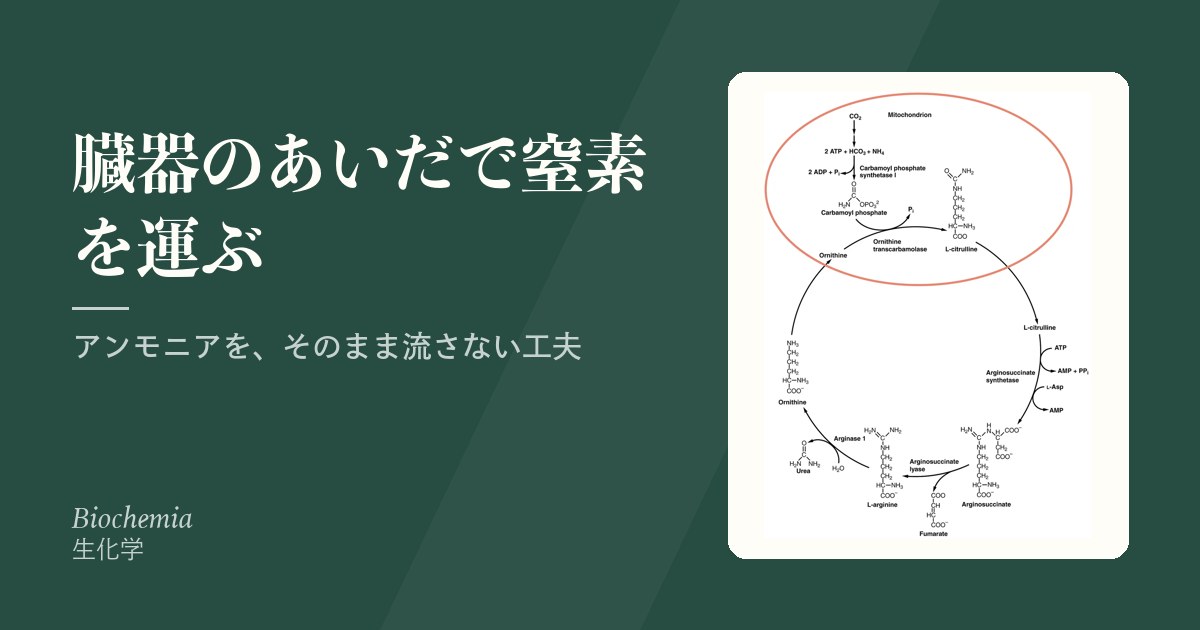
アミノ酸を燃やすとアンモニアが出る。アンモニアは低濃度でも脳に毒なので、血中を遊離のまま流すわけにいかない。
体は2つの運び屋を使う——グルタミンとアラニンである。どちらも「無毒な形に包んで肝へ送り、肝で尿素にする」という同じ目的を果たすが、使う臓器と、ついでに運ぶものが違う。
- グルタミンとアラニン — 2つの運び屋の使い分け
- 尿素回路異常症 — アンモニアが上がるのに、アシドーシスが無い
- 分枝鎖アミノ酸と Fischer 比 — 肝が悪いと、比が崩れる
- クレアチンとクレアチニン — 筋が使うエネルギーの緩衝
- シトリン欠損症 — 甘いものを嫌う赤ちゃんと、大人になってからの高アンモニア血症
- アルギニンとシトルリン — 尿素回路の途中から、血管を広げる分子が分かれていく
グルタミンとアラニン — 2つの運び屋の使い分け
| グルタミン | アラニン(グルコース・アラニン回路) | |
|---|---|---|
| 作る場所 | ほぼ全身(特に筋・脳) | 骨格筋 |
| 運ぶもの | 窒素2個 | 窒素1個+炭素骨格 |
| 行き先 | 肝・腎・腸 | 肝 |
| ついでの役割 | 腎でアンモニアを作り、酸を捨てる | 肝で糖新生の材料になる |
- 血中で最も濃度の高いアミノ酸はグルタミン
- 脳はグルタミン合成酵素でアンモニアを固定する——これが脳のアンモニア解毒のほぼ唯一の手段
- 腸細胞はグルタミンを主要な燃料にする
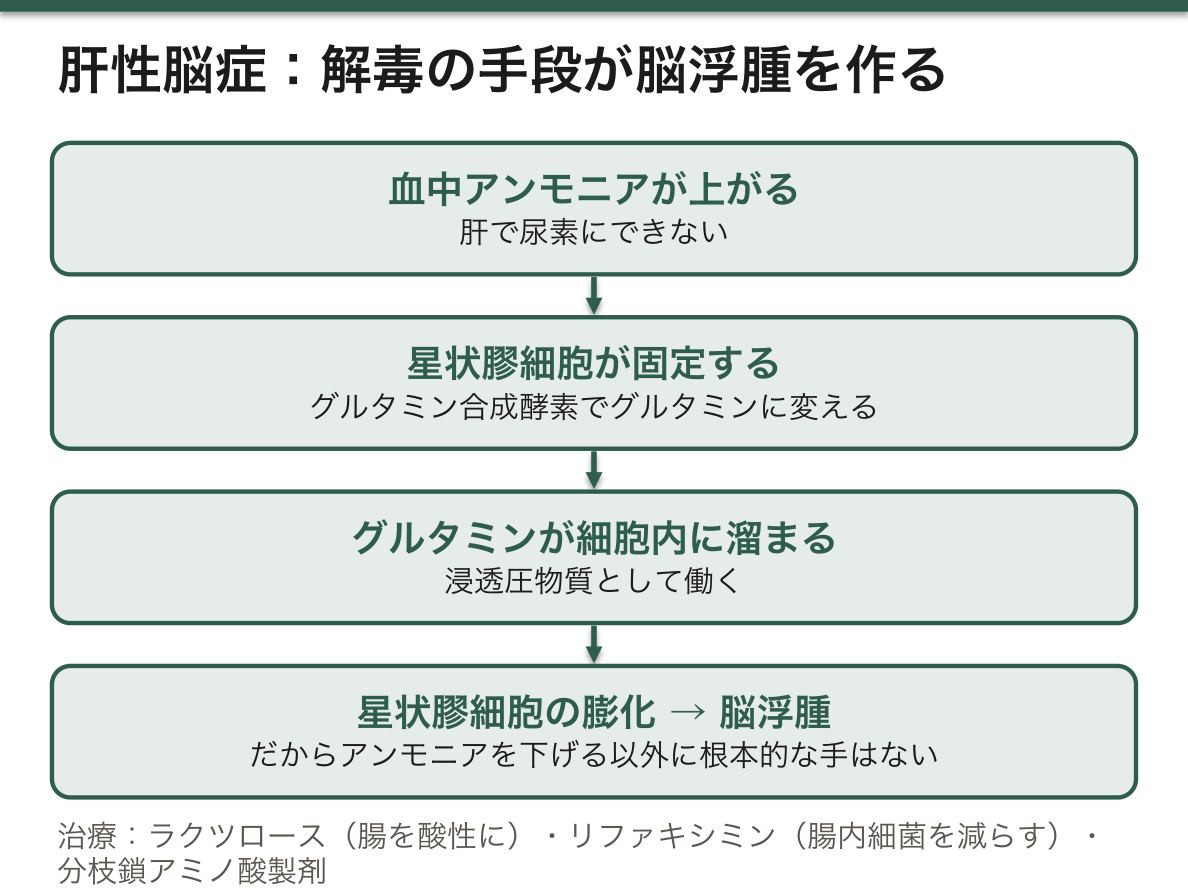
肝性脳症でグルタミンが悪者になるのが、この話の臨床的な要である。アンモニアが上がると、脳の星状膠細胞がグルタミン合成酵素で必死に固定する。ところがグルタミンは細胞内に溜まると浸透圧物質として働き、星状膠細胞を膨化させる。これが脳浮腫の正体である。
つまり解毒の手段そのものが脳浮腫を作っている——だからアンモニアを下げる以外に根本的な手はない。
治療も経路から出る。
- ラクツロース——大腸で分解されて腸内を酸性にし、アンモニアをアンモニウムイオンに変えて吸収させない。同時に排便を促す
- リファキシミン——吸収されない抗菌薬で、アンモニアを産生する腸内細菌を減らす
- 分枝鎖アミノ酸製剤——芳香族アミノ酸との比(Fischer比)を是正する。肝硬変では芳香族アミノ酸が肝で処理されず増え、脳内で偽性神経伝達物質になる
腎でのグルタミンの役割も押さえておく。アシドーシスでは腎がグルタミンを分解してアンモニアを作り、尿へ酸を捨てる。アンモニウムイオンとして捨てることで、尿のpHを下げすぎずに大量の酸を排泄できる。だから慢性の代謝性アシドーシスでは尿中アンモニウムが増える——増えていなければ、腎そのものに問題がある(尿細管性アシドーシス)と分かる。
English version
Core
| Glutamine | Alanine (the glucose–alanine cycle) | |
|---|---|---|
| Made in | Almost everywhere (especially muscle and brain) | Skeletal muscle |
| Carries | Two nitrogens | One nitrogen + a carbon skeleton |
| Destination | Liver, kidney, gut | Liver |
| Additional role | Makes ammonia in the kidney and discards acid | Substrate for gluconeogenesis in the liver |
- Glutamine is the most concentrated amino acid in the blood.
- The brain fixes ammonia with glutamine synthetase — essentially its only means of detoxifying ammonia.
- The enterocyte uses glutamine as its principal fuel.
Going further
That glutamine becomes the villain in hepatic encephalopathy is the clinical crux of this story. As the ammonia rises, astrocytes fix it desperately with glutamine synthetase. But glutamine accumulating within the cell acts as an osmolyte and swells the astrocyte. This is the substance of the cerebral oedema.
That is, the means of detoxification is itself creating the oedema — so there is no fundamental measure other than lowering the ammonia.
The treatment comes out of the pathway.
- Lactulose — broken down in the colon to acidify the lumen, converting ammonia to ammonium so that it is not absorbed, and promoting defaecation.
- Rifaximin — a non-absorbed antibiotic reducing the ammonia-producing flora.
- Branched-chain amino acid preparations — correcting the ratio to the aromatic amino acids (Fischer’s ratio). In cirrhosis the aromatic amino acids are not processed by the liver, increase, and become false transmitters in the brain.
Fix the renal role of glutamine too. In acidosis the kidney breaks down glutamine to make ammonia and discards acid in the urine. Excreting it as ammonium allows a great deal of acid to be discarded without lowering the urinary pH too far. So in chronic metabolic acidosis the urinary ammonium increases — and if it has not, the problem is in the kidney itself (renal tubular acidosis).
尿素回路異常症 — アンモニアが上がるのに、アシドーシスが無い
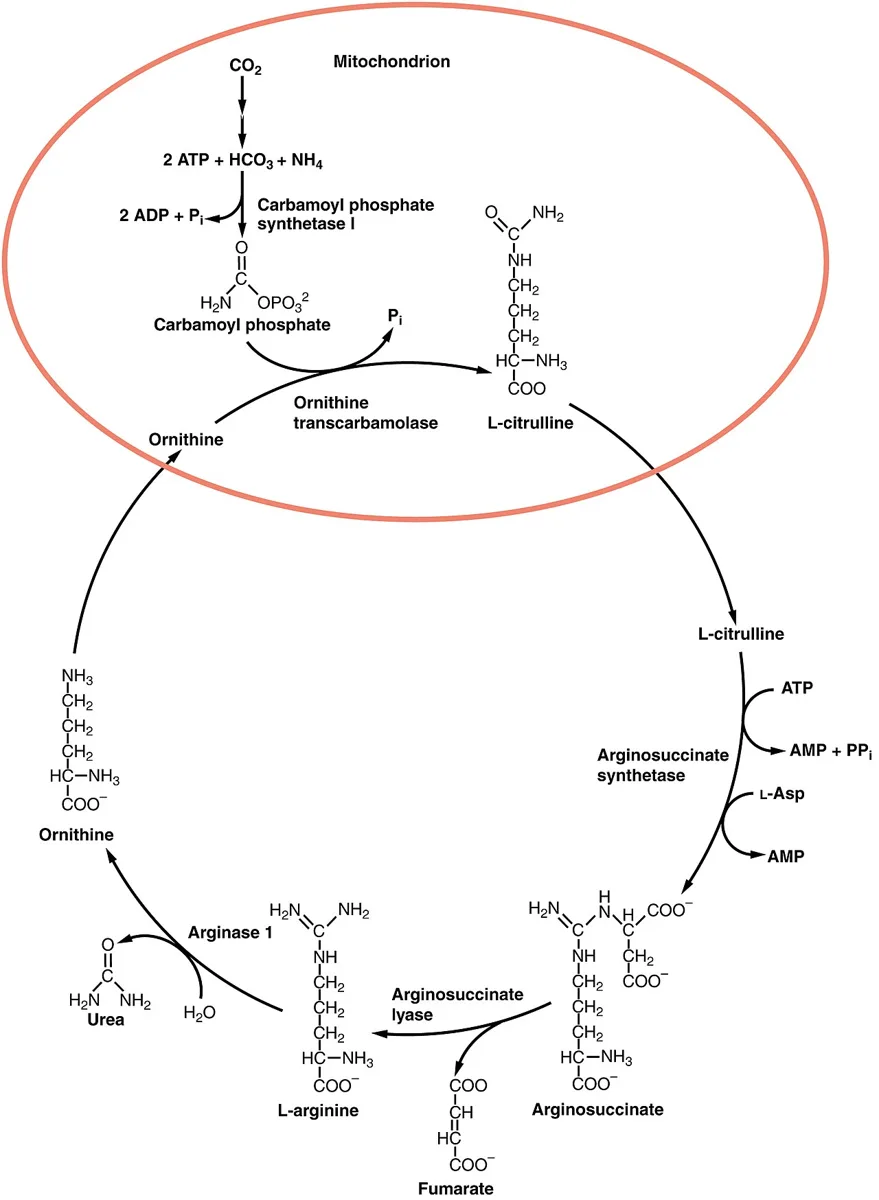
尿素回路の5酵素のいずれかが欠損する。最多はオルニチントランスカルバミラーゼ欠損症で、唯一のX連鎖(他は常染色体潜性)。
| 所見 | 理由 |
|---|---|
| 高アンモニア血症 | 解毒できない |
| 呼吸性アルカローシス | アンモニアが呼吸中枢を刺激 |
| 代謝性アシドーシスが無い | 有機酸が溜まらない |
| 血中シトルリンで部位が分かる | シトルリンは回路の途中の産物 |
| 尿中オロト酸(オルニチントランスカルバミラーゼ欠損) | 余ったカルバモイルリン酸がピリミジン合成へ流れる |
- 治療:蛋白制限・十分な糖質・アルギニン補充、安息香酸ナトリウム/フェニル酪酸ナトリウム(窒素を別の形で捨てる)、高度なら血液透析
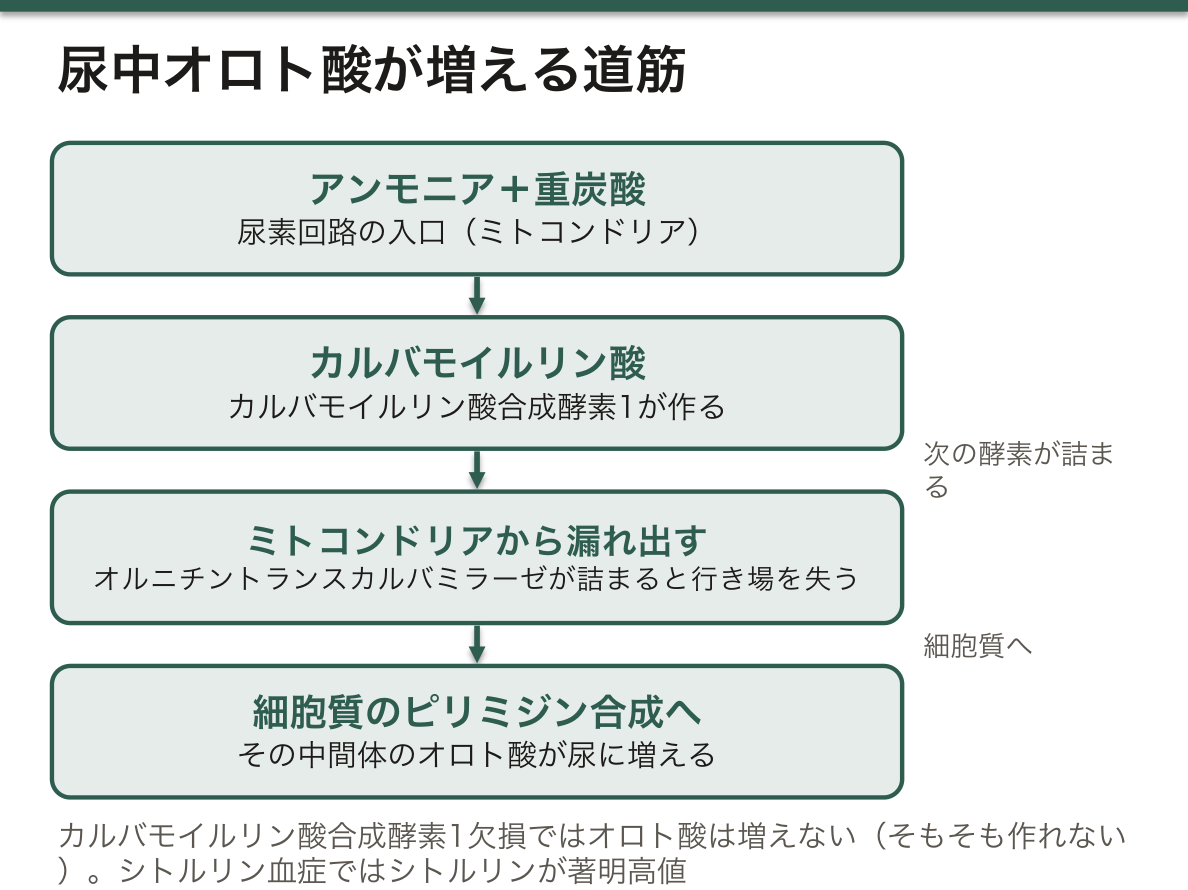
尿中オロト酸が診断に効く理屈を、経路の絵で押さえる。尿素回路の入口ではカルバモイルリン酸合成酵素1がアンモニアと重炭酸からカルバモイルリン酸を作る。次のオルニチントランスカルバミラーゼが詰まると、行き場を失ったカルバモイルリン酸がミトコンドリアから漏れ出し、細胞質のピリミジン合成経路へ入る。その中間体がオロト酸である。
- オルニチントランスカルバミラーゼ欠損——オロト酸が増える。シトルリンは低い
- カルバモイルリン酸合成酵素1欠損——オロト酸は増えない(そもそも作れない)。シトルリンも低い
- シトルリン血症——シトルリンが著明高値
1つの検査値で、回路のどこが詰まったかを言い当てられる——これが代謝経路を覚える実利である。
X連鎖であることの帰結も重要である。男児は新生児期に劇症で発症するが、女性のヘテロ接合体は、ライオニゼーションの偏りによって成人期に初発しうる。妊娠・分娩・手術・高蛋白食・ステロイド投与といった異化が進む状況が引き金になる。原因不明の意識障害の成人で、アンモニアを測っていなければ辿り着けない。
安息香酸ナトリウムとフェニル酪酸ナトリウムの機序は共通していて、グリシンやグルタミンと結合し、尿素以外の形で窒素を尿へ捨てる迂回路を作ることである。尿素回路を治すのではなく、別の出口を開ける——代謝疾患の治療戦略として覚えておく価値がある考え方である。
English version
Core
Any of the five enzymes of the urea cycle may be deficient. The commonest is ornithine transcarbamylase deficiency, the only X-linked one (the rest are autosomal recessive).
| Finding | Reason |
|---|---|
| Hyperammonaemia | It cannot be detoxified |
| Respiratory alkalosis | Ammonia stimulates the respiratory centre |
| No metabolic acidosis | No organic acids accumulate |
| The blood citrulline localises the block | Citrulline is an intermediate of the cycle |
| Urinary orotic acid (OTC deficiency) | Surplus carbamoyl phosphate flows into pyrimidine synthesis |
Treatment: protein restriction, ample carbohydrate, arginine supplementation, sodium benzoate / sodium phenylbutyrate (discarding nitrogen in another form), and haemodialysis if severe.
Going further
Fix on the diagram why urinary orotic acid is diagnostic. At the entrance of the cycle, carbamoyl phosphate synthetase 1 makes carbamoyl phosphate from ammonia and bicarbonate. Block the next step, ornithine transcarbamylase, and the carbamoyl phosphate with nowhere to go leaks from the mitochondrion into the cytosolic pyrimidine pathway. Orotic acid is an intermediate of that.
- OTC deficiency — orotic acid rises; citrulline is low.
- CPS1 deficiency — orotic acid does not rise (none can be made); citrulline is also low.
- Citrullinaemia — citrulline is markedly high.
One laboratory value names where the cycle is blocked — this is the practical value of learning a metabolic pathway.
Being X-linked has its own consequence. Boys present fulminantly in the newborn period, but a heterozygous female may present for the first time in adult life through skewed lyonisation. Pregnancy, delivery, surgery, a high-protein meal or steroids — states that increase catabolism — are the triggers. In an adult with unexplained impaired consciousness it cannot be reached unless the ammonia is measured.
Sodium benzoate and sodium phenylbutyrate share a mechanism: conjugating with glycine or glutamine, they make a bypass discarding nitrogen in the urine in a form other than urea. Not repairing the cycle but opening another exit — an idea worth remembering as a strategy in metabolic disease.
分枝鎖アミノ酸と Fischer 比 — 肝が悪いと、比が崩れる
分枝鎖アミノ酸(バリン・ロイシン・イソロイシン)は、他のアミノ酸と扱いが違う。
- 肝ではほとんど代謝されず、主に骨格筋で代謝される
- 筋でアミノ基を受け取り、グルタミンとアラニンとして運び出す
- ロイシンは mTOR を介して蛋白合成を促す
芳香族アミノ酸(フェニルアラニン・チロシン)は、逆に肝でしか代謝されない。
Fischer 比 = 分枝鎖アミノ酸 / 芳香族アミノ酸。正常は 3〜4。肝硬変では低下する。
肝性脳症では、芳香族アミノ酸が脳へ入り、偽性神経伝達物質を作るという説がある。
「代謝する臓器が違う」という一点が、比が動く理由の全部になる。肝が壊れると芳香族アミノ酸だけが処理されずに溜まり、分枝鎖アミノ酸は筋で消費され続ける(解毒の項)——「分子の量ではなく、比が病態を映す」。
だから肝硬変では、蛋白を一律に制限しない。分枝鎖アミノ酸を強化した経腸栄養剤(BCAA 製剤)を使い、就寝前の補食(LES)を勧める(栄養をどう入れるかの章)——「肝硬変の夜間は、健常人の数日の絶食に相当する」。
筋がアンモニアの処理を肩代わりしていることも重要になる。サルコペニアが進むとグルタミン合成の場が減り、高アンモニア血症が悪化する(運動の生化学の章)——「筋を保つことが、脳を守ることになる」。
ロイシンが mTOR を動かすことは、栄養学の応用に直結する(インスリンシグナルの章)——「高齢者のサルコペニア対策で、ロイシン強化の食品が使われる根拠になる」。
メープルシロップ尿症は、この分枝鎖アミノ酸が代謝できない病気になる(分枝鎖アミノ酸代謝異常の章)——「同じ分子が、栄養にも毒にもなる」。
English version
Core
The branched-chain amino acids (valine, leucine, isoleucine) are handled differently from the rest.
- Scarcely metabolised in the liver; metabolised chiefly in skeletal muscle.
- In muscle they accept amino groups and are exported as glutamine and alanine.
- Leucine promotes protein synthesis through mTOR.
The aromatic amino acids (phenylalanine, tyrosine) are the converse — metabolised only in the liver.
Fischer’s ratio = branched-chain / aromatic. Normally 3–4; it falls in cirrhosis. In hepatic encephalopathy the aromatic amino acids are held to enter the brain and form false transmitters.
Going further
The single point that they are metabolised in different organs is the whole reason the ratio moves. When the liver fails, the aromatic amino acids alone go unprocessed and accumulate while the branched-chain ones continue to be consumed in muscle — the ratio, not the amount, reflecting the state.
So protein is not restricted indiscriminately in cirrhosis. A branched-chain-enriched enteral feed is used and a bedtime snack (a late evening snack) recommended — a night in cirrhosis is equivalent to some days of fasting in a healthy person.
That muscle takes over the handling of ammonia matters too. As sarcopenia advances the site of glutamine synthesis diminishes and the hyperammonaemia worsens — preserving muscle is protecting the brain.
That leucine drives mTOR bears directly on applied nutrition — the basis for leucine-enriched foods in preventing sarcopenia in the elderly.
Maple syrup urine disease is the disease in which these branched-chain amino acids cannot be metabolised — the same molecule as nutrient and as poison.
クレアチンとクレアチニン — 筋が使うエネルギーの緩衝
クレアチンは3つのアミノ酸から作られる——グリシン+アルギニン → 腎でグアニジノ酢酸 → 肝でメチル化(S-アデノシルメチオニンを使う)。
筋でクレアチンキナーゼによりリン酸化され、クレアチンリン酸として蓄えられる。
働きはエネルギーの緩衝になる——ATP が消費された瞬間に、リン酸を渡して ADP を ATP へ戻す。数秒〜十数秒の全力運動を支える。
クレアチンとクレアチンリン酸は、非酵素的に一定の割合で環化してクレアチニンになる。1日あたり総プールの約 1.7%。
だから尿中クレアチニン排泄量は、筋肉量にほぼ比例する。
「一定の割合で、勝手に壊れる」という性質が、クレアチニンを腎機能の指標にしている。産生が安定しているので、血中濃度の変化を濾過の変化として読める(クレアチニンの項)——「調節されないことが、指標としての価値になっている」。
だから尿中クレアチニンは、蓄尿の正確さを確かめる道具にもなる(尿を読む章)——「随時尿で、蛋白/クレアチニン比を使って1日排泄量を推定できるのも同じ理屈になる」。
合成にメチル基を大量に使うことは、意外な繋がりを作る。クレアチン合成は、体内で最大のメチル基消費の一つで、ホモシステインを生む(ホモシステインの章)——「筋の分子を作ることが、血管の危険因子と繋がっている」。
クレアチンキナーゼのアイソザイムが、臓器を教える(アイソザイムの章)——「CK-MB は心筋、CK-MM は骨格筋、CK-BB は脳と平滑筋になる」。
先天性のクレアチン欠乏症では、知的障害とてんかんが出る(先天代謝異常症の章)——「脳も、この緩衝系に依存している」。
English version
Core
Creatine is made from three amino acids — glycine + arginine → guanidinoacetate in the kidney → methylated in the liver (using S-adenosylmethionine). In muscle it is phosphorylated by creatine kinase and stored as creatine phosphate.
Its function is a buffer of energy — the moment ATP is consumed it hands over a phosphate and returns ADP to ATP. It supports maximal exercise for seconds to a dozen or so seconds.
Creatine and creatine phosphate cyclise non-enzymatically at a fixed rate to creatinine — about 1.7 per cent of the total pool a day. Hence urinary creatinine excretion is nearly proportional to muscle mass.
Going further
That it breaks down of its own accord at a fixed rate is what makes creatinine an index of renal function. Production being stable, a change in the blood level can be read as a change in filtration — that it is not regulated is what gives it value as an index.
So urinary creatinine is also a tool for checking the completeness of a 24-hour collection — and the protein/creatinine ratio on a spot sample estimates the daily excretion by the same reasoning.
That its synthesis consumes a great deal of methyl makes an unexpected connection. Creatine synthesis is one of the largest consumers of methyl groups in the body and generates homocysteine — making a molecule for muscle connecting with a risk factor for the vessels.
The isoenzymes of creatine kinase name the organ — CK-MB the myocardium, CK-MM skeletal muscle, CK-BB brain and smooth muscle.
Congenital creatine deficiency gives intellectual disability and epilepsy — the brain too depends on this buffer.
シトリン欠損症 — 甘いものを嫌う赤ちゃんと、大人になってからの高アンモニア血症
ミトコンドリア内膜のアスパラギン酸・グルタミン酸キャリア(シトリン)が働かない病気で、東アジアに多く、日本人の保因者は約 65 人に 1 人と推定されている。
シトリンは 2 つの役目を同時に果たしている。
- 尿素回路にアスパラギン酸を供給する——欠けるとシトルリンから先へ進めず、シトルリンとアンモニアが溜まる
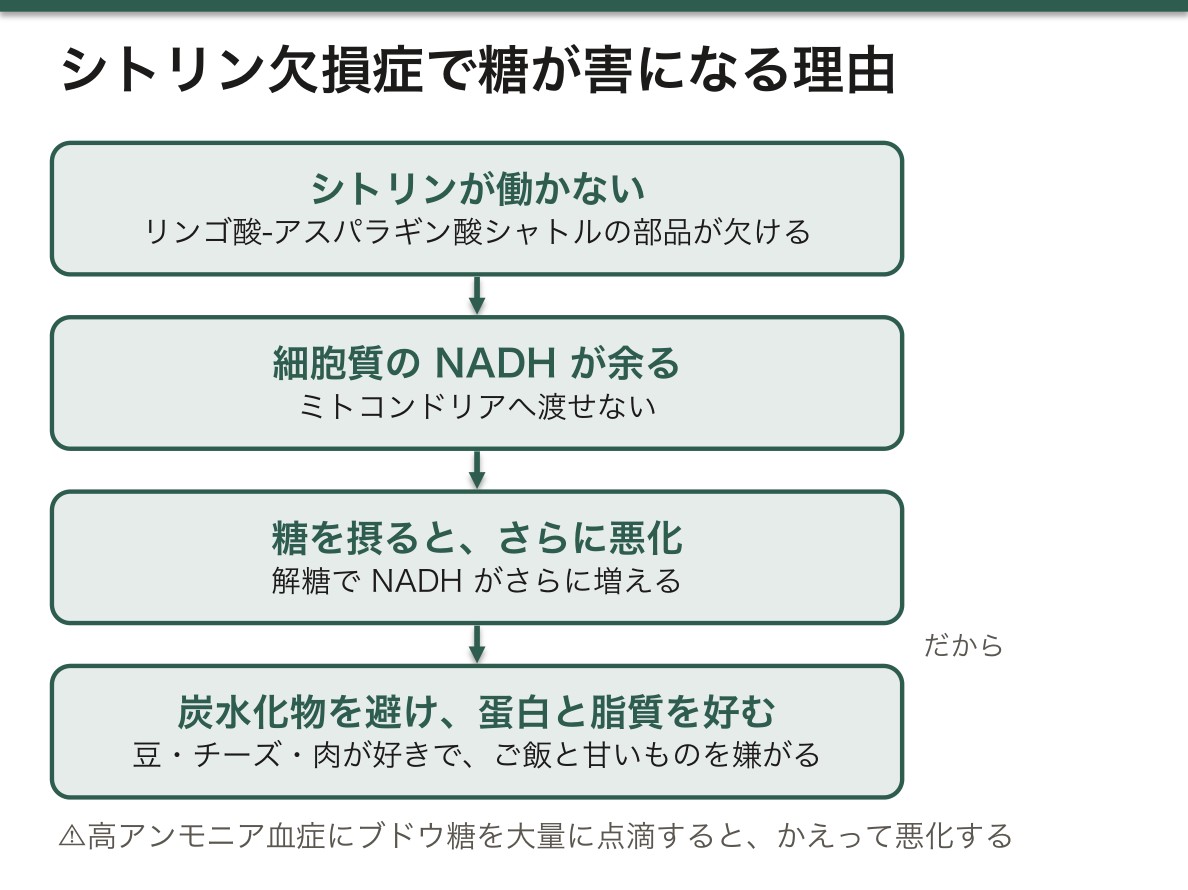
- リンゴ酸-アスパラギン酸シャトルの部品——欠けると細胞質の NADH をミトコンドリアへ渡せず、細胞質の NADH が余る
2 番目が、この病気の独特な食嗜好を説明する。糖を摂ると解糖でさらに NADH が増えて悪化するので、患者は本能的に炭水化物を避け、蛋白と脂質を好む。「豆・チーズ・肉が好きで、ご飯と甘いものを嫌がる」という病歴が、そのまま手がかりになる。
年齢によって3つの顔を見せる。
| 新生児〜乳児 | 胆汁うっ滞型(NICCD) | 黄疸・肝腫大・低出生体重。多くは1歳までに自然に軽快する |
| 幼児〜学童 | 見かけ上は無症状の時期 | 低身長・低血糖・膵炎・脂肪肝を伴うことがある |
| 成人 | II 型シトルリン血症(CTLN2) | 突然の意識障害・異常行動・けいれん。精神疾患と誤られる |
⚠️ ここが最大の落とし穴である。高アンモニア血症を見てブドウ糖を大量に点滴すると、かえって悪化する——余った NADH をさらに増やしてしまうためである。他の尿素回路異常症では正しい対応(異化を止めるためのブドウ糖)が、この病気では逆に働く。
治療は低炭水化物・高蛋白・高脂質という、現代の食事指導の常識と正反対の方向になる。中鎖脂肪酸(MCT)とアルギニンが有効で、重症例では肝移植が行われる。
成人の原因不明の意識障害でアンモニアが高いとき、「肝が悪くないのに」と切り捨てず、食嗜好を聞く。「昔から甘いものが嫌いだった」という一言が診断に繋がる。
日本で診療するなら覚えておく価値が高い。成人発症の高アンモニア血症で、蛋白と脂を好み糖を嫌う人を見たら、この病気を疑う。
English version
Core
A disease in which the aspartate–glutamate carrier of the inner mitochondrial membrane (citrin) does not work; common in East Asia, with an estimated carrier frequency of about 1 in 65 in Japanese people.
Citrin does two jobs at once.
- Supplies aspartate to the urea cycle — without it, the cycle cannot proceed beyond citrulline and citrulline and ammonia accumulate.
- Is part of the malate–aspartate shuttle — without it, cytosolic NADH cannot be handed to the mitochondrion and NADH accumulates in the cytosol.
The second explains the peculiar food preference of this disease. Taking sugar increases the NADH further through glycolysis and makes it worse, so the patient instinctively avoids carbohydrate and prefers protein and fat. A history of "likes beans, cheese and meat and dislikes rice and sweet things" is itself the clue.
Going further
It shows three faces according to age.
| Age | Form | Features |
|---|---|---|
| Newborn to infant | Cholestatic (NICCD) | Jaundice, hepatomegaly, low birth weight. Most resolve spontaneously by one year |
| Toddler to school age | An apparently asymptomatic period | May have short stature, hypoglycaemia, pancreatitis, fatty liver |
| Adult | Citrullinaemia type II (CTLN2) | Sudden impaired consciousness, abnormal behaviour, seizures. Mistaken for psychiatric disease |
⚠️ Here is the greatest pitfall. Seeing hyperammonaemia and giving a large glucose infusion makes it worse — it increases the surplus NADH further. What is correct in the other urea cycle disorders (glucose to stop catabolism) works in reverse here.
The treatment is low carbohydrate, high protein, high fat — the opposite direction from the conventional dietary advice of our time. Medium-chain triglyceride and arginine are effective, and liver transplantation is performed in severe cases.
In an adult with unexplained impaired consciousness and a high ammonia, do not dismiss it as "but the liver is not diseased" — ask about food preferences. The single remark "I have never liked sweet things" leads to the diagnosis.
In the clinic
Well worth knowing if you will practise in Japan. In adult-onset hyperammonaemia in someone who prefers protein and fat and dislikes sugar, suspect this disease.
アルギニンとシトルリン — 尿素回路の途中から、血管を広げる分子が分かれていく
尿素回路の中間体であるアルギニンは、尿素を作る材料であると同時に、一酸化窒素(NO)の唯一の材料でもある。NO 合成酵素がアルギニンから NO を作ると、残りはシトルリンになる。
ここで生じたシトルリンは、再びアルギニンへ戻される(シトルリン-NO 回路)。尿素回路と NO 産生は、同じ分子を共有する 2 本の枝である。
だから次のことが言える。
- シトルリンを摂るとアルギニンが増える——アルギニンは腸と肝で大量に分解されるが、シトルリンは初回通過を受けにくいので、経口では効率がよい
- 尿素回路異常症でアルギニンが枯れると、NO も作りにくくなる
NO を作れなくする内因性の物質がある。非対称ジメチルアルギニン(ADMA)はアルギニンによく似た構造を持ち、NO 合成酵素を競合的に阻害する。蛋白がメチル化された後に分解されて生じ、腎不全で溜まる。慢性腎臓病で心血管疾患が多い理由の 1 つとして注目されている。
基質が足りないと、酵素が別のものを作り始める。NO 合成酵素はアルギニンや補酵素(テトラヒドロビオプテリン)が不足すると、NO ではなくスーパーオキシドを出す(脱共役)。血管を守るはずの酵素が、酸化ストレスの発生源に変わる——動脈硬化・糖尿病・高血圧で内皮機能が落ちる機序として、繰り返し取り上げられる。
臨床への応用は、期待と実際にずれがある。
- 効果が確立している——尿素回路異常症でのアルギニン/シトルリン補充(回路を回すために必要)。新生児遷延性肺高血圧症での NO 吸入
- 効果がはっきりしない——健常者や運動選手のサプリメントとしてのアルギニン。血中濃度は上がっても、臨床的な効果は一貫していない
- MELAS の脳卒中様発作——アルギニン投与が試みられている
尿素回路異常症では、アルギニンは栄養ではなく薬である。回路を回すために必須で、自己判断で中断させない。
English version
Core
Arginine, an intermediate of the urea cycle, is also the only material of nitric oxide (NO). When NO synthase makes NO from arginine, what remains is citrulline. That citrulline is returned to arginine (the citrulline–NO cycle).
The urea cycle and NO production are two branches sharing the same molecule. From which follows:
- Taking citrulline raises arginine — arginine is largely degraded in gut and liver, whereas citrulline escapes the first pass, so it is more efficient by mouth.
- When arginine is exhausted in a urea cycle disorder, NO also becomes hard to make.
Going further
There is an endogenous substance that prevents NO being made. Asymmetric dimethylarginine (ADMA) closely resembles arginine and competitively inhibits NO synthase. It arises from the degradation of methylated protein and accumulates in renal failure. It has attracted attention as one reason cardiovascular disease is common in chronic kidney disease.
When the substrate is short, the enzyme begins to make something else. Lacking arginine or its cofactor (tetrahydrobiopterin), NO synthase releases superoxide instead of NO (uncoupling). An enzyme that should protect the vessel turning into a source of oxidative stress — repeatedly cited as the mechanism by which endothelial function falls in atherosclerosis, diabetes and hypertension.
The clinical application diverges from the expectation.
- Established — arginine or citrulline supplementation in urea cycle disorders (necessary to turn the cycle). Inhaled NO in persistent pulmonary hypertension of the newborn.
- Unclear — arginine as a supplement in healthy people and athletes. The blood level rises but the clinical effect is inconsistent.
- Arginine has been tried in the stroke-like episodes of MELAS.
In the clinic
In a urea cycle disorder, arginine is a drug and not a nutrient. It is essential to turning the cycle, and must not be stopped on the patient’s own judgement.
まとめ
| グルタミンとアラニン — 2つの運び屋の使い分け | グルタミンアラニン(グルコース・アラニン回路)作る場所ほぼ全身(特に筋・脳)骨格筋運ぶもの窒素2個窒素1個+炭素骨格行き先肝・腎・腸肝ついでの役割腎でアンモニアを作り、酸を捨てる肝… |
|---|---|
| 尿素回路異常症 — アンモニアが上がるのに、アシドーシスが無い | 尿素回路の5酵素のいずれかが欠損する。最多はオルニチントランスカルバミラーゼ欠損症で、唯一のX連鎖(他は常染色体潜性)。 |
| 分枝鎖アミノ酸と Fischer 比 — 肝が悪いと、比が崩れる | 分枝鎖アミノ酸(バリン・ロイシン・イソロイシン)は、他のアミノ酸と扱いが違う。 |
| クレアチンとクレアチニン — 筋が使うエネルギーの緩衝 | クレアチンは3つのアミノ酸から作られる——グリシン+アルギニン → 腎でグアニジノ酢酸 → 肝でメチル化(S-アデノシルメチオニンを使う)。 |
| シトリン欠損症 — 甘いものを嫌う赤ちゃんと、大人になってからの高アンモニア血症 | ミトコンドリア内膜のアスパラギン酸・グルタミン酸キャリア(シトリン)が働かない病気で、東アジアに多く、日本人の保因者は約 65 人に 1 人と推定されている。 |
| アルギニンとシトルリン — 尿素回路の途中から、血管を広げる分子が分かれていく | 尿素回路の中間体であるアルギニンは、尿素を作る材料であると同時に、一酸化窒素(NO)の唯一の材料でもある。 |
このノートは医学生が授業の内容を自分の言葉でまとめたもので、診療の判断に使うものではありません。誤りに気づいたらお知らせください。