腎は1日に約150 Lを濾過し、99%を再吸収する。この極端な設計は、「まず全部出して、要るものだけ取り返す」ほうが、個々の物質に専用の排泄機構を持つより簡単だからである。
結果として尿は体内で最も濃縮された溶液になり、結晶が析出しやすい。結石の化学は、この制約との戦いである。
- 尿の生化学 — 何を測っているのか
- 結石の化学 — pHと、溶解度
- 腎機能を測る分子 — クレアチニンが答えられないこと
- 尿を濃縮する化学 — 尿素も、濃縮のための道具になっている
- 薬は腎で濃縮される — 腎障害が起きる場所は決まっている
- 尿の色とにおいは、溶けているものを語っている
尿の生化学 — 何を測っているのか
| 項目 | 原理 | 落とし穴 |
|---|---|---|
| 尿蛋白(試験紙) | 指示薬の蛋白誤差。主にアルブミンを見る | Bence Jones蛋白は検出できない。アルカリ尿で偽陽性 |
| 尿糖 | グルコースオキシダーゼ | グルコース以外の糖は陰性(果糖の章)。SGLT2阻害薬で陽性 |
| 潜血 | ヘムのペルオキシダーゼ様作用 | ミオグロビン・遊離ヘモグロビンでも陽性。沈渣で赤血球が無ければ横紋筋融解症を疑う |
| ケトン体 | ニトロプルシド反応 | βヒドロキシ酪酸を検出しない——重症時ほど低く出る |
「試験紙で陽性/陰性が、実際の病態とずれる」場面を具体的に持っておくことが、この項目の目的である。
ケトン体の落とし穴は特に重要である。糖尿病性ケトアシドーシスでは還元状態が強く、アセト酢酸よりβヒドロキシ酪酸が優位になる。試験紙はアセト酢酸しか見ないので、最重症のときに弱陽性にしか出ない。しかも治療で改善するとβヒドロキシ酪酸がアセト酢酸に変わるので、試験紙の反応はむしろ強くなる——「治療して悪化した」と誤読する。血中βヒドロキシ酪酸を直接測るのが正しい。
潜血陽性で沈渣に赤血球が無いのは、横紋筋融解症か血管内溶血である。血清が透明ならミオグロビン(腎から速やかに濾過される)、赤みがあれば遊離ヘモグロビン(ハプトグロビンに結合して残る)——遠心した血清の色を見るだけで区別できる。
尿蛋白の定量は、随時尿の蛋白/クレアチニン比で行う。24時間蓄尿は正確だが実行が難しく、採り漏れがあると無意味になる。クレアチニンで割ることで、尿の希釈の影響を打ち消している。
アルブミン尿と蛋白尿は別の検査である。糖尿病性腎症の早期は微量アルブミン尿で、通常の試験紙では検出できない濃度である。だから糖尿病患者では、試験紙が陰性でも別途アルブミンを測る。
English version
Core
| Item | Principle | Pitfall |
|---|---|---|
| Protein (dipstick) | The protein error of an indicator. Chiefly sees albumin | Bence Jones protein is not detected. False positive in alkaline urine |
| Glucose | Glucose oxidase | Negative for other sugars. Positive with SGLT2 inhibitors |
| Blood | The peroxidase-like action of haem | Positive with myoglobin and free haemoglobin too. If no red cells are seen on microscopy, suspect rhabdomyolysis |
| Ketones | Nitroprusside reaction | Does not detect β-hydroxybutyrate — so it reads lowest when the patient is sickest |
Going further
The object of this section is to hold concrete instances in which the dipstick’s positive or negative departs from the actual state.
The ketone pitfall is especially important. In diabetic ketoacidosis the redox state is strongly reduced and β-hydroxybutyrate predominates over acetoacetate. The strip sees only acetoacetate, so at the most severe it is only weakly positive. And as treatment improves matters the β-hydroxybutyrate converts to acetoacetate and the reaction becomes stronger — read as "worse on treatment". Measuring blood β-hydroxybutyrate directly is correct.
Blood positive with no red cells means rhabdomyolysis or intravascular haemolysis. If the serum is clear it is myoglobin (rapidly filtered by the kidney); if it is reddish, free haemoglobin (bound to haptoglobin and retained) — the colour of the spun serum alone separates them.
Proteinuria is quantified by the protein/creatinine ratio on a spot sample. A 24-hour collection is accurate but hard to carry out and meaningless if any is missed. Dividing by creatinine cancels the effect of the dilution of the urine.
Albuminuria and proteinuria are different tests. Early diabetic nephropathy is microalbuminuria, at a concentration the ordinary dipstick cannot detect. So in a diabetic patient, measure albumin separately even when the strip is negative.
結石の化学 — pHと、溶解度
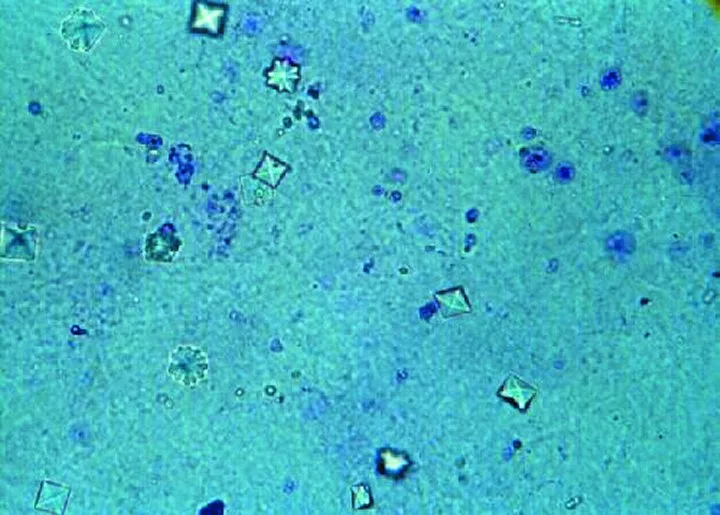
| 結石 | 割合 | X線 | 尿pH | 要点 |
|---|---|---|---|---|
| シュウ酸カルシウム | 約80% | 写る | — | 最多。脂肪吸収不良で増える |
| リン酸カルシウム | 写る | アルカリ | 尿細管性アシドーシス | |
| 尿酸 | 約5〜10% | 写らない | 酸性 | アルカリ化で溶ける |
| リン酸マグネシウムアンモニウム | 写る | アルカリ | ウレアーゼ産生菌(Proteus)・サンゴ状結石 | |
| シスチン | 稀 | わずかに写る | 酸性 | シスチン尿症・六角形の結晶 |
予防の基本は水分摂取(1日2 L以上の尿量)。クエン酸は結石抑制因子——カルシウムと結合して溶けたまま保つ。
「カルシウム結石だからカルシウムを制限する」は誤りである——これは実務で必ず問われる。食事のカルシウムを減らすと、腸内でシュウ酸と結合する相手がいなくなり、シュウ酸の吸収が増えて、かえって結石が増える。カルシウムは通常量を摂り、シュウ酸の多い食品(ほうれん草・紅茶・ナッツ・チョコレート)を控えるのが正しい。
腸性高シュウ酸尿症も同じ理屈で起きる。Crohn病や短腸症候群、肥満手術後では、吸収されなかった脂肪酸がカルシウムと結合してしまう。相手を奪われたシュウ酸が大量に吸収され、結石と腎障害を起こす。脂肪吸収障害があれば結石を疑うという繋がりを持っておく。
リン酸マグネシウムアンモニウム結石は「感染結石」である。ウレアーゼを持つ細菌が尿素をアンモニアに分解し、尿をアルカリ化する。アルカリになるとこの塩の溶解度が下がって析出する。結石の中に細菌がいるので、完全に除去しなければ再発する——抗菌薬だけでは治らない。
尿酸結石はX線に写らないが、CTでは写る。単純撮影で見えないから結石ではない、とは言えない。そして尿酸結石は唯一「溶かせる」結石である——クエン酸製剤で尿pHを6.2〜6.8に保つ。上げすぎるとリン酸カルシウムが析出するので、目標範囲がある。
シスチン尿症は近位尿細管の二塩基性アミノ酸輸送体の異常で、シスチン・オルニチン・アルギニン・リジンが尿へ漏れる。結石になるのはシスチンだけ——4つのうちシスチンだけが水に溶けにくいからである。
English version
Core
| Stone | Share | Radiopaque | Urine pH | Point |
|---|---|---|---|---|
| Calcium oxalate | About 80% | Yes | — | The commonest. Increased in fat malabsorption |
| Calcium phosphate | Yes | Alkaline | Renal tubular acidosis | |
| Uric acid | About 5–10% | No | Acid | Dissolves with alkalinisation |
| Struvite | Yes | Alkaline | Urease-producing organisms (Proteus); staghorn calculi | |
| Cystine | Rare | Faintly | Acid | Cystinuria; hexagonal crystals |
The basis of prevention is fluid (a urine output above 2 L a day). Citrate is an inhibitor of stone formation — it binds calcium and keeps it in solution.
Going further
"It is a calcium stone, so restrict calcium" is wrong — and this is always asked in practice. Reduce dietary calcium and there is nothing in the gut to bind the oxalate; oxalate absorption increases and stones become more frequent. Take calcium in the usual amount and restrict foods rich in oxalate (spinach, tea, nuts, chocolate).
Enteric hyperoxaluria arises by the same reasoning. In Crohn’s disease, short bowel syndrome and after bariatric surgery, unabsorbed fatty acids bind the calcium. Deprived of its partner, oxalate is absorbed in quantity and causes stones and renal injury. Hold the connection: fat malabsorption means suspect stones.
Struvite stones are infection stones. Urease-producing organisms split urea to ammonia and alkalinise the urine; the solubility of this salt falls in alkali and it precipitates. The organisms are inside the stone, so unless it is completely removed it recurs — antibiotics alone will not cure it.
Uric acid stones are not seen on plain radiographs but are seen on CT. "Not visible on the plain film, therefore not a stone" cannot be said. And uric acid is the one stone that can be dissolved — hold the urine pH at 6.2–6.8 with citrate. Raise it too far and calcium phosphate precipitates, hence the target range.
Cystinuria is a defect of the proximal tubular transporter for dibasic amino acids, leaking cystine, ornithine, arginine and lysine into the urine. Only cystine forms stones — of the four, only cystine is poorly soluble.
腎機能を測る分子 — クレアチニンが答えられないこと
糸球体濾過量(GFR)を直接は測れないので、代わりの分子で推定する。
| クレアチニン | シスタチンC | |
|---|---|---|
| どこから来るか | 筋のクレアチンが非酵素的に変換される | 全ての有核細胞が一定に産生 |
| 筋肉量の影響 | 受ける(少ないと低く出る) | 受けない |
| 尿細管 | 一部が分泌される(GFR を過大評価する) | 再吸収され分解される |
| 影響するもの | 肉食・激しい運動・シメチジン・トリメトプリム | ステロイド・甲状腺機能・喫煙 |
尿素窒素(BUN)は、腎機能だけでは決まらない——脱水・消化管出血・高蛋白食・ステロイドで上がり、肝不全・低栄養で下がる。
BUN/クレアチニン比が 20 を超えるときは、腎前性か消化管出血を考える。
「何で代用しているか」を知らないと、数字に騙される。クレアチニンは筋の量に比例するので、るい痩の高齢者では腎機能が悪くても正常に見える(腎機能をどう測るかの章)——「クレアチニンが正常であることは、腎が正常であることを意味しない」。
だから薬の投与量を決めるときに、実測の体重と年齢を式に入れる(Cockcroft-Gault)(臓器に合わせて量を決める章)——「eGFR は体表面積で標準化されているので、投与量の計算にはそのまま使わない」。
シスタチンC は、筋肉量に左右されない代わりに別の弱点を持つ——「万能な指標は無いので、2つを組み合わせて解釈する」。
尿細管からの分泌があることは、薬の相互作用として現れる。トリメトプリムやシメチジンは分泌を止めるので、GFR が変わっていないのにクレアチニンが上がる(相互作用の章)——「腎障害と見分けるには、尿素窒素が一緒に動いているかを見る」。
急性腎障害では、そもそも定常状態でないことに注意する(急性腎障害の章)——「濾過が止まった直後は、まだクレアチニンが上がっていない」。
English version
Core
GFR cannot be measured directly, so it is estimated from a surrogate molecule.
| Creatinine | Cystatin C | |
|---|---|---|
| Where it comes from | Non-enzymatic conversion of muscle creatine | Produced at a constant rate by all nucleated cells |
| Muscle mass | Affected (reads low when muscle is scant) | Not affected |
| Tubule | Partly secreted (overestimates GFR) | Reabsorbed and degraded |
| Influenced by | Meat, vigorous exercise, cimetidine, trimethoprim | Steroids, thyroid function, smoking |
Urea nitrogen is not settled by renal function alone — it rises with dehydration, gastrointestinal bleeding, a high-protein diet and steroids, and falls in liver failure and malnutrition. A BUN/creatinine ratio above 20 suggests a prerenal cause or gastrointestinal bleeding.
Going further
Not knowing what is being used as the surrogate means being deceived by the number. Creatinine is proportional to muscle mass, so in a wasted older person the renal function looks normal when it is not — a normal creatinine does not mean a normal kidney.
So in deciding a dose, put the actual weight and age into the formula (Cockcroft–Gault) — eGFR is standardised to body surface area and is not used as it stands for calculating a dose.
Cystatin C is not affected by muscle mass but has weaknesses of its own — there is no universal index, so interpret the two together.
That some is secreted by the tubule shows itself as a drug interaction. Trimethoprim and cimetidine block the secretion, so the creatinine rises with no change in GFR — to distinguish it from renal injury, see whether the urea nitrogen has moved with it.
In acute kidney injury, note that there is no steady state at all — just after filtration stops, the creatinine has not yet risen.
尿を濃縮する化学 — 尿素も、濃縮のための道具になっている
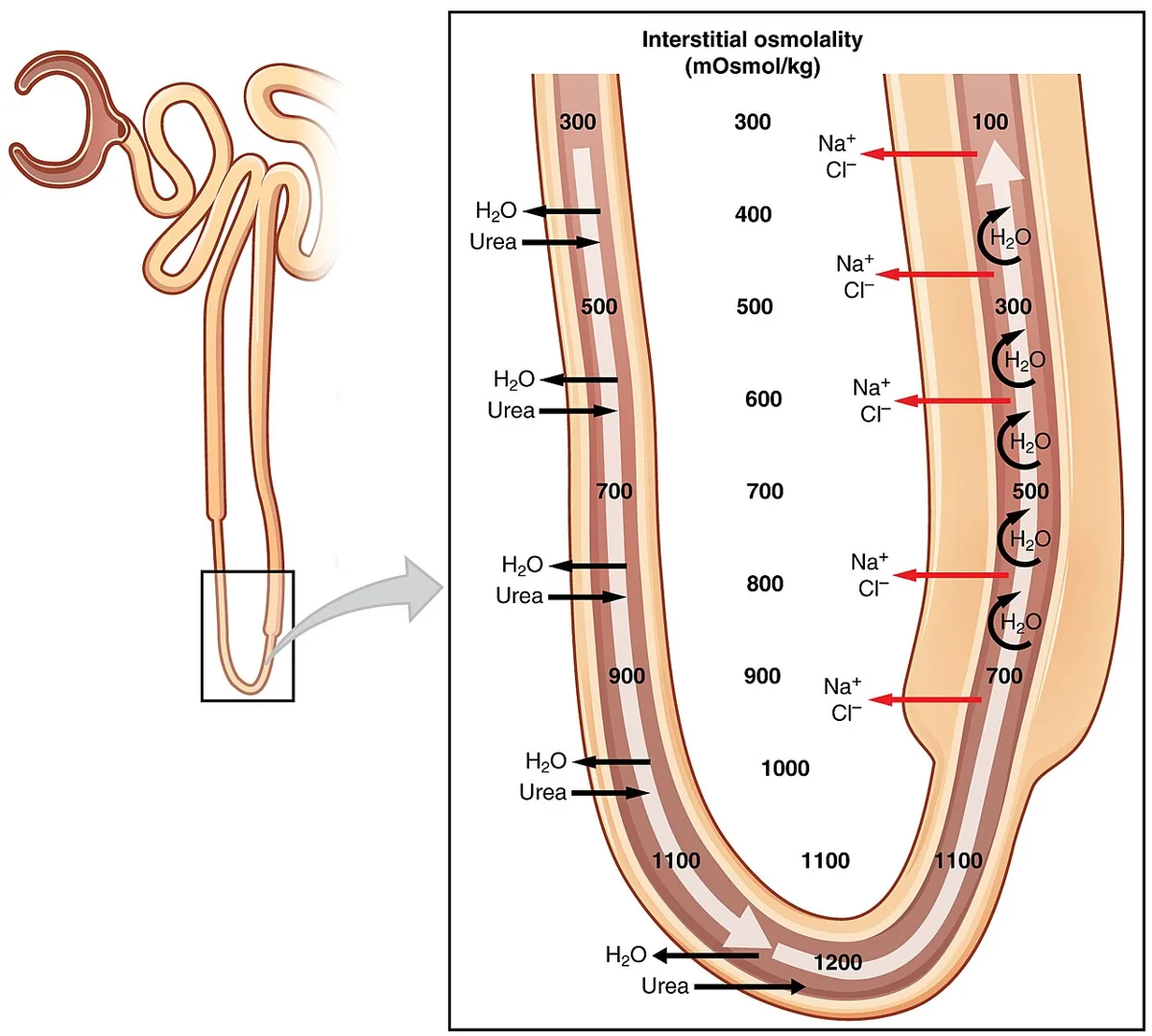
濃縮には2つが要る——①髄質の高い浸透圧勾配 ②集合管の水透過性(バソプレシンが上げる)。
勾配を作るもの。
| 要素 | 割合 | 作られ方 |
|---|---|---|
| NaCl | 約半分 | Henle 係蹄太い上行脚の NKCC2 が汲み上げる(対向流増幅系) |
| 尿素 | 約半分 | 内髄集合管から UT-A1/A3 で髄質へ再循環する |
直血管(vasa recta)が対向流交換系として、勾配を洗い流さずに保つ。
最大濃縮尿は約 1,200 mOsm/kg、最大希釈尿は約 50 mOsm/kg。
1日に捨てるべき溶質は約 600 mOsm——だから最低でも約 500 mL の尿が要る(不可避尿)。
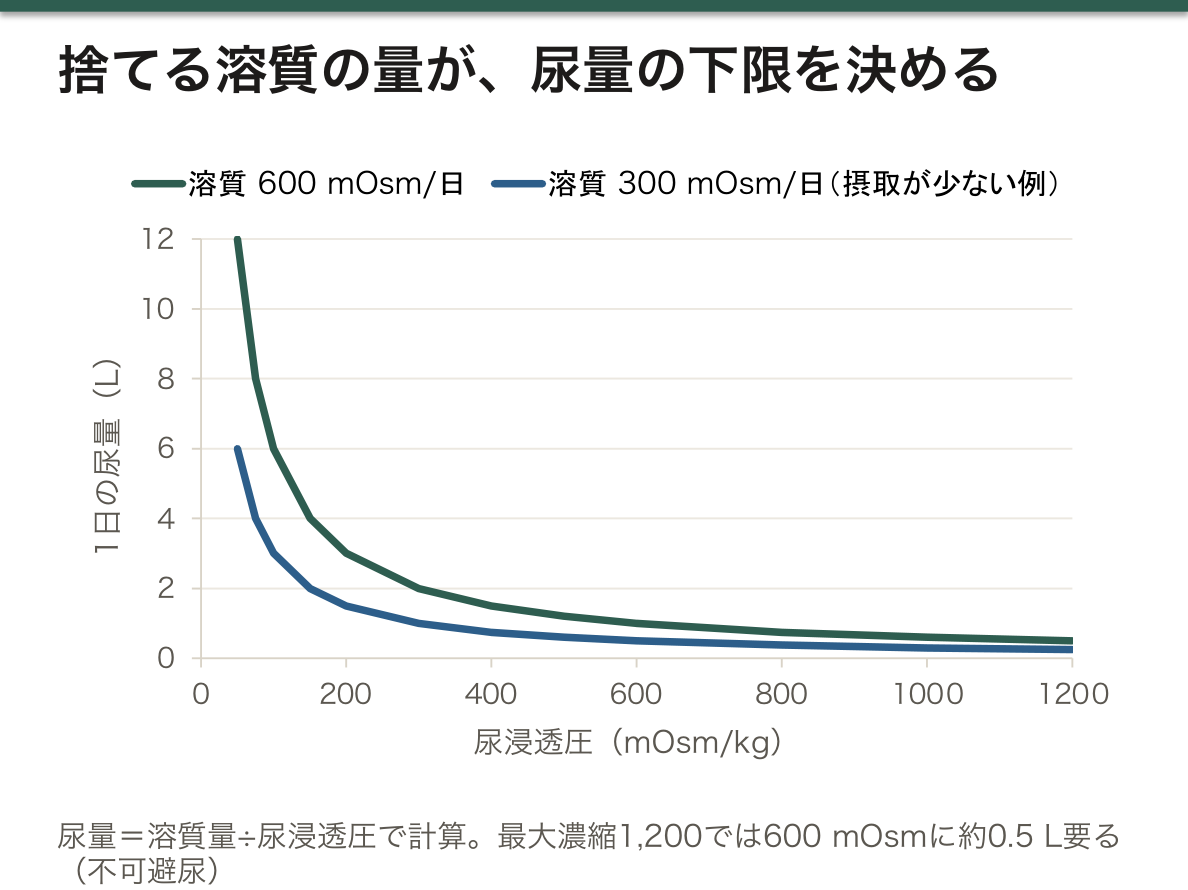
「尿素が濃縮の道具である」という点が、この項でいちばん見落とされる。低蛋白食や低栄養では尿素が足りず、髄質の勾配が作れないので濃縮できない(尿の濃縮の章)——「老廃物だと思っていた分子が、装置の部品になっている」。
不可避尿という考え方が、水中毒と高齢者の脱水の両方を説明する。溶質の摂取が少ないと、捨てられる水の量そのものが減る(水と細胞の章)——「ビールばかり飲むと低ナトリウム血症になる(beer potomania)」。
ループ利尿薬が強い理由も、この図から出てくる。NKCC2 を止めると、再吸収そのものだけでなく髄質の勾配も崩れるので、濃縮できなくなる(利尿薬の章)——「二重に効くので、他の利尿薬より作用が強い」。
尿浸透圧を測る意味も、ここで決まる。低ナトリウム血症で尿が薄ければ水の過剰、濃ければバソプレシンが出ている(SIADH・循環血漿量減少)(電解質の実際の章)——「1つの数字が、原因を2つに割る」。
尿崩症では、逆に濃縮できない。バソプレシンが出ない中枢性か、腎が反応しない腎性かを、デスモプレシン負荷で分ける(多飲・多尿の章)——「装置が無いのか、指令が無いのかを試す」。
English version
Core
Concentration requires two things — ① a high osmotic gradient in the medulla ② water permeability of the collecting duct (raised by vasopressin).
What makes the gradient.
| Component | Share | How it is made |
|---|---|---|
| NaCl | About half | Pumped up by NKCC2 in the thick ascending limb (the countercurrent multiplier) |
| Urea | About half | Recirculated into the medulla from the inner medullary collecting duct by UT-A1/A3 |
The vasa recta act as a countercurrent exchanger and preserve the gradient without washing it away.
Maximum concentration is about 1,200 mOsm/kg and maximum dilution about 50. About 600 mOsm of solute must be discarded daily — so at least about 500 mL of urine is unavoidable (obligatory urine).
Going further
That urea is a tool of concentration is what is most often overlooked here. On a low-protein diet or in malnutrition there is not enough urea, the medullary gradient cannot be built and the urine cannot be concentrated — a molecule taken for a waste product turns out to be a component of the apparatus.
The idea of obligatory urine explains both water intoxication and dehydration in the elderly. With little solute intake, the amount of water that can be discarded itself falls — drinking nothing but beer gives hyponatraemia (beer potomania).
Why loop diuretics are powerful comes out of the same diagram. Blocking NKCC2 stops not only the reabsorption but the medullary gradient, so the urine cannot be concentrated — a double action, and hence stronger than the others.
The meaning of measuring urine osmolality is settled here too. In hyponatraemia, dilute urine means excess water and concentrated urine means vasopressin is being released (SIADH, volume depletion) — one number dividing the cause in two.
In diabetes insipidus, conversely, it cannot be concentrated. Central (no vasopressin) is separated from nephrogenic (the kidney does not respond) by a desmopressin challenge — testing whether it is the apparatus or the command that is missing.
薬は腎で濃縮される — 腎障害が起きる場所は決まっている
腎は血流の 20〜25% を受け、濾過した液を 99% 再吸収する。つまり尿細管の中で、薬は何十倍にも濃縮される。腎毒性が多いのは偶然ではない。
| 近位尿細管の細胞毒性 | アミノグリコシド・シスプラチン・テノホビル・造影剤 | 取り込まれて細胞内に蓄積する。非乏尿性で、数日遅れて現れる |
| 急性間質性腎炎 | βラクタム・NSAID・プロトンポンプ阻害薬・アロプリノール | アレルギー機序。用量に依存しない。好酸球・発疹・尿中白血球 |
| 結晶性腎症 | アシクロビル・メトトレキサート・スルホンアミド・尿酸 | 尿細管内で析出して詰まる。補液と尿の pH 調整で防ぐ |
| 血行動態 | NSAID・ACE 阻害薬/ARB・利尿薬 | 細胞は傷んでいない。糸球体の圧が保てないだけ——中止で戻る |
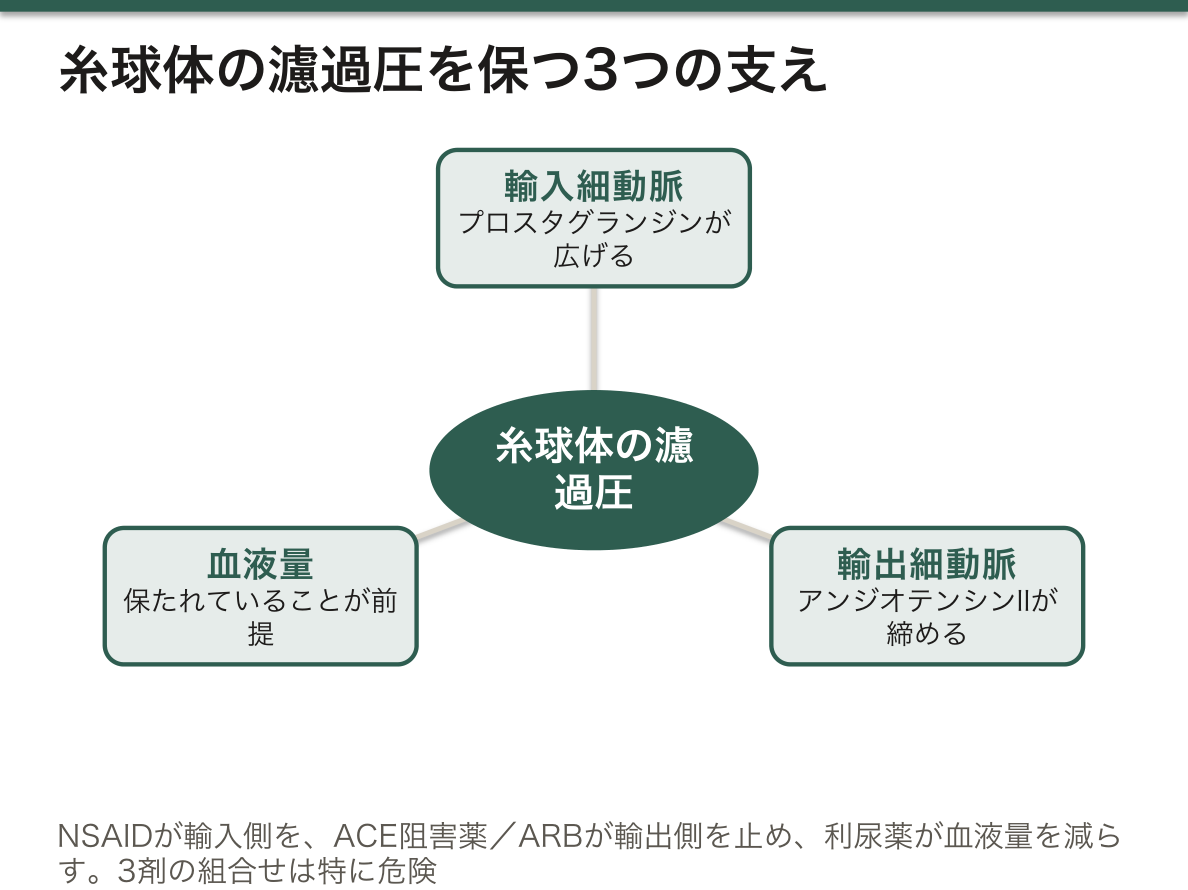
血行動態による腎前性の低下は、最も頻度が高く、最も防げる。
糸球体の濾過圧は輸入細動脈を広げるプロスタグランジンと、輸出細動脈を締めるアンジオテンシン II の釣り合いで保たれている。
- NSAID が前者を止め、ACE 阻害薬/ARB が後者を止める
- そこへ利尿薬で血液量が減ると、圧を保つ手段が無くなる
- この 3 剤の組合せは特に危険として知られている
⚠️ 単独では問題なく飲めていた薬が、脱水・発熱・下痢が加わった日に腎障害を起こす。だから体調不良のときは一時的に休薬するよう、あらかじめ指導しておく(sick day rules)。「ずっと飲んでいる薬だから安全」は成り立たない。
予防の要点は共通している。投与前に体液量を確保する・腎機能に応じて減量する・腎毒性のある薬を重ねない・可能なら投与回数を減らす(アミノグリコシドの 1 日 1 回投与は、濃度依存の殺菌効果を保ちつつ、蓄積を減らす設計である)。
腎機能が急に落ちた患者では、新しく始まった薬とその日の体調を必ず確認する。中止だけで戻ることが多い。
English version
Core
The kidney receives 20–25 per cent of the cardiac output and reabsorbs 99 per cent of what it filters. That is, within the tubule a drug is concentrated tens of times over. That nephrotoxicity is common is no accident.
| Pattern | Drugs | Features |
|---|---|---|
| Toxicity to the proximal tubule | Aminoglycosides, cisplatin, tenofovir, contrast media | Taken up and accumulating within the cell. Non-oliguric, appearing some days later |
| Acute interstitial nephritis | β-lactams, NSAIDs, PPIs, allopurinol | Allergic; not dose-dependent. Eosinophils, rash, leucocytes in the urine |
| Crystal nephropathy | Aciclovir, methotrexate, sulphonamides, urate | Precipitate within the tubule and obstruct it. Prevented by fluid and adjusting the urine pH |
| Haemodynamic | NSAIDs, ACE inhibitors/ARBs, diuretics | The cells are not injured; only the glomerular pressure cannot be maintained — it recovers on stopping |
Going further
The haemodynamic, prerenal fall is the commonest and the most preventable. The filtration pressure is held by the balance of prostaglandins dilating the afferent arteriole and angiotensin II constricting the efferent.
- An NSAID stops the former and an ACE inhibitor or ARB the latter.
- Add a diuretic and reduce the blood volume, and there is no means left of maintaining the pressure.
- This combination of three is known to be particularly dangerous.
⚠️ A drug taken without trouble on its own causes renal injury on the day dehydration, fever or diarrhoea is added. So instruct the patient in advance to withhold it temporarily when unwell (sick day rules). "I have taken it for years, so it is safe" does not hold.
The points of prevention are shared: secure the volume before giving it, reduce the dose for the renal function, do not stack nephrotoxic drugs, and where possible reduce the frequency (once-daily aminoglycoside dosing is designed to keep the concentration-dependent bactericidal effect while reducing accumulation).
In the clinic
In a patient whose renal function has fallen suddenly, always check what drug was newly started and how the patient was that day. It often recovers on stopping alone.
尿の色とにおいは、溶けているものを語っている
尿の性状は、いまも診断の手がかりになる。何が溶けているかで色が決まる。
| 赤〜赤褐色 | 血尿/ヘモグロビン尿/ミオグロビン尿 | 遠心して沈殿すれば血尿、上清が赤いままなら色素。潜血陽性だが赤血球が見えなければ後二者 |
| 放置すると赤〜黒 | ポルフィリン症/アルカプトン尿症 | 出したときは正常な色で、時間が経って変わるのが特徴 |
| 濃い黄褐色(振ると黄色の泡) | 抱合型ビリルビン | 閉塞性・肝細胞性の黄疸。泡が黄色いのが手がかり |
| 橙〜赤 | リファンピシン | 涙・汗も染まる。あらかじめ説明する |
| 暗赤〜褐色 | メトロニダゾール | 無害 |
| 緑〜青 | プロポフォール・アミトリプチリン・メチレンブルー | |
| 白濁 | 膿尿/乳び尿/リン酸塩の析出 | 乳び尿はリンパ管の交通(フィラリア症・外傷・腫瘍) |
においが診断名になっている代謝異常症がある。新生児の代謝異常を疑う場面で、実際に手がかりとして使われてきた。
| メープルシロップ様 | メープルシロップ尿症 | 分枝鎖ケト酸。病名がにおいから付いている |
| かび臭い・ネズミ様 | フェニルケトン尿症 | フェニル酢酸 |
| 足の裏・汗臭い | イソ吉草酸血症 | イソ吉草酸 |
| 茹でたキャベツ様 | チロシン血症 | |
| 魚臭 | トリメチルアミン尿症 | 腸内細菌が作るトリメチルアミンを酸化できない。体臭として現れ、社会生活に影響する |
⚠️ 甘いにおいには2種類ある。アセトン様(果実様)はケトーシスで、糖尿病性ケトアシドーシスや飢餓。メープルシロップ様は代謝異常症。混同しない。
アスパラガスを食べた後の特有のにおいは病気ではないが、においを感じられる人と感じられない人がいる(嗅覚の遺伝的多型)という点で、「所見が取れないこと」が観察者の側の問題でありうることを示す例になっている。
患者が「尿の色が変わった」と言ったら、いつから・薬を変えたか・出したときか置いた後かを聞く。それだけで鑑別がかなり絞れる。
English version
Core
The appearance of the urine is still a clue to diagnosis. What is dissolved in it decides the colour.
| Colour | Substance | Point |
|---|---|---|
| Red to red-brown | Haematuria / haemoglobinuria / myoglobinuria | Spin it: a deposit means haematuria; a red supernatant means a pigment. Blood positive with no red cells means the latter two |
| Darkens on standing | Porphyria / alkaptonuria | Normal when passed and changing with time is the characteristic |
| Deep yellow-brown with yellow froth | Conjugated bilirubin | Obstructive or hepatocellular jaundice. Yellow froth is the clue |
| Orange-red | Rifampicin | Tears and sweat are coloured too. Warn the patient in advance |
| Green-blue | Propofol, amitriptyline, methylene blue | — |
| Cloudy white | Pyuria / chyluria / phosphate precipitate | Chyluria means a lymphatic communication (filariasis, trauma, tumour) |
Going further
There are metabolic diseases named from their smell, and it has actually been used as a clue where a metabolic disorder is suspected in a newborn.
| Smell | Disease | Substance |
|---|---|---|
| Maple syrup | Maple syrup urine disease | Branched-chain keto acids. The disease is named from the smell |
| Musty, mousy | Phenylketonuria | Phenylacetate |
| Sweaty feet | Isovaleric acidaemia | Isovaleric acid |
| Boiled cabbage | Tyrosinaemia | — |
| Fishy | Trimethylaminuria | Trimethylamine made by the gut flora cannot be oxidised. It appears as body odour and affects social life |
⚠️ There are two kinds of sweet smell. Acetone (fruity) is ketosis — diabetic ketoacidosis or starvation. Maple syrup is a metabolic disease. Do not confuse them.
The characteristic smell after eating asparagus is not a disease, but some people can smell it and some cannot (a genetic polymorphism of olfaction) — an example showing that failure to elicit a sign may be a problem on the observer’s side.
In the clinic
When a patient says the colour of the urine has changed, ask since when, whether any drug has been changed, and whether it was so when passed or only after standing. That alone narrows the differential considerably.
まとめ
| 尿の生化学 — 何を測っているのか | 項目原理落とし穴尿蛋白(試験紙)指示薬の蛋白誤差。 |
|---|---|
| 結石の化学 — pHと、溶解度 | 結石割合X線尿pH要点シュウ酸カルシウム約80%写る—最多。 |
| 腎機能を測る分子 — クレアチニンが答えられないこと | 糸球体濾過量(GFR)を直接は測れないので、代わりの分子で推定する。 |
| 尿を濃縮する化学 — 尿素も、濃縮のための道具になっている | 濃縮には2つが要る——①髄質の高い浸透圧勾配 ②集合管の水透過性(バソプレシンが上げる)。 |
| 薬は腎で濃縮される — 腎障害が起きる場所は決まっている | 腎は血流の 20〜25% を受け、濾過した液を 99% 再吸収する。 |
| 尿の色とにおいは、溶けているものを語っている | 尿の性状は、いまも診断の手がかりになる。 |
このノートは医学生が授業の内容を自分の言葉でまとめたもので、診療の判断に使うものではありません。誤りに気づいたらお知らせください。