体液の管理では、「濃さ(浸透圧)」と「量(循環血漿量)」が別々に制御されていることを最初に押さえる。混同すると、低ナトリウム血症の輸液がまったく逆になる。
- 濃さを守るのは、バソプレシンと口渇——水の出入りで調節
- 量を守るのは、レニン・アンジオテンシン・アルドステロン系と交感神経——ナトリウムの出入りで調節
そして量が脅かされたときは、濃さを犠牲にしてでも量が優先される。
- アクアポリンとバソプレシン — 水だけを通す穴
- 細胞の容積調節 — 膨れるときと、縮むときの手当て
- 輸液の張度 — 入れた水は、どこへ行くのか
- 浸透圧性脱髄 — 速く直しすぎてはいけない理由
- 失われる体液の「濃さ」が、起きる電解質異常を決める
- 経口補水液は、輸送体の仕組みを使って設計されている
アクアポリンとバソプレシン — 水だけを通す穴
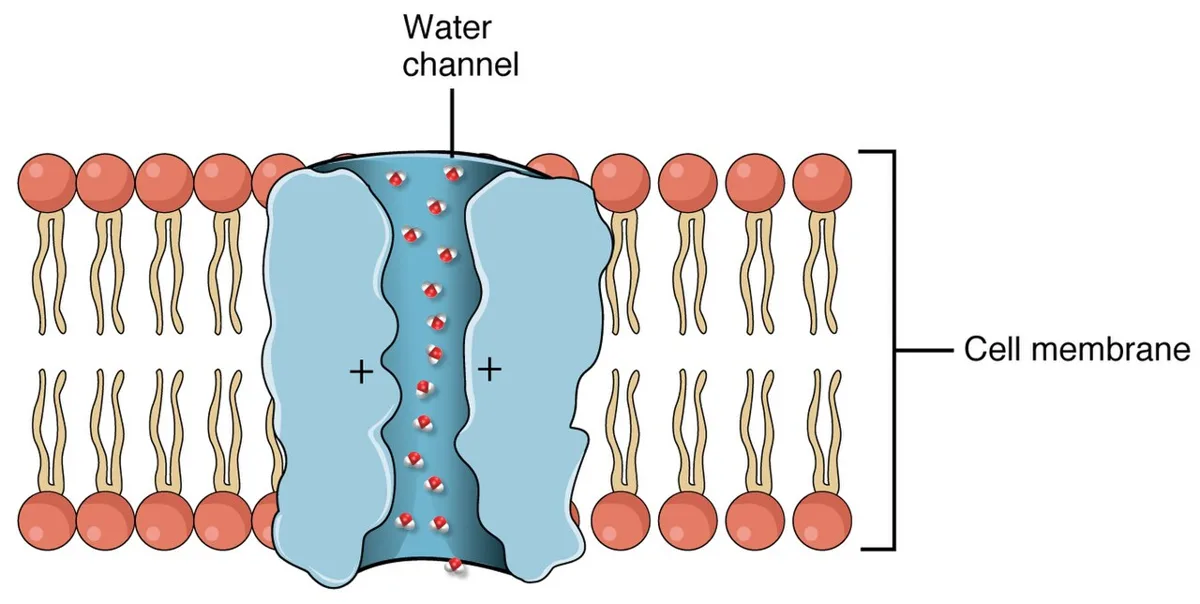
アクアポリンは水だけを通し、イオンとプロトンは通さない膜蛋白である。
| 種類 | 場所 | 制御 |
|---|---|---|
| アクアポリン2 | 集合管の管腔側 | バソプレシンで小胞から膜へ移動する |
| アクアポリン3・4 | 集合管の血管側 | 常時発現 |
| アクアポリン4 | 星状膠細胞 | 脳浮腫に関与。視神経脊髄炎の自己抗体の標的 |
- バソプレシンはV2受容体(集合管、環状AMP)とV1受容体(血管平滑筋、収縮)に働く
- 中枢性尿崩症——バソプレシンが出ない。デスモプレシンが効く
- 腎性尿崩症——受容体・アクアポリンの異常。デスモプレシンが効かない。リチウムが代表的な原因
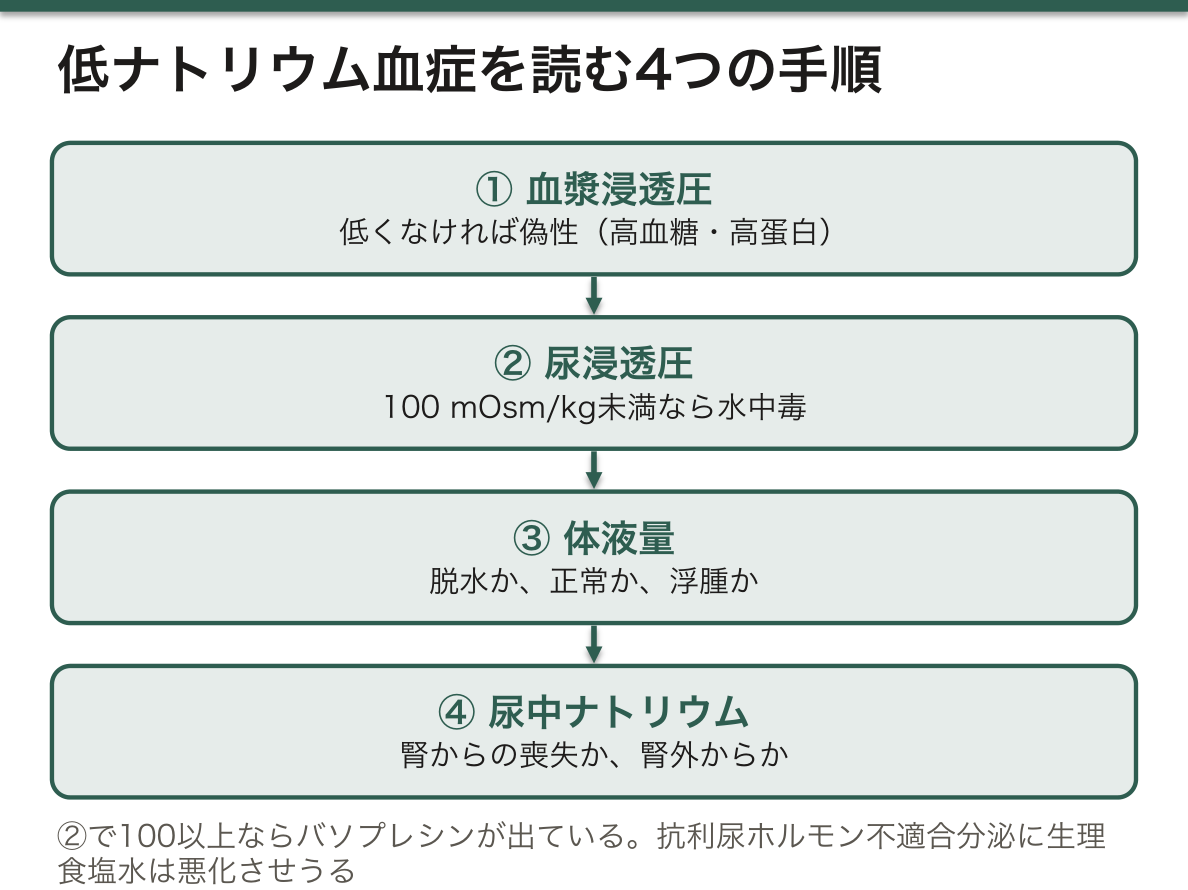
低ナトリウム血症を読むときの手順を、この生化学から組み立てる。
- 血漿浸透圧を測る——低くなければ偽性(高血糖・高蛋白)
- 尿浸透圧——100 mOsm/kg未満なら水中毒(バソプレシンは正しく止まっている)。それ以上ならバソプレシンが出ている
- 体液量——脱水か、正常か、浮腫か
- 尿中ナトリウム——腎からの喪失か、腎外からの喪失か
| 体液量 | 尿Na | 治療 | |
|---|---|---|---|
| 脱水(下痢・嘔吐) | 減少 | 低い | 生理食塩水 |
| 抗利尿ホルモン不適合分泌 | 正常 | 高い | 水制限。生理食塩水はむしろ悪化させうる |
| 心不全・肝硬変 | 増加(浮腫) | 低い | 水と塩の制限 |
抗利尿ホルモン不適合分泌に生理食塩水を入れると悪化しうるのは、尿が濃縮されているので、入れた塩は尿へ出て水だけが残るためである。「ナトリウムが低いから塩を入れる」という直感が裏切られる——尿浸透圧を見なければ判断できない。
補正の速度は生化学的な理由から制限される。慢性の低ナトリウム血症では、脳細胞が浸透圧物質を排出して容積を保っている。ここで急に血漿浸透圧を上げると脳細胞から水が抜けて、浸透圧性脱髄症候群を起こす。1日10 mEq/L以内が目安になる。低ナトリウム血症そのものより、直し方のほうが危ない。
English version
Core
Aquaporins are membrane proteins that pass water alone and not ions or protons.
| Type | Location | Control |
|---|---|---|
| Aquaporin 2 | The luminal side of the collecting duct | Moved from vesicles to the membrane by vasopressin |
| Aquaporins 3 and 4 | The vascular side of the collecting duct | Constitutively expressed |
| Aquaporin 4 | Astrocyte | Involved in cerebral oedema. The target of the autoantibody of neuromyelitis optica |
- Vasopressin acts at the V2 receptor (collecting duct, cyclic AMP) and the V1 receptor (vascular smooth muscle, contraction).
- Central diabetes insipidus — no vasopressin is released. Desmopressin works.
- Nephrogenic diabetes insipidus — an abnormality of the receptor or aquaporin. Desmopressin does not work. Lithium is the representative cause.
Going further
Build the sequence for reading a hyponatraemia out of this biochemistry.
- Plasma osmolality — if it is not low, it is pseudohyponatraemia (hyperglycaemia, high protein).
- Urine osmolality — below 100 mOsm/kg is water intoxication (vasopressin is correctly switched off). Above that, vasopressin is being released.
- Volume status — dehydrated, normal, or oedematous.
- Urinary sodium — loss through the kidney or outside it.
| Volume | Urine Na | Treatment | |
|---|---|---|---|
| Dehydration (diarrhoea, vomiting) | Reduced | Low | Normal saline |
| SIADH | Normal | High | Water restriction. Saline may make it worse |
| Heart failure, cirrhosis | Increased (oedema) | Low | Restriction of water and salt |
Saline can worsen SIADH because the urine is concentrated, so the salt given goes out in the urine and only the water remains. The intuition "the sodium is low, so give salt" is betrayed — it cannot be judged without looking at the urine osmolality.
The rate of correction is limited for a biochemical reason. In chronic hyponatraemia the brain cells have expelled osmolytes to keep their volume. Raise the plasma osmolality suddenly and water leaves the brain cells, giving osmotic demyelination syndrome. Within 10 mEq/L a day is the guide. The way it is corrected is more dangerous than the hyponatraemia itself.
細胞の容積調節 — 膨れるときと、縮むときの手当て
細胞は浸透圧の変化に対し、イオンと有機浸透圧物質を出し入れして容積を戻す。
- 膨れたとき——K⁺とCl⁻、およびタウリン・ミオイノシトール・グルタミンなどを排出する
- 縮んだとき——Na⁺を取り込み、有機浸透圧物質を合成・蓄積する
有機浸透圧物質を使うのは、蛋白の機能を乱さずに浸透圧を稼げるからである。イオン濃度を大きく変えると酵素が働かなくなる。
- 脳は頭蓋という固い箱に入っているため、この調節が生死に関わる
- 急性では間に合わず、慢性なら適応している——だから補正の速度が問題になる
「有効浸透圧(張度)」と「測定浸透圧」の区別が、この話の核心である。
- 張度を生むのは、膜を通れない粒子だけ——ナトリウム・グルコース(インスリン非依存組織以外)・マンニトール
- 尿素とエタノールは膜を自由に通るので、測定浸透圧は上げるが、水を動かさない
だから尿毒症で血漿浸透圧が高くても、細胞は縮まない。逆に透析で尿素を急に除去すると、脳内の尿素だけが残って水を引き込み、不均衡症候群になる。初回透析は短時間・低効率で行う——生化学が手技を決めている。
浸透圧ギャップは中毒の診断に使う。
計算浸透圧 = 2×Na⁺ + 血糖÷18 + 尿素窒素÷2.8
- 測定値と計算値の差が10 mOsm/kgを超えるなら、式に入っていない小分子がいる
- メタノール・エチレングリコール・イソプロパノール・エタノール
- 浸透圧ギャップ+アニオンギャップ開大性代謝性アシドーシスという組み合わせは、メタノールかエチレングリコールの中毒を強く示唆する
治療も生化学から出る。どちらもアルコール脱水素酵素で毒性代謝物(ギ酸・シュウ酸)に変わってから害を出すので、ホメピゾールかエタノールで酵素を占領して代謝を止め、その間に透析で除去する。「代謝させないこと」そのものが治療になる、珍しい例である。
English version
Core
Against a change of osmolality the cell moves ions and organic osmolytes in and out to restore its volume.
- When swollen — it expels K⁺ and Cl⁻ and taurine, myo-inositol and glutamine.
- When shrunken — it takes in Na⁺ and synthesises and accumulates organic osmolytes.
Organic osmolytes are used because they can raise the osmolality without disturbing the function of proteins. Change the ion concentrations greatly and the enzymes stop working.
- The brain is in the rigid box of the skull, so this regulation is a matter of life and death.
- In an acute change it cannot keep up; in a chronic one it has adapted — hence the rate of correction matters.
Going further
The distinction between "effective osmolality (tonicity)" and "measured osmolality" is the core of this account.
- Only particles that cannot cross the membrane create tonicity — sodium, glucose (outside the insulin-independent tissues), mannitol.
- Urea and ethanol cross freely, so they raise the measured osmolality without moving water.
So in uraemia the plasma osmolality is high and the cells do not shrink. Conversely, remove urea suddenly by dialysis and the urea remaining in the brain draws in water, giving the disequilibrium syndrome. The first dialysis is short and of low efficiency — biochemistry deciding the procedure.
The osmolal gap is used in the diagnosis of poisoning.
- Calculated osmolality = 2 × Na⁺ + glucose ÷ 18 + urea nitrogen ÷ 2.8
- If the difference between measured and calculated exceeds 10 mOsm/kg, there is a small molecule not in the formula.
- Methanol, ethylene glycol, isopropanol, ethanol.
- An osmolal gap plus a high anion gap metabolic acidosis strongly suggests methanol or ethylene glycol poisoning.
The treatment comes out of the biochemistry too. Both do harm only after alcohol dehydrogenase converts them into toxic metabolites (formate, oxalate), so fomepizole or ethanol occupies the enzyme and stops the metabolism while dialysis removes them. A rare instance in which not letting something be metabolised is itself the treatment.
輸液の張度 — 入れた水は、どこへ行くのか
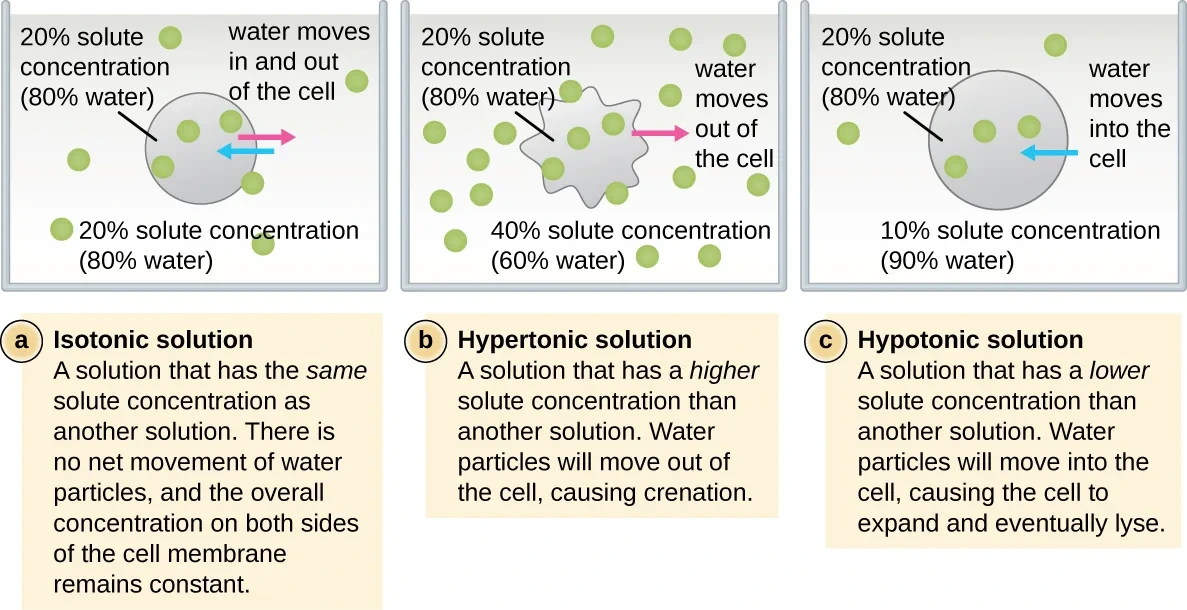
浸透圧と張度は別の概念になる——張度は「細胞膜を通れない溶質」だけで決まる。
尿素とエタノールは膜を自由に通るので、浸透圧は上げても張度は上げない。
| 輸液 | 張度 | 1 L 入れたときの行き先 |
|---|---|---|
| 5% ブドウ糖液 | 等張だが、糖が代謝されるので実質は自由水 | 全体液に分布(血管内には約 1/12) |
| 生理食塩水・乳酸リンゲル | 等張 | 細胞外液のみ(血管内には約 1/4) |
| 3% 食塩水 | 高張 | 細胞内から水を引き出す |
体液は体重の約 60%(細胞内 40%・細胞外 20%、うち血漿 5%)。
血漿浸透圧 ≒ 2×Na⁺ + 血糖/18 + BUN/2.8(mg/dL の場合)。
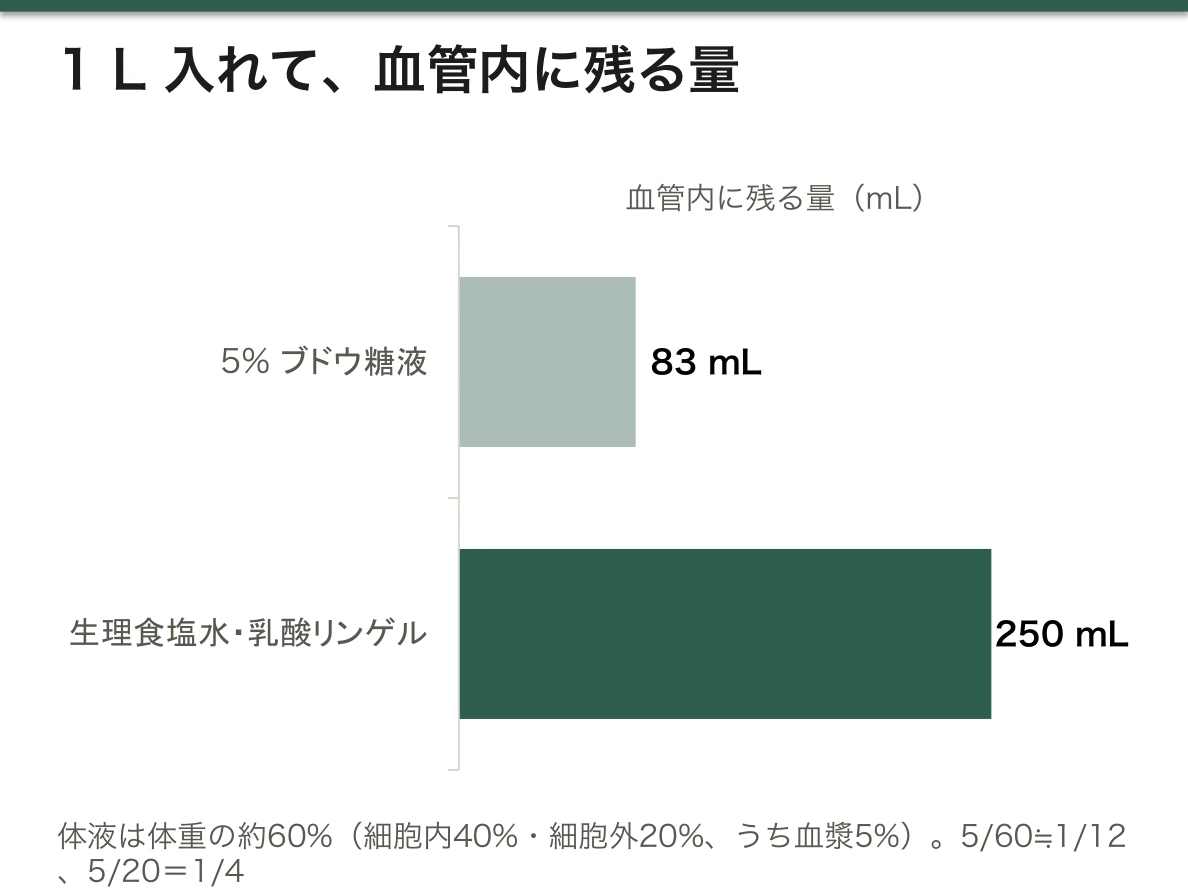
「水を入れたいのか、細胞外液を増やしたいのか」で選ぶ輸液が決まる。循環を支えたいときにブドウ糖液を入れても、ほとんど血管内に残らない(術中の輸液の章)——「目的が違えば、同じ 1 L の意味が違う」。
浸透圧ギャップは、この式から出てくる。実測浸透圧が計算値より 10 以上高ければ、式に入っていない溶質がある(中毒の章)——「メタノール・エチレングリコール・イソプロパノールを疑う」。
高血糖では、偽性低ナトリウム血症ではなく本当の希釈が起きる。糖が細胞外に留まって水を引き出すので、血糖 100 mg/dL 上昇につき Na⁺ が約 1.6〜2.4 mEq/L 下がる(電解質の実際の章)——「補正して読まないと、ナトリウムの異常を見誤る」。
高度の高脂血症や高蛋白血症では、測り方によって偽性低ナトリウム血症が起こる(測り方の原理の章)——「血漿の水の割合が減っているだけで、体の濃さは正常になる」。
尿素が張度を上げないことは、透析の合併症を説明する(腎代替療法の章)——「急速に尿素を除くと、脳内に残った溶質との差で水が脳へ入る(不均衡症候群)」。
English version
Core
Osmolality and tonicity are different concepts — tonicity is set only by solutes that cannot cross the cell membrane.
Urea and ethanol cross freely, so they raise the osmolality without raising the tonicity.
| Fluid | Tonicity | Where 1 L goes |
|---|---|---|
| 5% glucose | Isotonic, but the sugar is metabolised so it is effectively free water | Distributed through all the body water (about 1/12 stays intravascular) |
| Normal saline, lactated Ringer’s | Isotonic | Extracellular fluid only (about 1/4 intravascular) |
| 3% saline | Hypertonic | Draws water out of the cells |
Body water is about 60 per cent of body weight (intracellular 40, extracellular 20, of which plasma is 5).
Plasma osmolality ≈ 2 × Na⁺ + glucose/18 + BUN/2.8 (in mg/dL).
Going further
- Which fluid to choose is settled by whether one wants to give water or to expand the extracellular fluid. Give glucose solution to support the circulation and almost none stays in the vessels (the chapter on intraoperative fluids) — with a different object, the same litre means something different.
- The osmolal gap comes out of this formula. If the measured osmolality is more than 10 above the calculated, there is a solute not in the formula (the chapter on poisoning) — suspect methanol, ethylene glycol, isopropanol.
- In hyperglycaemia there is a true dilution rather than a pseudohyponatraemia. The sugar stays outside the cells and draws water out, so the Na⁺ falls about 1.6–2.4 mEq/L for each 100 mg/dL rise in glucose (the chapter on electrolytes in practice) — without correcting before reading, an abnormality of sodium is misjudged.
- With marked hyperlipidaemia or hyperproteinaemia, a pseudohyponatraemia arises according to the method of measurement (the chapter on the principles of measurement) — only the proportion of water in the plasma has fallen and the concentration in the body is normal.
- That urea does not raise tonicity explains a complication of dialysis (the chapter on renal replacement therapy) — remove urea rapidly and water enters the brain on the difference from the solute left within it (the disequilibrium syndrome).
浸透圧性脱髄 — 速く直しすぎてはいけない理由
脳細胞は、慢性の低ナトリウム血症に適応している。
- 数時間で無機イオン(K⁺・Cl⁻)を細胞外へ出す
- 数日で有機浸透圧物質(ミオイノシトール・タウリン・グルタミン)を捨てる
この適応があるので、慢性であれば血清ナトリウムが低くても症状が乏しい。
ところが有機浸透圧物質を戻すには、数日かかる。だから血清ナトリウムを急に上げると、脳細胞は水を失って縮み、脱髄が起こる。
補正の上限——1日 8〜10 mEq/L まで(高リスクでは 8 未満)。
症状は 2〜6 日遅れて出る——構音障害・嚥下障害・四肢麻痺・意識障害・閉じ込め症候群。
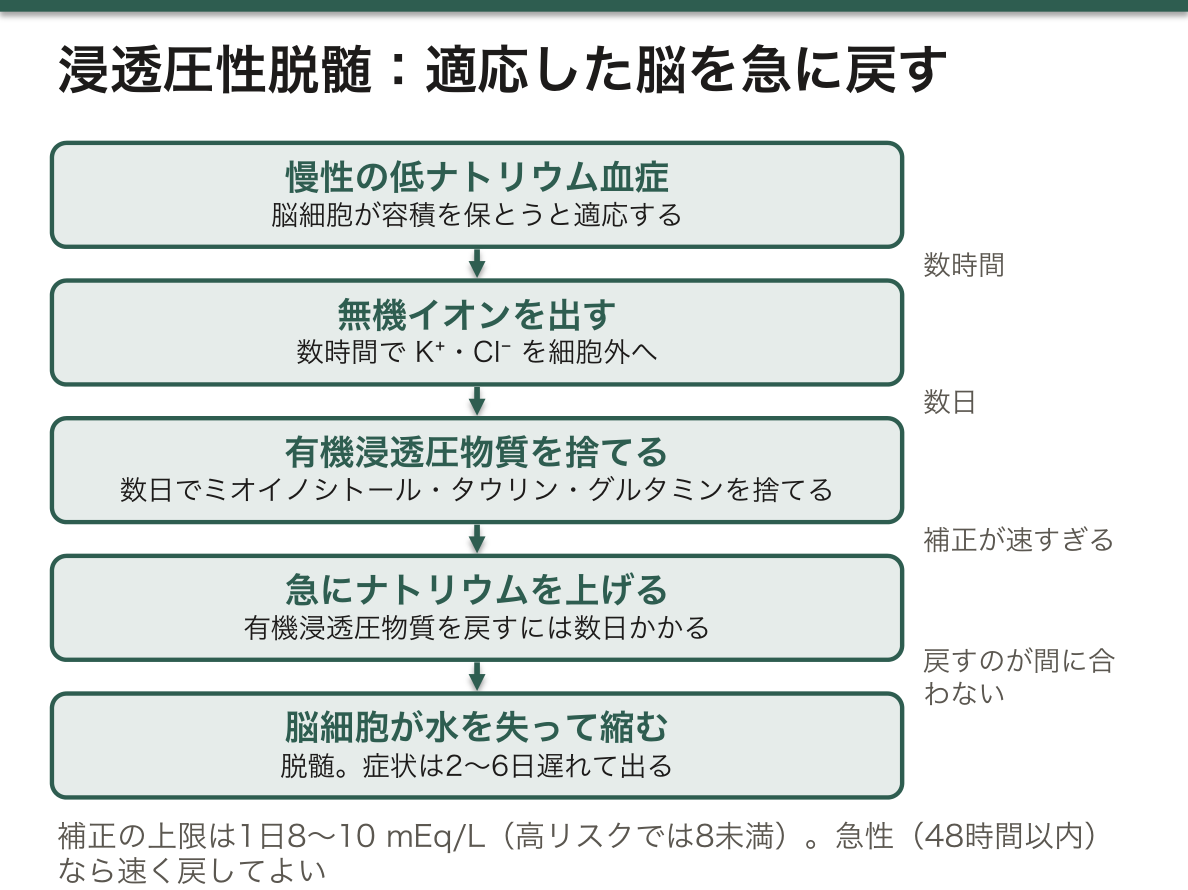
「適応が完成しているほど、戻すのが危険になる」という逆説が、この項の核心になる。急性(48時間以内)ならまだ適応していないので、速く戻してよい(電解質の実際の章)——「治療方針を分けるのは、数値ではなく経過の長さになる」。
だから最初に聞くのは「いつからか」になる——「けいれんや昏睡があれば急性として扱い、高張食塩水で速やかに数 mEq/L だけ上げる」。
危険が高いのは、適応が深く進んでいる人になる——「アルコール依存・低栄養・低カリウム血症・肝硬変・高度の低ナトリウム血症」。
意図せず速く上がってしまう場面がある。循環血漿量減少性の低ナトリウム血症に生理食塩水を入れると、バソプレシンの刺激が消えて一気に水利尿が起こる(尿の濃縮の項)——「治療が効いた瞬間に、補正が暴走する」。
上がりすぎたら、ブドウ糖液やデスモプレシンで意図的に下げ戻す(バソプレシンの章)——「速度そのものが治療の対象になる、数少ない病態になる」。
English version
Core
Brain cells adapt to chronic hyponatraemia.
- Within hours they put inorganic ions (K⁺, Cl⁻) out of the cell.
- Over days they discard organic osmolytes (myo-inositol, taurine, glutamine).
Because of this adaptation, symptoms are slight in a chronic case even with a low serum sodium.
But restoring the organic osmolytes takes days. So raise the serum sodium suddenly and the brain cells lose water, shrink, and demyelination follows.
The ceiling on correction — 8–10 mEq/L a day (under 8 in the high-risk).
Symptoms appear 2–6 days later — dysarthria, dysphagia, quadriparesis, impaired consciousness, locked-in syndrome.
Going further
- The core of this section is the paradox that the more complete the adaptation, the more dangerous the reversal. In an acute case (within 48 hours) adaptation has not yet occurred and it may be corrected quickly (the chapter on electrolytes in practice) — what divides the plan is not the number but the length of the course.
- Hence the first question is "since when" — with seizures or coma, treat it as acute and raise it a few mEq/L promptly with hypertonic saline.
- Those at highest risk are those in whom adaptation has gone deepest — alcohol dependence, malnutrition, hypokalaemia, cirrhosis, severe hyponatraemia.
- There are settings where it rises too fast unintentionally. Give saline in hypovolaemic hyponatraemia and the stimulus to vasopressin disappears, producing a sudden water diuresis (the section on concentrating the urine) — the correction running away at the moment the treatment works.
- If it has risen too far, deliberately bring it back down with glucose solution or desmopressin (the chapter on vasopressin) — one of the few conditions in which the rate itself is the object of treatment.
失われる体液の「濃さ」が、起きる電解質異常を決める
脱水を「水が減った」と一括りにすると、方向を誤る。出ていった液体が、血漿より濃いか薄いかで、残された体はまったく違う状態になる。
| 薄い液を失う | 発汗・不感蒸泄・尿崩症 | 水が優先的に減る → 高ナトリウム血症 |
| ほぼ等張の液を失う | 下痢・出血・third space への移行 | Na 濃度は変わらず、量だけ減る → 循環血液量の減少 |
| 濃い液を失う | 浸透圧利尿・利尿薬 | Na が水より多く出る → 低ナトリウム血症になりうる |
「脱水=ナトリウムが高い」ではない。利尿薬を飲んでいる高齢者の脱水では、むしろ低ナトリウム血症のことが多い。
だから補うものも変わる。失った液の組成に近いものを入れる、というのが原則になる。
- 発汗・不感蒸泄による脱水——自由水が足りない。5% ブドウ糖液や経口の水で補う
- 下痢・嘔吐・出血——細胞外液が足りない。生理食塩水や乳酸リンゲル液で補う。ここに自由水を入れると低 Na になる
嘔吐だけは、電解質の動きが独特である。胃液には塩酸が多くカリウムも含まれるので、低クロール性代謝性アルカローシス+低カリウム血症になる。しかも循環血液量の減少がアルドステロンを介してアルカローシスを維持するので、生理食塩水で量を戻さないとアルカローシスが治らない(生理食塩水反応性アルカローシス)。
⚠️ 高齢者の高ナトリウム血症は「水を飲めなかった」ことの結果であることが多い。口渇が鈍く、自分で水分を取れない状況(認知症・寝たきり・発熱)が背景にある。電解質の異常を見たら、その人の生活の状況を聞く——検査値の裏には、いつも行動がある。
補正の速度については、低ナトリウム血症を速く直しすぎないという原則が別項にある。
脱水の患者では、「何をどれくらい失ったか」を先に聞く。下痢か、発汗か、利尿薬か——それだけで入れるべき輸液が変わる。
English version
Core
Lump dehydration together as "water has been lost" and the direction is mistaken. According to whether the fluid that left was more or less concentrated than plasma, the body left behind is in an entirely different state.
| Losing a dilute fluid | Sweating, insensible loss, diabetes insipidus | Water is lost preferentially → hypernatraemia |
| Losing a nearly isotonic fluid | Diarrhoea, haemorrhage, movement into the third space | The Na concentration is unchanged and only the volume falls → reduced circulating volume |
| Losing a concentrated fluid | Osmotic diuresis, diuretics | More Na goes out than water → hyponatraemia can result |
"Dehydration = a high sodium" is not so. In the dehydration of an elderly person on a diuretic, hyponatraemia is if anything the commoner.
Going further
So what is replaced changes too. The principle is to give something close in composition to what was lost.
- Dehydration from sweating and insensible loss — free water is short. Replace with 5% glucose or water by mouth.
- Diarrhoea, vomiting, haemorrhage — extracellular fluid is short. Replace with saline or lactated Ringer’s. Give free water here and the sodium falls.
Vomiting alone has a distinctive electrolyte pattern. Gastric juice is rich in hydrochloric acid and contains potassium, so it gives a hypochloraemic metabolic alkalosis with hypokalaemia. And the reduced circulating volume maintains the alkalosis through aldosterone, so the alkalosis does not resolve until the volume is restored with saline (saline-responsive alkalosis).
⚠️ Hypernatraemia in an elderly person is usually the result of "being unable to drink". Behind it lies blunted thirst and a situation in which they cannot take fluid themselves (dementia, being bedbound, fever). Seeing an electrolyte abnormality, ask about the circumstances of that person’s life — behind a laboratory value there is always behaviour.
On the rate of correction, the principle not to correct hyponatraemia too fast is in a separate section.
In the clinic
In a dehydrated patient, first ask what was lost and how much. Diarrhoea, sweat or a diuretic — that alone changes the fluid to be given.
経口補水液は、輸送体の仕組みを使って設計されている
コレラのような分泌性下痢では、腸が水と電解質を大量に出す。ところが水を飲ませても吸収されない——出す力のほうが強いからである。
ここで使われたのが SGLT1 という共輸送体である。ナトリウムとブドウ糖を、必ず一緒に取り込むという性質を持つ。
- 分泌性下痢でも、この輸送体は壊れていない
- ブドウ糖を一緒に入れれば、ナトリウムが吸収される
- ナトリウムが動けば、水が浸透圧で後を追う
だから「塩+糖+水」という組成になる。点滴が要らず、経口で治療できるようになったことで、途上国の下痢による小児死亡が劇的に減った——生化学の知識が最も多くの命を救った例の1つに数えられている。
比が重要である。糖が多すぎると吸収されない糖が水を引き込み、下痢が悪化する。だから配合には最適点がある。
| 経口補水液 | Na 約 50 mEq/L・糖 約 1.8%・低浸透圧(約 245 mOsm/L) | 吸収を最大にする設計 |
| スポーツドリンク | Na が少なく(約 20 mEq/L)、糖が多い(6% 前後) | 味を優先している。脱水の治療には向かない |
| ジュース・炭酸飲料 | 糖が 10% 以上、Na はほぼ無い | 下痢を悪化させる。薄めても Na は増えない |
「浸透圧を下げたほうがよく効く」ことが試験で示され、現在の推奨は低浸透圧型になっている。糖を増やせば力が強くなる、という直感が誤りだった例である。
使い方の要点。
- 少量を頻回に——一度に飲ませると嘔吐する。スプーンで数分おきに
- 嘔吐があっても試す価値がある——少量なら吸収されることが多い
- ⚠️ 経口で追いつかない状況は点滴に切り替える——意識障害・循環不全・持続する嘔吐・重度脱水
SGLT1 の兄弟である SGLT2 は、腎で糖を再吸収している。同じ共輸送の仕組みが、片方では脱水の治療に、片方では糖尿病の薬(阻害薬)の標的になっている。
小児の胃腸炎で「水分を摂らせてください」とだけ伝えない。何を、どれくらいずつを具体的に言う。ジュースを勧めると悪化する。
English version
Core
In a secretory diarrhoea such as cholera the gut puts out a great deal of water and electrolyte. And yet drinking water does not get it absorbed — the secreting force is the stronger.
What was used here is a cotransporter called SGLT1. It has the property of always taking up sodium and glucose together.
- In secretory diarrhoea this transporter is not broken.
- Put glucose in with it and the sodium is absorbed.
- Once sodium moves, water follows it osmotically.
Hence the composition "salt + sugar + water". That treatment became possible by mouth without a drip reduced child mortality from diarrhoea in developing countries dramatically — counted among the instances in which biochemical knowledge saved the most lives.
Going further
The ratio matters. Too much sugar and the unabsorbed sugar draws in water and the diarrhoea worsens. So there is an optimum in the formulation.
| Oral rehydration solution | Na about 50 mEq/L, sugar about 1.8 per cent, low osmolality (about 245 mOsm/L) | Designed to maximise absorption |
| Sports drink | Na low (about 20 mEq/L), sugar high (around 6 per cent) | Taste takes priority. Not suited to treating dehydration |
| Juice, carbonated drinks | Sugar over 10 per cent, almost no Na | They worsen the diarrhoea. Diluting them does not add Na |
Trials showed that lowering the osmolality works better, and the present recommendation is the low-osmolality type. An instance in which the intuition that more sugar makes it stronger was wrong.
Key points of use.
- Small amounts, often — given all at once it is vomited. By the spoonful every few minutes.
- Worth trying even with vomiting — a small amount is often absorbed.
- ⚠️ Switch to a drip when the oral route cannot keep up — impaired consciousness, circulatory failure, persistent vomiting, severe dehydration.
SGLT2, the sibling of SGLT1, reabsorbs glucose in the kidney. The same cotransport mechanism is on one side the treatment of dehydration and on the other the target of a drug for diabetes (an inhibitor).
In the clinic
In childhood gastroenteritis, do not simply say "give fluids". Say specifically what, and how much at a time. Recommending juice makes it worse.
まとめ
| アクアポリンとバソプレシン — 水だけを通す穴 | アクアポリンは水だけを通し、イオンとプロトンは通さない膜蛋白である。 |
|---|---|
| 細胞の容積調節 — 膨れるときと、縮むときの手当て | 細胞は浸透圧の変化に対し、イオンと有機浸透圧物質を出し入れして容積を戻す。 |
| 輸液の張度 — 入れた水は、どこへ行くのか | 浸透圧と張度は別の概念になる——張度は「細胞膜を通れない溶質」だけで決まる。 |
| 浸透圧性脱髄 — 速く直しすぎてはいけない理由 | 脳細胞は、慢性の低ナトリウム血症に適応している。 |
| 失われる体液の「濃さ」が、起きる電解質異常を決める | 脱水を「水が減った」と一括りにすると、方向を誤る。 |
| 経口補水液は、輸送体の仕組みを使って設計されている | コレラのような分泌性下痢では、腸が水と電解質を大量に出す。 |
このノートは医学生が授業の内容を自分の言葉でまとめたもので、診療の判断に使うものではありません。誤りに気づいたらお知らせください。