酸素を使ってエネルギーを作ることには、必ず副産物が伴う。電子伝達系から漏れた電子が、活性酸素を作る。
だから活性酸素は、事故ではなく代謝の必然になる——「呼吸している限り、酸化は起き続けている」。
そして体は、これを2通りに扱っている。
- 消す——SOD → カタラーゼ/グルタチオンペルオキシダーゼ。ビタミンC・E
- 使う——好中球が細菌を殺すのに、わざと作っている(呼吸バースト)
「使う」側が壊れるのが慢性肉芽腫症になる——「殺菌の道具が作れないので、食べても殺せない」。
薬の副作用の一部も、この枠組みで説明できる——アセトアミノフェン中毒はグルタチオンの枯渇、G6PD 欠損症の溶血は還元力の不足になる。
電子伝達系はTCA回路と電子伝達系の章、ペントースリン酸経路は糖代謝の章、ビタミンはビタミンの章にある。
- 活性酸素の作られ方と、消し方
- オキシダーゼとオキシゲナーゼ — 酸素を「電子の受け手」にするか「材料」にするか
- 脂質過酸化の連鎖反応 — 1個のラジカルが膜を次々に壊す仕組みと、ビタミンの受け渡し
- わざと作る活性酸素 — 好中球の殺菌と、その破綻
- グルタチオンとG6PD — 赤血球が持つ、唯一の還元力
- 一酸化窒素 — 同じ分子が、信号にも毒にもなる
- 抗酸化サプリメントは、なぜ効かなかったのか
- Nrf2 — 酸化ストレスを感じて、防御を一斉に立ち上げる仕組み
活性酸素の作られ方と、消し方
作られる場所——電子伝達系(複合体IとIII)・NADPHオキシダーゼ・チトクロムP450・キサンチンオキシダーゼ。
種類と処理の順。
- スーパーオキシド(O₂⁻) →(SOD)→ 過酸化水素(H₂O₂) →(カタラーゼ/グルタチオンペルオキシダーゼ)→ 水
- ヒドロキシラジカル(·OH)——鉄が触媒する Fenton 反応で生じる。最も反応性が高く、これを消す酵素は無い
抗酸化系。
- 酵素——SOD(Cu/Zn型は細胞質、Mn型はミトコンドリア)・カタラーゼ(ペルオキシソーム)・グルタチオンペルオキシダーゼ(セレン)
- 非酵素——グルタチオン・ビタミンC(水溶性)・ビタミンE(膜)・尿酸・カロテノイド
還元型グルタチオンを保つのは NADPH で、その供給源がペントースリン酸経路になる。
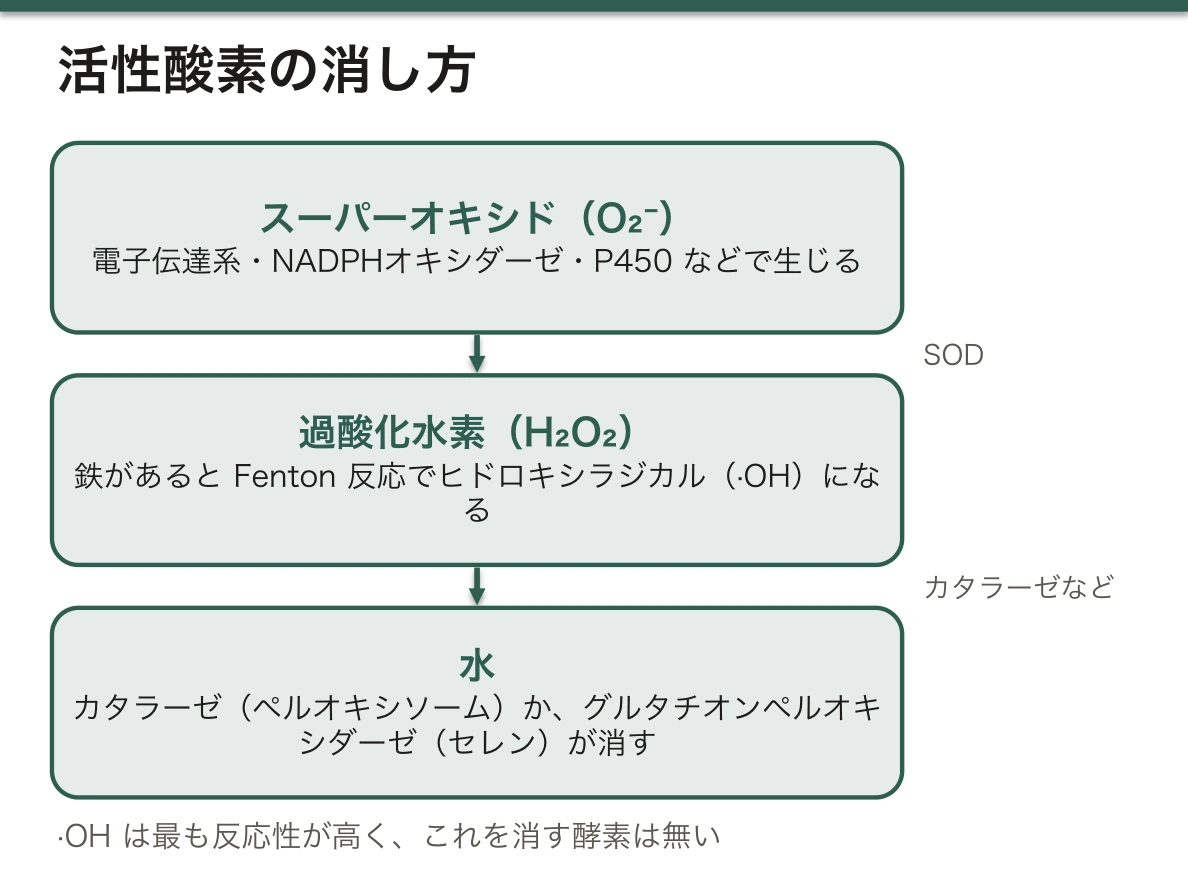
「ヒドロキシラジカルを消す酵素は無い」ことと「鉄が触媒する」ことが結びつくと、鉄過剰が臓器を壊す理由が出てくる(鉄代謝の章)——「遊離した鉄が、最も危険なラジカルを作り続ける」。
だから鉄キレート薬が、輸血依存の患者で臓器を守る(鉄過剰症の章)——「鉄を結合させておくことが、そのまま抗酸化になる」。
NADPH の供給が絶たれると、赤血球は酸化に耐えられなくなる。G6PD 欠損症では、酸化ストレス(薬・ソラマメ・感染)で急性溶血が起きる(溶血性貧血の章)——「赤血球にはミトコンドリアが無いので、この経路しか還元力の供給源が無い」。
そして酸化されたヘモグロビンが Heinz 小体として見える(赤血球の章)——「生化学の欠損が、顕微鏡の所見として出る」。
アセトアミノフェンの中毒も、グルタチオンの枯渇になる。代謝産物 NAPQI がグルタチオンを消費し、尽きると肝細胞を壊す(薬物代謝の章)——「解毒の材料が尽きた時点から、急に毒になる」。
だから解毒薬の N-アセチルシステインは、グルタチオンの材料を補っている(中毒の解毒薬の章)——「機序を知っていれば、解毒薬の名前を覚える必要が無い」。
English version
Core
Where it is made — the electron transport chain (complexes I and III), NADPH oxidase, cytochrome P450, xanthine oxidase.
The species and the order of disposal.
- Superoxide (O₂⁻) →(SOD)→ hydrogen peroxide (H₂O₂) →(catalase / glutathione peroxidase)→ water
- The hydroxyl radical (·OH) — formed in the iron-catalysed Fenton reaction. The most reactive, and there is no enzyme that removes it.
The antioxidant systems.
- Enzymes — SOD (the Cu/Zn form in the cytosol, the Mn form in the mitochondrion), catalase (peroxisome), glutathione peroxidase (selenium).
- Non-enzymatic — glutathione, vitamin C (water-soluble), vitamin E (membrane), urate, carotenoids.
What keeps glutathione reduced is NADPH, and its source is the pentose phosphate pathway.
Going further
- Join "no enzyme removes the hydroxyl radical" to "iron catalyses it" and the reason iron overload destroys organs appears (the chapter on iron metabolism) — free iron going on making the most dangerous radical.
- Hence iron chelators protect the organs of transfusion-dependent patients (the chapter on iron overload) — keeping iron bound is itself an antioxidant measure.
- Cut off the supply of NADPH and the red cell cannot withstand oxidation. In G6PD deficiency, oxidative stress (drugs, broad beans, infection) causes acute haemolysis (the chapter on haemolytic anaemia) — the red cell has no mitochondria, so this pathway is its only source of reducing power.
- And the oxidised haemoglobin is seen as Heinz bodies (the chapter on the red cell) — a biochemical deficiency appearing as a finding down the microscope.
- Paracetamol poisoning is also the exhaustion of glutathione. The metabolite NAPQI consumes glutathione and, once it runs out, destroys hepatocytes (the chapter on drug metabolism) — it turns poisonous suddenly at the point where the material for detoxification runs out.
- Hence the antidote N-acetylcysteine is supplying the material of glutathione (the chapter on antidotes in poisoning) — knowing the mechanism, there is no need to memorise the antidote’s name.
オキシダーゼとオキシゲナーゼ — 酸素を「電子の受け手」にするか「材料」にするか
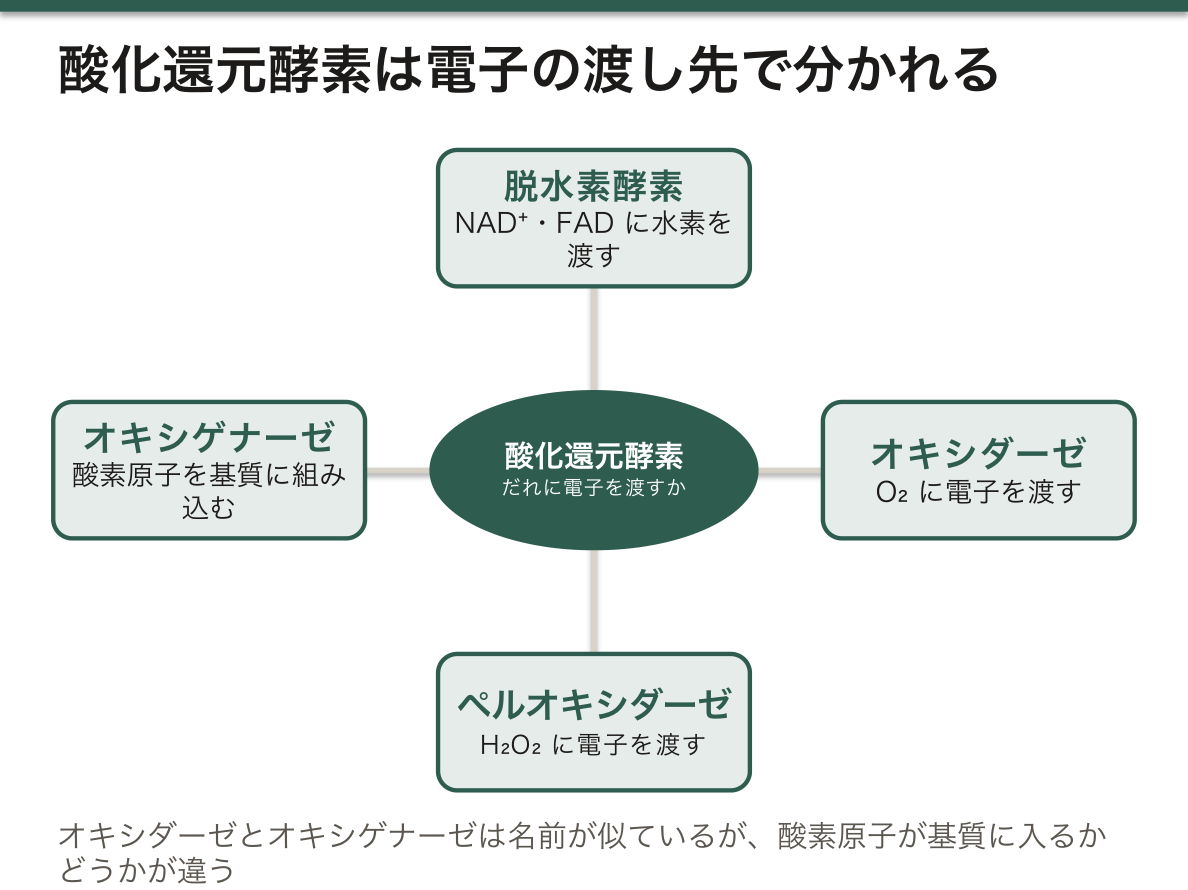
酸化還元酵素のうち、O₂ を使うものは2つに分かれる。名前が似ているが、酸素原子が基質に入るかどうかがまったく違う。
| オキシダーゼ(酸化酵素) | オキシゲナーゼ(酸素添加酵素) | |
|---|---|---|
| O₂ の役目 | 電子(と H)の受け手 | 酸素原子そのものを基質に組み込む |
| O₂ の行き先 | H₂O または H₂O₂ | 基質の –OH などの一部(残りは H₂O) |
| 反応の形 | AH₂+½O₂ → A+H₂O | 一原子酸素添加酵素:XH+O₂+NADPH+H⁺ → XOH+H₂O+NADP⁺ |
| 例 | シトクロム c オキシダーゼ(複合体 IV)・キサンチンオキシダーゼ・モノアミンオキシダーゼ・グルコースオキシダーゼ | シトクロム P450・フェニルアラニン水酸化酵素・ヘムオキシゲナーゼ・シクロオキシゲナーゼ(二原子酸素添加) |
ほかに、O₂ を使わない脱水素酵素(NAD⁺・FAD に水素を渡す)と、H₂O₂ を電子の受け手にするペルオキシダーゼがある。酸化還元酵素の4つの型を「電子をだれに渡すか」で並べると、NAD⁺/FAD(脱水素酵素)・O₂(オキシダーゼ)・H₂O₂(ペルオキシダーゼ)、そして酸素原子を取り込むオキシゲナーゼになる。
一原子酸素添加酵素(モノオキシゲナーゼ)は「混合機能酸化酵素」とも呼ばれる。O₂ の2つの酸素原子のうち、1つを基質に入れ、もう1つを NADPH の電子で水に還元するので、基質と NADPH の2つを同時に酸化している。シトクロム P450 がこの型で、脂溶性の薬や毒に –OH を付けて水に溶けやすくし、抱合と排泄につなぐ。ステロイドホルモンの合成(副腎の水酸化酵素群)とビタミン D の活性化(1α・25 位の水酸化)も同じ型である。
オキシダーゼの中には、O₂ を H₂O まで還元しきらずに H₂O₂ を作るものがある(キサンチンオキシダーゼ・モノアミンオキシダーゼ・ペルオキシソームのオキシダーゼ)。だからこうした酵素が多い場所には、H₂O₂ を壊すカタラーゼが一緒に置かれている。ペルオキシソームはその典型である。
キサンチンオキシダーゼはプリンを尿酸にする最後の酵素で、アロプリノール・フェブキソスタットの標的になる。この酵素は虚血のあと血流が戻るときに大量の活性酸素を作り、再灌流障害の一因になる。シトクロム P450 の誘導と阻害は薬物相互作用の主な原因で、グレープフルーツジュースが CYP3A4 を阻害する話はその代表である。
English version
Core
Oxidoreductases that use O₂ come in two kinds. The names are similar, but whether oxygen atoms end up in the substrate is completely different.
| Oxidase | Oxygenase | |
|---|---|---|
| Role of O₂ | Accepts electrons (and H) | Its oxygen atoms are built into the substrate |
| Where O₂ goes | H₂O or H₂O₂ | Part of the substrate (e.g. –OH); the rest to H₂O |
| Form | AH₂ + ½O₂ → A + H₂O | Monooxygenase: XH + O₂ + NADPH + H⁺ → XOH + H₂O + NADP⁺ |
| Examples | Cytochrome c oxidase (complex IV), xanthine oxidase, monoamine oxidase, glucose oxidase | Cytochrome P450, phenylalanine hydroxylase, haem oxygenase, cyclooxygenase (dioxygenase type) |
There are also dehydrogenases, which do not use O₂ (they pass hydrogen to NAD⁺ or FAD), and peroxidases, which use H₂O₂ as the electron acceptor. Sorted by ‘who takes the electrons’: NAD⁺/FAD (dehydrogenase), O₂ (oxidase), H₂O₂ (peroxidase), plus oxygenases, which insert oxygen atoms.
Going further
Monooxygenases are also called mixed-function oxidases. One oxygen atom of O₂ goes into the substrate and the other is reduced to water with electrons from NADPH, so the substrate and NADPH are oxidised together. Cytochrome P450 works this way: it adds –OH to fat-soluble drugs and toxins, making them more water-soluble for conjugation and excretion. Steroid hormone synthesis (adrenal hydroxylases) and vitamin D activation (1α- and 25-hydroxylation) use the same type.
Some oxidases do not reduce O₂ all the way to water but make H₂O₂ (xanthine oxidase, monoamine oxidase, peroxisomal oxidases). Where such enzymes are abundant, catalase sits nearby to destroy H₂O₂; the peroxisome is the classic example.
In the clinic
Xanthine oxidase is the last enzyme turning purines into uric acid and the target of allopurinol and febuxostat. When blood flow returns after ischaemia it produces much reactive oxygen and contributes to reperfusion injury. Induction and inhibition of cytochrome P450 are a main cause of drug interactions; grapefruit juice inhibiting CYP3A4 is the classic example.
脂質過酸化の連鎖反応 — 1個のラジカルが膜を次々に壊す仕組みと、ビタミンの受け渡し
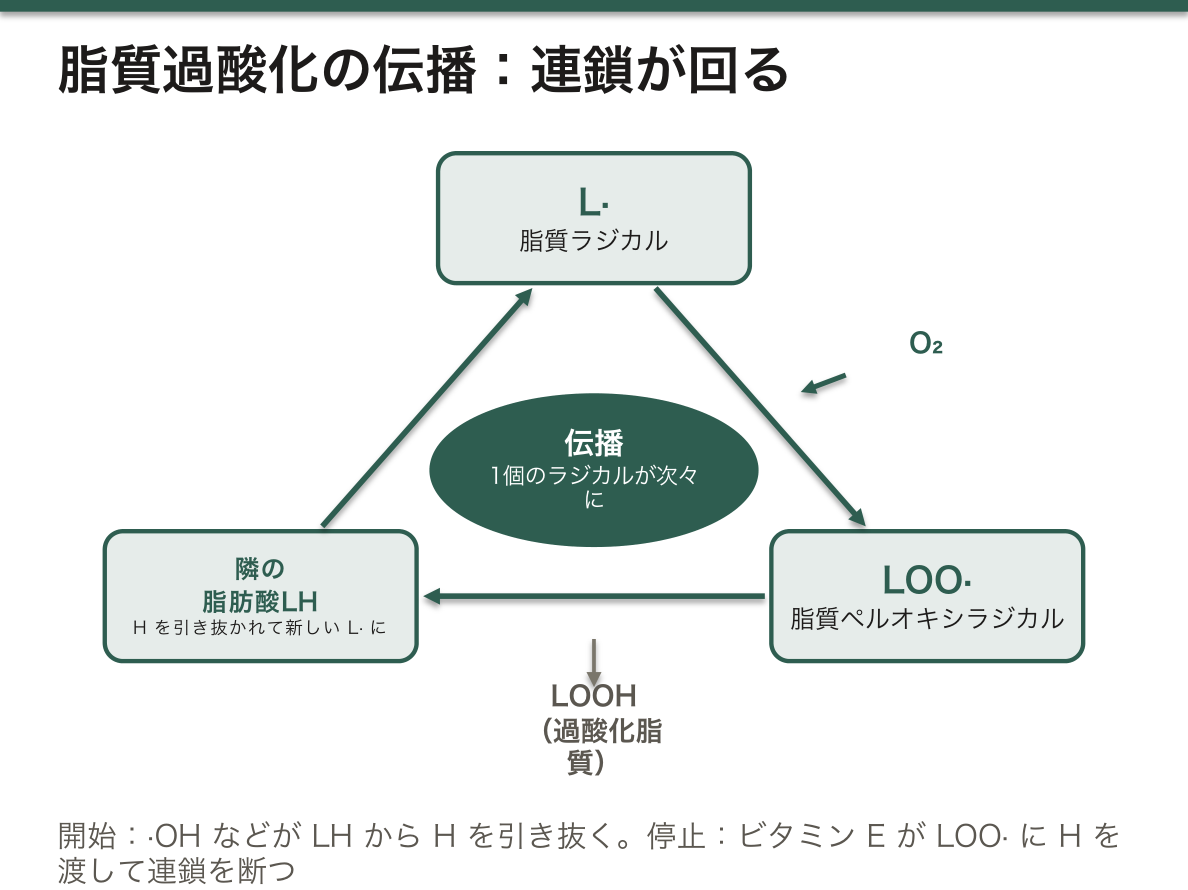
膜の多価不飽和脂肪酸は、活性酸素に最も壊されやすい分子である。反応は連鎖反応として3段階で進む。
| 段階 | 起きること |
|---|---|
| 開始 | ·OH などのラジカルが、脂肪酸(LH)の二重結合にはさまれた炭素から H を引き抜く → 脂質ラジカル L· |
| 伝播 | L· が O₂ と結合して脂質ペルオキシラジカル LOO· になる。LOO· は隣の脂肪酸から H を引き抜いて過酸化脂質 LOOH になり、隣に新しい L· を作る → これが繰り返される |
| 停止 | ラジカルどうしが結合するか、ビタミン E(α-トコフェロール)が LOO· に H を渡して連鎖を断つ |
過酸化脂質は分解してマロンジアルデヒド(MDA)や 4-ヒドロキシノネナールなどのアルデヒドになり、蛋白や DNA に結合して傷つける。MDA は酸化ストレスの指標として測られる。
蛋白も酸化される。最も酸化されやすいのは硫黄を持つ Cys と Met で、Lys・Arg・Pro・Thr の酸化や、脂質・糖の酸化産物との反応ではカルボニル基が生じる(カルボニル化蛋白)。DNA では 8-オキソグアニンが代表的な変化である。
なぜ多価不飽和脂肪酸が狙われるのか。2つの二重結合にはさまれた –CH₂– の C–H 結合は特に弱く、H が抜けたあとのラジカルが2つの二重結合にまたがって安定化できるからである。二重結合が多い脂肪酸(アラキドン酸・DHA)ほど過酸化されやすい。
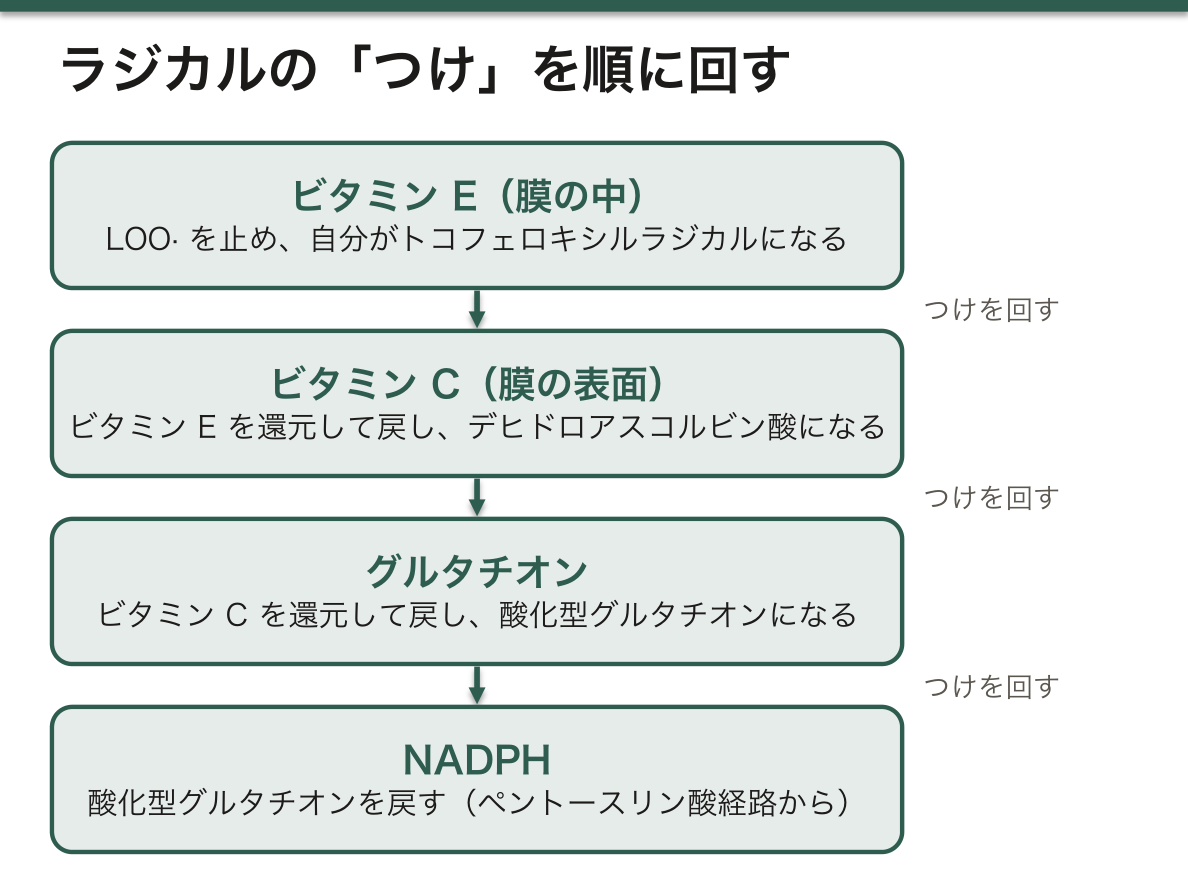
抗酸化ビタミンは、互いに再生し合う。ビタミン E は膜の中で LOO· を止めると、自分がトコフェロキシルラジカルになる。これを膜の表面でビタミン Cが還元してビタミン E に戻し、酸化されたビタミン C(デヒドロアスコルビン酸)はグルタチオンが還元し、酸化型グルタチオンはNADPH(ペントースリン酸経路)が戻す。脂溶性(膜の中)→ 水溶性(細胞質)→ 代謝の還元力へと、ラジカルの「つけ」が順に回されていく。β-カロテン(ビタミン A の前駆体)は一重項酸素を消し、植物のフラボノイドもラジカルを捕まえるが、体内での効果の大きさははっきりしない。
膜の過酸化脂質を直接還元して止める酵素が、セレンを含むグルタチオンペルオキシダーゼ 4(GPX4)である。この酵素が働かなくなると、鉄に依存した脂質過酸化で細胞が死ぬ(フェロトーシス)。
酸化された LDL はマクロファージのスカベンジャー受容体に取り込まれて泡沫細胞になり、粥状硬化の始まりになる。ビタミン E 欠乏(脂肪の吸収障害・無βリポ蛋白血症)では、膜の多い神経と赤血球が傷つき、運動失調・末梢神経障害・溶血が起きる。
English version
Core
Polyunsaturated fatty acids in membranes are the molecules most easily damaged by reactive oxygen. The damage runs as a chain reaction in three stages.
| Stage | What happens |
|---|---|
| Initiation | A radical such as ·OH pulls H from the carbon between two double bonds of a fatty acid (LH) → lipid radical L· |
| Propagation | L· binds O₂ → lipid peroxyl radical LOO·. LOO· pulls H from the next fatty acid → lipid hydroperoxide LOOH and a new L· → repeat |
| Termination | Two radicals combine, or vitamin E (α-tocopherol) gives H to LOO· and breaks the chain |
Lipid hydroperoxides break down to aldehydes such as malondialdehyde (MDA) and 4-hydroxynonenal, which bind and damage proteins and DNA. MDA is measured as a marker of oxidative stress.
Proteins are oxidised too. Most sensitive are the sulphur-containing Cys and Met; oxidation of Lys, Arg, Pro and Thr and reactions with lipid and sugar oxidation products create carbonyl groups (protein carbonylation). In DNA, 8-oxoguanine is the typical lesion.
Going further
Why are polyunsaturated fatty acids the target? The C–H bond of a –CH₂– between two double bonds is especially weak, and the radical left behind is stabilised across both double bonds. The more double bonds (arachidonic acid, DHA), the easier the peroxidation.
Antioxidant vitamins recycle each other. Vitamin E stops LOO· in the membrane and becomes a tocopheroxyl radical. At the membrane surface vitamin C reduces it back to vitamin E; oxidised vitamin C (dehydroascorbate) is reduced by glutathione; oxidised glutathione is reduced by NADPH (pentose phosphate pathway). The radical’s ‘debt’ is passed from fat-soluble (membrane) to water-soluble (cytosol) to metabolic reducing power. β-Carotene (pro-vitamin A) quenches singlet oxygen and plant flavonoids also trap radicals, but how much they do in the body is unclear.
The enzyme that directly reduces membrane lipid hydroperoxides is selenium-containing glutathione peroxidase 4 (GPX4). Without it, cells die by iron-dependent lipid peroxidation (ferroptosis).
In the clinic
Oxidised LDL is taken up by macrophage scavenger receptors, forming foam cells and starting atherosclerosis. In vitamin E deficiency (fat malabsorption, abetalipoproteinaemia) membrane-rich nerves and red cells are damaged: ataxia, peripheral neuropathy and haemolysis.
わざと作る活性酸素 — 好中球の殺菌と、その破綻
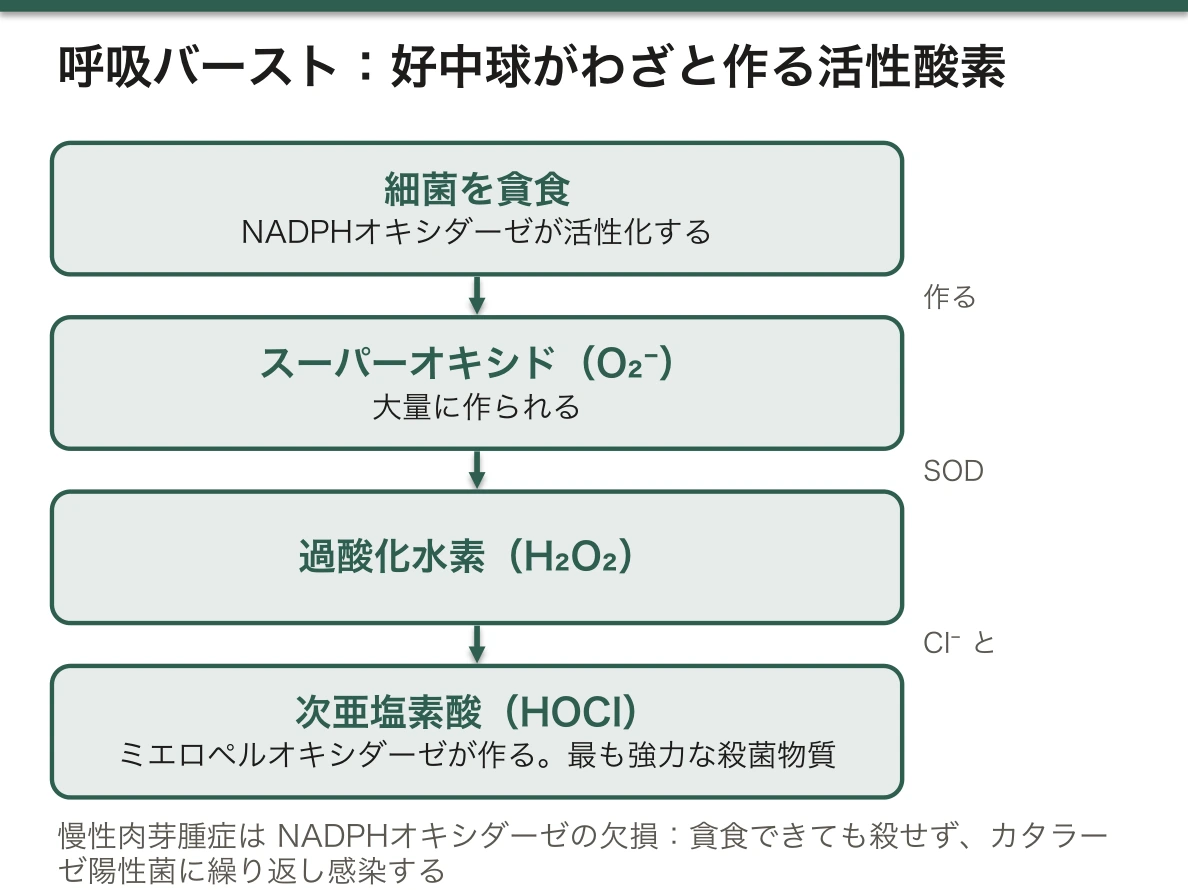
呼吸バースト——好中球が細菌を貪食すると、NADPHオキシダーゼが活性化して大量の O₂⁻ を作る。
- O₂⁻ → H₂O₂ →(ミエロペルオキシダーゼ+Cl⁻)→ 次亜塩素酸(HOCl)
- 次亜塩素酸が、最も強力な殺菌物質になる
慢性肉芽腫症——NADPHオキシダーゼの欠損。多くはX連鎖劣性。
- 貪食はできるが殺せない。だからカタラーゼ陽性菌(黄色ブドウ球菌・セラチア・ノカルジア・アスペルギルス・バークホルデリア)に繰り返し感染する
- 診断——ジヒドロローダミン試験(旧:NBT還元試験)
- 肉芽腫を作る——殺せない菌を囲い込むため
ミエロペルオキシダーゼ欠損症——より軽症。カンジダ感染が問題になることがある。
「カタラーゼ陽性菌に弱い」という一文が、この病気の要点そのものになる。カタラーゼ陰性菌は自分の作る H₂O₂ を分解できず、それを患者の好中球が借りて殺せる(細菌の分類の章)——「敵が落とした武器を使う、という状況になっている」。
だからカタラーゼ陽性の菌だけが生き残る(免疫不全の章)——「感染する菌の顔ぶれが、欠損した機能を教える」。
免疫不全の鑑別は、この「どの菌に感染するか」から入る(免疫不全の鑑別の章)——「莢膜を持つ菌なら抗体か補体、細胞内寄生菌ならT細胞、カタラーゼ陽性菌なら食細胞になる」。
治療は予防投与とインターフェロンγになる。ST合剤とイトラコナゾール——「殺菌能を戻せないので、菌に出会う量を減らす」。
活性酸素の過剰は、再灌流障害の主な機序でもある。虚血中に溜まったヒポキサンチンが、再灌流の酸素でラジカルに変わる(虚血再灌流障害の章)——「血流を戻した瞬間が、最も傷む」。
だから血流の再開は、心筋梗塞でも脳梗塞でも「早いほど良いが、無害ではない」ことになる(再灌流療法の章)——「治療そのものが、別の傷害を作る」。
English version
Core
The respiratory burst — when a neutrophil phagocytoses a bacterium, NADPH oxidase is activated and makes a great deal of O₂⁻.
- O₂⁻ → H₂O₂ →(myeloperoxidase + Cl⁻)→ hypochlorous acid (HOCl)
- Hypochlorous acid is the most powerful bactericidal substance.
Chronic granulomatous disease — deficiency of NADPH oxidase. Mostly X-linked recessive.
- It can phagocytose and cannot kill. Hence repeated infection with catalase-positive organisms (Staph. aureus, Serratia, Nocardia, Aspergillus, Burkholderia).
- Diagnosis — the dihydrorhodamine test (formerly the NBT reduction test).
- It forms granulomas — to wall off the organisms it cannot kill.
Myeloperoxidase deficiency — milder. Candida infection can be a problem.
Going further
- The single sentence "vulnerable to catalase-positive organisms" is the crux of this disease. A catalase-negative organism cannot degrade the H₂O₂ it makes itself, and the patient’s neutrophils borrow it to kill (the chapter on the classification of bacteria) — a situation of using the weapon the enemy has dropped.
- Hence only the catalase-positive organisms survive (the chapter on immunodeficiency) — the roster of organisms that infect telling which function is missing.
- The differential of immunodeficiency starts from this "which organisms infect" (the chapter on the differential of immunodeficiency) — encapsulated organisms point to antibody or complement, intracellular organisms to T cells, catalase-positive organisms to phagocytes.
- Treatment is prophylaxis and interferon γ. Co-trimoxazole and itraconazole — the killing capacity cannot be restored, so reduce the load of organisms met.
- An excess of reactive oxygen is also the chief mechanism of reperfusion injury. The hypoxanthine accumulated during ischaemia turns into radicals with the oxygen of reperfusion (the chapter on ischaemia–reperfusion injury) — the moment the flow is restored is when the damage is greatest.
- Hence restoring flow, in myocardial and in cerebral infarction alike, is "the sooner the better, but not harmless" (the chapter on reperfusion therapy) — the treatment itself creating another injury.
グルタチオンとG6PD — 赤血球が持つ、唯一の還元力
赤血球はミトコンドリアも核も持たないので、還元力はペントースリン酸経路の NADPH だけになる。
道筋——グルコース6-リン酸 →(G6PD)→ NADPH → グルタチオン還元酵素 → 還元型グルタチオン(GSH)→ グルタチオンペルオキシダーゼが過酸化水素を消す。
G6PD 欠損症は、世界で最も多い酵素欠損症(X連鎖)。マラリア流行地域に多く残っている。
誘因——感染・ソラマメ・薬(スルホンアミド・ニトロフラントイン・プリマキン・ラスブリカーゼ・ダプソン)。
血液塗抹——Heinz 小体(変性ヘモグロビンの凝集)と、脾で齧られた bite cell。
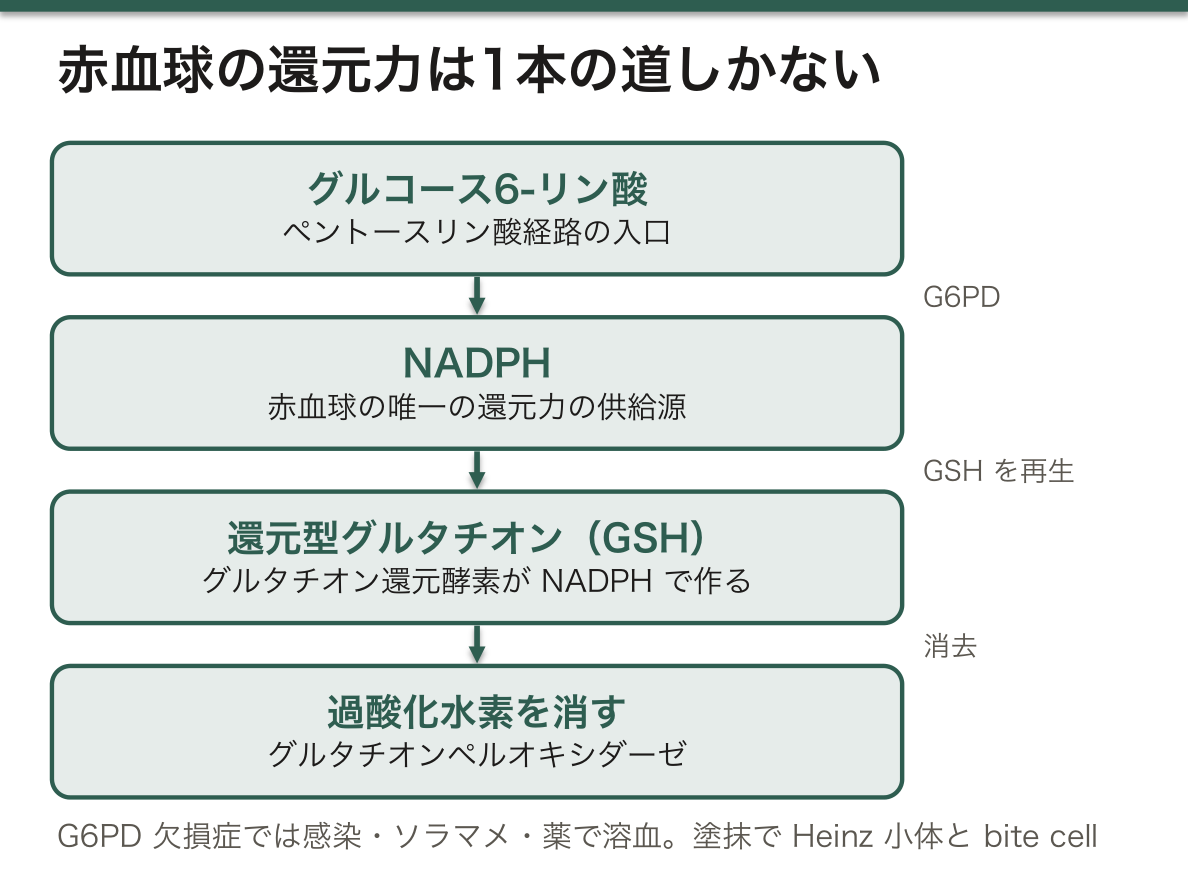
「予備を持たない細胞は、消耗品の1つが欠けただけで壊れる」という話がここに集約されている。赤血球は他の代謝経路で埋め合わせができない(ペントースリン酸経路の章)——「同じ酵素の欠損でも、赤血球だけが症状を出す理由になる」。
発作性であることが、診断のときの落とし穴になる。溶血の直後は、酵素活性の高い若い赤血球(網赤血球)ばかりが残るので、酵素活性が正常に見える(溶血の章)——「発作が落ち着いてから測り直す」。
マラリアとの関係は、鎌状赤血球やサラセミアと同じ構図になる(鎌状赤血球症の章)——「感染症が、有害な遺伝子を集団に残す圧力になった」。
グルタチオンは、赤血球以外でも解毒の中心になる。アセトアミノフェンの NAPQI を捕まえるのも同じ分子で、在庫が尽きると肝が壊れる(アセトアミノフェン中毒の項)——「1つの還元剤が、赤血球と肝で別の毒を引き受けている」。
だから G6PD 欠損症の患者では、酸化ストレスをかける薬を投与前に確認する(個体差の章)——「渡航前のマラリア予防薬が、実際に問題になる場面になる」。
English version
Core
The red cell has neither mitochondria nor a nucleus, so its only reducing power is the NADPH of the pentose phosphate pathway.
The route — glucose 6-phosphate →(G6PD)→ NADPH → glutathione reductase → reduced glutathione (GSH) → glutathione peroxidase removes hydrogen peroxide.
G6PD deficiency is the commonest enzyme deficiency in the world (X-linked). It has remained common in malarial regions.
Triggers — infection, broad beans, drugs (sulphonamides, nitrofurantoin, primaquine, rasburicase, dapsone).
Blood film — Heinz bodies (aggregates of denatured haemoglobin) and bite cells, nibbled in the spleen.
Going further
- The story "a cell with no reserve breaks when a single consumable is missing" is concentrated here. The red cell cannot make up for it by another pathway (the chapter on the pentose phosphate pathway) — the reason that, with the same enzyme deficiency, only the red cell shows symptoms.
- Being episodic is the pitfall in diagnosis. Just after a haemolytic episode only young red cells (reticulocytes) with high enzyme activity remain, so the activity looks normal (the chapter on haemolysis) — re-measure once the episode has settled.
- The relation with malaria has the same structure as sickle cell and thalassaemia (the chapter on sickle cell disease) — an infection becoming the pressure that keeps a harmful gene in the population.
- Glutathione is central to detoxification outside the red cell too. The same molecule traps the NAPQI of paracetamol, and when the stock runs out the liver breaks (the section on paracetamol poisoning) — one reducing agent taking on different poisons in red cell and in liver.
- Hence, in a patient with G6PD deficiency, check before giving a drug that imposes oxidative stress (the chapter on individual variation) — malaria prophylaxis before travel being a setting where this really arises.
一酸化窒素 — 同じ分子が、信号にも毒にもなる
L-アルギニンから一酸化窒素合成酵素(NOS)が作る。副産物はシトルリン。
| 型 | どこに | 量と性質 |
|---|---|---|
| eNOS(内皮型) | 血管内皮 | 少量・持続的。血管を広げる |
| nNOS(神経型) | 神経 | 神経伝達物質として |
| iNOS(誘導型) | マクロファージなど | 大量・炎症で誘導される。殺菌と、組織傷害 |
信号としての道筋——NO → 可溶性グアニル酸シクラーゼ → cGMP → 血管平滑筋の弛緩。
毒としての道筋——NO + スーパーオキシド → ペルオキシナイトライト(強力な酸化剤)。
気体なので貯蔵できず、作られたその場で働き、すぐ消える。
「量が性質を決める」という点が、この分子の要点になる。少量なら血管を広げる信号、大量なら組織を壊す毒になる——「善玉・悪玉という分け方が成り立たない分子がある」。
敗血症性ショックは、この大量産生で説明できる。iNOS が誘導されて全身の血管が開き、輸液しても血圧が戻らない(血管拡張性ショック)(ショックと敗血症の章)——「だから血管を締める薬が必要になる」。
逆に足りないことが病気になる場面もある。動脈硬化では内皮が傷み、eNOS 由来の NO が減って血管が広がらなくなる(内皮機能障害)(動脈硬化の章)——「血管が硬くなる前に、広がらなくなる」。
治療に使うときは、届く場所を選ぶ工夫が要る。一酸化窒素の吸入は、換気されている肺胞の血管だけを広げるので、換気血流比を改善する(新生児の呼吸の章)——「気体で入れることが、そのまま選択性になっている」。
硝酸薬も、体内で NO を出す薬になる(硝酸薬の章)——「連続して使うと耐性が生じるので、休薬の時間を作る」。
English version
Core
Made from L-arginine by nitric oxide synthase (NOS). The by-product is citrulline.
| Isoform | Where | Amount and character |
|---|---|---|
| eNOS (endothelial) | Vascular endothelium | Small amounts, continuous. Dilates vessels |
| nNOS (neuronal) | Nerve | As a neurotransmitter |
| iNOS (inducible) | Macrophages and others | Large amounts, induced in inflammation. Bactericidal, and injurious to tissue |
The route as a signal — NO → soluble guanylate cyclase → cGMP → relaxation of vascular smooth muscle.
The route as a poison — NO + superoxide → peroxynitrite (a powerful oxidant).
Being a gas it cannot be stored; it acts where it is made and disappears at once.
Going further
- The crux of this molecule is that the amount decides its character. In small amounts a signal that dilates vessels, in large amounts a poison that destroys tissue — there are molecules for which the division into good and bad does not hold.
- Septic shock is explained by this large production. iNOS is induced, the vessels open throughout the body, and the blood pressure does not return with fluid (vasodilatory shock) (the chapter on shock and sepsis) — hence the need for a drug that tightens the vessels.
- Conversely there are settings in which having too little is the disease. In atherosclerosis the endothelium is damaged, eNOS-derived NO falls and the vessel no longer dilates (endothelial dysfunction) (the chapter on atherosclerosis) — the vessel stops dilating before it stiffens.
- Used in treatment, ingenuity is needed in choosing where it reaches. Inhaled nitric oxide dilates only the vessels of ventilated alveoli, so it improves the ventilation–perfusion ratio (the chapter on neonatal respiration) — giving it as a gas is itself the selectivity.
- The nitrates are also drugs that release NO in the body (the chapter on the nitrates) — used continuously, tolerance develops, so a drug-free interval is made.
抗酸化サプリメントは、なぜ効かなかったのか
「活性酸素が老化と癌の原因である。ならば抗酸化物質を摂ればよい」——この推論は明快で、大規模な試験が組まれた。結果は期待に反した。
| βカロテン | 喫煙者・石綿曝露者で肺癌と死亡が増えた | 2 つの大規模試験がいずれも途中で中止された |
| ビタミン E | 前立腺癌が増えたという報告 | 心血管疾患の予防効果も示されなかった |
| ビタミン C・セレン | 癌も心血管疾患も減らなかった | 欠乏している人以外では利益が見えない |
「増えた」という結果が出たことが重要である。効かなかっただけでなく、害があった。抗酸化という発想そのものを見直す契機になった。
理由として、3 つが考えられている。
- 活性酸素には役割がある——好中球の殺菌、細胞内の信号、そして異常な細胞を排除するアポトーシスの引き金。全部消すことは、防御も消すことになる
- ホルミシス——弱い酸化ストレスは、体自身の抗酸化系(Nrf2 経路)を立ち上げる。外から抗酸化物質を入れると、この適応が起こらなくなる。運動の効果が抗酸化サプリメントで鈍る、という報告はこれで説明される
- 癌細胞も酸化ストレスに耐えている——抗酸化を助けることが、癌細胞の生存を助けうる
「酸化ストレスは悪、抗酸化は善」という単純な図式が成り立たないという点が、この領域の教訓である。
では抗酸化が意味を持つ場面はあるのか。ある。ただし限定的である。
- N-アセチルシステイン——アセトアミノフェン中毒でグルタチオンを補充する。明確な適応
- 欠乏している人への補充——欠乏症の治療は別の話である
- 加齢黄斑変性の一部——特定の配合で進行抑制が示されている(ただし喫煙者にβカロテンは使わない)
「病気の機序として正しいこと」と「介入して良くなること」は別である——ホモシステインや HDL と同じ構図が、ここでも繰り返されている。
患者から抗酸化サプリメントについて聞かれたら、「食品として摂ることは勧められるが、高用量の単剤は勧められない」と伝える。喫煙者のβカロテンは明確に避ける。
English version
Core
"Reactive oxygen causes ageing and cancer. Then taking antioxidants should help" — the reasoning was clear and large trials were mounted. The results were contrary to expectation.
| β-Carotene | Lung cancer and mortality increased in smokers and those exposed to asbestos | Two large trials were both stopped early |
| Vitamin E | A report that prostate cancer increased | No preventive effect on cardiovascular disease either |
| Vitamin C, selenium | Neither cancer nor cardiovascular disease fell | No benefit visible except in those who are deficient |
That the result was "an increase" matters. Not merely ineffective but harmful. It became the occasion for reconsidering the very idea of antioxidation.
Going further
Three reasons are considered.
- Reactive oxygen has roles — killing bacteria in the neutrophil, signalling within the cell, and triggering the apoptosis that removes abnormal cells. Removing it all is removing the defences too.
- Hormesis — mild oxidative stress raises the body’s own antioxidant systems (the Nrf2 pathway). Put antioxidants in from outside and this adaptation does not occur. Reports that the benefits of exercise are blunted by antioxidant supplements are explained this way.
- Cancer cells are also withstanding oxidative stress — assisting antioxidation may assist the survival of cancer cells.
That the simple scheme "oxidative stress is bad, antioxidation is good" does not hold is the lesson of this field.
Are there settings where antioxidation does matter? There are, but limited.
- N-acetylcysteine — replacing glutathione in paracetamol poisoning. A clear indication.
- Replacement in someone who is deficient — treating a deficiency is another matter.
- Some age-related macular degeneration — a particular formulation has been shown to slow progression (but β-carotene is not used in smokers).
"Being correct as a mechanism of disease" and "improving things when acted on" are different — the same structure as homocysteine and HDL, repeated here.
In the clinic
Asked by a patient about antioxidant supplements, say "taking them as food is reasonable; high-dose single agents are not recommended". β-Carotene in a smoker is clearly to be avoided.
Nrf2 — 酸化ストレスを感じて、防御を一斉に立ち上げる仕組み
細胞は抗酸化物質を「常に大量に持つ」のではなく、必要になったときに一斉に作る。その司令塔が転写因子 Nrf2 である。
- ふだんは Keap1 に捕まえられ、すぐ分解されている——濃度が低く保たれる
- Keap1 のシステイン残基が酸化・修飾されると、掴めなくなる——Nrf2 が分解を免れ、核へ入る
- 核で 抗酸化応答配列に結合し、数百の遺伝子を同時に読ませる——グルタチオン合成酵素、SOD、カタラーゼ、第 II 相の解毒酵素、排出トランスポーター
センサーが「酸化されること自体」で働く——受容体にリガンドが結合するのではなく、蛋白が化学的に修飾されることがスイッチになっている。
この経路は、薬としても、癌の標的としても現れる。
| フマル酸ジメチル | Keap1 を修飾して Nrf2 を活性化する | 多発性硬化症・乾癬の治療薬。⚠️ リンパ球減少と進行性多巣性白質脳症の報告がある |
| スルフォラファン | ブロッコリー新芽に含まれる | Nrf2 を活性化する。野菜の摂取が良いとされる機序の1つとして研究されている |
| バルドキソロン | 強力な活性化薬 | 慢性腎臓病で開発されたが、心不全のイベントが増えて試験が中止された |
⚠️ 癌では、この経路が裏返る。肺癌などで Keap1 や Nrf2 の変異により Nrf2 が常に活性化していることがあり、そのような腫瘍は抗癌剤と放射線に抵抗性を示し、予後が悪い。解毒と排出の遺伝子が常時オンになっているためである。
つまり Nrf2 は、正常細胞では守る側、癌細胞では守られる側に回る。「活性化すれば良い」とも「抑えれば良い」とも言えない——抗酸化サプリメントが効かなかったことと、同じ構造の難しさがここにある。
関連して、ヘムオキシゲナーゼ-1 も Nrf2 の下流にある。ヘムを分解してビリルビン(抗酸化物質)と一酸化炭素を作る。ビリルビンがやや高い人で心血管疾患が少ないという観察は、この文脈で議論される。
フマル酸ジメチルを使う患者では、リンパ球数を定期的に見る。減少が続く場合は中止を検討する。
English version
Core
The cell does not hold antioxidants in quantity at all times but makes them all at once when they are needed. The commander of that is the transcription factor Nrf2.
- Normally it is held by Keap1 and degraded at once — its concentration is kept low.
- When cysteine residues of Keap1 are oxidised or modified, it can no longer hold it — Nrf2 escapes degradation and enters the nucleus.
- In the nucleus it binds the antioxidant response element and has hundreds of genes read at once — glutathione synthase, SOD, catalase, the phase II detoxifying enzymes and efflux transporters.
The sensor works by "being oxidised" itself — not a ligand binding a receptor but a protein being chemically modified as the switch.
Going further
This pathway appears both as a drug and as a target in cancer.
| Dimethyl fumarate | Modifies Keap1 and activates Nrf2 | A treatment for multiple sclerosis and psoriasis. ⚠️ Lymphopenia and progressive multifocal leukoencephalopathy have been reported |
| Sulforaphane | Present in broccoli sprouts | Activates Nrf2. Studied as one mechanism behind the benefit attributed to eating vegetables |
| Bardoxolone | A powerful activator | Developed for chronic kidney disease, but the trial was stopped as heart failure events increased |
⚠️ In cancer this pathway is turned inside out. In lung and other cancers, mutations of Keap1 or Nrf2 can leave Nrf2 constitutively active, and such tumours resist antitumour drugs and radiation and carry a poor prognosis, because the genes of detoxification and efflux are permanently on.
That is, Nrf2 is on the protecting side in a normal cell and on the protected side in a cancer cell. One can say neither "activate it" nor "suppress it" — the same structural difficulty as the failure of antioxidant supplements.
Related to this, haem oxygenase-1 is also downstream of Nrf2. It degrades haem to make bilirubin (an antioxidant) and carbon monoxide. The observation that people with a slightly high bilirubin have less cardiovascular disease is discussed in this context.
In the clinic
In a patient on dimethyl fumarate, check the lymphocyte count regularly. If it stays low, consider stopping.
まとめ
| 活性酸素の作られ方と、消し方 | 作られる場所——電子伝達系(複合体IとIII)・NADPHオキシダーゼ・チトクロムP450・キサンチンオキシダーゼ。 |
|---|---|
| オキシダーゼとオキシゲナーゼ — 酸素を「電子の受け手」にするか「材料」にするか | 酸化還元酵素のうち、O₂ を使うものは2つに分かれる。 |
| 脂質過酸化の連鎖反応 — 1個のラジカルが膜を次々に壊す仕組みと、ビタミンの受け渡し | 膜の多価不飽和脂肪酸は、活性酸素に最も壊されやすい分子である。 |
| わざと作る活性酸素 — 好中球の殺菌と、その破綻 | 呼吸バースト——好中球が細菌を貪食すると、NADPHオキシダーゼが活性化して大量の O₂⁻ を作る。 |
| グルタチオンとG6PD — 赤血球が持つ、唯一の還元力 | 赤血球はミトコンドリアも核も持たないので、還元力はペントースリン酸経路の NADPH だけになる。 |
| 一酸化窒素 — 同じ分子が、信号にも毒にもなる | L-アルギニンから一酸化窒素合成酵素(NOS)が作る。 |
| 抗酸化サプリメントは、なぜ効かなかったのか | 「活性酸素が老化と癌の原因である。ならば抗酸化物質を摂ればよい」——この推論は明快で、大規模な試験が組まれた。 |
| Nrf2 — 酸化ストレスを感じて、防御を一斉に立ち上げる仕組み | 細胞は抗酸化物質を「常に大量に持つ」のではなく、必要になったときに一斉に作る。 |
このノートは医学生が授業の内容を自分の言葉でまとめたもので、診療の判断に使うものではありません。誤りに気づいたらお知らせください。