老化は単一の原因では説明できないが、分子レベルではいくつかの共通した変化が繰り返し観察される。ゲノムの不安定化・テロメアの短縮・エピジェネティックな変化・蛋白恒常性の破綻・ミトコンドリアの機能低下・細胞老化・慢性炎症である。
臨床的な意義は、これらが「加齢に伴う病気」の共通の土台になっている点にある。フレイル・サルコペニア・多疾患併存を、個別の疾患の集まりではなく1つの過程として見る視点を与える。
- テロメアと細胞老化 — 分裂の回数券
- 蛋白とミトコンドリアの摩耗 — 凝集と、エネルギーの低下
- 老化細胞と SASP — 死なずに残ることが、周りを傷める
- サーチュインと NAD⁺ — 足りない状態が、修復のほうへ資源を回す
- 一生入れ替わらない蛋白がある — 時間が、そのまま化学変化として積もる
- 代謝は時刻に従っている — 体内時計という、もう一つの調節軸
テロメアと細胞老化 — 分裂の回数券
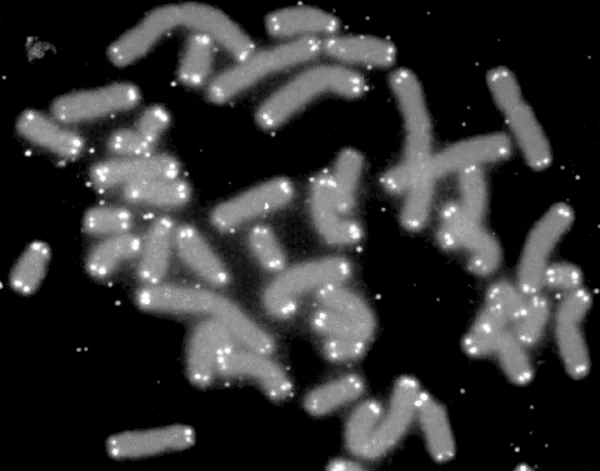
テロメアは染色体の末端にある反復配列で、分裂のたびに短くなる(DNAポリメラーゼが末端を複製できないため)。
- 一定の長さを下回ると、DNA損傷として認識され、細胞周期が止まる(Hayflick限界)
- テロメラーゼが伸ばす——生殖細胞・幹細胞・約9割の癌細胞で活性がある
- 細胞老化した細胞は死なずに残り、炎症性の因子を出し続ける(老化関連分泌形質)
| 疾患 | 異常 | 特徴 |
|---|---|---|
| 先天性角化異常症 | テロメラーゼ関連遺伝子 | 骨髄不全・爪の異常・白斑・肺線維症 |
| Werner症候群 | DNAヘリカーゼ(WRN) | 成人早老症。日本人に多い |
| Hutchinson-Gilford症候群 | ラミンA | 小児早老症 |
テロメアは「老化の原因」であると同時に「癌の防御」でもある——この二面性が、老化研究の中心的な逆説である。分裂の回数に上限があるからこそ、変異を蓄積した細胞が無限に増えることが防がれている。
- テロメラーゼを活性化すれば老化を遅らせられるかもしれないが、発癌の危険が上がる
- 逆にテロメラーゼを阻害すれば癌を抑えられるが、幹細胞も傷む
Werner症候群は日本人に世界で最も多い(報告例の6割以上が日本から)。20代から白髪・白内障・皮膚の萎縮が始まり、糖尿病・脂質異常症・動脈硬化が早期に進む。悪性腫瘍も多く、しかも肉腫や甲状腺癌など、通常とは異なる分布を示す。「若年で老化に見える所見が集まる」ときに想起する。
老化細胞の除去(セノリティクス)は、この領域で最も注目される治療戦略である。老化細胞は数としては少ないのに、周囲へ炎症性因子をまき散らすので、取り除くだけで組織の機能が回復しうると動物実験で示されている。ヒトでの有効性はまだ確立していない——この点は正確に伝える必要がある。
「炎症老化」という概念も押さえておく。加齢に伴う慢性の低度炎症が、動脈硬化・サルコペニア・認知症・フレイルに共通の土台として関わる。C反応性蛋白やインターロイキン6の軽度上昇が、高齢者の予後を予測するという観察が積み重なっている。
English version
Core
The telomere is a repeat sequence at the end of the chromosome, shortening with every division (DNA polymerase cannot copy the end).
- Below a certain length it is recognised as DNA damage and the cell cycle stops (the Hayflick limit).
- Telomerase lengthens it — active in germ cells, stem cells and about 90 per cent of cancers.
- A senescent cell does not die but remains, continuing to release inflammatory factors (the senescence-associated secretory phenotype).
| Disease | Defect | Features |
|---|---|---|
| Dyskeratosis congenita | Telomerase-related genes | Bone marrow failure, nail dystrophy, leukoplakia, pulmonary fibrosis |
| Werner syndrome | DNA helicase (WRN) | Adult progeria. Common in Japanese people |
| Hutchinson–Gilford syndrome | Lamin A | Childhood progeria |
Going further
The telomere is at once a cause of ageing and a defence against cancer — this double aspect is the central paradox of ageing research. It is precisely because there is a ceiling on the number of divisions that a cell accumulating mutations is prevented from proliferating without limit.
- Activating telomerase might delay ageing, but the danger of cancer rises.
- Inhibiting telomerase might suppress cancer, but stem cells are damaged.
Werner syndrome is commoner in Japanese people than anywhere in the world (over 60 per cent of reported cases are from Japan). Grey hair, cataract and atrophy of the skin begin in the twenties, and diabetes, dyslipidaemia and atherosclerosis advance early. Malignancy is also frequent, and with an unusual distribution — sarcoma, thyroid cancer and the like. Think of it when findings that look like ageing gather in a young person.
Removing senescent cells (senolytics) is the treatment strategy attracting most attention in this field. Senescent cells are few in number yet scatter inflammatory factors into their surroundings, so animal experiments have shown that removing them alone can restore the function of a tissue. Efficacy in humans is not yet established — a point that must be stated accurately.
Hold on to the concept of inflammaging as well. The chronic low-grade inflammation of ageing is involved as a common substrate of atherosclerosis, sarcopenia, dementia and frailty. Observations have accumulated that a mild rise of C-reactive protein or interleukin-6 predicts the prognosis of an older person.
蛋白とミトコンドリアの摩耗 — 凝集と、エネルギーの低下
蛋白恒常性の破綻。
- シャペロンの働きが落ち、折り畳みの失敗が増える
- プロテアソームとオートファジーの処理能力も落ちる
- 結果として凝集体が溜まる——アミロイドβ・タウ・αシヌクレイン・TDP-43
ミトコンドリアの機能低下。
- ミトコンドリアDNAは修復系が乏しく、活性酸素の発生源のすぐそばにある → 変異が蓄積する
- ヘテロプラスミー——変異型と正常型が混在し、変異型の比率が閾値を超えると症状が出る
- 母系遺伝(TCA回路と電子伝達系の章)
神経変性疾患を「凝集する蛋白の名前で分類する」見方は、臨床でも定着している。
| 凝集する蛋白 | 疾患 |
|---|---|
| アミロイドβ・タウ | Alzheimer病 |
| タウ | 進行性核上性麻痺・大脳皮質基底核変性症 |
| αシヌクレイン | Parkinson病・Lewy小体型認知症・多系統萎縮症 |
| TDP-43 | 筋萎縮性側索硬化症・前頭側頭葉変性症 |
| ポリグルタミン | Huntington病・脊髄小脳変性症 |
臨床像が違っても同じ蛋白が溜まることがあり、逆に同じ臨床像でも溜まる蛋白が違うことがある。だから病理診断と臨床診断がずれる——「認知症」という症候の下に、複数の分子病態が並んでいる。
プリオン様の伝播という概念も重要である。異常な形に折り畳まれた蛋白が、正常な蛋白を同じ形へ変える——この性質が、凝集体が脳内を一定の順序で広がっていく(Braak病期)ことを説明しうると考えられている。ただしヒトからヒトへ感染するという意味ではない——ここは誤解を招きやすいので、説明の言葉を選ぶ必要がある。
ミトコンドリア病の遺伝相談は難しい。卵子ごとに変異型の比率が違う(ボトルネック効果)ため、次子の重症度を予測できない。核移植による予防(いわゆる三人の親の技術)は、国によって法的な扱いが分かれている。
English version
Core
Breakdown of protein homeostasis.
- Chaperone function falls and failures of folding increase.
- The capacity of the proteasome and of autophagy also falls.
- As a result aggregates accumulate — amyloid β, tau, α-synuclein, TDP-43.
Mitochondrial decline.
- Mitochondrial DNA has poor repair systems and sits next to the source of reactive oxygen → mutations accumulate.
- Heteroplasmy — mutant and normal coexist, and symptoms appear once the proportion of mutant passes a threshold.
- Maternal inheritance (the chapter on the TCA cycle and the electron transport chain).
Going further
Classifying the neurodegenerative diseases by the name of the protein that aggregates is a view established in clinical practice too.
| Protein that aggregates | Disease |
|---|---|
| Amyloid β and tau | Alzheimer’s disease |
| Tau | Progressive supranuclear palsy, corticobasal degeneration |
| α-Synuclein | Parkinson’s disease, dementia with Lewy bodies, multiple system atrophy |
| TDP-43 | Amyotrophic lateral sclerosis, frontotemporal lobar degeneration |
| Polyglutamine | Huntington’s disease, spinocerebellar degeneration |
The same protein may accumulate with different clinical pictures, and conversely the protein may differ with the same clinical picture. Hence pathological and clinical diagnosis diverge — under the syndrome called "dementia" several molecular diseases stand side by side.
Prion-like propagation is another important concept. A protein folded into an abnormal shape converts normal protein to the same shape — a property thought capable of explaining why aggregates spread through the brain in a fixed order (the Braak stages). It does not mean transmission from person to person — easily misunderstood, so the words of the explanation must be chosen with care.
Genetic counselling in mitochondrial disease is difficult. Because the proportion of mutant differs from oocyte to oocyte (the bottleneck effect), the severity in the next child cannot be predicted. Prevention by nuclear transfer (so-called three-parent technique) is treated differently in law from country to country.
老化細胞と SASP — 死なずに残ることが、周りを傷める
細胞老化とは、分裂を不可逆的にやめた状態になる。死んではいない。
引き金——テロメアの短縮・DNA 損傷・癌遺伝子の活性化・酸化ストレス・治療(放射線・抗腫瘍薬)。
止めているのは p16-Rb 経路と p53-p21 経路。
老化細胞は、炎症性の分泌を続ける(SASP)——IL-6・IL-1β・IL-8・MMP・増殖因子。
本来は免疫が除去するが、加齢とともに除去が追いつかなくなり、組織に溜まる。
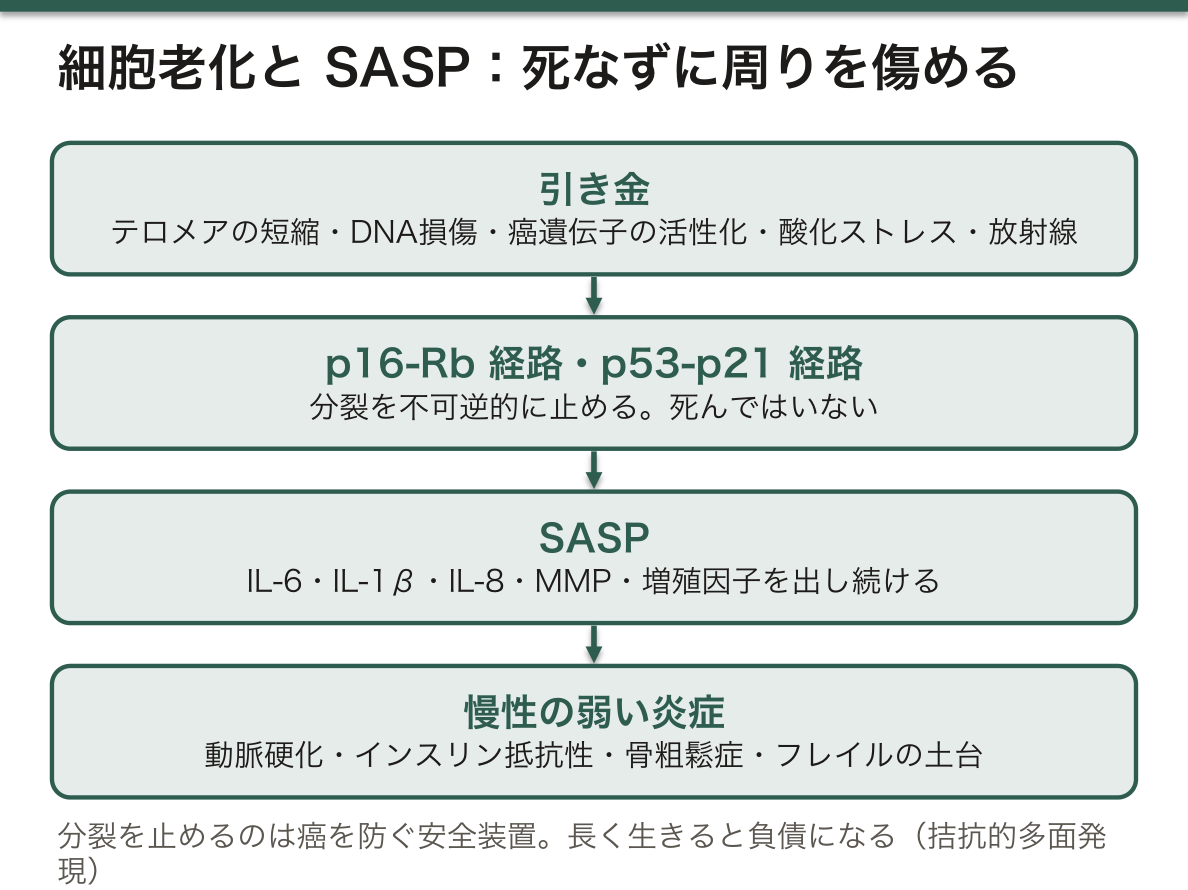
「癌を防ぐ仕組みが、そのまま老化を進める」という両面性が、この概念の核心になる。分裂を止めることは、変異した細胞を増やさないための安全装置になる(p53 の項)——「個体を守る仕組みが、長く生きると負債になる(拮抗的多面発現)」。
SASP が「慢性の弱い炎症」の源になる(全身に及ぶ炎症の章)——「加齢に伴う動脈硬化・インスリン抵抗性・骨粗鬆症・フレイルに共通の土台とされる」。
抗腫瘍薬や放射線が老化細胞を増やすことは、長期の後遺症を説明しうる(後から出る影響の章)——「がんサバイバーで、二次性の心血管疾患や機能低下が増える背景の1つになる」。
老化細胞を選んで除く薬(セノリティクス)の研究が進んでいる——「まだ臨床で確立した治療ではない、という線を引いておく」。
逆に、老化細胞が役に立つ場面もある(修復と創傷治癒の章)——「創傷治癒や胎生期の組織のリモデリングでは、一時的に現れて役割を果たす」。
English version
Core
Cellular senescence is a state of having irreversibly stopped dividing. The cell has not died.
Triggers — telomere shortening, DNA damage, activation of an oncogene, oxidative stress, treatment (radiation, antitumour drugs).
What holds it there is the p16–Rb pathway and the p53–p21 pathway.
The senescent cell continues an inflammatory secretion (SASP) — IL-6, IL-1β, IL-8, MMPs, growth factors.
Immunity should remove them, but with age removal fails to keep pace and they accumulate in the tissue.
Going further
The core of this concept is the double aspect that the mechanism preventing cancer is the very thing advancing ageing.
- Stopping division is a safety device preventing a mutated cell from multiplying (the section on p53) — a mechanism protecting the organism becoming a debt when life is long (antagonistic pleiotropy).
- The SASP becomes a source of chronic weak inflammation (the chapter on inflammation reaching the whole body) — held to be the common ground of the atherosclerosis, insulin resistance, osteoporosis and frailty of ageing.
- That antitumour drugs and radiation increase senescent cells may explain late sequelae (the chapter on effects appearing later) — one part of the background to the increase of secondary cardiovascular disease and functional decline in cancer survivors.
- Research into drugs that selectively remove senescent cells (senolytics) is advancing — draw the line that this is not yet an established clinical treatment.
- Conversely there are settings in which senescent cells are useful (the chapter on repair and wound healing) — in wound healing and in the remodelling of embryonic tissue they appear transiently and serve a purpose.
サーチュインと NAD⁺ — 足りない状態が、修復のほうへ資源を回す
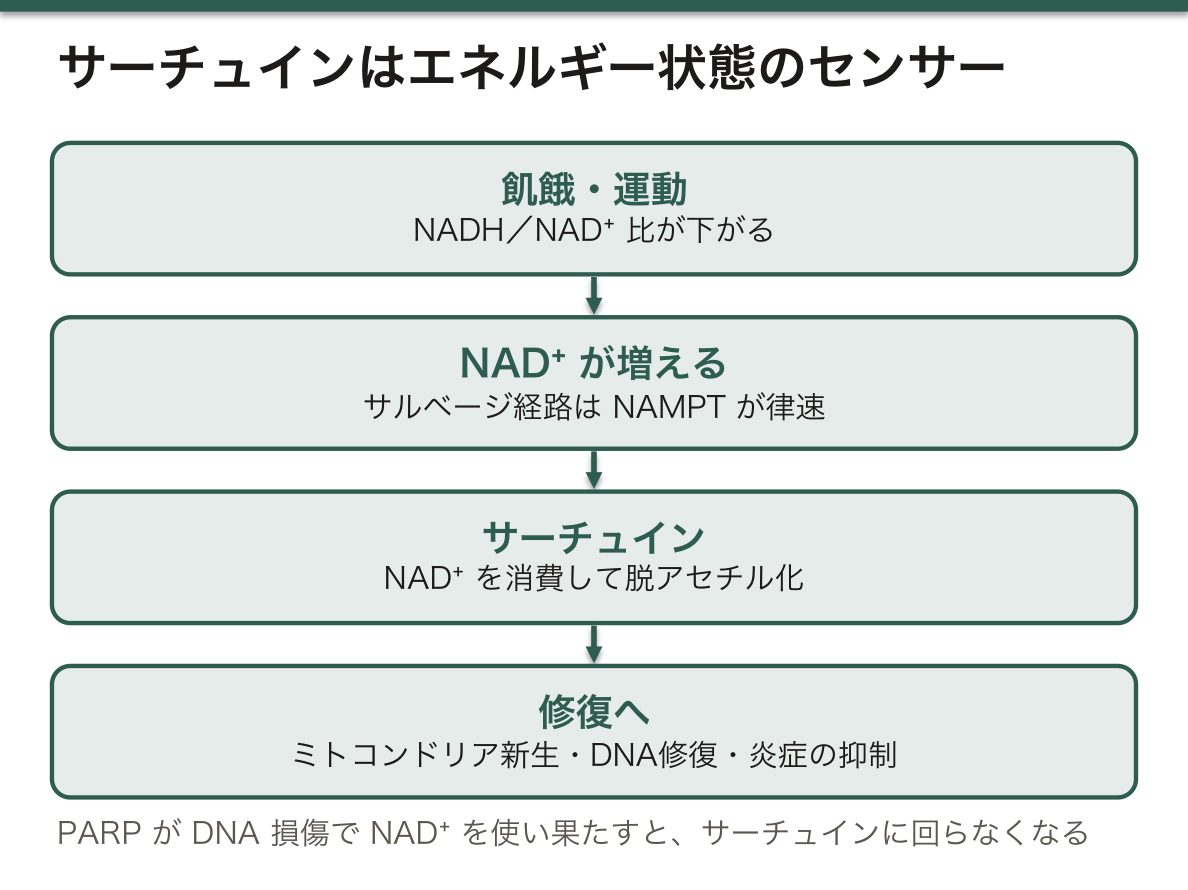
サーチュイン(SIRT1〜7)は、NAD⁺ を消費してヒストンや蛋白の脱アセチル化を行う酵素になる。
NAD⁺ を必要とすることが、この酵素を「エネルギー状態のセンサー」にしている——飢餓や運動で NADH/NAD⁺ 比が下がると、NAD⁺ が増えて活性化する。
働き——ミトコンドリア新生(PGC-1α)・脂肪酸酸化・抗酸化・DNA 修復・炎症の抑制。
NAD⁺ はナイアシン(トリプトファンからも作られる)を材料に、サルベージ経路(NAMPT が律速)で作り直される。
NAD⁺ は加齢とともに減るとされる。
「補酵素の濃度が、遺伝子の読み方を決めている」という点が、代謝とエピジェネティクスの接点になる。NAD⁺ が足りなければ、脱アセチル化が進まない(エピジェネティクスの章)——「栄養状態が、そのまま転写の状態になる」。
だからカロリー制限・運動・断続的な絶食が、同じ方向へ働くと説明される(AMPK の項)——「AMPK とサーチュインは、互いを高め合う関係にある」。
NAD⁺ を消費する酵素は、他にもある(PARP 阻害薬の項)——「DNA 損傷が多いと PARP が NAD⁺ を使い果たし、サーチュインに回らなくなる」。
ナイアシンが不足すれば、この系全体が動かない(トリプトファンの項)——「ペラグラの症状に神経と皮膚が並ぶことと、無関係ではない」。
NAD⁺ 前駆体のサプリメントは、まだ人での効果が確立していない——「動物実験の結果を、そのまま人に持ち込まないという態度が要る」。
English version
Core
The sirtuins (SIRT1–7) are enzymes that consume NAD⁺ to deacetylate histones and proteins.
Requiring NAD⁺ is what makes this enzyme a sensor of energy state — with starvation or exercise the NADH/NAD⁺ ratio falls, NAD⁺ increases and they are activated.
Actions — mitochondrial biogenesis (PGC-1α), fatty acid oxidation, antioxidant defence, DNA repair, suppression of inflammation.
NAD⁺ is remade from niacin (also made from tryptophan) by the salvage pathway (NAMPT is rate-limiting).
NAD⁺ is held to fall with age.
Going further
The point that the concentration of a coenzyme determines how genes are read is the junction between metabolism and epigenetics.
- Without enough NAD⁺, deacetylation does not proceed (the chapter on epigenetics) — nutritional state becoming, directly, the state of transcription.
- Hence calorie restriction, exercise and intermittent fasting are explained as acting in the same direction (the section on AMPK) — AMPK and the sirtuins raise one another.
- There are other enzymes that consume NAD⁺ (the section on PARP inhibitors) — with much DNA damage, PARP uses up the NAD⁺ and none is left for the sirtuins.
- Without niacin this whole system does not turn (the section on tryptophan) — not unconnected with the fact that the symptoms of pellagra put nerve and skin side by side.
- Supplements of NAD⁺ precursors are not yet of established effect in humans — an attitude is needed that does not carry animal results straight over to people.
一生入れ替わらない蛋白がある — 時間が、そのまま化学変化として積もる
体の蛋白はふつう数日から数週で作り替えられる。ところが、ほとんど入れ替わらない蛋白がいくつかある。
| エラスチン | 半減期 約 70 年 | 大動脈・肺・皮膚。実質、一生ものである |
| 水晶体のクリスタリン | 胎生期に作られたものが中心に残る | 血管も無く、入れ替えの仕組みも無い |
| 関節軟骨のII型コラーゲン | 半減期 100 年を超えるという推定もある | だから摩耗が戻らない |
| 歯のエナメル質 | 細胞が残らないので、まったく作り替えられない | う蝕は自然には治らない |
入れ替わらないということは、化学変化が消えずに積み上がるということである。
時間だけで進む化学変化が3つあり、どれも酵素を必要としない。
- 糖化と架橋——糖が非酵素的に結合し、やがて分子どうしを繋いでしまう。繋がれた線維は硬くなる。大動脈が加齢で硬くなり、収縮期血圧だけが上がっていくのはこれによる
- ラセミ化——L 型アミノ酸が、ゆっくり D 型へ変わる。速度が一定なので、象牙質のアスパラギン酸のラセミ化率から年齢を推定できる(法医学で使われる)
- 脱アミド化と酸化——側鎖が変質し、蛋白が凝集しやすくなる。水晶体のクリスタリンで進むと、透明性が失われて白内障になる
これが「老化は病気ではなく、化学の必然か」という問いの土台になっている。細胞が代謝を止めなくても、入れ替えの効かない分子には時間そのものが刻まれていく。
臨床的な帰結もはっきりしている。入れ替わらない組織は、治らない——関節軟骨・水晶体・エナメル質・弾性線維。だからこれらの疾患は「修復」ではなく置換(人工関節・眼内レンズ・充填)で対処されてきた。再生医療がこの領域を狙うのは、まさに自然な修復が期待できないからである。
逆に、入れ替わりの速い組織は薬と栄養で立て直せる(腸上皮 3〜5 日、好中球 半日、赤血球 120 日、骨 数年)。「どのくらいで入れ替わるか」を知っていると、治療の効果を待つ時間の見当がつく。
治療の効果判定にかかる時間は、標的組織の入れ替わり速度で決まる。HbA1c が 2 か月、骨密度が半年から1年というのは、赤血球と骨の寿命そのものである。
English version
Core
The proteins of the body are usually remade over days to weeks. There are, however, a few that scarcely turn over at all.
| Half-life | ||
|---|---|---|
| Elastin | About 70 years | Aorta, lung, skin. In effect it lasts a lifetime |
| The crystallins of the lens | What was made in fetal life largely remains | No blood vessels and no machinery for replacement |
| Type II collagen of articular cartilage | Estimated by some at over 100 years | Which is why wear does not come back |
| Dental enamel | No cells remain, so it is never remade at all | Caries do not heal of themselves |
Not turning over means that chemical change accumulates without being erased.
Going further
Three chemical changes advance with time alone, and none requires an enzyme.
- Glycation and cross-linking — sugar binds non-enzymatically and eventually ties molecules to one another. Tied fibres become stiff. This is why the aorta stiffens with age and the systolic pressure alone rises.
- Racemisation — L-amino acids change slowly to D. The rate being constant, age can be estimated from the racemisation of aspartate in dentine (used in forensic medicine).
- Deamidation and oxidation — side chains alter and the protein aggregates readily. Advancing in the crystallins of the lens, transparency is lost and a cataract forms.
This is the ground of the question whether ageing is not a disease but a chemical necessity. Even without the cell stopping its metabolism, time itself is inscribed on the molecules that cannot be replaced.
The clinical consequence is plain. A tissue that does not turn over does not heal — articular cartilage, lens, enamel, elastic fibres. Which is why these diseases have been dealt with not by repair but by replacement (joint prosthesis, intraocular lens, filling). Regenerative medicine aims at this field precisely because no natural repair can be expected.
Conversely a tissue that turns over quickly can be restored with drugs and nutrition (intestinal epithelium 3–5 days, neutrophil half a day, red cell 120 days, bone some years). Knowing how fast a tissue turns over gives an idea of how long to wait for a treatment to work.
In the clinic
The time needed to judge the effect of a treatment is set by the turnover of the target tissue. HbA1c at two months and bone density at six months to a year are the lifespan of the red cell and of bone themselves.
代謝は時刻に従っている — 体内時計という、もう一つの調節軸
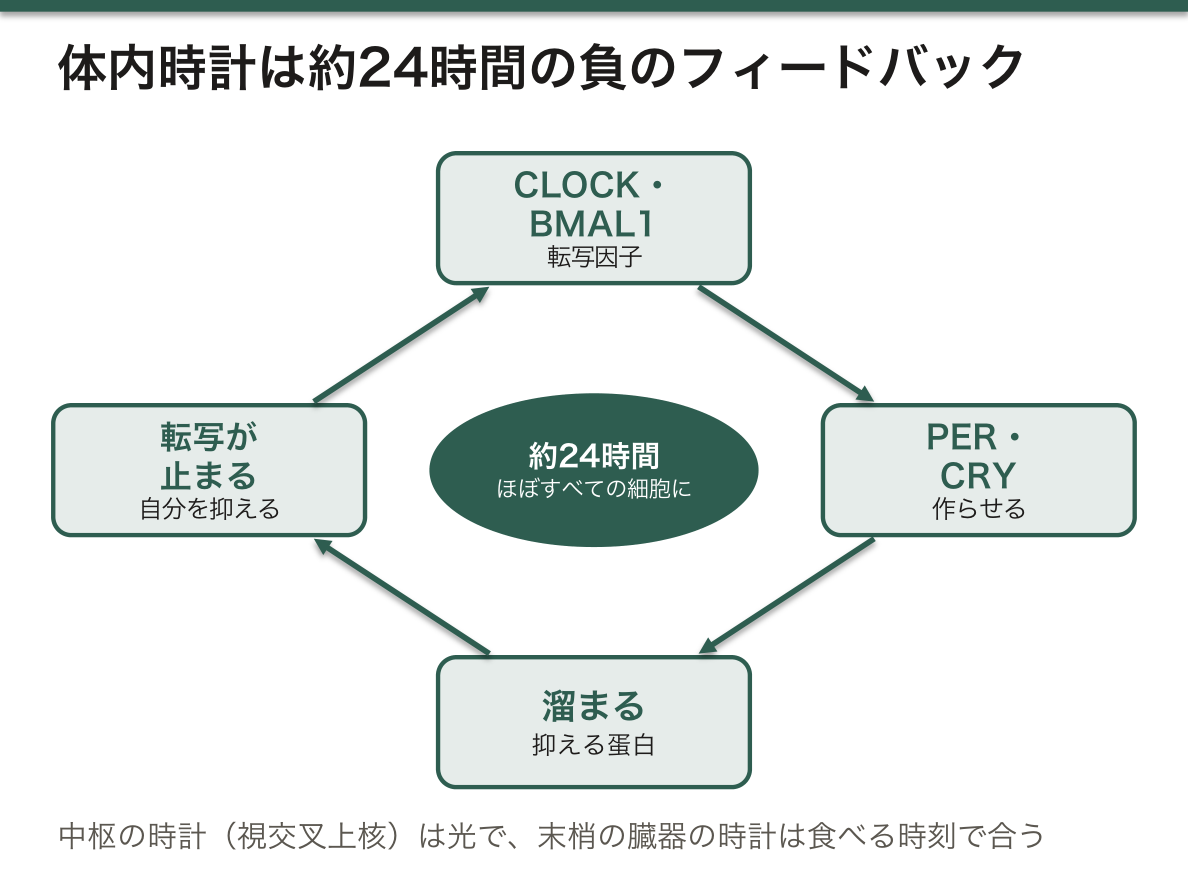
ほぼすべての細胞が時計を持っている。転写因子(CLOCK・BMAL1)が自分を抑える蛋白(PER・CRY)を作らせ、その蛋白が溜まると転写が止まる——という約 24 時間かかる負のフィードバックが実体である。
この時計が、代謝の酵素を時間帯ごとに切り替えている。
- 肝——夜間に糖新生とコレステロール合成が高まる(HMG-CoA 還元酵素の活性が夜に上がる)
- 膵と筋——朝はインスリン感受性が高く、夜は同じ食事でも血糖が上がりやすい
- 副腎——早朝にコルチゾールが出る
中枢の時計は視交叉上核にあり光で合わせられるが、末梢の臓器の時計は「食べる時刻」で合う。光と食事がずれると、臓器のあいだで時計がばらばらになる。
この仕組みが、生活と病気を結ぶ経路を作っている。
| 夜勤・交代勤務 | 肥満・2 型糖尿病・脂質異常症・心血管疾患が増える | 光と食事の時刻が毎週入れ替わり、臓器の時計が合わない |
| 夜遅い食事 | 同じ内容でも体重と血糖に不利 | インスリン感受性が最も低い時間帯に糖が入る |
| 睡眠不足 | 食欲が増える | グレリンが上がり、レプチンが下がる |
薬にも最適な時刻がある(時間薬理学)。
- 短時間作用のスタチン——コレステロール合成が高まる夜に飲む。半減期の長いものは時刻を選ばない
- ステロイドの補充——生理的な分泌に合わせて朝に多く配分する
- 抗癌剤の投与時刻——正常組織と腫瘍で分裂の時間帯が違うことを利用する試みがある
⚠️ 診断の解釈も時刻に依存する。コルチゾール・TSH・鉄・テストステロンは日内変動が大きく、採血の時刻を揃えないと比較できない。血圧も夜間に下がるのが正常で、下がらない型(non-dipper)は臓器障害の危険が高い——1点の値ではなく時間の形を見る、という考え方である。
生活指導では「何を食べるか」だけでなく「いつ食べるか」「いつ寝るか」を聞く。同じ摂取量でも、時刻が違えば結果が変わる。
English version
Core
Almost every cell has a clock. Transcription factors (CLOCK, BMAL1) drive production of proteins that repress them (PER, CRY), and when those proteins accumulate transcription stops — a negative feedback taking about 24 hours is the substance of it.
This clock switches the enzymes of metabolism by time of day.
- Liver — gluconeogenesis and cholesterol synthesis rise at night (the activity of HMG-CoA reductase rises at night).
- Pancreas and muscle — insulin sensitivity is high in the morning; at night the same meal raises the blood glucose more.
- Adrenal — cortisol is released in the early morning.
The central clock is in the suprachiasmatic nucleus and is set by light, but the clocks of the peripheral organs are set by the time of eating. When light and food diverge, the clocks of the organs scatter.
Going further
This mechanism makes a route connecting daily life with disease.
| Night and shift work | Obesity, type 2 diabetes, dyslipidaemia and cardiovascular disease increase | The times of light and of food change every week and the organ clocks never settle |
| Eating late at night | Unfavourable for weight and blood glucose with the same content | Sugar arrives in the hours when insulin sensitivity is lowest |
| Short sleep | Appetite increases | Ghrelin rises and leptin falls |
Drugs also have an optimal hour (chronopharmacology).
- Short-acting statins — taken at night, when cholesterol synthesis rises. Those with a long half-life are indifferent to the hour.
- Steroid replacement — distributed with more in the morning to match physiological secretion.
- The hour of giving an antitumour drug — attempts exist to exploit the different hours of division in normal tissue and tumour.
⚠️ The interpretation of tests depends on the hour too. Cortisol, TSH, iron and testosterone vary widely through the day, and cannot be compared unless the hour of sampling is aligned. Blood pressure too normally falls at night, and the pattern that does not fall (non-dipper) carries a high risk of organ damage — the idea of looking at the shape in time rather than a single value.
In the clinic
In advising on daily life, ask not only what is eaten but when it is eaten and when the patient sleeps. With the same intake, a different hour gives a different result.
まとめ
| テロメアと細胞老化 — 分裂の回数券 | テロメアは染色体の末端にある反復配列で、分裂のたびに短くなる(DNAポリメラーゼが末端を複製できないため)。 |
|---|---|
| 蛋白とミトコンドリアの摩耗 — 凝集と、エネルギーの低下 | 蛋白恒常性の破綻。シャペロンの働きが落ち、折り畳みの失敗が増えるプロテアソームとオートファジーの処理能力も落ちる結果として凝集体が溜まる——アミロイドβ・タウ・αシヌクレイン・TD… |
| 老化細胞と SASP — 死なずに残ることが、周りを傷める | 細胞老化とは、分裂を不可逆的にやめた状態になる。 |
| サーチュインと NAD⁺ — 足りない状態が、修復のほうへ資源を回す | サーチュイン(SIRT1〜7)は、NAD⁺ を消費してヒストンや蛋白の脱アセチル化を行う酵素になる。 |
| 一生入れ替わらない蛋白がある — 時間が、そのまま化学変化として積もる | 体の蛋白はふつう数日から数週で作り替えられる。 |
| 代謝は時刻に従っている — 体内時計という、もう一つの調節軸 | ほぼすべての細胞が時計を持っている。転写因子(CLOCK・BMAL1)が自分を抑える蛋白(PER・CRY)を作らせ、その蛋白が溜まると転写が止まる——という約 24 時間かかる負の… |
このノートは医学生が授業の内容を自分の言葉でまとめたもので、診療の判断に使うものではありません。誤りに気づいたらお知らせください。