個々の疾患は稀でも、まとめれば新生児の約1500人に1人いる。多くは発症前に見つけて治療すれば正常に育つ——だから新生児マススクリーニングが行われている。
一方、スクリーニングの対象外の疾患が急性に発症することがある。そのときに必要なのは、個々の疾患名ではなく、「代謝異常かもしれない」と気づく型と、診断より先に始める初期対応である。
- 新生児マススクリーニング — 何を、どうやって拾っているか
- 急性に発症したとき — 診断より先にやること
- 治療できる先天代謝異常 — 介入の型は4つしかない
- 発症の引き金 — 代謝が破綻するのは、負荷がかかったときになる
- なぜ代謝異常症の多くは、常染色体潜性なのか
- 酵素を外から入れても届かない場所がある — 補充療法の3つの壁
新生児マススクリーニング — 何を、どうやって拾っているか
生後4〜6日に足底から採血し、濾紙にしみ込ませて検査する。
| 方法 | 対象 |
|---|---|
| タンデム質量分析 | アミノ酸代謝異常症・有機酸代謝異常症・脂肪酸酸化異常症(20疾患以上を一度に) |
| 酵素法・免疫測定 | 先天性甲状腺機能低下症・先天性副腎皮質過形成・ガラクトース血症 |
- 頻度が最も高いのは先天性甲状腺機能低下症(約2500〜3000人に1人)
- スクリーニングの原則——頻度がある程度あり、見つける方法があり、そして治療法があること
- 陽性はあくまで「疑い」——確定診断は精密検査で行う
タンデム質量分析が変えたのは、「1疾患1検査」から「一度に多数」への転換である。アシルカルニチンとアミノ酸の質量と量の組み合わせを一括で測るので、検体1つ・1回の測定で数十疾患を評価できる。日本では2011年頃から全国に広がった。
採血の時期が決まっている理由も理解しておく。
- 早すぎる——母体の代謝に守られていた影響が残り、異常が出ない(偽陰性)
- 遅すぎる——発症してしまう
- 低出生体重児・輸血後・経静脈栄養中は結果が影響を受けるので、時期をずらして再検する
スクリーニング陽性の家族への説明は、実務上きわめて難しい部分である。「病気が見つかった」ではなく「確認が必要な結果が出た」と伝える。偽陽性が一定割合あるためで、不必要な不安と、母子の愛着形成への影響が現実の問題として知られている。
拡大スクリーニング——重症複合免疫不全症・脊髄性筋萎縮症・ライソゾーム病など——は自治体によって実施状況が違う。治療法が確立した疾患から順に加わっていくので、受験する年の状況を確認する必要がある領域である。
English version
Core
Blood is taken from the heel at 4–6 days of age and dried onto filter paper.
| Method | Diseases |
|---|---|
| Tandem mass spectrometry | Amino acid, organic acid and fatty acid oxidation disorders (more than 20 at once) |
| Enzyme assay, immunoassay | Congenital hypothyroidism, congenital adrenal hyperplasia, galactosaemia |
- The commonest is congenital hypothyroidism (about 1 in 2,500–3,000).
- The principle of screening — that it is common enough, that there is a way of finding it, and that there is a treatment.
- A positive is only a suspicion — the diagnosis is confirmed by further testing.
Going further
What tandem mass spectrometry changed was the shift from one test per disease to many at once. Measuring the masses and amounts of acylcarnitines and amino acids together, one specimen and one run assess dozens of diseases. It spread across Japan from about 2011.
Understand also why the timing of the sample is fixed.
- Too early — the protection of the mother’s metabolism still shows and the abnormality does not appear (a false negative).
- Too late — the child has already presented.
- Low birth weight, recent transfusion and parenteral nutrition affect the result, so it is repeated at a different time.
Explaining a positive screen to the family is one of the most difficult parts in practice. Say not "a disease has been found" but "a result has come back that needs confirming", since a proportion are false positives, and needless anxiety and the effect on the attachment between mother and child are known to be real problems.
Extended screening — severe combined immunodeficiency, spinal muscular atrophy, lysosomal disease — differs between local authorities. Diseases are added as treatments become established, so this is an area in which the situation in the year of the examination must be checked.
急性に発症したとき — 診断より先にやること
疑うべき状況。
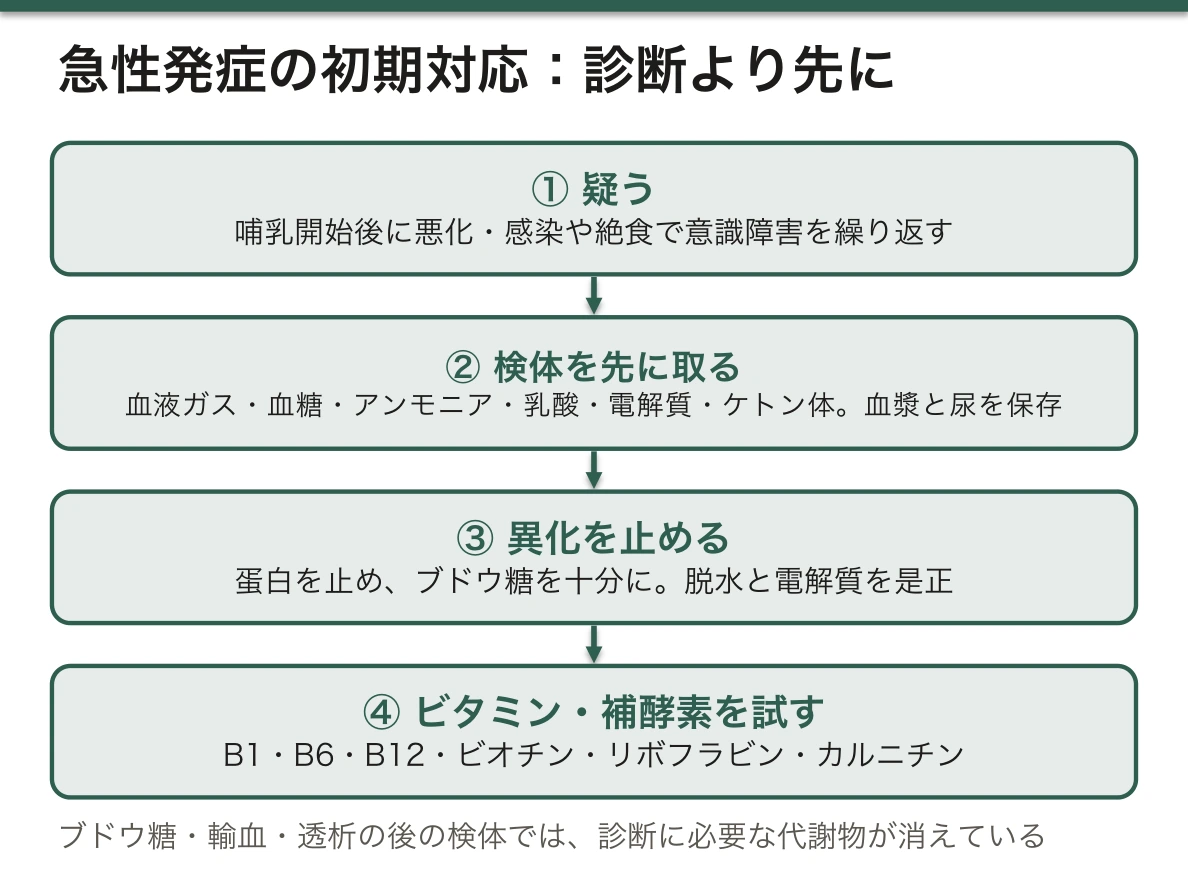
- 健康に生まれた新生児が、哺乳開始後に悪化する(数時間〜数日)
- 感染や絶食を契機に、繰り返し意識障害を起こす乳幼児
- 説明のつかない意識障害・けいれん・嘔吐・呼吸障害
- 近親婚・同胞の乳児期死亡
最初に取る検体(治療を始める前に)。
- 血液ガス・血糖・アンモニア・乳酸・電解質・ケトン体
- 血漿と尿を保存する(後からアミノ酸分析・有機酸分析・アシルカルニチン分析ができる)
初期対応の原則は「異化を止める」。蛋白を止め、ブドウ糖を十分に投与し、脱水と電解質を是正する。
「検体を先に取る」ことの重要性は、いくら強調してもしすぎることがない。ブドウ糖を投与し、輸血し、透析を始めた後の検体では、診断に必要な代謝物が消えている。治療を遅らせてはならないが、採血だけは先に済ませられる。
低血糖時の検体(critical sample)は特に価値が高い。血糖が低いその瞬間に、インスリン・遊離脂肪酸・ケトン体・成長ホルモン・コルチゾール・乳酸を同時に採ると、1回で鑑別が絞れる(脂肪酸酸化異常症の章)。ブドウ糖を入れてしまうと、二度と同じ条件は作れない。
剖検に至る場合にも同じ原則が適用される。死亡直後の血液・尿・皮膚(線維芽細胞培養用)・肝の保存が、次子の遺伝カウンセリングを可能にする。原因不明の乳児死亡で、家族に次の妊娠の見通しを示せるかどうかが、この判断にかかっている。
ビタミン・補酵素の負荷は必ず試す。ビタミンB1・B6・B12・ビオチン・リボフラビン・カルニチンのいずれかに反応する型が、多くの疾患に存在する。反応型を見逃すと、治療できたはずの子を治療しないことになる。
そして「代謝異常を疑うこと自体」が最大の障壁である。敗血症として治療されている新生児が実は代謝異常だった、という経過は稀ではない。抗菌薬に反応しない、アンモニアを測っていない——この2つが揃ったときに、立ち止まれるかどうかである。
English version
Core
When to suspect it.
- A baby born healthy deteriorates after feeding begins (hours to days).
- An infant with repeated episodes of impaired consciousness triggered by infection or fasting.
- Unexplained impaired consciousness, seizures, vomiting or respiratory disturbance.
- Consanguinity, or the death of a sibling in infancy.
The specimens to take first (before treatment begins): blood gases, glucose, ammonia, lactate, electrolytes, ketones. Save plasma and urine (so that amino acid, organic acid and acylcarnitine analysis can be done later).
The principle of initial management is to stop catabolism — stop protein, give ample glucose, correct dehydration and electrolytes.
Going further
The importance of taking the specimens first cannot be overstated. After glucose has been given, blood transfused and dialysis started, the metabolites needed for diagnosis have gone. Treatment must not be delayed, but the blood can at least be taken first.
The specimen taken while the glucose is low (the critical sample) is especially valuable. Insulin, free fatty acids, ketones, growth hormone, cortisol and lactate taken at that moment narrow the differential in one go. Once glucose has been given, those conditions can never be recreated.
The same principle applies where it comes to a post-mortem. Preserving blood, urine, skin (for fibroblast culture) and liver immediately after death makes genetic counselling possible for the next child. Whether the family can be given a prospect for the next pregnancy turns on that decision.
Always try a vitamin or coenzyme challenge. For many of these diseases there is a form responsive to thiamine, B6, B12, biotin, riboflavin or carnitine. Miss a responsive form and a treatable child goes untreated.
And the greatest barrier is suspecting a metabolic disease at all. A newborn treated as sepsis who in fact had a metabolic disease is not a rare course. Not responding to antibiotics, and the ammonia not measured — when those two coincide, the question is whether one can stop and think.
治療できる先天代謝異常 — 介入の型は4つしかない
「詰まった経路」に対して打てる手は、原理的に4つに分類できる。
| 型 | やること | 例 |
|---|---|---|
| ①溜まるものを減らす | 基質を食事から制限する | フェニルケトン尿症(フェニルアラニン制限)・ガラクトース血症・メープルシロップ尿症 |
| ②足りないものを補う | 産物を外から与える | チロシン・アルギニン・L-カルニチン・コエンザイムQ10 |
| ③溜まったものを逃がす | 別の経路で捨てさせる | 安息香酸ナトリウム・フェニル酪酸(尿素回路異常症) |
| ④酵素を助ける・入れ替える | 補酵素の大量投与/酵素補充/移植 | ビタミンB6・B12 反応型・酵素補充療法・肝移植・造血幹細胞移植 |
どの型が使えるかは、詰まった場所と、溜まる分子の性質で決まる。
この4つは、代謝経路の図を1本の管として見ると自然に出てくる。入口を絞る・出口の先を補う・迂回路を作る・詰まりそのものを取る(代謝の見取り図の章)——「経路図を描ければ、治療の選択肢は自分で導ける」。
③の「別の経路で捨てさせる」が、最も工夫の要る発想になる。安息香酸はグリシンと、フェニル酪酸はグルタミンと結合して尿へ出る。尿素回路を通さずに窒素を捨てる道を、薬で作っている(尿素回路異常症の章)——「本来存在しない排泄路を、化学で足している」。
④の補酵素反応型は、必ず試す価値がある。酵素と補酵素の親和性が落ちているだけなら、補酵素を大量に入れると反応が戻る(酵素の章)——「同じ病名でも、反応型かどうかで治療も予後も変わる」。
フェニルケトン尿症の食事療法は、生涯続ける必要がある(フェニルケトン尿症の章)——「妊娠可能な女性では、母体高フェニルアラニン血症が胎児に小頭症と心奇形を起こす」。
アスパルテームがフェニルアラニンを含むことも、この文脈で出題される——「甘味料の表示に、警告が書かれている理由になる」。
English version
Core
Against a blocked pathway, the moves available fall in principle into four types.
| Type | What is done | Examples |
|---|---|---|
| ① Reduce what accumulates | Restrict the substrate in the diet | Phenylketonuria (phenylalanine restriction), galactosaemia, maple syrup urine disease |
| ② Supply what is lacking | Give the product from outside | Tyrosine, arginine, L-carnitine, coenzyme Q10 |
| ③ Let what has accumulated escape | Discard it by another route | Sodium benzoate, phenylbutyrate (urea cycle disorders) |
| ④ Help or replace the enzyme | High-dose coenzyme, enzyme replacement, transplantation | B6- and B12-responsive forms, enzyme replacement therapy, liver or haematopoietic stem cell transplantation |
Which type is available is decided by where the block is and by the properties of the molecule that accumulates.
Going further
The four come out naturally if the pathway is seen as one pipe: narrow the entrance, supply beyond the exit, make a bypass, or remove the blockage — draw the pathway and the options derive themselves.
③, discarding by another route, requires the most ingenuity. Benzoate conjugates with glycine and phenylbutyrate with glutamine and both leave in the urine. A road for discarding nitrogen without passing through the urea cycle, made with a drug — a route of excretion that does not naturally exist, added by chemistry.
④, the coenzyme-responsive forms, are always worth trying. If only the affinity between enzyme and coenzyme has fallen, a large dose of the coenzyme restores the reaction — with the same disease name, whether it is a responsive form changes both treatment and prognosis.
The diet in phenylketonuria must be continued for life — in a woman of childbearing age, maternal hyperphenylalaninaemia causes microcephaly and cardiac malformation in the fetus. That aspartame contains phenylalanine is asked in this context — the reason for the warning on the label of a sweetener.
発症の引き金 — 代謝が破綻するのは、負荷がかかったときになる
多くの先天代謝異常は、平時は代償されている。破綻するのは負荷がかかったときになる。
| 引き金 | 何が起きるか |
|---|---|
| 感染・発熱 | 異化が亢進し、自分の蛋白と脂肪が分解される |
| 絶食・嘔吐 | グリコーゲンが尽き、脂肪酸酸化と糖新生に切り替わる |
| 蛋白の過剰摂取 | 窒素の負荷が増える(尿素回路異常症) |
| 手術・外傷・分娩 | 侵襲による異化 |
| 特定の薬 | バルプロ酸・ステロイド・全身麻酔・アスピリン |
だから対応の基本は「異化を止める」ことになる——ブドウ糖を十分に入れ、蛋白を一時的に止め、脱水を直す。
新生児期の発症は、哺乳の確立や離乳、初めての発熱と時期が重なる。
「負荷がかかると出る」という性質が、診断を難しくしている。発作の合間は検査値が正常なので、症状のあるときに採らなければ捕まらない(小児の急性疾患の章)——「急性期の検体を保存することが、後の診断を可能にする」。
採るべきは、血糖・血液ガス・アンモニア・乳酸・ケトン体・アシルカルニチン分析・尿有機酸分析になる(酸塩基平衡の章)——「治療を始める前の一滴が、一生の診断を決める」。
ブドウ糖を入れることが治療の中心になるのは、異化を止めるためになる。栄養を補うためではなく、自分の体を壊させないために入れている(飢餓の章)——「同じ点滴でも、目的が違えば速度も濃度も変わる」。
例外があることも押さえる。ミトコンドリア病やピルビン酸脱水素酵素欠損症では、ブドウ糖の負荷が乳酸を増やす(ミトコンドリア病の章)——「原則に当てはまらない群があるので、診断が付いた後は個別の指示に従う」。
Reye 症候群は、この文脈の古典になる。ウイルス感染中のアスピリンがミトコンドリアの脂肪酸酸化を障害し、脳症と肝障害を起こす(小児の薬の章)——「小児の解熱にアスピリンを使わない理由が、代謝の話として説明できる」。
English version
Core
Most inborn errors are compensated at rest. They break down when a load is applied.
| Trigger | What happens |
|---|---|
| Infection, fever | Catabolism increases and the body’s own protein and fat are broken down |
| Fasting, vomiting | Glycogen is exhausted and it switches to fatty acid oxidation and gluconeogenesis |
| Excess protein | The nitrogen load increases (urea cycle disorders) |
| Surgery, trauma, labour | Catabolism from the insult |
| Certain drugs | Valproate, steroids, general anaesthesia, aspirin |
So the basis of management is to stop catabolism — give ample glucose, stop protein temporarily, correct dehydration.
Presentation in the newborn period coincides with the establishment of feeding, with weaning, and with the first fever.
Going further
That it appears only under load makes the diagnosis difficult. Between attacks the tests are normal, so unless the sample is taken while there are symptoms it will not be caught — preserving a specimen from the acute phase is what makes the later diagnosis possible.
What to take: glucose, blood gases, ammonia, lactate, ketones, acylcarnitine profile, urinary organic acids — a single drop taken before treatment begins decides a lifetime’s diagnosis.
Giving glucose is the centre of treatment because it stops catabolism. It is given not to supply nutrition but to stop the body destroying itself — the same infusion with a different purpose runs at a different rate and concentration.
Note that there are exceptions. In mitochondrial disease and pyruvate dehydrogenase deficiency a glucose load increases the lactate — there is a group to which the rule does not apply, so once the diagnosis is made, follow the individual instructions.
Reye’s syndrome is the classic of this context: aspirin during a viral infection impairs mitochondrial fatty acid oxidation and causes encephalopathy and liver injury — the reason aspirin is not used for fever in children, explained as metabolism.
なぜ代謝異常症の多くは、常染色体潜性なのか
先天代謝異常症の大半は常染色体潜性(劣性)遺伝である。これは偶然ではなく、酵素という分子の性質から導かれる。
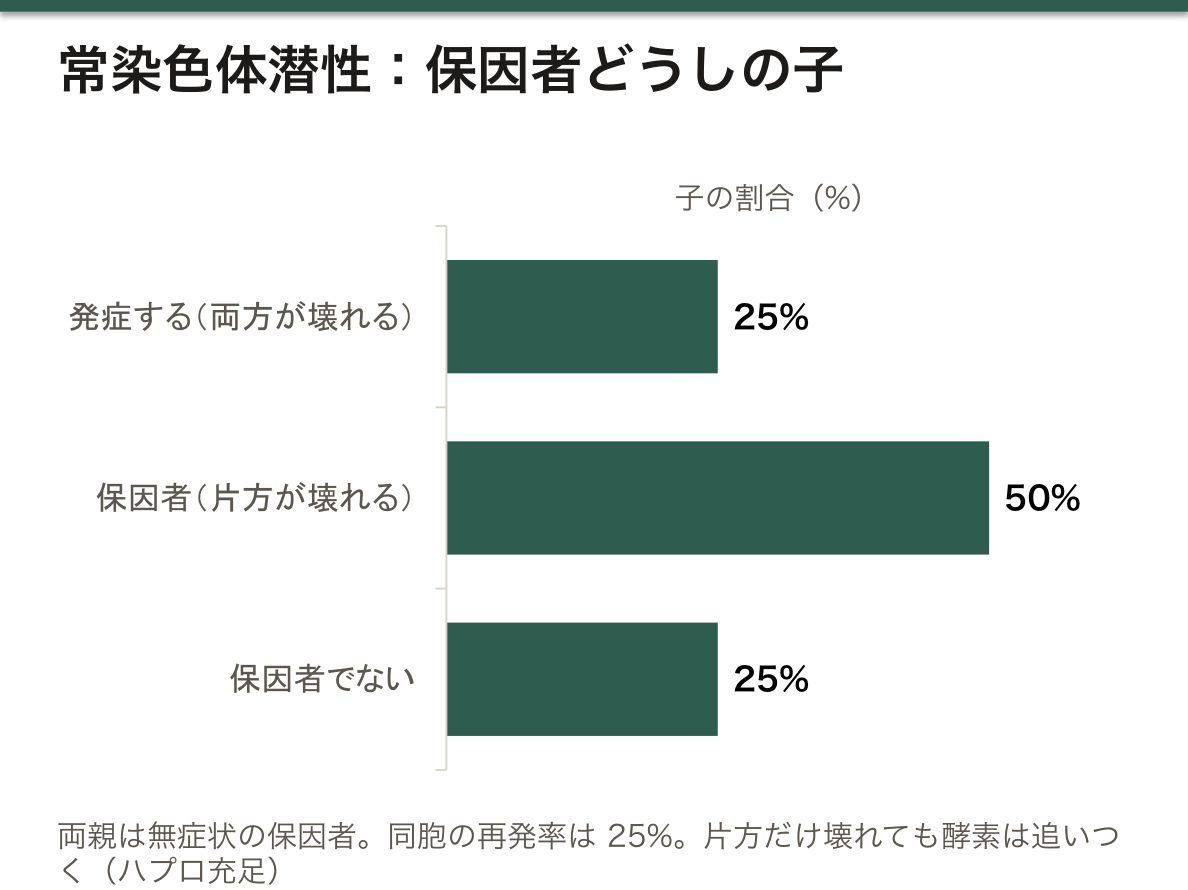
酵素は触媒なので、1 分子が何度も反応を回す。だから遺伝子が片方だけ壊れて量が半分になっても、ふつうは代謝が追いつく(ハプロ充足)。両方壊れて初めて症状が出る——これが潜性の正体である。
逆に、顕性(優性)になるのはどういうときかを押さえると、遺伝形式を暗記でなく推論で答えられる。
| 構造蛋白 | 量がそのまま必要(触媒ではない) | 骨形成不全症・Marfan 症候群。不良品が正常品の邪魔をすることも多い |
| 受容体 | 数が効果を決める | 家族性高コレステロール血症 |
| 律速酵素の調節が絡む | 半分でも均衡が崩れる | 急性間欠性ポルフィリン症 |
例外を3つ知っておくと、実際の症例で迷わない。
- X 連鎖のもの——オルニチントランスカルバミラーゼ欠損症が代表。男児は重症で新生児期に発症するが、女性保因者も発症しうる(ライオニゼーションの偏りによる)。ほかに Fabry 病・Hunter 症候群・副腎白質ジストロフィー・G6PD 欠損症
- 母系遺伝のもの——ミトコンドリア DNA の異常(MELAS・MERRF)。父から子へは伝わらない。同じ変異でも症状の重さが家族内でばらつく(ヘテロプラスミー)
- 刷り込み——Prader-Willi 症候群と Angelman 症候群。同じ場所の欠失でも、父由来か母由来かで別の病気になる
潜性であることは、臨床の場面設定を決める。
- 両親は無症状で、家族歴が無いのがふつう——「家族に誰もいないから遺伝病ではない」とは言えない
- 血族婚で頻度が上がる——稀な疾患ほど影響が大きい
- 同胞の再発率は 25%——次の妊娠の相談が必ず必要になる
- 保因者は約 1/2——同胞の保因者診断をどう扱うかは、本人が成人して自分で決めるのが原則である
先天代謝異常を疑ったら、両親の血族関係と同胞の健康状態を必ず聞く。家系図は診断の道具である。
English version
Core
Most inborn errors of metabolism are autosomal recessive. This is not accidental but follows from the nature of an enzyme as a molecule.
An enzyme is a catalyst: one molecule turns the reaction over and over. So halving the amount by breaking one allele usually leaves metabolism able to keep up (haplosufficiency). Symptoms appear only when both are broken — that is the substance of recessiveness.
Fix conversely when it becomes dominant and the mode of inheritance can be reasoned rather than memorised.
| Kind | Why | Examples |
|---|---|---|
| Structural protein | The amount is itself required (it is not a catalyst) | Osteogenesis imperfecta, Marfan syndrome. The faulty product often obstructs the good one |
| Receptor | The number decides the effect | Familial hypercholesterolaemia |
| A regulated rate-limiting enzyme | Half is enough to upset the balance | Acute intermittent porphyria |
Going further
Know three exceptions and you will not be lost in a real case.
- X-linked — ornithine transcarbamylase deficiency is the representative. Boys are severely affected in the newborn period, but a female carrier may also be affected (from skewed lyonisation). Also Fabry disease, Hunter syndrome, adrenoleukodystrophy, G6PD deficiency.
- Maternally inherited — abnormalities of mitochondrial DNA (MELAS, MERRF). Never transmitted from father to child. The same mutation varies in severity within a family (heteroplasmy).
- Imprinting — Prader–Willi and Angelman syndromes. The same deletion is a different disease according to whether it is paternal or maternal.
Being recessive determines the clinical setting.
- The parents are unaffected and there is usually no family history — "no one in the family has it, so it is not genetic" cannot be said.
- Consanguinity raises the frequency — the rarer the disease, the greater the effect.
- The recurrence risk in a sibling is 25 per cent — advice about the next pregnancy is always needed.
- About half of the siblings are carriers — how to handle carrier testing in a sibling is, as a rule, for that person to decide as an adult.
In the clinic
Suspecting an inborn error, always ask about consanguinity of the parents and the health of the siblings. The pedigree is a diagnostic instrument.
酵素を外から入れても届かない場所がある — 補充療法の3つの壁
足りない酵素を点滴で入れる——原理は単純だが、入った酵素が働くには、細胞の中の正しい場所まで運ばれなければならない。
リソソーム病で酵素補充が成り立つのは、リソソーム酵素に付いたマンノース 6-リン酸を、細胞表面の受容体が拾ってくれるからである。この受け渡しがあるおかげで、血中に入れた酵素が細胞内のリソソームへ届く。
それでも、届かない場所が3つある。
| 脳 | 血液脳関門を通れない | 中枢症状のある型には効かない |
| 骨・軟骨 | 血流が乏しく、基質が密 | 骨変形は改善しにくい |
| 角膜・心臓弁 | 同じく血管が乏しい | 混濁と弁膜症が残る |
だから「治療がある」ことと「治る」ことは違う。Gaucher 病(肝脾腫・血球減少)はよく反応するが、神経型では中枢症状が止まらない。
壁を越えるために、別の型の治療が組み合わされる。
- 基質減少療法——酵素を入れる代わりに、溜まる物質を作らせない。小分子なので脳に届く。Gaucher 病・Niemann-Pick 病 C 型で使われる
- シャペロン療法——変異酵素が折り畳めずに壊されている場合に、形を安定させて働かせる。残存活性のある変異型にしか効かない(Fabry 病では適応となる変異が限られる)
- 造血幹細胞移植——移植したドナー由来の細胞(脳ではミクログリア)が脳内で酵素を出し続ける。副腎白質ジストロフィー・Hurler 症候群では発症前〜早期にしか意味がない
- 遺伝子治療——ベクターで遺伝子を入れる。脳へ直接投与する/血液脳関門を越える型のウイルスを使う試みが進んでいる
⚠️ 補充した酵素に対して抗体ができることがある。特に酵素がまったく作られていない型(自分の体にとって完全な異物になる)で問題になり、効果が落ちる。Pompe 病では抗体の有無が予後を大きく変える。
だから治療の入口は、いつも「どれだけ早く診断できたか」に戻ってくる。壊れる前に始めれば守れるが、壊れた後では戻せない。新生児マススクリーニングの対象が広がってきた理由がここにある。
治療のある病気ほど、診断の遅れがそのまま不可逆の障害になる。疑わしければ、専門施設へ相談する閾値を下げる。
English version
Core
Give the missing enzyme by infusion — simple in principle, but for it to work it must be carried to the right place inside the cell.
Enzyme replacement works in the lysosomal diseases because the mannose 6-phosphate on a lysosomal enzyme is picked up by a receptor on the cell surface. That hand-over is what lets an enzyme put into the blood reach the lysosome inside the cell.
Even so, there are three places it does not reach.
| Place | Why | Consequence |
|---|---|---|
| Brain | It cannot cross the blood–brain barrier | Ineffective in forms with central symptoms |
| Bone, cartilage | Poor blood supply, dense substrate | Skeletal deformity improves little |
| Cornea, heart valves | Likewise poorly vascularised | Opacity and valve disease persist |
So "there is a treatment" and "it can be cured" are different. Gaucher disease (hepatosplenomegaly, cytopenia) responds well, but in the neuronopathic form the central symptoms are not halted.
Going further
Other kinds of treatment are combined to cross the barriers.
- Substrate reduction therapy — instead of supplying the enzyme, prevent the accumulating substance from being made. Being a small molecule it reaches the brain. Used in Gaucher disease and Niemann–Pick type C.
- Chaperone therapy — where the mutant enzyme cannot fold and is degraded, stabilise its shape so that it works. Only for mutations with residual activity (the eligible mutations in Fabry disease are limited).
- Haematopoietic stem cell transplantation — donor-derived cells (microglia in the brain) go on releasing the enzyme within the brain. In adrenoleukodystrophy and Hurler syndrome it has meaning only before or very early after onset.
- Gene therapy — the gene is introduced by a vector. Delivery directly to the brain, or viruses that cross the barrier, are being tried.
⚠️ Antibodies to the replaced enzyme can develop, particularly in forms in which none of the enzyme is made at all (so that it is wholly foreign), and the effect falls. In Pompe disease the presence of antibody greatly changes the outcome.
So the entrance to treatment always comes back to how early the diagnosis was made. Begin before things are destroyed and they can be protected; after they are destroyed they cannot be restored. Here is the reason the newborn screening panel has been widening.
In the clinic
The more treatable the disease, the more directly a delay in diagnosis becomes an irreversible disability. Where there is doubt, lower the threshold for referring to a specialist centre.
まとめ
| 新生児マススクリーニング — 何を、どうやって拾っているか | 生後4〜6日に足底から採血し、濾紙にしみ込ませて検査する。 |
|---|---|
| 急性に発症したとき — 診断より先にやること | 疑うべき状況。健康に生まれた新生児が、哺乳開始後に悪化する(数時間〜数日)感染や絶食を契機に、繰り返し意識障害を起こす乳幼児説明のつかない意識障害・けいれん・嘔吐・呼吸障害近親婚・… |
| 治療できる先天代謝異常 — 介入の型は4つしかない | 「詰まった経路」に対して打てる手は、原理的に4つに分類できる。 |
| 発症の引き金 — 代謝が破綻するのは、負荷がかかったときになる | 多くの先天代謝異常は、平時は代償されている。 |
| なぜ代謝異常症の多くは、常染色体潜性なのか | 先天代謝異常症の大半は常染色体潜性(劣性)遺伝である。 |
| 酵素を外から入れても届かない場所がある — 補充療法の3つの壁 | 足りない酵素を点滴で入れる——原理は単純だが、入った酵素が働くには、細胞の中の正しい場所まで運ばれなければならない。 |
このノートは医学生が授業の内容を自分の言葉でまとめたもので、診療の判断に使うものではありません。誤りに気づいたらお知らせください。