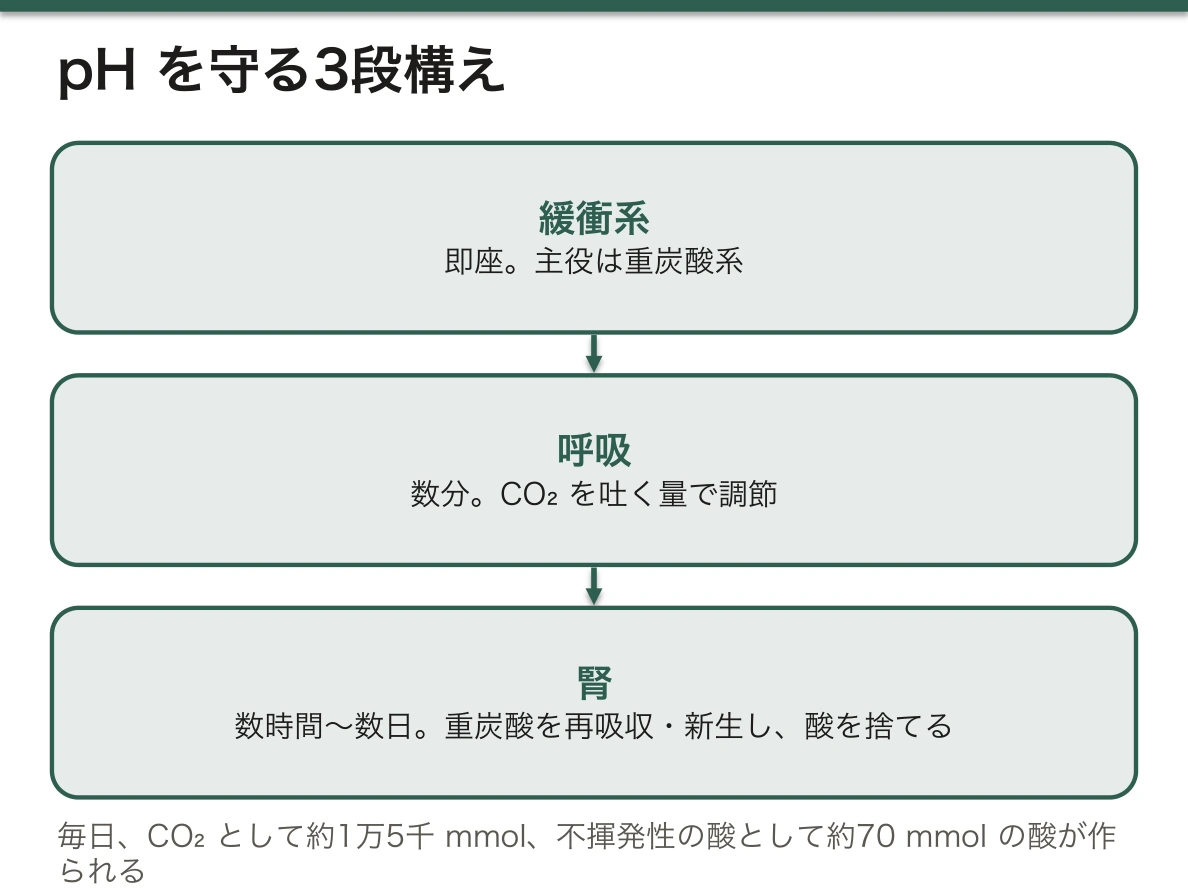
体は毎日、代謝によって大量の酸を作っている(二酸化炭素として1日1万5千mmol、不揮発性の酸として約70mmol)。それでも血液のpHは 7.35〜7.45 という狭い幅に保たれる。守るのは3段構えである。
- 緩衝系——即座。主役は重炭酸系
- 呼吸——数分。二酸化炭素を吐く量で調節
- 腎——数時間〜数日。重炭酸を再吸収/新生し、酸を捨てる
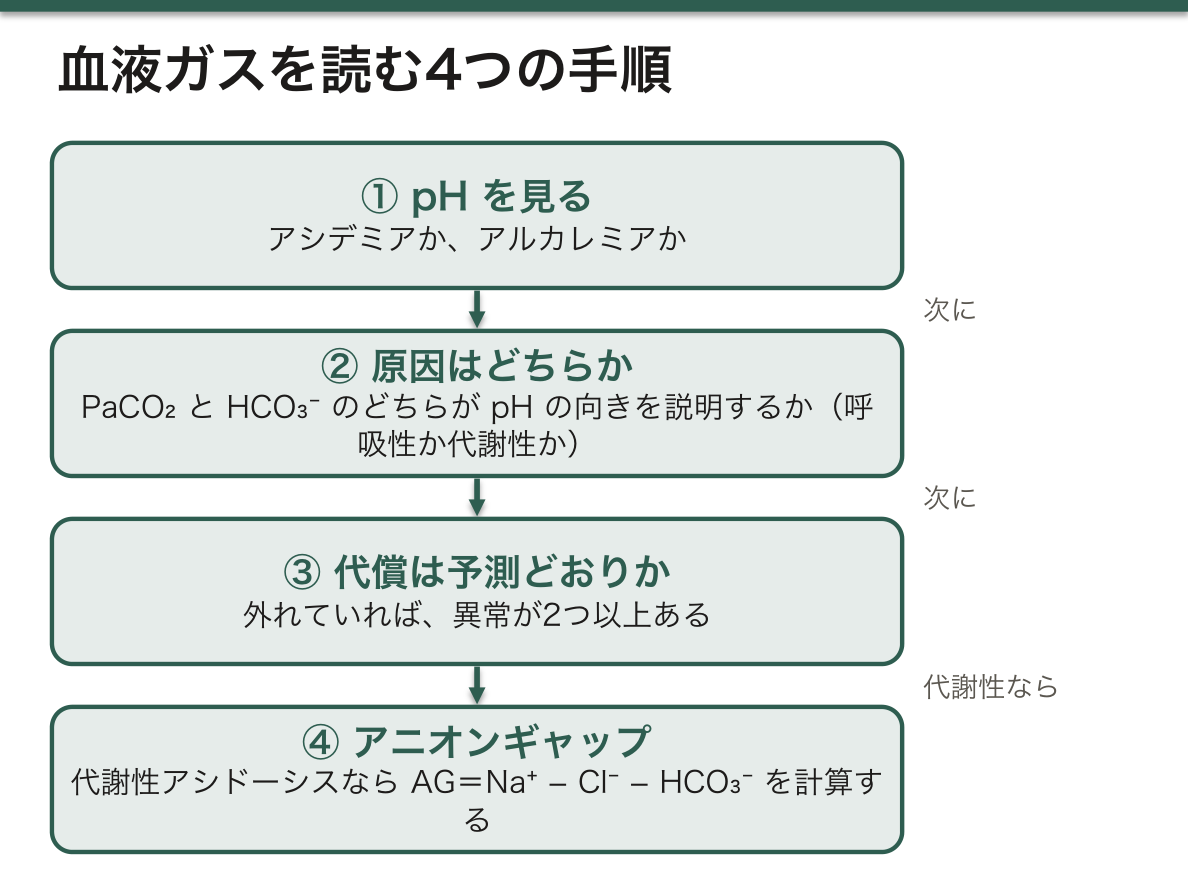
この章の目的は暗記ではなく、血液ガスを毎回同じ手順で読めるようになることである。手順は4つ。
- pH を見る(アシデミアか、アルカレミアか)
- PaCO₂ と HCO₃⁻ のどちらが pH の向きを説明するか(呼吸性か、代謝性か)
- 代償は予測どおりか(外れていれば2つ以上起きている)
- 代謝性アシドーシスなら アニオンギャップ
- 緩衝系 — なぜ重炭酸が主役なのか
- アニオンギャップ — 何が酸を持ち込んだか
- カリウムと pH — 一緒に動く理由
- 代償の予測式 — 「そのぶんで説明がつくか」を数で確かめる
- 乳酸アシドーシス — 作りすぎか、捨てられないか
緩衝系 — なぜ重炭酸が主役なのか
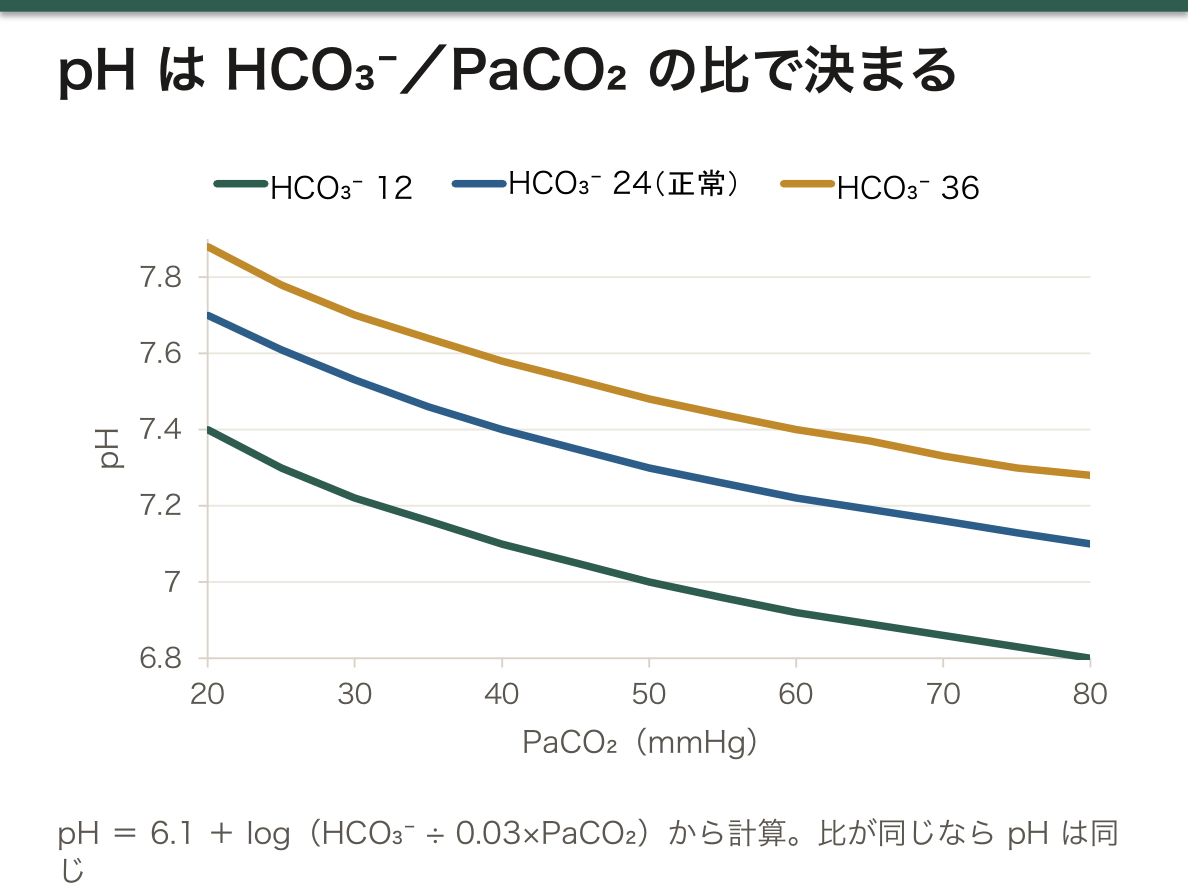
Henderson-Hasselbalch の式:pH = 6.1 + log([HCO₃⁻] ÷ 0.03×PaCO₂)
主な緩衝系。
- 重炭酸系——細胞外液の主役。pKa は 6.1 で血液のpH から離れているのに主役を張る
- ヘモグロビン——血液中で重炭酸に次ぐ
- リン酸・蛋白——細胞内と尿中
- 骨——慢性のアシドーシスで炭酸塩を放出する
緩衝剤としては pKa が pH に近いほど優秀なはずで、6.1 の重炭酸系は本来向いていない。それでも主役なのは、開放系だからである。
二酸化炭素は肺から捨てられる。つまり酸が加わって重炭酸が消費されても、生じた二酸化炭素を呼気として系の外へ出せるので、反応が右へ進み続ける。閉じた系なら生成物が溜まって効率が落ちるところを、出口があることで解決している。
だから式の読み方も定まる——分子(HCO₃⁻)は腎が、分母(PaCO₂)は肺が担当する。比だけが pH を決めるので、両方が同じ向きに動けば pH は保たれる。これが代償の正体である。
代償には限界と法則がある。
- 代償はやりすぎない——pH を正常域に戻しはするが、行き過ぎて反対側へ振ることはない。だからpH が正常なのに PaCO₂ も HCO₃⁻ も大きく異常なら、2つの障害が同時に起きている
- 呼吸性の代償は速く(数分)、代謝性の代償は遅い(腎は2〜3日)。急性と慢性で予測値が違うのはこのため
実務的な目安:代謝性アシドーシスでは Winter の式——予測 PaCO₂ = 1.5×[HCO₃⁻] + 8 ± 2。予測より高ければ呼吸性アシドーシスの合併、低ければ呼吸性アルカローシスの合併である。
English version
Core
The Henderson–Hasselbalch equation: pH = 6.1 + log([HCO₃⁻] ÷ 0.03 × PaCO₂)
The main buffers
- Bicarbonate — the principal one of the extracellular fluid. Its pKa is 6.1, far from the pH of blood, yet it takes the leading role.
- Haemoglobin — second to bicarbonate in the blood.
- Phosphate and protein — within the cell and in the urine.
- Bone — releases carbonate in chronic acidosis.
Going further
As a buffer, the closer the pKa to the pH the better, and 6.1 should be unsuitable. It takes the leading role nonetheless because the system is open. Carbon dioxide is discarded by the lung. That is, when acid is added and bicarbonate is consumed, the carbon dioxide formed can leave the system in the breath, so the reaction goes on proceeding to the right. Where a closed system would lose efficiency as the product accumulated, an exit solves it.
So the reading of the equation is settled — the numerator (HCO₃⁻) is the kidney’s business and the denominator (PaCO₂) the lung’s. Only the ratio decides the pH, so if both move in the same direction the pH is preserved. This is the substance of compensation.
Compensation has limits and rules.
- Compensation never overshoots — it brings the pH back towards normal but never past it to the other side. So if the pH is normal while both PaCO₂ and HCO₃⁻ are grossly abnormal, two disorders are present at once.
- Respiratory compensation is fast (minutes) and metabolic compensation slow (the kidney, 2–3 days). This is why the predicted values differ between acute and chronic.
A practical rule: in metabolic acidosis, Winter’s formula — predicted PaCO₂ = 1.5 × [HCO₃⁻] + 8 ± 2. Higher than predicted means a coexisting respiratory acidosis; lower, a coexisting respiratory alkalosis.
アニオンギャップ — 何が酸を持ち込んだか
AG = [Na⁺] − [Cl⁻] − [HCO₃⁻] 正常 12 ± 2(施設により 8〜16)。
測っていない陰イオン(主にアルブミン)の量を映す。
- AG 開大——酸が外から加わった/作られた。その陰イオンが重炭酸と入れ替わる
- AG 正常(高クロール性)——重炭酸そのものを失った。失った分をクロールが埋める
低アルブミン血症では AG が過小評価される。アルブミンが1g/dL 下がるごとに AG を約2.5 足して補正する。
AG が開くか開かないかは、「酸が来たのか、塩基が逃げたのか」の区別である。
AG 開大(覚え方は GOLD MARK)
- 糖尿病性ケトアシドーシス——ケト酸。アルコール性・飢餓性も同型
- 乳酸アシドーシス——組織低灌流・敗血症・メトホルミン・チアミン欠乏
- 腎不全——リン酸・硫酸が排泄されない
- 中毒——メタノール(ギ酸)・エチレングリコール(シュウ酸)・サリチル酸
AG 正常(高クロール性)
- 下痢——腸液から重炭酸を失う。最も多い
- 尿細管性アシドーシス——腎で重炭酸を保てない(II型)/酸を捨てられない(I型)
- 生理食塩水の大量投与——クロールを負荷して相対的に重炭酸が薄まる
下痢と嘔吐で逆になるのが要点である。下痢は腸液(重炭酸に富む)を失うのでアシドーシス、嘔吐は胃液(塩酸)を失うのでアルカローシス。どこの体液を失ったかを問えば向きが決まる。
浸透圧ギャップと組み合わせると中毒が絞れる。実測浸透圧が計算値より大きく開いていれば、アルコール類(メタノール・エチレングリコール)が入っている。AG も浸透圧ギャップも開いていたら中毒を疑う——2つの隙間を並べて読む。
糖尿病性ケトアシドーシスの治療で起こる典型的な変化が、この章の理解を試す。ケト体は代謝されると重炭酸に戻るので AG は閉じるが、治療中に投与した生理食塩水のクロールにより、AG 正常の高クロール性アシドーシスへ移行することがある。
pH がなかなか戻らないのを「治療が効いていない」と読み違えない——AG を追えば、最初の酸はすでに処理されていることが分かる。同じ「アシドーシス」でも中身が入れ替わっている。
サリチル酸中毒は呼吸中枢を直接刺激して呼吸性アルカローシスを起こしつつ、代謝性アシドーシスも起こすという混合性の代表である。成人で pH が正常近くでも重症でありうる——手順3(代償が予測どおりか)を飛ばすと見逃す。
English version
Core
AG = [Na⁺] − [Cl⁻] − [HCO₃⁻]; normal 12 ± 2 (8–16 by laboratory). It reflects the unmeasured anions (chiefly albumin).
- Widened AG — acid has been added or made. Its anion has taken the place of bicarbonate.
- Normal AG (hyperchloraemic) — bicarbonate itself has been lost, and chloride has filled the gap.
Hypoalbuminaemia underestimates the AG. Add about 2.5 to the AG for every 1 g/dL fall in albumin.
Going further
Whether the gap opens is the distinction between "acid came in" and "base escaped".
Widened AG (the mnemonic GOLD MARK)
- Diabetic ketoacidosis — keto acids. The alcoholic and starvation forms are the same type.
- Lactic acidosis — hypoperfusion, sepsis, metformin, thiamine deficiency.
- Renal failure — phosphate and sulphate not excreted.
- Poisoning — methanol (formate), ethylene glycol (oxalate), salicylate.
Normal AG (hyperchloraemic)
- Diarrhoea — loss of bicarbonate in intestinal fluid. The commonest.
- Renal tubular acidosis — bicarbonate cannot be retained (type II) or acid cannot be excreted (type I).
- Large volumes of normal saline — a chloride load relatively dilutes the bicarbonate.
That diarrhoea and vomiting are opposite is the point. Diarrhoea loses intestinal fluid (rich in bicarbonate) and gives acidosis; vomiting loses gastric juice (hydrochloric acid) and gives alkalosis. Ask which body fluid was lost and the direction is settled.
Combined with the osmolal gap it narrows a poisoning. If the measured osmolality greatly exceeds the calculated, an alcohol (methanol, ethylene glycol) is present. A widened anion gap and a widened osmolal gap together suggest poisoning — read the two gaps side by side.
In the clinic
A typical change during the treatment of diabetic ketoacidosis tests the understanding of this chapter. The ketones are metabolised back to bicarbonate and the AG closes, but the chloride of the saline given during treatment may convert it into a normal-AG hyperchloraemic acidosis.
Do not misread a pH that is slow to return as "the treatment is not working" — follow the AG and it is clear that the original acid has already been dealt with. The same "acidosis" has changed its contents.
Salicylate poisoning is the classic mixed disorder, stimulating the respiratory centre directly to give a respiratory alkalosis while also causing a metabolic acidosis. In an adult it can be severe with a nearly normal pH — skip step 3 (is the compensation as predicted?) and it is missed.
カリウムと pH — 一緒に動く理由
アシドーシスでは高カリウム血症、アルカローシスでは低カリウム血症に傾く。
水素イオンが細胞内へ入るとき、電気的な釣り合いのためにカリウムが細胞外へ出る(逆も同じ)。
ただし細胞内から出てきているだけで、体全体のカリウムが増えたわけではない。
目安としてpH が0.1下がるとカリウムが約0.5mEq/L 上がる。
「見えているカリウム値」と「体に貯まっているカリウム総量」を分けて考えることが要点である。
糖尿病性ケトアシドーシスがその典型になる。
- 浸透圧利尿で体のカリウムは大量に失われている(欠乏している)
- しかしアシドーシスとインスリン欠乏により細胞外へ出ているので、採血では正常か高値に見える
- インスリンを投与すると、糖と一緒にカリウムが細胞内へ戻る → 一気に低カリウム血症になり、致死性不整脈を起こしうる
だから治療の順序が決まる——カリウムが 3.3mEq/L 未満ならインスリンより先にカリウムを補う。「見かけの値が下がる方向へ治療する」ときが最も危ない。
逆向きの応用もある。高カリウム血症の緊急治療では、この移動をわざと利用する。
- グルコース・インスリン療法——細胞内へ押し込む
- β2刺激薬——同じく細胞内へ
- 重炭酸ナトリウム——pH を上げて細胞内へ
- グルコン酸カルシウム——カリウムは動かさないが、心筋の膜を安定させる(最も速い)
前3つは「隠すだけ」で体から出してはいないので、利尿薬・陽イオン交換樹脂・透析で実際に捨てる手当てが別に要る。移動と排泄を区別できるかが、この病態を理解しているかの分かれ目である。
English version
Core
Acidosis tends to hyperkalaemia and alkalosis to hypokalaemia. As hydrogen ions enter the cell, potassium leaves it to balance the charge (and the reverse).
But it has only come out of the cells: the total body potassium has not increased.
As a rule of thumb, a fall of 0.1 in pH raises the potassium by about 0.5 mEq/L.
Going further
The point is to think separately of the potassium you can see and the total potassium in the body.
Diabetic ketoacidosis is the classic case.
- Osmotic diuresis has lost a great deal of body potassium (there is a deficit).
- Yet acidosis and lack of insulin have driven it out of the cells, so the blood level looks normal or high.
- Give insulin and the potassium returns into the cells with the glucose — hypokalaemia develops at a stroke and can cause a fatal arrhythmia.
So the order of treatment is fixed — if the potassium is below 3.3 mEq/L, replace potassium before giving insulin. The most dangerous moment is when the treatment moves the apparent value downwards.
The reverse application also exists. In the emergency treatment of hyperkalaemia this shift is used deliberately.
- Glucose and insulin — push it into the cells.
- β2 agonists — likewise.
- Sodium bicarbonate — raise the pH and drive it in.
- Calcium gluconate — does not move the potassium but stabilises the myocardial membrane (the fastest).
The first three only hide it and do not remove it from the body, so diuretics, cation exchange resins or dialysis are needed separately to discard it. Whether one can distinguish shifting from excreting is the dividing line of understanding this problem.
代償の予測式 — 「そのぶんで説明がつくか」を数で確かめる
一次性の異常が起きると、体はもう一方を動かして pH を戻そうとする。代償は行きすぎないし、完全にも戻らない。
| 一次性の異常 | 代償 | 予測 |
|---|---|---|
| 代謝性アシドーシス | 過換気 | PaCO₂ ≒ 1.5 × HCO₃⁻ + 8 ± 2(Winter の式) |
| 代謝性アルカローシス | 低換気 | PaCO₂ が HCO₃⁻ の 1 mEq/L 上昇につき約 0.7 mmHg 上がる |
| 呼吸性アシドーシス | 腎で HCO₃⁻ を保つ | 急性:PaCO₂ 10 上昇で HCO₃⁻ +1/慢性:+3〜4 |
| 呼吸性アルカローシス | 腎で HCO₃⁻ を捨てる | 急性:PaCO₂ 10 低下で HCO₃⁻ −2/慢性:−4〜5 |
代償には時間がかかる——呼吸性の代償は数分〜数時間、腎性の代償は 2〜5 日。
予測から外れていれば、異常が2つ以上ある(混合性)。
予測式の意味は「代償を評価する」ことではなく、「隠れた第2の異常を暴く」ことにある。実測が予測より低ければ呼吸性アルカローシスの合併、高ければ呼吸性アシドーシスの合併になる——「合っていれば1つ、ずれていれば2つ以上」。
急性と慢性で係数が違うことが、そのまま経過の推定になる。PaCO₂ が高いのに HCO₃⁻ が十分に上がっていなければ、それは今日始まった呼吸不全になる(呼吸器の章)——「数字の組み合わせが、いつからかを教えている」。
腎の代償が 2〜5 日かかることは、治療の速さを決める。慢性の呼吸性アシドーシスで PaCO₂ を急に下げると、残った HCO₃⁻ でアルカレミアになる(酸塩基の実際の章)——「戻すのは、作られた速さと同じ速さで」。
そして代償は必ず不完全になる。pH が完全に 7.40 に戻っていたら、代償ではなく2つの異常が打ち消し合っていると考える——「正常な pH が、正常であることを意味しない場合がある」。
English version
Core
When a primary disorder occurs the body moves the other side to bring the pH back. Compensation neither overshoots nor fully corrects.
| Primary disorder | Compensation | Prediction |
|---|---|---|
| Metabolic acidosis | Hyperventilation | PaCO₂ ≈ 1.5 × HCO₃⁻ + 8 ± 2 (Winter’s) |
| Metabolic alkalosis | Hypoventilation | PaCO₂ rises about 0.7 mmHg per 1 mEq/L rise in HCO₃⁻ |
| Respiratory acidosis | The kidney retains HCO₃⁻ | Acute: +1 per 10 rise in PaCO₂ / chronic: +3–4 |
| Respiratory alkalosis | The kidney discards HCO₃⁻ | Acute: −2 per 10 fall / chronic: −4–5 |
Compensation takes time — respiratory in minutes to hours, renal in 2–5 days. If it departs from the prediction, there is more than one disorder (a mixed picture).
Going further
The point of the predictive formulae is not to assess the compensation but to expose a hidden second disorder. Measured lower than predicted means a coexisting respiratory alkalosis; higher, a coexisting respiratory acidosis — agreement means one, discrepancy means two or more.
That the coefficients differ between acute and chronic is itself an estimate of the time course. If the PaCO₂ is high but the HCO₃⁻ has not risen sufficiently, the respiratory failure began today — the combination of numbers tells you since when.
That renal compensation takes 2–5 days decides how fast to treat. Lower the PaCO₂ suddenly in a chronic respiratory acidosis and the retained HCO₃⁻ gives alkalaemia — bring it back at the speed at which it was made.
And compensation is always incomplete. If the pH has returned exactly to 7.40, think not of compensation but of two disorders cancelling each other — a normal pH does not always mean normality.
乳酸アシドーシス — 作りすぎか、捨てられないか
乳酸は解糖系の最終産物の一つで、ピルビン酸から乳酸脱水素酵素によって作られる。
酸素が足りないと、ピルビン酸が TCA 回路へ入れず乳酸に流れる。NAD⁺ を再生して解糖を回し続けるためになる。
2型に分ける。
| 型 | 機序 | 原因 |
|---|---|---|
| A 型 | 組織の酸素不足 | ショック・重症低酸素血症・重症貧血・痙攣・腸管虚血 |
| B 型 | 酸素は足りているが代謝が回らない | ビグアナイド薬・肝不全・悪性腫瘍・ビタミンB1欠乏・ミトコンドリア病 |
乳酸は主に肝で糖新生の材料として消費される(Cori 回路)。肝不全では捨てる側が止まる。
アニオンギャップの開いた代謝性アシドーシスになる。
「作りすぎ」と「捨てられない」を分ける発想が、この項の核心になる。乳酸値は産生と除去の差でしかないので、高値の意味が2通りある(Cori 回路の項)——「同じ数字が、循環の話にも肝の話にもなる」。
だから敗血症で乳酸を測る意味がはっきりする。組織への酸素の届き方を、間接的に数字で見ている(ショックと敗血症の章)——「乳酸が下がるかどうかが、蘇生の答え合わせになる」。
ビタミンB1欠乏は、B型の中でも見落としやすく、しかも治せる。ピルビン酸脱水素酵素の補酵素なので、欠乏するとピルビン酸が TCA 回路へ入れず乳酸へ流れる(水溶性ビタミンの章)——「ブドウ糖を先に入れると、かえって悪化する」。
ビグアナイド薬(メトホルミン)は、肝での糖新生を抑えることで乳酸の消費を減らす(糖尿病の各論の章)——「腎機能が落ちて薬が溜まる場面と、造影剤を使う場面で休薬するのは、この機序による」。
D-乳酸アシドーシスという例外もある。短腸症候群で腸内細菌が作る D 体は、通常の乳酸測定に引っかからない(腸内細菌の章)——「測っている乳酸が L 体だけであることを知らないと、説明のつかない酸血症になる」。
English version
Core
Lactate is one of the end products of glycolysis, made from pyruvate by lactate dehydrogenase. When oxygen is short, pyruvate cannot enter the TCA cycle and flows to lactate — to regenerate NAD⁺ and keep glycolysis turning.
| Type | Mechanism | Causes |
|---|---|---|
| A | Tissue hypoxia | Shock, severe hypoxaemia, severe anaemia, seizures, bowel ischaemia |
| B | Oxygen is sufficient but metabolism will not turn | Biguanides, liver failure, malignancy, thiamine deficiency, mitochondrial disease |
Lactate is consumed chiefly in the liver as substrate for gluconeogenesis (the Cori cycle). In liver failure the disposal side stops. It gives a metabolic acidosis with a widened anion gap.
Going further
The core of this section is the idea of separating "too much made" from "not disposed of". The lactate is nothing but the difference between production and removal, so a high value has two meanings — the same number may be a matter of the circulation or of the liver.
So the meaning of measuring lactate in sepsis becomes clear — it looks indirectly, as a number, at how oxygen is reaching the tissues. Whether the lactate falls is the check on the resuscitation.
Thiamine deficiency is easily missed among the type B causes, and is treatable. Being the coenzyme of pyruvate dehydrogenase, its lack means pyruvate cannot enter the TCA cycle and flows to lactate — and giving glucose first makes it worse.
Biguanides (metformin) suppress hepatic gluconeogenesis and so reduce the consumption of lactate — the reason it is withheld when renal function falls and the drug accumulates, and around the use of contrast media.
There is an exception, D-lactic acidosis. In short bowel syndrome the D form made by the gut flora is not detected by the usual lactate assay — not knowing that the lactate measured is only the L form leaves an unexplained acidaemia.
まとめ
| 緩衝系 — なぜ重炭酸が主役なのか | Henderson-Hasselbalch の式:pH = 6.1 + log([HCO₃⁻] ÷ 0.03×PaCO₂)主な緩衝系。 |
|---|---|
| アニオンギャップ — 何が酸を持ち込んだか | AG = [Na⁺] − [Cl⁻] − [HCO₃⁻] 正常 12 ± 2(施設により 8〜16)。 |
| カリウムと pH — 一緒に動く理由 | アシドーシスでは高カリウム血症、アルカローシスでは低カリウム血症に傾く。 |
| 代償の予測式 — 「そのぶんで説明がつくか」を数で確かめる | 一次性の異常が起きると、体はもう一方を動かして pH を戻そうとする。 |
| 乳酸アシドーシス — 作りすぎか、捨てられないか | 乳酸は解糖系の最終産物の一つで、ピルビン酸から乳酸脱水素酵素によって作られる。 |
このノートは医学生が授業の内容を自分の言葉でまとめたもので、診療の判断に使うものではありません。誤りに気づいたらお知らせください。