栄養は、記憶する分野ではなく計算する分野になる。必要量は体重・活動・侵襲から出せる。
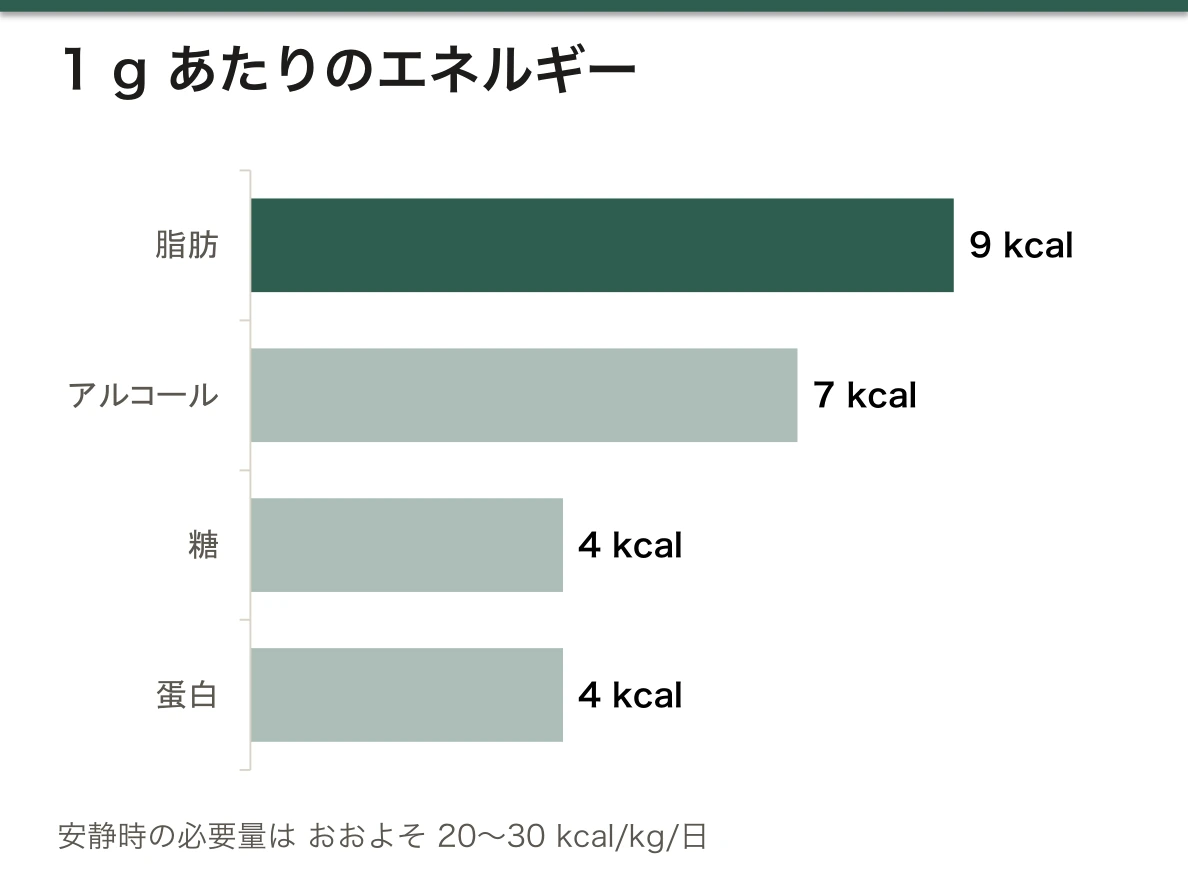
- エネルギー——糖 4 kcal/g・蛋白 4 kcal/g・脂肪 9 kcal/g・アルコール 7 kcal/g
- 安静時の必要量——おおよそ 20〜30 kcal/kg/日
- 蛋白——健常で 0.8〜1.0 g/kg/日、侵襲下で 1.2〜2.0 g/kg/日
そして「入れ方」の原則が1つある——「腸が使えるなら、腸を使う」。
腸を使わないと、粘膜が萎縮して細菌が体内へ入りやすくなる(バクテリアルトランスロケーション)。
飢餓の長い患者に急に栄養を入れると、リフィーディング症候群が起きる——「治療のつもりの栄養が、致死的になる」。
- エネルギー代謝を測る — 呼吸商と、間接熱量測定
- 飢餓と、栄養を再開するときの危険
- 蛋白質の必要量とアミノ酸スコア — 一番少ないものが、全体を決める
- 脂肪組織という内分泌器官 — 溜める場所が、命令も出している
- 減った体重が戻るのは、意志の問題ではない
- ビタミンとミネラルには、上限がある
エネルギー代謝を測る — 呼吸商と、間接熱量測定
呼吸商(RQ)= 産生CO₂ / 消費O₂。
| 基質 | RQ |
|---|---|
| 糖質 | 1.0 |
| 蛋白質 | 約0.8 |
| 脂質 | 約0.7 |
| 混合食(通常) | 0.8〜0.85 |
| 脂肪合成(過剰投与) | 1.0を超える |
基礎代謝量——体表面積・除脂肪体重に比例。年齢とともに低下し、甲状腺機能で変わる。
Harris-Benedict の式——基礎代謝量を推算し、活動係数と侵襲係数を掛ける。
窒素バランス——摂取窒素 − 排泄窒素。蛋白 6.25 g が窒素 1 g に相当する。
- 正——成長・回復期。負——侵襲・飢餓・ステロイド
侵襲期の代謝——異化が亢進し、糖新生が進む。インスリン抵抗性が出る(外傷後の高血糖)。
呼吸商が1.0を超えたら、糖を入れすぎていることになる(経静脈栄養の章)——「余った糖が脂肪に変えられ、その過程でCO₂が出る」。
だから呼吸不全の患者に糖を入れすぎると、CO₂ 産生が増えて人工呼吸器から離れにくくなる(人工呼吸器離脱の章)——「栄養の組成が、呼吸の負荷を変える」。
侵襲期のインスリン抵抗性が、外傷後の高血糖を作る。糖尿病でなくても起きる(外傷後の代謝の章)——「血糖が高いこと自体は、必ずしも糖尿病を意味しない」。
そして急性期に厳格すぎる血糖管理は、低血糖の害が上回る(重症患者の血糖管理の章)——「正常化ではなく、範囲に収めることを目標にする」。
窒素バランスが負であることは、栄養が足りていないか、侵襲が続いていることを示す(がん悪液質の章)——「栄養を足しても正に戻らないとき、原因は栄養以外にある」。
基礎代謝が除脂肪体重に比例することが、肥満患者の必要量の計算をゆがめる。実体重で計算すると過剰になる(体重による投与設計の章)——「薬の量と栄養の量で、使う体重が違う」。
English version
Core
Respiratory quotient (RQ) = CO₂ produced / O₂ consumed.
| Substrate | RQ |
|---|---|
| Carbohydrate | 1.0 |
| Protein | About 0.8 |
| Fat | About 0.7 |
| Mixed diet (usual) | 0.8–0.85 |
| Lipogenesis (overfeeding) | Above 1.0 |
Basal metabolic rate — proportional to body surface area and lean body mass; falls with age and varies with thyroid function. The Harris–Benedict equation estimates it, multiplied by activity and stress factors.
Nitrogen balance — nitrogen taken in minus nitrogen excreted. 6.25 g of protein corresponds to 1 g of nitrogen. Positive in growth and recovery; negative in injury, starvation and with steroids.
Metabolism after injury — catabolism increases and gluconeogenesis proceeds. Insulin resistance appears (post-traumatic hyperglycaemia).
Going further
An RQ above 1.0 means too much carbohydrate is being given — the surplus is being converted to fat and CO₂ is released in the process. So overfeeding carbohydrate to a patient in respiratory failure increases CO₂ production and makes weaning from the ventilator harder — the composition of the feed changing the respiratory load.
The insulin resistance of injury creates post-traumatic hyperglycaemia. It occurs without diabetes — a high blood glucose does not necessarily mean diabetes. And in the acute phase, too strict glycaemic control does more harm through hypoglycaemia — aim to keep it within a range rather than to normalise it.
A negative nitrogen balance shows either that the nutrition is insufficient or that the insult continues — when adding nutrition does not turn it positive, the cause is not nutritional.
That the basal rate is proportional to lean mass distorts the calculation in an obese patient: calculated on actual weight it is excessive — the weight used for a drug dose and for a feed are not the same.
飢餓と、栄養を再開するときの危険
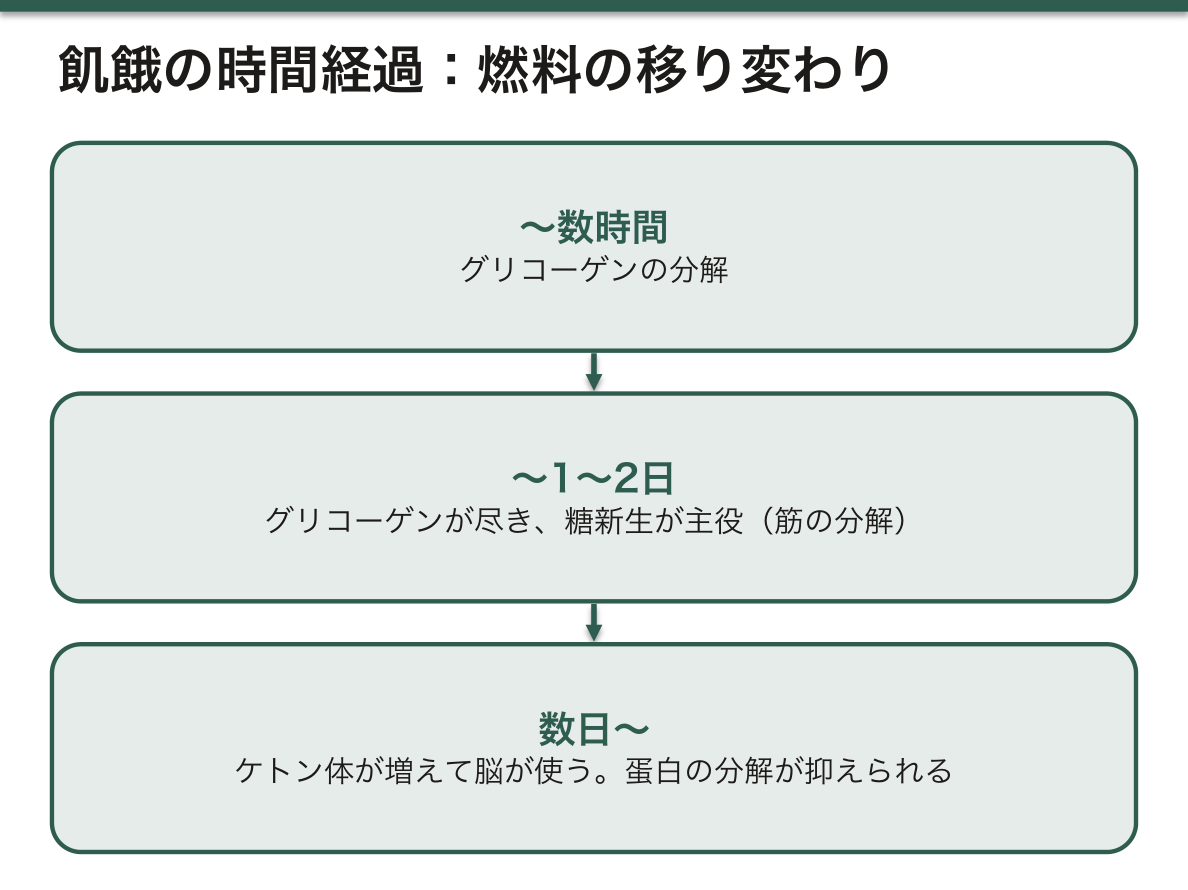
飢餓の時間経過。
- 〜数時間——グリコーゲンの分解
- 〜1〜2日——グリコーゲンが尽き、糖新生が主役になる(筋の分解)
- 数日〜——ケトン体が増え、脳がこれを使い始める。蛋白の分解が抑えられる(蛋白節約)
リフィーディング症候群——飢餓状態に糖を投与すると、インスリンが分泌され、細胞内へ一気に移動が起きる。
- 低リン血症(最も重要)・低カリウム血症・低マグネシウム血症
- ビタミンB1の急激な消費——Wernicke 脳症
- 体液貯留——心不全
危険因子——BMI低値・長期の低摂取・大量の飲酒・神経性やせ症・電解質の低値。
予防——少量から始めて数日かけて増やす。開始前にビタミンB1を投与し、リン・カリウム・マグネシウムを測って補う。
蛋白エネルギー低栄養は、2つの型に分けて記述されてきた。
- マラスムス——エネルギーと蛋白の両方が長期に不足する。著明なるい痩・皮下脂肪と筋の消失。血清アルブミンは比較的保たれる
- クワシオルコル——エネルギーに対して蛋白が相対的に不足する。浮腫・腹水・脂肪肝・皮膚と毛髪の変化。血清アルブミンが低下する
- 実際には両者が混在する型が多い
入院患者の低栄養では、炎症の有無で分けて考える——飢餓によるものと、疾患に伴う炎症によるものでは、栄養投与だけでは改善しない場合がある。
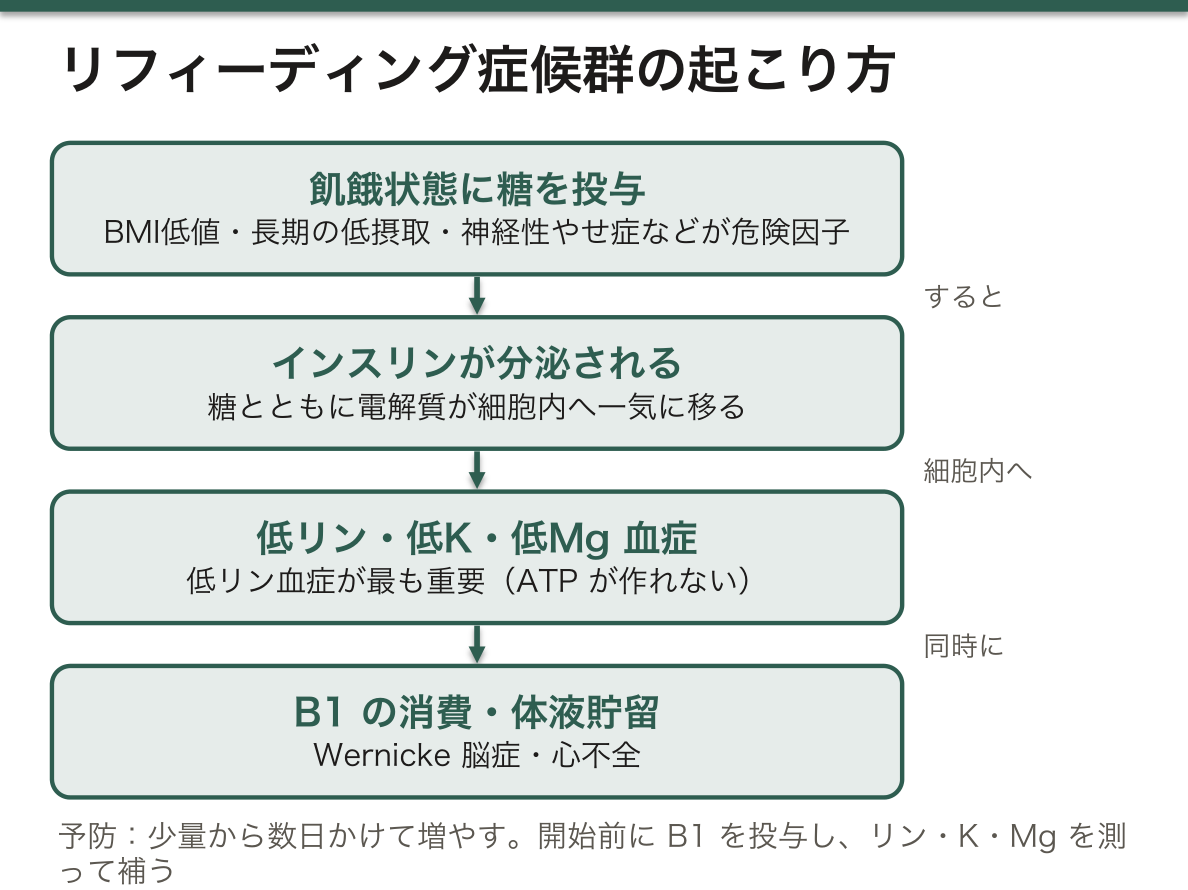
「良かれと思って栄養を入れることが、最も危ない」という構図になる(栄養の開始の章)——「治療の意図が、そのまま害になりうる」。
低リン血症が最も重要なのは、ATP が作れなくなるからになる。呼吸筋の脱力・心不全・溶血・意識障害(リンの異常の章)——「エネルギーの通貨そのものが作れない」。
ビタミンB1をブドウ糖より先に投与するのは、糖代謝がB1を消費するからになる(ビタミンB1の章)——「順番を間違えると、Wernicke 脳症を誘発する」。
だから意識障害の患者にブドウ糖を投与する場面では、B1 を併せて考える(意識障害の初期対応の章)——「救急での定型的な手順に、この理由が組み込まれている」。
ケトン体が脳の燃料になれることが、長期の飢餓に耐えられる理由になる(ケトン体の章)——「脳が糖しか使えないままなら、数日で筋が尽きる」。
神経性やせ症では、この症候群の危険が最も高い(摂食障害の章)——「精神科の疾患だが、死因は身体の合併症になる」。
マラスムスとクワシオルコルという区分は、血清アルブミンの低下を「蛋白が足りないこと」と読ませてきた。しかし入院患者のアルブミン低下は、炎症による血管透過性の亢進と合成の低下でも起こる(急性期蛋白の章、アルブミンの読み方の章)——「アルブミンが低いことは、栄養が足りないことの証明にならない」。
だから低栄養の診断は、体重減少・摂取量・筋量・炎症の有無を組み合わせて行う(サルコペニアの章、高齢者の栄養の章)——「1つの検査値で決めない」。
English version
Core
The time course of starvation.
- Up to some hours — glycogenolysis.
- 1–2 days — glycogen is exhausted and gluconeogenesis takes over (breaking down muscle).
- From some days — ketones rise and the brain begins to use them. Protein breakdown is suppressed (protein sparing).
Refeeding syndrome — giving carbohydrate to a starved patient releases insulin and everything moves into the cells at once.
- Hypophosphataemia (the most important), hypokalaemia, hypomagnesaemia.
- A sudden consumption of thiamine — Wernicke’s encephalopathy.
- Fluid retention — heart failure.
Risk factors — low BMI, prolonged poor intake, heavy drinking, anorexia nervosa, low electrolytes. Prevention — start small and increase over days; give thiamine before starting; measure and replace phosphate, potassium and magnesium.
Protein–energy malnutrition has traditionally been described in two forms — marasmus (long-standing lack of both energy and protein; marked wasting; the serum albumin comparatively preserved) and kwashiorkor (protein lacking relative to energy; oedema, ascites, fatty liver, changes in skin and hair; a low serum albumin). In practice mixed forms are common.
Going further
The pattern here is that giving nutrition with the best of intentions is the most dangerous thing of all — the intention of treatment becoming directly the harm.
Hypophosphataemia matters most because ATP cannot be made: weakness of the respiratory muscles, heart failure, haemolysis, impaired consciousness — the currency of energy itself cannot be made.
Thiamine is given before glucose because carbohydrate metabolism consumes it — get the order wrong and Wernicke’s encephalopathy is precipitated. So whenever glucose is given for impaired consciousness, thiamine is considered with it — the reason is built into the standard emergency protocol.
That ketones can fuel the brain is why prolonged starvation can be tolerated — were the brain able to use only sugar, the muscle would be exhausted within days.
The risk of this syndrome is highest in anorexia nervosa — a psychiatric disease whose cause of death is a physical complication.
The marasmus–kwashiorkor division taught a low serum albumin to be read as "too little protein". But a falling albumin in an inpatient also occurs from increased vascular permeability and reduced synthesis in inflammation — a low albumin is not proof of insufficient nutrition. So malnutrition is diagnosed by combining weight loss, intake, muscle mass and the presence of inflammation — not decided by one laboratory value.
蛋白質の必要量とアミノ酸スコア — 一番少ないものが、全体を決める
必須アミノ酸は9種——バリン・ロイシン・イソロイシン・トレオニン・メチオニン・リジン・フェニルアラニン・トリプトファン・ヒスチジン。
アミノ酸スコア——基準となるアミノ酸評点パターンに対して、最も不足しているアミノ酸(第一制限アミノ酸)の比率で表す。
| 食品 | スコア | 第一制限アミノ酸 |
|---|---|---|
| 卵・肉・魚・乳 | 100 | — |
| 大豆 | 100 | — |
| 精白米 | 約 65 | リジン |
| 小麦(食パン) | 約 44 | リジン |
不足しているものを他の食品で補うことを、蛋白質の補足効果という——米+大豆でスコアが上がる。
窒素出納——摂取した窒素と排泄した窒素の差。成長期・妊娠・回復期では正、飢餓・侵襲・臥床では負になる。
「一番少ないものが全体を決める」という桶の理屈が、この項の全部になる。他が十分でも、1つ足りなければそこで蛋白合成が止まる(翻訳の章)——「合計の量ではなく、一番細い所を見る」。
だから穀物中心の食事では、リジンが律速になる。米と大豆、パンと乳製品という組み合わせが、経験的に成立してきた理由がここにある(食の政策の章)——「食文化の組み合わせが、生化学として説明できる」。
窒素出納が負であることは、蛋白が壊されている証拠になる。侵襲後は糖質と脂質を十分に入れないと、アミノ酸が糖新生に回されて筋が削られる(蛋白節約効果)(栄養をどう入れるかの章)——「蛋白を足すだけでなく、燃やす分を別に用意する」。
分枝鎖アミノ酸は、この文脈で特別な位置にある。筋で直接代謝され、肝性脳症では芳香族アミノ酸との比(Fischer 比)が下がる(分枝鎖アミノ酸の章)——「肝が悪い人に、蛋白を一律に制限しない」。
腎不全では逆に、制限しつつ質を上げる(慢性腎臓病の章)——「量を減らすほど、アミノ酸スコアの高い蛋白が必要になる」。
English version
Core
Nine essential amino acids — valine, leucine, isoleucine, threonine, methionine, lysine, phenylalanine, tryptophan, histidine.
Amino acid score — expressed as the proportion of the most deficient amino acid (the first limiting amino acid) against a reference pattern.
| Food | Score | First limiting |
|---|---|---|
| Egg, meat, fish, milk | 100 | — |
| Soya | 100 | — |
| Polished rice | About 65 | Lysine |
| Wheat (white bread) | About 44 | Lysine |
Making up what is lacking with another food is the complementary effect of proteins — rice plus soya raises the score.
Nitrogen balance — the difference between nitrogen taken in and excreted. Positive in growth, pregnancy and recovery; negative in starvation, injury and bed rest.
Going further
The whole of this section is the logic of the barrel — the shortest stave decides the whole. Sufficient of all the others is useless if one is lacking; protein synthesis stops there — look not at the total but at the narrowest point.
So on a diet centred on cereals, lysine is rate-limiting. Rice with soya, bread with dairy — here is why those combinations arose empirically: a combination of food cultures explicable as biochemistry.
A negative nitrogen balance is evidence that protein is being broken down. After injury, unless enough carbohydrate and fat are given, amino acids are diverted to gluconeogenesis and muscle is consumed (protein sparing) — do not only add protein; provide separately what is to be burnt.
The branched-chain amino acids have a special place in this context. Metabolised directly in muscle, their ratio to the aromatic amino acids (Fischer’s ratio) falls in hepatic encephalopathy — do not restrict protein indiscriminately in a patient with liver disease.
In renal failure, conversely, restrict the quantity but raise the quality — the more the amount is reduced, the higher the amino acid score of the protein must be.
脂肪組織という内分泌器官 — 溜める場所が、命令も出している
脂肪細胞はエネルギーを溜めるだけでなく、生理活性物質(アディポカイン)を分泌する。
| 物質 | 働き | 肥満で |
|---|---|---|
| レプチン | 視床下部に働き、食欲を抑える | 増える(が効かない=レプチン抵抗性) |
| アディポネクチン | インスリン感受性を高め、動脈硬化を抑える | 減る |
| TNF-α・IL-6 | 炎症・インスリン抵抗性 | 増える |
| PAI-1 | 線溶を抑える(血栓に傾く) | 増える |
| アンジオテンシノゲン | 血圧を上げる | 増える |
内臓脂肪と皮下脂肪は性質が違う——内臓脂肪は分解されやすく、遊離脂肪酸を門脈へ直接流す。
だから代謝症候群の基準は、腹囲(内臓脂肪の代理指標)から始まる。
「悪いものが増え、良いものが減る」という一方向の変化が、肥満で同時に起こる。アディポネクチンだけが、脂肪が増えると減る——「守る側の分子が、いちばん必要なときに減っている」。
内臓脂肪が門脈へ注ぐという解剖が、肝の病態を決めている。遊離脂肪酸が肝へ直接届き、脂肪肝とインスリン抵抗性を作る(インスリン抵抗性の章)——「同じ体重でも、どこに付いているかで意味が変わる」。
脂肪組織が炎症の場になることが、代謝症候群を「慢性の炎症」として捉える根拠になる。肥大した脂肪細胞の周りにマクロファージが集まり(crown-like structure)、TNF-α を出す(全身に及ぶ炎症の章)——「太っているという状態が、免疫の状態でもある」。
レプチンが「足りないことを知らせる」ホルモンだという向きも押さえる。本来は飢餓を検知する仕組みで、減ると食欲が増え、生殖機能が止まる(無月経の章)——「神経性やせ症や過度の運動で月経が止まる理由が、この分子にある」。
先天性レプチン欠損症では、レプチン補充が劇的に効く(代謝の異常の章)——「抵抗性の肥満には効かないので、区別が要る」。
English version
Core
The adipocyte does not merely store energy; it secretes biologically active substances (adipokines).
| Substance | Action | In obesity |
|---|---|---|
| Leptin | Acts on the hypothalamus and suppresses appetite | Increased (but ineffective — leptin resistance) |
| Adiponectin | Increases insulin sensitivity, suppresses atherosclerosis | Decreased |
| TNF-α, IL-6 | Inflammation, insulin resistance | Increased |
| PAI-1 | Suppresses fibrinolysis (towards thrombosis) | Increased |
| Angiotensinogen | Raises the blood pressure | Increased |
Visceral and subcutaneous fat differ in character — visceral fat is broken down more readily and pours free fatty acids directly into the portal vein. So the criteria of the metabolic syndrome begin with the waist circumference (a proxy for visceral fat).
Going further
A change in one direction — the bad increasing and the good decreasing — occurs together in obesity. Adiponectin alone falls as the fat increases — the protective molecule diminishing exactly when it is most needed.
The anatomy of visceral fat draining into the portal vein decides the hepatic pathology. Free fatty acids reach the liver directly and create fatty liver and insulin resistance — at the same body weight, where it sits changes the meaning.
That adipose tissue becomes a site of inflammation is the basis for regarding the metabolic syndrome as a chronic inflammation. Macrophages gather around enlarged adipocytes (crown-like structures) and release TNF-α — being fat is also an immunological state.
Fix also the direction in which leptin is a hormone that signals a shortage. It is properly a mechanism for detecting starvation: when it falls, appetite rises and reproductive function stops — here is the molecule behind amenorrhoea in anorexia nervosa and in excessive exercise.
In congenital leptin deficiency, leptin replacement works dramatically — it does not work in obesity with resistance, so the distinction is needed.
減った体重が戻るのは、意志の問題ではない
減量すると、体は元の体重へ戻そうとする方向に働く。しかもその力は、体重が減っている間ずっと続く。
- 安静時代謝が、予測より下がる——体が小さくなった分以上に消費が落ちる(適応的熱産生)
- レプチンが下がる——脂肪が減ると分泌が減り、視床下部は「飢餓だ」と受け取る。食欲が増す
- グレリンが上がる——空腹感が強くなる
- 甲状腺ホルモンと交感神経活動が下がる——消費をさらに抑える
これらは減量が終わっても、1 年以上続くことが示されている。同じ体重の人と比べて、減量して到達した人のほうが消費が低い——だから同じ食事量でも太る。
リバウンドは、生理的に予測される現象である。
この理解が、臨床の態度を変える。
| 古い枠組み | 「意志が弱いから戻る」 | 患者を責め、受診を遠ざける |
| 現在の枠組み | 肥満は慢性疾患で、体重は生理的に防御されている | 治療は中断すれば戻る——高血圧の薬をやめれば血圧が戻るのと同じ |
「セットポイント」は上方向へは動きやすく、下方向へは動きにくいという非対称がある。進化的には、飢餓に備える仕組みしか要らなかったためと説明される。
実務での含意。
- 目標を現実的にする——体重の 5〜10% の減量で、血糖・血圧・脂質・脂肪肝は明確に改善する。「理想体重まで」を目標にしない
- 維持のための介入を、減量と同じくらい続ける——支援が切れた時点から戻り始める
- 筋を保つ——除脂肪量が減ると安静時代謝がさらに落ちる。蛋白摂取とレジスタンス運動を組み合わせる
- GLP-1 受容体作動薬などの薬物療法も、中止すれば体重は戻る——「治す」薬ではなく「抑え続ける」薬であることを、始める前に説明する
減量が続かない患者に「頑張りましょう」とだけ言わない。戻ろうとする力が働いていることを、生理として説明するほうが、治療は続く。
English version
Core
When weight is lost, the body works in the direction of restoring it — and that force continues for as long as the weight is down.
- The resting metabolic rate falls more than predicted — consumption falls by more than the reduction in size accounts for (adaptive thermogenesis).
- Leptin falls — less fat means less secretion, and the hypothalamus reads it as starvation. Appetite increases.
- Ghrelin rises — hunger becomes stronger.
- Thyroid hormone and sympathetic activity fall — consumption is suppressed further.
These have been shown to continue for more than a year after the weight loss ends. Compared with a person of the same weight, one who has reached it by losing weight consumes less — so the same intake makes them gain. Regain is a physiologically predicted phenomenon.
Going further
This understanding changes the clinical attitude.
| Framework | Consequence | |
|---|---|---|
| Old | "It comes back because the will is weak" | Blames the patient and drives them away from care |
| Present | Obesity is a chronic disease and the weight is physiologically defended | Treatment stopped means regain — as blood pressure returns when the drug is stopped |
The set point moves upwards readily and downwards with difficulty — an asymmetry explained evolutionarily by our having needed only a mechanism against famine.
The practical implications.
- Make the target realistic — a loss of 5–10 per cent of body weight clearly improves the blood glucose, blood pressure, lipids and fatty liver. Do not set "down to the ideal weight" as the aim.
- Continue the intervention for maintenance as long as for the loss — regain begins the moment support stops.
- Preserve muscle — losing lean mass lowers the resting rate further. Combine protein intake with resistance exercise.
- Drug treatment such as GLP-1 receptor agonists also gives regain on stopping — explain before starting that it is a drug that goes on suppressing, not one that cures.
In the clinic
Do not simply say "keep at it" to a patient who cannot sustain weight loss. Explaining as physiology that a force is working to restore it is what keeps the treatment going.
ビタミンとミネラルには、上限がある
欠乏症ばかりが教えられるが、サプリメントが普及した現在、過剰症のほうが日常的に起こる。特に脂溶性ビタミンは蓄積する。
| ビタミン A | 肝障害・頭蓋内圧亢進・骨痛・脱毛 | ⚠️ 妊娠初期の過剰は催奇形性。レチノイド製剤も同じ(内服後の避妊期間が定められている) |
| ビタミン D | 高カルシウム血症・腎結石・腎障害 | サプリメントの大量摂取で起こる |
| ビタミン B6 | 感覚性の末梢神経障害 | 水溶性なのに蓄積する例外。長期大量で起こる |
| 鉄 | 急性中毒(小児の誤飲)・臓器への沈着 | 鉄剤の誤飲は小児の中毒死の原因になってきた |
| ヨウ素 | 甲状腺機能低下にも亢進にもなりうる | 日本は海藻から摂るので過剰になりやすい国 |
「足りないものを補えば良い」という直感が、試験で否定された例がいくつもある。
- βカロテン——喫煙者の肺癌が増えた(試験が途中で中止された)
- ビタミン E——前立腺癌が増えたという報告がある
- 抗酸化ビタミン全般——癌も心血管疾患も減らなかった
食品として摂ることと、単離した成分を高用量で摂ることは、別の行為である。
⚠️ 診断を隠す組合せに注意する。
- 葉酸だけを補うと、ビタミン B12 欠乏の貧血が改善してしまう。神経症状だけが進行し、非可逆になりうる。高齢者に葉酸を出すときは B12 を確認する
- ビオチンの大量摂取は、免疫測定を妨害する。甲状腺機能やトロポニンの値が大きく狂う(測定にビオチンを使うため)。美容目的のサプリメントで実際に起きている
問診では「薬」だけでなく「サプリメント・健康食品・漢方」を分けて聞く。患者はそれらを「薬」だと思っていないことが多い。
検査値が臨床像と合わないとき、サプリメントによる測定干渉を疑う。特にビオチンは、複数の項目を同時に狂わせる。
English version
Core
Deficiency is what is taught, but now that supplements are widespread, excess is the commoner event. The fat-soluble vitamins in particular accumulate.
| Toxicity | Note | |
|---|---|---|
| Vitamin A | Liver injury, raised intracranial pressure, bone pain, hair loss | ⚠️ Teratogenic in excess in early pregnancy. The same for retinoid drugs (a period of contraception after treatment is stipulated) |
| Vitamin D | Hypercalcaemia, renal stones, renal injury | From large doses of supplements |
| Vitamin B6 | Sensory peripheral neuropathy | The exception of a water-soluble vitamin that accumulates. With long-term high doses |
| Iron | Acute poisoning (accidental ingestion by a child), deposition in organs | Accidental ingestion of iron tablets has been a cause of childhood poisoning deaths |
| Iodine | Can cause either hypo- or hyperthyroidism | Japan takes it from seaweed and is a country where excess occurs readily |
Going further
The intuition that "supply what is lacking" has been refuted by trials several times.
- β-carotene — lung cancer increased in smokers (the trial was stopped early).
- Vitamin E — an increase in prostate cancer has been reported.
- Antioxidant vitamins generally — reduced neither cancer nor cardiovascular disease.
Taking something as food and taking an isolated component in high dose are two different acts.
⚠️ Watch for combinations that conceal a diagnosis.
- Giving folate alone improves the anaemia of B12 deficiency while the neurological disease alone progresses and may become irreversible. When prescribing folate to an older person, check the B12.
- Large doses of biotin interfere with immunoassays. Thyroid function and troponin values are grossly distorted (biotin being used in the assay). It is actually happening with cosmetic supplements.
In the history, ask separately about drugs, supplements, health foods and herbal preparations. Patients often do not think of them as medicines.
In the clinic
When a laboratory value does not fit the clinical picture, suspect interference by a supplement. Biotin in particular distorts several tests at once.
まとめ
| エネルギー代謝を測る — 呼吸商と、間接熱量測定 | 呼吸商(RQ)= 産生CO₂ / 消費O₂。 |
|---|---|
| 飢餓と、栄養を再開するときの危険 | 飢餓の時間経過。〜数時間——グリコーゲンの分解〜1〜2日——グリコーゲンが尽き、糖新生が主役になる(筋の分解)数日〜——ケトン体が増え、脳がこれを使い始める。 |
| 蛋白質の必要量とアミノ酸スコア — 一番少ないものが、全体を決める | 必須アミノ酸は9種——バリン・ロイシン・イソロイシン・トレオニン・メチオニン・リジン・フェニルアラニン・トリプトファン・ヒスチジン。 |
| 脂肪組織という内分泌器官 — 溜める場所が、命令も出している | 脂肪細胞はエネルギーを溜めるだけでなく、生理活性物質(アディポカイン)を分泌する。 |
| 減った体重が戻るのは、意志の問題ではない | 減量すると、体は元の体重へ戻そうとする方向に働く。 |
| ビタミンとミネラルには、上限がある | 欠乏症ばかりが教えられるが、サプリメントが普及した現在、過剰症のほうが日常的に起こる。 |
このノートは医学生が授業の内容を自分の言葉でまとめたもので、診療の判断に使うものではありません。誤りに気づいたらお知らせください。