生化学は経路の暗記に見えて、実際には「いま体は何を燃やしているか」という一本の問いに答える科目である。食後か空腹か、運動中か、飢餓か——状況が決まれば、動く経路は自動的に決まる。経路を先に覚えるのではなく、状況を先に置くと量が一気に減る。
覚えるべき軸は3つしかない。
- 異化か同化か——壊してATPを取り出すか、作って蓄えるか。両方が同時に全開になることはない
- どこで起きるか——細胞質かミトコンドリアか。解糖は細胞質、TCAとβ酸化はミトコンドリア。この線引きが律速段階と輸送の問題を生む
- 誰が指揮するか——インスリン(同化)とグルカゴン・アドレナリン・コルチゾール(異化)。ホルモンが決めれば酵素が従う
国試で問われるのはほぼ先天代謝異常と糖尿病・飢餓の代謝である。どちらも「経路のどこが止まると、何が溜まり、何が足りなくなるか」という同じ形の問いなので、経路図を詰まる場所として読む癖をつけると強い。
- 代謝の全体図 — 3大栄養素はどこで合流するか
- 細胞内のどこで起きるか — 区画が問題を作る
- 食後・空腹・飢餓 — 状況が経路を決める
- インスリンとその拮抗ホルモン — 誰が指揮しているか
- 代謝を数字で押さえる — 覚えておくと計算できる値
- 測っているのは、いつの何か — 検査値の時間軸
代謝の全体図 — 3大栄養素はどこで合流するか
糖質・脂質・蛋白質は、それぞれ分解されたあとアセチルCoA という一点で合流し、TCA回路へ入る。
- 糖質 → グルコース → 解糖系(細胞質) → ピルビン酸 → アセチルCoA
- 脂質 → 脂肪酸 → β酸化(ミトコンドリア) → アセチルCoA
- 蛋白質 → アミノ酸 → 炭素骨格はアセチルCoA か TCA中間体へ、アミノ基は尿素回路へ
そして TCA回路 → 電子伝達系 → ATP。すべての道はアセチルCoA に通じる。
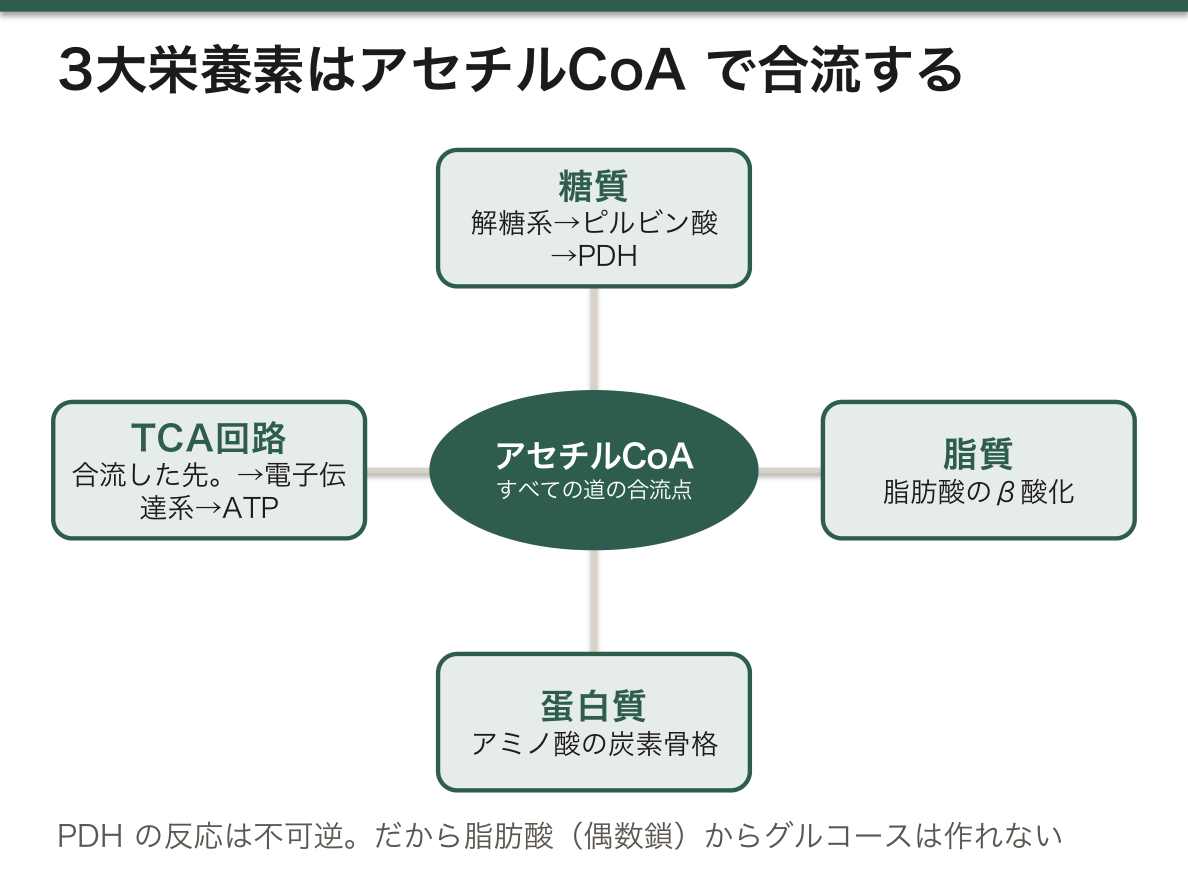
この図から一方通行の場所を読むことが決定的に重要である。
アセチルCoA からグルコースは作れない。ピルビン酸デヒドロゲナーゼの反応(ピルビン酸 → アセチルCoA)が不可逆だからである。だから:
- 脂肪酸は糖にならない(偶数鎖の場合)。飢餓で脂肪をいくら燃やしても血糖は作れない
- 糖新生の材料になれるのは乳酸・アミノ酸(糖原性)・グリセロールだけ
- 脂肪酸の奇数鎖と分枝鎖アミノ酸の一部だけがプロピオニルCoA 経由で糖新生に入れる(例外として問われる)
だからこそ飢餓時に筋蛋白を壊してまで糖新生する必要があり、それを節約するためにケトン体が使われる。「なぜケトン体が要るのか」という問いの答えは、この不可逆性にある。
English version
Core
Carbohydrate, fat and protein are each broken down and converge at a single point, acetyl-CoA, entering the TCA cycle.
- Carbohydrate → glucose → glycolysis (cytosol) → pyruvate → acetyl-CoA
- Fat → fatty acids → β-oxidation (mitochondrion) → acetyl-CoA
- Protein → amino acids → the carbon skeleton to acetyl-CoA or a TCA intermediate, the amino group to the urea cycle
Then TCA cycle → electron transport chain → ATP. All roads lead to acetyl-CoA.
Going further
Reading the one-way streets out of this diagram is decisive.
Glucose cannot be made from acetyl-CoA, because the pyruvate dehydrogenase reaction (pyruvate → acetyl-CoA) is irreversible. So:
- Fatty acids do not become sugar (even-chain ones).
- The only substrates for gluconeogenesis are lactate, glucogenic amino acids and glycerol.
- Only odd-chain fatty acids and part of the branched-chain amino acids can enter gluconeogenesis by way of propionyl-CoA (asked as the exception).
This is exactly why the body must break down muscle protein for gluconeogenesis in starvation, and why ketone bodies are used to spare it. The answer to "why are ketone bodies needed?" lies in that irreversibility.
細胞内のどこで起きるか — 区画が問題を作る
経路がどの区画で起きるかを覚えると、輸送と調節の問題が解ける。
- 細胞質——解糖系・ペントースリン酸経路・脂肪酸合成・グリコーゲン代謝・糖新生の大半
- ミトコンドリア——TCA回路・電子伝達系・β酸化・ケトン体生成・尿素回路の前半
- 両方にまたがる——糖新生(ピルビン酸カルボキシラーゼはミトコンドリア)と尿素回路(後半は細胞質)
区画が分かれていること自体が輸送系という律速点を生む。
- カルニチンシャトル——長鎖脂肪酸をミトコンドリアへ入れる。CPT-1 が律速で、マロニルCoA に阻害される。だから脂肪酸を合成しているとき(食後)はβ酸化が止まる。合成と分解の同時進行を防ぐ仕組み
- クエン酸シャトル——ミトコンドリアで余ったアセチルCoA をクエン酸として細胞質へ出し、脂肪酸合成に使う。アセチルCoA は膜を通れないため
- リンゴ酸-アスパラギン酸シャトル/グリセロールリン酸シャトル——細胞質のNADHの電子をミトコンドリアへ渡す。NADH自体は膜を通れない。どちらを使うかでATP収量が変わる
カルニチン欠乏症・CPT-II欠損症では長鎖脂肪酸が燃やせず、空腹・運動・感染で低ケトン性低血糖・横紋筋融解を起こす。「ケトン体が上がらない低血糖」は脂肪酸酸化障害を強く示唆する——区画の理解がそのまま診断になる。
English version
Core
Learn which compartment a pathway occupies and the problems of transport and regulation solve themselves.
- Cytosol — glycolysis, the pentose phosphate pathway, fatty acid synthesis, glycogen metabolism, most of gluconeogenesis.
- Mitochondrion — the TCA cycle, the electron transport chain, β-oxidation, ketogenesis, the first half of the urea cycle.
- Spanning both — gluconeogenesis (pyruvate carboxylase is mitochondrial) and the urea cycle (its latter half is cytosolic).
Going further
That the compartments are separate itself creates transport systems as rate-limiting points.
- The carnitine shuttle — brings long-chain fatty acids into the mitochondrion. CPT-1 is rate-limiting and is inhibited by malonyl-CoA. So when fatty acids are being synthesised (after a meal), β-oxidation stops — the device that prevents synthesis and breakdown running together.
- The citrate shuttle — surplus mitochondrial acetyl-CoA leaves as citrate for fatty acid synthesis in the cytosol, because acetyl-CoA cannot cross the membrane.
- The malate–aspartate and glycerol phosphate shuttles — hand the electrons of cytosolic NADH to the mitochondrion, NADH itself being unable to cross. Which is used changes the ATP yield.
In carnitine deficiency and CPT-II deficiency, long-chain fatty acids cannot be burnt, and hunger, exercise or infection cause hypoketotic hypoglycaemia and rhabdomyolysis. "Hypoglycaemia without a rise in ketones" strongly suggests a fatty acid oxidation defect — understanding the compartments becoming directly the diagnosis.
食後・空腹・飢餓 — 状況が経路を決める
食後(インスリン優位)——同化。グリコーゲン合成・解糖・脂肪酸合成が動く。糖新生とβ酸化は止まる。
空腹(数時間〜1日、グルカゴン優位)——まずグリコーゲン分解(肝のグリコーゲンは約12〜24時間で尽きる)、続いて糖新生が主役になる。
飢餓(数日以降)——脂肪分解が進みケトン体が主要燃料になる。脳はケトン体を使えるようになり、糖新生のための筋蛋白分解が抑えられる(蛋白節約効果)。
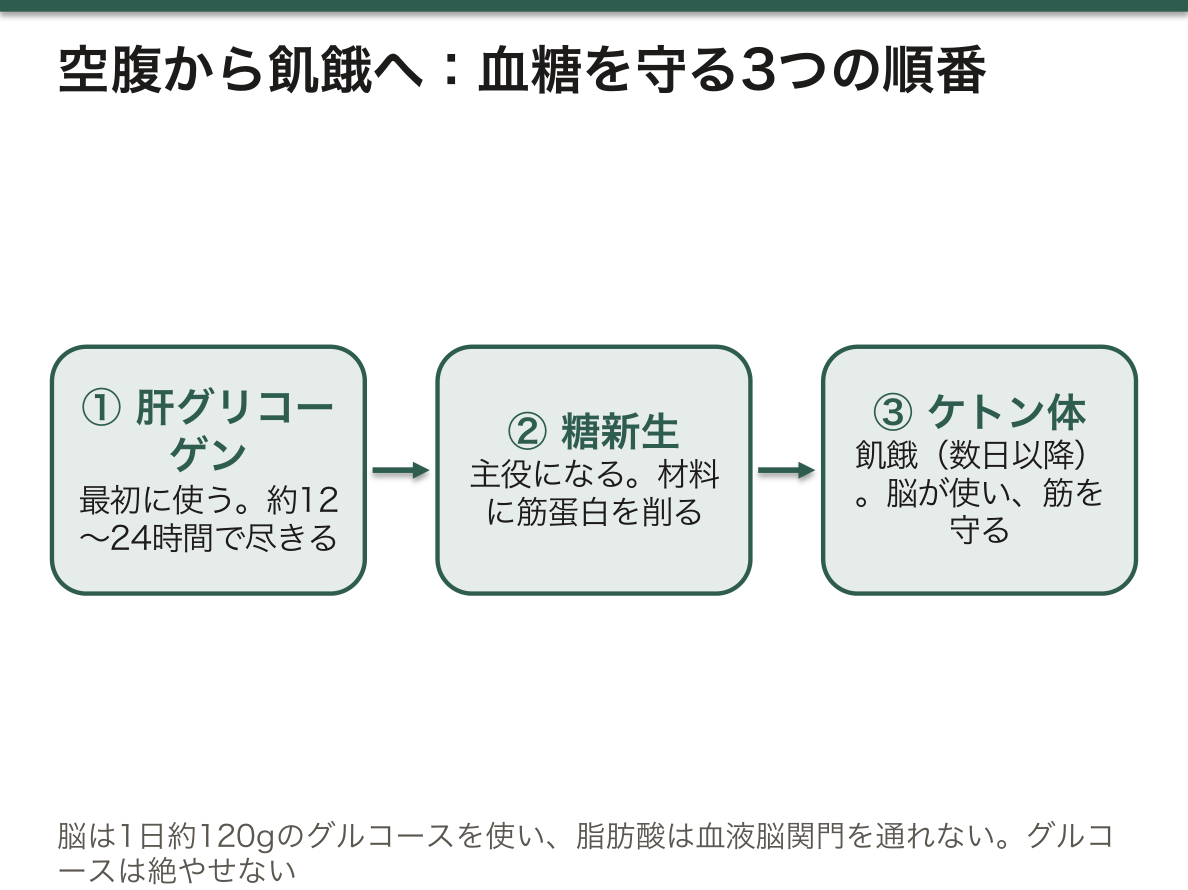
この3相を「脳とグルコースをどう守るか」という一つの問題として読むと筋が通る。
脳は1日約120gのグルコースを消費するが、脂肪酸は血液脳関門を通れない(アルブミン結合のため)。赤血球はミトコンドリアが無いのでグルコース以外を使えない。だから体はグルコースを絶やせない。
順序はこうなる——①肝グリコーゲン(すぐ枯れる)→ ②糖新生(筋を削る)→ ③ケトン体(筋を守る)。飢餓が長引くほどケトン体の比率が上がり、脳の燃料の2/3までを賄えるようになる。ケトン体は飢餓の産物ではなく、筋肉を守るための適応である。
筋のグリコーゲンは血糖にならない点も重要。筋にはグルコース6ホスファターゼが無いので、遊離グルコースを作って血中へ出せない。筋グリコーゲンは筋自身のためだけにある。
糖尿病ケトアシドーシス(DKA)は「飢餓の代謝が、血糖が高いのに起きている」状態である。インスリンが絶対的に欠乏すると、細胞は糖があっても取り込めず飢餓と同じ信号を出す。結果として脂肪分解とケトン体産生が暴走し、高血糖+高ケトン+アシドーシスが揃う。1型糖尿病に多い。
これに対し高浸透圧高血糖状態(HHS)は2型に多く、わずかなインスリンが残っているため脂肪分解が抑えられ、ケトンは出ないまま著明な高血糖と脱水が進む。「インスリンがゼロか、少しあるか」で病態が分かれる。
English version
Core
Fed (insulin predominant) — anabolic. Glycogen synthesis, glycolysis and lipogenesis run; gluconeogenesis and β-oxidation stop.
Fasting (hours to a day, glucagon predominant) — glycogenolysis first (hepatic glycogen is exhausted in about 12–24 hours), then gluconeogenesis takes over.
Starvation (from some days) — lipolysis advances and ketone bodies become the principal fuel. The brain becomes able to use ketone bodies, and the breakdown of muscle protein for gluconeogenesis is suppressed (protein sparing).
Going further
Read the three phases as one problem — how to protect the brain and its glucose — and it hangs together. The brain consumes about 120 g of glucose a day, and fatty acids cannot cross the blood–brain barrier (being bound to albumin). Red cells have no mitochondria and can use nothing but glucose. So the body cannot let glucose run out.
The order is: ① hepatic glycogen (soon exhausted) → ② gluconeogenesis (at the cost of muscle) → ③ ketone bodies (which spare the muscle). The longer starvation lasts, the higher the proportion of ketones, until they supply up to two thirds of the brain’s fuel. Ketone bodies are not a product of starvation but an adaptation to protect muscle.
That muscle glycogen does not become blood glucose also matters. Muscle has no glucose 6-phosphatase and cannot release free glucose into the blood. Muscle glycogen exists for the muscle alone.
In the clinic
Diabetic ketoacidosis (DKA) is the metabolism of starvation occurring while the blood glucose is high. With an absolute lack of insulin the cells cannot take up glucose even though it is there, and they send the same signal as starvation. The result is runaway lipolysis and ketogenesis, and hyperglycaemia, ketosis and acidosis appear together. Commonest in type 1.
By contrast the hyperosmolar hyperglycaemic state (HHS) is commoner in type 2: a little insulin remains, so lipolysis is suppressed, no ketones appear, and marked hyperglycaemia and dehydration advance instead. Whether insulin is zero or merely low divides the two.
インスリンとその拮抗ホルモン — 誰が指揮しているか
血糖を下げるホルモンはインスリンただ1つ。上げるホルモンは複数ある(グルカゴン・アドレナリン・コルチゾール・成長ホルモン)。この非対称が、低血糖が生命に直結することを示している。
- インスリン——グルコース取り込み(GLUT4)・グリコーゲン合成・脂肪酸合成・蛋白合成。同化のすべて
- グルカゴン——肝のグリコーゲン分解・糖新生。肝にしか効かない(筋にグルカゴン受容体は無い)
- アドレナリン——肝と筋の両方に効き、脂肪分解も進める。急性のストレス応答
- コルチゾール——糖新生の酵素を転写レベルで増やす。効果が出るのが遅く、持続する
作用の速さが違うことに意味がある。グルカゴンとアドレナリンは既存の酵素をリン酸化して数秒〜数分で効き、コルチゾールは酵素を作らせるので数時間かかる。低血糖への応答が段階的になるのはこのためで、急性期はカテコラミン、遷延すればコルチゾールが支える。
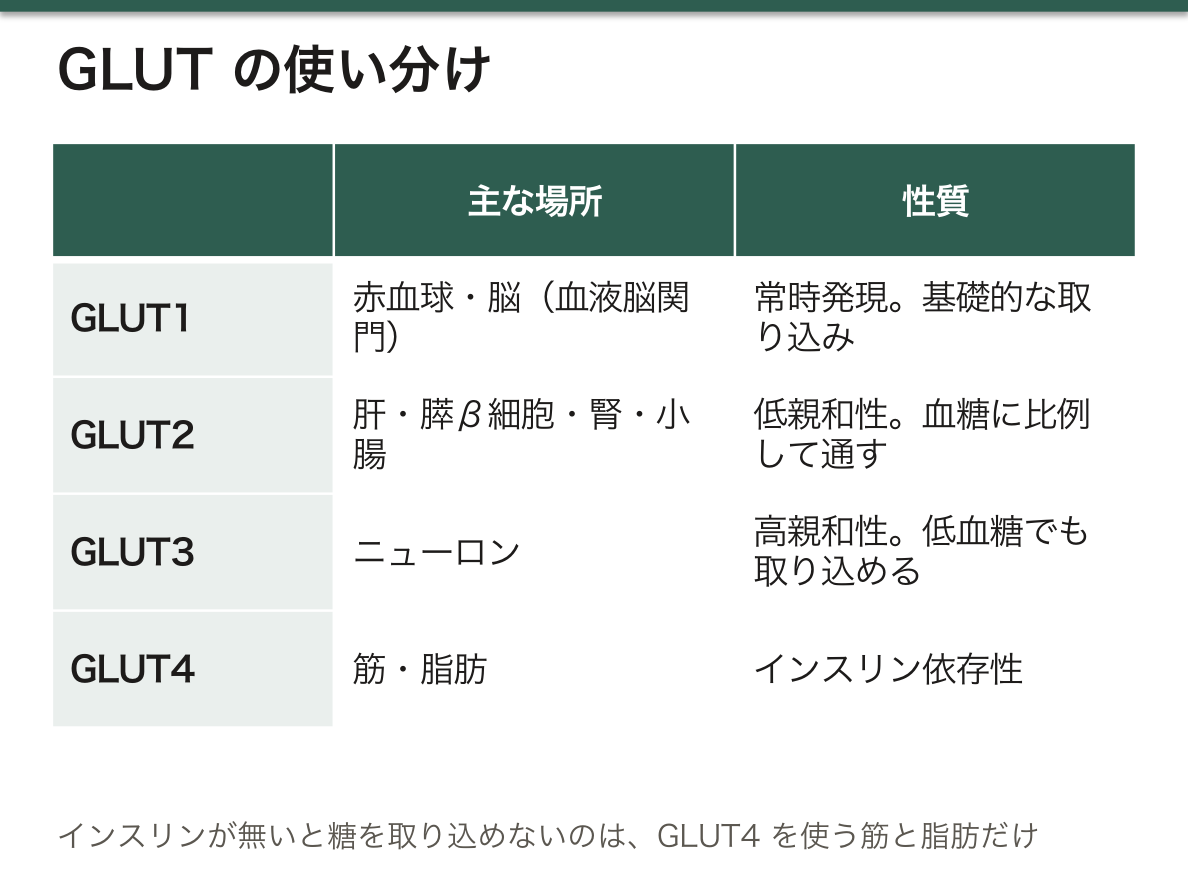
GLUT の使い分けも頻出である。
- GLUT4——筋・脂肪。インスリン依存性。だからインスリンが無いとこの2つだけが糖を取り込めない
- GLUT2——肝・膵β細胞・腎・小腸。低親和性で、血糖に比例して糖を通す。β細胞が血糖を「測れる」のはこの性質による
- GLUT1——赤血球・脳(血液脳関門)。常時発現し、基礎的な取り込みを担う
- GLUT3——ニューロン。高親和性で、低血糖でも取り込める
脳と赤血球がインスリン非依存性だからこそ、インスリンが無い糖尿病でも脳は糖を使える。逆にインスリン過剰では筋と脂肪が糖を取り込みすぎ、脳が飢える——低血糖で意識障害が出る理由である。
English version
Core
There is only one hormone that lowers the blood glucose — insulin. Several raise it (glucagon, adrenaline, cortisol, growth hormone). That asymmetry shows that hypoglycaemia is immediately a threat to life.
- Insulin — glucose uptake (GLUT4), glycogen synthesis, lipogenesis, protein synthesis. Everything anabolic.
- Glucagon — hepatic glycogenolysis and gluconeogenesis. It acts on the liver only (muscle has no glucagon receptor).
- Adrenaline — acts on both liver and muscle and also drives lipolysis. The acute stress response.
- Cortisol — increases the enzymes of gluconeogenesis at the level of transcription. Slow to act and sustained.
Going further
That they differ in speed has a meaning. Glucagon and adrenaline phosphorylate existing enzymes and act within seconds to minutes; cortisol has enzymes made and takes hours. The response to hypoglycaemia is therefore staged — catecholamines acutely, cortisol if it is prolonged.
The division of labour among the GLUTs is also frequently asked.
- GLUT4 — muscle and fat. Insulin-dependent. So without insulin these two alone cannot take up glucose.
- GLUT2 — liver, pancreatic β cell, kidney, small intestine. Low affinity, passing glucose in proportion to the blood level. This property is how the β cell can measure the blood glucose.
- GLUT1 — red cell, brain (blood–brain barrier). Constitutively expressed, providing the basal uptake.
- GLUT3 — neurones. High affinity, taking up glucose even at low levels.
Because brain and red cell are insulin-independent, the brain can use glucose even in untreated diabetes. Conversely, in insulin excess, muscle and fat take up too much and the brain starves — which is why hypoglycaemia impairs consciousness.
代謝を数字で押さえる — 覚えておくと計算できる値
| 項目 | 値 |
|---|---|
| エネルギー | 糖 4 kcal/g・蛋白 4 kcal/g・脂質 9 kcal/g・アルコール 7 kcal/g |
| 基礎代謝量 | 成人で約 20〜25 kcal/kg/日 |
| グリコーゲン | 肝 約 100 g・筋 約 300〜400 g |
| 血糖 | 血中の総量は約 4 g(体重 60 kg で血液 5 L・100 mg/dL) |
| 脳のブドウ糖消費 | 約 120 g/日(安静時の全消費の約 6 割) |
| ATP | 体内の在庫は約 50 g。1日に体重ぶんを作って壊している |
| グルコース 1 分子から | 好気的に約 30〜32 ATP、嫌気的に 2 ATP |
1 kg の体脂肪は約 7,200 kcal に相当する。
数字を持っていると、経路の意味が体の実感に変わる。血中のブドウ糖は 4 g しかないのに、脳が 1 日 120 g を使う(この章の食後・空腹・飢餓の項)——「絶えず補い続けなければ、数分ももたない」。
肝グリコーゲンが 100 g しかないことが、絶食に耐えられる時間を決めている(グリコーゲンの章)——「12〜24 時間で尽き、そこから糖新生とケトン体に切り替わる」。
ATP の在庫が 50 g しかないことは、循環停止に耐えられない理由になる(救急の初期対応の章)——「作り続けているから存在している分子で、貯えではない」。
7,200 kcal という数字が、減量の見通しを現実的にする(生活としての治療の章)——「1 日 240 kcal を減らして、1 か月で約 1 kg。数字で示すほうが続く」。
アルコールが 7 kcal/g であることは、栄養指導で見落とされやすい(酒の政策の章)——「脂質に次いで高く、しかも満腹感を生まない」。
English version
Core
| Item | Value |
|---|---|
| Energy | Carbohydrate 4 kcal/g, protein 4 kcal/g, fat 9 kcal/g, alcohol 7 kcal/g |
| Basal metabolic rate | About 20–25 kcal/kg/day in the adult |
| Glycogen | Liver about 100 g, muscle about 300–400 g |
| Blood glucose | About 4 g in the whole circulation (60 kg, 5 L of blood, 100 mg/dL) |
| Cerebral glucose use | About 120 g/day (about 60 per cent of resting consumption) |
| ATP | About 50 g in store — the body makes and breaks its own weight of it daily |
One molecule of glucose gives about 30–32 ATP aerobically and 2 anaerobically. 1 kg of body fat is about 7,200 kcal.
Going further
Hold the numbers and the pathways stop being abstractions.
There are only 4 g of glucose in the blood, yet the brain uses 120 g a day — without continuous replenishment it would not last minutes.
That hepatic glycogen is only 100 g sets how long a fast can be tolerated — exhausted in 12–24 hours, after which it switches to gluconeogenesis and ketones.
That the ATP store is only 50 g is why circulatory arrest cannot be tolerated — a molecule that exists because it is being made continuously, not a reserve.
The figure of 7,200 kcal makes the prospect of weight loss realistic — 240 kcal less a day is about 1 kg a month. Set out as a number it is more likely to be sustained.
That alcohol is 7 kcal/g is easily overlooked in dietary advice — second only to fat, and it produces no satiety.
測っているのは、いつの何か — 検査値の時間軸
同じ「異常値」でも、どのくらいの期間を映しているかが違う。
| 期間 | 指標 |
|---|---|
| いま | 血糖・電解質・血液ガス・乳酸・アンモニア |
| 数時間〜数日 | PT・トロポニン・CRP・プレアルブミン |
| 1〜3 週 | グリコアルブミン・トランスフェリン・網赤血球 |
| 1〜2 か月 | HbA1c・アルブミン |
| 数か月〜年 | フェリチン・骨密度・尿中クレアチニン(筋肉量) |
期間を決めているのは、その分子の半減期か、宿す細胞の寿命になる。
だから「治療を変えてから、いつ測り直すか」も、この表から決まる。
「いつを映しているか」を言えることが、検査を使いこなすということになる。速い指標は今日の判断に、遅い指標は方針の評価に使う(検査の性能の章)——「同じ数字を、別の目的で読み分ける」。
栄養の評価で、アルブミンだけを見ると判断を誤る(肝の合成能の項)——「炎症で下がる負の急性期蛋白でもあるので、CRP と組で読む」。
貧血の治療では、網赤血球が最初に動く(貧血の各論の章)——「鉄剤を始めて 1 週間で網赤血球が上がる。ヘモグロビンが動くのは数週間後になる」。
甲状腺ホルモン薬の調整に 4〜6 週かけるのも、この考え方になる(遊離型と結合型の項)——「定常状態に達する前に測ると、量を誤る」。
逆に、数分で動く指標は、蘇生の答え合わせに使える(ショックの章)——「乳酸が下がるかどうかを、時間を追って見る」。
English version
Core
The same "abnormal value" differs in what length of time it reflects.
| Period | Index |
|---|---|
| Now | Blood glucose, electrolytes, blood gases, lactate, ammonia |
| Hours to days | PT, troponin, CRP, prealbumin |
| 1–3 weeks | Glycated albumin, transferrin, reticulocytes |
| 1–2 months | HbA1c, albumin |
| Months to years | Ferritin, bone density, urinary creatinine (muscle mass) |
The period is set by the half-life of the molecule or by the lifespan of the cell that carries it. So "when to repeat the test after changing treatment" is decided by this table too.
Going further
Being able to say what period a test reflects is what it means to use it well. Fast indices are for today’s decision, slow ones for evaluating a policy.
In assessing nutrition, looking at albumin alone misleads — it is also a negative acute-phase protein and falls with inflammation, so read it together with the CRP.
In treating anaemia the reticulocytes move first — they rise a week after iron is started; the haemoglobin moves weeks later.
That thyroid replacement is adjusted over 4–6 weeks follows the same thinking — measure before the steady state is reached and the dose will be wrong.
Conversely, indices that move within minutes can be used to check the answer in resuscitation — follow whether the lactate is falling, over time.
まとめ
| 代謝の全体図 — 3大栄養素はどこで合流するか | 糖質・脂質・蛋白質は、それぞれ分解されたあとアセチルCoA という一点で合流し、TCA回路へ入る。 |
|---|---|
| 細胞内のどこで起きるか — 区画が問題を作る | 経路がどの区画で起きるかを覚えると、輸送と調節の問題が解ける。 |
| 食後・空腹・飢餓 — 状況が経路を決める | 食後(インスリン優位)——同化。グリコーゲン合成・解糖・脂肪酸合成が動く。 |
| インスリンとその拮抗ホルモン — 誰が指揮しているか | 血糖を下げるホルモンはインスリンただ1つ。 |
| 代謝を数字で押さえる — 覚えておくと計算できる値 | 項目値エネルギー糖 4 kcal/g・蛋白 4 kcal/g・脂質 9 kcal/g・アルコール 7 kcal/g基礎代謝量成人で約 20〜25 kcal/kg/日グリコーゲン肝… |
| 測っているのは、いつの何か — 検査値の時間軸 | 同じ「異常値」でも、どのくらいの期間を映しているかが違う。 |
このノートは医学生が授業の内容を自分の言葉でまとめたもので、診療の判断に使うものではありません。誤りに気づいたらお知らせください。