酵素は活性化エネルギーを下げる触媒であって、反応の向きも平衡も変えない。速くするだけである。この一点を外さなければ、酵素の話はほとんど誤解しない。
臨床で酵素が問われる形は3つに絞られる。①律速酵素はどこか(=調節点はどこか)、②その酵素が欠けると何が起きるか(先天代謝異常)、③血中に漏れ出た酵素は何を意味するか(逸脱酵素)。教科書的な酵素反応速度論も、この3つに効く形で覚えると生きる。
阻害様式(競合・非競合)は式を覚えるよりグラフのどこが動くかを押さえるほうが速い。競合は Km だけ動き、非競合は Vmax だけ動く——これで薬理の設問はほぼ通る。
- 酵素とは何をしているか
- Km と Vmax — 何を測っているのか
- 阻害の様式 — グラフのどこが動くか
- 調節のかけ方 — 速い順に4つ
- 調節を4つの軸で分ける — 特異的か・量か質か・促進か抑制か・戻れるか
- 逸脱酵素 — 血中の酵素が語ること
- アロステリック調節 — S字曲線が意味すること
酵素とは何をしているか
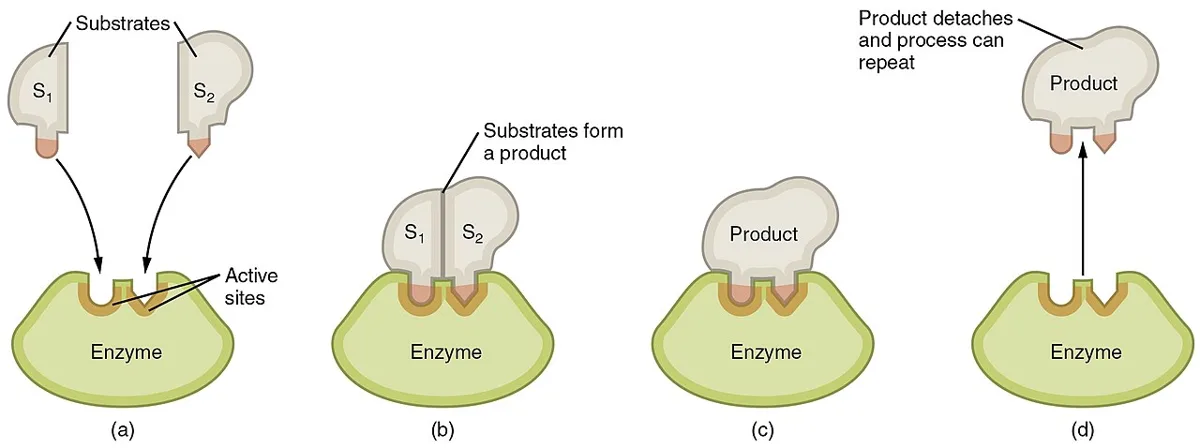
基質と結合して遷移状態を安定化し、活性化エネルギーを下げる蛋白(一部はRNA=リボザイム)。
- 反応の向きは変えない。平衡定数も変えない。到達を速めるだけ
- 基質特異性がある——鍵と鍵穴、より正確には誘導適合
- 反応の前後で自分は変化しない
多くは補因子を要する——補酵素(ビタミン由来の有機分子)と補欠分子族(強く結合したもの、金属など)。
「向きを変えない」ことの帰結として、不可逆反応は酵素のせいではなく熱力学のせいである。解糖系の3つの不可逆段階(ヘキソキナーゼ・PFK-1・ピルビン酸キナーゼ)は大きな自由エネルギー低下を伴うため、糖新生では別の酵素で迂回する必要がある。「逆行できない場所に、専用の酵素が用意されている」という構図は代謝全体で繰り返される。
補酵素の大半が水溶性ビタミンである点も重要で、欠乏症の症状はその補酵素を使う酵素が止まった結果として説明できる。ビタミンB1(チアミン)欠乏でピルビン酸デヒドロゲナーゼとα-ケトグルタル酸デヒドロゲナーゼが止まり、乳酸が溜まりTCAが回らない——脚気と Wernicke 脳症はここから来る。
English version
Core
A protein (a few are RNA — ribozymes) that binds the substrate, stabilises the transition state and lowers the activation energy.
- It does not change the direction of the reaction, nor the equilibrium constant. It only hastens the arrival.
- It has substrate specificity — a lock and key, or more accurately induced fit.
- It is unchanged by the reaction.
- Most require a cofactor — a coenzyme (an organic molecule, usually vitamin-derived) or a prosthetic group (tightly bound; a metal, for instance).
Going further
It follows from "it does not change the direction" that an irreversible reaction is irreversible because of thermodynamics, not because of the enzyme. The three irreversible steps of glycolysis (hexokinase, PFK-1, pyruvate kinase) involve a large fall in free energy, so gluconeogenesis must bypass them with different enzymes. The pattern — a dedicated enzyme provided wherever the road cannot be run backwards — recurs throughout metabolism.
That most coenzymes are water-soluble vitamins also matters: the symptoms of a deficiency can be explained as the consequence of the enzyme using that coenzyme having stopped. In thiamine (B1) deficiency, pyruvate dehydrogenase and α-ketoglutarate dehydrogenase stop, lactate accumulates and the TCA cycle will not turn — from which come beriberi and Wernicke’s encephalopathy.
Km と Vmax — 何を測っているのか
Km=最大速度の半分に達する基質濃度。基質への親和性の逆数と考えてよい(Km が小さい=親和性が高い)。
Vmax=酵素がすべて基質で飽和したときの最大速度。酵素の量に比例する。
Lineweaver-Burk プロット(1/v と 1/[S])にすると直線になり、y切片=1/Vmax、x切片=−1/Km。
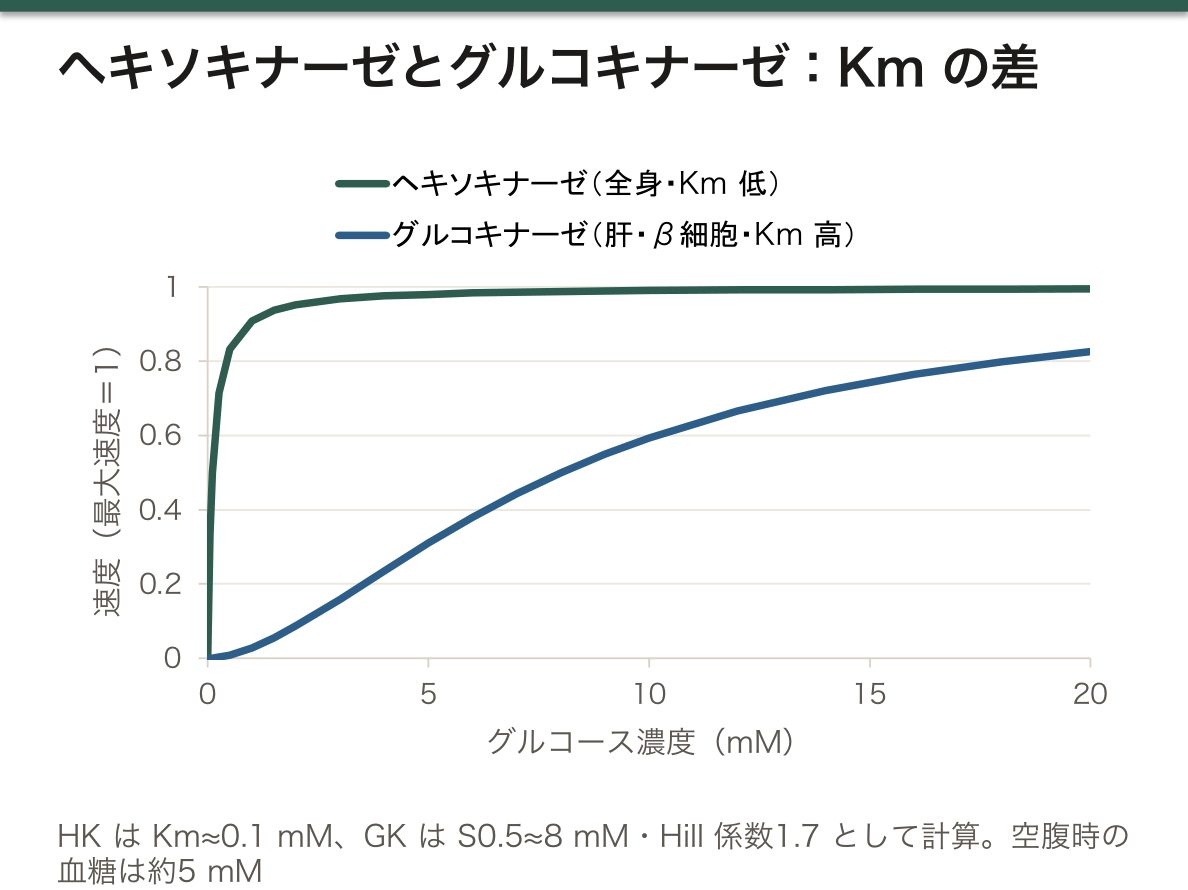
同じ反応を触媒する酵素でも Km が違えば役割が違う——これが理解の要になる。
ヘキソキナーゼ(Km 低)は全身の細胞にあり、低い血糖でもグルコースを取り込む。生成物のグルコース6リン酸で阻害される(取り込みすぎない)。
グルコキナーゼ(=ヘキソキナーゼIV、Km 高)は肝と膵β細胞にあり、血糖が高いときだけ働く。生成物阻害を受けない。だから食後の余剰糖を肝が一気に取り込め、β細胞は血糖を「測れる」。
グルコキナーゼの変異が MODY2 を起こすのは、この「センサー」の閾値がずれるためである。軽度の空腹時高血糖が持続するが合併症は稀で、治療を要さないことが多い——酵素の Km が病型と治療方針を決めている。
同じ論理はアルコール脱水素酵素にも当てはまる。低濃度では ADH(Km 低・飽和しやすい)が働き、高濃度では MEOS(CYP2E1)が動員される。慢性飲酒で MEOS が誘導されることが、耐性と薬物相互作用の基礎になる。
English version
Core
Km = the substrate concentration at which half the maximum velocity is reached. Think of it as the inverse of affinity (a low Km means high affinity).
Vmax = the maximum velocity when the enzyme is saturated with substrate. It is proportional to the amount of enzyme.
Plotted as a Lineweaver–Burk plot (1/v against 1/[S]) it is a straight line, with the y-intercept 1/Vmax and the x-intercept −1/Km.
Going further
Even for enzymes catalysing the same reaction, a different Km means a different role — and this is the key to the whole subject.
- Hexokinase (low Km) is in every cell and takes up glucose even at a low blood level. It is inhibited by its product, glucose 6-phosphate (so it does not take up too much).
- Glucokinase (= hexokinase IV, high Km) is in liver and pancreatic β cell and works only when the blood glucose is high. It is not subject to product inhibition.
So the liver can take up the surplus sugar after a meal at a stroke, and the β cell can measure the blood glucose.
A mutation of glucokinase causes MODY2 because the threshold of that sensor is displaced. A mild fasting hyperglycaemia persists but complications are rare and treatment is often unnecessary — the Km of an enzyme deciding both the type of disease and the policy of treatment.
The same logic applies to alcohol dehydrogenase. At low concentrations ADH (low Km, readily saturated) works; at high concentrations the MEOS (CYP2E1) is recruited. That chronic drinking induces the MEOS is the basis of tolerance and of drug interactions.
阻害の様式 — グラフのどこが動くか
- 競合阻害——基質と同じ部位を奪い合う。基質を増やせば打ち勝てる。Km 上昇・Vmax 不変
- 非競合阻害——別の部位に結合し、酵素そのものを働けなくする。基質を増やしても無駄。Vmax 低下・Km 不変
- 不競合阻害——酵素-基質複合体にだけ結合。Km も Vmax も低下
- 不可逆阻害——共有結合で失活させる。回復には酵素の再合成が要る
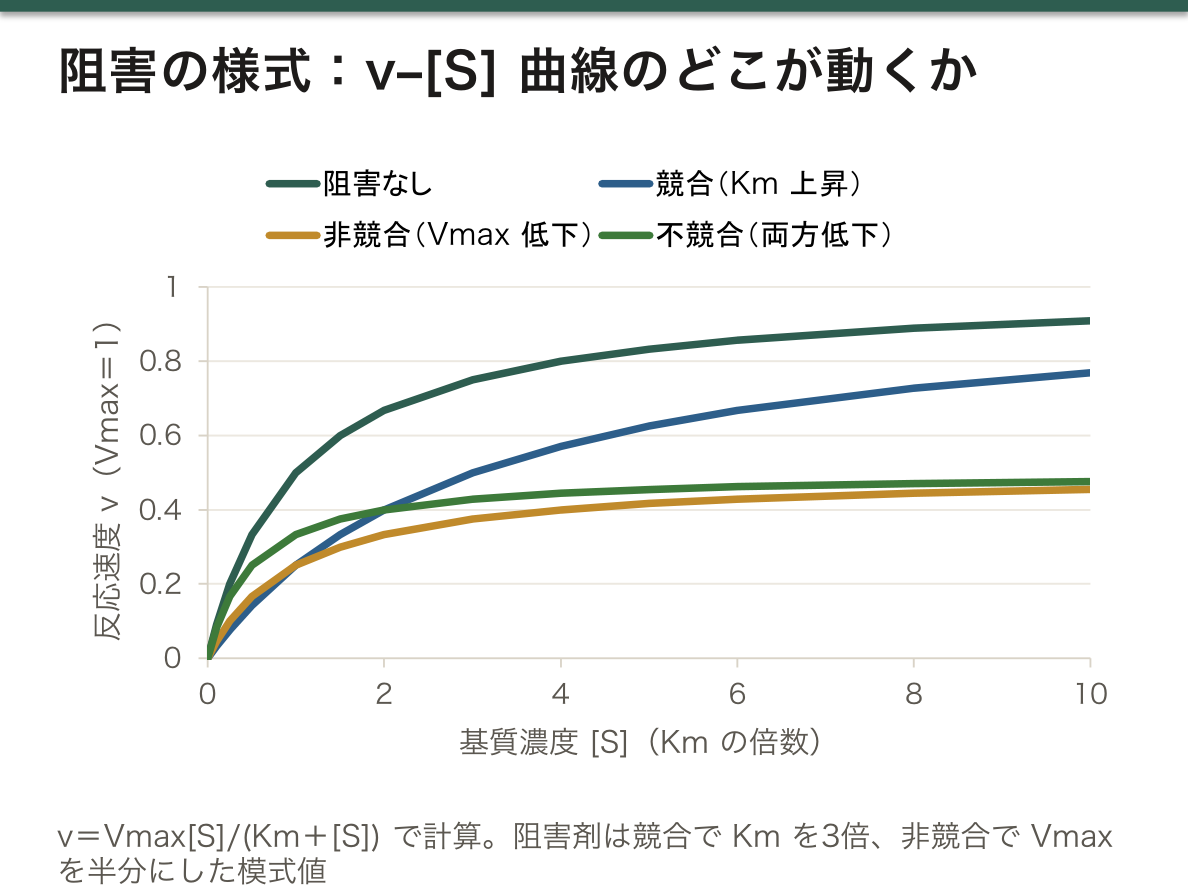
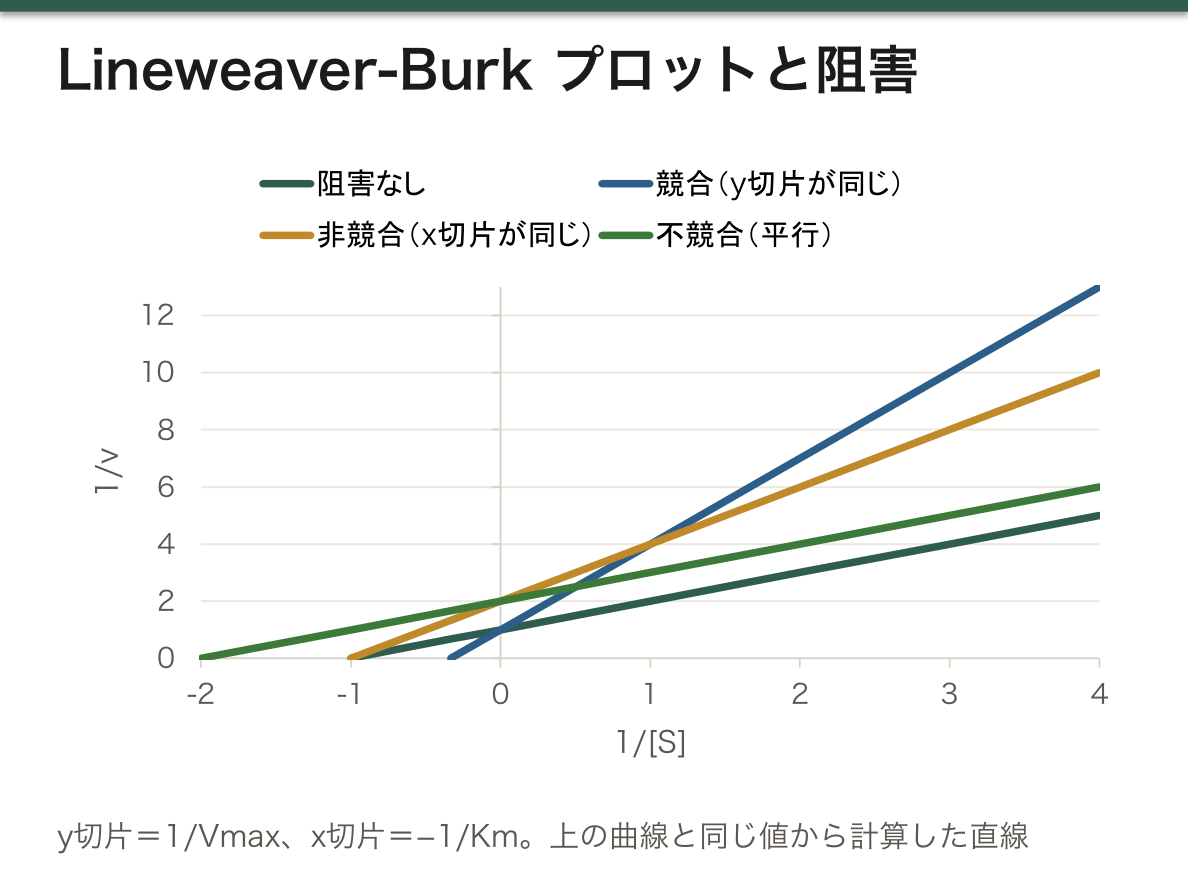
薬の設計と中毒の治療が、この分類にそのまま乗る。
- メタノール・エチレングリコール中毒——アルコール脱水素酵素の競合阻害を利用する。ホメピゾール(またはエタノール)を投与し、毒性代謝物(ギ酸・シュウ酸)の生成を止める。「毒そのものではなく、代謝物が毒」という型
- アスピリン——COX の不可逆阻害。血小板は酵素を作り直せないので効果が寿命ぶん続く
- 有機リン——アセチルコリンエステラーゼの不可逆阻害。時間が経つとエイジングして解毒薬(プラリドキシム)が効かなくなるため、投与を急ぐ
- スタチン——HMG-CoA還元酵素の競合阻害
- アロプリノール——キサンチンオキシダーゼの阻害。6-メルカプトプリンと併用すると代謝が止まり中毒になる(相互作用の代表例)
「基質を増やせば勝てるか」で競合か否かが決まる——治療戦略が薬理学の暗記ではなく速度論から導ける。
English version
Core
- Competitive — competes for the same site as the substrate. More substrate overcomes it. Km rises, Vmax unchanged.
- Non-competitive — binds at another site and disables the enzyme itself. More substrate is useless. Vmax falls, Km unchanged.
- Uncompetitive — binds only the enzyme–substrate complex. Both Km and Vmax fall.
- Irreversible — inactivates by covalent bonding. Recovery requires resynthesis of the enzyme.
Going further
Drug design and the treatment of poisoning sit directly on this classification.
- Methanol and ethylene glycol poisoning — uses competitive inhibition of alcohol dehydrogenase. Fomepizole (or ethanol) is given to stop the formation of the toxic metabolites (formate, oxalate). The pattern in which the poison is not the poison but its metabolite.
- Aspirin — irreversible inhibition of COX. The platelet cannot remake the enzyme, so the effect lasts its lifetime.
- Organophosphates — irreversible inhibition of acetylcholinesterase. With time it "ages" and the antidote (pralidoxime) ceases to work, so it must be given quickly.
- Statins — competitive inhibition of HMG-CoA reductase.
- Allopurinol — inhibition of xanthine oxidase. Combined with 6-mercaptopurine, the metabolism of the latter stops and toxicity follows (the classic interaction).
Whether more substrate can win decides whether the inhibition is competitive — so the therapeutic strategy is derived from kinetics rather than memorised from pharmacology.
調節のかけ方 — 速い順に4つ
速いものから並べる。
- アロステリック調節(ミリ秒〜秒)——活性部位以外に代謝産物が結合し、活性を上下させる。最終産物による阻害(フィードバック阻害)が典型
- 共有結合修飾(秒〜分)——主にリン酸化・脱リン酸化。ホルモンの指令はここに落ちる
- 限定分解(酵素前駆体の活性化)——チモーゲンを切って活性化する。不可逆
- 合成量の変化(時間〜日)——転写レベル。コルチゾールなどが担う
リン酸化されると活性化するか不活性化するかは酵素ごとに逆で、ここが混乱の元になる。ただし「グルカゴン/アドレナリンで動く方向は必ず異化」という原則で統一的に理解できる。
- グリコーゲンホスホリラーゼ(分解)——リン酸化で活性化
- グリコーゲンシンターゼ(合成)——リン酸化で不活性化
1つのシグナル(cAMP → PKA)で、分解を促し合成を止めるという反対向きの制御が同時にかかる。これを相反調節といい、無駄なサイクル(futile cycle)を防ぐための仕組みである。
限定分解は消化酵素と凝固因子に典型的で、作った場所で働かせないための仕掛けである。膵臓でトリプシンが早期に活性化してしまうのが急性膵炎——膵が自分を消化する。だから膵は SPINK1 などのトリプシンインヒビターを備えており、その遺伝子変異が遺伝性膵炎を起こす。
English version
Core
In order of speed.
- Allosteric regulation (milliseconds to seconds) — a metabolite binds away from the active site and raises or lowers the activity. Inhibition by the end product (feedback inhibition) is the classic case.
- Covalent modification (seconds to minutes) — chiefly phosphorylation and dephosphorylation. This is where hormonal commands land.
- Limited proteolysis (activation of a proenzyme) — a zymogen is cut and activated. Irreversible.
- Change in the amount synthesised (hours to days) — at the level of transcription; cortisol and others act here.
Going further
Whether phosphorylation activates or inactivates differs from enzyme to enzyme, and that is the source of confusion. But it can be unified by the principle that the direction glucagon and adrenaline move things is always catabolic.
- Glycogen phosphorylase (breakdown) — activated by phosphorylation.
- Glycogen synthase (synthesis) — inactivated by phosphorylation.
One signal (cAMP → PKA) simultaneously drives breakdown and stops synthesis — opposite controls applied at once. This is reciprocal regulation, the device that prevents a futile cycle.
Limited proteolysis is typical of the digestive enzymes and the clotting factors — the device that keeps them from working where they are made. Premature activation of trypsin in the pancreas is acute pancreatitis — the pancreas digesting itself. Hence the pancreas carries trypsin inhibitors such as SPINK1, and mutations of that gene cause hereditary pancreatitis.
調節を4つの軸で分ける — 特異的か・量か質か・促進か抑制か・戻れるか
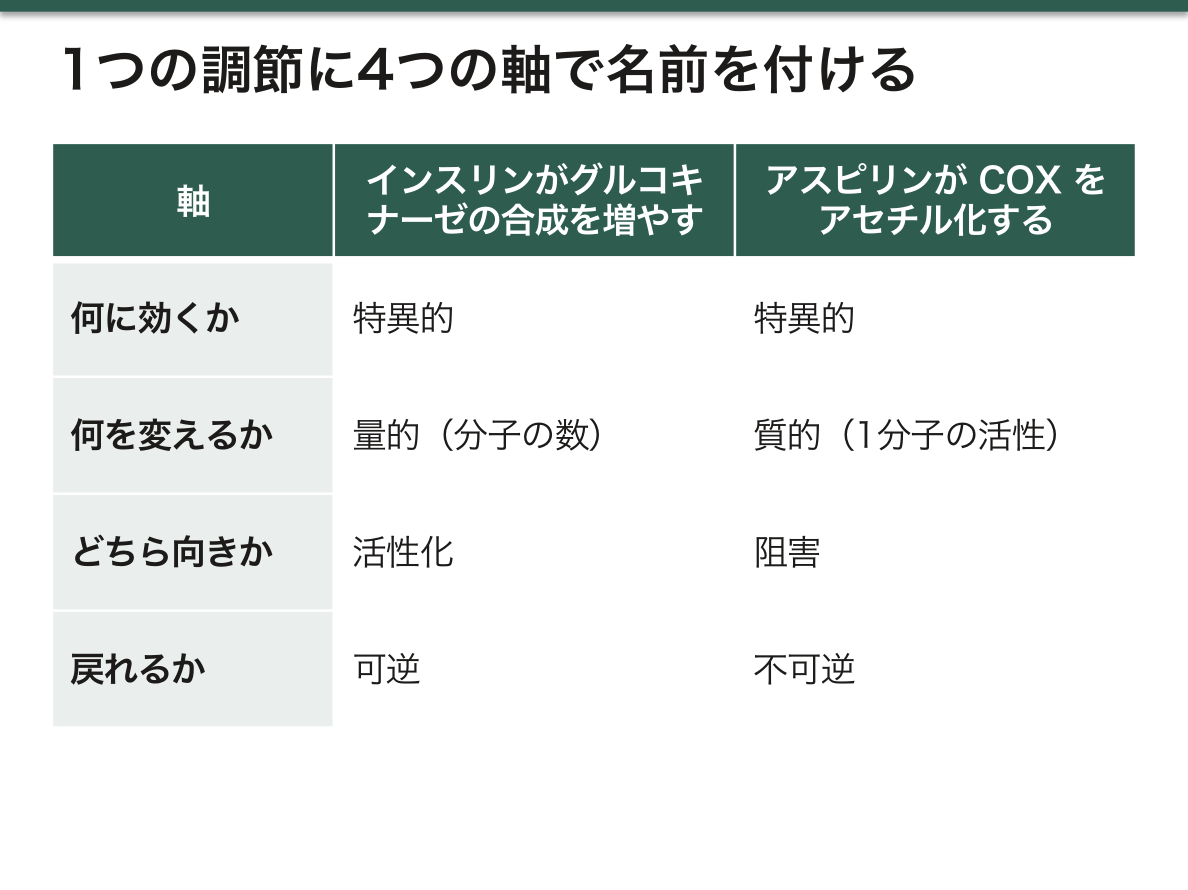
ヨーロッパの医学部の生化学では、酵素の調節を4つの独立した軸で分類する。1つの調節は4つの軸すべてで名前が付く。
| 軸 | 一方 | 他方 |
|---|---|---|
| 何に効くか | 特異的:特定の酵素だけに効く(アロステリック因子・リン酸化・特異的な阻害薬) | 非特異的:すべての酵素に同じように効く(温度・pH・塩濃度・変性剤) |
| 何を変えるか | 量的:酵素の分子の数を変える(遺伝子発現の誘導・抑制、分解の速さ) | 質的:分子の数は同じまま、1分子の活性を変える(アロステリック・共有結合修飾・限定分解) |
| どちら向きか | 活性化 | 阻害 |
| 戻れるか | 可逆:外せば元に戻る(アロステリック・リン酸化・競合阻害) | 不可逆:元に戻らない(限定分解・共有結合する阻害薬・変性) |
たとえば「インスリンがグルコキナーゼの合成を増やす」は特異的・量的・活性化・可逆、「アスピリンが COX をアセチル化する」は特異的・質的・阻害・不可逆、と言える。
どの段階に調節がかかるかにも規則がある。調節を受けるのは、経路の最初の不可逆な段階——コミットステップ(後戻りしない段階)であることが多い。ここを止めれば、無駄な中間体を作らずに経路全体を止められる。解糖の PFK-1、コレステロール合成の HMG-CoA 還元酵素、脂肪酸合成のアセチル CoA カルボキシラーゼがその例である。見分けるには、①その段階が不可逆で、②分岐点を過ぎて産物がその経路にしか使えなくなる最初の段階、を探す。
フィードバック阻害は最終産物が上流を止める調節、フィードフォワード活性化は上流の中間体が下流を先回りして開ける調節である。解糖では PFK-1 の産物フルクトース1,6-ビスリン酸がピルビン酸キナーゼを活性化する。どちらも特異的・質的・可逆の調節に分類される。
不可逆な阻害では、効果の長さが薬の半減期ではなく酵素を作り直す速さで決まる。プロトンポンプ阻害薬は血中から数時間で消えるが、止めたポンプは新しく作られるまで戻らないので、1日1回の服用で効果が続く。有機リン系の農薬・神経剤はアセチルコリンエステラーゼの活性部位のセリンに結合し、時間がたつと結合が「エイジング」して完全に不可逆になる。解毒薬のプラリドキシム(PAM)がエイジングの前にしか効かないのは、まだ可逆な段階でしか酵素を取り戻せないからである。
English version
Core
European medical biochemistry often classifies enzyme regulation along four independent axes; every regulation gets a name on all four.
| Axis | One side | Other side |
|---|---|---|
| What it acts on | Specific: only certain enzymes (allosteric effectors, phosphorylation, specific inhibitors) | Non-specific: all enzymes alike (temperature, pH, salt, denaturants) |
| What it changes | Quantitative: the number of enzyme molecules (induction or repression, rate of breakdown) | Qualitative: activity per molecule with the same number (allosteric, covalent modification, limited proteolysis) |
| Direction | Activation | Inhibition |
| Can it be undone? | Reversible (allosteric, phosphorylation, competitive inhibition) | Irreversible (limited proteolysis, covalent inhibitors, denaturation) |
‘Insulin increases glucokinase synthesis’ is specific, quantitative, activating, reversible. ‘Aspirin acetylates COX’ is specific, qualitative, inhibiting, irreversible.
Going further
Where regulation acts also follows a rule. It usually acts on the first irreversible step of a pathway — the committed step. Blocking it stops the whole pathway without making useless intermediates: PFK-1 in glycolysis, HMG-CoA reductase in cholesterol synthesis, acetyl-CoA carboxylase in fatty acid synthesis. Look for a step that (1) is irreversible and (2) is the first after a branch point whose product can only go down this pathway.
Feedback inhibition: the end product stops an upstream step. Feed-forward activation: an upstream intermediate opens a downstream step in advance; in glycolysis fructose-1,6-bisphosphate (the PFK-1 product) activates pyruvate kinase. Both are specific, qualitative and reversible.
In the clinic
With irreversible inhibition, the length of effect is set not by the drug half-life but by how fast the enzyme is remade. Proton pump inhibitors leave the blood within hours, but blocked pumps stay blocked until new ones are made, so once-daily dosing works. Organophosphate pesticides and nerve agents bind the active-site serine of acetylcholinesterase; with time the bond ‘ages’ and becomes fully irreversible. The antidote pralidoxime works only before ageing, while the enzyme can still be recovered.
逸脱酵素 — 血中の酵素が語ること
細胞が壊れると中身の酵素が血中へ出る。どの酵素が上がったかで、どの臓器のどの部分が壊れたかが分かる。
- AST・ALT——肝細胞。ALT は肝に比較的特異的、AST は心筋・骨格筋・赤血球にもある
- ALP・γ-GTP——胆道系。ALP は骨にもある(骨疾患で上昇)
- CK——筋。CK-MB は心筋、CK-MM は骨格筋、CK-BB は脳
- アミラーゼ・リパーゼ——膵。リパーゼのほうが特異的
- LDH——どこにでもある。特異性は低いが溶血・腫瘍・組織壊死で上がる
組み合わせと比で読むのが実際である。
- AST/ALT 比 > 2——アルコール性肝障害を示唆。アルコールでピリドキサールリン酸(B6)が不足し、B6 をより強く要求する ALT の合成が落ちるため。比の理由まで説明できる
- ALP・γ-GTP が優位——胆汁うっ滞。ALP が高いが γ-GTP は正常なら、由来は肝ではなく骨(骨転移・Paget病・成長期)
- CK 高値+ミオグロビン尿——横紋筋融解。高K血症と急性腎障害を警戒する
心筋梗塞では現在心筋トロポニンT/I が主役で、これは酵素ではなく構造蛋白である。CK-MB より特異度が高く、発症3〜6時間で上がり1〜2週間持続する。CK-MB は早く正常化するため再梗塞の判定に使われる——「上がる速さ」と「消える速さ」で使い分ける。
English version
Core
When cells are destroyed their enzymes leak into the blood. Which enzyme rises tells which part of which organ has been destroyed.
- AST, ALT — hepatocytes. ALT is relatively specific to liver; AST is also in heart, skeletal muscle and red cells.
- ALP, γ-GT — the biliary system. ALP is also in bone (raised in bone disease).
- CK — muscle. CK-MB heart, CK-MM skeletal muscle, CK-BB brain.
- Amylase, lipase — pancreas. Lipase is the more specific.
- LDH — everywhere. Poorly specific, but raised in haemolysis, tumour and tissue necrosis.
Going further
In practice they are read in combinations and as ratios.
- AST/ALT ratio > 2 — suggests alcoholic liver injury. Alcohol depletes pyridoxal phosphate (B6), and the synthesis of ALT, which requires B6 more strongly, falls. Be able to explain the reason for the ratio.
- ALP and γ-GT predominant — cholestasis. A high ALP with a normal γ-GT means the source is bone, not liver (metastases, Paget’s disease, growth).
- A high CK with myoglobinuria — rhabdomyolysis. Watch for hyperkalaemia and acute kidney injury.
In myocardial infarction the protagonist now is cardiac troponin T/I, which is not an enzyme but a structural protein. It is more specific than CK-MB, rises at 3–6 hours and persists 1–2 weeks. CK-MB normalises sooner and is used to judge re-infarction — the two are chosen by how fast they rise and how fast they disappear.
アロステリック調節 — S字曲線が意味すること
アロステリック酵素は活性部位とは別の場所(アロステリック部位)に調節因子が結合して、酵素の形を変える。多くは複数のサブユニットからなる。
| Michaelis-Menten型 | アロステリック型 | |
|---|---|---|
| v–[S] 曲線 | 双曲線 | S字(シグモイド) |
| 理由 | 各分子が独立に働く | 共同性——1つ結合すると次が結合しやすくなる |
| 指標 | Km | K0.5(Km は定義できない) |
| 利点 | — | 基質濃度のわずかな変化に、大きく応答できる |
S字曲線の意味——双曲線では基質が2倍になっても速度はさほど変わらないが、S字の急峻な部分では、わずかな濃度変化が活性を大きく動かす。「スイッチとして働ける」のがアロステリック酵素の存在理由になる。
ヘモグロビンが最も分かりやすい例——酵素ではないが同じ原理で働く。酸素が1つ結合すると T型(低親和性)から R型(高親和性)へ変わり、次が結合しやすくなる。結果として酸素解離曲線がS字になり、肺では十分に載せ、組織では大きく手放すことができる。ミオグロビンは単量体なので双曲線で、この切り替えができない。
| 代謝の律速酵素 | 促進するもの | 抑制するもの |
|---|---|---|
| ホスホフルクトキナーゼ-1〈PFK-1〉(解糖) | AMP・フルクトース2,6-ビスリン酸 | ATP・クエン酸 |
| ピルビン酸カルボキシラーゼ(糖新生) | アセチルCoA | — |
| アセチルCoAカルボキシラーゼ(脂肪酸合成) | クエン酸 | パルミトイルCoA |
| カルバモイルリン酸合成酵素I(尿素回路) | N-アセチルグルタミン酸 | — |
| ALA合成酵素(ヘム合成) | — | ヘム(最終産物による阻害) |
「その細胞が今エネルギーを持っているか」が、そのまま調節因子になっている——ATP が多ければ解糖を止め、AMP が多ければ回す。クエン酸は「TCA回路が満杯」の信号なので解糖を止め、同時に余った炭素を脂肪酸へ回すように働く。1つの分子が2つの経路に逆向きに作用して、細胞全体の方針を揃えている。
フィードバック阻害〈最終産物阻害〉は最も基本的な型で、経路の最初の不可逆段階(committed step)を最終産物が抑える。無駄な合成を止める最短の仕組みになっている。
English version
Core
An allosteric enzyme changes its shape when a regulator binds at a site other than the active site (the allosteric site). Most consist of several subunits.
| Michaelis–Menten type | Allosteric type | |
|---|---|---|
| v–[S] curve | Hyperbolic | Sigmoid |
| Why | Each molecule works independently | Cooperativity — one binding makes the next easier |
| Index | Km | K0.5 (Km cannot be defined) |
| Advantage | — | A large response to a slight change in substrate concentration |
What the sigmoid means — on a hyperbola, doubling the substrate scarcely changes the rate; on the steep part of a sigmoid, a slight change in concentration moves the activity greatly. Being able to act as a switch is the reason allosteric enzymes exist.
Going further
Haemoglobin is the clearest example — not an enzyme, but working on the same principle. Binding one oxygen shifts it from the T (low affinity) to the R (high affinity) state and makes the next binding easier. The result is a sigmoid dissociation curve: it can load fully in the lung and release greatly in the tissues. Myoglobin, being a monomer, has a hyperbola and cannot make that switch.
| Rate-limiting enzyme | Activated by | Inhibited by |
|---|---|---|
| Phosphofructokinase-1 (glycolysis) | AMP, fructose 2,6-bisphosphate | ATP, citrate |
| Pyruvate carboxylase (gluconeogenesis) | Acetyl-CoA | — |
| Acetyl-CoA carboxylase (fatty acid synthesis) | Citrate | Palmitoyl-CoA |
| Carbamoyl phosphate synthetase I (urea cycle) | N-acetylglutamate | — |
| ALA synthase (haem synthesis) | — | Haem (end-product inhibition) |
Whether the cell has energy at that moment is itself the regulator — plenty of ATP stops glycolysis, plenty of AMP drives it. Citrate is the signal that the TCA cycle is full, so it stops glycolysis and at the same time directs the surplus carbon to fatty acids. One molecule acting in opposite directions on two pathways aligns the policy of the whole cell.
Feedback (end-product) inhibition is the most basic type, the end product suppressing the first irreversible step (the committed step) of the pathway — the shortest possible way of stopping a needless synthesis.
まとめ
| 酵素とは何をしているか | 基質と結合して遷移状態を安定化し、活性化エネルギーを下げる蛋白(一部はRNA=リボザイム)。 |
|---|---|
| Km と Vmax — 何を測っているのか | Km=最大速度の半分に達する基質濃度。基質への親和性の逆数と考えてよい(Km が小さい=親和性が高い)。 |
| 阻害の様式 — グラフのどこが動くか | 競合阻害——基質と同じ部位を奪い合う。基質を増やせば打ち勝てる。 |
| 調節のかけ方 — 速い順に4つ | 速いものから並べる。アロステリック調節(ミリ秒〜秒)——活性部位以外に代謝産物が結合し、活性を上下させる。 |
| 調節を4つの軸で分ける — 特異的か・量か質か・促進か抑制か・戻れるか | ヨーロッパの医学部の生化学では、酵素の調節を4つの独立した軸で分類する。 |
| 逸脱酵素 — 血中の酵素が語ること | 細胞が壊れると中身の酵素が血中へ出る。どの酵素が上がったかで、どの臓器のどの部分が壊れたかが分かる。 |
| アロステリック調節 — S字曲線が意味すること | アロステリック酵素は活性部位とは別の場所(アロステリック部位)に調節因子が結合して、酵素の形を変える。 |
このノートは医学生が授業の内容を自分の言葉でまとめたもので、診療の判断に使うものではありません。誤りに気づいたらお知らせください。