細胞が生きているとは、濃度差を保ち続けているということになる。そしてその濃度差の維持に、体の基礎代謝の2〜3割が使われている。
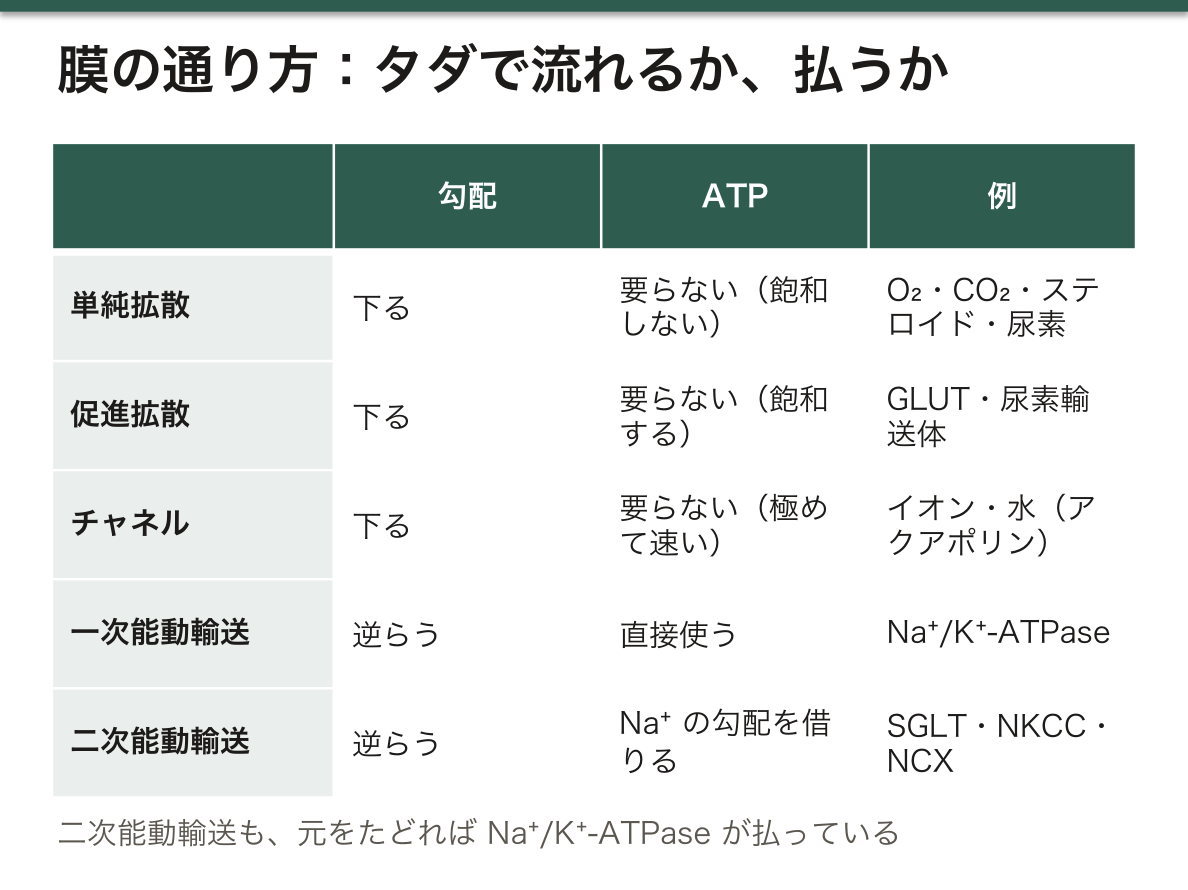
だから輸送は「タダで流れるか、ATPを払うか」で最初に分ける。
- 受動輸送——単純拡散・促進拡散・チャネル。勾配を下る。ATPは要らない
- 一次能動輸送——ATPを直接使う。Na⁺/K⁺-ATPase・H⁺/K⁺-ATPase・Ca²⁺-ATPase・ABC輸送体
- 二次能動輸送——Na⁺の勾配を借りる。SGLT・NKCC・NCX
二次能動輸送が要点になる——「直接ATPを使っていなくても、元をたどれば Na⁺/K⁺-ATPase が払っている」。だからポンプを止めると、無関係に見える輸送が全部止まる。
膜の構造は細胞膜の章、膜電位は膜電位の章、腎の輸送は腎と体液の章にある。
- 膜を通る4つの通り方
- エンドサイトーシスと、細胞が物を取り込む仕組み
- ナトリウムポンプ — 体の ATP の、かなりの部分を使っている
- 膜の流動性 — コレステロールが、二重の役割を果たしている
- 輸送体が、薬の運命を決めている
- 細胞は、膜そのものを外へ出して情報を運んでいる
膜を通る4つの通り方
単純拡散——脂溶性・小さい・電荷が無いものだけ。O₂・CO₂・ステロイド・尿素・水(一部)。飽和しない。
促進拡散——輸送体を使うが勾配は下る。GLUT・尿素輸送体。飽和する・競合阻害を受ける。
チャネル——孔が開閉する。イオンと水(アクアポリン)。極めて速い。
- 開き方——電位依存性・リガンド依存性・機械受容性
能動輸送——勾配に逆らう。
- Na⁺/K⁺-ATPase——ATP 1つで Na⁺ 3個を出し K⁺ 2個を入れる。電気を生む(起電性)
- 共輸送(同方向)——SGLT1/2・NKCC2
- 対向輸送(逆方向)——Na⁺/H⁺ 交換体・Na⁺/Ca²⁺ 交換体
Na⁺/K⁺-ATPase が「起電性」であることが、この章の中心になる。正電荷が正味1つ出ていくので、静止膜電位に直接寄与する(静止膜電位の章)——「ポンプが止まれば、電位そのものが崩れる」。
そしてジギタリスは、このポンプを止める薬になる(ジギタリスの章)——「細胞内 Na⁺ が上がり、Na⁺/Ca²⁺ 交換体が働きにくくなり、細胞内 Ca²⁺ が増える」。
だから強心作用と不整脈が、同じ機序から出てくる。治療域が狭いのは、効果と毒性の分子機序が同一だからになる(薬物血中濃度モニタリングの章)——「効かせ方と副作用が一本道で結ばれている薬は、必ず測る」。
低カリウム血症でジギタリス中毒が起きやすいのも、同じポンプの話になる。K⁺ とジギタリスが結合部位を競合する——「電解質の是正が、そのまま解毒になる」。
SGLT2 が二次能動輸送であることが、SGLT2 阻害薬の作用を説明する。近位尿細管でのグルコース再吸収を止め、尿へ捨てる(糖尿病治療薬の章)——「インスリンに依存しない機序なので、低血糖を起こしにくい」。
そして尿に糖が出ることが、尿路感染と性器感染の副作用になる——「効かせ方そのものが、副作用の原因になっている」。
English version
Core
- Simple diffusion — only what is lipid-soluble, small and uncharged. O₂, CO₂, steroids, urea, water (in part). Does not saturate.
- Facilitated diffusion — uses a carrier but goes down the gradient. GLUT, urea transporters. Saturates and is competitively inhibited.
- Channels — a pore that opens and shuts. Ions and water (aquaporins). Extremely fast. Gated by voltage, by ligand or mechanically.
- Active transport — against the gradient. Na⁺/K⁺-ATPase — one ATP sends out 3 Na⁺ and brings in 2 K⁺. It generates current (electrogenic). Symport — SGLT1/2, NKCC2. Antiport — Na⁺/H⁺ and Na⁺/Ca²⁺ exchangers.
Going further
That the Na⁺/K⁺-ATPase is electrogenic is the centre of this chapter. A net positive charge leaves, so it contributes directly to the resting membrane potential — stop the pump and the potential itself collapses.
And digitalis is a drug that stops this pump — intracellular Na⁺ rises, the Na⁺/Ca²⁺ exchanger works less well, and intracellular Ca²⁺ increases. So the inotropic effect and the arrhythmias come from the same mechanism.
The narrow therapeutic window exists because the molecular mechanism of the effect and of the toxicity is identical — a drug in which the way it works and its adverse effect are joined in one line is always measured.
That hypokalaemia predisposes to digitalis toxicity is the same pump again: K⁺ and digitalis compete for the binding site — correcting the electrolyte is itself an antidote.
That SGLT2 is a secondary active transporter explains the action of the SGLT2 inhibitors: they stop the reabsorption of glucose in the proximal tubule and discard it in the urine — an insulin-independent mechanism, so hypoglycaemia is uncommon. And that sugar appears in the urine is the adverse effect of urinary and genital infection — the very way it works is the cause of the side effect.
エンドサイトーシスと、細胞が物を取り込む仕組み
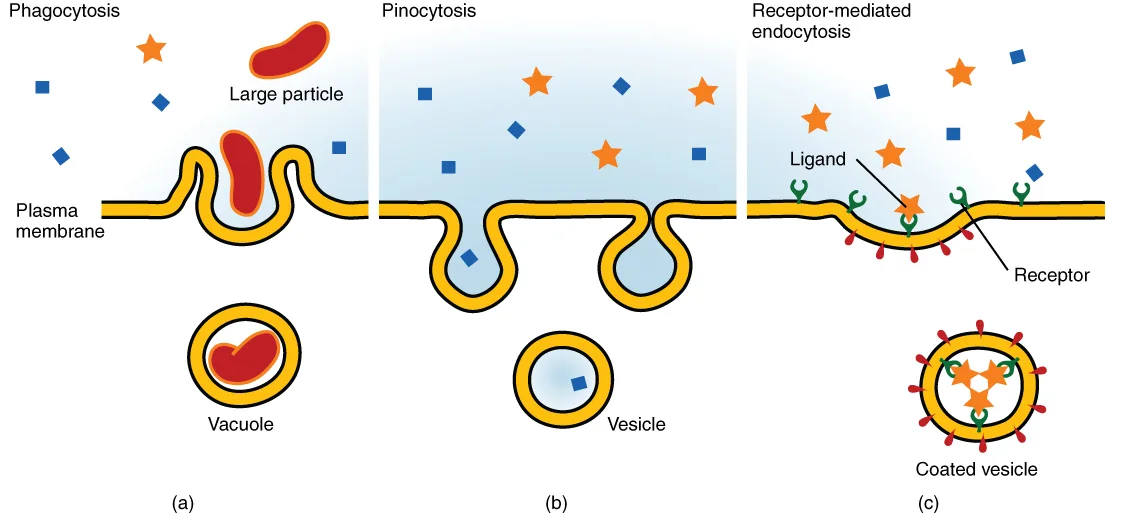
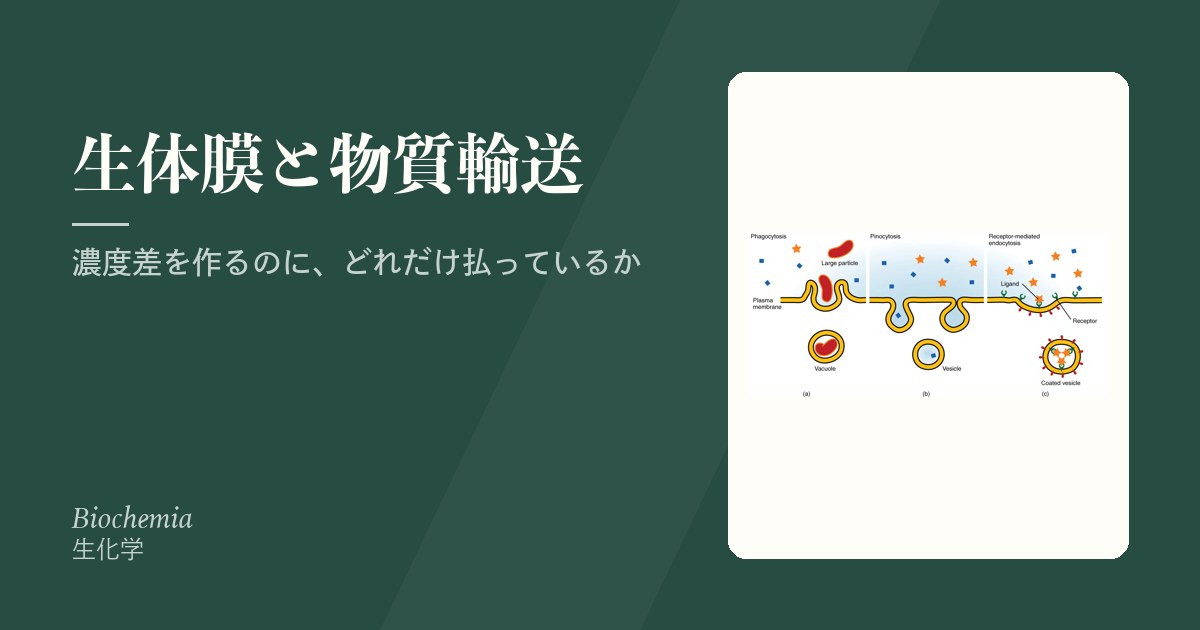
大きなものは、膜で包んで取り込む。
- 食作用(ファゴサイトーシス)——粒子を包む。好中球・マクロファージだけ
- 飲作用(ピノサイトーシス)——液体を無選択に飲む
- 受容体介在性エンドサイトーシス——クラスリン被覆小胞。LDL・トランスフェリン・インスリン
取り込まれた小胞はエンドソームになり、酸性化して受容体とリガンドを分ける。
- 受容体は膜へ戻る(リサイクル)
- リガンドはリソソームへ行く
LDL 受容体の経路——受容体が LDL を捉える → 取り込む → コレステロールを放出 → 受容体は戻る。
この受容体の異常が家族性高コレステロール血症になる。
LDL 受容体の経路が、脂質治療の全体像を決めている。スタチンは合成を止めることで、細胞に LDL 受容体を増やさせる(脂質異常症の章)——「血中の LDL を下げているのは、受容体の数になる」。
だから受容体が全く無いホモ接合体では、スタチンが効きにくい(家族性高コレステロール血症の章)——「作用点が壊れている患者では、その薬は原理的に効かない」。
PCSK9 阻害薬は、受容体の分解を防いで数を保つ薬になる(生物学的製剤の章)——「同じ受容体を、作らせる側と壊させない側の2方向から増やしている」。
鉄の取り込みも同じ経路になる。トランスフェリン受容体が鉄を運び込み、エンドソームの酸性化で鉄が離れる(鉄代謝の章)——「酸性化という1つの仕掛けが、多くの受容体で使い回されている」。
ウイルスと毒素も、この経路を乗っ取る。インフルエンザウイルスはエンドソームの酸性化を利用して膜融合する(ウイルスの侵入の章)——「取り込みの仕組みが、そのまま感染の入口になる」。
だからエンドソームの酸性化を妨げる薬が、抗ウイルス薬として検討されてきた——「宿主側の仕組みを狙うので、耐性ができにくいが、副作用が出やすい」。
English version
Core
What is large is taken in wrapped in membrane.
- Phagocytosis — engulfing particles. Neutrophils and macrophages only.
- Pinocytosis — drinking fluid indiscriminately.
- Receptor-mediated endocytosis — clathrin-coated vesicles. LDL, transferrin, insulin.
The vesicle becomes an endosome, acidifies, and the receptor and ligand separate. The receptor returns to the membrane (recycling); the ligand goes to the lysosome.
The LDL receptor pathway — the receptor catches LDL → it is taken in → cholesterol is released → the receptor returns. A defect of this receptor is familial hypercholesterolaemia.
Going further
The LDL receptor pathway determines the whole shape of lipid treatment. A statin, by blocking synthesis, makes the cell increase its LDL receptors — what lowers the blood LDL is the number of receptors.
So in a homozygote with no receptors at all a statin works poorly — a drug cannot work in principle in a patient whose site of action is broken.
PCSK9 inhibitors preserve the number by preventing the degradation of the receptor — increasing the same receptor from two directions, by making more and by breaking down fewer.
Iron uptake uses the same pathway: the transferrin receptor carries iron in and the acidification of the endosome releases it — one device, acidification, used again and again by many receptors.
Viruses and toxins hijack this route. Influenza virus uses the acidification of the endosome to fuse its membrane — the mechanism of uptake becoming directly the entrance of infection. Hence drugs that prevent endosomal acidification have been considered as antivirals — aiming at a host mechanism, so resistance is slow but adverse effects are common.
ナトリウムポンプ — 体の ATP の、かなりの部分を使っている
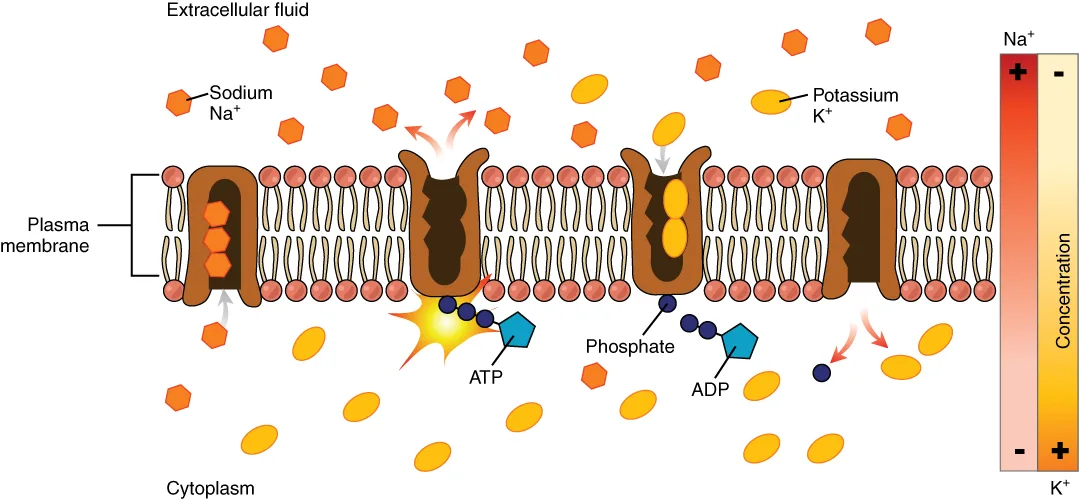
1回の反応で、Na⁺ を3個外へ、K⁺ を2個内へ運ぶ。ATP を1分子使う。
電荷が差し引き1つ外へ出るので、わずかに電気を作る(起電性)。
安静時に消費される ATP の 20〜30%(腎や神経ではさらに多い)を占める。
作られる濃度差が、他の輸送の動力になる。
- 二次性能動輸送——SGLT(糖)・NKCC2(腎)・NCX(Na⁺/Ca²⁺ 交換)・NHE(Na⁺/H⁺ 交換)
- 静止膜電位の維持
- 細胞容積の維持
ジギタリスはこのポンプを阻害する。
「1つのポンプが作った勾配を、他の全部が借りている」という構図が、この項の要点になる。だからここが止まると、糖の吸収も pH の調節もカルシウムの排出も同時に止まる(SGLT1 の項)——「エネルギーを1か所に集中投資している」。
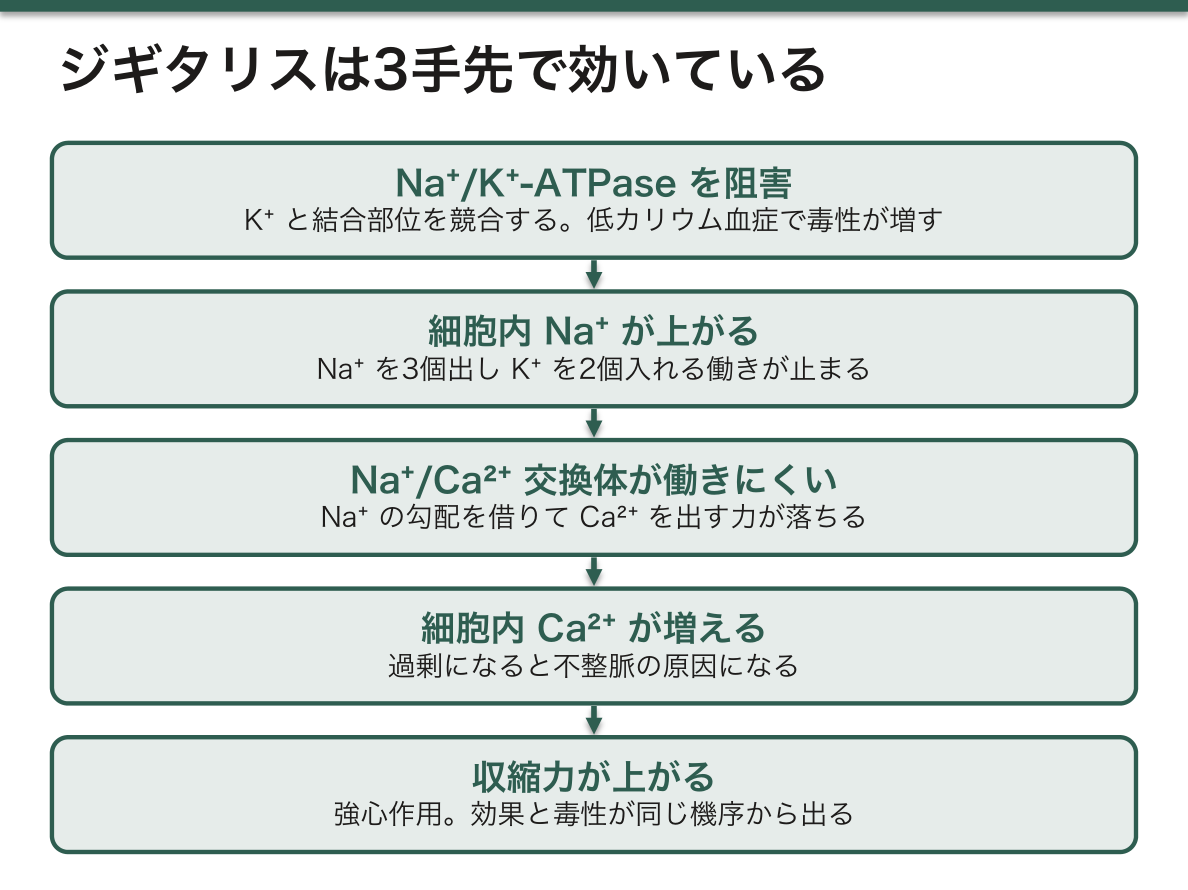
ジギタリスの強心作用は、この連鎖から導ける。ポンプを止める → 細胞内 Na⁺ が上がる → Na⁺/Ca²⁺ 交換体が働きにくくなる → 細胞内 Ca²⁺ が増える → 収縮力が上がる(循環器の薬の章)——「3手先で効いている薬になる」。
同時に副作用も同じ機序から出る。細胞内 Ca²⁺ 過剰による不整脈、そして低カリウム血症で毒性が増す(K⁺ と結合部位を競合するため)(カリウムの章)——「利尿薬との併用が、ジギタリス中毒の典型的な入口になる」。
虚血で ATP が尽きると、細胞は膨れる。ポンプが止まって Na⁺ と水が入り込む(細胞性浮腫)(細胞傷害の章)——「可逆的な傷害の最初の形が、この膨化になる」。
甲状腺ホルモンがポンプの数を増やすことが、基礎代謝と熱産生の一部を説明する(体温の章)——「動かなくても熱が出る仕組みの1つになる」。
English version
Core
One cycle carries 3 Na⁺ out and 2 K⁺ in, using one ATP. A net charge of one leaves, so it generates a small current (electrogenic).
It accounts for 20–30 per cent of the ATP consumed at rest (more in kidney and nerve).
The gradient it creates is the power source of other transport.
- Secondary active transport — SGLT (sugar), NKCC2 (kidney), NCX (Na⁺/Ca²⁺ exchange), NHE (Na⁺/H⁺ exchange).
- Maintenance of the resting membrane potential.
- Maintenance of cell volume.
Digitalis inhibits this pump.
Going further
The point is the arrangement in which one pump makes a gradient that everything else borrows. So when it stops, the absorption of sugar, the regulation of pH and the extrusion of calcium stop together — the energy is invested in one place.
The inotropic action of digitalis follows from that chain: stop the pump → intracellular Na⁺ rises → the Na⁺/Ca²⁺ exchanger works less well → intracellular Ca²⁺ rises → contractility increases — a drug acting three moves ahead.
The adverse effects come from the same mechanism: arrhythmia from excess intracellular Ca²⁺, and toxicity increased by hypokalaemia (competing for the binding site) — combination with a diuretic is the classic entrance to digitalis toxicity.
When ATP is exhausted in ischaemia the cell swells. The pump stops and Na⁺ and water enter (cellular oedema) — the first, reversible form of injury.
That thyroid hormone increases the number of pumps explains part of the basal metabolic rate and of heat production — one of the mechanisms by which heat is produced without moving.
膜の流動性 — コレステロールが、二重の役割を果たしている
膜は固体でも液体でもなく、脂質が横に動ける「流動モザイク」になる。
流動性を上げるもの——不飽和脂肪酸(二重結合が折れ曲がり、詰まりを妨げる)・短い鎖・高い温度。
下げるもの——飽和脂肪酸・長い鎖・低い温度・スフィンゴミエリン。
コレステロールは、温度によって逆の働きをする。
| 状況 | コレステロールの働き |
|---|---|
| 高温(流動的なとき) | 脂肪酸の動きを抑え、流動性を下げる |
| 低温(固まりそうなとき) | 整列を妨げ、固まるのを防ぐ |
脂質ラフト——コレステロールとスフィンゴ脂質が集まった、やや硬い領域。受容体や信号分子が集まる。
コレステロールは「流動性の緩衝材」になっている、という理解が要点になる。どちらの方向へも振れすぎないように働く(この章の膜輸送の項)——「上げる・下げるではなく、一定に保つ役になっている」。
膜の流動性は、蛋白の働きに直結する。受容体も輸送体も、膜の中で動いて集まることで機能する(シグナル伝達の章)——「硬すぎても軟らかすぎても、信号が伝わらない」。
脂質ラフトは、病原体の侵入口にもなっている(ウイルスの複製の章)——「受容体が集まっている場所は、狙われる場所でもある」。
吸入麻酔薬の作用機序は、かつて膜の流動性で説明されていた(麻酔の薬の章)——「今は特定のイオンチャネルへの直接作用が主とされる。脂質説は歴史として押さえる」。
赤血球膜の脂質組成は、血漿の脂質と交換される(赤血球膜の項)——「肝疾患でコレステロールが増えると、有棘赤血球や標的赤血球ができる」。
English version
Core
The membrane is neither solid nor liquid but a fluid mosaic in which the lipids move laterally.
Raising fluidity — unsaturated fatty acids (the double bond bends and prevents packing), shorter chains, higher temperature. Lowering it — saturated fatty acids, longer chains, low temperature, sphingomyelin.
Cholesterol acts in opposite directions according to temperature.
| Situation | What cholesterol does |
|---|---|
| Warm (fluid) | Restrains the movement of the fatty acids and lowers the fluidity |
| Cold (about to set) | Prevents them lining up and stops it setting |
Lipid rafts — slightly stiffer regions where cholesterol and sphingolipids gather, and where receptors and signalling molecules collect.
Going further
The point is to understand cholesterol as the buffer of fluidity — working so that it does not swing too far either way: not raising or lowering it but holding it constant.
The fluidity of the membrane bears directly on the working of its proteins. Receptors and transporters function by moving and gathering within the membrane — too stiff or too soft and the signal is not transmitted.
Lipid rafts are also the point of entry of pathogens — where the receptors gather is also where they are attacked.
The mechanism of the inhalational anaesthetics was once explained by membrane fluidity — now a direct action on particular ion channels is regarded as the main one. Keep the lipid theory as history.
The lipid composition of the red cell membrane exchanges with that of the plasma — when cholesterol rises in liver disease, acanthocytes and target cells appear.
輸送体が、薬の運命を決めている
薬の動きは「脂に溶けるかどうか」だけでは決まらない。細胞は輸送体を使って、薬を能動的に取り込み、汲み出している。
| OATP1B1 | 肝細胞が取り込む | スタチン・リファンピシンなど。ここが詰まると血中濃度が上がる |
| P 糖蛋白 | 腸・肝・腎・脳の関門で汲み出す | 吸収を減らし、脳への侵入を防ぐ |
| OCT2 / MATE | 腎尿細管で分泌する | メトホルミン。シメチジンなどが競合して血中濃度を上げる |
| URAT1 | 尿酸を再吸収する | ここを止めるのが尿酸排泄促進薬。逆に乳酸・ケトン体は再吸収を促す |
代謝酵素(P450)だけを見ていると、相互作用を読み違える。
臨床でよく問われる例が、スタチンによる筋障害である。
SLCO1B1(OATP1B1 をコードする遺伝子)に機能低下型の多型をもつ人では、肝が取り込めずに血中のスタチン濃度が上がり、筋に届く量が増える。シンバスタチン高用量では、筋症のリスクが数倍から十数倍になると報告されている。薬理遺伝学の指針で、実際に投与量や薬剤選択の推奨が出ている数少ない例の1つである。
薬でも同じことが起こる。OATP1B1 を阻害する薬(シクロスポリン・一部のマクロライド・グレープフルーツ果汁の一部成分)と併用すると、同じ状況になる。
血液脳関門の実体も、輸送体である。内皮のタイト結合が「壁」を作り、P 糖蛋白などが「汲み出し」を担う。ロペラミドが中枢性のオピオイド作用を出さないのは、P 糖蛋白に汲み出されているからで、阻害薬と併用すると中枢作用が出うる。
⚠️ 「濃度が足りないから効かない」と「届いていないから効かない」は違う。増量しても輸送が律速なら濃度は上がらず、副作用だけが増えることがある。
スタチンで筋肉痛が出たら、薬を替える・量を下げる・併用薬を見直す。同じ系統でも輸送体への依存度は薬ごとに違う。
English version
Core
The movement of a drug is not settled by lipid solubility alone. Cells use transporters to take drugs in and pump them out actively.
| Transporter | What it does | Note |
|---|---|---|
| OATP1B1 | Hepatic uptake | Statins, rifampicin. Block it and the blood level rises |
| P-glycoprotein | Pumps out at the barriers of gut, liver, kidney and brain | Reduces absorption and prevents entry into the brain |
| OCT2 / MATE | Secretion in the renal tubule | Metformin. Cimetidine and others compete and raise its level |
| URAT1 | Reabsorbs urate | Blocked by the uricosuric drugs. Lactate and ketones promote reabsorption |
Look only at the metabolising enzymes (P450) and interactions will be misread.
Going further
The example most often asked clinically is statin myopathy. In a person with a loss-of-function variant of SLCO1B1 (encoding OATP1B1), the liver cannot take it up, the blood level rises and more reaches the muscle. With high-dose simvastatin the risk of myopathy is reported as several to more than tenfold. It is one of the few examples in which pharmacogenetic guidelines actually recommend a dose or a choice of drug.
Drugs do the same thing. Combined with an inhibitor of OATP1B1 (ciclosporin, some macrolides, certain components of grapefruit juice), the same situation arises.
The substance of the blood–brain barrier is also transport. The tight junctions of the endothelium make the wall and P-glycoprotein and others do the pumping out. That loperamide produces no central opioid effect is because it is pumped out by P-glycoprotein, and with an inhibitor central effects can appear.
⚠️ "It does not work because the concentration is too low" and "it does not work because it is not getting there" are different. If transport is rate-limiting, increasing the dose does not raise the concentration and only increases the adverse effects.
In the clinic
If a statin causes muscle pain, change the drug, reduce the dose, or review the other medicines. Even within the same class, the dependence on transporters differs from drug to drug.
細胞は、膜そのものを外へ出して情報を運んでいる
細胞どうしの連絡は、可溶性の分子(ホルモン・サイトカイン)だけではない。細胞は膜に包まれた小胞を放出し、その中身を別の細胞へ届けている。
| エクソソーム | 30〜150 nm | 多胞体が細胞膜と融合して放出される。由来する細胞の膜と中身を持つ |
| 微小小胞 | 100〜1000 nm | 細胞膜が直接くびれて出る |
| アポトーシス小体 | 1〜5 μm | 死んだ細胞の断片 |
中身が重要である。蛋白・脂質のほかに mRNA と miRNA が入っていて、受け取った細胞の中で翻訳され、遺伝子発現を変えうる。つまり細胞が細胞へ「核酸を送っている」ということになる。
研究と臨床応用の現状を、期待と分けて押さえる。
- リキッドバイオプシー——血中のエクソソームに腫瘍由来の核酸と蛋白が含まれる。採血だけで腫瘍の情報を得る手法として開発が進む。ただし現在実用化が先行しているのは、血中循環腫瘍 DNA(ctDNA)のほうである
- 転移の準備——腫瘍が出したエクソソームが、転移する前に転移先の組織を作り変える(前転移ニッチ)という仮説が有力になっている。「どの臓器へ転移するか」が偶然ではないことの説明になる
- 薬の運び手——免疫原性が低く膜を越えやすいので、核酸医薬の運搬体として研究されている
- ⚠️ 「エクソソーム療法」を掲げる自由診療があるが、有効性と安全性は確立していない。患者から尋ねられる場面がある
生理的な役割も分かってきている。網状赤血球が成熟するとき、不要になった受容体をエクソソームとして捨てている——これが発見の発端だった。もとは「ゴミ捨て」の仕組みとして見つかり、後から情報伝達だと分かったという経緯を持つ。
患者が「エクソソーム点滴」などの自由診療について尋ねてきたら、研究段階であることを率直に伝える。頭ごなしに否定せず、根拠の所在を説明する。
English version
Core
Cells communicate not only by soluble molecules (hormones, cytokines). They release membrane-bound vesicles and deliver their contents to other cells.
| Kind | Size | Origin |
|---|---|---|
| Exosome | 30–150 nm | Released when a multivesicular body fuses with the cell membrane. Carries the membrane and contents of the cell of origin |
| Microvesicle | 100–1000 nm | Budded directly from the cell membrane |
| Apoptotic body | 1–5 µm | Fragments of a dead cell |
The contents are what matter. Besides proteins and lipids they contain mRNA and miRNA, which are translated in the receiving cell and can change its gene expression. That is, cells are sending nucleic acid to cells.
Going further
Keep the present state of research and application separate from the expectation.
- Liquid biopsy — circulating exosomes contain tumour-derived nucleic acid and protein. Development continues as a way of obtaining tumour information from a blood sample. But what is ahead in practice at present is circulating tumour DNA (ctDNA).
- Preparing for metastasis — the hypothesis that exosomes released by a tumour remodel the destination tissue before metastasis (the pre-metastatic niche) is now well supported. It explains why the organ to which a tumour spreads is not a matter of chance.
- Carriers for drugs — being poorly immunogenic and able to cross membranes, they are studied as vehicles for nucleic acid drugs.
⚠️ "Exosome therapy" is offered privately, but its efficacy and safety are not established. Patients will ask.
A physiological role is also known. As a reticulocyte matures it discards the receptors it no longer needs as exosomes — this was how they were discovered. They were first found as a mechanism of rubbish disposal and only later understood as communication.
In the clinic
If a patient asks about a private "exosome infusion", say frankly that it is at the research stage. Do not dismiss it out of hand; explain where the evidence stands.
まとめ
| 膜を通る4つの通り方 | 単純拡散——脂溶性・小さい・電荷が無いものだけ。 |
|---|---|
| エンドサイトーシスと、細胞が物を取り込む仕組み | 大きなものは、膜で包んで取り込む。食作用(ファゴサイトーシス)——粒子を包む。 |
| ナトリウムポンプ — 体の ATP の、かなりの部分を使っている | 1回の反応で、Na⁺ を3個外へ、K⁺ を2個内へ運ぶ。 |
| 膜の流動性 — コレステロールが、二重の役割を果たしている | 膜は固体でも液体でもなく、脂質が横に動ける「流動モザイク」になる。 |
| 輸送体が、薬の運命を決めている | 薬の動きは「脂に溶けるかどうか」だけでは決まらない。 |
| 細胞は、膜そのものを外へ出して情報を運んでいる | 細胞どうしの連絡は、可溶性の分子(ホルモン・サイトカイン)だけではない。 |
このノートは医学生が授業の内容を自分の言葉でまとめたもので、診療の判断に使うものではありません。誤りに気づいたらお知らせください。