食事の糖はグルコースだけではない。果糖(ショ糖の半分、果物、異性化糖)とガラクトース(乳糖の半分)は、グルコースとは別の入り口から代謝に入る。
この2つには共通の危うさがある。入り口の酵素に調節が効かないことである。グルコースの取り込みは血糖やインスリンで制御されるが、果糖もガラクトースも、入ってきた分だけリン酸化されてしまう。だから途中で詰まると、リン酸が捕らわれて細胞のATPが枯れる。
- 果糖の代謝 — リン酸を人質に取られる
- ガラクトース血症 — 白内障が最初の手がかりになる
- 果糖と代謝症候群 — 肝で、規制を受けずに代謝される糖
- 糖アルコール — 甘いのに吸収されない、という設計
- 果糖の吸収不良 — 遺伝病ではないのに、果物で腹が張る
- 尿に糖が出ているとき、それはブドウ糖とは限らない
果糖の代謝 — リン酸を人質に取られる
肝での果糖代謝は3段階。
- フルクトキナーゼ:果糖 → フルクトース1リン酸
- アルドラーゼB:フルクトース1リン酸 → ジヒドロキシアセトンリン酸+グリセルアルデヒド
- 解糖系へ合流(ホスホフルクトキナーゼ1を迂回する)
| 疾患 | 欠損 | 溜まるもの | 症状 |
|---|---|---|---|
| 本態性果糖尿症 | フルクトキナーゼ | 果糖(そのまま尿へ) | 無症状。尿の還元糖が陽性になるだけ |
| 遺伝性果糖不耐症 | アルドラーゼB | フルクトース1リン酸 | 果糖摂取後の嘔吐・低血糖・肝障害。離乳期に発症 |
同じ経路の隣り合う2つの酵素で、無症状と重症に分かれる——これが「詰まる場所が病気を決める」ことの最も明快な例である。
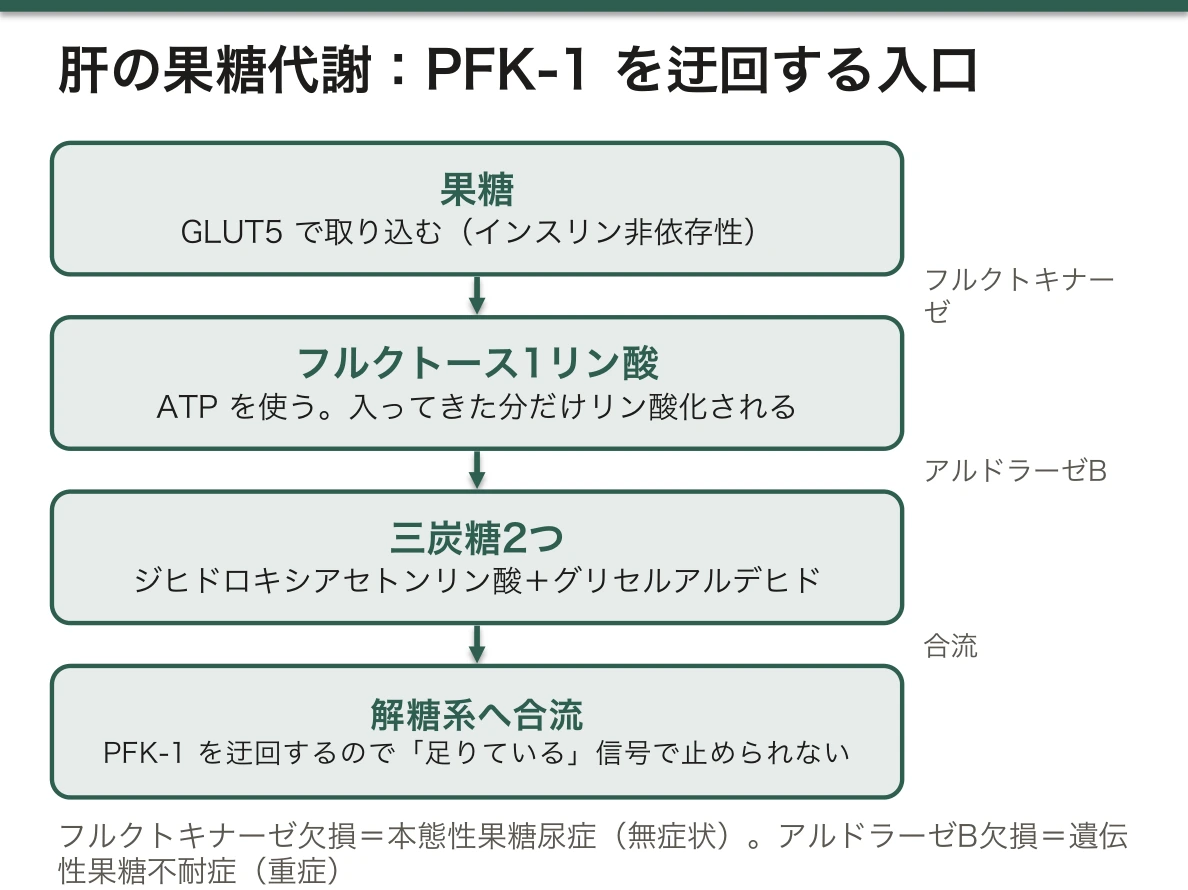
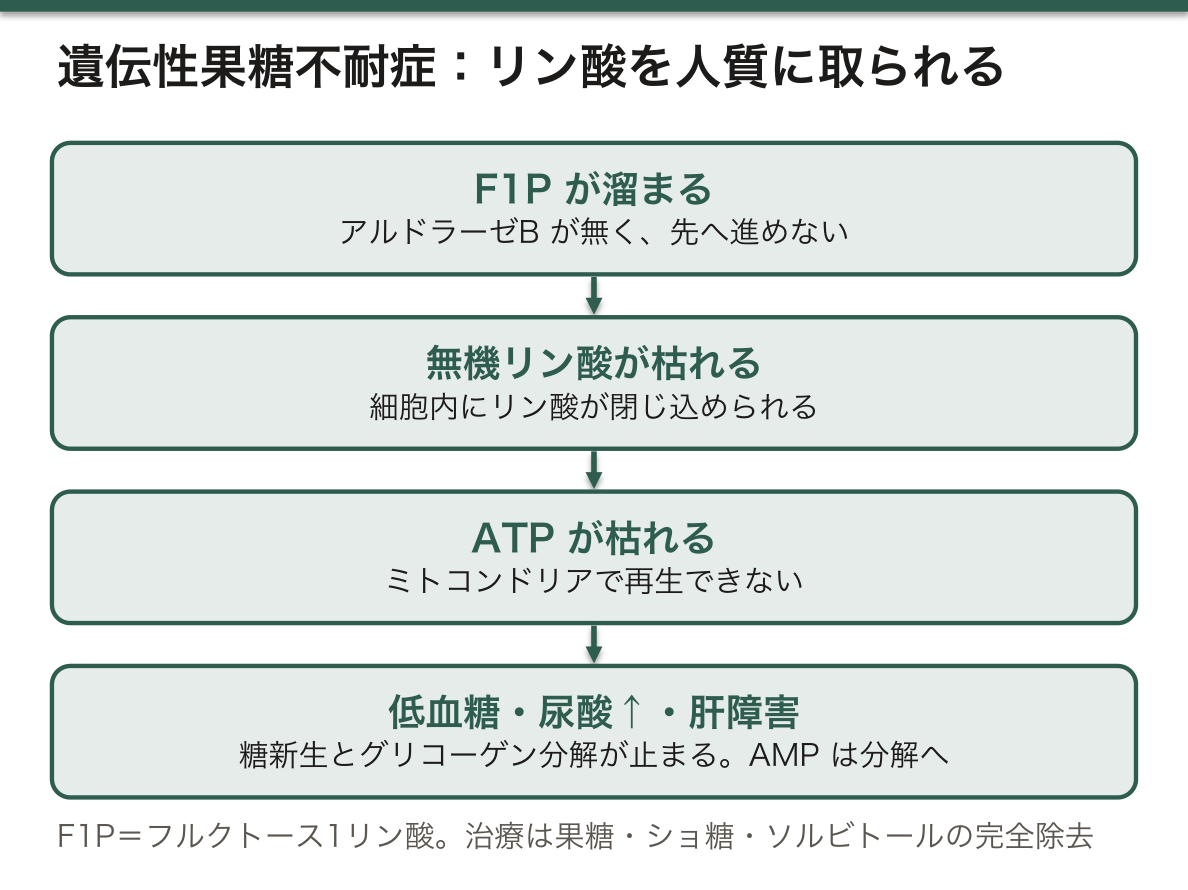
なぜアルドラーゼBの欠損だけが重いのか。フルクトキナーゼはATPを使って果糖をリン酸化する。その先が詰まるとフルクトース1リン酸が細胞内に溜まり続け、無機リン酸が中に閉じ込められる。
- 無機リン酸が枯れる → ミトコンドリアでATPが再生できない
- ATPが枯れる → AMPが分解へ回り尿酸が上がる。糖新生とグリコーゲン分解も止まり低血糖になる
- 肝細胞が傷害される → 肝腫大・黄疸・凝固障害
本態性果糖尿症では何も溜まらないので、果糖がそのまま血中へ出て尿へ捨てられるだけである。尿糖試験紙(グルコースオキシダーゼ法)は陰性なのに、還元糖の検査は陽性——この乖離が手がかりになる。
遺伝性果糖不耐症の子は、自ら甘いものを避けるようになる。食べると気分が悪くなるからで、う蝕がほとんど無いという特徴が出る。病歴を取るときに効く所見である。治療は果糖・ショ糖・ソルビトールの完全除去で、点滴や薬剤の添加物にも果糖やソルビトールが入っているため、そこまで確認する必要がある。
果糖が代謝症候群と結びつく理由も同じ生化学から出る。果糖はホスホフルクトキナーゼ1を迂回するため、「足りている」という信号で止められない。入った分だけアセチルCoAへ流れ、中性脂肪の合成に回る。清涼飲料の異性化糖が問題にされるのはこのためである。
English version
Core
Fructose metabolism in the liver has three steps.
- Fructokinase: fructose → fructose 1-phosphate
- Aldolase B: fructose 1-phosphate → dihydroxyacetone phosphate + glyceraldehyde
- It joins glycolysis (bypassing phosphofructokinase 1)
| Disease | Deficiency | What accumulates | Symptoms |
|---|---|---|---|
| Essential fructosuria | Fructokinase | Fructose (straight into the urine) | None. Only a positive test for reducing sugar in the urine |
| Hereditary fructose intolerance | Aldolase B | Fructose 1-phosphate | Vomiting, hypoglycaemia and liver injury after taking fructose. Presents at weaning |
Two neighbouring enzymes of the same pathway divide into the symptomless and the severe — the plainest example of "where the block lies decides the disease".
Going further
Why is only aldolase B deficiency severe? Fructokinase uses ATP to phosphorylate fructose. Blocked beyond that, fructose 1-phosphate goes on accumulating within the cell and inorganic phosphate is locked up inside it.
- Inorganic phosphate runs out → ATP cannot be regenerated in the mitochondrion.
- ATP runs out → AMP is diverted to degradation and urate rises. Gluconeogenesis and glycogenolysis stop too, giving hypoglycaemia.
- Hepatocytes are injured → hepatomegaly, jaundice, coagulopathy.
In essential fructosuria nothing accumulates, so the fructose simply passes into the blood and is discarded in the urine. The urinary glucose strip (glucose oxidase method) is negative while the test for reducing sugar is positive — this discrepancy is the clue.
A child with hereditary fructose intolerance comes to avoid sweet things of their own accord. Eating them makes them feel ill, and the feature emerges that they have almost no caries. A finding that tells when taking the history. Treatment is complete removal of fructose, sucrose and sorbitol, and since fructose and sorbitol are also present as excipients in infusions and medicines, that must be checked as well.
The reason fructose links with the metabolic syndrome comes out of the same biochemistry. Fructose bypasses phosphofructokinase 1, so it cannot be stopped by the signal that there is enough. Whatever enters flows on to acetyl-CoA and is diverted into triglyceride synthesis. This is why the high-fructose corn syrup of soft drinks is an issue.
ガラクトース血症 — 白内障が最初の手がかりになる
ガラクトース代謝は3つの酵素で進む。
- ガラクトキナーゼ:ガラクトース → ガラクトース1リン酸
- ガラクトース1リン酸ウリジルトランスフェラーゼ:ガラクトース1リン酸 → グルコース1リン酸
- ウリジン二リン酸ガラクトース4エピメラーゼ
| 型 | 欠損酵素 | 症状 |
|---|---|---|
| I型(古典型) | ウリジルトランスフェラーゼ | 哺乳後の嘔吐・黄疸・肝腫大・低血糖・大腸菌敗血症・白内障・知的障害 |
| II型 | ガラクトキナーゼ | 白内障のみ |
| III型 | エピメラーゼ | 多くは無症状 |
- 日本の新生児マススクリーニングの対象疾患
- 治療は乳糖除去乳。母乳も禁忌になる
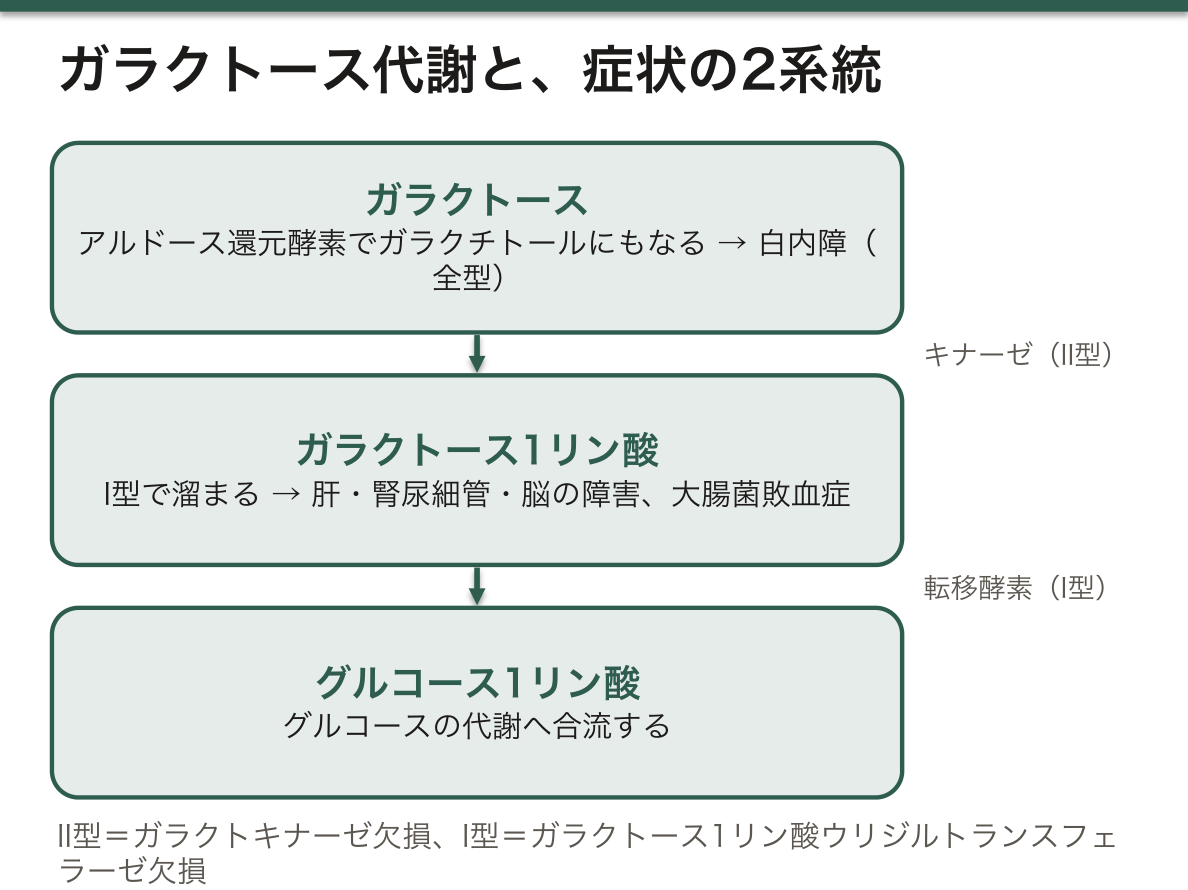
白内障がすべての型に共通する理由は、ガラクトースがアルドース還元酵素でガラクチトールに変えられ、水晶体に溜まるためである。ガラクチトールは細胞膜を通れないので、水を引き込んで水晶体線維を膨らませ、混濁させる。ガラクトキナーゼ欠損(II型)では白内障しか起きないのは、ガラクトース1リン酸が溜まらないからである。
つまり症状は2系統に分かれる。
- ガラクチトールによるもの——白内障。すべての型で起きうる
- ガラクトース1リン酸によるもの——肝障害・腎尿細管障害・脳障害。I型だけで起きる。機序は果糖不耐症と同じで、リン酸を人質に取る
大腸菌敗血症を合併しやすいのは古典型の重要な特徴で、ガラクトース1リン酸が好中球の殺菌能を落とすためと考えられている。新生児の大腸菌敗血症を見たらガラクトース血症を疑う——これは国試でも実務でも問われる線である。
食事療法をしても知的障害と卵巣機能不全は完全には防げない点が、この病気の難しさである。体内でもウリジン二リン酸ガラクトースが合成される(糖蛋白・糖脂質の材料として必要だから)ため、食事制限だけでは内因性の産生を止められない。治療しても完治ではないことを、家族に説明する必要がある。
English version
Core
Galactose metabolism proceeds by three enzymes.
- Galactokinase: galactose → galactose 1-phosphate
- Galactose 1-phosphate uridyltransferase: galactose 1-phosphate → glucose 1-phosphate
- UDP-galactose 4-epimerase
| Type | Enzyme deficient | Symptoms |
|---|---|---|
| Type I (classical) | Uridyltransferase | Vomiting after feeds, jaundice, hepatomegaly, hypoglycaemia, E. coli sepsis, cataract, intellectual disability |
| Type II | Galactokinase | Cataract only |
| Type III | Epimerase | Mostly symptomless |
- Included in the Japanese newborn mass screening.
- Treatment is lactose-free formula. Breast milk is contraindicated too.
Going further
Cataract is common to all the types because galactose is converted by aldose reductase into galactitol, which accumulates in the lens. Galactitol cannot cross the cell membrane, so it draws in water, swells the lens fibres and clouds them. In galactokinase deficiency (type II) only cataract occurs because galactose 1-phosphate does not accumulate.
That is, the symptoms fall into two lines.
- From galactitol — cataract. It can occur in every type.
- From galactose 1-phosphate — liver injury, renal tubular injury, brain injury. Only in type I. The mechanism is the same as in fructose intolerance: phosphate is taken hostage.
The tendency to E. coli sepsis is an important feature of the classical type, thought to be because galactose 1-phosphate impairs the bactericidal capacity of neutrophils. Seeing E. coli sepsis in a newborn, suspect galactosaemia — a line asked both in the national examination and in practice.
That diet does not fully prevent the intellectual disability and ovarian failure is the difficulty of this disease. UDP-galactose is synthesised within the body as well (being needed as material for glycoproteins and glycolipids), so dietary restriction cannot stop the endogenous production. Treatment is not cure, and this has to be explained to the family.
果糖と代謝症候群 — 肝で、規制を受けずに代謝される糖
グルコースとの決定的な違いは、律速がどこにあるかになる。
| グルコース | 果糖 | |
|---|---|---|
| 取り込み | インスリン依存性(組織による) | GLUT5(インスリン非依存性) |
| 最初のリン酸化 | ヘキソキナーゼ/グルコキナーゼ | フルクトキナーゼ |
| 律速 | ホスホフルクトキナーゼ(ATP とクエン酸で抑制される) | この段を飛び越える(抑制を受けない) |
| インスリン分泌 | 促す | ほとんど促さない |
結果として、果糖は肝で無制限にトリオースリン酸へ進み、脂肪酸合成へ流れやすい。
大量摂取で、ATP を消費して AMP が増え、尿酸が作られる。
「規制を受けない入口がある」ことが、果糖の代謝の特徴になる。糖代謝の安全弁であるホスホフルクトキナーゼを迂回している(律速の3か所の項)——「余っていても、止まらずに入ってくる」。
だから異性化糖(高果糖コーンシロップ)を含む飲料が、脂肪肝と関連するとされる(脂肪性肝疾患の章)——「同じカロリーでも、飲み物として入る糖の影響が議論されている」。
インスリンをほとんど出させないことは、満腹感にも関わる(脂肪組織の内分泌の項)——「インスリンもレプチンも動かないので、食べたという信号が弱い」。
高尿酸血症との関連も、同じ経路から出てくる(高尿酸血症の章)——「果糖の負荷が、ATP を食い潰して AMP からプリン分解へ流す」。
果物そのものと、清涼飲料水を同一視しない(食の政策の章)——「食物繊維と一緒に、ゆっくり入るかどうかで負荷の大きさが変わる」。
English version
Core
The decisive difference from glucose is where the rate-limiting step lies.
| Glucose | Fructose | |
|---|---|---|
| Uptake | Insulin-dependent (according to the tissue) | GLUT5 (insulin-independent) |
| First phosphorylation | Hexokinase / glucokinase | Fructokinase |
| Rate-limiting | Phosphofructokinase (inhibited by ATP and citrate) | It leaps over this step (no inhibition) |
| Insulin secretion | Promotes it | Scarcely promotes it |
As a result fructose proceeds without limit to the triose phosphates in the liver and flows readily into fatty acid synthesis.
With a large intake, ATP is consumed, AMP increases and urate is made.
Going further
- The feature of fructose metabolism is that there is an entrance not subject to regulation. It bypasses phosphofructokinase, the safety valve of carbohydrate metabolism (the section on the three rate-limiting steps) — it comes in without stopping even when there is a surplus.
- Hence drinks containing isomerised sugar (high-fructose corn syrup) are held to be associated with fatty liver (the chapter on fatty liver disease) — with the same calories, the effect of sugar arriving as a drink is under debate.
- That it scarcely elicits insulin bears on satiety too (the section on the endocrinology of adipose tissue) — neither insulin nor leptin moves, so the signal of having eaten is weak.
- The association with hyperuricaemia comes out of the same pathway (the chapter on hyperuricaemia) — a fructose load eating up ATP and running AMP into purine degradation.
- Do not equate fruit itself with soft drinks (the chapter on food policy) — whether it enters slowly, together with fibre, changes the size of the load.
糖アルコール — 甘いのに吸収されない、という設計
糖アルコール(ポリオール)は、糖のアルデヒド基を還元して作る。甘味は残るのに、体はうまく代謝できない——この性質がそのまま用途になっている。
| キシリトール | ほぼ 0 kcal 相当 | 虫歯菌が酸を作れないので、う蝕予防のガムに使われる |
| ソルビトール | 吸収が遅い | 無糖食品・便秘薬(浸透圧で水を引く)。果糖の吸収を妨げる |
| マンニトール | ほとんど吸収されない | 静注すれば浸透圧利尿・脳圧の低下に使える薬になる |
| エリスリトール | 小腸で吸収され、そのまま尿へ出る | 大腸へ行かないので、他より下痢を起こしにくい |
吸収されない糖は、必ず大腸で細菌に発酵される。だから量が増えると膨満・放屁・浸透圧性下痢が起きる。「無糖のお菓子を食べ過ぎるとお腹が緩くなる」のは、この化学そのものである。
体の中でも糖アルコールは作られている。アルドース還元酵素がブドウ糖をソルビトールに、ガラクトースをガラクチトールに変える(ポリオール経路)。作られた糖アルコールは膜を通れないので、細胞内に閉じ込められて水を引き込む——糖尿病白内障とガラクトース血症の白内障は、どちらも同じ物理で起きている。
「細胞の外にあれば下剤、細胞の中に溜まれば病気」——同じ性質が、置かれる場所で意味を変える。
臨床で押さえておくこと。
- 血糖をほとんど上げないので、糖尿病患者の甘味料として使える。ただし製品に含まれる他の炭水化物は計算に入れる
- 薬の添加物としても入っている——シロップ剤・液剤に含まれるソルビトールが、原因不明の下痢を作っていることがある。経管栄養の患者で見落とされやすい
- ⚠️ キシリトールは犬に極めて有毒である。犬ではインスリンを大量に放出させ、重い低血糖と肝壊死を起こす。ヒトでは起きない——種による受容体の違いによる。家庭内の誤食として問い合わせを受けることがある
- 近年、エリスリトールと心血管イベントの関連を報告した観察研究があるが、因果は確立していない。「安全性が確立している」とも「危険だ」とも断定しないのが現時点の扱いになる
原因のはっきりしない下痢では、飲んでいる薬の剤形と、無糖食品を確認する。有効成分ではなく添加物が原因のことがある。
English version
Core
The sugar alcohols (polyols) are made by reducing the aldehyde group of a sugar. The sweetness remains while the body cannot metabolise them well — and this property is directly their use.
| Xylitol | Effectively about 0 kcal | Caries bacteria cannot make acid from it, so it is used in chewing gum against caries |
| Sorbitol | Slowly absorbed | Sugar-free foods, laxatives (drawing water osmotically). It impedes the absorption of fructose |
| Mannitol | Almost unabsorbed | Given intravenously it is a drug for osmotic diuresis and lowering intracranial pressure |
| Erythritol | Absorbed in the small intestine and passed unchanged into the urine | It does not reach the colon, so it causes diarrhoea less than the others |
A sugar that is not absorbed is invariably fermented by bacteria in the colon. So as the amount rises there is bloating, flatus and osmotic diarrhoea. "Eat too many sugar-free sweets and the bowels loosen" is exactly this chemistry.
Going further
Sugar alcohols are made within the body too. Aldose reductase converts glucose to sorbitol and galactose to galactitol (the polyol pathway). The sugar alcohol made cannot cross the membrane, so it is trapped within the cell and draws in water — diabetic cataract and the cataract of galactosaemia occur by the same physics.
Outside the cell it is a laxative; accumulating within the cell it is a disease — the same property changing meaning with where it is placed.
What to hold on to clinically.
- They scarcely raise the blood glucose, so they serve as sweeteners for diabetic patients. But the other carbohydrate in the product must be counted.
- They are present as excipients in medicines — the sorbitol in syrups and liquid preparations sometimes causes diarrhoea of unknown cause. Readily missed in a patient on tube feeding.
- ⚠️ Xylitol is extremely toxic to dogs. In dogs it releases a great deal of insulin and causes severe hypoglycaemia and hepatic necrosis. It does not happen in humans — a difference of receptors between species. Enquiries about accidental ingestion in the household do occur.
- Observational studies have recently reported an association between erythritol and cardiovascular events, but causation is not established. Asserting neither "its safety is established" nor "it is dangerous" is the position for the present.
In the clinic
In diarrhoea of unclear cause, check the formulation of the drugs being taken and any sugar-free foods. The cause is sometimes an excipient rather than the active ingredient.
果糖の吸収不良 — 遺伝病ではないのに、果物で腹が張る
果糖は小腸で GLUT5 によって取り込まれるが、この輸送体の能力には個人差があり、しかも量に限りがある。処理しきれなかった果糖は大腸へ流れ、細菌に発酵される。
- 浸透圧性の下痢——吸収されない糖が水を引き込む
- ガスと膨満——発酵で水素・メタン・二酸化炭素が出る
- 診断——呼気水素試験。乳糖不耐症と同じ原理で調べる
⚠️ 遺伝性果糖不耐症とはまったく別の病気である。こちらは吸収の問題で、症状は腹部に留まる。遺伝性果糖不耐症は代謝の問題で、摂れば低血糖と肝不全を起こす。名前が似ているので混同しないこと。
ブドウ糖が一緒にあると、果糖の吸収がよくなる。だから同じ「果糖 25 g」でも、形によって症状が違う。
| ショ糖(砂糖) | ブドウ糖と果糖が 1 対 1 | 比較的よく吸収される |
| りんご・梨・はちみつ | 果糖がブドウ糖より多い | 症状が出やすい |
| 異性化糖(果糖ブドウ糖液糖) | 果糖が 55% 前後 | 清涼飲料に大量に入っている。量が多いので閾値を超えやすい |
| ソルビトール | 果糖の吸収を妨げる | プルーン・無糖ガムに含まれる。合わせて摂ると悪化する |
この問題は「FODMAP」という枠組みの一部として整理されている。発酵しやすいオリゴ糖・二糖・単糖・ポリオール(糖アルコール)の総称で、過敏性腸症候群の症状を悪化させることが分かっている。低 FODMAP 食は、症状のある人の 5〜7 割で改善するという報告がある。
ただし長く続ける食事ではない。腸内細菌の餌(発酵性の糖)を減らすので、細菌叢が痩せる。数週間で症状を確かめたら、1 つずつ戻して閾値を探るという使い方をする。「一生この食事」と指導するのは誤りである。
「果物を食べると調子が悪い」という訴えを、気のせいにしない。量と組合せを聞けば、生化学で説明がつくことが多い。
English version
Core
Fructose is taken up in the small intestine by GLUT5, but the capacity of this transporter varies between individuals and is limited in amount. What cannot be handled passes to the colon and is fermented by bacteria.
- Osmotic diarrhoea — the unabsorbed sugar draws in water.
- Gas and bloating — fermentation releases hydrogen, methane and carbon dioxide.
- Diagnosis — the hydrogen breath test. Investigated on the same principle as lactose intolerance.
⚠️ This is an entirely different disease from hereditary fructose intolerance. This one is a problem of absorption and the symptoms stay in the abdomen. Hereditary fructose intolerance is a problem of metabolism, and taking fructose causes hypoglycaemia and liver failure. The names resemble; do not confuse them.
Going further
With glucose present alongside, fructose is absorbed better. So the same "25 g of fructose" gives different symptoms according to its form.
| Sucrose (table sugar) | Glucose and fructose 1 to 1 | Relatively well absorbed |
| Apple, pear, honey | More fructose than glucose | Symptoms occur readily |
| Isomerised sugar (high-fructose corn syrup) | Fructose around 55 per cent | Present in large amounts in soft drinks. The quantity is large, so the threshold is readily passed |
| Sorbitol | Impedes the absorption of fructose | Present in prunes and sugar-free gum. Taken together it is worse |
This problem is organised as part of the framework of "FODMAPs" — a collective term for fermentable oligosaccharides, disaccharides, monosaccharides and polyols (sugar alcohols), known to worsen the symptoms of irritable bowel syndrome. A low-FODMAP diet is reported to improve 50–70 per cent of symptomatic people.
It is not, however, a diet to continue for long. Reducing the food of the gut flora (fermentable sugars) impoverishes the flora. It is used by checking the symptoms over some weeks and then restoring foods one at a time to find the threshold. Instructing "this diet for life" is wrong.
In the clinic
Do not dismiss the complaint "fruit makes me unwell" as imagination. Ask about quantity and combination and it can often be explained biochemically.
尿に糖が出ているとき、それはブドウ糖とは限らない
尿の糖の検査には、原理の違う 2 つがある。見えるものが違う。
| 試験紙法 | グルコースオキシダーゼを使う | ブドウ糖にしか反応しない。日常の尿検査はこれ |
| 還元糖の検査(Benedict 法など) | 糖の還元力を見る | ガラクトース・果糖・乳糖にも反応する |
だから「尿糖陰性」は「ブドウ糖が出ていない」という意味しかない。
ここが新生児で問題になる。ガラクトース血症の児は、尿にガラクトースが出ているのに試験紙は陰性になる。「尿糖が出ていないから代謝異常はない」と判断してはいけない。
逆に、ブドウ糖が出ているのに血糖が高くない場合もある。尿糖の有無は、血糖と腎の閾値の関係で決まる。
- ふつうは血糖 約 170〜180 mg/dL を超えると尿糖が出る——近位尿細管の SGLT2 が再吸収しきれなくなる点
- 腎性糖尿——閾値が低い体質。血糖は正常なのに尿糖が出る。治療は要らない
- 妊娠——糸球体濾過量が増えて閾値が下がる。尿糖が出やすくなる
- SGLT2 阻害薬——薬で閾値を下げている。尿糖が出るのは効いている証拠であり、尿糖を見て「血糖が高い」と判断してはいけない
- 高齢者・腎機能低下——閾値が上がる。かなりの高血糖でも尿糖が出ない
だから尿糖で糖尿病の管理はできない。血糖と尿糖のあいだに、腎という可変の関門が挟まっているからである。健診で尿糖が出た/出ないという情報は、血糖を測るきっかけとしてのみ使う。
⚠️ ビタミン C の大量摂取は試験紙の反応を妨げる(還元剤なので)。尿潜血や尿糖が偽陰性になりうるので、サプリメントの服用歴を聞く。
新生児の黄疸・哺乳不良・肝腫大では、尿の還元糖を調べるよう検査室に依頼する。通常の尿検査では拾えない。
English version
Core
There are two tests for sugar in the urine, on different principles. They see different things.
| Dipstick | Uses glucose oxidase | It responds only to glucose. The everyday urinalysis is this |
| Test for reducing sugar (Benedict’s and others) | Sees the reducing power of the sugar | It responds to galactose, fructose and lactose as well |
So "urinary glucose negative" means only "no glucose is coming out".
This becomes a problem in the newborn. A child with galactosaemia has galactose in the urine and the dipstick is negative. Do not conclude "no urinary sugar, so no metabolic disease".
Going further
Conversely, glucose may appear without the blood level being high. Whether there is glycosuria is set by the relation between the blood glucose and the renal threshold.
- Usually glycosuria appears above a blood glucose of about 170–180 mg/dL — the point at which SGLT2 in the proximal tubule can no longer reabsorb it all.
- Renal glycosuria — a constitutionally low threshold. Glycosuria with a normal blood glucose. No treatment is needed.
- Pregnancy — the glomerular filtration rate rises and the threshold falls. Glycosuria appears readily.
- SGLT2 inhibitors — the threshold is lowered by the drug. Glycosuria is the proof that it is working, and one must not read it as "the blood glucose is high".
- Old age and reduced renal function — the threshold rises. No glycosuria even with a considerable hyperglycaemia.
So diabetes cannot be managed by the urinary sugar. Between blood glucose and urinary sugar stands the variable gate of the kidney. Take the information that a health check found sugar in the urine or did not only as a prompt to measure the blood glucose.
⚠️ A large intake of vitamin C interferes with the dipstick reaction (being a reducing agent). Urinary blood and urinary sugar can read falsely negative, so ask about supplements.
In the clinic
In a newborn with jaundice, poor feeding and hepatomegaly, ask the laboratory for a test for reducing sugar in the urine. The ordinary urinalysis will not pick it up.
まとめ
| 果糖の代謝 — リン酸を人質に取られる | 肝での果糖代謝は3段階。フルクトキナーゼ:果糖 → フルクトース1リン酸アルドラーゼB:フルクトース1リン酸 → ジヒドロキシアセトンリン酸+グリセルアルデヒド解糖系へ合流(ホスホ… |
|---|---|
| ガラクトース血症 — 白内障が最初の手がかりになる | ガラクトース代謝は3つの酵素で進む。ガラクトキナーゼ:ガラクトース → ガラクトース1リン酸ガラクトース1リン酸ウリジルトランスフェラーゼ:ガラクトース1リン酸 → グルコース1リ… |
| 果糖と代謝症候群 — 肝で、規制を受けずに代謝される糖 | グルコースとの決定的な違いは、律速がどこにあるかになる。 |
| 糖アルコール — 甘いのに吸収されない、という設計 | 糖アルコール(ポリオール)は、糖のアルデヒド基を還元して作る。 |
| 果糖の吸収不良 — 遺伝病ではないのに、果物で腹が張る | 果糖は小腸で GLUT5 によって取り込まれるが、この輸送体の能力には個人差があり、しかも量に限りがある。 |
| 尿に糖が出ているとき、それはブドウ糖とは限らない | 尿の糖の検査には、原理の違う 2 つがある。 |
このノートは医学生が授業の内容を自分の言葉でまとめたもので、診療の判断に使うものではありません。誤りに気づいたらお知らせください。